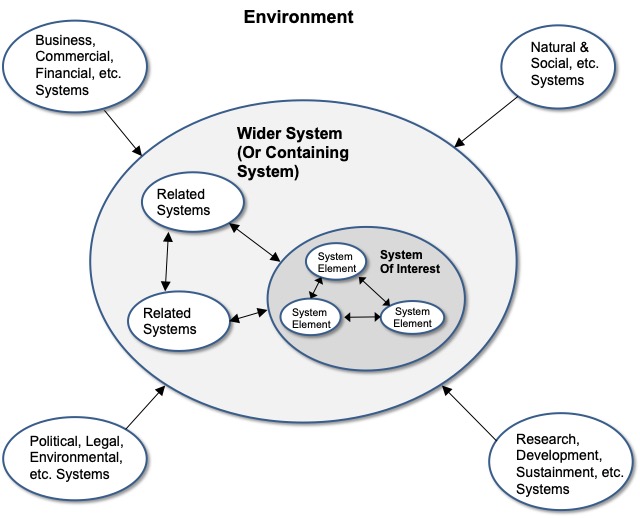
図1:システムコンテキストの一般的な記述(SEBoK Original)
Introduction to Systems Engineering Fundamentals
This article forms part of the Systems Engineering Fundamentals knowledge area (KA). It provides various perspectives on systems, including definitions, scope, and context.
本記事は、Systems Engineering Fundamentals(システムズエンジニアリング基礎知識)知識領域(KA)の一部を成す。定義、範囲(scope)、コンテキスト(context)を含め、システム(systems)に関するさまざまな視点を提供する。
This article provides a guide to some of the basic concepts of systems developed by systems science and discusses how these relate to the definitions to be found in systems engineering (SE) literature. The concept of an engineered system is introduced as the system context of critical relevance to SE.
本記事は、システム科学(systems science)が発展させてきたシステムの基本的な概念(concepts)のいくつかを案内し、それらがシステムズエンジニアリング(SE)の文献に見られる定義とどう関係するかを論じる。また、SE にとって決定的に重要なシステムコンテキストとして、エンジニアリング対象システム(engineered system)の概念を導入する。
In the System Fundamentals KA we will define some terms and ideas which are foundational to the understanding and practice of Systems Engineering (SE). In particular, a number of views of system are explored; these are summarized below and described in more detail with links to relevant references in the rest of this article. *The INCOSE Fellows’ Initiative on System and Systems Engineering Definitions expresses that "A system is an arrangement of parts or elements that together exhibit behavior or meaning that the individual constituents do not". The premise of the system phenomena and the basis for system science is that there are theories, models and approaches that are transversal and useful to anyone trying to understand, create, transform or experience systems, independent of what the system is made of or the application domain considering it. *Systems can be either physical or conceptual, or a combination of both. Systems in the physical universe are composed of matter and energy, may embody information encoded in matter-energy carriers, and exhibit observable behavior. Conceptual systems are abstract systems of pure information, and do not directly exhibit behavior, but exhibit “meaning”. In both cases, the system’s properties (as a whole) result, or emerge from: the parts or elements and their individual properties; AND the relationships and interactions between and among the parts, the system and its environment. *Many of these common systems ideas relate to complex networks or hierarchies of related system elements. A System Context is a set of system interrelationships associated with a particular system of interest (SoI) within a real-world environment. One or more views of a context allow us to focus on the SoI but not lose sight of its broader, holistic relationships and influences. Context can be used for many kinds of system but is particularly useful for scoping problems and enabling the creation of solutions which combine people and technology and operate in the natural world. These are referred to as socio-technical system contexts. *Systems Engineering is one of the disciplines interested in socio-technical systems across their whole life. This includes where problems come from and how they are defined, how we identify and select candidate solutions, how to balance technology and human elements in the wider solution context, how to manage the complex organizational systems needed to develop new solutions, and how developed solutions are used, sustained and disposed of. To support this, we define an Engineered System as a socio-technical system which is the focus of a Systems Engineering life cycle. *While SE is focused on the delivery of an engineered system of interest, an SE should consider the full Engineered System Context so that the necessary understanding can be reached and the right systems engineering decisions can be made across each Life Cycle.
System Fundamentals(システムズの基礎)知識領域では、システムズエンジニアリング(SE)の理解と実践の基礎となる用語と考え方をいくつか定義する。特に、システムに関するいくつかの見方を探る。それらを以下に要約し、本記事の残りの部分で、関連する参考文献へのリンクとともに、より詳しく述べる。
INCOSE フェローの System and Systems Engineering Definitions イニシアティブは、「システムとは、個々の構成要素にはない振る舞いや意味を、全体として示す部品や要素の配置である」と述べている。システム現象の前提であり、システム科学の基礎でもあるのは、システムが何でできているかにも、それを考察する応用領域にも依存せず、システムを理解し、作り、変革し、経験しようとするすべての人にとって横断的かつ有用な理論、モデル、アプローチが存在するということである。 システムは、物理的なもの、概念的なもの、あるいはその両方の組み合わせであり得る。物理的宇宙におけるシステムは物質とエネルギーで構成され、物質・エネルギーの担体に符号化された情報を内包することがあり、観察可能な振る舞いを示す。概念システムは純粋な情報からなる抽象システムであり、振る舞いを直接には示さないが、「意味」を示す。いずれの場合も、システムの(全体としての)特性は、部品や要素とその個々の特性、および、部品・システム・環境の間および内部の関係と相互作用から生じる、あるいは創発する。 これらの共通するシステムの考え方の多くは、関連するシステム要素からなる複雑なネットワークや階層に関わる。システムコンテキスト(System Context)とは、現実世界の環境の中で、特定の対象システム(system of interest、SoI)に関連付けられたシステムの相互関係の集合である。コンテキストを1つ以上のビューで捉えることで、SoI に焦点を当てつつ、その広く全体的な関係や影響を見失わずに済む。コンテキストは多くの種類のシステムに用いることができるが、とりわけ、問題の範囲を定めることや、人間と技術を組み合わせて自然世界で動作する解決策の創造を可能にすることに有用である。これらは社会技術システムコンテキストと呼ばれる。 システムズエンジニアリングは、社会技術システムにその全生涯にわたって関心を持つ分野の1つである。これには、問題がどこから生じ、どのように定義されるか、解決策の候補をどのように特定し選択するか、より広い解決策コンテキストの中で技術と人間の要素のバランスをどう取るか、新しい解決策の開発に必要な複雑な組織システムをどう管理するか、そして開発された解決策がどのように使われ、維持され、廃棄されるかが含まれる。これを支えるため、エンジニアリング対象システム(Engineered System)を、システムズエンジニアリングのライフサイクルの焦点となる社会技術システムと定義する。 * SE は対象となるエンジニアリング対象システムの提供に焦点を当てるが、システムズエンジニアは、必要な理解に到達し、各ライフサイクル(Life Cycle)にわたって正しいシステムズエンジニアリングの判断を下せるよう、エンジニアリング対象システムのコンテキスト全体を考慮すべきである。
The idea of a system whole can be found in both Western and Eastern philosophy. Many philosophers have considered notions of holism, the concept that ideas, people or things must be considered in relation to the things around them to be fully understood (M’Pherson 1974). Broader still, the concept of holarchy, that everything in the universal is an organized whole (a system) and also at the same time a part of a, at least one, greater whole (Koestler 1967).
One influential systems science definition of a system comes from general system theory (GST):
<blockquote> A System is a set of elements in interaction. (Bertalanffy 1968)</blockquote><nowiki/> The parts of a system may be conceptual organizations of ideas in symbolic form or real objects. GST considers abstract systems to contain only conceptual elements and concrete systems to contain at least two elements that are real objects, e.g. people, information, software, and physical artifacts, etc.
Similar ideas of wholeness can be found in systems engineering literature. For example: <blockquote> ''We believe that the essence of a system is 'togetherness', the drawing together of various parts and the relationships they form in order to produce a new whole… (Boardman and Sauser 2008). </blockquote><nowiki/>''
The cohesive interactions between a set of parts suggest a system boundary and define what membership of the system means. For closed systems, all aspects of the system exist within this boundary. This idea is useful for abstract systems and for some theoretical system descriptions.
The boundary of an open systems defines elements and relationships which can be considered part of the system and describes how these elements interact across the boundary with related elements in the environment. The relationships among the elements of an open system can be understood as a combination of the systems structure and behavior. The structure of a system describes a set of system elements and the allowable relationships between them. System behavior refers to the effects or outcomes produced when an instance of the system interacts with its environment. An allowable configuration of the relationships among elements is referred to as a system state. A stable system is one which returns to its original, or another stable, state following a disturbance in the environment. System wholes entities often exhibit emergence, behavior which is meaningful only when attributed to the whole, not to its parts (Checkland 1999).
The identification of a system and its boundary is ultimately the choice of the observer, the recognition of a system and to establish a relation with it is a decision made cognitively such as by a human actor or through affordances through physical relationships in the case of chemical substances. In the case of humans, this may be through observation and classification of sets of elements as systems, through an abstract conceptualization of one or more possible boundaries and relationships in a given situation, or a mixture of this concrete and conceptual thinking. This underlines the fact that any particular identification of a system by humans is a construct used by us to help make better sense of a set of things and to share that understanding with others if needed. It is important to recognize that this notion of observer is not limited to human perception. The observation and development of relationships between systems is a natural phenomenon inherent in all systems.
Many natural, social and man-made things can be better understood by recognizing the subjects of our interest as open systems as this takes into account this key dependency with the external, such as the stakeholder or actors with these systems. Additionally, one of the reasons we find the transversal nature of systems useful is that it is possible to identify shared concepts which apply to many system views. These recurring concepts or isomorphies can give useful insights into many situations, independently of the kinds of elements of which a particular system is composed. The ideas of structure, behavior, emergence and state are examples of such concepts. The identification of these shared system ideas is the basis for systems thinking and their use in developing theories and approaches in a wide range of fields of study the basis for system sciences.
Systems Engineering (SE), and a number of other related disciplines use systems concepts, patterns and models in the creation of useful outcomes or things. The concept of a network of open systems created, sustained and used to achieve a purpose within one or more environments is a powerful model that can be used to understand many complex real-world situations and provide a basis for effective problem solving within them.
システム全体という考え方は、西洋哲学にも東洋哲学にも見られる。多くの哲学者が全体論(holism)の概念、すなわち、考え、人間、事物を完全に理解するには、それらを周囲の物事との関係の中で考えなければならないという概念を考察してきた(M’Pherson 1974)。さらに広くは、ホラーキー(holarchy)の概念、すなわち、宇宙のあらゆるものは組織化された全体(システム)であると同時に、少なくとも1つのより大きな全体の一部でもあるという概念がある(Koestler 1967)。
システム科学におけるシステムの定義として影響力のあるものの1つは、一般システム理論(general system theory、GST)に由来する。
「システムとは、相互作用する要素の集合である。」(Bertalanffy 1968)
システムの部分は、記号形式で表された考えの概念的な組織化である場合もあれば、現実の対象である場合もある。GST では、抽象システム(abstract systems)は概念的な要素のみを含むものとし、具象システム(concrete systems)は現実の対象である要素を少なくとも2つ含むものとする。例えば、人間、情報、ソフトウェア(software)、物理的な人工物などである。
全体性に関する同様の考え方は、システムズエンジニアリングの文献にも見られる。例えば、
「我々は、システムの本質は『一体性(togetherness)』、すなわち、さまざまな部分と、それらが新しい全体を生み出すために形成する関係とを引き合わせることにあると信じる…」(Boardman and Sauser 2008)
部分の集合の間の凝集的な(cohesive)相互作用は、システム境界(system boundary)を示唆し、システムの成員であることの意味を定義する。閉じたシステム(closed systems)では、システムのあらゆる側面がこの境界の内側に存在する。この考え方は、抽象システムや、いくつかの理論的なシステム記述に有用である。
開いたシステム(open systems)の境界は、システムの一部とみなせる要素と関係を定義し、これらの要素が環境(environment)の中の関連する要素と境界を越えてどのように相互作用するかを記述する。開いたシステムの要素間の関係は、システムの構造(structure)と振る舞い(behavior)の組み合わせとして理解できる。システムの構造は、システム要素の集合と、それらの間に許される関係を記述する。システムの振る舞いとは、システムのインスタンスがその環境と相互作用するときに生じる効果や結果を指す。要素間の関係の許容される構成を、システムの状態(state)と呼ぶ。安定したシステムとは、環境における外乱の後に、元の状態、あるいは別の安定した状態に戻るシステムである。システム全体という実体は、しばしば創発(emergence)、すなわち、部分ではなく全体に帰属させて初めて意味を持つ振る舞いを示す(Checkland 1999)。
システムとその境界を特定するのは、最終的には観察者の選択である。システムを認識し、それとの関係を確立することは、人間の行為者のように認知的に、あるいは化学物質の場合のように物理的関係によるアフォーダンスを通じてなされる決定である。人間の場合、これは、要素の集合をシステムとして観察し分類することや、所与の状況における1つ以上の可能な境界と関係を抽象的に概念化すること、あるいはこうした具象的思考と概念的思考を組み合わせることを通じて行われる場合がある。このことは、人間によるシステムの特定はいずれも、物事の集合をよりよく理解し、必要に応じてその理解を他者と共有する助けとして我々が用いる構成物である、という事実を浮き彫りにする。この観察者という概念が人間の知覚に限定されないことを認識しておくことが重要である。システム間の関係の観察と発展は、すべてのシステムに固有の自然現象である。
多くの自然物、社会的な事物、人工物は、我々の関心の対象をオープンシステムとして認識することで、よりよく理解できる。そうすることで、ステークホルダーやこれらのシステムに関わる行為者といった外部との、この重要な依存関係を考慮に入れられるからである。さらに、システムの横断的な性質が有用だと我々が考える理由の1つは、多くのシステムの見方に当てはまる共通の概念を特定できることである。こうした繰り返し現れる概念、あるいは同型性は、特定のシステムがどのような種類の要素で構成されているかにかかわらず、多くの状況に対して有用な洞察を与え得る。構造、振る舞い、創発、状態という考え方は、そのような概念の例である。こうした共通のシステムの考え方を特定することがシステム思考の基礎であり、それらを広範な研究分野で理論やアプローチの発展に用いることがシステム科学(system sciences)の基礎である。
システムズエンジニアリング(SE)や、その他多くの関連分野(related disciplines)は、有用な成果や物事を生み出す際に、システムの概念、パターン、モデルを用いる。1つ以上の環境の中で目的(purpose)を達成するために作られ、維持され、使われるオープンシステムのネットワーク(network)という概念は、強力なモデル(model)であり、多くの複雑な現実世界の状況を理解し、その中で効果的な問題解決(problem solving)を行うための基礎を提供するのに用いることができる。
Bertalanffy (1968) divided open systems into nine real-world types ranging from static structures and control mechanisms to socio-cultural systems. Other similar classification systems are discussed in the article Engineered Systems.
The following is a simple classification of system elements which we find at the heart of many of these classifications:
While the above distinctions can be made as a general abstract classification, in reality there are no hard and fast boundaries between these types of systems: e.g., natural systems are operated by, developed by, and often contain social systems, which depend on technical systems to fully realize their purpose. Systems which contain technical and either human or natural elements are often called socio-technical systems. The behavior of such systems is determined both by the nature of the technical elements and by their ability to integrate with or deal with the variability of the natural and social systems around them.
Many of the original ideas upon which GST and other branches of system study are based come from the study of systems in the natural and social sciences. Many natural and social systems are initially formed as simple structures through the inherent cohesion among a set of elements. Once formed, they will tend to stay in this structure, as well as combine and evolve further into more complex stable states to exploit this cohesion in order to sustain themselves in the face of threats or environmental pressures. Such complex systems may exhibit specialization of elements, with elements taking on roles which contribute to the system purpose, but losing some or all of their separate identity outside the system. Such roles might include management of resources, defense, self-regulation or problem solving, and control. Natural and social systems can be understood through an understanding of this wholeness, cohesion and specialization. They can also be guided towards the development of behaviors which not only enhance their basic survival, but also fulfill other goals of benefit to them or the systems around them. In The Architecture of Complexity, Simon (1962) has shown that natural or social systems which evolve via a series of stable “hierarchical intermediate forms” will be more successful and resilient to environmental change.
Thus, it is often true that the environment in which a particular system sits and the elements of that system can themselves be considered as open systems. It can be useful to consider collections of related elements as both a system and a part of one or more other systems. For example, a “holon” or Complexity (glossary)|complex structures and emergent behaviors which are difficult to understand or predict. Such complexity can often best be dealt with not only by looking for more detail, but also by considering the wider open system relationships.
Bertalanffy (1968) は、オープンシステムを、静的な構造や制御機構から社会文化システムに至るまで、現実世界の9つの種類に分けた。同様の他の分類体系については、Engineered Systems の記事で論じられている。
以下は、こうした分類の多くの核心に見られる、システム要素の単純な分類である。
自然システム(Natural system)の要素。実践的な人間の制御の外に存在する対象や概念。例:実数系、太陽系、惑星大気循環システム。 社会システム(Social system)の要素。抽象的な人間の類型や社会的構成物、あるいは具体的な個人や社会集団のいずれか。 * 技術システムの要素。人間が作った人工物や構成物。物理的ハードウェア、ソフトウェア、情報を含む。
上記の区別は一般的・抽象的な分類としては可能だが、現実には、これらの種類のシステムの間に厳密な境界はない。例えば、自然システムは社会システムによって運用・開発され、しばしば社会システムを内包する。そして社会システムは、その目的を完全に実現するために技術システムに依存する。技術的要素と、人間または自然の要素のいずれかを含むシステムは、しばしば社会技術システム(socio-technical systems)と呼ばれる。そのようなシステムの振る舞いは、技術的要素の性質と、周囲の自然システムや社会システムと統合し、あるいはそれらの変動性に対処する能力の両方によって決まる。
GST やその他のシステム研究の分野の基礎となっている元来の考え方の多くは、自然科学と社会科学におけるシステムの研究に由来する。多くの自然システムと社会システムは、当初、要素の集合の間にある固有の凝集(cohesion)によって、単純な構造として形成される。ひとたび形成されると、それらはこの構造にとどまる傾向があり、また、脅威や環境からの圧力に直面しても自らを維持できるよう、この凝集を利用して結合し、さらに複雑な安定状態へと進化する。そのような複雑なシステムでは要素の特殊化が見られることがあり、要素はシステムの目的に寄与する役割を担う一方で、システムの外では独立した同一性の一部または全部を失う。そのような役割には、資源の管理、防衛、自己調節や問題解決、制御が含まれ得る。自然システムと社会システムは、こうした全体性、凝集、特殊化を理解することで理解できる。また、それらを導いて、基本的な生存を高めるだけでなく、自身や周囲のシステムにとって有益な他の目標も果たすような振る舞いを発展させることもできる。『The Architecture of Complexity』において、Simon (1962) は、一連の安定した「階層的な中間形態」を経て進化する自然システムや社会システムは、より成功を収め、環境の変化に対する回復力も高くなることを示した。
したがって、特定のシステムが置かれた環境も、そのシステムの要素自体も、オープンシステムとみなせることが多い。関連する要素の集まりを、システムとして、また1つ以上の他のシステムの一部として、両面から考えることが有用な場合がある。例えば、「ホロン」、あるいはシステム要素(System Element)は、Koestler によって、全体としても部分としても同時に存在するものと定義された(Koestler 1967)。ある時点で、システムの階層において境界の内側および境界を越えた要素間の関係の性質が、理解や予測が困難な複雑な構造や創発的な振る舞いにつながることがある。そのような複雑性には、より詳細を探すことだけでなく、より広いオープンシステムの関係を考えることによって対処するのが最善である場合が多い。
図中の英語
A system context describes all of the external elements which interact across the boundary of a particular system of interest (SoI) and a sufficient view of the elements within its boundary, to allow the SoI to be better understood as part of a wider systems whole. To fully understand the context, we also need to identify the environment in which the SoI and wider system sit and the systems in the environment which influence them.
システムコンテキスト(system context)は、特定の対象システム(system of interest、SoI)の境界を越えて相互作用するすべての外部要素と、その境界内の要素についての十分なビューを記述し、SoI をより広いシステム全体の一部としてよりよく理解できるようにする。コンテキストを完全に理解するには、SoI とより広いシステムが置かれた環境と、それらに影響を与える環境内のシステムも特定する必要がある。
Many man-made systems are designed as networks and hierarchies of related system elements to achieve desirable behaviors and the kinds of the resilience seen in natural systems. While such systems can be deliberately created to take advantage of system properties such as holism and stability, they must also consider system challenges such as complexity and emergence. Considering different views of a SoI and its context over its life can help enable this understanding. Considering systems in context allows us to focus on a SoI while maintaining the necessary wider, holistic systems perspective. This is one of the foundations of the Systems Approach described in SEBoK part 2, which forms a foundation of systems engineering.
多くの人工システムは、望ましい振る舞いや、自然システムに見られるような回復力を実現するために、関連するシステム要素のネットワークおよび階層として設計される。そのようなシステムは、全体論や安定性といったシステム特性を活かすよう意図的に作ることができるが、複雑性や創発といったシステムの課題も考慮しなければならない。SoI とそのコンテキストのさまざまなビューをその生涯にわたって考えることは、こうした理解を可能にする助けとなり得る。システムをコンテキストの中で考えることにより、必要とされる広く全体的なシステムの視点を保ちながら、SoI に焦点を当てることができる。これは、SEBoK Part 2 で記述されるシステムズアプローチ(Systems Approach)の基礎の1つであり、そのアプローチはシステムズエンジニアリングの基礎を成す。
Some of the systems ideas discussed above form part of the systems engineering body of knowledge. Systems engineering literature, standards and guides often refer to “the system” to characterize a socio-technical system with a defined purpose as the focus of SE, e.g.
The International Council on Systems Engineering Handbook (INCOSE 2015) generalizes this idea, defining system as “an interacting combination of elements to accomplish a defined objective. These include hardware, software, firmware, people, information, techniques, facilities, services, and other support elements." While these definitions cover the socio-technical systems created by SE, it is also necessary to consider the natural or social problem situations in which these systems sit, the social systems which developed, sustained and used them, and the commercial or public enterprises in which these all sit as systems (Martin 2004).
Hence, while many SE authors talk about systems and systems ideas, they are often based on a particular world view which related to engineered artifacts. It would also be useful to take a broader view of the context in which these artifacts sit, and to consider through life relationships as part of that context. To help promote this, the SEBoK will attempt to be more precise with its use of the word system, aligned with the work of the fellows initiative and distinguish between general systems principles and the specific socio-technical systems created by SE.
The term socio-technical system is used by many in the systems community and may have meanings outside of that relevant to SE. Hence, we will define an System of Interest (SoI) (glossary)|system of interest (SoI) for an application of SE. A SE will consider an engineered system context, from initial problem formulation through to final safe removal from use (INCOSE 2015). A more detailed discussion of engineered system context and how it relates to the foundations of systems engineering practice can be found below.
上で論じたシステムの考え方の一部は、システムズエンジニアリングの知識体系の一部を成している。システムズエンジニアリングの文献、標準、ガイドでは、SE の焦点となる、定義された目的を持つ社会技術システムを表すために、「そのシステム(the system)」という言い方をすることが多い。例えば、
「システムとは、価値を提供する対象である」(Dori 2002)。 「システムとは、計画に従って特定の目的を達成するために設計された構成要素の配列である」(Johnson, Kast, and Rosenzweig 1963)。 * 「システムとは、ニーズや要求を満たすために用いられる概念および/または要素の集合と定義される」(Miles 1973)。
International Council on Systems Engineering Handbook(INCOSE 2015)はこの考え方を一般化し、システムを「定義された目的を達成するための、要素が相互作用する組み合わせ。これにはハードウェア、ソフトウェア、ファームウェア、人間、情報、技法、施設、サービス、その他の支援要素が含まれる」と定義している。これらの定義は SE によって作られる社会技術システムを対象としているが、これらのシステムが置かれた自然的または社会的な問題状況、それらを開発し、維持し、使用した社会システム、そしてこれらすべてがシステムとして置かれている商業的または公共的なエンタープライズも考慮する必要がある(Martin 2004)。
したがって、多くの SE の著者がシステムやシステムの考え方について語っているものの、それらはしばしば、エンジニアリングされた人工物に関わる特定の世界観に基づいている。これらの人工物が置かれたコンテキストをより広く捉え、生涯を通じた関係をそのコンテキストの一部として考えることも有用であろう。これを後押しするため、SEBoK は、フェロー・イニシアティブの取り組みに沿って、システムという言葉をより厳密に用いるよう努め、一般的なシステム原則と、SE によって作られる特定の社会技術システムとを区別する。
社会技術システムという用語はシステムコミュニティの多くの人々が用いており、SE に関連する意味以外の意味を持つことがある。そこで、エンジニアリング対象システム(Engineered System)を、SE の適用における主要な焦点、あるいは対象システム(system of interest、SoI)を成す社会技術システムと定義する。SE のライフサイクル(Life Cycle)では、最初の問題定式化から、使用からの最終的な安全な除去に至るまで、エンジニアリング対象システムのコンテキストを考慮する(INCOSE 2015)。エンジニアリング対象システムのコンテキストと、それがシステムズエンジニアリング実践の基礎とどう関係するかについては、以下でより詳しく論じる。
An Life Cycle (glossary)|life cycle.
Engineered system contexts: *are created, used and sustained to achieve a purpose, goal or mission that is of interest to an enterprise, team, or an individual. *require a commitment of resources for development and support. *are driven by stakeholders with multiple views on the use or creation of the system, or with some other stake in the system, its properties or existence. *contain engineered hardware, software, people, services, or a combination of these. *exist within an environment that impacts the characteristics, use, sustainment and creation of the system.
Engineered systems typically: *are defined by their purpose, goal or mission. *have a life cycle and evolution dynamics. *may include human operators (interacting with the systems via processes) as well as other social and natural components that must be considered in the design and development of the system. *are part of a system-of-interest hierarchy.
Open systems are a useful way to understand many complex situations. Traditional engineering disciplines have become very good at building up detailed models and design practices to deal with the complexity of tightly integrated collections of elements within a technology domain. It is possible to model the seemingly random integration of lots of similar elements using statistical approaches. Systems Engineering makes use of both these aspects of system complexity, as discussed in the Emergence and Complexity article.
SE also considers the complexity of relatively small numbers of elements taken from a range of design disciplines together with people who may not always be experienced or have detailed training in their use. Such engineered systems may be deployed in uncertain or changing environments and be used to help people achieve a number of loosely defined outcomes. Relatively small changes in the internal working of these engineered systems’ elements, or in how those elements are combined, may lead to the emergence of complex or un-expected outcomes. It can be difficult to predict and design for all such outcomes during an engineered system’s creation, or to respond to them during its use. Iterative life cycle approaches which explore the complexity and emergence over a number of cycles of development and use are needed to deal with this aspect of complexity. The ways that system engineering deals with these aspects of complexity in the definition of life cycle and life cycle processes applied to an engineered system context is fully explored in Part 3
エンジニアリング対象システム(Engineered System)は、技術と、社会的または自然の要素の両方を含み、エンジニアリングのライフサイクル(life cycle)によって、定義された目的のために開発されるコンテキストを定義する。
エンジニアリング対象システムのコンテキストは、
エンタープライズ(enterprise)、チーム(team)、あるいは個人が関心を持つ目的、目標、あるいはミッション(mission)を達成するために作られ、使われ、維持される。 開発と支援のための資源の投入を必要とする。 システムの使用や創造について複数の見方を持つ、あるいはシステム、その特性、その存在に何らかの利害を持つステークホルダー(stakeholders)によって駆動される。 エンジニアリングされたハードウェア、ソフトウェア(software)、人間、サービス(services)、あるいはこれらの組み合わせを含む。 * システムの特性、使用、維持、創造に影響を与える環境の中に存在する。
エンジニアリング対象システムは、典型的には、
その目的、目標、あるいはミッションによって定義される。 ライフサイクル(life cycle)と進化のダイナミクスを持つ。 (プロセスを介してシステムと相互作用する)人間のオペレーターや、システムの設計・開発において考慮しなければならない他の社会的・自然的な構成要素を含むことがある。 対象システム(system-of-interest)の階層の一部である。
オープンシステムは、多くの複雑な状況を理解するのに有用な方法である。伝統的なエンジニアリング分野は、技術領域の中で緊密に統合された要素の集まりの複雑性に対処するため、詳細なモデルや設計実践を築き上げることに非常に長けるようになった。統計的アプローチを用いれば、多数の類似した要素が一見無作為に統合される様子をモデル化することもできる。システムズエンジニアリングは、Emergence and Complexity(創発と複雑性)の記事で論じられているように、システムの複雑性のこれら両方の側面を活用する。
SE はまた、さまざまな設計分野に由来する比較的少数の要素と、それらの使用について必ずしも経験や詳しい訓練があるとは限らない人々との組み合わせがもたらす複雑性も考慮する。そのようなエンジニアリング対象システムは、不確実な環境や変化する環境に配備され、大まかに定義されたいくつかの成果を人々が達成する助けとして使われることがある。これらのエンジニアリング対象システムの要素の内部の働きや、それらの要素の組み合わされ方の比較的小さな変化が、複雑な成果や予期しない成果の創発につながることがある。エンジニアリング対象システムの創造中にそうした成果をすべて予測して設計に織り込むこと、あるいは使用中にそれらに対応することは、困難な場合がある。こうした複雑性の側面に対処するには、開発と使用の複数のサイクルにわたって複雑性と創発を探求する、反復的なライフサイクルアプローチが必要である。エンジニアリング対象システムのコンテキストに適用されるライフサイクルとライフサイクルプロセスを定義する際に、システムズエンジニアリングが複雑性のこれらの側面にどう対処するかは、Part 3 で十分に探求される。
As well as being a kind of system, an engineered system is also the focus of a life cycle and hence part of a commercial transaction. Historically,
エンジニアリング対象システムは、システムの一種であると同時に、ライフサイクルの焦点でもあり、それゆえ商業取引の一部でもある。歴史的に、
<blockquote>Economists divide all economic activity into two broad categories, goods and services. Goods-producing industries are agriculture, mining, manufacturing, and construction; each of them creates some kind of tangible object. Service industries include everything else: banking, communications, wholesale and retail trade, all professional services such as engineering, computer software development, and medicine, nonprofit economic activity, all consumer services, and all government services, including defense and administration of justice.... (Encyclopedia Britannica 2011).</blockquote>
「経済学者は、すべての経済活動を、財(goods)とサービスという2つの大きなカテゴリーに分ける。財を生産する産業は農業、鉱業、製造業、建設業であり、いずれも何らかの有形の対象を生み出す。サービス産業にはそれ以外のすべてが含まれる。銀行、通信、卸売・小売業、エンジニアリング、コンピュータソフトウェア開発、医療などのすべての専門サービス、非営利の経済活動、すべての消費者サービス、そして防衛や司法行政を含むすべての政府サービスである…」(Encyclopedia Britannica 2011)
The following diagram defines some terms related to an engineered system life cycle and the development of goods (products) and services.
次の図は、エンジニアリング対象システムのライフサイクルと、財(製品)およびサービスの開発に関連するいくつかの用語を定義する。
Figure 2: Life Cycle Terminology (Modified from Capability Engineering – an Analysis of Perspectives (modified from (Henshaw et al, 2011), used with permission))
図2:ライフサイクル用語(Capability Engineering – an Analysis of Perspectives から修正(Henshaw et al, 2011)、used with permission)
この図は原典のページに掲載されています。権利の都合により本サイトでは省略しています。原典で見る
In the above figure the Enterprise (glossary) to achieve its goals is delivered by the synchronized use of services. Those services are provided by a Organization (glossary)|organizations. A service system is composed of people, technology, information, and access to related services and other necessary resources. Some of these resources are provided by enabling services and the technological elements may be developed and supplied as product systems. An describes a collection of related capabilities and associated services which together enable the achievement of the overall purpose of an enterprise as a government, business or societal entity. Measurement and review of enterprise goals may define needs for change which require an organization to acquire or modify, and integrate the elements needed to evolve its service systems. The general terminology above is described briefly in the associated glossary definitions and expanded in related articles in Part 4: Applications of Systems Engineering.
上の図では、エンタープライズ(Enterprise)が目標を達成できるようにするために必要な能力(Capability)は、サービス(services)を同期させて使用することによって提供される。それらのサービスはサービスシステム(Service System)によって提供され、サービスシステムは1つ以上の組織(organizations)によって作られ、維持され、展開される。サービスシステムは、人間、技術、情報、および関連するサービスやその他の必要な資源へのアクセスで構成される。これらの資源の一部は実現支援サービスによって提供され、技術的要素は製品システム(product systems)として開発・供給されることがある。エンタープライズシステム(Enterprise System)は、関連する能力とそれに付随するサービスの集まりを記述するものであり、それらが総体として、政府、ビジネス、社会的実体としてのエンタープライズの全体的な目的の達成を可能にする。エンタープライズの目標を測定しレビューすることで、組織がそのサービスシステムを進化させるのに必要な要素を獲得または修正し、統合することを求める変化のニーズが定義されることがある。上記の一般的な用語は、関連する用語集の定義で簡潔に説明され、Part 4 の関連記事で展開される:Applications of Systems Engineering(SE の応用)。
Engineered systems are developed as combinations of products and services within a life cycle. The figure below gives a general view of the full context for any potential application of a SE life cycle.
エンジニアリング対象システムは、ライフサイクルの中で、製品とサービスの組み合わせとして開発される。以下の図は、SE ライフサイクルを適用し得るあらゆる場合について、完全なコンテキストの一般的な見方を示す。
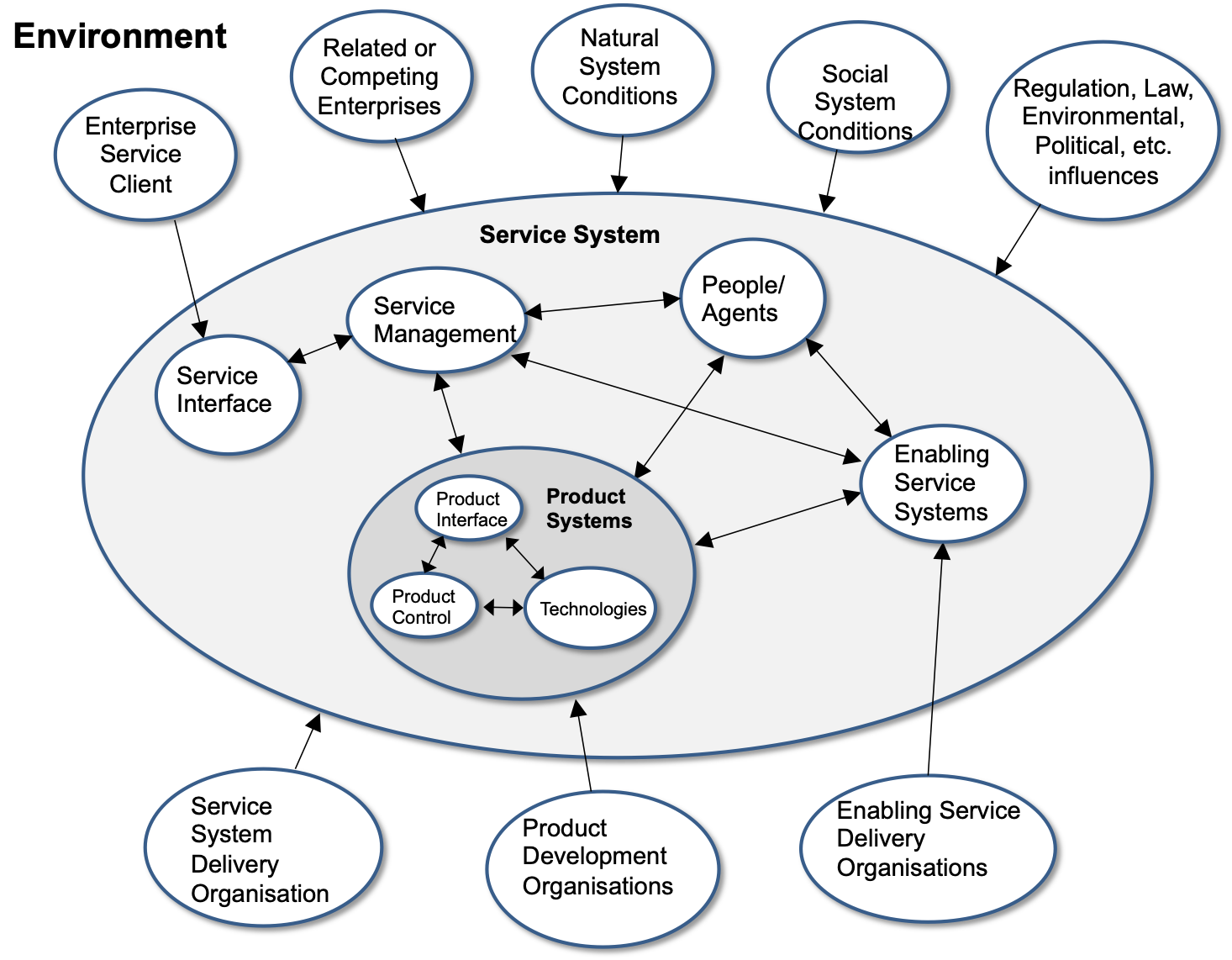
図中の英語
In this view a service system related directly to a capability need sets the overall boundary. This need establishes the problem situation or opportunity which encapsulates the starting point of any life cycle. Within this service system are the related services, products and people (or intelligent software agents) needed to fully deliver a solution to that need. The environment includes any people, organizations, rules or conditions which influence or constrain the service system or the things within it. The SoI for a particular SE life cycle may be defined at any level of this general context. While the focus of the context will vary for each life cycle it is important that some version of this general context is considered for all SE life cycles, to help maintain a holistic view of problem and solution. This is discussed in Engineered Systems.
この見方では、能力のニーズに直接関係するサービスシステムが全体の境界を定める。このニーズが、あらゆるライフサイクルの出発点を包含する問題状況や機会を確立する。このサービスシステムの中には、そのニーズに対する解決策を完全に提供するために必要な、関連するサービス、製品、人間(あるいは知的なソフトウェアエージェント)がある。環境には、サービスシステムやその中の物事に影響を与える、あるいはそれらを制約する、あらゆる人々、組織、規則、条件が含まれる。特定の SE ライフサイクルにおける SoI は、この一般的なコンテキストのどのレベルでも定義し得る。コンテキストの焦点はライフサイクルごとに異なるが、問題と解決策の全体的な見方を維持しやすくするため、すべての SE ライフサイクルに対して、この一般的なコンテキストの何らかの版が考慮されることが重要である。これについては Engineered Systems で論じられている。
An engineered system context describes the context for a SoI so that the necessary understanding can be reached and the right systems engineering decisions can be made across the life of that SoI. This will require a number of different views of the context across a SE life cycle, both to identify all external influence on the SoI and to guide and constraint the systems engineering of the elements of the SoI. A full engineered systems context will include the problem situation from which a need for a SoI is identified, one or more socio technical solutions, the organizations needed to create and sustain new solutions and the operational environment within which those solutions must be integrated, used and eventually disposed. The kinds of views which can be used to represent a SoI context over its life and how those views can be combined into models is discussed in the Representing Systems with Models KA in Part 2. The activities which use those models are described conceptually in the Systems Approach Applied to Engineered Systems KA in part 2 and related to more formal SE life cycle processes in Part 3.
エンジニアリング対象システムのコンテキストは、SoI のコンテキストを記述し、必要な理解に到達し、その SoI の生涯にわたって正しいシステムズエンジニアリングの判断を下せるようにする。これには、SoI に対するあらゆる外部の影響を特定することと、SoI の要素のシステムズエンジニアリングを導き制約することの両方のために、SE ライフサイクルを通じてコンテキストの多数の異なるビューが必要となる。完全なエンジニアリング対象システムのコンテキストには、SoI の必要性が特定される問題状況、1つ以上の社会技術的な解決策、新しい解決策を作り維持するために必要な組織、そしてそれらの解決策が統合され、使われ、最終的に廃棄されなければならない運用環境が含まれる。SoI のコンテキストをその生涯にわたって表すのに用いることのできるビューの種類と、それらのビューをモデルに組み合わせる方法については、Part 2 の Representing Systems with Models(モデルによるシステムの表現)知識領域で論じられている。それらのモデルを用いる活動は、Part 2 の Systems Approach Applied to Engineered Systems(エンジニアリング対象システムへのシステムズアプローチの適用)知識領域で概念的に記述され、Part 3 で、より形式的な SE ライフサイクルプロセスと関連づけられる。
Bertalanffy, L. von. 1968. General System Theory: Foundations, Development, Applications, rev. ed. New York: Braziller.
Boardman, J. and B. Sauser. 2008. Systems Thinking: Coping with 21st Century Problems. Boca Raton, FL, USA: Taylor & Francis.
Checkland, P. 1999. Systems Thinking, Systems Practice. New York, NY, USA: Wiley and Sons, Inc.
Dori, D. 2002. Object-Process Methodology – A Holistic Systems Paradigm. New York, NY, USA: Springer.
Henshaw, M., D. Kemp, P. Lister, A. Daw, A. Harding, A. Farncombe, and M. Touchin. 2011. "Capability engineering – An analysis of perspectives." Presented at International Council on Systems Engineering (INCOSE) 21st International Symposium, Denver, CO, USA, June 20-23, 2011.
Hitchins, D. 2009. “What are the general principles applicable to systems?” INCOSE Insight, vol. 12, no. 4, pp. 59-63.
INCOSE. 2015. Systems Engineering Handbook: A Guide for System Life Cycle Processes and Activities, version 4.0. San Diego, CA, USA: International Council on Systems Engineering (INCOSE), INCOSE-TP-2003-002-03.2.2.
Johnson, R.A., F.W. Kast, and J.E. Rosenzweig. 1963. The Theory and Management of Systems. New York, NY, USA: McGraw-Hill Book Company.
Koestler, A. 1990. The Ghost in the Machine, 1990 reprint ed. Sturgis, Michigan, USA: Penguin Group.
Martin, J, 2004. "The seven samurai of systems engineering: Dealing with the complexity of 7 interrelated systems." Proceedings of the 14th Annual International Council on Systems Engineering International Symposium, 20-24 June, 2004, Toulouse, France, 20-24 June, 2004.
Miles, R.F. (ed). 1973. System Concepts. New York, NY, USA: Wiley and Sons, Inc.
M’Pherson, P.K. 1974. "A perspective on systems science and systems philosophy." Futures. Vol. 6, no. 3, pp. 219-39.
Simon, H.A. 1962. "The architecture of complexity." Proceedings of the American Philosophical Society. Vol. 106, no. 6 (Dec. 12, 1962), pp. 467-482.
Bertalanffy, L., von. 1968. General System Theory: Foundations, Development, Applications, rev. ed. New York, NY, USA: Braziller.
INCOSE. 2015. Systems Engineering Handbook: A Guide for System Life Cycle Processes and Activities, version 4.0. San Diego, CA, USA: International Council on Systems Engineering (INCOSE), INCOSE-TP-2003-002-03.2.2.
Hybertson, Duane. 2009. Model-Oriented Systems Engineering Science: A Unifying Framework for Traditional and Complex Systems. Boca Raton, FL, USA: CRC Press.
Hubka, Vladimir, and W. E. Eder. 1988. Theory of Technical Systems: A Total Concept Theory for Engineering Design. Berlin: Springer-Verlag.
Laszlo, E., ed. 1972. The Relevance of General Systems Theory: Papers Presented to Ludwig von Bertalanffy on His Seventieth Birthday. New York, NY, USA: George Brazillier.