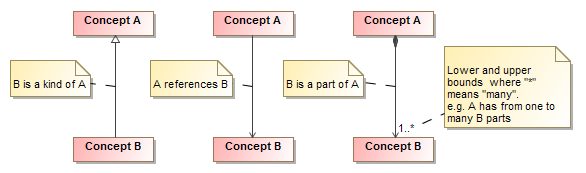
図1. SECM で用いられる概念間の関係。(SEBoK Original)
Systems Engineering Core Concepts
This article is part of the Foundations of Systems Engineering knowledge area. It integrates core systems engineering concepts, as presented in the SEBoK article Systems Engineering Core Concepts, with a general system model derived from systems science. The purpose is to enrich the conceptual foundation of systems engineering by showing how recent formal developments in systems science offer deeper theoretical structure to existing SE constructs. The integration is grounded in George Mobus’s axiomatic model (Mobus 2022), which provides mathematical formalisms for systems structure and behavior. This article shows how these axioms can underpin and clarify SE concepts such as the System-of-Interest, System Context, Life Cycle Process, and Emergence and Complexity. It also provides a generalized system model that enables consistency between conceptual understanding and quantitative modeling.
本記事は「Foundations of Systems Engineering(システムズエンジニアリングの基礎)」知識領域の一部である。本記事では、SEBoK の記事「Systems Engineering Core Concepts(システムズエンジニアリングの中核概念)」で示されたシステムズエンジニアリングの中核概念を、システム科学から導かれた一般システムモデルと統合する。その目的は、システム科学における近年の形式的な発展が既存の SE の諸概念により深い理論的構造を与え得ることを示し、それによってシステムズエンジニアリングの概念的基盤を豊かにすることにある。この統合は George Mobus の公理的モデル(Mobus 2022)に基づいており、同モデルはシステムの構造と振る舞いを数学的に形式化する手段を与える。本記事では、これらの公理が、対象システム(System-of-Interest)、システムコンテキスト(System Context)、ライフサイクルプロセス(Life Cycle Process)、創発と複雑性(Emergence and Complexity)といった SE の概念をどのように下支えし、明確にするかを示す。また、概念的な理解と定量的なモデリングとの一貫性を可能にする、一般化されたシステムモデルも提供する。
Concepts are the fundamental building blocks for the construction of theories, principles, thoughts and beliefs. They play an important role in all aspects of cognition and communication.
概念(concept)は、理論、原則、思考、信念を構築するための基本的な構成要素である。概念は、認知とコミュニケーションのあらゆる側面で重要な役割を果たす。
The Systems Engineering Concept Model (SECM) captures the concepts that are referred to in the Systems Engineering Body of Knowledge. The SECM provides a means to evaluate the consistency and coverage across the broad set of Systems Engineering concepts, and can facilitate communication to better understand and evolve these concepts. Although the primary reference for the SECM was the SEBoK, the concepts were cross-checked against other industry references including ISO/IEC/IEEE 15288:2015 and the INCOSE Systems Engineering Handbook version 5, enabling the SECM to be used to evaluate, understand, and evolve the concepts in these references as well. A small team developed the SECM to support the requirements for the next generation of the OMG Systems Modeling Language (OMG SysML™) to ensure SysML is consistent with the three leading industry standards.
システムズエンジニアリング概念モデル(Systems Engineering Concept Model、以下 SECM)は、Systems Engineering Body of Knowledge(SEBoK)で参照される概念群を捉えたものである。SECM は、システムズエンジニアリングの幅広い概念群全体にわたって一貫性と網羅性を評価する手段となり、これらの概念をよりよく理解し、発展させるためのコミュニケーションを促進できる。SECM が主に参照したのは SEBoK であるが、その概念は ISO/IEC/IEEE 15288:2015 や INCOSE Systems Engineering Handbook 第5版をはじめとする他の業界参照資料とも照合されている。そのため、SECM を用いてこれらの参照資料における概念を評価し、理解し、発展させることも可能である。SECM は小規模なチームによって開発された。その目的は、次世代の OMG Systems Modeling Language(OMG SysML™)の要求事項への対応を支援し、SysML が3つの主要な業界標準と確実に整合するようにすることにあった。
A concept model, called the Concept Map, was developed by the original SEBoK team prior to release of the SEBoK v1.0 in 2012 and was used to support integration of the initial concepts across the SEBoK topic areas. The Concept Map included a concept model and a mapping of the concepts to the glossary terms and to the sections of the SEBoK.
概念マップ(Concept Map)と呼ばれる概念モデルは、2012年の SEBoK v1.0 のリリースに先立って当初の SEBoK チームが開発したもので、SEBoK の各トピック領域にわたる初期の概念群の統合を支援するために用いられた。概念マップには、概念モデルに加え、概念と用語集の用語および SEBoK の各節との対応付けが含まれていた。
The SECM captures the Systems Engineering concepts and their relationship that are contained in today’s SEBoK. The small subset of UML constructs and symbols, shown in Figure 1, are used to represent the SECM model. The choice of notations is intended to balance simplicity, understandability, and precision.
SECM は、現在の SEBoK に含まれるシステムズエンジニアリングの概念とそれらの関係を捉えている。SECM モデルの表現には、図1に示す、UML の構成要素と記号のうちの小さなサブセットが用いられる。表記は、単純さ、理解しやすさ、正確さのバランスを取ることを意図して選ばれている。
図中の英語
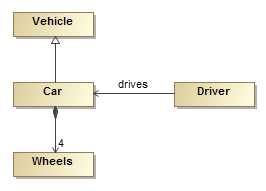
Figure 2 below shows a usage of these constructs and symbols when applied to a simple example of a Car. This diagram shows that a Car is kind of a Vehicle, and that the Driver drives the car (a reference relationship), and that there are four wheels that are parts of the Car.
以下の図2は、これらの構成要素と記号を、自動車(Car)という単純な例に適用したものである。この図は、自動車が乗り物(Vehicle)の一種であること、運転者(Driver)が自動車を運転すること(参照関係)、そして自動車の部分として車輪が4つあることを示している。
図中の英語
The SECM is presented in a series of diagrams that generally represent concepts for particular knowledge areas and topics in the SEBoK, and also includes references to glossary terms in the SEBoK.
SECM は一連の図として提示され、それらの図は概して SEBoK の特定の知識領域やトピックに関する概念を表す。また SECM には、SEBoK の用語集の用語への参照も含まれる。
The approach used to capture the SECM content from the SEBoK is described in the following steps:
SEBoK から SECM の内容を捉えるために用いたアプローチを、以下に手順として示す。
1. A topic within a SEBoK knowledge area is selected and the text is evaluated to identify key Systems Engineering concepts.
1. SEBoK の知識領域内のトピックを選び、そのテキストを評価して、システムズエンジニアリングの主要な概念を特定する。
2. From the sentences containing the concepts, the subjects, i.e. the concepts, and the predicate, i.e. the relationship between concepts, are identified. The predicate is a statement that says something about the subject.
2. 概念を含む文から、主語(すなわち概念)と述語(すなわち概念間の関係)を特定する。述語とは、主語について何かを述べる言明である。
3. A search is conducted for this concept in other areas of the SEBoK, and the accompanying text is evaluated to further refine the concept and its relationships to other concepts.
3. SEBoK の他の領域でこの概念が現れる箇所を検索し、付随するテキストを評価して、概念と他の概念へのその関係をさらに洗練させる。
4. The definition of the concept in the SEBoK glossary, if available, is evaluated.
4. SEBoK 用語集にその概念の定義があれば、それを評価する。
5. The use and definition of this concept in the other two industry references is evaluated.
5. 他の2つの業界参照資料におけるこの概念の用法と定義を評価する。
6. The concept and a derived definition from the above evaluation are added to the SECM.
6. 概念と、上記の評価から導いた定義を SECM に追加する。
7. The discovered relationships between the concepts are added to the model and to the relevant diagrams. The diagrams group related concepts that are often associated with a SEBoK Knowledge Area or Topic.
7. 発見された概念間の関係を、モデルおよび関連する図に追加する。図は、SEBoK の知識領域やトピックと結び付くことの多い、相互に関連する概念をまとめたものである。
8. As new contributions are made to the SEBoK, this approach can be used to identify new concepts and relationships, and add them to the SECM.
8. SEBoK に新たな寄稿が加わるのに応じて、このアプローチを用いて新たな概念と関係を特定し、SECM に追加できる。
The SECM was developed independently of the BKCASE project to support the evolution of the SysML standard. These models can be used to identify inconsistencies and/or areas requiring additional coverage within the SEBoK to support future updates.
SECM は、SysML 標準の進化を支援するために、BKCASE プロジェクトとは独立して開発された。これらのモデルは、SEBoK 内の不整合や、追加の網羅が必要な領域を特定し、将来の更新に役立てるために用いることができる。
The Core Concept Diagram shown in Figure 3 provides a high-level view of the some of the key concepts presented in the SEBoK. It should be emphasized that this figure is intended to be a representative interpretation of the current SEBoK without modifying or adding concepts, and no claim of the completeness of the SEBoK concepts is made. The colors correspond to logical groupings of concepts.
図3に示す中核概念図(Core Concept Diagram)は、SEBoK で提示される主要な概念の一部を高い視点から概観するものである。強調しておきたいのは、この図が、概念を変更したり追加したりすることなく、現在の SEBoK の代表的な解釈であることを意図したものであり、SEBoK の概念の完全性については何ら主張していないという点である。色は概念の論理的なグループ分けに対応している。
Figure 3. Core SEBoK Concepts. (SysML Roadmap SECM. Used with permission)
図3. SEBoK の中核概念。(SysML Roadmap SECM。Used with permission)
この図は原典のページに掲載されています。権利の都合により本サイトでは省略しています。原典で見る
A brief description of the core concepts model is provided below.
中核概念モデルの簡単な説明を以下に示す。
A Systems Engineer is a role within an Organization that practices the Engineering Discipline of Systems Engineering (SE), and is qualified by a set of SE Competencies. Systems Engineering integrates other Disciplines to support the Life Cycle Model. The Life Cycle Model is composed of life cycle Stages that typically include conceptual, realization, production, support, utilization and retirement stages (not shown). Each life cycle Stage refers to Life Cycle Processes that produce various kinds of Work Products. The Life Cycle Processes evolve the System-of-Interest (SoI).
システムズエンジニア(Systems Engineer)は、システムズエンジニアリングという工学分野(Engineering Discipline of Systems Engineering、SE)を実践する組織(Organization)内の役割であり、一連の SE のコンピテンシー(Competencies)によって資格づけられる。システムズエンジニアリングは、ライフサイクルモデル(Life Cycle Model)を支援するために他の分野(Disciplines)を統合する。ライフサイクルモデルはライフサイクルの段階(Stages)で構成され、典型的には概念、実現、生産、支援、利用、廃止の各段階を含む(図には示されていない)。各ライフサイクル段階は、さまざまな種類の作業成果物(Work Products)を生み出すライフサイクルプロセス(Life Cycle Processes)を参照する。ライフサイクルプロセスは対象システム(System-of-Interest、SoI)を進化させる。
There are many kinds of systems, including natural systems, social systems, and technological systems (not shown). Systems that are created by and for people are referred to as Engineered Systems. An Engineered System whose life cycle is under consideration is referred to as a System-of-Interest (SoI).
システムには、自然システム、社会システム、技術システムをはじめ、多くの種類がある(図には示されていない)。人によって、人のために作られたシステムは、エンジニアード・システム(Engineered Systems)と呼ばれる。ライフサイクルが検討の対象となっているエンジニアード・システムを、対象システム(SoI)と呼ぶ。
A System-of-Interest is part of a broader System Context, which also includes an Environment. The Environment consists of other open systems (not shown) that can influence the SoI. Systems are composed of System Elements and have Behavior and Properties. Systems can exhibit Emergence and Complexity and Emergence and Complexity.
対象システムは、より広いシステムコンテキストの一部であり、システムコンテキストには環境(Environment)も含まれる。環境は、SoI に影響を及ぼし得る他の開放系(図には示されていない)で構成される。システムはシステム要素で構成され、振る舞い(Behavior)と特性(Properties)を持つ。システムは創発と複雑性(Emergence and Complexity)を示すことがある。
Systems Engineering uses a System Approach which applies established system Principles. Systems Science is an interdisciplinary field of science that studies complex systems and helps define and update the Principles that are applied by the System Approach, which is used by the discipline of Systems Engineering.
システムズエンジニアリングは、確立されたシステム原則(Principles)を適用するシステムズアプローチ(System Approach)を用いる。システム科学(Systems Science)は複雑なシステムを研究する学際的な科学分野であり、原則(Principles)の定義と更新を助ける。この原則は、システムズエンジニアリングという分野が用いるシステムズアプローチによって適用されるものである。
Mobus (2022) introduces a formal system model expressed as: Si,l = ⟨C,N,G,B,T,H,Δt⟩i,l
Mobus(2022)は、次のように表される形式的システムモデルを提示している。S_i,l = ⟨C, N, G, B, T, H, Δt⟩_i,l
This model includes:
このモデルには以下が含まれる。
C: Components
C:構成要素(Components)
N: Internal network structure
N:内部ネットワーク構造
G: External interaction graph (context/environment)
G:外部相互作用グラフ(コンテキスト/環境)
B: System boundary and interface
B:システム境界とインタフェース
T: Transformation functions (behavior)
T:変換関数(振る舞い)
H: System history (state evolution)
H:システム履歴(状態の進化)
These map to axioms that characterize system properties:
これらは、システムの特性を特徴づける次の公理に対応する。
Relationality: Components interact through measurable flows, creating a network of quantifiable relationships.
関係性(Relationality):構成要素は測定可能なフローを通じて相互作用し、定量化可能な関係のネットワークを形成する。
Hierarchy: Systems decompose recursively into simpler subsystems until reaching atomic components.
階層性(Hierarchy):システムは、原子的な構成要素に到達するまで、より単純なサブシステムへと再帰的に分解される。
Context & environment: Systems interact with their environment through defined interfaces and measurable flows.
コンテキストと環境(Context & environment):システムは、定義されたインタフェースと測定可能なフローを通じて環境と相互作用する。
Emergence & holism: System behaviors arise from component interactions and transformations across levels.
創発と全体性(Emergence & holism):システムの振る舞いは、複数のレベルにまたがる構成要素の相互作用と変換から生じる。
Feedback: Information and material flows create regulatory patterns through circular causation.
フィードバック(Feedback):情報と物質のフローは、循環的な因果関係を通じて制御パターンを形成する。
Conservation & transformation: Systems maintain and transform flows while preserving conservation laws.
保存と変換(Conservation & transformation):システムは、保存則を保ちながらフローを維持し、変換する。
The following table maps SEBoK concepts to Mobus’s axiomatic framework:
次の表は、SEBoK の概念を Mobus の公理的枠組みに対応付けたものである。
| SEBoK Concept |
|---|
| Mobus Element |
| Description |
| System-of-Interest (SoI) |
| S_{i,l} |
| The engineered system modeled as a whole |
| System Elements |
| C |
| Components forming the system |
| Internal Relationships |
| N |
| Networked structure of interactions |
| Environment & Context |
| G |
| External systems and flow connections |
| Interfaces & Boundaries |
| B |
| Delineated inputs/outputs across system edges |
| System Behavior |
| T |
| Transformation of component states and flows |
| Lifecycle & History |
| H, Δt |
| Evolution and traceability over time |
| Emergence and Complexity |
| T, H, hierarchy |
| Outcomes of internal interactions and nested systems |
| SEBoK の概念 | Mobus の要素 | 説明 |
|---|---|---|
| 対象システム(SoI) | S_i,l | 全体としてモデル化されたエンジニアード・システム |
| システム要素 | C | システムを形成する構成要素 |
| 内部関係 | N | 相互作用のネットワーク構造 |
| 環境とコンテキスト | G | 外部システムおよびフロー接続 |
| インタフェースと境界 | B | システムの縁をまたいで明確に区分された入出力 |
| システムの振る舞い | T | 構成要素の状態とフローの変換 |
| ライフサイクルと履歴 | H, Δt | 時間の経過に伴う進化と追跡可能性 |
| 創発と複雑性 | T, H, 階層性 | 内部の相互作用と入れ子になったシステムがもたらす結果 |
This alignment enhances both theoretical rigor and modeling precision, complementing the SECM's conceptual focus with mathematical structure.
この対応付けは、理論的な厳密さとモデリングの精度をともに高め、SECM の概念的な焦点を数学的構造によって補完する。
The general system model scuh as that provided by Mobus could provide scientific underpinning for:
Mobus が提供するような一般システムモデルは、以下に対して科学的な裏付けを与え得る。
Unified structural and behavioral modeling
• 構造と振る舞いの統一的なモデリング
Quantitative basis for feedback and emergence
• フィードバックと創発の定量的な基盤
Compatibility with systems modeling languages (e.g., SysML)
• システムモデリング言語(例:SysML)との互換性
Support for lifecycle traceability and transformation
• ライフサイクルの追跡可能性と変換の支援
For example, in an engineered mobility system:
例えば、エンジニアード・システムの一例である移動システム(モビリティシステム)では次のようになる。
C: Subsystems (powertrain, sensors, chassis)
C:サブシステム(パワートレイン、センサー、シャシー)
N: Wiring and data bus interconnections
N:配線とデータバスの相互接続
G: Urban infrastructure, regulations, users
G:都市インフラ、規制、利用者
B: Interfaces such as GPS, brakes, communications
B:GPS、ブレーキ、通信などのインタフェース
T: Acceleration, routing, braking logic
T:加速、経路決定、制動のロジック
H: System logs, performance metrics
H:システムログ、性能指標
Δt: Millisecond-level telemetry samples
Δt:ミリ秒レベルのテレメトリサンプル
By grounding SE concepts in a general systems science model, systems engineering would gain:
SE の概念を一般的なシステム科学モデルに基礎づけることで、システムズエンジニアリングは以下を得ることになるだろう。
A formalized system context for MBSE
• MBSE のための形式化されたシステムコンテキスト
Improved capability to represent feedback, hierarchy, and emergence
• フィードバック、階層性、創発を表現する能力の向上
Alignment with system science education and interdisciplinary fields
• システム科学教育および学際分野との整合
Mobus, G. E. (2022). Systems Science: Theory, Analysis, Modeling, and Design. Springer Nature.
ISO/IEC/IEEE. 2015. Systems and Software Engineering -- System Life Cycle Processes. Geneva, Switzerland: International Organisation for Standardisation/International Electrotechnical Commissions/Institute of Electrical and Electronics Engineers. ISO/IEC/IEEE 15288:2015.
INCOSE. 2015. Systems Engineering Handbook: A Guide for System Life Cycle Processes and Activities, version 4.0. Hoboken, NJ, USA: John Wiley and Sons, Inc., ISBN: 978-1-118-99940-0.
OMG. SysML Roadmap: Systems Engineering Concept Model Workgroup (SECM) Available at: https://www.omgwiki.org/OMGSysML/doku.php?id=sysml-roadmap%3Asystems_engineering_concept_model_workgroup.
OMG. SysML Roadmap: Systems Engineering Concept Model Workgroup (SECM). Available at: https://www.omgwiki.org/OMGSysML/doku.php?id=sysml-roadmap%3Asystems_engineering_concept_model_workgroup.
ISO/IEC/IEEE. 2023. Systems and Software Engineering -- System Life Cycle Processes. Geneva, Switzerland: International Organisation for Standardisation/International Electrotechnical Commissions/Institute of Electrical and Electronics Engineers. ISO/IEC/IEEE 15288:2023.
INCOSE. 2023. Systems Engineering Handbook: A Guide for System Life Cycle Processes and Activities, version 5.0. Hoboken, NJ, USA: John Wiley and Sons, Inc.
None