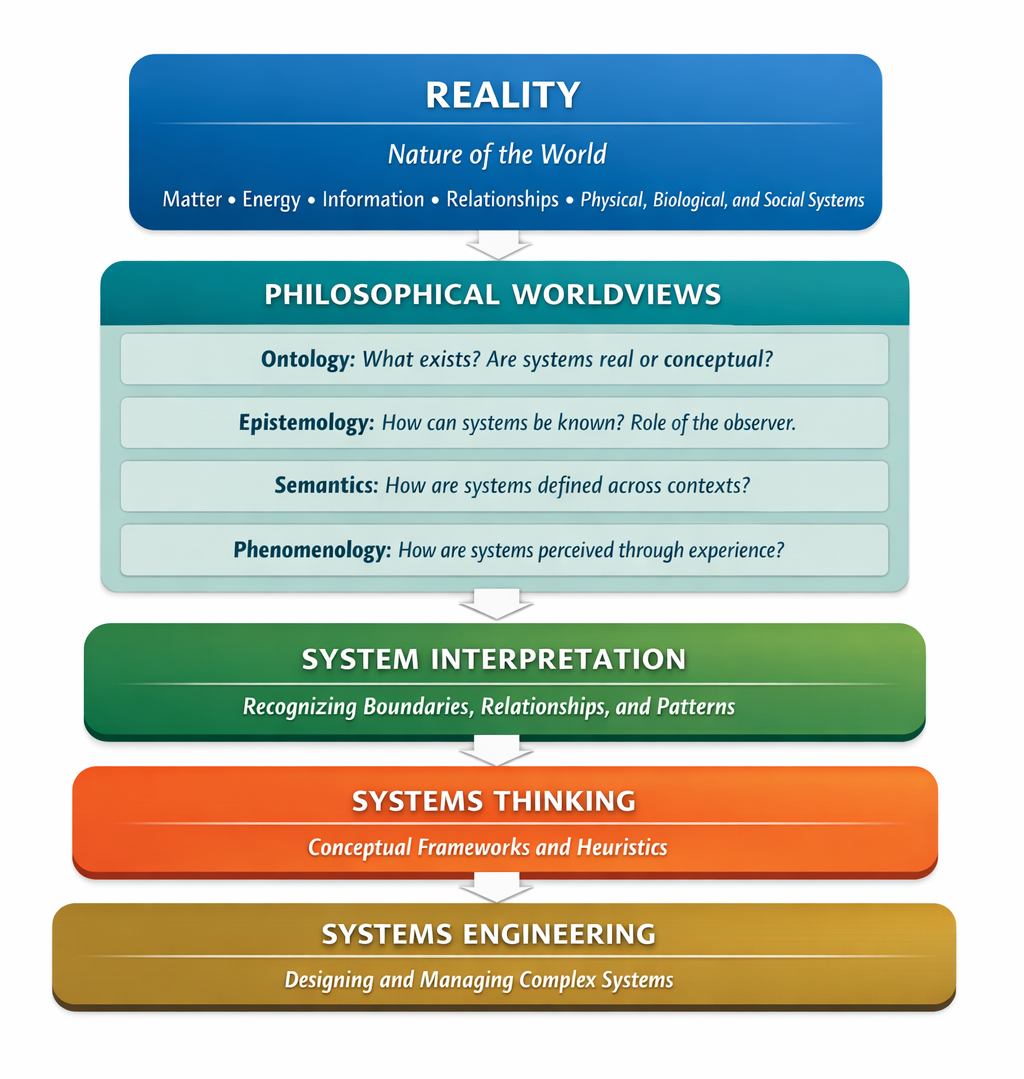
図1:システム的探究と実践を支える哲学的基盤。(SEBoK original)
Worldviews and Philosophies of Systemness
Different worldviews and philosophies of "systemness" shape how people define, interpret, and engage with systems across disciplines and contexts. Perspectives grounded in mechanistic, organismic, cybernetic, socio-technical, and holistic traditions each emphasize different aspects of systems, including structure, behavior, purpose, relationships, adaptation, and meaning. These philosophical foundations influence how systems are modeled, analyzed, engineered, and governed, particularly when addressing complex human and organizational challenges. Recognizing and navigating multiple perspectives on systemness strengthens systems thinking by encouraging flexibility, reflection, and a deeper appreciation for the assumptions underlying systems practice.
「システム性(systemness)」をめぐる異なる世界観や哲学は、学問分野やコンテキストを越えて、人々がシステムをどう定義し、どう解釈し、どう関わるかを形作る。機械論的、生物体的、サイバネティクス的、社会技術的、全体論的といった伝統に根ざす視点は、構造、振る舞い、目的、関係、適応、意味など、システムのそれぞれ異なる側面を重視する。こうした哲学的基盤は、とりわけ複雑な人間的・組織的課題に取り組む場面で、システムがどのようにモデル化され、分析され、エンジニアリングされ、統治されるかに影響を及ぼす。システム性をめぐる複数の視点を認識し、それらの間を行き来することは、柔軟性と省察を促し、システム実践の根底にある前提へのより深い理解を育むことで、システム思考を強化する。
Acknowledgement
謝辞
This article reflects established knowledge from systems science and systems engineering, organized and collated for the SEBoK. Drafting support was provided by OpenAI’s ChatGPT, with all content reviewed and finalized by the author, who retains full responsibility.
本記事は、システム科学とシステムズエンジニアリングにおいて確立された知識を、SEBoK 向けに整理・集約したものである。起草にあたっては OpenAI の ChatGPT の支援を受けており、すべての内容は著者がレビューして最終化したもので、全責任は著者が負う。
The concept of a system is widely used across science, engineering, and many other fields of inquiry. Yet the interpretation of what constitutes a system depends strongly on underlying philosophical assumptions about the nature of reality, knowledge, and meaning. Different disciplines and traditions often interpret systems in different ways: as objective structures present in the world, as conceptual constructs used to organize understanding, or as relational patterns emerging from interactions among entities.
システムという概念は、科学、工学をはじめ、多くの探究分野で広く用いられている。しかし、何をもってシステムとするかの解釈は、現実、知識、意味の本質に関する根底の哲学的前提に大きく左右される。学問分野や伝統が異なれば、システムの解釈もしばしば異なる。すなわち、世界に存在する客観的な構造として、理解を組織化するために用いられる概念的構成物として、あるいは実体間の相互作用から生じる関係的パターンとして解釈される。
These philosophical assumptions influence how systems are defined, how system boundaries are drawn, how systemic knowledge is generated, and how complex phenomena are interpreted. They therefore play a central role in shaping systemic inquiry.
こうした哲学的前提は、システムがどのように定義され、システム境界がどのように引かれ、システム的知識がどのように生成され、複雑な現象がどのように解釈されるかに影響する。したがって、それらはシステム的探究を形作るうえで中心的な役割を果たす。
Unlike the preceding article on the History and Foundations of Systems Science, which describes the intellectual development of the field, this article focuses on the philosophical perspectives that influence how systems are perceived and interpreted. These perspectives include ontological assumptions concerning the nature of systems, epistemological perspectives on systemic knowledge, semantic considerations concerning systemic language, and phenomenological insights concerning human experience and perception.
本分野の知的発展を記述した先行記事 History and Foundations of Systems Science(システム科学の歴史と基盤)とは異なり、本記事では、システムがどのように知覚され解釈されるかに影響を与える哲学的視点に焦点を当てる。これらの視点には、システムの本質に関する存在論的前提、システム的知識に関する認識論的視点、システム的言語に関する意味論的考察、そして人間の経験と知覚に関する現象学的洞察が含まれる。
Understanding these philosophical foundations helps clarify how systems are recognized and studied. It also provides an important bridge between systems science and the cognitive and methodological approaches of systems thinking that are addressed in the following section.
こうした哲学的基盤を理解することは、システムがどのように認識され研究されるのかを明らかにする助けとなる。また、システム科学と、次節で扱うシステム思考の認知的・方法論的アプローチとを結ぶ重要な橋渡しにもなる。
The interpretation of complex phenomena as systems depends on underlying philosophical assumptions about reality, knowledge, meaning, and experience. These assumptions shape how observers identify relationships, define system boundaries, and interpret systemic behavior.
複雑な現象をシステムとして解釈することは、現実、知識、意味、経験に関する根底の哲学的前提に依拠している。こうした前提は、観察者が関係をどう特定し、システム境界をどう定義し、システム的振る舞いをどう解釈するかを形作る。
Figure 1 illustrates how these philosophical perspectives support systemic inquiry and practice.
図1は、これらの哲学的視点がシステム的探究と実践をどのように支えているかを示している。
At the most fundamental level is reality itself, consisting of natural and social phenomena. Observers interpret these phenomena through philosophical worldviews concerning ontology, epistemology, semantics, and lived experience. These perspectives influence how systems are recognized and conceptualized. Systems thinking then provides conceptual frameworks for reasoning about these relationships, while systems engineering applies these insights in the design and management of complex socio-technical systems.
最も基礎的なレベルにあるのは、自然的・社会的現象からなる現実そのものである。観察者は、存在論、認識論、意味論、生きられた経験に関する哲学的世界観を通して、これらの現象を解釈する。こうした視点は、システムがどのように認識され概念化されるかに影響する。そのうえでシステム思考が、これらの関係について推論するための概念的枠組みを提供し、システムズエンジニアリングがその洞察を複雑な社会技術システムの設計とマネジメントに応用する。
Understanding these conceptual layers clarifies the intellectual foundations that support systemic inquiry.
これらの概念的な層を理解することで、システム的探究を支える知的基盤が明確になる。
図中の英語
Philosophical worldviews shape how observers interpret reality as systems. These foundations influence systemic interpretation, which supports systems thinking and ultimately informs systems engineering practice.
哲学的世界観は、観察者が現実をどのようにシステムとして解釈するかを形作る。これらの基盤はシステム解釈に影響を及ぼし、そのシステム解釈がシステム思考を支え、最終的にシステムズエンジニアリングの実践に情報を与える。
As shown in the figure, systemic inquiry involves several conceptual layers:
図に示すとおり、システム的探究にはいくつかの概念的な層が関わっている。
• Reality – the natural and social phenomena that observers encounter
• 現実(Reality):観察者が出会う自然的・社会的現象
• Philosophical worldviews – assumptions concerning ontology, epistemology, semantics, and experience
• 哲学的世界観(Philosophical worldviews):存在論、認識論、意味論、経験に関する前提
• System interpretation – recognizing relationships, boundaries, and patterns that constitute systems
• システム解釈(System interpretation):システムを構成する関係、境界、パターンの認識
• Systems thinking – conceptual frameworks and heuristics for understanding complex systems
• システム思考(Systems thinking):複雑なシステムを理解するための概念的枠組みとヒューリスティクス
• Systems engineering – practical methods for designing and managing complex systems
• システムズエンジニアリング(Systems engineering):複雑なシステムを設計し管理するための実践的方法
Understanding these layers helps clarify the intellectual foundations of systems science and its relationship to systems thinking and systems engineering.
これらの層を理解することは、システム科学の知的基盤、およびシステム科学とシステム思考・システムズエンジニアリングとの関係を明らかにする助けとなる。
Although the concept of a system is widely used across disciplines, its precise meaning varies depending on context. Most definitions converge on the idea that a system consists of interrelated components forming an integrated whole.
システムという概念は学問分野を越えて広く用いられているが、その厳密な意味はコンテキストによって異なる。ほとんどの定義は、システムとは相互に関連する構成要素が統合された全体を形成したものである、という考えに収束する。
For example, von Bertalanffy described systems as organized wholes whose properties arise from interactions among their components (von Bertalanffy 1968). Boulding emphasized hierarchical organization across levels of complexity (Boulding 1956). Ackoff emphasized purposeful systems capable of goal-directed behavior (Ackoff 1971). Meadows described systems as sets of elements interconnected in ways that produce patterns of behavior over time (Meadows 2008).
例えば von Bertalanffy は、システムを、構成要素間の相互作用から特性が生じる組織化された全体として記述した(von Bertalanffy 1968)。Boulding は、複雑性の諸レベルにわたる階層的組織化を強調した(Boulding 1956)。Ackoff は、目標指向の振る舞いが可能な目的設定型システムを強調した(Ackoff 1971)。Meadows は、システムを、時間を通じた振る舞いのパターンを生み出すような方法で相互に結びついた要素の集合として記述した(Meadows 2008)。
Despite differences among disciplines, most system definitions include three key characteristics:
学問分野による違いはあるものの、ほとんどのシステムの定義には3つの主要な特性が含まれる。
• elements or components
• 要素または構成要素
• relationships among those elements
• それらの要素間の関係
• an integrated whole exhibiting emergent behavior
• 創発的振る舞いを示す統合された全体
These shared characteristics provide a conceptual foundation for systemic inquiry across scientific and engineering domains.
これらの共通する特性は、科学・工学の諸領域にわたるシステム的探究に概念的基盤を与える。
A central philosophical question concerns the ontological status of systems: whether systems exist as real structures in the world or whether they are primarily conceptual constructs used to interpret complex phenomena.
中心的な哲学的問いの一つは、システムの存在論的地位に関わるものである。すなわち、システムは世界に実在する構造として存在するのか、それとも主として複雑な現象を解釈するために用いられる概念的構成物なのか、という問いである。
Some philosophers argue that systems represent genuine structures of reality. Bunge proposed the philosophical position known as systemism, which holds that the world is fundamentally composed of interconnected systems rather than isolated objects (Bunge 1979; Bunge 2000). From this perspective, systems science investigates real patterns of organization present in nature and society.
一部の哲学者は、システムは現実の真正な構造を表していると主張する。Bunge は「システム主義(systemism)」と呼ばれる哲学的立場を提唱した。これは、世界は根本的に、孤立した対象ではなく相互に結びついたシステムから構成されているとする立場である(Bunge 1979; Bunge 2000)。この視点に立てば、システム科学は自然と社会に実際に存在する組織化のパターンを探究するものとなる。
Examples of such systems include biological organisms, ecosystems, economies, and technological infrastructures, all of which exhibit organized relationships and dynamic behaviors that arise from interactions among their components.
こうしたシステムの例としては、生物、生態系、経済、技術インフラなどが挙げられ、いずれも構成要素間の相互作用から生じる組織化された関係と動的な振る舞いを示す。
Other perspectives emphasize that systems are often defined through analytical choices made by observers. System boundaries may be determined by the purpose of investigation rather than by intrinsic divisions in nature. From this viewpoint, systems function as conceptual models that help observers interpret complexity.
別の視点は、システムがしばしば観察者による分析上の選択を通じて定義されることを強調する。システム境界は、自然に内在する区分ではなく、探究の目的によって決まる場合がある。この観点からすると、システムは、観察者が複雑性を解釈するのを助ける概念モデルとして機能する。
This perspective has been influential in systemic problem-structuring approaches. Ackoff, for example, emphasized that systems are often defined in relation to the purposes of inquiry (Ackoff 1971). Churchman similarly argued that system boundaries are ethical and intellectual choices that shape how problems are framed (Churchman 1979).
この視点は、システム的な問題構造化アプローチにおいて影響力をもってきた。例えば Ackoff は、システムはしばしば探究の目的との関係において定義されると強調した(Ackoff 1971)。Churchman も同様に、システム境界は問題の枠組み方を左右する倫理的・知的な選択であると論じた(Churchman 1979)。
A third perspective emphasizes relationships as the fundamental basis of reality. In relational ontology, entities are defined primarily through their interactions with other entities.
第三の視点は、関係を現実の根本的な基盤として重視する。関係的存在論(relational ontology)では、実体は主として他の実体との相互作用を通じて定義される。
Rosen’s relational biology argued that living systems cannot be understood solely through material components but must be understood through the network of relationships that sustain their organization (Rosen 1991). Kineman similarly proposes a relational view of science in which systemic structures emerge through contextual relationships rather than isolated substances (Kineman 2011; Kineman 2017b). Relational ontology has become increasingly influential in fields such as ecology, network science, and systems biology, where interactions and relationships often provide deeper explanatory power than isolated components.
Rosen の関係生物学は、生命システムは物質的構成要素だけでは理解できず、その組織を維持する関係のネットワークを通じて理解されなければならないと論じた(Rosen 1991)。Kineman も同様に、システム的構造は孤立した実体ではなく文脈的な関係を通じて生じるとする、関係的な科学観を提唱している(Kineman 2011; Kineman 2017b)。関係的存在論は、生態学、ネットワーク科学、システム生物学などの分野でますます影響力を増している。これらの分野では、孤立した構成要素よりも相互作用や関係のほうが、より深い説明力をもつことが多い。
Systems science also raises important epistemological questions concerning how knowledge about systems is generated.
システム科学は、システムに関する知識がどのように生成されるかという、重要な認識論的問いも提起する。
Cybernetics introduced the insight that observers are themselves part of the systems they study. Wiener defined cybernetics as the study of control and communication in animals and machines (Wiener 1948). Cybernetic analysis revealed that feedback, communication, and regulation are fundamental features of many systems.
サイバネティクスは、観察者自身が、研究対象とするシステムの一部であるという洞察をもたらした。Wiener はサイバネティクスを、動物と機械における制御とコミュニケーションの研究と定義した(Wiener 1948)。サイバネティクス的分析によって、フィードバック、コミュニケーション、調節が多くのシステムの基本的な特徴であることが明らかになった。
Second-order cybernetics later emphasized the role of the observer in constructing descriptions of systems. Von Foerster argued that systemic knowledge is always produced by observers who participate in the systems they describe (von Foerster 1974; von Foerster 2003).
その後、二次サイバネティクス(second-order cybernetics)は、システムの記述を構築するうえでの観察者の役割を強調した。von Foerster は、システム的知識は常に、自らが記述するシステムに参加している観察者によって生み出されると論じた(von Foerster 1974; von Foerster 2003)。
Constructivist approaches emphasize that knowledge about systems is shaped by interpretation and context. Checkland highlighted the role of stakeholder worldviews when defining systems of interest in complex social situations (Checkland 1989; Checkland 1999). Similarly, Maturana and Varela showed how living systems generate meaning through structural coupling with their environments (Maturana and Varela 1980).
構成主義的アプローチは、システムに関する知識が解釈とコンテキストによって形作られることを強調する。Checkland は、複雑な社会的状況において対象システム(systems of interest)を定義する際に、ステークホルダーの世界観が果たす役割に光を当てた(Checkland 1989; Checkland 1999)。同様に、Maturana と Varela は、生命システムが環境との構造的カップリングを通じていかに意味を生成するかを示した(Maturana and Varela 1980)。
From this perspective, systemic knowledge arises through interaction between observers and the phenomena they investigate.
この視点に立てば、システム的知識は、観察者と、観察者が探究する現象との相互作用を通じて生じる。
Many contemporary systems scholars combine realist and constructivist insights. Systemic structures exist in the world, yet human observers interpret and model those structures using conceptual frameworks.
現代の多くのシステム研究者は、実在論的な洞察と構成主義的な洞察を組み合わせている。システム的構造は世界に存在するが、人間の観察者は概念的枠組みを用いてそれらの構造を解釈し、モデル化する。
This integrative perspective supports systems science as both empirical inquiry and conceptual modelling (Mobus and Kalton 2014; Hieronymi 2013).
この統合的視点は、システム科学を、実証的探究であると同時に概念的モデリングでもあるものとして支えている(Mobus and Kalton 2014; Hieronymi 2013)。
Karl Popper proposed that reality can be understood through three interacting domains (Popper 1972):
Karl Popper は、現実は相互に作用し合う3つの領域を通じて理解できると提唱した(Popper 1972)。
• World 1 – Physical Reality Material objects and natural processes.
• 世界1 ― 物理的現実(World 1 – Physical Reality):物質的対象と自然的プロセス。
• World 2 – Subjective Experience Human perception, cognition, and awareness.
• 世界2 ― 主観的経験(World 2 – Subjective Experience):人間の知覚、認知、意識。
• World 3 – Objective Knowledge Scientific theories, models, and conceptual knowledge.
• 世界3 ― 客観的知識(World 3 – Objective Knowledge):科学理論、モデル、概念的知識。
Systems science frequently operates across all three domains. Ecological systems exist in World 1, human perception of those systems occurs in World 2, and systemic theories and models belong to World 3.
システム科学は、しばしばこれら3つの領域すべてにまたがって機能する。生態系は世界1に存在し、そうしたシステムについての人間の知覚は世界2で生じ、システム的な理論やモデルは世界3に属する。
Recent work has extended this interpretation within engineering and systemic practice. For example, Blockley and colleagues relate Popper’s framework to relational approaches to engineering knowledge and systemic reasoning (Blockley et al. 2023).
近年の研究は、エンジニアリングとシステム実践の中でこの解釈を拡張している。例えば Blockley らは、Popper の枠組みを、エンジニアリング知識やシステム的推論に対する関係的アプローチと結びつけている(Blockley et al. 2023)。
Another philosophical perspective relevant to systems science concerns the role of information in the structure of reality.
システム科学に関わるもう一つの哲学的視点は、現実の構造において情報が果たす役割に関するものである。
Stonier argued that information should be considered a fundamental property of the universe alongside matter and energy (Stonier 1997; Stonier 2012). From this viewpoint, physical structures can be interpreted as organized information patterns.
Stonier は、情報は物質やエネルギーと並ぶ宇宙の基本的な特性とみなされるべきだと主張した(Stonier 1997; Stonier 2012)。この観点からすると、物理的構造は組織化された情報パターンとして解釈できる。
Information-based perspectives are increasingly influential in systems biology, network science, and complex adaptive systems. Vedral, for example, argues that information provides a foundational basis for understanding physical reality and organization across scales (Vedral 2018).
情報に基づく視点は、システム生物学、ネットワーク科学、複雑適応システムの分野でますます影響力を増している。例えば Vedral は、情報は物理的現実やスケールを越えた組織化を理解するための基礎的な土台となると論じている(Vedral 2018)。
These perspectives suggest that systemic organization may often be interpreted in terms of information flows, transformations, and constraints.
こうした視点は、システム的組織化がしばしば、情報の流れ、変換、制約という観点から解釈できることを示唆している。
The concept of a system functions as a semantic abstraction that enables diverse phenomena to be described using common conceptual frameworks. However, different disciplines interpret systemic language differently.
Engineering systems often emphasize functional architecture and performance. Biological systems emphasize self-maintaining organization. Social systems emphasize institutions and relationships.
These variations highlight the importance of semantic clarity within systems science. Rousseau, Billingham, and Calvo-Amodio emphasize the need for coherent systemic semantics when building shared ontologies and conceptual frameworks across the systems field (Rousseau, Billingham, and Calvo-Amodio 2018).
Dori and colleagues similarly highlight the importance of distinguishing system definitions, worldviews, and systemness characteristics when establishing conceptual clarity (Dori et al. 2019).
システムという概念は、多様な現象を共通の概念的枠組みで記述することを可能にする意味論的抽象(semantic abstraction)として機能する。しかし、システム的な言語の解釈は学問分野によって異なる。
エンジニアリングシステムでは、機能アーキテクチャと性能が重視されることが多い。
生物的システムでは、自己維持的な組織化が重視される。
社会的システムでは、制度と関係が重視される。
こうした違いは、システム科学における意味論的明確さの重要性を浮き彫りにする。Rousseau、Billingham、Calvo-Amodio は、システム分野全体で共有される存在論や概念的枠組みを構築するにあたり、一貫したシステム的意味論が必要であることを強調している(Rousseau, Billingham, and Calvo-Amodio 2018)。
Dori らも同様に、概念的明確さを確立するうえで、システムの定義、世界観、システム性の特性を区別することの重要性を浮き彫りにしている(Dori et al. 2019)。
Phenomenological insights connect closely with the role of heuristics in systemic practice. Heuristics are practical guiding principles that support reasoning and decision-making under complexity.
現象学的洞察は、システム実践におけるヒューリスティクス(heuristics)の役割と密接に結びついている。ヒューリスティクスとは、複雑性のもとでの推論や意思決定を支える実践的な指針である。
Simon showed that decision-making under bounded rationality often relies on heuristic judgment rather than exhaustive optimization (Simon 1957). Kahneman later demonstrated how heuristic reasoning shapes human judgment under uncertainty (Kahneman 2011).
Simon は、限定合理性のもとでの意思決定が、網羅的な最適化ではなく、しばしばヒューリスティックな判断に依拠することを示した(Simon 1957)。その後 Kahneman は、ヒューリスティックな推論が不確実性のもとで人間の判断をどのように形作るかを示した(Kahneman 2011)。
In systems engineering, heuristics help practitioners identify system boundaries, anticipate emergent behavior, and balance competing system objectives.
システムズエンジニアリングにおいて、ヒューリスティクスは、実践者がシステム境界を特定し、創発的振る舞いを予見し、競合するシステム目的のバランスをとるのに役立つ。
Historically, systems engineering itself developed largely through heuristic practice derived from engineering experience. Ring explicitly framed systems engineering in terms of value-seeking heuristics that guide systemic design and integration (Ring 1998).
歴史的に見ると、システムズエンジニアリングそのものが、主としてエンジニアリング経験から導かれたヒューリスティックな実践を通じて発展してきた。Ring は、システムズエンジニアリングを、システム的な設計と統合を導く価値追求型のヒューリスティクスという観点から明示的に位置づけた(Ring 1998)。
Worldviews strongly influence how system boundaries are defined. Different observers may interpret the same situation through different conceptual frameworks.
Environmental scientists may define systems using ecological boundaries. Policy makers may define them using administrative jurisdictions. Communities may interpret systems through cultural or historical relationships.
Churchman emphasized that boundary judgments are always ethically and practically significant because they determine what is included, excluded, or valued in systemic inquiry (Churchman 1979).
世界観は、システム境界がどのように定義されるかに大きな影響を及ぼす。異なる観察者が、同じ状況を異なる概念的枠組みを通して解釈することもある。
環境科学者は、生態学的な境界によってシステムを定義することがある。
政策立案者は、行政上の管轄区域によってシステムを定義することがある。
コミュニティは、文化的・歴史的な関係を通してシステムを解釈することがある。
Churchman は、境界判断は、システム的探究において何を含め、何を除外し、何に価値を置くかを決定するものであるため、常に倫理的にも実践的にも重要であると強調した(Churchman 1979)。
Understanding the philosophical foundations of systemness has practical implications for systems science and engineering.
システム性の哲学的基盤を理解することは、システム科学とシステムズエンジニアリングにとって実践的な含意をもつ。
Practitioners must make assumptions concerning:
実践者は、以下の事柄について前提を置かなければならない。
• what constitutes a system
• 何がシステムを構成するか
• how system boundaries are defined
• システム境界がどのように定義されるか
• how systemic knowledge is generated
• システム的知識がどのように生成されるか
• how values and perspectives influence interpretation
• 価値観と視点が解釈にどのように影響するか
Recognizing these assumptions helps ensure that systemic inquiry remains transparent and coherent.
これらの前提を認識することは、システム的探究が透明で首尾一貫したものであり続けることを確実にする助けとなる。
It also clarifies the relationship between systems science and the next knowledge area in SEBoK: Systems Thinking. Systems science investigates the nature and principles of systems, while systems thinking provides cognitive and methodological approaches for reasoning about complex situations.
それはまた、システム科学と、SEBoK の次の知識領域である Systems Thinking との関係を明確にする。システム科学がシステムの本質と原理を探究するのに対し、システム思考は複雑な状況について推論するための認知的・方法論的アプローチを提供する。
Systems science rests upon philosophical foundations concerning the nature of reality, the role of observers, and the interpretation of systemic concepts. Ontological, epistemological, semantic, and phenomenological perspectives together shape how systems are recognized and studied.
システム科学は、現実の本質、観察者の役割、システム的概念の解釈に関する哲学的基盤の上に成り立っている。存在論的、認識論的、意味論的、現象学的な視点が一体となって、システムがどのように認識され研究されるかを形作っている。
Understanding these philosophical foundations strengthens the conceptual coherence of systems science and provides an important bridge to the practical methods of systems thinking and systems engineering.
こうした哲学的基盤を理解することは、システム科学の概念的一貫性を強め、システム思考とシステムズエンジニアリングの実践的方法への重要な橋渡しとなる。
Ackoff, R. L. 1971. “Towards a System of Systems Concepts.” Management Science 17(11): 661–671.
Blockley, D., et al. 2023. “Relational Holon Science and Popper’s 3 Worlds in Engineering Practice.” Systems Research and Behavioral Science 40(6): 955–967.
Boulding, K. E. 1956. “General Systems Theory—The Skeleton of Science.” Management Science 2(3): 197–208.
Bunge, M. 1979. “A Systemic World View.” In Treatise on Basic Philosophy: Ontology II: A World of Systems. Dordrecht: Reidel.
Bunge, M. 2000. “Systemism: The Alternative to Individualism and Holism.” The Journal of Socio-Economics 29(2): 147–157.
Checkland, P. B. 1989. “Soft Systems Methodology.” Human Systems Management 8: 273–289.
Checkland, P. 1999. Systems Thinking, Systems Practice. Chichester, UK: Wiley.
Churchman, C. W. 1979. The Systems Approach and Its Enemies. New York, NY, USA: Basic Books.
Dori, D., et al. 2019. “System Definition, System Worldviews, and Systemness Characteristics.” IEEE Systems Journal.
Hieronymi, A. 2013. “Understanding Systems Science: A Visual and Integrative Approach.” Systems Research and Behavioral Science 30(5): 580–595.
Husserl, E. 1931. Ideas: General Introduction to Pure Phenomenology. London, UK: George Allen & Unwin.
Jonkisz, J. 2021. “Consciousness, Subjectivity, and Gradedness.” Semiotic Studies 35(1).
Kahneman, D. 2011. Thinking, Fast and Slow. New York, NY, USA: Farrar, Straus and Giroux.
Kineman, J. J. 2011. “Relational Science: A Synthesis.” Axiomathes 21(3): 393–437.
Kineman, J. J. 2017b. “Systems Research Framework.” In Edson, M. C., Henning, P. B., and Sankaran, S., eds. A Guide to Systems Research: Philosophy, Processes and Practice. Singapore: Springer, pp. 21–57.
Maturana, H. R., and Varela, F. J. 1980. Autopoiesis and Cognition: The Realization of the Living. Dordrecht, The Netherlands: Reidel.
Meadows, D. H. 2008. Thinking in Systems: A Primer. White River Junction, VT, USA: Chelsea Green.
Merleau-Ponty, M. 1945. Phenomenology of Perception. Paris, France: Gallimard.
Mobus, G. E., and Kalton, M. C. 2014. Principles of Systems Science. New York, NY, USA: Springer.
Popper, K. R. 1972. Objective Knowledge: An Evolutionary Approach. Oxford, UK: Clarendon Press.
Ring, J. 1998. “A Value-Seeking Approach to the Engineering of Systems.” In Proceedings of the 1998 IEEE International Conference on Systems, Man, and Cybernetics.
Rosen, R. 1991. Life Itself: A Comprehensive Inquiry into the Nature, Origin, and Fabrication of Life. New York, NY, USA: Columbia University Press.
Rousseau, D., Billingham, J., and Calvo-Amodio, J. 2018. “Systemic Semantics: A Systems Approach to Building Ontologies and Concept Maps.” Systems 6(3): 32.
Simon, H. A. 1957. Models of Man: Social and Rational. New York, NY, USA: Wiley.
Stonier, T. 1997. Information and Meaning: An Evolutionary Perspective. London, UK: Springer.
Stonier, T. 2012. Information and the Internal Structure of the Universe: An Exploration into Information Physics. London, UK: Springer.
Vedral, V. 2018. Decoding Reality: The Universe as Quantum Information. Oxford, UK: Oxford University Press.
von Bertalanffy, L. 1968. General System Theory: Foundations, Development, Applications. New York, NY, USA: Braziller.
von Foerster, H. 1974. Cybernetics of Cybernetics. Urbana, IL, USA: University of Illinois.
von Foerster, H. 2003. Understanding Understanding: Essays on Cybernetics and Cognition. New York, NY, USA: Springer.
Wiener, N. 1948. Cybernetics: Or Control and Communication in the Animal and the Machine. Cambridge, MA, USA: MIT Press.
None.
None.