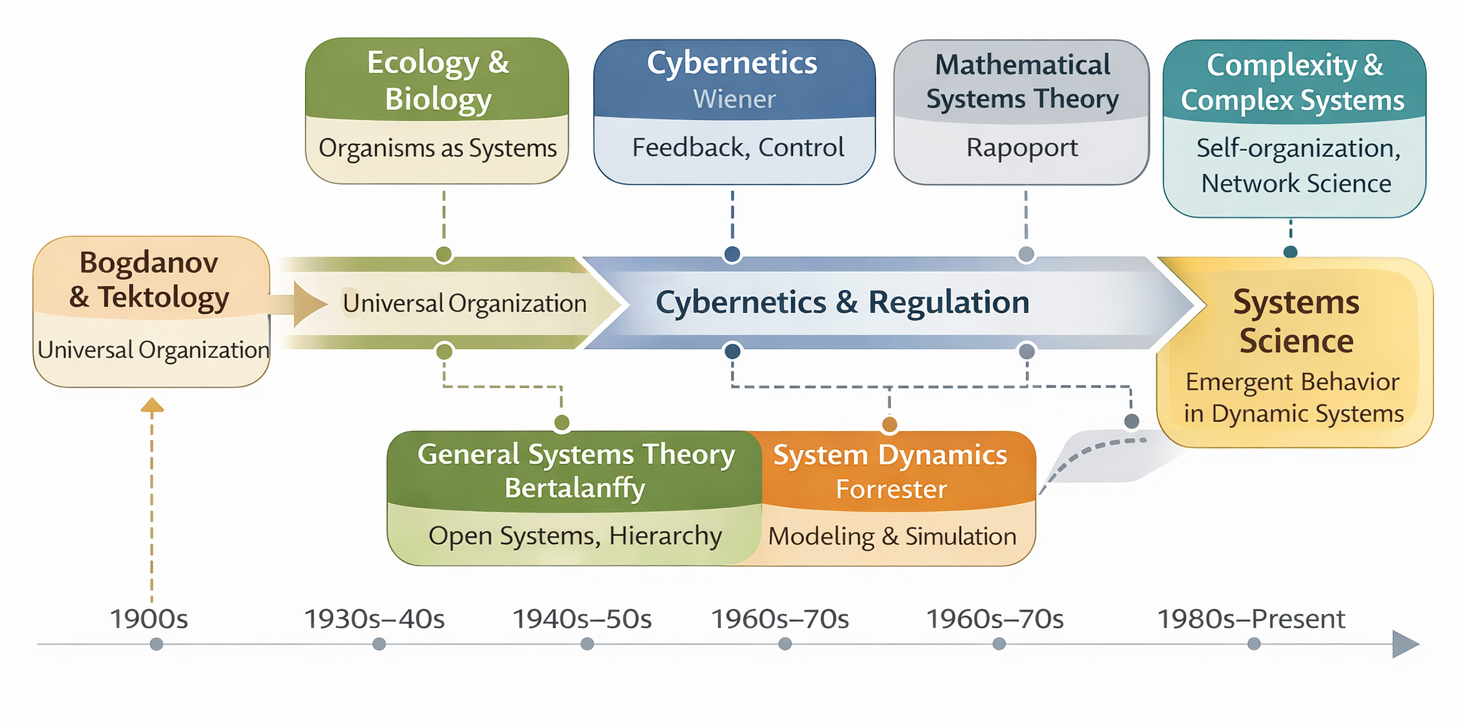
図1:システム科学の出現に寄与した主要な知的潮流。(SEBoK original)
History and Foundations of Systems Science
The intellectual foundations of systems science emerged through contributions from biology, engineering, mathematics, philosophy, and the social sciences, gradually shaping a more holistic understanding of complex systems and their behaviors. Foundational concepts such as general systems theory, cybernetics, feedback, emergence, and interdisciplinarity helped establish systems thinking as a distinct way of understanding relationships, interactions, and dynamic change. These historical developments flow into contemporary systems engineering practice, informing how complexity, integration, adaptation, and socio-technical interactions are understood across domains. Together, these perspectives provide critical conceptual grounding for modern systems thinking and engineering practice.
システム科学の知的基盤は、生物学、工学、数学、哲学、社会科学からの貢献を通じて生まれ、複雑なシステムとその振る舞いに対するより全体論的な理解を徐々に形づくってきた。一般システム理論、サイバネティクス、フィードバック、創発、学際性といった基礎的概念は、関係、相互作用、動的変化を理解するための独自の方法としてシステム思考を確立するうえで役立った。これらの歴史的発展は現代のシステムズエンジニアリングの実践へと流れ込み、さまざまな領域において複雑性、統合、適応、社会技術的相互作用がどのように理解されるかに影響を与えている。これらの視点は全体として、現代のシステム思考とエンジニアリング実践にとって重要な概念的基盤を提供している。
Acknowledgement
謝辞
This article reflects established knowledge from systems science and systems engineering, organized and collated for the SEBoK. Drafting support was provided by OpenAI’s ChatGPT, with all content reviewed and finalized by the author, who retains full responsibility.
本記事は、システム科学とシステムズエンジニアリングにおける確立された知識を、SEBoK 向けに整理・集約したものである。起草の支援は OpenAI の ChatGPT によって提供され、すべての内容は著者がレビューし最終化したものであり、著者が全責任を負う。
Systems science emerged during the twentieth century as researchers across many disciplines began investigating phenomena that could not be adequately explained through reductionist approaches alone. Complex systems, including organisms, ecosystems, economies, societies, and large technological infrastructures, exhibit behaviors that arise from interactions among their components and from relationships with their environments. Understanding such phenomena required conceptual frameworks capable of studying systems as organized wholes.
システム科学は、多くの学問分野の研究者たちが、還元主義的アプローチだけでは十分に説明できない現象を探究し始めたことを背景に、20世紀に出現した。生物、生態系、経済、社会、大規模な技術インフラを含む複雑なシステムは、構成要素間の相互作用や環境との関係から生じる振る舞いを示す。そうした現象を理解するには、システムを組織化された全体として研究できる概念的枠組みが必要であった。
The development of systems science did not originate from a single discipline or theory. Instead, it emerged through the convergence of several intellectual traditions concerned with organization, interaction, regulation, and complexity. These traditions arose in fields such as biology, engineering, mathematics, physics, and the social sciences. Together they contributed to a growing recognition that many systems, despite differences in their elements, share common patterns of organization and behavior.
システム科学の発展は、単一の学問分野や理論に端を発するものではない。むしろそれは、組織化、相互作用、調節、複雑性に関心を寄せるいくつかの知的伝統が収束することによって出現した。これらの伝統は、生物学、工学、数学、物理学、社会科学といった分野で生まれた。それらは全体として、多くのシステムが、要素は異なっていても組織化と振る舞いの共通パターンを共有しているという認識の高まりに寄与した。
Building on the preceding article, From Nature’s Patterns to Systems Science, which describes how systemic patterns observed in nature motivated the search for general principles of organization, this article outlines the major intellectual streams that contributed to the development of systems science as a formal interdisciplinary field.
本記事は、自然界で観察されるシステム的パターンが組織化の一般原理の探求をどのように促したかを述べた先行記事 From Nature's Patterns to Systems Science(自然のパターンからシステム科学へ)を受けて、一つの学際分野としてのシステム科学の発展に寄与した主要な知的潮流を概観する。
An explainer video is also provided here to support the introduction to the topic.
このトピックへの導入を支援するため、説明動画も提供されている(https://youtu.be/QeaavKxTuhM)。
Prior to the formal emergence of systems science, several scientific traditions had already begun to recognize the importance of studying organized wholes rather than isolated components.
システム科学が一つの学問分野として成立するのに先立ち、いくつかの科学的伝統は、孤立した構成要素ではなく組織化された全体を研究することの重要性をすでに認識し始めていた。
In biology, researchers increasingly emphasized the integrated nature of living organisms. Organisms could not be fully understood solely through the study of individual parts; rather, their properties arise from coordinated interactions among multiple subsystems. Similarly, ecological research highlighted the interdependence of species and the dynamic relationships within ecosystems.
生物学では、研究者たちが生命体の統合的な性質をますます強調するようになった。生物は、個々の部分を研究するだけでは完全には理解できない。その特性はむしろ、複数のサブシステム間の協調的な相互作用から生じるのである。同様に、生態学の研究は、種どうしの相互依存性や生態系内の動的な関係を浮き彫りにした。
At the same time, developments in engineering and mathematics were revealing the importance of communication, control, and feedback in both natural and artificial systems. These developments helped shift scientific attention toward the study of relationships, interactions, and regulatory processes.
同じ頃、工学と数学における発展によって、自然的システムと人工的システムの双方においてコミュニケーション、制御、フィードバックが重要であることが明らかになりつつあった。こうした発展は、科学的な関心を関係、相互作用、調節プロセスの研究へと向かわせる一助となった。
An early attempt to formulate a universal science of organization was developed by Alexander Bogdanov in the early twentieth century. His framework, known as Tektology, sought to identify general organizational principles applicable across biological, social, and technological systems (Bogdanov 1980). Although largely unknown in Western scientific communities for many decades, Bogdanov’s work anticipated many themes later associated with systems theory.
組織化の普遍科学を定式化しようとする初期の試みは、20世紀初頭に Alexander Bogdanov によって展開された。「テクトロジー(Tektology)」として知られる彼の枠組みは、生物的、社会的、技術的システムに共通して適用できる一般的な組織化原理を特定しようとするものであった(Bogdanov 1980)。Bogdanov の仕事は、西洋の科学界では数十年にわたってほとんど知られていなかったものの、後にシステム理論と結び付けられる多くのテーマを先取りしていた。
One of the most influential contributions to the development of systems science was General Systems Theory (GST), developed by Ludwig von Bertalanffy.
システム科学の発展に最も大きな影響を与えた貢献の一つは、Ludwig von Bertalanffy が発展させた一般システム理論(General Systems Theory、GST)であった。
Bertalanffy argued that many systems, particularly living organisms, must be understood as open systems that exchange matter, energy, and information with their environments (Bertalanffy 1968). This perspective contrasted with earlier mechanistic views that treated systems as closed and static.
Bertalanffy は、多くのシステム、とりわけ生命体は、環境との間で物質、エネルギー、情報を交換する開放系(open systems)として理解されなければならないと主張した(Bertalanffy 1968)。この視点は、システムを閉じた静的なものとして扱っていた従来の機械論的な見方とは対照的であった。
General Systems Theory sought to identify principles of organization that apply across different scientific domains. These included concepts such as open systems, dynamic equilibrium, hierarchical organization, and interactions among system components.
一般システム理論は、異なる科学領域に共通して適用される組織化の原理を特定しようとした。そこには、開放系、動的平衡、階層的組織化、システム構成要素間の相互作用といった概念が含まれていた。
Rather than replacing existing disciplines, Bertalanffy envisioned systems theory as a transdisciplinary framework capable of revealing common patterns of organization across biological, social, and technological systems.
Bertalanffy はシステム理論を、既存の学問分野に取って代わるものとしてではなく、生物的、社会的、技術的システムに共通する組織化のパターンを明らかにできる超学際的(transdisciplinary)枠組みとして構想した。
Kenneth Boulding expanded these ideas by proposing a hierarchical classification of systems, illustrating how increasing levels of complexity emerge across physical, biological, and social domains (Boulding 1956). Boulding’s framework highlighted the progressive increase in organizational complexity from simple physical structures to complex social systems.
Kenneth Boulding は、システムの階層的分類を提案することでこれらの考えを拡張し、物理的、生物的、社会的領域にわたって複雑性のレベルがどのように高まっていくかを示した(Boulding 1956)。Boulding の枠組みは、単純な物理的構造から複雑な社会システムに至るまで、組織的複雑性が段階的に増大していくことを浮き彫りにした。
A second major intellectual stream contributing to systems science was cybernetics, developed through the work of Norbert Wiener and colleagues studying communication and control in animals and machines.
システム科学に寄与した第二の主要な知的潮流はサイバネティクス(cybernetics)であり、これは動物と機械におけるコミュニケーションと制御を研究した Norbert Wiener とその同僚たちの仕事を通じて発展した。
Cybernetics introduced powerful concepts for understanding how systems regulate their behavior through feedback processes (Wiener 1948). Feedback mechanisms allow systems to monitor their own states and adjust their behavior in response to environmental changes.
サイバネティクスは、システムがフィードバックプロセスを通じて自らの振る舞いを調節する仕組みを理解するための強力な概念をもたらした(Wiener 1948)。フィードバックのメカニズムによって、システムは自らの状態を監視し、環境の変化に応じて振る舞いを調整できる。
W. Ross Ashby further developed these ideas through his work on regulatory systems. Ashby introduced the principle of requisite variety, which states that the capacity of a control system must be at least as diverse as the disturbances it must regulate (Ashby 1956). This principle highlighted the relationship between environmental complexity and the regulatory capacity required for system stability.
W. Ross Ashby は、調節システムに関する仕事を通じてこれらの考えをさらに発展させた。Ashby が導入した必要多様性(requisite variety)の原理は、制御システムの能力は、それが調節すべき外乱と少なくとも同程度に多様でなければならないとするものである(Ashby 1956)。この原理は、環境の複雑性と、システムの安定に必要な調節能力との関係を浮き彫りにした。
Cybernetics had profound influence across many disciplines, including neuroscience, engineering, computing, and organizational studies. It established feedback and regulation as central concepts within systems science.
サイバネティクスは、神経科学、工学、コンピューティング、組織研究をはじめとする多くの学問分野に深い影響を与えた。サイバネティクスによって、フィードバックと調節はシステム科学の中心的概念として確立された。
The application of cybernetic principles to organizations was further developed by Stafford Beer, whose work on management cybernetics explored how organizations can maintain viability in complex and changing environments.
サイバネティクスの原理を組織に応用する取り組みは、Stafford Beer によってさらに発展した。彼のマネジメントサイバネティクス(management cybernetics)に関する仕事は、組織が複雑で変化する環境の中でいかにして生存可能性を維持できるかを探究した。
Beer developed the Viable System Model, which describes the organizational structures required for adaptive regulation and coordination within complex systems (Beer 1972). His work demonstrated how cybernetic principles could be applied to governance, management, and institutional design.
Beer は生存可能システムモデル(Viable System Model)を開発した。このモデルは、複雑なシステムにおける適応的な調節と調整に必要な組織構造を記述するものである(Beer 1972)。彼の仕事は、サイバネティクスの原理をガバナンス、マネジメント、制度設計に応用できることを示した。
These ideas helped extend systems science beyond natural and engineering systems into the study of complex social and organizational systems.
こうした考えは、システム科学を自然システムやエンジニアリングシステムにとどまらず、複雑な社会的・組織的システムの研究へと広げる一助となった。
Another important development within systems science was the emergence of system dynamics, pioneered by Jay Forrester.
システム科学におけるもう一つの重要な発展は、Jay Forrester が先駆けとなったシステムダイナミクス(system dynamics)の出現であった。
System dynamics focuses on understanding how feedback structures, delays, and nonlinear interactions shape the behavior of complex systems over time (Forrester 1961). Using mathematical models and computer simulations, system dynamics allows researchers to explore how interactions among system components generate dynamic patterns such as growth, decline, oscillation, and instability.
システムダイナミクスは、フィードバック構造、遅延、非線形の相互作用が、複雑なシステムの時間的な振る舞いをどのように形づくるかを理解することに焦点を当てる(Forrester 1961)。システムダイナミクスでは、数学モデルとコンピュータシミュレーションを用いることで、システム構成要素間の相互作用が成長、衰退、振動、不安定性といった動的パターンをどのように生み出すかを研究者が探究できる。
System dynamics became widely applied in fields such as industrial management, urban planning, environmental policy, and sustainability studies.
システムダイナミクスは、産業マネジメント、都市計画、環境政策、持続可能性研究といった分野で広く応用されるようになった。
Mathematical approaches also played an important role in the development of systems science. Researchers sought to develop formal frameworks capable of describing system behavior across diverse domains.
数学的アプローチもまた、システム科学の発展において重要な役割を果たした。研究者たちは、多様な領域にわたるシステムの振る舞いを記述できる形式的枠組みの構築を目指した。
Anatol Rapoport contributed significantly to the development of mathematical systems theory, exploring how systems concepts could be expressed through formal models and applied to social and behavioral systems (Rapoport 1986). His work helped bridge the gap between abstract systems theory and practical applications in social science and policy.
Anatol Rapoport は数学的システム理論の発展に大きく貢献し、システムの概念を形式モデルによってどのように表現し、社会的・行動的システムにどのように応用できるかを探究した(Rapoport 1986)。彼の仕事は、抽象的なシステム理論と、社会科学や政策における実践的応用との間の溝を埋める一助となった。
Later developments in mathematics and physics contributed to the emergence of complexity science, which studies how large numbers of interacting components give rise to organized structures and emergent behavior.
数学と物理学におけるその後の発展は、複雑性科学(complexity science)の出現に寄与した。複雑性科学は、多数の相互作用する構成要素がどのようにして組織化された構造や創発的振る舞いを生み出すかを研究する。
Research on nonlinear dynamics and thermodynamics revealed that complex systems can spontaneously generate ordered structures under certain conditions. Studies of self-organization demonstrated how patterns and structures can emerge from local interactions without centralized control.
非線形ダイナミクスと熱力学の研究により、複雑なシステムは一定の条件下で秩序ある構造を自発的に生成し得ることが明らかになった。自己組織化(self-organization)の研究は、中央集権的な制御がなくても、局所的な相互作用からパターンや構造がどのように生じ得るかを示した。
Work by Nicolis and Prigogine showed how systems operating far from equilibrium can develop structured patterns through nonlinear interactions (Nicolis and Prigogine 1977). These discoveries significantly expanded the scientific understanding of dynamic systems.
Nicolis と Prigogine の仕事は、平衡から遠く離れた状態で動作するシステムが、非線形の相互作用を通じて構造化されたパターンを形成し得ることを示した(Nicolis and Prigogine 1977)。これらの発見は、動的システムに関する科学的理解を大きく広げた。
Today, complexity science investigates phenomena such as network dynamics, adaptive systems, and emergent behavior across domains ranging from physics and biology to economics and social systems.
今日、複雑性科学は、物理学や生物学から経済学や社会システムに至るまでのさまざまな領域において、ネットワークダイナミクス、適応システム、創発的振る舞いといった現象を探究している。
Although the traditions described above emerged within different disciplines, they share a common concern with understanding systems as organized wholes whose behavior arises from relationships among components.
上に述べた伝統は異なる学問分野の中で出現したが、システムを、構成要素間の関係からその振る舞いが生じる組織化された全体として理解しようとする関心を共有している。
Systems science gradually developed as an integrative field of inquiry bringing together insights from biology, engineering, mathematics, physics, and the social sciences. Its central aim is to identify general principles and patterns of organization that apply across different types of systems.
システム科学は、生物学、工学、数学、物理学、社会科学からの洞察を結集する探究の統合的分野(integrative field of inquiry)として徐々に発展した。その中心的な狙いは、異なる種類のシステムに共通して適用される組織化の一般原理とパターンを特定することにある。
These insights have influenced research and practice in fields including ecology, economics, organizational theory, computer science, and systems engineering.
これらの洞察は、生態学、経済学、組織理論、コンピュータ科学、システムズエンジニアリングをはじめとする諸分野の研究と実践に影響を与えてきた。
Systems science continues to evolve as researchers investigate increasingly complex socio-technical and socio-ecological systems. Contemporary research explores topics such as:
研究者たちがますます複雑な社会技術的・社会生態的システムを探究するなか、システム科学は進化を続けている。現代の研究は次のようなトピックを探求している。
• complex networks
• 複雑ネットワーク
• adaptive systems
• 適応システム
• resilience and sustainability
• レジリエンスと持続可能性
• multi-scale system dynamics
• マルチスケールのシステムダイナミクス
• interactions between technological, social, and ecological systems
• 技術的、社会的、生態的システム間の相互作用
Despite the diversity of approaches, the central goal of systems science remains consistent: to understand how systems organize, interact, adapt, and evolve across different domains of reality.
アプローチは多様であっても、システム科学の中心的な目標は一貫している。すなわち、現実のさまざまな領域において、システムがどのように組織化され、相互作用し、適応し、進化するかを理解することである。
Subsequent articles in this Knowledge Area explore several of the key concepts that have emerged from this interdisciplinary field.
この知識領域の後続の記事では、この学際的分野から生まれた主要な概念のいくつかを探究する。
The development of systems science can be understood as the convergence of several intellectual streams that emerged during the twentieth century. Early work on universal organizational principles was followed by research on feedback and regulation, general systems theory, dynamic modeling, and complexity science.
システム科学の発展は、20世紀に出現した複数の知的潮流の収束として理解できる。組織化の普遍原理に関する初期の研究に続いて、フィードバックと調節、一般システム理論、動的モデリング、複雑性科学に関する研究が登場した。
The timeline in Figure 1 illustrates several of the major contributions that shaped the development of systems science.
図1のタイムラインは、システム科学の発展を形づくった主要な貢献のいくつかを示している。
図中の英語
Ashby, W. R. 1956. An Introduction to Cybernetics. London, UK: Chapman & Hall.
Beer, S. 1972. Brain of the Firm. London, UK: Allen Lane.
Bertalanffy, L. von. 1968. General System Theory: Foundations, Development, Applications. New York, NY: Braziller.
Bogdanov, A. 1980. Essays in Tektology. Seaside, CA: Intersystems.
Boulding, K. E. 1956. “General Systems Theory—The Skeleton of Science.” Management Science 2(3), pp. 197–208.
Forrester, J. W. 1961. Industrial Dynamics. Cambridge, MA: MIT Press.
Nicolis, G., and I. Prigogine. 1977. Self-Organization in Nonequilibrium Systems. New York, NY: Wiley.
Rapoport, A. 1986. General System Theory: Essential Concepts and Applications. Tunbridge Wells: Abacus.
Wiener, N. 1948. Cybernetics: Or Control and Communication in the Animal and the Machine. Cambridge, MA: MIT Press.
None.
Mobus, G. E., and M. C. Kalton. 2015. Principles of Systems Science. New York, NY: Springer.
Prigogine, I., and I. Stengers. 1984. Order Out of Chaos. New York, NY: Bantam.