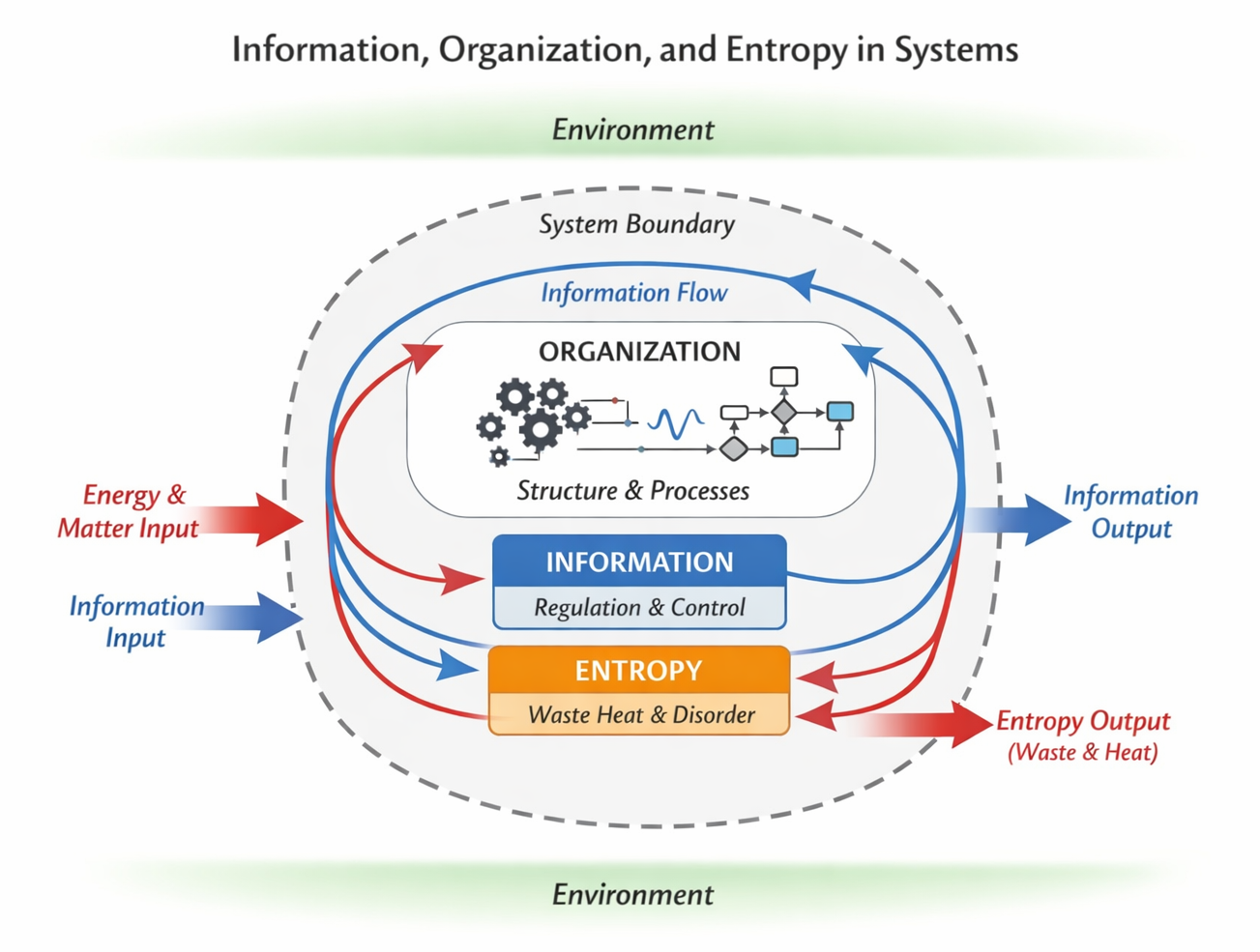
図1:システムにおける情報、組織、エントロピー。(SEBoK オリジナル)
Information, Organization, and Entropy in Systems
Information, organization, and entropy help explain how systems create, maintain, and lose structure over time. Information supports coordination, communication, adaptation, and decision-making within and across systems, while organization reflects the patterns and relationships that give systems coherence and purpose. Entropy describes the tendency toward disorder, uncertainty, or loss of structure when energy, information, or control are insufficient to sustain the system. Together, these concepts provide insight into how systems evolve, remain stable, adapt to change, and respond to disruption across natural, engineered, and socio-technical contexts.
情報、組織、エントロピーは、システムが時間の経過とともにどのように構造を生み出し、維持し、失っていくのかを説明するのに役立つ。情報は、システム内部およびシステム間の調整、コミュニケーション、適応、意思決定を支え、組織は、システムに一貫性と目的を与えるパターンと関係を反映する。エントロピーは、エネルギー、情報、制御がシステムを維持するのに不十分なときに、無秩序、不確実性、あるいは構造の喪失へと向かう傾向を表す。これらの概念はあわせて、自然、人工、社会技術のいずれのコンテキストにおいても、システムがどのように進化し、安定を保ち、変化に適応し、機能中断に応答するのかについての洞察をもたらす。
Acknowledgement
謝辞
This article reflects established knowledge from systems science and systems engineering, organized and collated for the SEBoK. Drafting support was provided by OpenAI’s ChatGPT, with all content reviewed and finalized by the author, who retains full responsibility.
本記事は、システム科学とシステムズエンジニアリングにおける確立された知識を、SEBoK 向けに整理・集約したものである。草稿作成の支援は OpenAI の ChatGPT によって提供され、すべての内容は著者がレビューし確定したものであり、著者が全責任を負う。
This article forms part of the Systems Science knowledge area (KA). It examines the relationships between information, organization, and entropy, concepts that help explain how organized systems arise and persist within a universe governed by thermodynamic constraints.
本記事は、システム科学知識領域(KA)の一部をなす。情報、組織、エントロピーの関係を検討するものであり、これらの概念は、熱力学的制約に支配される宇宙の中で、組織化されたシステムがどのように生じ、存続するのかを説明するのに役立つ。
Earlier articles in this knowledge area examined recurring patterns in natural systems, the historical development of systems science, philosophical perspectives on systemness, structural organization, emergent phenomena, and the dynamic processes of feedback and regulation. These topics address how systems behave and regulate themselves over time. This article focuses on a more fundamental question: how organized systems are able to exist and persist at all.
この知識領域のこれまでの記事では、自然システムに繰り返し現れるパターン、システム科学の歴史的発展、システム性(systemness)に関する哲学的視点、構造的組織、創発的現象、そしてフィードバックと調節の動的プロセスを検討した。これらのトピックは、システムが時間とともにどのように振る舞い、自らを調節するのかを扱うものである。本記事は、より根本的な問いに焦点を当てる。すなわち、組織化されたシステムはそもそもどのようにして存在し、存続し得るのか(how organized systems are able to exist and persist at all)という問いである。
Across physical, biological, social, and engineered domains, systems maintain organization through continuous flows of energy, matter, and information with their environments. These exchanges allow systems to sustain ordered structures, regulate internal processes, and adapt to environmental change.
物理、生物、社会、人工のいずれの領域においても、システムは、環境とのエネルギー、物質、情報の継続的なフロー(flows of energy, matter, and information)を通じて組織を維持している。これらの交換によって、システムは秩序ある構造を維持し、内部プロセスを調節し、環境の変化に適応することができる。
Systems science investigates how organized structures can arise and persist in environments where physical processes tend toward increasing entropy. Real systems exist through ongoing interaction with their environments. Fully closed systems rarely occur in practice and are primarily theoretical idealizations used in physical modeling. Organized systems persist instead through dynamic coupling with their surroundings.
システム科学は、物理プロセスがエントロピー増大へと向かう傾向をもつ環境の中で、組織化された構造がどのように生じ、存続し得るのかを探究する。現実のシステムは、環境との継続的な相互作用(ongoing interaction with their environments)を通じて存在している。完全に閉じたシステムが実際に現れることはまれであり、それは主として物理的モデリングで用いられる理論上の理想化である。組織化されたシステムは、むしろ周囲との動的な結合を通じて存続する。
Understanding the relationships among information, organization, and entropy helps explain how complex systems maintain coherence despite the universal tendency toward increasing disorder.
情報、組織、エントロピー(information, organization, and entropy)の関係を理解することは、無秩序の増大へと向かう普遍的な傾向があるにもかかわらず、複雑なシステムがどのように一貫性を維持しているのかを説明するのに役立つ。
Information plays a central role in systemic processes because it enables systems to sense conditions, coordinate internal activity, and regulate interactions with their environments.
In systems science, information is often understood more broadly than in classical communication theory. It refers to distinctions, signals, or constraints that influence the state or behavior of a system. This systemic interpretation includes, but is not limited to, the formal definitions developed in communication theory.
Gregory Bateson described information as “a difference that makes a difference,” emphasizing that information becomes meaningful only when distinctions in the environment influence system behavior (Bateson 1972).
The formal study of information expanded significantly with the development of information theory. Shannon demonstrated that communication systems transmit information by reducing uncertainty within signals (Shannon 1948). Informational entropy provides a quantitative measure of uncertainty associated with possible system states.
Information processes appear across many types of systems:
*Biological systems, where genetic information regulates cellular processes *Ecological systems, where environmental signals influence species interactions *Social systems, where communication networks coordinate collective activity *Engineered systems, where sensors and communication channels enable monitoring and control
Across these domains, information enables systems to interpret conditions and coordinate behavior.
情報は、システムが条件を感知し、内部の活動を調整し、環境との相互作用を調節する(sense conditions, coordinate internal activity, and regulate interactions with their environments)ことを可能にするため、システム的プロセスにおいて中心的な役割を果たす。
システム科学では、情報は古典的なコミュニケーション理論におけるよりも広い意味で理解されることが多い。情報とは、システムの状態や振る舞いに影響を及ぼす区別、信号、あるいは制約(distinctions, signals, or constraints that influence the state or behavior of a system)を指す。このシステム的な解釈は、コミュニケーション理論で発展した形式的定義を含むが、それに限定されるものではない。
Gregory Bateson は情報を「違いを生む違い(a difference that makes a difference)」と表現し、環境における区別がシステムの振る舞いに影響を及ぼすときにのみ、情報は意味を持つと強調した(Bateson 1972)。
情報の形式的研究は、情報理論(information theory)の発展とともに大きく拡大した。Shannon は、コミュニケーションシステムが信号内の不確実性を減らすことによって情報を伝達することを示した(Shannon 1948)。情報エントロピーは、システムがとり得る状態に伴う不確実性の定量的な測定量となる。
情報プロセスは、多くの種類のシステムに見られる:
これらの領域のいずれにおいても、情報は、システムが条件を解釈し、振る舞いを調整することを可能にする。
While information influences system behavior, organization refers to the relational structure that enables systems to function as coherent wholes.
情報がシステムの振る舞いに影響を及ぼすのに対し、組織(organization)は、システムが一貫した全体として機能することを可能にする関係的構造を指す。
Systems maintain identity through patterns of organization that persist even when individual components change. Living organisms illustrate this principle clearly: cellular components are continuously replaced through metabolic processes, yet the organism maintains continuity of identity.
システムは、個々の構成要素が変化しても存続する組織のパターンを通じて、アイデンティティを維持する。生物はこの原則を明確に示している。細胞の構成要素は代謝プロセスを通じて絶えず入れ替わるが、生物はアイデンティティの連続性を保つ。
Maturana and Varela described this phenomenon as organizational closure, where networks of processes continually regenerate the components necessary to sustain the system (Maturana and Varela 1980).
Maturana と Varela は、この現象を組織的閉包(organizational closure)として記述した。そこでは、プロセスのネットワークが、システムの維持に必要な構成要素を絶えず再生成している(Maturana and Varela 1980)。
More generally, organization can be understood as the network of relationships that connects system elements and governs their interactions. These relationships determine:
より一般的には、組織は、システムの要素どうしを結びつけ、その相互作用を規定する関係のネットワークとして理解できる。これらの関係は、次のことを決定する:
• how information flows through the system
• 情報がシステム内をどのように流れるか
• how energy and resources are distributed
• エネルギーと資源がどのように分配されるか
• how system behavior emerges from interactions among components
• システムの振る舞いが構成要素間の相互作用からどのように創発するか
Organizational structure therefore provides the framework within which informational and energetic processes operate.
したがって、組織構造は、情報プロセスとエネルギープロセスがその中で動作する枠組みを提供する。
Entropy originates in thermodynamics and describes the tendency of physical systems toward increasing disorder.
エントロピーは熱力学に由来し、物理システムが無秩序の増大へと向かう傾向を表す。
If systems were completely isolated, entropy would steadily increase until equilibrium was reached and organized structures would eventually disappear. However, most real systems are environmentally coupled systems that exchange energy and matter with their surroundings.
システムが完全に孤立していれば、エントロピーは平衡に達するまで着実に増大し、組織化された構造はやがて消失するだろう。しかし、現実のシステムのほとんどは、周囲とエネルギーと物質を交換する環境と結合したシステム(environmentally coupled systems)である。
Such systems can maintain internal organization by exporting entropy to their environments.
このようなシステムは、エントロピーを環境へ輸出することによって、内部の組織を維持できる。
Schrödinger highlighted this phenomenon when he observed that living systems maintain order by drawing on “negative entropy” from their environments (Schrödinger 1944).
Schrödinger は、生命システムが環境から「負のエントロピー(negative entropy)」を取り込むことによって秩序を維持していることを指摘し、この現象を浮き彫りにした(Schrödinger 1944)。
Later developments in nonequilibrium thermodynamics demonstrated that energy flows through such systems can generate organized structures. Prigogine and Nicolis showed that systems operating far from equilibrium may develop dissipative structures, organized patterns sustained by energy flows (Nicolis and Prigogine 1977).
その後の非平衡熱力学の発展により、こうしたシステムを通過するエネルギーフローが組織化された構造を生み出し得ることが示された。Prigogine と Nicolis は、平衡から遠く離れた状態で動作するシステムが、エネルギーフローによって維持される組織化されたパターン、すなわち散逸構造(dissipative structures)を発達させ得ることを示した(Nicolis and Prigogine 1977)。
Examples include:
例としては次のようなものがある:
• convection patterns in heated fluids
• 加熱された流体における対流パターン
• oscillating chemical reactions
• 振動する化学反応
• metabolic cycles in biological organisms
• 生物における代謝サイクル
• ecological nutrient cycles
• 生態系における栄養塩サイクル
These phenomena demonstrate that organization can arise from interactions between energy flows and system structure.
これらの現象は、エネルギーフローとシステム構造の相互作用から組織が生じ得ることを示している。
The relationship between information and thermodynamics became clearer through developments in physics and computation.
情報と熱力学の関係は、物理学と計算の分野における発展を通じて、より明確になった。
A classic thought experiment illustrating this connection is Maxwell’s demon, proposed by James Clerk Maxwell in the nineteenth century. The demon was imagined as a microscopic observer capable of selectively allowing faster or slower molecules to pass between chambers, apparently reducing entropy by sorting particles. Later analysis revealed that the act of acquiring and processing information itself carries thermodynamic consequences, preserving the second law of thermodynamics.
この結びつきを示す古典的な思考実験が、19世紀に James Clerk Maxwell によって提案されたマクスウェルの悪魔(Maxwell's demon)である。悪魔は、粒子の選別によって見かけ上エントロピーを減らしながら、速い分子か遅い分子を選択的に区画間を通すことのできる微視的な観察者として想像された。その後の分析によって、情報を取得し処理するという行為そのものが熱力学的な帰結を伴い、それによって熱力学の第二法則が保たれることが明らかになった。
Landauer demonstrated that information processing has unavoidable physical consequences, showing that logically irreversible operations, such as erasing information, require energy dissipation (Landauer 1961). This principle establishes that information processing is fundamentally constrained by thermodynamic laws.
Landauer は、情報処理には避けられない物理的帰結(unavoidable physical consequences)があることを示し、情報の消去のような論理的に不可逆な操作にはエネルギーの散逸が必要であることを明らかにした(Landauer 1961)。この原則は、情報処理が根本的に熱力学の法則による制約を受けることを確立するものである。
Information therefore cannot be treated as purely abstract; it must always be embodied in physical systems.
したがって、情報を純粋に抽象的なものとして扱うことはできない。情報は常に物理システムに具現化されていなければならない。
Some physicists have suggested that information may play a deeper role in the structure of physical reality. Wheeler summarized this idea with the phrase “it from bit,” suggesting that informational distinctions may play a fundamental role in physical phenomena (Wheeler 1990). This formulation is best understood as a hypothesis highlighting the close relationship between physical processes and informational structure rather than as an established scientific consensus.
一部の物理学者は、情報が物理的実在の構造においてより深い役割を果たしている可能性を示唆してきた。Wheeler はこの考えを「it from bit」という言葉で要約し、情報的な区別が物理現象において根本的な役割を果たしている可能性を示唆した(Wheeler 1990)。この定式化は、確立した科学的合意としてではなく、物理プロセスと情報構造の密接な関係を浮き彫りにする仮説として理解するのが最も適切である。
Stonier similarly proposed that organized structures can be interpreted as manifestations of accumulated information, suggesting that the evolution of complex systems involves the progressive transformation of informational organization (Stonier 1997).
Stonier も同様に、組織化された構造は蓄積された情報の現れとして解釈できると提唱し、複雑なシステムの進化には情報的組織の漸進的な変容が伴うことを示唆した(Stonier 1997)。
These perspectives emphasize the deep connections between information, physical processes, and systemic organization.
これらの視点は、情報、物理プロセス、システム的組織(information, physical processes, and systemic organization)の間の深い結びつきを強調している。
System organization emerges through the interaction of energy flows, informational constraints, and structural relationships.
システム組織は、エネルギーフロー、情報的制約、構造的関係(energy flows, informational constraints, and structural relationships)の相互作用を通じて創発する。
Energy flows provide the physical processes that sustain system activity. Information constrains these processes by regulating interactions among system components. Organizational structure channels these flows into coordinated behavior.
エネルギーフローは、システムの活動を支える物理プロセスをもたらす。情報は、システム構成要素間の相互作用を調節することによって、これらのプロセスに制約を課す。組織構造は、これらのフローを調整された振る舞いへと導く。
Living systems illustrate this relationship clearly. Biological organisms maintain complex internal structures through metabolic processes that transform energy while genetic and biochemical information regulate cellular behavior.
生命システムはこの関係を明確に示している。生物は、エネルギーを変換する代謝プロセスを通じて複雑な内部構造を維持し、その一方で遺伝情報と生化学的情報が細胞の振る舞いを調節する。
Similar relationships appear in many other domains:
同様の関係は、他の多くの領域にも見られる:
• ecosystems organize through flows of energy and nutrients regulated by ecological interactions
• 生態系は、生態学的相互作用によって調節されるエネルギーと栄養塩のフローを通じて組織化される
• economic systems organize through flows of resources coordinated by institutions and information
• 経済システムは、制度と情報によって調整される資源のフローを通じて組織化される
• engineered systems rely on sensing, communication, and control mechanisms to regulate physical processes
• エンジニアード・システムは、物理プロセスを調節するために、センシング、コミュニケーション、制御のメカニズムに依存している
Across these domains, organization arises through the integration of energy flows and information processing within structured networks of interaction.
これらの領域のいずれにおいても、組織は、構造化された相互作用ネットワークの中でのエネルギーフローと情報処理の統合(energy flows and information processing within structured networks of interaction)を通じて生じる。
図中の英語
Figure 1 illustrates the relationships among information flows, organizational structure, and entropy within an environmentally coupled system.
図1は、環境と結合したシステムにおける情報フロー、組織構造、エントロピー(information flows, organizational structure, and entropy)の関係を示している。
The boundary represents a system interacting dynamically with its surrounding environment. Energy and matter enter the system and support internal processes. Informational inputs allow the system to sense conditions and regulate behavior.
境界は、周囲の環境と動的に相互作用するシステムを表している。エネルギーと物質がシステムに流入し、内部プロセスを支える。情報入力によって、システムは条件を感知し、振る舞いを調節することができる。
Within the system boundary, organizational structures transform energy and information through networks of interactions. These processes generate coordinated activity and maintain systemic coherence.
システム境界の内側では、組織構造が相互作用のネットワークを通じてエネルギーと情報を変換する。これらのプロセスが調整された活動を生み出し、システムとしての一貫性を維持する。
At the same time, entropy is continually produced as a consequence of physical processes. To sustain internal order, the system exports entropy, often in the form of heat or waste, back into the environment. The continuous export of entropy allows the system to maintain internal organization despite thermodynamic constraints.
同時に、エントロピーは物理プロセスの帰結として絶えず生成される。内部の秩序を保つために、システムはエントロピーを、しばしば熱や廃棄物の形で、環境へと輸出する。エントロピーを継続的に輸出することで、システムは熱力学的制約があるにもかかわらず内部の組織を維持することができる。
The figure highlights a central insight of systems science: organized systems persist through the integration of energy flows, information processing, and structural relationships within ongoing environmental interaction.
この図は、システム科学の中心的な洞察を浮き彫りにしている。すなわち、組織化されたシステムは、環境との継続的な相互作用の中で、エネルギーフロー、情報処理、構造的関係を統合することによって存続する(organized systems persist through the integration of energy flows, information processing, and structural relationships within ongoing environmental interaction)ということである。
Although information enables organization, systems cannot sustain unlimited informational complexity.
情報は組織を可能にするが、システムが無制限の情報的複雑性を維持できるわけではない。
Ashby’s law of requisite variety states that regulators must possess sufficient informational capacity to respond to environmental disturbances (Ashby 1956). Systems lacking sufficient informational capacity cannot effectively regulate their interactions with their environments.
Ashby の必要多様性の法則によれば、調節者は環境からの撹乱に応答するのに十分な情報容量を持たなければならない(Ashby 1956)。十分な情報容量を欠くシステムは、環境との相互作用を効果的に調節することができない。
At the same time, excessive informational complexity may destabilize systems. As complexity increases, coordination becomes more difficult and the cost of maintaining organizational coherence rises.
同時に、過剰な情報的複雑性はシステムを不安定にし得る。複雑性が増すにつれて調整は難しくなり、組織としての一貫性を維持するコストは上昇する。
Simon observed that complex systems often evolve modular or hierarchical structures because such architectures help manage informational complexity (Simon 1962). Tainter similarly argued that societies may collapse when the cost of sustaining increasing organizational complexity exceeds the benefits derived from it (Tainter 1988).
Simon は、複雑なシステムがモジュール構造や階層構造を進化させることが多いのは、そうしたアーキテクチャが情報的複雑性の管理に役立つからだと指摘した(Simon 1962)。Tainter も同様に、増大する組織的複雑性を維持するコストがそこから得られる便益を上回ると、社会は崩壊し得ると論じた(Tainter 1988)。
Research in complexity science suggests that adaptive systems frequently operate between extremes of rigid order and chaotic instability, sometimes described as the edge of chaos (Kauffman 1993).
複雑性科学の研究は、適応システムが、硬直した秩序と混沌とした不安定性という両極端の間で動作することが多く、そうした状態はときにカオスの縁(edge of chaos)と呼ばれることを示唆している(Kauffman 1993)。
Rose articulated a related view in which self-organizing systems maintain stability between extremes of insufficient and excessive informational interaction, suggesting that viable systems exist within ranges where informational exchange can be processed without overwhelming organizational capacity (Rose 1997).
Rose は関連する見解を明確に示しており、自己組織化システムは不十分な情報的相互作用と過剰な情報的相互作用という両極端の間で安定性を維持し、生存可能なシステムは、組織の容量を圧倒することなく情報交換を処理できる範囲の中に存在することを示唆した(Rose 1997)。
These perspectives suggest that organized systems persist within bounded regions of informational complexity that balance stability, coordination, and adaptability.
これらの視点は、組織化されたシステムが、安定性、調整、適応性のバランスをとる、情報的複雑性の限定された領域(bounded regions of informational complexity that balance stability, coordination, and adaptability)の中で存続することを示唆している。
Understanding the relationships among information, organization, and entropy is increasingly important for systems engineering.
情報、組織、エントロピー(information, organization, and entropy)の関係を理解することは、システムズエンジニアリングにとってますます重要になっている。
Modern engineered systems frequently combine physical infrastructure, digital information systems, and human organizations within complex socio-technical networks. Examples include transportation systems, energy infrastructures, communication networks, and cyber-physical systems.
現代のエンジニアード・システムでは、複雑な社会技術ネットワークの中で物理インフラ、デジタル情報システム、人間の組織(physical infrastructure, digital information systems, and human organizations)が組み合わされることが多い。例としては、交通システム、エネルギーインフラ、通信ネットワーク、サイバーフィジカルシステムが挙げられる。
Designing such systems requires attention to:
このようなシステムを設計するには、次の点に注意を払う必要がある:
• the structure and integrity of information flows
• 情報フローの構造と完全性
• sensing and monitoring architectures
• センシングと監視のアーキテクチャ
• the ability of control mechanisms to regulate system behavior
• 制御メカニズムがシステムの振る舞いを調節する能力
• resilience under changing environmental conditions
• 変化する環境条件の下でのレジリエンス
• the management of informational complexity across distributed networks
• 分散ネットワークにわたる情報的複雑性の管理
Insights from systems science help engineers design systems that maintain organization and functionality within dynamic environments.
システム科学から得られる洞察は、動的な環境の中で組織と機能性を維持するシステムをエンジニアが設計するうえで役立つ。
Information, organization, and entropy together provide a powerful framework for understanding how systems maintain coherence and evolve.
情報、組織、エントロピーはあわせて、システムがどのように一貫性を維持し、進化するのかを理解するための強力な枠組みを提供する。
Information enables systems to sense conditions, communicate internally, and regulate behavior. Organizational structures provide the relational framework within which informational processes operate. Thermodynamic principles explain why systems must continually exchange energy and information with their environments in order to maintain organized structures.
情報は、システムが条件を感知し、内部でコミュニケーションを行い、振る舞いを調節することを可能にする。組織構造は、情報プロセスがその中で動作する関係的枠組みを提供する。熱力学の原理は、組織化された構造を維持するために、システムが環境とエネルギーと情報を絶えず交換しなければならない理由を説明する。
Across many domains of science and engineering, similar relationships between information, structure, and dynamic processes appear repeatedly. Cybernetics, thermodynamics, information theory, and complexity science each contribute insights into these relationships.
科学と工学の多くの領域において、情報、構造、動的プロセスの間の同様の関係が繰り返し現れる。サイバネティクス、熱力学、情報理論、複雑性科学は、それぞれこれらの関係についての洞察をもたらしている。
By integrating these perspectives, systems science provides a coherent framework for understanding how organized systems emerge, persist, and evolve within a dynamic universe.
これらの視点を統合することによって、システム科学は、組織化されたシステムが動的な宇宙の中でどのように創発し、存続し、進化するのかを理解するための一貫した枠組みを提供する。
Ashby, W. R. 1956. An Introduction to Cybernetics. London, UK: Chapman & Hall.
Bateson, G. 1972. Steps to an Ecology of Mind. Chicago, IL, USA: University of Chicago Press.
Bertalanffy, L. von. 1968. General System Theory: Foundations, Development, Applications. New York, NY, USA: George Braziller.
Kauffman, S. A. 1993. The Origins of Order: Self-Organization and Selection in Evolution. New York, NY, USA: Oxford University Press.
Landauer, R. 1961. “Irreversibility and Heat Generation in the Computing Process.” IBM Journal of Research and Development 5(3): 183–191.
Maturana, H., and F. Varela. 1980. Autopoiesis and Cognition: The Realization of the Living. Dordrecht, Netherlands: Reidel.
Nicolis, G., and I. Prigogine. 1977. Self-Organization in Nonequilibrium Systems. New York, NY, USA: Wiley.
Rose, J. N. 1997. The Integrity Paradigm: An Explanation of the Behavior of Self-Organizing Systems. Proceedings of the International Conference on Complex Systems.
Schrödinger, E. 1944. What Is Life? Cambridge, UK: Cambridge University Press.
Shannon, C. E. 1948. “A Mathematical Theory of Communication.” Bell System Technical Journal 27: 379–423, 623–656.
Simon, H. A. 1962. “The Architecture of Complexity.” Proceedings of the American Philosophical Society 106(6): 467–482.
Stonier, T. 1997. Information and Meaning: An Evolutionary Perspective. London, UK: Springer.
Tainter, J. A. 1988. The Collapse of Complex Societies. Cambridge, UK: Cambridge University Press.
Vedral, V. 2018. Decoding Reality: The Universe as Quantum Information. Oxford, UK: Oxford University Press.
Wheeler, J. A. 1990. “Information, Physics, Quantum: The Search for Links.” In W. H. Zurek (ed.), Complexity, Entropy, and the Physics of Information. Redwood City, CA: Addison-Wesley.
None.
None.