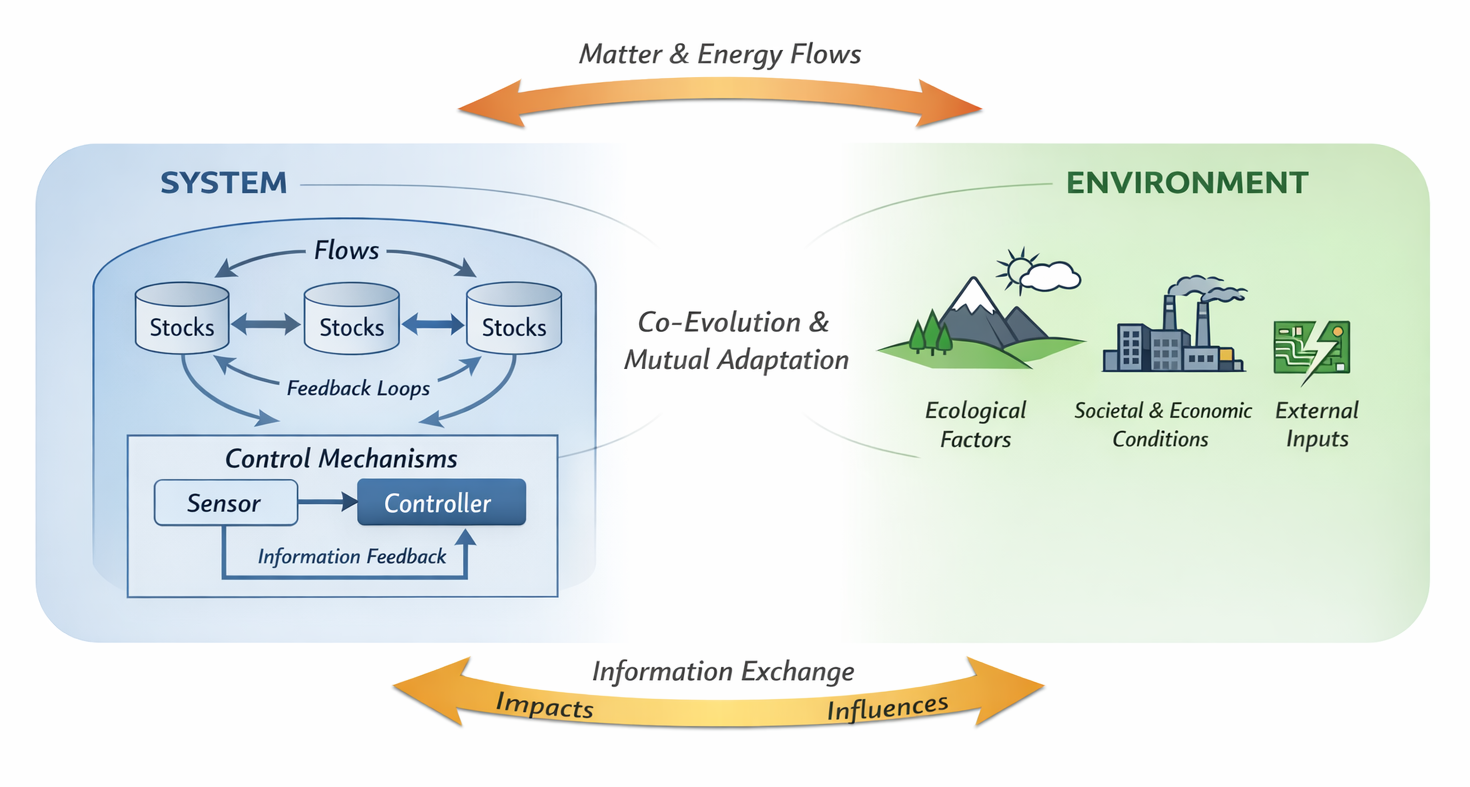
図1:システムと環境の結合ダイナミクス。(SEBoK オリジナル)
System Dynamics and Control
System dynamics and control examine how systems change over time and how feedback, interactions, and decision-making influence system behavior. Dynamic systems often exhibit patterns such as growth, delay, oscillation, adaptation, and unintended consequences that emerge through the relationships between system elements and their environments. Control mechanisms, whether automated, organizational, or human-driven, help systems maintain stability, respond to changing conditions, and pursue desired outcomes. Understanding these dynamics supports more effective analysis, prediction, and management of complex systems across engineering, natural, and socio-technical domains.
システムダイナミクスと制御は、システムが時間とともにどのように変化するのか、またフィードバック、相互作用、意思決定がシステムの振る舞いにどう影響するのかを扱う。動的システムはしばしば、成長、遅延、振動、適応、意図しない結果といったパターンを示し、これらはシステム要素とその環境との関係を通じて創発する。制御メカニズムは、自動化されたものであれ、組織的なものであれ、人間が主導するものであれ、システムが安定性を維持し、変化する条件に応答し、望ましい結果を追求するのを助ける。これらのダイナミクスを理解することは、工学、自然、社会技術の各領域にわたる複雑なシステムを、より効果的に分析、予測、管理するのに役立つ。
Acknowledgement
謝辞
This article reflects established knowledge from systems science and systems engineering, organized and collated for the SEBoK. Drafting support was provided by OpenAI’s ChatGPT, with all content reviewed and finalized by the author, who retains full responsibility.
本記事は、システム科学とシステムズエンジニアリングにおける確立された知識を、SEBoK 向けに整理・集約したものである。草稿作成には OpenAI の ChatGPT の支援を受けたが、すべての内容は著者がレビューして確定しており、著者が全責任を負う。
Systems exist within changing environments and must continually adapt in order to remain viable. System dynamics refers to the patterns of change that arise in systems through interactions among components, feedback processes, and environmental influences. Control refers to the mechanisms through which systems regulate these dynamics in order to maintain stability, achieve goals, or respond to disturbances.
システムは変化する環境の中に存在し、存続可能であり続けるためには絶えず適応しなければならない。システムダイナミクス(System dynamics)とは、構成要素間の相互作用、フィードバック過程、環境からの影響を通じてシステムに生じる変化のパターンを指す。制御(Control)とは、安定性の維持、目標の達成、あるいは撹乱への応答のために、システムがこれらのダイナミクスを調節するメカニズムを指す。
Understanding system dynamics and control is therefore fundamental to both systems science and systems engineering. System behavior rarely arises from simple linear cause-and-effect relationships; rather, it emerges from networks of interactions that may produce amplification, stabilization, oscillation, adaptation, or collapse (Meadows 2008; Sterman 2000).
したがって、システムダイナミクスと制御の理解は、システム科学とシステムズエンジニアリングの双方にとって基礎となる。システムの振る舞いが単純な線形の因果関係から生じることはまれであり、むしろ、増幅、安定化、振動、適応、あるいは崩壊を生み出し得る相互作用のネットワークから創発する(Meadows 2008; Sterman 2000)。
These behaviors occur across many domains, including biological regulation, ecological systems, economic systems, engineered infrastructures, and socio-technical systems. The study of system dynamics and control provides a foundation for understanding how systems maintain coherence while interacting with their environments.
こうした振る舞いは、生物学的調節、生態系、経済システム、人工インフラ、社会技術システムをはじめ、多くの領域で生じる。システムダイナミクスと制御の研究は、システムが環境と相互作用しながらどのように一貫性を維持するのかを理解するための基礎となる。
An explainer video is also provided here to support the introduction to the topic.
このトピックへの入門を支援するために、解説動画も https://youtu.be/PSaDCPyqn44 に提供されている。
System dynamics arises from interactions among system elements and between the system and its environment. These interactions generate flows of matter, energy, and information that evolve over time. Because of these interactions, systems often exhibit behaviors that cannot be understood solely by examining individual components.
A number of recurring dynamic patterns appear across many types of systems:
*Stabilizing behavior, where feedback processes maintain equilibrium *Amplifying behavior, where reinforcing processes drive growth or decline *Oscillatory behavior, where interactions produce cycles or rhythmic patterns *Adaptive behavior, where systems adjust to environmental change *Emergent behavior, where new structures or patterns arise from collective interactions
These patterns are widely observed in natural systems such as ecosystems, metabolic networks, and planetary processes, as well as in engineered systems such as power grids, transportation systems, and communication networks (Bertalanffy 1968; Sterman 2000).
In many cases, system behavior is best understood as the result of interacting feedback loops, rather than simple linear causation.
システムダイナミクスは、システム要素間の相互作用、およびシステムとその環境との間の相互作用から生じる。これらの相互作用は、時間とともに進化する物質、エネルギー、情報のフローを生み出す。こうした相互作用があるため、システムはしばしば、個々の構成要素を調べるだけでは理解できない振る舞いを示す。
多くの種類のシステムに共通して、繰り返し現れる動的パターンがいくつかある:
これらのパターンは、生態系、代謝ネットワーク、惑星プロセスといった自然システムにも、電力網、交通システム、通信ネットワークといったエンジニアード・システムにも広く見られる(Bertalanffy 1968; Sterman 2000)。
多くの場合、システムの振る舞いは、単純な線形の因果関係ではなく、相互作用するフィードバックループ(interacting feedback loops)の結果として捉えるのが最もよい。
Feedback is one of the most fundamental mechanisms underlying system dynamics. A feedback loop occurs when the output of a process influences the conditions that produced it (Ashby 1956; Wiener 1948).
フィードバックは、システムダイナミクスの根底にある最も基本的なメカニズムの1つである。フィードバックループ(feedback loop)は、あるプロセスの出力が、その出力を生み出した条件に影響を及ぼすときに生じる(Ashby 1956; Wiener 1948)。
Two major types of feedback are commonly observed.
フィードバックには、一般に2つの主要なタイプが見られる。
Reinforcing feedback amplifies change within a system. In these loops, an increase in one variable leads to further increases in the same direction.
Examples include:
*population growth in biological systems *viral spread in information networks *compound interest in financial systems
Reinforcing feedback can drive rapid growth or decline and is often associated with nonlinear change and tipping points (Meadows 2008).
強化フィードバックは、システム内の変化を増幅する。このループでは、ある変数の増加が、同じ方向へのさらなる増加をもたらす。
例としては次のようなものがある:
強化フィードバックは急速な成長や衰退をもたらし得るものであり、非線形の変化やティッピングポイントとしばしば関連する(Meadows 2008)。
Balancing feedback counteracts change and tends to stabilize a system around a target condition or equilibrium.
Examples include:
*temperature regulation in organisms *homeostasis in physiological systems *automatic control systems in engineering
Balancing feedback allows systems to maintain stability despite disturbances.
Most complex systems contain multiple interacting feedback loops, producing behaviors that are often difficult to anticipate without systemic analysis (Sterman 2000).
バランスフィードバックは変化を打ち消すように働き、システムを目標条件や平衡の近傍で安定させる傾向がある。
例としては次のようなものがある:
バランスフィードバックがあることで、システムは撹乱を受けても安定性を維持できる。
ほとんどの複雑なシステムは複数の相互作用するフィードバックループ(multiple interacting feedback loops)を含み、システム的な分析なしには予期しにくい振る舞いを生むことが多い(Sterman 2000)。
Systems do not exist in isolation. They are embedded within broader environments with which they continually interact. These interactions shape both the system and its environment over time.
システムは孤立して存在するわけではない。システムはより広い環境の中に組み込まれており、その環境と絶えず相互作用している。こうした相互作用は、時間とともにシステムとその環境の双方を形づくる。
Rather than treating systems as closed entities, systems science recognizes that systems and environments co-evolve through ongoing exchanges of matter, energy, and information. This relational perspective has roots in early systems thinking, including the work of Alexander Bogdanov, who emphasized that systems must be understood in terms of their interactions with surrounding processes (Bogdanov 1922/1980).
システム科学は、システムを閉じた実体として扱うのではなく、システムと環境が物質、エネルギー、情報の継続的な交換を通じて共進化することを認識している。この関係的な視点は、Alexander Bogdanov の研究をはじめとする初期のシステム思考に根ざしている。Bogdanov は、システムは周囲のプロセスとの相互作用という観点から理解されなければならないと強調した(Bogdanov 1922/1980)。
This insight has also been developed in ecological and social-ecological systems research, where systems and environments are viewed as coupled adaptive systems (Holling 2001; Ostrom 2009).
この洞察は、生態システムおよび社会・生態システムの研究においても発展してきた。そこでは、システムと環境は結合した適応システムとして捉えられる(Holling 2001; Ostrom 2009)。
Engineered systems likewise exhibit this coupling. Infrastructure systems interact with ecological conditions, social behavior, economic forces, and technological change. Similarly, digital platforms evolve through interactions with users and wider technological ecosystems.
エンジニアード・システムも同様にこの結合を示す。インフラシステムは、生態学的条件、社会的振る舞い、経済的な力、技術の変化と相互作用する。同様に、デジタルプラットフォームも、利用者やより広い技術エコシステムとの相互作用を通じて進化する。
Understanding system dynamics therefore requires attention not only to internal structure but also to the boundary interactions that connect systems with their environments.
したがって、システムダイナミクスを理解するには、内部構造だけでなく、システムをその環境と結びつける境界相互作用(boundary interactions)にも注意を払う必要がある。
図中の英語
Figure 1 illustrates the coupled dynamics between a system and its environment. The system contains interacting stocks, flows, and feedback loops that generate behavior over time. These internal dynamics are influenced by environmental conditions, which both constrain and are altered by system activity.
The figure highlights several important principles:
*systems contain internal feedback structures that regulate behavior *systems exchange matter, energy, and information with their environments *environmental conditions influence system dynamics *system activity can reshape environmental conditions over time
This bidirectional interaction reflects the view that systems and environments form interacting processes within a larger dynamic context, rather than independent entities.
図1は、システムとその環境との間の結合したダイナミクスを示している。システムは相互作用するストック、フロー、フィードバックループを含み、それらが時間の経過に伴う振る舞いを生み出す。これらの内部ダイナミクスは環境条件の影響を受ける。環境条件はシステムの活動を制約するとともに、その活動によって変化する。
この図は、いくつかの重要な原則を浮き彫りにしている:
このような双方向の相互作用は、システムと環境が独立した実体ではなく、より大きな動的コンテキストの中の相互作用するプロセス(interacting processes within a larger dynamic context)を形成するという見方を反映している。
Control refers to the processes by which systems regulate behavior in order to maintain coherence, achieve goals, or respond to changing conditions.
In natural systems, control mechanisms often emerge through evolutionary processes. Examples include:
*biological homeostasis *ecological regulation *neural control in organisms
These mechanisms allow living systems to maintain stability while adapting to environmental variation (Ashby 1956; Maturana and Varela 1980).
In engineered systems, control mechanisms are often deliberately designed. Examples include:
*feedback controllers in industrial processes *flight control systems in aircraft *traffic management systems in urban infrastructure
Modern engineering increasingly recognizes that control must often be distributed rather than centralized, particularly in large-scale systems such as networks, transportation systems, and socio-technical infrastructures.
制御とは、一貫性の維持、目標の達成、あるいは変化する条件への応答のために、システムが自らの振る舞いを調節するプロセスを指す。
自然システムでは、制御メカニズムはしばしば進化の過程を通じて創発する。例としては次のようなものがある:
これらのメカニズムによって、生命システムは環境の変動に適応しながら安定性を維持できる(Ashby 1956; Maturana and Varela 1980)。
エンジニアード・システムでは、制御メカニズムはしばしば意図的に設計される。例としては次のようなものがある:
現代の工学では、とりわけネットワーク、交通システム、社会技術インフラのような大規模システムにおいて、制御は中央集権化されるのではなく分散されなければならない(distributed rather than centralized)ことが多いと、ますます認識されるようになっている。
Many contemporary systems combine technological infrastructure, human behavior, and environmental processes. These social-ecological-technical systems exhibit complex dynamics that cannot be understood by examining any single domain alone.
Examples include:
*climate and energy systems *urban infrastructures *food and water systems *digital information ecosystems
In these contexts, system dynamics emerges from the interaction of:
*physical processes *technological capabilities *human decision-making *institutional structures
Research on complex adaptive systems and social-ecological systems has increasingly emphasized the importance of understanding these coupled dynamics when addressing large-scale societal challenges (Holland 1995; Ostrom 2009).
多くの現代のシステムは、技術インフラ、人間の振る舞い、環境プロセスを組み合わせたものである。こうした社会・生態・技術システム(social-ecological-technical systems)は、どれか単一の領域だけを調べても理解できない複雑なダイナミクスを示す。
例としては次のようなものがある:
こうしたコンテキストにおいて、システムダイナミクスは次のものの相互作用から創発する:
複雑適応システムや社会・生態システムに関する研究では、大規模な社会的課題に取り組む際に、こうした結合したダイナミクスを理解することの重要性がますます強調されてきた(Holland 1995; Ostrom 2009)。
For systems engineering, understanding system dynamics and control is essential for designing systems that are stable, adaptable, and resilient.
Engineered systems often operate within uncertain and evolving environments. Effective system design therefore requires attention to:
*feedback structures *dynamic interactions between components *system responses to disturbance *adaptation and learning over time
Model-based systems engineering (MBSE) and simulation tools increasingly support the analysis of system dynamics during design and operation. These approaches allow engineers to explore how feedback processes and environmental interactions influence system behavior across the system lifecycle (INCOSE 2023).
By incorporating dynamic thinking into system design, engineers can better anticipate unintended consequences and improve system resilience.
システムズエンジニアリングにとって、システムダイナミクスと制御の理解は、安定し、適応可能で、レジリエントなシステムを設計するうえで不可欠である。
エンジニアード・システムは、不確実で進化する環境の中で運用されることが多い。したがって、効果的なシステム設計には次の点への注意が必要である:
モデルベースシステムズエンジニアリング(MBSE)とシミュレーションツールは、設計時および運用時のシステムダイナミクスの分析をますます支えるようになっている。これらのアプローチにより、エンジニアは、フィードバック過程や環境との相互作用が、システムライフサイクル全体にわたってシステムの振る舞いにどう影響するかを探ることができる(INCOSE 2023)。
動的な思考をシステム設計に取り入れることで、エンジニアは意図しない結果をよりよく予期し、システムのレジリエンスを向上させることができる。
System dynamics and control depend fundamentally on flows of information and the organization of system structures. Feedback processes rely on the detection of system states and the transmission of signals that influence future behaviour.
システムダイナミクスと制御は、根本的には情報のフローとシステム構造の組織に依存している。フィードバック過程は、システム状態の検知と、将来の振る舞いに影響を与える信号の伝達に依拠している。
The next article, Information, Organisation, and Entropy, explores how information flows support the maintenance of system organization and how entropy-related processes influence system stability, adaptation, and transformation.
次の記事「Information, Organisation, and Entropy(情報、組織、エントロピー)」では、情報フローがシステム組織の維持をどのように支えるのか、またエントロピーに関連するプロセスがシステムの安定性、適応、変革にどのように影響するのかを探る。
Together, these concepts deepen understanding of how systems maintain coherence while evolving within changing environments.
これらの概念は相まって、システムが変化する環境の中で進化しながらどのように一貫性を維持するのかについての理解を深める。
Ashby, W. Ross. 1956. An Introduction to Cybernetics. London: Chapman & Hall.
Bertalanffy, Ludwig von. 1968. General System Theory: Foundations, Development, Applications. New York: George Braziller.
Bogdanov, Alexander. 1922/1980. Essays in Tektology: The General Science of Organization. Seaside, CA: Intersystems Publications.
Holland, John H. 1995. Hidden Order: How Adaptation Builds Complexity. Reading, MA: Addison-Wesley.
Holling, C. S. 2001. “Understanding the Complexity of Economic, Ecological, and Social Systems.” Ecosystems 4(5): 390–405.
INCOSE. 2023. Systems Engineering Handbook: A Guide for System Life Cycle Processes and Activities. 5th Edition.
Maturana, Humberto R., and Francisco J. Varela. 1980. Autopoiesis and Cognition: The Realization of the Living. Dordrecht: D. Reidel.
Meadows, Donella. 2008. Thinking in Systems: A Primer. White River Junction, VT: Chelsea Green.
Ostrom, Elinor. 2009. “A General Framework for Analyzing Sustainability of Social-Ecological Systems.” Science 325(5939): 419–422.
Sterman, John. 2000. Business Dynamics: Systems Thinking and Modeling for a Complex World. Boston: Irwin/McGraw-Hill.
Wiener, Norbert. 1948. Cybernetics: Or Control and Communication in the Animal and the Machine. Cambridge, MA: MIT Press.
None.
None.