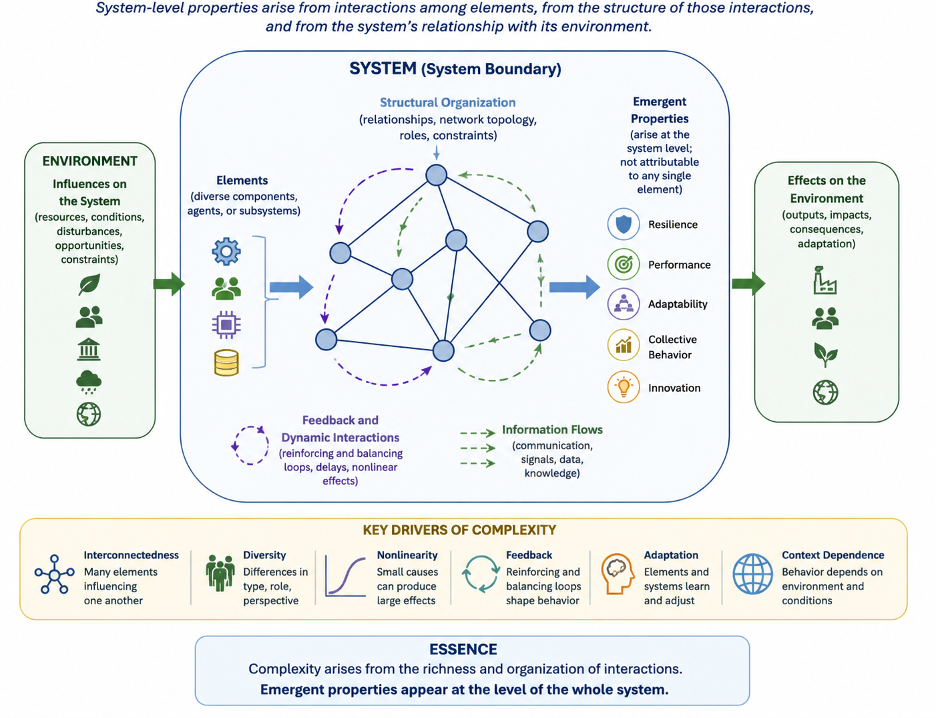
図1:システムにおける複雑性と創発。(SEBoK オリジナル)
Emergence and Complexity
Emerence and complexity describe how systems can exhibit behaviors, patterns, and outcomes that cannot be fully understood by examining individual parts in isolation. As interactions between components increase, systems often become less predictable, more adaptive, and more sensitive to relationships, context, and feedback. Complex systems may display nonlinearity, self-organization, adaptation, and unexpected emergent behaviors that arise from the interactions within the system as a whole. Understanding these dynamics is essential for systems thinking and systems engineering, particularly when working with large-scale, interconnected, or socio-technical systems.
創発と複雑性は、個々の部分を切り離して調べるだけでは完全には理解できないシステムが振る舞い、パターン、結果をどのように示し得るかを説明するものである。構成要素間の相互作用が増えるにつれて、システムはしばしば予測しにくくなり、より適応的になり、関係、コンテキスト、フィードバックに対してより敏感になる。複雑なシステムは、非線形性、自己組織化、適応、そしてシステム全体における相互作用から生じる予期しない創発的振る舞いを示すことがある。これらのダイナミクスを理解することは、システム思考とシステムズエンジニアリングにとって不可欠であり、大規模なシステムや相互接続されたシステム、社会技術システムを扱う際にはとりわけそうである。
Acknowledgement
謝辞
This article reflects established knowledge from systems science and systems engineering, organized and collated for the SEBoK. Drafting support was provided by OpenAI’s ChatGPT, with all content reviewed and finalized by the author, who retains full responsibility
本記事は、システム科学とシステムズエンジニアリングにおける確立した知識を、SEBoK のために整理し集約したものである。草稿の作成には OpenAI の ChatGPT による支援を受けており、すべての内容は著者がレビューして確定したもので、著者が全責任を負う。
This article forms part of the Systems Science knowledge area (KA). It examines the closely related concepts of complexity and emergence, which are fundamental to understanding how systems behave as organized wholes.
The preceding article, Structure, Identity, and Function in Systems, examined how systems maintain coherence through relationships among components, boundaries, organization, and functions. This article builds on that foundation by considering how complex behavior arises from such relationships. It prepares the ground for the following article, System Dynamics and Control, which examines how feedback processes and regulatory mechanisms shape system behavior over time.
Many systems cannot be fully understood by examining their components in isolation. Instead, system-level properties and behaviors arise from interactions among elements, from the structure of those interactions, and from the system’s relationship with its environment. These phenomena are central to systems science and have direct implications for systems engineering.
Early recognition of these issues can be traced to Warren Weaver’s distinction between problems of simplicity, disorganized complexity, and organized complexity. Organized complexity arises when many interacting elements form structured patterns of behavior that cannot be adequately understood through simple reduction or statistical aggregation alone (Weaver 1948).
Within this context:
*Complexity refers to the richness, diversity, and interdependence of relationships among system elements and between the system and its environment. *Emergence refers to system-level properties or behaviors that arise from these interactions and cannot be attributed to any single component.
Understanding complexity and emergence is essential for systems engineering, particularly when designing, integrating, and operating large-scale, adaptive, or socio-technical systems.
本記事は「システム科学(Systems Science)」知識領域(KA)の一部をなす。ここでは、互いに密接に関連する複雑性(complexity)と創発(emergence)という概念を検討する。これらは、システムが組織化された全体としてどのように振る舞うかを理解するうえで基礎となる概念である。
前の記事「Structure, Identity, and Function in Systems(システムにおける構造、アイデンティティ、機能)」では、システムが構成要素、境界、組織、機能の間の関係を通じてどのように一貫性を維持するかを検討した。本記事はその基礎を踏まえ、そうした関係から複雑な振る舞いがどのように生じるかを考察する。本記事は、続く記事「System Dynamics and Control(システムダイナミクスと制御)」の下地ともなる。同記事では、フィードバック過程と調節メカニズムが、時間の経過に伴うシステムの振る舞いをどのように形作るかを検討する。
多くのシステムは、その構成要素を切り離して調べるだけでは完全には理解できない。むしろ、システムレベルの特性と振る舞いは、要素間の相互作用から、それらの相互作用の構造から、そしてシステムとその環境との関係から生じる。これらの現象はシステム科学の中核にあり、システムズエンジニアリングにも直接的な含意を持つ。
こうした問題に対する初期の認識は、Warren Weaver による「単純性の問題」「無組織的複雑性の問題」「組織化された複雑性の問題」の区別にまでさかのぼることができる。組織化された複雑性は、相互作用する多数の要素が、単純な還元や統計的な集約だけでは十分に理解できない、構造化された振る舞いのパターンを形成するときに生じる(Weaver 1948)。
この文脈において:
複雑性と創発を理解することは、システムズエンジニアリングにおいて不可欠であり、大規模なシステムや適応的なシステム、社会技術システムを設計、統合、運用する際にはとりわけそうである。
このトピックに関する解説動画は、上の画像をクリックするか、[https://youtu.be/7DVagCT5_HA here] をクリック。
この図は原典のページに掲載されています。権利の都合により本サイトでは省略しています。原典で見る
Click the image above for an explainer video on this topic or click here .
System complexity arises from the number, diversity, organization, and interaction of system elements, and from the relationships between the system and its environment. It reflects the degree to which system behavior cannot be fully understood, predicted, or influenced simply from knowledge of individual components.
システムの複雑性は、システム要素の数、多様性、組織、相互作用から、そしてシステムとその環境との間の関係から生じる。複雑性は、個々の構成要素に関する知識だけでは、システムの振る舞いを完全には理解したり、予測したり、影響を与えたりできない度合いを反映する。
Complexity should not be understood only as an intrinsic property of a system considered in isolation. It is also relational: it depends on the system’s organization, its environmental coupling, the perspective and purpose of the observer, and the extent to which system behavior can be understood, anticipated, influenced, or controlled.
複雑性を、切り離して考えたシステムに内在する特性としてのみ理解すべきではない。複雑性は関係的なものでもある。すなわち、システムの組織、環境との結合、観察者の視点と目的、そしてシステムの振る舞いをどの程度理解し、予期し、影響を及ぼし、制御できるかに依存する。
A useful distinction is often made between complicated and complex systems.
込み入った(complicated)システムと複雑な(complex)システムは、しばしば有用な形で区別される。
Complicated systems may contain many components but behave in broadly predictable ways because the relationships among elements are stable and well understood. Many mechanical systems are complicated in this sense. They may be difficult to design, build, or maintain, but their behavior can often be decomposed, analyzed, and predicted.
込み入ったシステムは多くの構成要素を含むことがあるが、要素間の関係が安定していて十分に理解されているため、おおむね予測可能な振る舞いをする。多くの機械システムは、この意味で込み入っている。こうしたシステムは設計、構築、保守が難しい場合もあるが、その振る舞いは多くの場合、分解し、分析し、予測することができる。
Complex systems, by contrast, involve interactions that may be nonlinear, adaptive, evolving, or context dependent. Their behavior may change over time as elements interact with one another and with their environment. Ladyman, Lambert, and Wiesner (2013) emphasize that complex systems are typically characterized by multiple interacting parts, nonlinear relations, feedback, robustness, and emergent organization.
これに対して複雑なシステムには、非線形的、適応的、進化的、あるいはコンテキスト依存的であり得る相互作用が含まれる。その振る舞いは、要素どうしが、また要素と環境とが相互作用するにつれて、時間とともに変化し得る。Ladyman、Lambert、Wiesner(2013)は、複雑なシステムは典型的に、相互作用する複数の部分、非線形の関係、フィードバック、ロバストネス、創発的な組織によって特徴づけられると強調している。
The distinction between complicated and complex systems is useful, but should not be treated as absolute. Many engineered systems are complicated in their technical architecture while becoming complex in operation because of changing environments, human interaction, organizational coupling, lifecycle effects, or system-of-systems dependencies. A system may therefore be complicated in design, complex in use, and increasingly complex as it becomes embedded within wider operational and social contexts.
込み入ったシステムと複雑なシステムの区別は有用だが、絶対的なものとして扱うべきではない。多くのエンジニアード・システムは、技術アーキテクチャの面では込み入ったものだが、環境の変化、人間の相互作用、組織的な結合、ライフサイクルの影響、システム・オブ・システムズの依存関係といった要因によって、運用においては複雑になる。したがって、あるシステムが、設計においては込み入っており、利用においては複雑であり、より広い運用的・社会的コンテキストに組み込まれていくにつれてますます複雑になる、ということがあり得る。
Complexity often arises from several systemic characteristics:
複雑性はしばしば、次のようないくつかのシステム的特性から生じる:
• Interconnectedness — elements influence one another through networks of relationships.
• 相互接続性(Interconnectedness)——要素が関係のネットワークを通じて互いに影響し合う。
• Diversity — elements differ in structure, role, capability, or perspective.
• 多様性(Diversity)——要素どうしが構造、役割、能力、視点において異なる。
• Nonlinear interaction — small changes may produce disproportionate effects.
• 非線形の相互作用(Nonlinear interaction)——小さな変化が不釣り合いな効果を生むことがある。
• Feedback — reinforcing and balancing loops shape behavior over time.
• フィードバック(Feedback)——強化ループとバランスループが、時間とともに振る舞いを形作る。
• Adaptation — elements or systems adjust in response to internal or environmental change.
• 適応(Adaptation)——要素やシステムが、内部または環境の変化に応じて自らを調整する。
• Context dependence — behavior depends on the surrounding environment and conditions of operation.
• コンテキスト依存性(Context dependence)——振る舞いが周囲の環境と運用条件に依存する。
These characteristics are widely observed in ecosystems, economies, biological organisms, organizations, infrastructure systems, and many engineered systems. Holland (1995) and Mitchell (2009) show how complex adaptive behavior frequently arises when many interacting agents operate within networks and adapt to changing conditions.
これらの特性は、生態系、経済、生物、組織、インフラシステム、そして多くのエンジニアード・システムにおいて広く観察される。Holland(1995)と Mitchell(2009)は、相互作用する多数のエージェントがネットワーク内で活動し、変化する条件に適応するときに、複雑な適応的振る舞いが頻繁に生じることを示している。
From a systems engineering perspective, complexity may arise across several dimensions:
システムズエンジニアリングの観点から見ると、複雑性はいくつかの次元にわたって生じ得る:
• Structural complexity, related to the number and arrangement of elements and interfaces.
• 構造的複雑性(Structural complexity):要素とインタフェースの数と配置に関連する。
• Dynamic complexity, related to feedback, delays, and changing behavior over time.
• 動的複雑性(Dynamic complexity):フィードバック、遅延、時間とともに変化する振る舞いに関連する。
• Socio-technical complexity, arising from interactions among people, technologies, organizations, and institutions.
• 社会技術的複雑性(Socio-technical complexity):人々、技術、組織、制度の間の相互作用から生じる。
• Contextual complexity, arising from environmental uncertainty, stakeholder diversity, and changing operational conditions.
• コンテキスト的複雑性(Contextual complexity):環境の不確実性、ステークホルダーの多様性、運用条件の変化から生じる。
These dimensions often interact, making the behavior of complex systems difficult to predict or control through reductionist analysis alone. Sheard and Mostashari (2011) provide a systems engineering perspective on different types of complexity and how they affect engineering practice.
これらの次元はしばしば相互に作用し合い、そのため複雑なシステムの振る舞いを還元主義的な分析だけで予測したり制御したりすることは難しくなる。Sheard と Mostashari(2011)は、複雑性のさまざまなタイプと、それらがエンジニアリングの実践にどう影響するかについて、システムズエンジニアリングの観点からの見方を示している。
Emergence refers to properties or behaviors that arise at the level of the system as a whole and cannot be attributed to any individual component.
創発とは、システム全体のレベルで生じ、個々の構成要素のいずれにも帰属させることのできない特性や振る舞いを指す。
Emergent properties are meaningful only when the system is considered as an organized whole. Checkland describes emergence as the principle that entities exhibit properties that are meaningful when attributed to the whole, not to its parts (Checkland 1999). In systems science, emergence is closely associated with holism, interaction, organization, and system context.
創発的特性は、システムを組織化された全体として捉えるときにのみ意味を持つ。Checkland は、創発を、実体が、その部分ではなく全体に帰属させるときに意味を持つ特性を示すという原則として記述している(Checkland 1999)。システム科学では、創発は全体性(ホーリズム)、相互作用、組織、システムコンテキストと密接に関連している。
Examples of emergence include:
創発の例としては、次のようなものがある:
• chemical compounds exhibiting properties different from their constituent elements
• 構成要素である元素とは異なる特性を示す化合物
• coordinated movement in animal groups arising from local interactions
• 局所的な相互作用から生じる、動物の群れの協調した動き
• consciousness arising from networks of neurons
• ニューロンのネットワークから生じる意識
• traffic patterns emerging from interactions among drivers, vehicles, and infrastructure.
• 運転者、車両、インフラの間の相互作用から創発する交通パターン
• resilience or adaptability emerging from the organization of a socio-technical system
• 社会技術システムの組織から創発するレジリエンスや適応性
Many important properties of engineered systems are also emergent. These include performance, safety, reliability, resilience, usability, interoperability, and mission effectiveness. Such properties arise from the combined effects of architecture, component behavior, human use, operational context, and environmental conditions.
エンジニアード・システムの多くの重要な特性もまた創発的である。これには、性能、安全性、信頼性、レジリエンス、ユーザビリティ、相互運用性、ミッション有効性が含まれる。こうした特性は、アーキテクチャ、構成要素の振る舞い、人間による利用、運用コンテキスト、環境条件が複合的に作用した結果として生じる。
Emergence is therefore not only a theoretical concept. It is central to systems engineering because many of the properties that matter most to stakeholders exist only at the whole-system level.
したがって創発は、単なる理論上の概念ではない。創発はシステムズエンジニアリングの中核をなす。なぜなら、ステークホルダーにとって最も重要な特性の多くは、全体システムのレベルでのみ存在するからである。
At the same time, emergence should not be treated as a mysterious or non-scientific phenomenon. Abbott (2006) argues that emergence can be understood without assuming that higher-level phenomena violate physical explanation. This view is important for systems engineering: emergent behavior may be difficult to predict or manage, but it is still produced through interactions among real components, structures, processes, and environments
同時に、創発を神秘的な現象や非科学的な現象として扱うべきではない。Abbott(2006)は、高次の現象が物理的説明に反すると仮定しなくても、創発は理解できると論じている。この見方はシステムズエンジニアリングにとって重要である。創発的振る舞いは予測や管理が難しいことがあるが、それでもやはり、実在する構成要素、構造、プロセス、環境の間の相互作用によって生み出されるのである。
Several forms of emergence have been described in the systems and complexity literature (Emmeche, Koppe, and Stjernfelt 1997; Bedau and Humphreys 2008). A useful distinction for systems engineering can be made between simple, weak, and strong emergence.
システムと複雑性に関する文献では、創発のいくつかの形態が記述されてきた(Emmeche, Koppe, and Stjernfelt 1997; Bedau and Humphreys 2008)。システムズエンジニアリングにとっては、単純な(simple)創発、弱い(weak)創発、強い(strong)創発を区別するのが有用である。
Simple Emergence
単純な創発(Simple Emergence)
Simple emergence occurs when system-level properties arise from combinations of elements and relationships that are sufficiently well understood to be predicted.
単純な創発は、予測が可能なほど十分に理解された要素と関係の組み合わせから、システムレベルの特性が生じる場合に起こる。
For example, the aerodynamic lift generated by an aircraft arises from interactions among aerodynamic surfaces, propulsion systems, control systems, and airflow. Although lift is a system-level property, it can be analyzed using established physical principles and engineering models.
例えば、航空機が生み出す空気力学的揚力は、空力面、推進システム、制御システム、気流の間の相互作用から生じる。揚力はシステムレベルの特性だが、確立された物理原理と工学モデルを用いて分析できる。
In engineered systems, many system-level performance measures can be understood as forms of simple emergence when their contributing factors are well characterized.
エンジニアード・システムでは、多くのシステムレベルの性能測定量は、それに寄与する要因が十分に特徴づけられている場合、単純な創発の一形態として理解できる。
Weak Emergence
弱い創発(Weak Emergence)
Weak emergence occurs when system-level behavior arises from interactions among components but cannot be predicted directly from component properties alone. Such behavior may require simulation, modeling, experimentation, or operational observation to understand.
弱い創発は、システムレベルの振る舞いが構成要素間の相互作用から生じるものの、構成要素の特性だけからは直接予測できない場合に起こる。そのような振る舞いを理解するには、シミュレーション、モデリング、実験、あるいは運用中の観察が必要となることがある。
Examples include:
例としては、次のようなものがある:
• traffic congestion patterns
• 交通渋滞のパターン
• collective behavior in animal groups
• 動物の群れにおける集合行動
• market behavior
• 市場の振る舞い
• organizational performance
• 組織のパフォーマンス
• distributed behavior in complex software or networked systems
• 複雑なソフトウェアやネットワーク化されたシステムにおける分散した振る舞い
Weak emergence is especially important in systems engineering because it can often be explored through modeling, simulation, prototyping, and iterative development. Page (2009) discusses emergence and complexity in ways that support this practical distinction between behavior that can be analytically derived and behavior that must be explored through models or observation.
弱い創発は、モデリング、シミュレーション、プロトタイピング、反復的な開発を通じて探求できることが多いため、システムズエンジニアリングにおいて特に重要である。Page(2009)は、分析的に導出できる振る舞いと、モデルや観察を通じて探求しなければならない振る舞いとの間のこの実践的な区別を支持する形で、創発と複雑性を論じている。
Strong Emergence
強い創発(Strong Emergence)
Strong emergence refers to unexpected system-level behavior that is not anticipated during design or analysis and may only become visible during integration, testing, or operation.
強い創発とは、設計や分析の段階では予期されず、統合、テスト、あるいは運用の段階になって初めて表面化することがある、予期しないシステムレベルの振る舞いを指す。
Strong emergence is common in systems of systems, where independently developed systems interact in new operational contexts. Examples include cascading failures in power grids, unexpected interactions between digital platforms, or unintended consequences in large-scale infrastructure systems.
強い創発はシステム・オブ・システムズにおいてよく見られる。そこでは、独立に開発されたシステムどうしが、新たな運用コンテキストの中で相互作用する。例としては、電力網における連鎖的障害、デジタルプラットフォーム間の予期しない相互作用、大規模インフラシステムにおける意図しない結果がある。
Strong emergence may be beneficial or harmful. It can produce innovation, adaptability, and new capability, but it can also generate instability, failure, or unacceptable risk.
強い創発は、有益な場合もあれば有害な場合もある。イノベーション、適応性、新たな能力を生み出し得る一方で、不安定性、障害、あるいは許容できないリスクを生み出すこともある。
Ryan (2007) argues that emergence is coupled to scope rather than simply to hierarchical level. This is important for systems engineering because emergent properties depend on how the system of interest, its boundaries, its environment, and the purpose of inquiry are defined. A property may appear emergent when one scope is selected but become explainable when a broader or different scope is considered.
Ryan(2007)は、創発は単に階層レベルにではなく、範囲(スコープ)に結びついていると論じている。これがシステムズエンジニアリングにとって重要なのは、創発的特性が、対象システム、その境界、その環境、そして探究の目的をどう定義するかに依存するからである。ある特性は、1つの範囲を選んだときには創発的に見えても、より広い範囲や異なる範囲で考えると説明可能になることがある。
Emergence, Self-Organization, and Adaptation
創発、自己組織化、適応(Emergence, Self-Organization, and Adaptation)
Many emergent phenomena arise through self-organization, in which system structure or behavior develops through interactions among elements rather than through centralized control.
多くの創発的現象は自己組織化(self-organization)を通じて生じる。自己組織化とは、システムの構造や振る舞いが、中央集権的な制御によってではなく、要素間の相互作用を通じて形成されていくことである。
Self-organization is observed in many natural systems, including biological development, ecosystem dynamics, flocking behavior, and neural pattern formation. It is also increasingly relevant in engineered and socio-technical systems, including distributed computing, autonomous systems, adaptive networks, and collaborative organizations.
自己組織化は、生物学的発達、生態系のダイナミクス、群れ行動、神経のパターン形成など、多くの自然システムで観察される。また、分散コンピューティング、自律システム、適応的ネットワーク、協働的組織など、エンジニアード・システムや社会技術システムにおいても、ますます関連性を増している。
Research in thermodynamics and nonlinear systems has shown that ordered structures can emerge in systems operating far from equilibrium (Nicolis and Prigogine 1977). In such systems, flows of energy, matter, or information can sustain organized patterns that would not exist in equilibrium conditions.
熱力学と非線形システムの研究は、平衡から遠く離れた状態で動作するシステムにおいて、秩序構造が創発し得ることを示してきた(Nicolis and Prigogine 1977)。そのようなシステムでは、エネルギー、物質、情報の流れによって、平衡条件では存在しない組織化されたパターンが維持され得る。
Complex adaptive systems research has further shown how adaptation can arise when interacting agents adjust their behavior in response to experience and changing environments (Holland 1995; Mitchell 2009). Such systems may evolve new patterns of organization over time.
複雑適応システムの研究はさらに、相互作用するエージェントが経験と変化する環境に応じて自らの振る舞いを調整するときに、適応がどのように生じ得るかを示してきた(Holland 1995; Mitchell 2009)。そのようなシステムは、時間とともに新たな組織パターンを進化させ得る。
For systems engineering, these insights are important because modern engineered systems increasingly operate within adaptive environments involving human behavior, organizational learning, digital technologies, and environmental change.
システムズエンジニアリングにとって、これらの知見は重要である。なぜなら現代のエンジニアード・システムは、人間の振る舞い、組織学習、デジタル技術、環境変化を含む適応的な環境の中で運用されることがますます多くなっているからである。
Complexity and emergence can be understood through the interaction of several fundamental dimensions of systems:
複雑性と創発は、システムのいくつかの基本的な次元の相互作用を通じて理解することができる:
• Structural organization — how system elements are arranged and related.
• 構造的組織(Structural organization)——システム要素がどのように配置され、関係づけられているか。
• Dynamic behavior — how elements interact and change over time.
• 動的振る舞い(Dynamic behavior)——要素がどのように相互作用し、時間とともに変化するか。
• Information and control — how signals, feedback, and constraints influence behavior.
• 情報と制御(Information and control)——信号、フィードバック、制約がどのように振る舞いに影響するか。
• Environmental context — how surrounding conditions affect the system and are affected by it.
• 環境コンテキスト(Environmental context)——周囲の条件がシステムにどのように影響し、またシステムからどのように影響を受けるか。
Emergent properties arise from the interaction of these dimensions. Structural arrangements enable and constrain interactions. Dynamic processes generate patterns of behavior over time. Information and feedback support coordination, regulation, and adaptation. Environmental influences shape how systems respond and evolve.
創発的特性は、これらの次元の相互作用から生じる。構造的な配置は、相互作用を可能にすると同時に制約する。動的プロセスは、時間とともに振る舞いのパターンを生み出す。情報とフィードバックは、調整、調節、適応を支える。環境からの影響は、システムがどのように応答し進化するかを形作る。
This relationship is important across the Systems Science KA. Complexity and emergence provide a bridge between:
この関係は、システム科学 KA 全体を通じて重要である。複雑性と創発は、次のものの間の橋渡しとなる:
• the structure and identity of systems
• システムの構造とアイデンティティ
• the dynamics and feedback processes that shape behavior
• 振る舞いを形作るダイナミクスとフィードバック過程
• the information flows that sustain organization
• 組織を維持する情報フロー
• the multi-level structures through which systems evolve
• システムが進化する多レベル構造
In this sense, emergence is not an isolated phenomenon. It is a consequence of organized interaction within and across systems.
この意味で、創発は孤立した現象ではない。それは、システム内部およびシステム間における組織化された相互作用の帰結である。
Work in relational systems theory, including Rosen’s account of living systems, further emphasizes that some systems cannot be fully understood only as collections of components; the organization of relations is central to their identity and behavior (Rosen 1991). This reinforces the importance of studying system organization, not only system parts.
Rosen による生命システムの記述を含む関係システム理論の研究はさらに、一部のシステムは構成要素の集合としてだけでは完全には理解できず、関係の組織がそのアイデンティティと振る舞いの中心にあることを強調している(Rosen 1991)。これは、システムの部分だけでなく、システムの組織を研究することの重要性を補強するものである。
図中の英語
System-level properties arise from interactions among elements, from the structure of those interactions, and from the system’s relationship with its environment. Complexity increases when relationships are numerous, diverse, nonlinear, adaptive, or context dependent. Emergent behavior appears at the level of the system as a whole and may be anticipated, explored, or discovered through analysis, modeling, experimentation, and operational learning.
システムレベルの特性は、要素間の相互作用から、それらの相互作用の構造から、そしてシステムとその環境との関係から生じる。関係が多数、多様、非線形、適応的、あるいはコンテキスト依存であるとき、複雑性は増大する。創発的振る舞いはシステム全体のレベルに現れ、分析、モデリング、実験、運用を通じた学習によって、予期したり、探求したり、発見したりできることがある。
Modern engineered systems frequently operate within complex socio-technical environments and interact with other systems. As a result, system behavior often cannot be completely predicted during design.
現代のエンジニアード・システムは、複雑な社会技術的環境の中で運用され、他のシステムと相互作用することが多い。その結果、システムの振る舞いを設計段階で完全に予測することは、多くの場合できない。
Systems engineering approaches therefore seek to manage complexity and emergence through techniques such as:
したがって、システムズエンジニアリングのアプローチは、次のような技法を通じて複雑性と創発を管理しようとする:
• architectural design and modularization
• アーキテクチャ設計とモジュール化
• interface management
• インタフェース管理
• modeling and simulation
• モデリングとシミュレーション
• iterative development and experimentation
• 反復的な開発と実験
• prototyping and test environments
• プロトタイピングとテスト環境
• stakeholder engagement and socio-technical analysis
• ステークホルダーエンゲージメントと社会技術的分析
• monitoring and adaptation during operation
• 運用中の監視と適応
• learning from patterns across multiple systems
• 複数のシステムにわたるパターンからの学習
Simulation and modeling are particularly important for exploring potential emergent behaviors before deployment. However, some emergent behaviors can only be understood through operational experience.
シミュレーションとモデリングは、展開前に潜在的な創発的振る舞いを探るうえで特に重要である。しかし、運用経験を通じてしか理解できない創発的振る舞いもある。
Over time, successful patterns of system architecture and design can be captured and applied to future systems. Hybertson (2009) emphasizes the importance of model-oriented systems engineering knowledge, in which patterns learned from multiple systems can support future design and analysis.
時間の経過とともに、成功したシステムアーキテクチャや設計のパターンを捉え、将来のシステムに適用することができる。Hybertson(2009)は、モデル指向のシステムズエンジニアリング知識の重要性を強調している。そこでは、複数のシステムから学んだパターンが、将来の設計と分析を支援し得る。
Research into recurring patterns across complex systems, including work by Troncale on systems isomorphies, suggests that many systemic processes appear across diverse domains of science (Troncale 1985). Recognizing such patterns may help systems engineers anticipate common mechanisms underlying complexity and emergence.
Troncale のシステム同型性(systems isomorphies)に関する研究を含む、複雑なシステムにわたって繰り返し現れるパターンの研究は、多くのシステム的プロセスが科学の多様な領域にまたがって現れることを示唆している(Troncale 1985)。こうしたパターンを認識することは、システムズエンジニアが複雑性と創発の根底にある共通のメカニズムを予期する助けとなり得る。
For systems engineers, the practical challenge is not to eliminate emergence. Many desirable system properties are emergent. The challenge is to increase the likelihood of desirable emergence while reducing the likelihood and impact of harmful or unexpected emergence.
システムズエンジニアにとっての実践的な課題は、創発を排除することではない。望ましいシステム特性の多くは創発的である。課題は、望ましい創発を起こりやすくしつつ、有害な創発や予期しない創発の起こりやすさと影響を抑えることである。
Sillitto (2010) emphasizes the importance of design principles for ultra-large-scale systems, where interactions among many independently evolving elements may create both opportunities and risks. This reinforces the need for systems engineering approaches that combine architecture, modeling, iteration, operational learning, and systemic judgement.
Sillitto(2010)は、超大規模システムのための設計原則の重要性を強調している。そうしたシステムでは、独立に進化する多数の要素間の相互作用が、機会とリスクの両方を生み出し得る。このことは、アーキテクチャ、モデリング、反復、運用を通じた学習、システム的判断を組み合わせたシステムズエンジニアリングのアプローチが必要であることを補強する。
Complexity and emergence are central characteristics of many natural, social, and engineered systems. Complexity arises from the organization and interaction of diverse system elements within changing environments. Emergence refers to system-level properties and behaviors that arise from those interactions.
複雑性と創発は、多くの自然システム、社会システム、エンジニアード・システムの中核的な特性である。複雑性は、変化する環境の中で、多様なシステム要素の組織と相互作用から生じる。創発とは、そうした相互作用から生じるシステムレベルの特性や振る舞いを指す。
Understanding complexity and emergence is essential for systems engineering practice, particularly when addressing large-scale, adaptive, or socio-technical systems. Many properties that matter most to stakeholders, including resilience, safety, adaptability, usability, and mission effectiveness, exist only at the level of the whole system.
複雑性と創発を理解することは、システムズエンジニアリングの実践において不可欠であり、大規模なシステムや適応的なシステム、社会技術システムに対処する際にはとりわけそうである。レジリエンス、安全性、適応性、ユーザビリティ、ミッション有効性をはじめ、ステークホルダーにとって最も重要な特性の多くは、全体システムのレベルでのみ存在する。
By recognizing how interactions among structure, dynamics, information, and environment produce emergent outcomes, systems engineers can better design architectures, explore system behavior, anticipate unintended consequences, and support systems that remain viable under conditions of complexity and change.
構造、ダイナミクス、情報、環境の間の相互作用がどのようにして創発的な結果を生み出すかを認識することで、システムズエンジニアは、アーキテクチャをよりよく設計し、システムの振る舞いを探求し、意図しない結果を予期し、複雑性と変化という条件のもとでも存続可能であり続けるシステムを支援することができる。
The following article, System Dynamics and Control, examines how feedback processes and regulatory mechanisms shape such behavior over time.
続く記事「System Dynamics and Control(システムダイナミクスと制御)」では、フィードバック過程と調節メカニズムが、こうした振る舞いを時間とともにどのように形作るかを検討する。
Abbott, R. 2006. “Emergence Explained: Getting Epiphenomena to Do Real Work.” Complexity 12(1): 13–26.
Ashby, W. R. 1956. An Introduction to Cybernetics. London, UK: Chapman & Hall.
Bedau, M. A., and P. Humphreys, eds. 2008. Emergence: Contemporary Readings in Philosophy and Science. Cambridge, MA, USA: MIT Press.
Bertalanffy, L. von. 1968. General System Theory: Foundations, Development, Applications. New York, NY, USA: Braziller.
Checkland, P. 1999. Systems Thinking, Systems Practice. Chichester, UK: Wiley.
Emmeche, C., S. Koppe, and F. Stjernfelt. 1997. “Explaining Emergence: Towards an Ontology of Levels.” Journal for General Philosophy of Science 28(1): 83–119.
Holland, J. H. 1995. Hidden Order: How Adaptation Builds Complexity. Reading, MA, USA: Addison-Wesley.
Hybertson, D. 2009. Model-Oriented Systems Engineering Science: A Unifying Framework for Traditional and Complex Systems. Boca Raton, FL, USA: CRC Press.
Ladyman, J., J. Lambert, and K. Wiesner. 2013. “What Is a Complex System?” European Journal for Philosophy of Science 3: 33–67.
Meadows, D. H. 2008. Thinking in Systems: A Primer. White River Junction, VT, USA: Chelsea Green.
Mitchell, M. 2009. Complexity: A Guided Tour. Oxford, UK: Oxford University Press.
Nicolis, G., and I. Prigogine. 1977. Self-Organization in Nonequilibrium Systems. New York, NY, USA: Wiley.
Page, S. E. 2009. Understanding Complexity. Chantilly, VA, USA: The Teaching Company.
Rosen, R. 1991. Life Itself: A Comprehensive Inquiry Into the Nature, Origin, and Fabrication of Life. New York, NY, USA: Columbia University Press.
Ryan, A. J. 2007. “Emergence Is Coupled to Scope, Not Level.” Complexity 13(2): 67–77.
Sheard, S. A., and A. Mostashari. 2011. “Complexity Types: From Science to Systems Engineering.” INCOSE International Symposium.
Sillitto, H. G. 2010. “Design Principles for Ultra-Large-Scale Systems.” Proceedings of the 20th Annual INCOSE International Symposium.
Simon, H. A. 1962. “The Architecture of Complexity.” Proceedings of the American Philosophical Society 106(6): 467–482.
Troncale, L. R. 1985. “On the Possible Order of Systems Isomorphies.” General Systems 30: 179–188.
Weaver, W. 1948. “Science and Complexity.” American Scientist 36(4): 536–544.