人工知能(AI)を主要な要素とするシステムが数多く検討されている。AI要素の故障はシステムの故障につながりうる(Dreossi et al 2017)ため、AIの検証と妥当性確認(verification and validation, V&V)が必要となる。AI能力を含む要素はサブシステムとして扱われ、他のサブシステムと同様に、そのサブシステム自体と、研究対象のシステムの他の要素とのインタフェースに対してV&Vが実施される。つまり、1つ以上のAI要素を含むシステムであっても、V&Vの上位レベルの定義は変わらない。
しかし、AIのV&Vの課題には、従来型あるいは伝統的な(AI要素を持たない)システム向けのものを超えるアプローチと解決策が必要である。本記事では、機械学習コンポーネント/サブシステムがシステムズエンジニアリングのフレームワークにどのように「適合」するかを概観し、V&Vに課題をもたらすAIサブシステムの特性を特定して、それらの課題を明らかにするとともに、AIサブシステムのV&Vにおける未解決あるいは継続中の研究領域に触れつつ、いくつかの潜在的な解決策を示す。
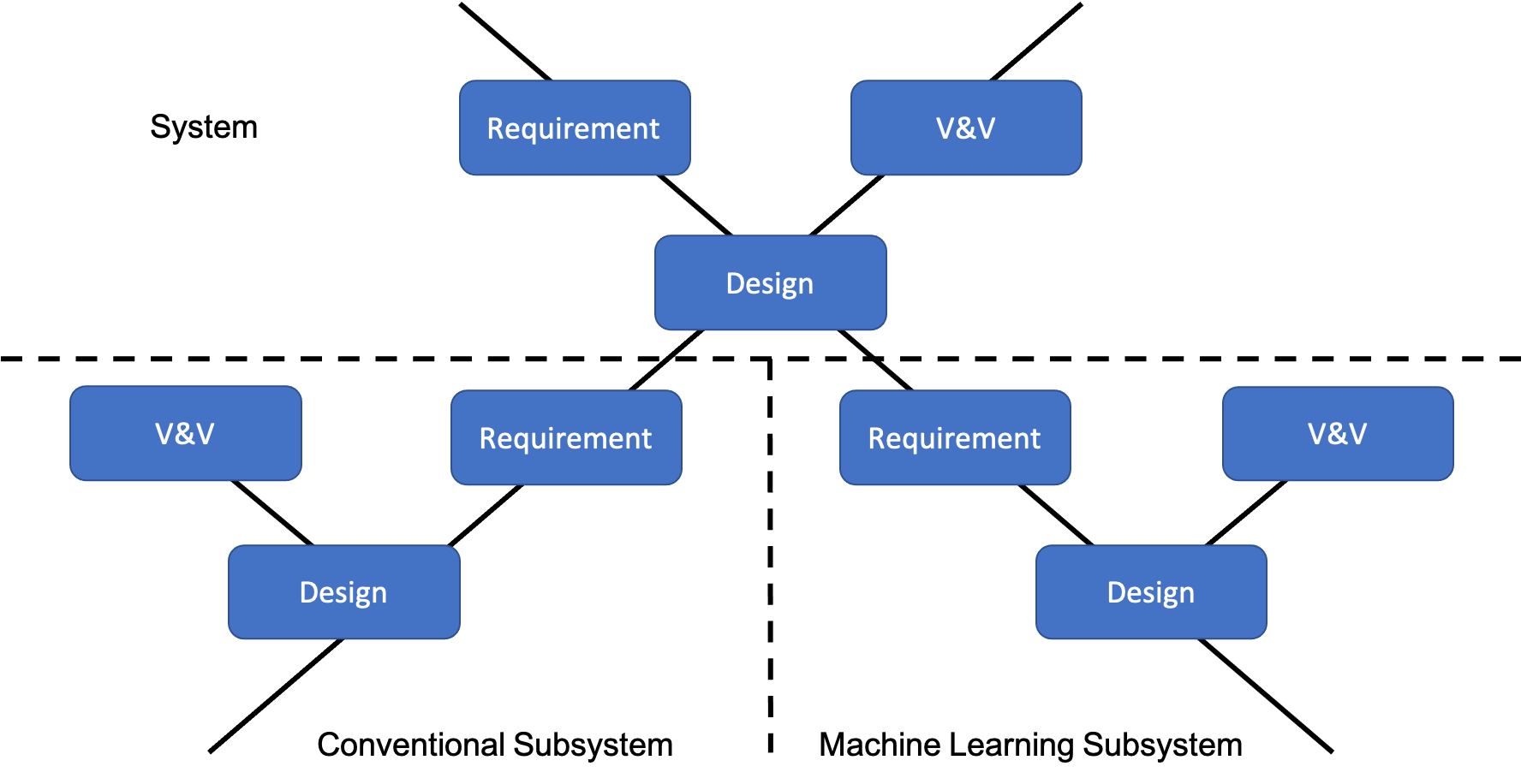
従来型システムは、要求、設計、V&Vという3つの包括的なフェーズを通じてエンジニアリングされる。これらのフェーズは、各サブシステムと研究対象のシステムのそれぞれに適用される。図1に示すように、これはサブシステムがAI技術に基づく場合でも変わらない。
図中の英語
AIベースシステムは、伝統的なシステムとは異なるライフサイクルをたどる。図2に示す一般的な機械学習ライフサイクルのとおり、V&V活動はライフサイクル全体を通じて行われる。(従来型サブシステムの場合と同様に)AIサブシステムに割り当てられる要求事項に加えて、AIサブシステムから上位のシステムへ渡されるデータに対する要求事項も存在しうる。
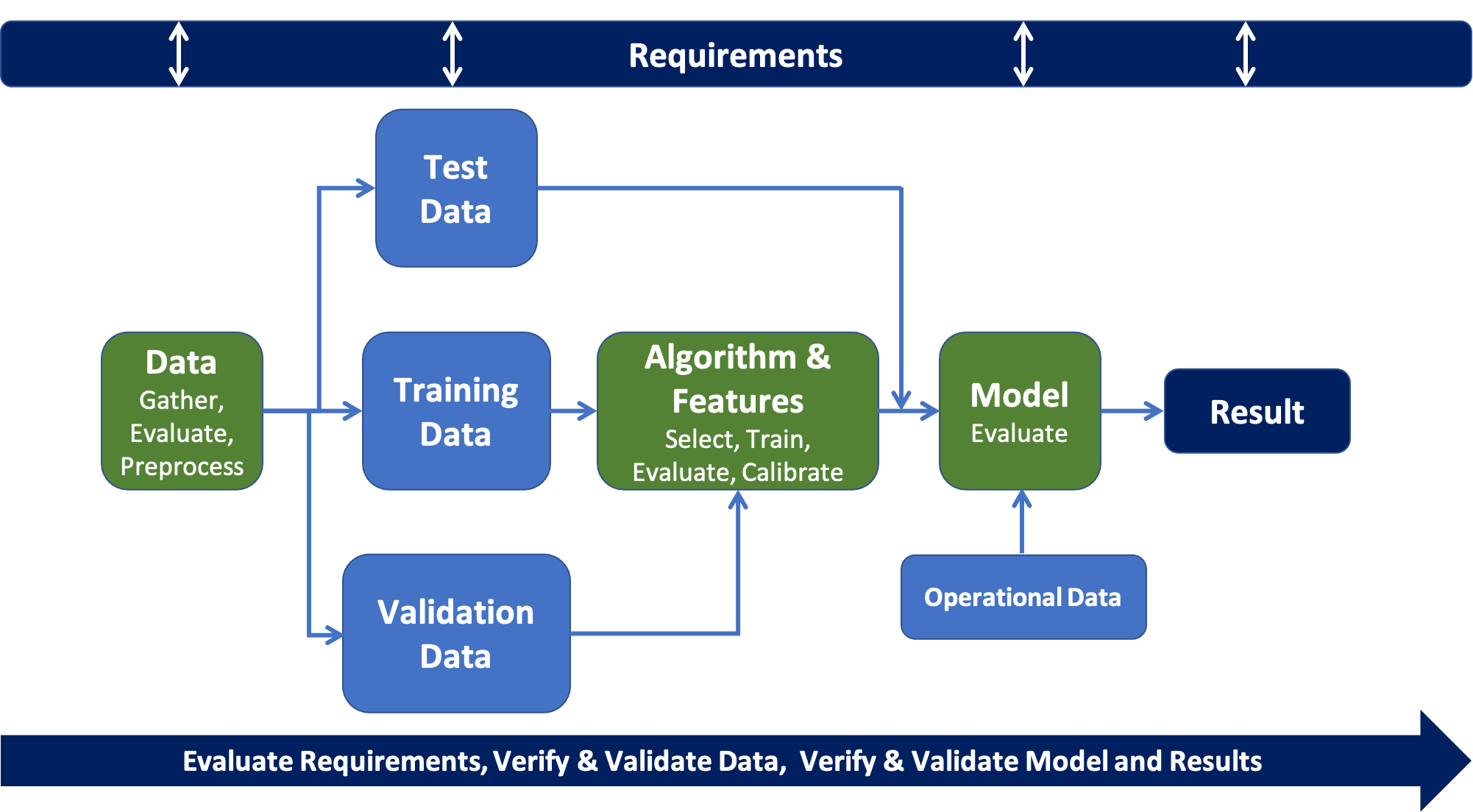
図中の英語
従来型システムのV&Vの一部の側面はそのまま使用できるが、AIサブシステムには、その検証と妥当性確認に課題をもたらす重要な特性がある。Ishikawa and Yoshioka (2019) は、エンジニアを対象とした調査において、機械学習のエンジニアリングを困難にしている機械学習の属性を特定している。調査対象のエンジニアによれば、上位の属性とエンジニアのコメントの要約は以下のとおりである:
これらはAIそのものを特徴づける属性であり、以下のように一般化できる:
AI要求事項とAI要求工学に関する課題は多岐にわたり、その一部は、AI要素を「ブラックボックス」として扱う一部の実践に起因する(Gunning 2016)。形式仕様化も試みられてきたが、形式化が困難なタスクについては難しいことが明らかになっており、また定量的仕様あるいはブール仕様の使用、およびデータと形式的要求事項の使用に関する意思決定が必要となる。ここでの課題は、AIベースあるいはMLベースのコンポーネントを使用するシステムについて、望ましい特性と望ましくない特性の両方を仕様化する効果的な方法を設計することである(Seshia 2020)。
Belani ら(2019)が概説したAI要求工学の課題のタクソノミーを表1に示す。
表1:AIのための要求工学(RE4AI)タクソノミー、課題とAI関連エンティティおよび要求工学アクティビティとの対応付け((Belani et al., 2019) に基づく)
| RE4AI | AI関連エンティティ | ||
|---|---|---|---|
| REアクティビティ | データ | モデル | システム |
| 抽出 | 大規模データセットの利用可能性、要求アナリストのアップグレード | ドメイン知識の不足、明示されていないモデルの利用者 | 問題/スコープの定義方法、規制(例:倫理)が不明確 |
| 分析 | 不均衡なデータセット、サイロ、役割:データサイエンティストが必要 | 自明なワークフローがない、自動化ツールが必要 | 最終結果の統合がない、役割:ビジネスアナリストのアップグレード |
| 仕様化 | データのラベリングは高コストで必要、役割:データエンジニアが必要 | エンドツーエンドのパイプライン支援がない、実用最小限のモデルが有用 | 設計のアンチパターンを避ける、コグニティブ/システムアーキテクトが必要 |
| 妥当性確認 | 訓練データの批判的分析、データの依存関係 | 絡み合い、CACE問題、MLのスケーラビリティに関する大きな課題 | デバッグ、解釈可能性、隠れたフィードバックループ |
| 管理 | 実験管理、GOREのような手法が洗練されていない | ログ記録と再現が困難、AIのためのDevOpsの役割が必要 | ITリソースの制約、コスト、性能の測定 |
| 文書化 | データとモデルの可視化、役割:リサーチサイエンティストが有用 | データセットとモデルのバージョン、スタッフの教育と訓練 | エンドユーザーからのフィードバック、開発手法 |
| 上記の全て | データプライバシーとデータ安全性、データの依存関係 |
CACE:change anything, change everything(何かを変更すれば、すべてが変わる)
GORE:goal-oriented requirements engineering(目標指向要求工学)
データはAIモデルの訓練と評価に用いられ、その能力を生み出すものであることから、AI能力の生命線である。AIにとって重要なデータ品質の属性には、正確さ、最新性と適時性、正しさ、一貫性に加えて、使用可能性、セキュリティとプライバシー、アクセス可能性、説明責任、スケーラビリティ、バイアスの欠如などが含まれる。前述のとおり、教師なし手法の正しさは訓練データと環境の中に組み込まれている。
訓練データが運用空間をどの程度カバーしているかという問題がある。データが運用空間を十分にカバーしていなければ、AIコンポーネントの振る舞いは疑わしいものとなる。しかし、データセットがどの時点で「十分に大きい」と言えるかについて、強い保証はない。加えて、「大きい」だけでは十分ではない。データは運用空間を十分にカバーしていなければならない。
データに関するもう1つの課題は、敵対的入力である。Szegedy et al. (2014) は、いくつかのMLモデルが敵対的サンプルに対して脆弱であることを発見した。このことは画像分類ソフトウェアで繰り返し示されてきたが、敵対的攻撃は他のAIタスク(例えば自然言語処理)に対しても、また強化学習(例えば報酬ハッキング)モデルのような、(通常は画像分類に使用される)ニューラルネットワーク以外の技術に対しても行われうる。
モデルの領域では多数のV&Vの課題が生じる。その一部を以下に示す。
AIシステムを信頼できるようにするには、トランストワージネス(trustworthiness)など、システムのいくつかの特性を保証する必要がある。これは、AIシステムにおけるシステムディペンダビリティの、別個ではあるが必要な側面である。いくつかの重要な特性を以下に列挙する。これは広範ではあるが、包括的ではない。
深層学習が普及する以前、ニューラルネットワークのV&Vに関する研究では、当時のIEEE Std 1012(ソフトウェア検証と妥当性確認)プロセスなどの既存の規格の適応(Pullum et al. 2007)、V&Vを可能にするために拡張が必要な領域(Taylor 2006)、ニューラルネットワークを用いた高保証システムのV&Vの例(Schumann et al., 2010)が取り上げられていた。これらの書籍は、現在でも関連性を持つ多くの技術と教訓を提供しているが、深層学習がもたらす追加の課題は未解決のままである。
課題の1つはデータの妥当性確認である。AIが依拠するデータにV&Vを実施することが不可欠である。AIシステムにとって重要なデータ品質の属性には、正確さ、最新性と適時性、正しさ、一貫性、使用可能性、セキュリティとプライバシー、アクセス可能性、説明責任、スケーラビリティ、バイアスの欠如、状態空間のカバレッジが含まれる。データ妥当性確認のステップには、ファイル妥当性確認、インポート妥当性確認、ドメイン妥当性確認、変換妥当性確認、集約ルールの妥当性確認と、業務要件に照らしたデータの妥当性確認が含まれうる(Gao et al. 2011)。
AIコンポーネントのV&Vには、形式手法(例えば形式的証明、モデル検査、確率的検証)、ソフトウェアテスト、シミュレーションベースのテストと実験など、いくつかのアプローチがある。具体的なアプローチには以下のようなものがある:
規格開発組織(Standards development organizations, SDO)は、AIシステムの安全性とトランストワージネスを含むAI分野の規格開発に精力的に取り組んでいる。以下に挙げるのは、SDOとそのAI標準化の取り組みのほんの一部である。
ISOは、AIの標準化活動を行う専門家グループを設置した最初の国際SDOである。小委員会(SC)42は、合同技術委員会ISO/IEC JTC 1の一部である。SC 42には、フレームワークと共通の語彙を提供する基礎規格のワーキンググループのほか、AIシステムへの計算アプローチとAIシステムの特性、トランストワージネス、ユースケース、応用、ビッグデータに関するいくつかのワーキンググループがある。(https://www.iso.org/committee/6794475.html)
IEEE P7000シリーズのプロジェクトは、2016年に開始された、自律・知的システムの倫理に関するIEEEグローバルイニシアチブ(IEEE Global Initiative on Ethics of Autonomous and Intelligent Systems)の一部である。IEEE P7009「Fail-Safe Design of Autonomous and Semi-Autonomous Systems」は、このシリーズに含まれる13の規格の1つである。(https://standards.ieee.org/project/7009.html)
Underwriters Laboratoryは125年にわたり技術の安全性に携わっており、ANSI/UL 4600「Standard for Safety for the Evaluation of Autonomous Products」を発行している。(https://ul.org/UL4600)
SAE G-34(航空における人工知能)委員会は、航空宇宙システムおよび航空宇宙機の安全な運用のための、機上・機外のあらゆるシステムを含むAI技術に関連する実装と認証の側面について、規格を含むSAE技術報告書を作成・維持する責任を負っている。(https://www.sae.org/works/committeeHome.do?comtID=TEAG34)
Belani, Hrvoje, Marin Vuković, and Željka Car. Requirements Engineering Challenges in Building AI-Based Complex Systems. 2019. IEEE 27<sup>th</sup> International Requirements Engineering Conference Workshops (REW).
Breck, Eric, Shanqing Cai, Eric Nielsen, Michael Salib and D. Sculley. What’s your ML Test Score? A Rubric for ML Production Systems. 2016. 30<sup>th</sup> Conference on Neural Information Processing Systems (NIPS 2016), Barcelona Spain.
Daume III, Hal, and Daniel Marcu. Domain adaptation for statistical classifiers. Journal of Artificial Intelligence Research, 26:101–126, 2006.
Dreossi, T., A. Donzé, S.A. Seshia. Compositional falsification of cyber-physical systems with machine learning components. In Barrett, C., M. Davies, T. Kahsai (eds.) NFM 2017. LNCS, vol. 10227, pp. 357-372. Springer, Cham (2017). https://doi.org/10.1007/978-3-319-57288-8_26
Faria, José M. Machine learning safety: An overview. In Proceedings of the 26th Safety-Critical Systems Symposium, York, UK, February 2018.
Farrell, M., Luckcuck, M., Fisher, M. Robotics and Integrated Formal Methods. Necessity Meets Opportunity. In: Integrated Formal Methods. pp. 161-171. Springer (2018).
Gao, Jerry, Chunli Xie, and Chuanqi Tao. 2016. Big Data Validation and Quality Assurance – Issues, Challenges and Needs. 2016 IEEE Symposium on Service-Oriented System Engineering (SOSE), Oxford, UK, 2016, pp. 433-441, doi: 10.1109/SOSE.2016.63.
Gleirscher, M., Foster, S., Woodcock, J. New Opportunities for Integrated Formal Methods. ACM Computing Surveys 52(6), 1-36 (2020).
Goodfellow, Ian, J. Shlens, C. Szegedy. Explaining and harnessing adversarial examples. In International Conference on Learning Representations (ICLR), May 2015.
Gunning, D. Explainable Artificial Intelligence (XAI). In IJCAI 2016 Workshop on Deep Learning for Artificial Intelligence (DLAI), July 2016.
Huang, X., M. Kwiatkowska, S. Wang, and M. Wu. Safety Verification of deep neural networks. In. Majumdar, R., and V. Kunčak (eds.) CAV 2017. LNCS, vol. 10426, pp. 3-29. Springer, Cham (2017). https://doi.org/10.1007/978-3-319-63387-9_1
Ishikawa, Fuyuki and Nobukazu Yoshioka. How do Engineers Perceive Difficulties in Engineering of Machine-Learning Systems? - Questionnaire Survey. 2019 IEEE/ACM Joint 7th International Workshop on Conducting Empirical Studies in Industry (CESI) and 6th International Workshop on Software Engineering Research and Industrial Practice (SER&IP) (2019)
Jones, Cliff B. Tentative steps toward a development method for interfering programs. ACM Transactions on Programming Languages and Systems (TOPLAS), 5(4):596–619, 1983.
Kelly, T., and R. Weaver. The goal structuring notation – a safety argument notation. In Dependable Systems and Networks 2004 Workshop on Assurance Cases, July 2004.
Klein, G., Andronick, J., Fernandez, M., Kuz, I., Murray, T., Heiser, G. Formally verified software in the real world. Comm. of the ACM 61(10), 68-77 (2018).
Kuwajima, Hiroshi, Hirotoshi Yasuoka, and Toshihiro Nakae. Engineering problems in machine learning systems. Machine Learning (2020) 109:1103–1126. https://doi.org/10.1007/s10994-020-05872-w
Lwakatare, Lucy Ellen, Aiswarya Raj, Ivica Crnkovic, Jan Bosch, and Helena Holmström Olsson. Large-scale machine learning systems in real-world industrial settings: A review of challenges and solutions. Information and Software Technology 127 (2020) 106368
Luckcuck, M., Farrell, M., Dennis, L.A., Dixon, C., Fisher, M. Formal Specification and Verification of Autonomous Robotic Systems: A Survey. ACM Computing Surveys 52(5), 1-41 (2019).
Marijan, Dusica and Arnaud Gotlieb. Software Testing for Machine Learning. The Thirty-Fourth AAAI Conference on Artificial Intelligence (AAAI-20) (2020)
Miller, Tim. Explanation in artificial intelligence: Insights from the social sciences. arXiv Preprint arXiv:1706.07269. (2017).
Pei, K., Y. Cao, J Yang, and S. Jana. DeepXplore: automated whitebox testing of deep learning systems. In The 26<sup>th</sup> Symposium on Operating Systems Principles (SOSP 2017), pp. 1-18, October 2017.
Picardi, Chiara, Paterson, Colin, Hawkins, Richard David et al. (2020) Assurance Argument Patterns and Processes for Machine Learning in Safety-Related Systems. In: Proceedings of the Workshop on Artificial Intelligence Safety (SafeAI 2020). CEUR Workshop Proceedings, pp. 23-30.
Pullum, Laura L., Brian Taylor, and Marjorie Darrah, Guidance for the Verification and Validation of Neural Networks, IEEE Computer Society Press (Wiley), 2007.
Rozier, K.Y. Specification: The Biggest Bottleneck in Formal Methods and Autonomy. In: Verified Software. Theories, Tools, and Experiments. pp. 8-26. Springer (2016).
Schumann, Johan, Pramod Gupta and Yan Liu. Application of neural networks in High Assurance Systems: A Survey. In Applications of Neural Networks in High Assurance Systems, Studies in Computational Intelligence, pp. 1-19. Springer, Berlin, Heidelberg, 2010.
Sculley, D., Gary Holt, Daniel Golovin, Eugene Davydov, Todd Phillips, Dietmar Ebner, Vinay Chaudhary, Michael Young, Jean-François Crespo, and Dan Dennison. Machine Learning: the high interest credit card of technical debt. In NIPS 2014 Workshop on Software Engineering for Machine Learning (SE4ML), December 2014.
Seshia, Sanjit A. Compositional verification without compositional specification for learning-based systems. Technical Report UCB/EECS-2017-164, EECS Department, University of California, Berkeley, Nov 2017.
Seshia, Sanjit A., Dorsa Sadigh, and S. Shankar Sastry. Towards Verified Artificial Intelligence. arXiv:1606.08514v4 [cs.AI] 23 Jul 2020.
Szegedy, Christian, Zaremba, Wojciech, Sutskever, Ilya, Bruna, Joan, Erhan, Dumitru, Goodfellow, Ian J., and Fergus, Rob. Intriguing properties of neural networks. ICLR, abs/1312.6199, 2014b. URL https://arxiv.org/abs/1312.6199.
Taylor, Brian, ed. Methods and Procedures for the Verification and Validation of Artificial Neural Networks, Springer-Verlag, 2005.
Thompson, E. (2007). Mind in life: Biology, phenomenology, and the sciences of mind. Cambridge, MA: Harvard University Press.
Tiwari, Ashish, Bruno Dutertre, Dejan Jovanović, Thomas de Candia, Patrick D. Lincoln, John Rushby, Dorsa Sadigh, and Sanjit Seshia. Safety envelope for security. In Proceedings of the 3rd International Conference on High Confidence Networked Systems (HiCoNS), pp. 85-94, Berlin, Germany, April 2014. ACM.
Uesato, Jonathan, O’Donoghue, Brendan, van den Oord, Aaron, Kohli, Pushmeet. Adversarial Risk and the Dangers of Evaluating Against Weak Attacks. Proceedings of the 35<sup>th</sup> International Conference on Machine Learning, Stockholm, Sweden, PMLR 80, 2018.
Varshney, Kush R., and Homa Alemzadeh. On the safety of machine learning: Cyber-physical systems, decision sciences, and data products. Big Data, 5(3):246–255, 2017.
Webster, M., Wester, D.G., Araiza-Illan, D., Dixon, C., Eder, K., Fisher, M., Pipe, A.G. A corroborative approach to verification and validation of human-robot teams. J. Robotics Research 39(1) (2020).
Xie, Xiaoyuan, J.W.K. Ho, C. Murphy, G. Kaiser, B. Xu, and T.Y. Chen. 2011. “Testing and Validating Machine Learning Classifiers by Metamorphic Testing,” Journal of Software Testing, April 1, 84(4): 544-558, doi:10.1016/j.jss.2010.11.920.
Zhang, J., Li, J. Testing and verification of neural-network-based safety-critical control software: A systematic literature review. Information and Software Technology 123, 106296 (2020).
Zhang, J.M., Harman, M., Ma, L., Liu, Y. Machine learning testing: Survey, landscapes and horizons. IEEE Transactions on Software Engineering. 2020, doi: 10.1109/TSE.2019.2962027.
Belani, Hrvoje, Marin Vuković, and Željka Car. Requirements Engineering Challenges in Building AI-Based Complex Systems. 2019. IEEE 27<sup>th</sup> International Requirements Engineering Conference Workshops (REW).
Dutta, S., Jha, S., Sankaranarayanan, S., Tiwari, A. 2018. Output range analysis for deep feedforward neural networks. In: NASA Formal Methods. pp. 121-138.
Gopinath, D., G. Katz, C. Pāsāreanu, and C. Barrett. 2018. DeepSafe: A Data-Driven Approach for Assessing Robustness of Neural Networks. In: ATVA.
Huang, X., M. Kwiatkowska, S. Wang and M. Wu. 2017. Safety Verification of Deep Neural Networks. Computer Aided Verification.
Jha, S., V. Raman, A. Pinto, T. Sahai, and M. Francis. 2017. On Learning Sparse Boolean Formulae for Explaining AI Decisions, NASA Formal Methods.
Katz, G., C. Barrett, D. Dill, K. Julian, M. Kochenderfer. 2017. Reluplex: An Efficient SMT Solver for Verifying Deep Neural Networks, https://arxiv.org/abs/1702.01135.
Leofante, F., N. Narodytska, L. Pulina, A. Tacchella. 2018. Automated Verification of Neural Networks: Advances, Challenges and Perspectives, https://arxiv.org/abs/1805.09938 Marijan, Dusica and Arnaud Gotlieb. Software Testing for Machine Learning. The Thirty-Fourth AAAI Conference on Artificial Intelligence (AAAI-20) (2020)
Mirman, M., T. Gehr, and M. Vechev. 2018. Differentiable Abstract Interpretation for Provably Robust Neural Networks. International Conference on Machine Learning.
Pullum, Laura L., Brian Taylor, and Marjorie Darrah, Guidance for the Verification and Validation of Neural Networks, IEEE Computer Society Press (Wiley), 2007.
Seshia, Sanjit A., Dorsa Sadigh, and S. Shankar Sastry. Towards Verified Artificial Intelligence. arXiv:1606.08514v4 [cs.AI] 23 Jul 2020.
Taylor, Brian, ed. Methods and Procedures for the Verification and Validation of Artificial Neural Networks, Springer-Verlag, 2005.
Xiang, W., P. Musau, A. Wild, D.M. Lopez, N. Hamilton, X. Yang, J. Rosenfeld, and T. Johnson. 2018. Verification for Machine Learning, Autonomy, and Neural Networks Survey. https://arxiv.org/abs/1810.01989
Zhang, J., Li, J. Testing and verification of neural-network-based safety-critical control software: A systematic literature review. Information and Software Technology 123, 106296 (2020).
Jha, Sumit Kumar, Susmit Jha, Rickard Ewetz, Sunny Raj, Alvaro Velasquez, Laura L. Pullum, and Ananthram Swami. An Extension of Fano’s Inequality for Characterizing Model Susceptibility to Membership Inference Attacks. arXiv:2009.08097v1 [cs.LG] 17 Sep 2020.
Sunny Raj, Mesut Ozdag, Steven Fernandes, Sumit Kumar Jha, Laura Pullum, “On the Susceptibility of Deep Neural Networks to Natural Perturbations,” AI Safety 2019 (held in conjunction with IJCAI 2019 - International Joint Conference on Artificial Intelligence), Macao, China, August 2019.
Ak, R., R. Ghosh, G. Shao, H. Reed, Y.-T. Lee, L.L. Pullum. “Verification-Validation and Uncertainty Quantification Methods for Data-Driven Models in Advanced Manufacturing,” ASME Verification and Validation Symposium, Minneapolis, MN, 2018.
Pullum, L.L., C.A. Steed, S.K. Jha, and A. Ramanathan. “Mathematically Rigorous Verification and Validation of Scientific Machine Learning,” DOE Scientific Machine Learning Workshop, Bethesda, MD, Jan/Feb 2018.
Ramanathan, A., L.L. Pullum, Zubir Husein, Sunny Raj, Neslisah Totosdagli, Sumanta Pattanaik, and S.K. Jha. 2017. “Adversarial attacks on computer vision algorithms using natural perturbations.” In 2017 10th International Conference on Contemporary Computing (IC3). Noida, India. August 2017.
Raj, S., L.L. Pullum, A. Ramanathan, and S.K. Jha. 2017. “Work in Progress: Testing Autonomous cyber-physical systems using fuzzing features derived from convolutional neural networks.” In ACM SIGBED International Conference on Embedded Software (EMSOFT). Seoul, South Korea. October 2017.
Raj, S., L.L. Pullum, A. Ramanathan, and S.K. Jha, “SATYA: Defending against Adversarial Attacks using Statistical Hypothesis Testing,” in 10th International Symposium on Foundations and Practice of Security (FPS 2017), Nancy, France. (Best Paper Award), 2017.
Ramanathan, A., Pullum, L.L., S. Jha, et al. “Integrating Symbolic and Statistical Methods for Testing Intelligent Systems: Applications to Machine Learning and Computer Vision.” IEEE Design, Automation & Test in Europe(DATE), 2016.
Pullum, L.L., C. Rouff, R. Buskens, X. Cui, E. Vassiv, and M. Hinchey, “Verification of Adaptive Systems,” AIAA Infotech@Aerospace 2012, April 2012.
Pullum, L.L., and C. Symons, “Failure Analysis of a Complex Learning Framework Incorporating Multi-Modal and Semi-Supervised Learning,” In IEEE Pacific Rim International Symposium on Dependable Computing(PRDC 2011), 308-313, 2011.
Haglich, P., C. Rouff, and L.L. Pullum, “Detecting Emergent Behaviors with Semi-Boolean Algebra,” Proceedings of AIAA Infotech @ Aerospace, 2010.
Pullum, L.L., Marjorie A. Darrah, and Brian J. Taylor, “Independent Verification and Validation of Neural Networks – Developing Practitioner Assistance,” Software Tech News, July 2004.