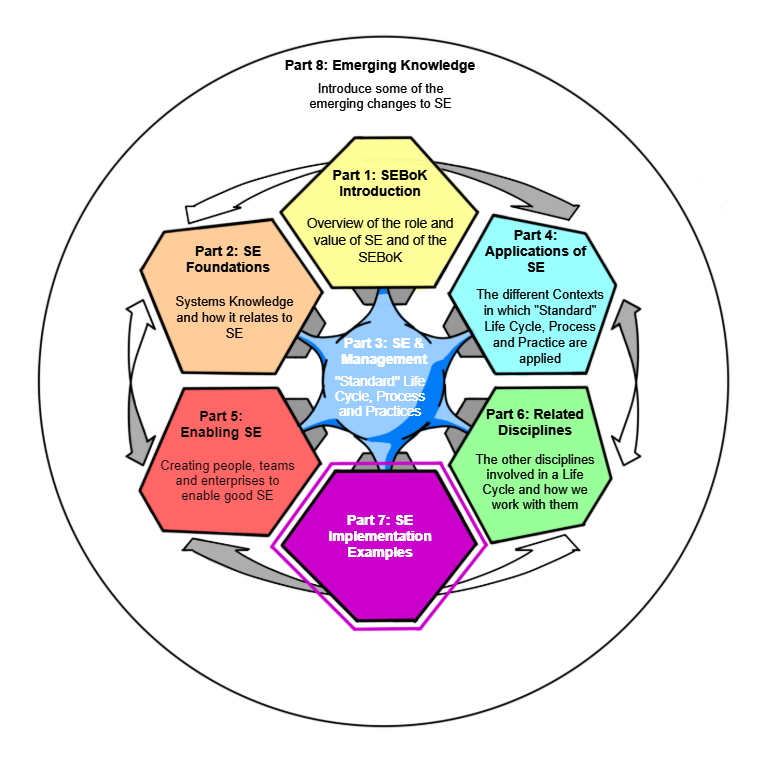
図1:SEBoK 全体における Part 7 の位置付け(Adcock et al. 2016 を基に改変)。詳細については、SEBoK の構造を参照。
Systems Engineering Implementation Examples
Part 7 is a collection of systems engineering (SE) implementation examples to illustrate the principles described in the Systems Engineering Body of Knowledge (SEBoK) Parts 1-6. These examples describe the application of SE practices, principles, and concepts in real settings.
Part 7 は、システムズエンジニアリング知識体系(Systems Engineering Body of Knowledge, SEBoK)の Part 1-6 で述べた原則を例示するための、システムズエンジニアリング(systems engineering, SE)の実践事例集である。これらの事例は、SE の実践、原則、概念を現実の場面に適用した様子を記述したものである。
図中の英語
The intent is to provide typical instances of the application of systems engineering (SE) and relate these to key SE principles and concepts from the rest of the SEBoK. This can improve the practice of SE by illustrating to students, educators, and practitioners the benefits of effective practice, as well as the risks and liabilities of poor practice.
そのねらいは、システムズエンジニアリング(SE)の適用の典型例を示し、それらを SEBoK の他の部分で扱う主要な SE 原則や概念と関連付けることにある。これにより、効果的な実践がもたらす利点と、不十分な実践に伴うリスクや責任の両方を学生、教育者、実践者に示し、SE の実践の改善につなげることができる。
A published case study will typically describe aspects of the practice of SE in a particular situation and then provide comments and critique of that practice. Where possible, examples in the SEBoK refer to published case studies and relate the discussions in them to appropriate areas of the SEBoK. In some case, good or bad examples of SE practice are available but have not been documented in a case study. In these cases the SEBoK authors have described and commented on these examples directly.
公表されたケーススタディは通常、特定の状況における SE の実践の諸側面を記述したうえで、その実践に対するコメントと批評を加える。SEBoK の事例は、可能な場合には公表されたケーススタディを参照し、そこでの議論を SEBoK の該当する領域に関連付けている。場合によっては、SE 実践の良い例や悪い例が存在していても、ケーススタディとして文書化されていないことがある。そのような場合には、SEBoK の著者がこれらの事例を直接記述し、コメントしている。
A matrix of implementation examples is used to map these examples to main topics in the SEBoK which they cover.
実践事例のマトリクスを用いて、これらの事例を、それぞれが扱う SEBoK の主要トピックに対応付けている。
More examples will be added over time to highlight the different aspects and applications of SE. In addition, new examples can be added to demonstrate the evolving state of practice, such as the application of model-based SE and the engineering of complex, adaptive systems.
SE のさまざまな側面や応用を浮き彫りにするため、事例は時間とともに追加されていく。加えて、モデルベース SE(model-based SE)や、複雑で(complex)適応的な(adaptive)システムのエンジニアリングなど、進化しつつある実践の現状を示すために、新しい事例が追加され得る。
Learning from critical examples has been used for decades in medicine, law, and business to help students learn fundamentals and to help practitioners improve their practice. A Matrix of Implementation Examples is used to show the alignment of systems engineering case studies to specific areas of the SEBoK. This matrix is intended to provide linkages between each implementation example to the discussion of the systems engineering principles illustrated. The selection of examples covers a variety of sources, domains, and geographic locations. Both effective and ineffective use of systems engineering principles are illustrated.
The United States Air Force Center for Systems Engineering (AF CSE) has developed a set of case studies "to facilitate learning by emphasizing the long-term consequences of the systems engineering/programmatic decisions on cost, schedule, and operational effectiveness." (USAF Center for Systems Engineering 2011) The AF CSE is using these cases to enhance SE curriculum. The cases are structured using the Friedman-Sage framework (Friedman and Sage 2003; Friedman and Sage 2004, 84-96), which decomposes a case into contractor, government, and shared responsibilities in the following nine concept areas: #Requirements Definition and Management #Systems Architecture Development #System/Subsystem Design #Verification/Validation #Risk Management #Systems Integration and Interfaces #Life Cycle Support #Deployment and Post Deployment #System and Program Management
This framework forms the basis of the case study analysis carried out by the AF CSE. Two of these case studies are highlighted in this SEBoK section, the Hubble Space Telescope Case Study and the Global Positioning System Case Study.
The United States National Aeronautics and Space Administration (NASA) has a catalog of more than fifty NASA-related case studies (NASA 2011). These case studies include insights about both program management and systems engineering. Varying in the level of detail, topics addressed, and source organization, these case studies are used to enhance learning at workshops, training, retreats, and conferences. The use of case studies is viewed as important by NASA since "organizational learning takes place when knowledge is shared in usable ways among organizational members. Knowledge is most usable when it is contextual" (NASA 2011). Case study teaching is a method for sharing contextual knowledge to enable reapplication of lessons learned. The MSTI Case Study is from this catalog.
重要な事例から学ぶという方法は、医学、法学、ビジネスの分野で、学生が基礎を身につけ、実践者が実践を改善するのを助けるために数十年にわたって用いられてきた。実践事例のマトリクスは、システムズエンジニアリングのケーススタディが SEBoK のどの領域に対応するかを示すために用いられる。このマトリクスは、各実践事例と、その事例が例示するシステムズエンジニアリング原則の議論とを結び付けることを意図している。事例の選択は、さまざまな出典、ドメイン、地理的場所をカバーしている。システムズエンジニアリング原則の効果的な使用と効果的でない使用の両方が示されている。
米国空軍システムズエンジニアリングセンター(United States Air Force Center for Systems Engineering, AF CSE)は、「コスト、スケジュール、運用上の有効性に対するシステムズエンジニアリング/プログラム上の決定の長期的な帰結を強調することで学習を促進する」ための一連のケーススタディを開発した(USAF Center for Systems Engineering 2011)。AF CSE は、SE カリキュラムを強化するためにこれらのケースを活用している。これらのケースは Friedman-Sage フレームワーク(Friedman and Sage 2003; Friedman and Sage 2004, 84-96)を用いて構成されており、このフレームワークは、以下の9つの概念領域について、ケースを請負者の責任、政府の責任、共有の責任に分解する:
このフレームワークは、AF CSE が実施するケーススタディ分析の基礎となっている。これらのケーススタディのうち2つ、Hubble Space Telescope Case Study と Global Positioning System Case Study を、この SEBoK セクションで取り上げている。
米国航空宇宙局(United States National Aeronautics and Space Administration, NASA)は、50を超える NASA 関連ケーススタディのカタログを保有している(NASA 2011)。これらのケーススタディには、プログラムマネジメントとシステムズエンジニアリングの両方に関する洞察が含まれている。詳細さの程度、扱うトピック、出典組織はケーススタディごとにさまざまであり、これらはワークショップ、研修、リトリート、会議での学習を強化するために用いられている。NASA がケーススタディの活用を重視しているのは、「組織的学習は、知識が組織の成員の間で利用可能な形で共有されるときに生じる。知識は、それが文脈的であるときに最も利用可能である」からである(NASA 2011)。ケーススタディによる教育は、教訓を再び適用できるようにするために文脈的知識を共有する方法である。MSTI Case Study は、このカタログに収録されたものである。
Adcock, R., N. Hutchison, C. Nielsen, 2016, "Defining an architecture for the Systems Engineering Body of Knowledge," Annual IEEE Systems Conference (SysCon) 2016.
Friedman, G.R., and A.P. Sage. 2003. Systems Engineering Concepts: Illustration Through Case Studies.
Friedman, G.R., and A.P. Sage. 2004. "Case Studies of Systems Engineering and Management in Systems Acquisition." Systems Engineering. 7 (1): 84-96.
NASA. 2011. A Catalog of NASA-Related Case Studies. Goddard Space Flight Center: Office of the Chief Knowledge Officer, National Aeronautics and Space Administration (NASA). Updated June 2011. Accessed September 2011. Available: https://www.nasa.gov/centers/goddard/pdf/450420main_NASA_Case_Study_Catalog.pdf.
United States Air Force (USAF) Center for Systems Engineering. 2011. Why Case Studies?. Wright-Patterson Air Force Base, Ohio, USA: Air Force Institute of Technology (AFIT), US Air Force. Accessed September 2011. Available: https://www.afit.edu/cse/cases.cfm.
Friedman, G., and A.P. Sage. 2004. "Case studies of systems engineering and management in systems acquisition". Systems Engineering 7(1): 84-96.
Gorod, A., B.E. White, V. Ireland, S.J. Gandhi, and B.J. Sauser. 2014. Case Studies in System of Systems, Enterprise Systems, and Complex Systems Engineering. Boca Raton, FL: CRC Press, Taylor & Francis Group.
NASA. A Catalog of NASA-Related Case Studies. Greenbelt, MD, USA: Office of the Chief Knowledge Officer, Goddard Space Flight Center, National Aeronautics and Space Administration (NASA). Updated June 2011. Accessed December 5, 2014 at NASA https://www.nasa.gov/centers/goddard/pdf/450420main_NASA_Case_Study_Catalog.pdf.
United States Air Force (USAF) Center for Systems Engineering. 2011. Why Case Studies?. Wright-Patterson Air Force Base, OH, USA: Air Force Institute of Technology (AFIT).
None.