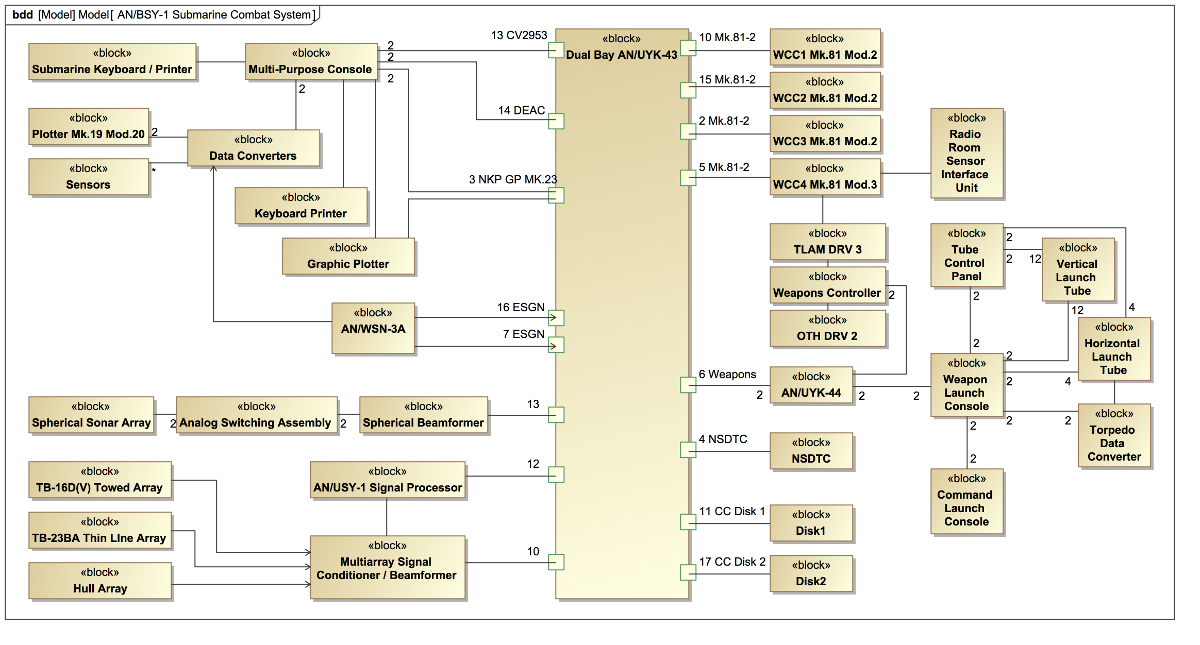
図1:ポイント・ツー・ポイントのインターフェースを持つ独立した構成システムから構成される1985年ごろの潜水艦戦闘システム(SEBoK Original)
Submarine Warfare Federated Tactical Systems
This article describes the transformation of the systems engineering and integration program that produces the common combat system used across the United States Navy (USN) submarine fleet from traditional document-based systems engineering (DBSE) to model-based systems engineering (MBSE).. The topic may be of particular interest to those dealing with programs in the sustainment and evolution phase of their life cycle. For addition information, refer to the links provided in Section V, Lessons Learned below.
本記事では、米国海軍(United States Navy, USN)の潜水艦艦隊全体で使用される共通戦闘システムを生み出すシステムズエンジニアリングおよび統合プログラムが、従来の文書ベースシステムズエンジニアリング(document-based systems engineering, DBSE)からモデルベースシステムズエンジニアリング(model-based systems engineering, MBSE)へと変革を遂げた経緯を記述する。このトピックは、ライフサイクルの維持・進化フェーズにあるプログラムに携わる人々にとって、特に関心が高いであろう。追加情報については、後述の Section V, Lessons Learned に示すリンクを参照されたい。
Modern submarines are typically in service for 20 - 40 years. Historically, each new class of submarines has been equipped with a new combat system, with a corresponding logistics and sustainment tail unique to that class. Submarines and their internal systems are commonly state-of-the-practice at launch, but most navies find it necessary to upgrade the ship’s combat system at least once during the operational lifetime. The evolution of threats, technology and interoperability drives the USN to upgrade their submarine combat systems and key components including the sonar (Fages 1998) (Ford and Dillard 2009) and tactical control systems continuously (Jacobus and Barrett 2002).
現代の潜水艦は通常、20 - 40 年にわたって就役する。歴史的に、潜水艦は新しいクラスごとに新しい戦闘システムを装備し、それに伴って、そのクラスに固有のロジスティクスと維持整備の継続的な負担を抱えてきた。潜水艦とその内部システムは、進水時点では当時の実用技術の水準(state-of-the-practice)にあるのが一般的だが、ほとんどの海軍は、運用寿命の間に少なくとも一度は艦の戦闘システムをアップグレードする必要があると考えている。脅威、技術、相互運用性の進化に促され、USN は、ソナー(Fages 1998)(Ford and Dillard 2009)や戦術制御システム(Jacobus and Barrett 2002)を含む潜水艦戦闘システムとその主要構成要素を継続的にアップグレードしている。
Over the last three decades submarine combat systems have evolved from multiple independent systems (sonar, combat control, imaging, electronic warfare, weapon control, etc.) with manual or point-to-point interfaces into networked federations of systems (FoS). Confusingly, these component systems are often referred to as subsystems in the literature.
過去30年間で、潜水艦戦闘システムは、手動またはポイント・ツー・ポイントのインターフェースを持つ複数の独立したシステム(ソナー、戦闘制御、イメージング、電子戦、兵器制御など)から、ネットワーク化されたシステムのフェデレーション(federations of systems, FoS)へと進化した。紛らわしいことに、文献ではこれらの構成システムがしばしばサブシステムと呼ばれる。
図中の英語
In the USN, each of these component systems has its own acquisition program, customer, and contractor team. Starting as legacy military systems hosted on traditional military-unique computational platforms, these systems have evolved to utilize Commercial Off-The-Shelf (COTS) computational and networking platforms, and leverage large amounts of COTS software.
USN では、これらの構成システムがそれぞれ独自の取得プログラム、顧客、請負業者チームを持つ。これらのシステムは当初、従来の軍固有の計算プラットフォーム上で稼働するレガシーな軍事システムであったが、やがて市販の既製品(Commercial Off-The-Shelf, COTS)の計算・ネットワークプラットフォームを利用し、大量の COTS ソフトウェアを活用するように進化してきた。
As the component systems became more tightly interconnected, the acquisition customers established and collaboratively funded a systems engineering and integration (SE&I) program to manage the interfaces between systems, manage technology insertion and the obsolescence of common COTS components, and to integrate and test the production systems (Cooper, Sienkiewicz and Oliver 2006). Starting with the Virginia class, this SE&I program was expanded to encompass both new-production and in-service submarine modernization efforts. Over time, the combat systems of the various USN submarine classes were converged into variants of a single product line (Zingarelli, et al. 2010).
構成システム同士の相互接続が緊密になるにつれて、取得側の顧客は、システム間のインターフェースの管理、技術挿入と共通 COTS 構成要素の陳腐化の管理、生産システムの統合とテストを目的として、システムズエンジニアリングおよび統合(systems engineering and integration, SE&I)プログラムを設立し、共同で資金を拠出した(Cooper, Sienkiewicz and Oliver 2006)。バージニア級を皮切りに、この SE&I プログラムは、新規生産と就役中潜水艦の近代化の両方の取り組みを包含するよう拡大された。時を経て、USN のさまざまな潜水艦クラスの戦闘システムは、単一のプロダクトラインの変種へと収束していった(Zingarelli, et al. 2010)。
The submarine combat system SE&I program delivers an updated production baseline annually, along with product line variants for each submarine class or subclass being built or upgraded that year. Production systems implementing this baseline are delivered to new-build submarines, and to in-service submarines being upgraded on a roughly six-year cycle. The common combat system product line is referred to as the Submarine Warfare Federated Tactical Systems (SWFTS). SWFTS is deployed by the USN on submarines of the Los Angeles (SSN 688), Ohio (SSGN 726, SSBN 730), Seawolf (SSN 21), and Virginia (SSN 774) classes, and by the Royal Australian Navy on the Collins (SSG 73) class. SWFTS is also planned for the next-generation USN Columbia (SSBN) class. Compared to the submarine combat systems that it replaced, SWFTS significantly reduces development, maintenance and training costs while delivering enhanced combat capabilities and facilitating the rapid insertion of new or improved capabilities (Zingarelli, et al. 2010).
潜水艦戦闘システム SE&I プログラムは、更新した生産ベースラインを毎年提供し、あわせて、その年に建造またはアップグレードされる各潜水艦クラスまたはサブクラス向けのプロダクトライン変種も提供する。このベースラインを実装した生産システムは、新造潜水艦と、およそ6年周期でアップグレードされる就役中の潜水艦に提供される。共通戦闘システムのプロダクトラインは、潜水艦戦連合戦術システム(Submarine Warfare Federated Tactical Systems, SWFTS)と呼ばれる。SWFTS は、USN ではロサンゼルス級(SSN 688)、オハイオ級(SSGN 726, SSBN 730)、シーウルフ級(SSN 21)、バージニア級(SSN 774)の潜水艦に、オーストラリア海軍(Royal Australian Navy)ではコリンズ級(SSG 73)に配備されている。次世代の USN コロンビア級(SSBN)にも SWFTS の搭載が計画されている。SWFTS は、それが置き換えた潜水艦戦闘システムと比べて、開発・保全・訓練のコストを大幅に削減すると同時に、強化された戦闘能力を提供し、新規または改良された能力の迅速な挿入を容易にする(Zingarelli, et al. 2010)。
Figure 2. Contemporary submarine combat systems are networked with converged data interfaces (Produced by Lockheed Martin for US Navy. Approved for Public Release by US Navy, #16-348, June 2016)
図2:収束したデータインターフェースでネットワーク化された現代の潜水艦戦闘システム(Lockheed Martin が米海軍のために作成。米海軍により公開承認済み、#16-348、June 2016)
この図は原典のページに掲載されています。権利の都合により本サイトでは省略しています。原典で見る
The USN submarine fleet encompasses substantial platform variability between class, sub-classes, and even individual ships within a sub-class. The RAN Collins class contributes additional variability. Platform variability drives combat system variability.
USN の潜水艦艦隊には、クラス間、サブクラス間、さらには同一サブクラス内の個々の艦の間にも、かなりのプラットフォームのばらつきがある。RAN のコリンズ級は、さらなるばらつきをもたらす。プラットフォームのばらつきは、戦闘システムのばらつきを生む要因となる。
SWFTS is a Federation of Systems, with each platform hosting a subset of 40 systems produced by 20 different program offices. As is common with system of systems (SoS) and FoS, there is no central program office that can command the compliance of all of the component system programs. Instead, the evolution of SWFTS is executed through negotiation and consensus.
SWFTS はシステムのフェデレーションであり、各プラットフォームは、20の異なるプログラムオフィスが生産する40のシステムのうちの一部をホストする。システム・オブ・システムズ(system of systems, SoS)や FoS によくあるように、すべての構成システムプログラムに準拠を命じることのできる中央のプログラムオフィスは存在しない。代わりに、SWFTS の進化は交渉と合意を通じて進められる。
Many baselines must be produced each year: new common hardware baselines are introduced in odd years, while new common software baselines are introduced in even years (Jacobus, Yan and Barrett 2002). In addition, multiple incremental developmental baselines are established each year. Once the annual production baseline for the product line is defined, variants must be developed for each submarine class or subclass built or upgraded that year (Mitchell 2012).
毎年、多くのベースラインを生産しなければならない:新しい共通ハードウェアベースラインは奇数年に、新しい共通ソフトウェアベースラインは偶数年に導入される(Jacobus, Yan and Barrett 2002)。加えて、毎年複数の漸進的な開発ベースラインが確立される。プロダクトラインの年次生産ベースラインが定まったら、その年に建造またはアップグレードされる各潜水艦クラスまたはサブクラス向けに変種を開発しなければならない(Mitchell 2012)。
Like most other defense programs, the SWFTS SE&I program is under constant pressure to accomplish more with decreasing resources. There has been steady increase in SE scope despite decreasing budgets. Program leadership has responded in part through continuous SE process improvement. Improvements have included test automation, changes in the requirements management processes and tools (spreadsheets to IBM® Rational® DOORS® to OMG® SysML®), refined tooling for change management, and the DBSE to MBSE transition that is the focus of this case study. Substantial Return on Investment (ROI) has been achieved with each major SE process or tooling improvement (Mitchell 2014, Rogers III and Mitchell 2021).
他のほとんどの防衛プログラムと同様に、SWFTS SE&I プログラムも、減り続けるリソースでより多くを達成せよという絶え間ない圧力にさらされている。予算が減少しているにもかかわらず、SE の範囲は着実に拡大してきた。プログラムのリーダーシップは、継続的な SE プロセス改善によって、これに部分的に対応してきた。改善には、テスト自動化、要求マネジメントのプロセスとツールの変更(スプレッドシートから IBM® Rational® DOORS®、さらに OMG® SysML® へ)、変更マネジメント用ツールの改良、そして本ケーススタディの焦点である DBSE から MBSE への移行が含まれる。各主要な SE プロセスまたはツールの改善により、相当な投資収益率(Return on Investment, ROI)が達成されてきた(Mitchell 2014, Rogers III and Mitchell 2021)。
During 2009 the SWFTS SE&I program conducted a Model Driven Architecture (MDA) study to determine if MDA should be the next step in the program’s continuous SE process improvement. The MDA study predicted a positive ROI from converting to MBSE. In January 2010 the SWFTS SE&I program office kicked-off a three-year effort to develop and validate a SWFTS FoS model and MBSE process. In 2013 a SWFTS baseline was developed using both DBSE and MBSE in parallel. The DBSE products were used to validate the MBSE products. Based on that successful validation, the SWFTS SE&I program transitioned to MBSE for all ongoing work.
2009年中に、SWFTS SE&I プログラムは、MDA をプログラムの継続的な SE プロセス改善の次のステップとすべきかどうかを判断するため、モデル駆動アーキテクチャ(Model Driven Architecture, MDA)の調査を実施した。MDA 調査は、MBSE への転換によってプラスの ROI が得られると予測した。2010年1月、SWFTS SE&I プログラムオフィスは、SWFTS FoS モデルと MBSE プロセスを開発し妥当性確認するための3年間の取り組みを開始した。2013年には、DBSE と MBSE の両方を並行して用いて SWFTS ベースラインが開発された。DBSE の成果物は、MBSE の成果物を妥当性確認するために使用された。この妥当性確認が成功したことを受けて、SWFTS SE&I プログラムは以後のすべての作業を MBSE へ移行した。
Until the transition in 2013, SWFTS SE was performed using traditional DBSE. Requirements were managed in DOORS, and reviewed and used by engineers in the form of massive spreadsheets with hundreds of columns and thousands of rows. The design of each variant was documented in Microsoft Office files. Baseline Change Requests (BCR) were documented in briefings, and analyzed by all component system programs in parallel for potential impact. Approved BCRs were manually merged into DOORS and into revised baseline documents for each effected variant.
2013年の移行までは、SWFTS の SE は従来の DBSE を用いて実施されていた。要求事項は DOORS で管理され、エンジニアは、何百もの列と何千もの行からなる巨大なスプレッドシートの形でそれをレビューし、使用していた。各変種の設計は Microsoft Office ファイルに文書化された。ベースライン変更要求(Baseline Change Requests, BCR)はブリーフィング資料として文書化され、すべての構成システムプログラムが並行して潜在的な影響を分析した。承認された BCR は、DOORS と、影響を受ける各変種の改訂版ベースライン文書とに、手作業でマージされた。
Starting in 2010, the customer community invested in a three-year MBSE transformation effort. The engineering team performed an in-depth tool trade study to select and set up the MBSE environment. That trade study resulted in the selection of MagicDraw™ for system modeling, using Teamwork™ as the model repository.
2010年から、顧客コミュニティは3年間の MBSE 変革の取り組みに投資した。エンジニアリングチームは、MBSE 環境を選定し構築するために、詳細なツールのトレード調査を実施した。そのトレード調査の結果、システムモデリングには MagicDraw™ が、モデルリポジトリには Teamwork™ が選定された。
Once the modeling environment was installed, the MBSE transformation team architected, developed and populated a SysML-based model of the SWFTS FoS interfaces. The team updated the SWFTS SE process to take advantage of the new MBSE environment, with the constraint that the MBSE process produce SE products that were effectively identical to those produced by the DBSE process.
モデリング環境が導入されると、MBSE 変革チームは、SWFTS FoS インターフェースの SysML ベースのモデルを設計・開発し、データを投入した。チームは、MBSE プロセスが DBSE プロセスによって生産される SE 成果物と実質的に同一の SE 成果物を生産するという制約の下で、新しい MBSE 環境を活用できるよう SWFTS SE プロセスを更新した。
As the SWFTS model was developed, unanticipated benefits emerged. Capturing the architecture in a model improves the depth and quality of baseline products due to the fact that, unlike the spreadsheets it replaced, the model inherently captures relationships between elements. Using the model, one can drill down and explore various aspects of the architecture, e.g., a) the network design that supports data exchanges; b) component systems that use a particular network Virtual Local Area Network (VLAN); c) service level requirements levied upon data providers.
SWFTS モデルの開発が進むにつれて、予期しなかった便益が現れた。アーキテクチャをモデルに捕捉すると、ベースライン成果物の深さと品質が向上する。これは、モデルが置き換えたスプレッドシートとは違い、モデルは要素間の関係を本質的に捕捉するためである。モデルを用いれば、例えば、a) データ交換を支えるネットワーク設計、b) 特定のネットワーク仮想 LAN(Virtual Local Area Network, VLAN)を使用する構成システム、c) データ提供者に課されるサービスレベル要件といった、アーキテクチャのさまざまな側面を掘り下げて探ることができる。
In 2013 the new MBSE environment and process was used to produce a set of SWFTS baseline SE products. In parallel, the DBSE process produced equivalent products. The two sets of baseline products were compared in detail, with all differences traced back to root causes.
2013年、新しい MBSE 環境とプロセスを用いて、SWFTS ベースラインの SE 成果物一式が生産された。並行して、DBSE プロセスでも同等の成果物が生産された。2組のベースライン成果物は詳細に比較され、すべての相違はその根本原因までさかのぼって追跡された。
The relationships in the model also support automated integrity and consistency checking between model elements, which is also called model concordance. Analysis of these relationships identified a significant number of minor differences that were all traced to errors in the DBSE products. This validated the MBSE process, and demonstrated that while those initial MBSE baseline products were more labor-intensive than the DBSE baseline products, the new MBSE process produced higher quality products. After this validation, the SWFTS SE&I program switched over to MBSE as their basic process.
モデル内の関係は、モデル要素間の完全性と一貫性の自動チェックも支援し、これはモデル整合(model concordance)とも呼ばれる。これらの関係を分析したところ、多数の小さな相違が特定され、そのすべてが DBSE 成果物のエラーに起因することが突き止められた。これにより MBSE プロセスが妥当性確認されるとともに、初期の MBSE ベースライン成果物は DBSE ベースライン成果物よりも多くの労力を要したものの、新しい MBSE プロセスのほうがより高品質な成果物を生産することが実証された。この妥当性確認を経て、SWFTS SE&I プログラムは基本プロセスを MBSE に切り替えた。
Since that transformation, SE process improvement has continued apace. Requirements management has moved from DOORS to the system model in MagicDraw. As of 2016, the system model is the baseline for requirements, architecture and the FoS design. BCR impact analysis is now performed in model, leveraging capabilities of the toolset for automated assistance. Variants are documented in the system model as system configurations. Most SE products are generated from the system model on demand.
その変革以降も、SE プロセスの改善は速いペースで続いている。要求マネジメントは、DOORS から MagicDraw 上のシステムモデルへ移行した。2016年時点では、システムモデルが要求事項、アーキテクチャ、FoS 設計のベースラインとなっている。BCR の影響分析は現在、ツールセットの自動支援機能を活用して、モデル内で実施されている。変種は、システム構成としてシステムモデル内に文書化される。ほとんどの SE 成果物は、必要に応じてシステムモデルから生成される。
The MBSE process has been matured and refined over subsequent baseline development efforts. As the team climbed the learning curve, the average cost of processing a BCR declined. New SE artifacts capturing specific aspects of the FoS model were conceived and auto-generated from the model to improve communication with targeted audiences. Where before the transition to MBSE it was not cost-effective to manually generate tailored SE artifacts for individual systems, developing scripts to auto-generate tailored artifacts proved cost effective and improved the efficiency of the component system developers. Additional scripts were developed to tailor the modeling tool user interface and focus it on the specific activities performed by the SWFTS SE&I engineers. MagicDraw™ has very extensive modeling capabilities with a correspondingly expansive user interface, and tailoring the user interface both reduced the learning curve for new engineers coming onto the program and streamlined routine SWFTS SE activities.
MBSE プロセスは、その後のベースライン開発の取り組みを通じて成熟し、洗練されてきた。チームが学習曲線を上るにつれて、BCR の平均処理コストは低下した。想定する受け手とのコミュニケーションを改善するため、FoS モデルの特定の側面を捕捉する新しい SE 成果物が考案され、モデルから自動生成された。MBSE への移行前は、個々のシステム向けに調整した SE 成果物を手作業で作成することは費用対効果に見合わなかったが、調整された成果物を自動生成するスクリプトの開発はコスト効果的であることが証明され、構成システム開発者の効率を向上させた。さらに、モデリングツールのユーザーインターフェースを調整し、SWFTS SE&I エンジニアが行う具体的なアクティビティに焦点を絞るためのスクリプトも開発された。MagicDraw™ はきわめて広範なモデリング能力を備え、それに応じてユーザーインターフェースも広大であるため、ユーザーインターフェースの調整は、プログラムに加わる新しいエンジニアの学習曲線を低減し、日常的な SWFTS SE アクティビティを合理化した。
While the initial scope of MBSE was limited to managing the interfaces between component systems, once the transition was successful MBSE started expanding out to encompass additional SWFTS SE&I tasks. MBSE is now beginning to spread into the component system programs as well as the overall submarine combat system SE&I program.
MBSE の当初の範囲は構成システム間のインターフェース管理に限られていたが、移行が成功すると、MBSE は追加の SWFTS SE&I タスクを包含するよう拡大し始めた。現在、MBSE は構成システムプログラムや、潜水艦戦闘システム SE&I プログラム全体にも広がり始めている。
After the MBSE process reached a reasonable level of maturity, a retrospective analysis (Rogers III and Mitchell 2021) was performed to determine if the anticipated cost savings had been achieved. This analysis compared the requirements database-managed 2010 baselines, which were generated using the mature common requirements baseline and common change management process institutionalized by 2008, with the 2014 baselines built using the mature MBSE process. This analysis made a quantitative comparison of the efficiencies between the legacy interface requirements management process using the IBM DOORS® toolset, and the model-based interface requirements management process employing the MagicDraw™ toolset.
MBSE プロセスが相応の成熟水準に達した後、見込まれたコスト削減が達成されたかどうかを判断するため、回顧的分析(Rogers III and Mitchell 2021)が実施された。この分析では、2008年までに制度化された成熟した共通要求事項ベースラインと共通変更マネジメントプロセスを用いて生成され、要求データベースで管理された2010年ベースラインと、成熟した MBSE プロセスを用いて構築された2014年ベースラインとを比較した。この分析は、IBM DOORS® ツールセットを用いるレガシーなインターフェース要求マネジメントプロセスと、MagicDraw™ ツールセットを用いるモデルベースのインターフェース要求マネジメントプロセスとの効率を、定量的に比較したものである。
These two distinct SWFTS baseline updates provided a good case study as both
これら2つの異なる SWFTS ベースライン更新は、いずれも以下の条件を満たしていたため、良いケーススタディとなった。
• utilized the same high-level SWFTS process and contract,
• 同じ上位水準の SWFTS プロセスと契約を利用したこと
• involved updating the lead boat in a new group of submarines added to the SWFTS SE&I program, and
• SWFTS SE&I プログラムに新たに加わった潜水艦グループの先行艦の更新を含んでいたこと
• involved updates to a similar number of submarine classes.
• 同程度の数の潜水艦クラスへの更新を含んでいたこと
The second bullet is key, since it suggests that the overall level of complexity of the requirements changes is similar between the two sets of baselines.
第2の箇条が鍵となる。それは、要求事項の変更の全体的な複雑さの水準が2組のベースラインの間で同程度であることを示唆するからである。
The 2010 baseline developed using DOORS® will be referred to hereafter as the Legacy Process Baseline. The 2014 baseline developed using MBSE with the MagicDraw™ toolset will henceforth be referred to as the MBSE Baseline. The timing of these two baselines in the context of the MBSE transition is shown in Figure 3.
DOORS® を用いて開発された2010年ベースラインを、以下ではレガシープロセスベースラインと呼ぶ。MagicDraw™ ツールセットを用いた MBSE で開発された2014年ベースラインを、以下では MBSE ベースラインと呼ぶ。MBSE 移行の文脈におけるこれら2つのベースラインのタイミングを図3に示す。
Figure 3. Timing of the Legacy Process Baseline and the MBSE Baseline relative to other SE process improvement. (Rogers III and Mitchell 2021)
図3:他の SE プロセス改善との関係で見た、レガシープロセスベースラインと MBSE ベースラインのタイミング。(Rogers III and Mitchell 2021)
Since a requirement modification is the basic unit of systems engineering work depicting development needs at the FoS level, it is a useful metric to compare the scope of the updates. As can be seen from Table 1, the MBSE Baseline involved 42% more interface requirements changes than the Legacy Process, while consuming only 16% more hours. Another way of looking at these numbers is that the SE hours per requirement decreased from 12.1 in the Legacy baseline to 9.9 in the MBSE baseline. This is equivalent to saying that the MBSE process is 18% more efficient than the older DBSE process. This exceeded the 13% improvement projected by the 2009 SWFTS pilot study (Mitchell 2014).
要求事項の変更は、FoS 水準での開発ニーズを表すシステムズエンジニアリング作業の基本単位であるため、更新の範囲を比較するうえで有用な指標となる。表1から分かるように、MBSE ベースラインはレガシープロセスよりもインターフェース要求事項の変更が42%多かったにもかかわらず、消費した時間は16%多いだけであった。これらの数字を別の見方で捉えれば、要求事項あたりの SE 時間が、レガシーベースラインの12.1から MBSE ベースラインの9.9へ減少したことになる。これは、MBSE プロセスが旧来の DBSE プロセスよりも18%効率的であるというのと同じことである。この結果は、2009年の SWFTS パイロット調査(Mitchell 2014)が予測した13%の改善を上回った。
Table 1. Summary of the SWFTS MBSE ROI Analysis Baselines. (Rogers III and Mitchell 2021)
表1:SWFTS MBSE ROI 分析ベースラインの要約。(Rogers III and Mitchell 2021)
In addition to the decrease in labor hours per requirements change, measurable improvements in quality were found. A 9% reduction in total interface defects were discovered in the MBSE Baseline compared to the Legacy Process Baseline. In addition, there was an 18% shift of defect discovery from platform integration testing to laboratory integration testing with the MBSE Baseline. Estimates of the cost savings achieved by shifting defect eradication from platform integration to laboratory integration range from 1.6x (Rogers III and Mitchell 2021) to 4x (Feiler et al. 2013), but in any case these savings can contribute significantly to the overall ROI.
要求事項の変更あたりの労働時間の減少に加えて、品質面でも測定可能な改善が見られた。MBSE ベースラインでは、レガシープロセスベースラインと比べてインターフェース欠陥の総数が9%減少していることが判明した。さらに、MBSE ベースラインでは、欠陥の発見がプラットフォーム統合テストから実験室統合テストへ18%シフトした。欠陥の除去をプラットフォーム統合から実験室統合へ移すことで得られるコスト削減の見積りは、1.6x(Rogers III and Mitchell 2021)から4x(Feiler et al. 2013)までの幅があるが、いずれにせよ、これらの削減は全体の ROI に大きく寄与し得る。
Seven learning principles (LPs) (Friedman and Sage 2005) were derived that address the more broadly applicable areas of systems engineering knowledge, and inform the areas of the SEBoK that are most strongly related to the case study. They are:
より広く適用可能なシステムズエンジニアリング知識の領域を扱い、本ケーススタディと最も強く関連する SEBoK の領域に示唆を与える、7つの学習原則(learning principles, LPs)(Friedman and Sage 2005)が導き出された。それらは次のとおりである:
• Requirements traceability (LP1);
• Requirements traceability(LP1);
• Communications (LP2);
• Communications(LP2);
• Productivity (LP3);
• Productivity(LP3);
• Quality (LP4);
• Quality(LP4);
• Managing Change (LP5);
• Managing Change(LP5);
• Managing variants (LP6); and
• Managing variants(LP6); and
• Life cycle (LP7).
• Life cycle(LP7)。
Requirements traceability LP1: MBSE improves traceability in multiple dimensions, but maintaining requirements traceability between a traditional database and the MBSE system model can be challenging. While DOORS, MagicDraw and Teamwork can interoperate to provide requirements management and traceability, the combination is fragile. Without careful configuration management, synchronization can lead to database corruption. If DOORS and Teamwork are on separate servers, maintaining the connection can run afoul of ever-evolving corporate information assurance policies.
Requirements traceability LP1:MBSE はトレーサビリティを複数の次元で改善するが、従来のデータベースと MBSE のシステムモデルとの間で要求トレーサビリティを維持することは難しい場合がある。DOORS、MagicDraw、Teamwork は相互運用によって要求マネジメントとトレーサビリティを提供できるが、その組み合わせは脆弱である。慎重な構成管理を行わなければ、同期によってデータベースが破損するおそれがある。DOORS と Teamwork が別々のサーバー上にある場合、接続の維持が、絶えず変化する企業の情報保証ポリシーに抵触する場合がある。
Requirements can be managed using the SysML language inside the system model quite effectively. This approach can reduce the resources needed to keep the system model in sync with a traditional requirements database system and increase overall SE productivity.
要求事項は、システムモデル内部で SysML 言語を用いて非常に効果的に管理できる。このアプローチにより、システムモデルを従来の要求データベースシステムと同期させておくのに必要なリソースを削減し、SE 全体の生産性を高めることができる。
Communications LP2: Tailored SE products generated from the system model can substantially enhance communications both within the technical team and between customer stakeholders.
Communications LP2:システムモデルから生成される調整された SE 成果物は、技術チーム内と顧客側のステークホルダー同士の双方で、コミュニケーションを大きく改善できる。
Graphical depictions of the system model often communicate better to human stakeholders than massive spreadsheets and textual documents. Further, the enhanced precision driven by modeling can reduce miscommunications between both technical and programmatic stakeholders.
システムモデルをグラフィカルに描いたものは、巨大なスプレッドシートやテキスト文書よりも、人間のステークホルダーに伝わりやすいことが多い。さらに、モデリングによってもたらされる精度の向上は、技術的ステークホルダーとプログラム的ステークホルダーの双方の間の誤解を減らすことができる。
Having the architecture and design in a system model makes it affordable to generate specialized SE products on demand for particular communications needs while keeping all SE products in concordance. Even technical stakeholders who thought they understood the design can find new insights by looking at it in different representations.
アーキテクチャと設計がシステムモデルにあれば、すべての SE 成果物の整合を保ったまま、特定のコミュニケーションのニーズに合わせた特殊な SE 成果物を必要に応じて生成することが、現実的なコストで可能になる。設計を理解していると思っていた技術的ステークホルダーでさえ、それを異なる表現で見ることで新たな洞察を得ることがある。
Productivity LP3: MBSE increases productivity by enhancing communications within the team, automating routine tasks and through cost avoidance.
Productivity LP3:MBSE は、チーム内のコミュニケーションの強化、日常的なタスクの自動化、そしてコスト回避によって生産性を高める。
DBSE processes often require substantial revision to achieve the potential productivity gains of MBSE. In particular, review processes should be modified to take advantage of the tooling.
DBSE のプロセスは、MBSE がもたらし得る生産性向上を実現するために、大幅な改訂を要することが多い。特に、レビュープロセスは、ツールの利点を生かせるよう修正すべきである。
The modeling tools selected constrain how you can practically re-engineer SE processes. Automation can replace a great deal of routine SE work (document generation, identifying potential impacts of changes, etc.).
選定したモデリングツールによって、SE プロセスを現実的にどう再設計できるかが制約される。自動化によって、日常的な SE 作業の多く(文書生成、変更の潜在的影響の特定など)を置き換えることができる。
Developing strong modeling style guidelines and specialized representations, along with training materials to indoctrinate new team members as they join the program, is worth the investment. MBSE does require a trained cadre of modelers, but not all systems engineers have to become skilled modelers.
強力なモデリングスタイルのガイドラインと特殊な表現を整備し、プログラムに加わる新しいチームメンバーを教育するための訓練資料とあわせて用いることは、投資に値する。MBSE には訓練を受けたモデラーの中核集団が確かに必要だが、すべてのシステムエンジニアが熟練したモデラーになる必要はない。
To effectively quantify the benefits of MBSE, a program needs to plan metrics collection carefully, and then stick to the plan long enough to collect meaningful data.
MBSE の便益を効果的に定量化するには、プログラムは指標収集を慎重に計画し、意味のあるデータを収集できるだけの期間、その計画を守り続ける必要がある。
Quality LP4: Much of the ROI from the MBSE transition can be in improved quality. Improving the quality of SE products enhances early discovery of defects, which reduces integration costs. It also reduces latent defects in systems delivered to the customer, reducing maintenance costs and increasing customer satisfaction.
Quality LP4:MBSE 移行による ROI の多くは、品質の改善によってもたらされ得る。SE 成果物の品質を改善すると、欠陥の早期発見が促進され、統合コストが削減される。また、顧客に納入されるシステムの潜在欠陥が減り、保全コストが削減され、顧客満足度が高まる。
Models are less tolerant of imprecision than documents. The increased precision improves SE product quality, both in reduced defect generation and in reduced defect escape.
モデルは文書よりも不正確さに対して寛容でない。精度が高まることで、欠陥の作り込みの削減と欠陥流出の削減の両面から、SE 成果物の品質が改善される。
The automation of product generation can make specialized SE products affordable, further enhancing system quality.
成果物生成の自動化により、特殊な SE 成果物を現実的なコストで作成でき、システム品質をさらに高めることができる。
Managing change LP5: How a proposed system change is understood and executed is fundamentally different between a model- and a document-centric approach. In the document-centric approach, the focus is on “What should my final output look like?” In the model-based approach, the focus is on “What does this change mean to the system? Which other parts of the system are impacted by this change?”
Managing change LP5:提案されたシステム変更をどのように理解し実行するかは、モデル中心のアプローチと文書中心のアプローチとで根本的に異なる。文書中心のアプローチでは、「最終的な成果物はどう見えるべきか?」に焦点が置かれる。モデルベースのアプローチでは、「この変更はシステムにとって何を意味するのか? システムの他のどの部分がこの変更の影響を受けるのか?」に焦点が置かれる。
Change management is hard. When moving from DBSE to MBSE you need to think carefully up front about what approach you are going to take, and then design the system model to facilitate that approach. Change management also impacts tool selection, since different tools align better with different approaches.
変更マネジメントは難しい。DBSE から MBSE へ移行する際は、どのようなアプローチを取るかを事前に慎重に検討し、そのアプローチを容易にするようシステムモデルを設計する必要がある。変更マネジメントはツールの選定にも影響する。ツールによって適合しやすいアプローチが異なるためである。
Managing variants LP6: The most common process for managing variants in DBSE is ‘clone and own’, where each new product family member takes the then-current baseline and ‘forks’ the baseline for evolution of the variant. This makes synchronizing changes to the core baseline across the product family a very labor-intensive process. Treating variants as deviations from a core baseline in a model greatly reduces the cost of managing variation in a product family.
Managing variants LP6:DBSE において変種を管理する最も一般的なプロセスは "clone and own" であり、プロダクトファミリーの新しいメンバーごとに、その時点の現行ベースラインを取得し、変種の進化のためにそのベースラインを "フォーク" する。このため、中核ベースラインへの変更をプロダクトファミリー全体で同期させることは、非常に労働集約的なプロセスとなる。モデル内で変種を中核ベースラインからの差分として扱えば、プロダクトファミリーのばらつきを管理するコストは大幅に削減される。
Variant management is hard. You need to think about what approach you plan to take up front and design your system model to accommodate it. The selected approach impacts tool selection and tailoring.
変種管理は難しい。取ろうとするアプローチを事前に検討し、それに対応できるようシステムモデルを設計する必要がある。選定したアプローチは、ツールの選定と調整に影響する。
Design the system model to treat variants as deviations from the core baseline. Then changes to the core baseline are automatically shared among all variants, and impact to product family members is limited to any impact of core baseline change on specific variant deviations. This also facilitates commonality between variants, a key customer goal as commonality reduces logistics and training costs.
システムモデルは、変種を中核ベースラインからの差分として扱うように設計する。そうすれば、中核ベースラインへの変更はすべての変種の間で自動的に共有され、プロダクトファミリーのメンバーへの影響は、中核ベースラインの変更が個々の変種の差分に及ぼす影響に限定される。これはまた変種間の共通性を促進する。共通性はロジスティクスと訓練のコストを削減するため、顧客の主要な目標である。
Life cycle LP7: MBSE can be applied early or late in the product family life cycle. While most projects using MBSE start off model-based, a program can transition to MBSE late in the life cycle.
Life cycle LP7:MBSE は、プロダクトファミリーのライフサイクルの初期にも後期にも適用できる。MBSE を使用するプロジェクトの大半は最初からモデルベースで始まるが、プログラムがライフサイクルの後期に MBSE へ移行することも可能である。
Getting from DBSE to MBSE requires serious engineering, careful thought, planning and implementation. The SWFTS MBSE transition required three years of investment by the customer. That time and budget was spent primarily in designing and developing the system model and in re-engineering the SE processes.
DBSE から MBSE へ移行するには、本格的なエンジニアリング、慎重な検討、計画、そして実装が必要である。SWFTS の MBSE 移行には、顧客による3年間の投資が必要であった。その時間と予算は、主にシステムモデルの設計・開発と SE プロセスの再設計に費やされた。
Start the transition with carefully defined scope. Once that is accomplished you can expand the scope of MBSE from there.
移行は、慎重に定義した範囲から開始する。それが達成できたら、そこから MBSE の範囲を拡大していける。
Cooper, D. J., J. Sienkiewicz, and M. Oliver, "System engineering and integration for submarine combat systems in the COTS environment", NDIA Systems Engineering Conference, San Diego, CA, 23-26 October 2006.
Fages, H I. ‘Submarine programs: A resource sponsor’s perspective," The Submarine Review, July pp. 53–59, 1998.
Fages, H I. ‘Submarine programs: A resource sponsor's perspective," The Submarine Review, July pp. 53–59, 1998.
Feiler, Peter H., John B. Goodenough, Arie Gurfinkel, Charles B. Weinstock and Lutz Wrage, “Four Pillars for Improving the Quality of Safety-Critical Software-Reliant Systems”, CMU/SEI White Paper, April 2013. Accessed 10 Sept 2017 at https://www.dtic.mil/get-tr-doc/pdf?AD=ADA585679
Ford, D. N., and J. T. Dillard, "Modeling open architecture and evolutionary acquisition: implementation lessons from the ARCI program for the Rapid Capability Insertion process ", Proceedings of the Sixth Acquisition Research Symposium: Defense Acquisition in Transition 2 (Apr 2009): pp. 207- 235.
Friedman, G.R. and A.P. Sage, “Case studies of systems engineering and management in systems acquisition." Systems Engineering, vol. 7, No. 1, pp. 84-97, 2004.
Jacobus, P., P. Yan, and J. Barrett, "Information management: The advanced processor build (tactical)", JOHNS HOPKINS APL TECHNICAL DIGEST, vol. 23, No. 4 Jan, pp. 366-372, 2002.
Mitchell, Steven W., "Efficiently Managing Product Baseline Configurations in the Model-Based System Development of a Combat System Product Family", INCOSE International Symposium, Rome, Italy, July 2012.
Zingarelli, M. A., S. R. Wright, R. J. Pallack, and K. C. Matto, “SWFTS - System engineering applied to submarine combat systems,” Engineering the Total Ship, Falls Church, VA, July 2010.
Mitchell, S. W., "Transitioning the SWFTS program combat system product family from traditional document-centric to model-based systems engineering", Journal of Systems Engineering, Vol. 17, No. 2, Spring 2014.
Rogers III, Edward B. and Steven W. Mitchell, "MBSE Delivers Significant Return on Investment in Evolutionary Development of Complex SoS", Systems Engineering, vol. 24, No. 6, pp. 385-408, November 2021. DOI 10.1002/sys.21592
Gibson, B., S. W. Mitchell, and D. Robinson, "Bridging the gap: Modeling federated combat systems," Third International Conference on Model Based Systems Engineering, Fairfax, VA, Sept 2010.
Mitchell, S. W., “Model-based system development for managing the evolution of a common submarine combat system," A FCEA-GMU C4I Center Symposium on Critical Issues in C4I, 18-19 May 2010.
Mitchell, S. W., "Complex product family modeling for common submarine combat system MBSE," Third International Conference on Model Based Systems Engineering, Fairfax, VA, Sept 2010.
Mitchell, S. W., ”Efficient management of configurations in the model-based system development of a common submarine combat system," A FCEA-GMU C4I Center Symposium on Critical Issues in C4I, 24-25 May 2011.
OMG® and SysML® are registered trademarks of Object Management Group, Inc. in the United States and/or other countries. IBM®, Rational®, and DOORS® are registered trademarks of International Business Machines Corporation, registered in many jurisdictions worldwide.
OMG® および SysML® は、米国および/またはその他の国における Object Management Group, Inc. の登録商標である。IBM®、Rational®、DOORS® は、世界の多くの法域で登録された International Business Machines Corporation の登録商標である。