環境工学は、システムの設計と運用において生じる4つの課題に対処する。すなわち、(1) 所与の運用環境に向けた設計、(2) 環境影響、(3) グリーン設計、(4) 環境規制への準拠である。
システムは特定の運用環境を想定して設計される。特に製品システムでは、温度や湿度の条件が日常的に考慮される。製品によっては、紫外線曝露、放射線、磁力、振動など、その他の環境条件も考慮する必要がある。これらの条件の許容範囲は、システムに対する要求事項の中で規定しなければならない。
要求事項(requirements)の記述に関する一般原則は、システムとその要素の運用環境を規定する場合にも適用される。要求事項は、一連の標準への準拠を求める形で書かれることが多い。
多くの国では、大規模プロジェクトについて、規制当局の承認に先立って環境影響の評価を求めている。その評価は環境影響評価書(environmental impact statement, EIS)として文書化される。米国では、複雑なプロジェクトに EIS が必要となることがあり、それによってプロジェクトのコスト、スケジュール、リスクが大幅に増大する。
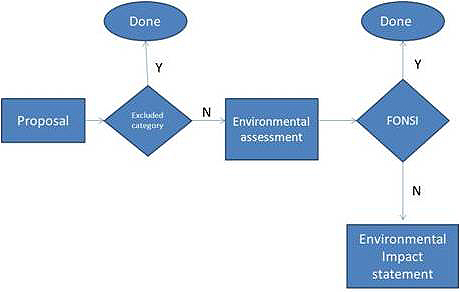
米国では、図1のプロセスに従って手続きが進められる。プロジェクトに資金が提供される前に、提案書が作成される。規制当局はその提案書を審査する。除外カテゴリーに該当する場合、それ以上の措置は取られない。該当しない場合は、環境アセスメントが実施される。そのアセスメントで重大な影響がないという所見(finding of no significant impact, FONSI)が出された場合、それ以上の措置は取られない。それ以外のすべての場合には、環境影響評価書が必要となる。
図中の英語
EIS の作成は、リソースの面で負担の大きいタスクである。Bregman (2000) と Kreske (1996) は、このプロセスを分かりやすく概説している。Lee and Lin (2000) は、提出用の技術資料の作成に役立つ、環境工学の計算ハンドブックを提供している。コンサルティングサービスを提供する企業も多い。
米国における基本的な参考文献には、1969年の国家環境政策法とその施行規則(NEPA 1969)、および欧州委員会指令(EC 1985)が含まれる。州および地方の規制は広範囲に及ぶことがある。Burby and Paterson (1993) は、準拠の改善について論じている。
プロジェクトの規模によっては、EIS の作成に数年を要し、費用が数百万ドル規模に上ることがある。例えば、ホノルルのライトレール計画の EIS には4年を要し、$156M のコストがかかった(Hill 2011)。EIS が負の影響を見出したとしてもプロジェクトは進行し得るが、プロジェクトへの反対者は、EIS プロセスを用いてプロジェクトを遅らせることがある。よく用いられる戦術は、EIS が何らかの環境影響を省いており不完全であったと主張することである。Eccleston (2000) は、EIS に向けた計画策定の指針を示している。
エネルギー効率のための設計については、大量の文献が公表されている。Lovins (2010) は10の設計原則を提示している。また、事例研究も示している(Lovins et al. 2011)。Intel (2021) は、自社のコンピュータチップのエネルギー効率を改善するための指針を示している。構造物の効率的な設計についても、多くの情報が入手可能である。DOE (2011) は良い概観を提供している。
エネルギー効率の向上は、システムの総ライフサイクルコストを大幅に削減し得る。例えば、トヨタ・プリウスは、初期購入価格が高いにもかかわらず、60,000 マイル、3年間でのライフサイクルコストが最も低いことが分かった(Brown 2011)。
二酸化炭素の排出には、ますます注目が集まっている。BSI British Standards は、商品およびサービスのライフサイクルにおける温室効果ガス排出量を評価するための仕様を提供している(BSI 2011)。
Graedel and Allenby (2009)、Maydl (2004)、Stasinopoulos (2009)、Meryman (2004)、Lockton and Harrison (2008) は、持続可能性のための設計について論じている。持続可能性は、国連の報告書『我ら共有の未来(Our Common Future)』(WCED 1987)やリオ宣言(UN 1992)の文脈で論じられることが多い。
エンタープライズは、さまざまな環境規制への準拠に注意を払わなければならない。Dechant et al. (1994) は、売上1ドルのうち17%が準拠アクティビティに充てられている企業の例を示している。彼らは、準拠の改善を通じて競争優位を獲得することについて論じている。Gupta (1995) は、規制への準拠によって企業の業務運営機能がどのように改善され得るかを研究している。Berry (1998) と Nash (2001) は、エンタープライズによる環境マネジメントの方法について論じている。
ISO14001 は、組織が環境規制に準拠するための標準を定めている。Kwon and Seo (2002) は韓国の文脈でこれを論じており、Whitelaw (2004) は ISO14001 の導入に関するハンドブックを示している。
開発する製品によっては、運用条件に関する標準が存在する場合がある。例えば、ISO 9241-6 はビデオ表示端末のオフィス環境を規定している。軍事装備には、米国では MILSTD 810G 標準(DoD 2014)、英国では DEF STAN 00-35(MoD 2017)への適合が求められる場合がある。
米国連邦航空局は、EIS のベストプラクティスの一覧を公表している(FAA 2002)。
米国環境保護庁(EPA)は、グリーンエンジニアリング(Green Engineering)を次のように定義している。すなわち、(1) 発生源での汚染の発生と、(2) 人の健康および環境へのリスクを最小限に抑えつつ、実現可能かつ経済的なプロセスと製品を設計し、商業化し、利用することである(EPA 2011)。グリーンエンジニアリングには、人の健康と環境を守るための決定は、プロセスや製品の設計・開発フェーズの早い段階で適用されたときに最大の効果と費用対効果をもたらし得る、という考え方が含まれている。
EPA (2011) は、グリーンエンジニアリングの原則として以下を示している。
Berry, M. A. “Proactive Corporate Environmental Management: A New Industrial Revolution.” The Academy of Management Executive 12, no. 2: 38–50. 1998.
Bregman, J.I. Environmental Impact Statements, 2nd ed. Boca Raton, FL: CRC Press. 2000.
Brown, C. "The Green Fleet Price Tag." Business Fleet. 2011. https://www.businessfleet.com/Article/Story/2011/07/The-Green-Fleet-Price-Tag.aspx.
British Standards Institution (BSI). "Specification for the assessment of the life cycle greenhouse gas emissions of goods and service, PAS 2050:2011." British Standards Institution (BSI), London, UK: 2011. https://shop.bsigroup.com/en/forms/PASs/PAS-2050.
BSI. Specification for the Assessment of the Life Cycle Greenhouse Gas Emissions of Goods and Services: PAS 2050:2011. London: BSI. 2011. https://shop.bsigroup.com/en/forms/PASs/PAS-2050
Burby, R. J., and R. G. Paterson. “Improving Compliance with State Environmental Regulations.” Journal of Policy Analysis and Management 12, no. 4: 753–772.1993.
Dechant, K., B. Altman, R. M. Downing, and T. Keeney. “Environmental Leadership: From Compliance to Competitive Advantage.” Academy of Management Executive 8, no. 3: 7. 1994.
Department of Defense (DoD). Department of Defense Test Method Standard: Environmental Engineering Considerations and Laboratory Tests, MIL‑STD‑810G Change Notice 1. Washington, DC: US Army Test and Evaluation Command, US Department of Defense. Accessed May 15, 2022. https://everyspec.com/MIL-STD/MIL-STD-0800-0899/MIL-STD-810G_CHG-1_50560/. 2014.
Eccleston, C. Environmental Impact Statements: A Comprehensive Guide to Project and Strategic Planning. New York: Wiley. 2014.
Environmental Protection Agency (EPA). “Green Engineering.” United States Environmental Protection Agency. 2011. https://www.epa.gov/green-engineering.
European Commission (EC). “Council Directive of 27 June 1985 on the Assessment of the Effects of Certain Public and Private Projects on the Environment (85/337/EEC).” 1985. https://www.legislation.gov.uk/eudr/1985/337/pdfs/eudr_19850337_adopted_en.pdf.
Federal Aviation Administration (FAA). “Best Practices for Environmental Impact Statement (EIS) Management.” 2002. https://www.faa.gov/airports/environmental/eis_best_practices/?sect=intro.
Graedel, T. E., and B. R. Allenby. Industrial Ecology and Sustainable Engineering. Upper Saddle River, NJ: Prentice Hall. 2009.
Gupta, M. C. “Environmental Management and Its Impact on the Operations Function.” International Journal of Operations and Production Management 15, no. 8: 34–51. 1995
Hill, T. “Honolulu Rail’s Next Stop?” Honolulu Magazine, July 2011.
Intel. “Corporate Social Responsibility.” Intel Corporation. 2021. https://www.intel.com/intel/other/ehs/product_ecology/energy.htm.
Kreske, D. L. Environmental Impact Statements: A Practical Guide for Agencies, Citizens, and Consultants. New York: Wiley. 1996.
Kwon, D. M., and M. S. Seo. “A Study of Compliance with Environmental Regulations of ISO 14001 Certified Companies in Korea.” Journal of Environmental Management 65, no. 4: 347–353. 2002.
Lee, C. C., and S. D. Lin. Handbook of Environmental Engineering Calculations. New York: McGraw Hill Professional. 2000.
Lockton, D., and D. Harrison. “Making the User More Efficient: Design for Sustainable Behaviour.” International Journal of Sustainable Engineering 1, no. 1: 3–8. 2008
Lovins, A. “Factor Ten Engineering Design Principles,” version 1.0. 2011. https://www.rmi.org/Knowledge-Center/Library/2010-10_10xEPrinciples.
Lovins, A., et al. “Case Studies.” 2011. https://move.rmi.org/markets-in-motion/case-studies/.
Maydl, P. “Sustainable Engineering: State-of-the-Art and Prospects.” Structural Engineering International 14, no. 3: 176–180. 2004.
Meryman, H. “Sustainable Engineering Using Specifications to Make It Happen.” Structural Engineering International 14, no. 3. 2004.
UK Ministry of Defence (MoD). Standard 00‑35, Environmental Handbook for Defence Materiel (Part 3) Environmental Test Methods. London: UK Ministry of Defence. 2017. https://standards.globalspec.com/std/10074175/def-stan-00-035-part-3.
Nash, J. Regulating From the Inside: Can Environmental Management Systems Achieve Policy Goals? Washington, DC: Resources for the Future Press. 2001.
National Environmental Policy Act (NEPA). 42 USC 4321–4347. 1969. https://ceq.doe.gov/laws-regulations/laws.html.
Stasinopoulos, P. Whole System Design: An Integrated Approach to Sustainable Engineering. London: Routledge. 2009.
United Nations (UN). “Rio Declaration on Environment and Development.” 1992. thttps://www.un.org/en/development/desa/population/migration/generalassembly/docs/globalcompact/A_CONF.151_26_Vol.I_Declaration.pdf.
Whitelaw, K. ISO 14001: Environmental Systems Handbook, 2nd ed. Oxford: Elsevier. 2004.
World Commission on Environment and Development (WCED). “Report of the World Commission on Environment and Development: Our Common Future.” 1987. https://sustainabledevelopment.un.org/milestones/wced.
Bregman, J.I. Environmental Impact Statements, 2nd ed. Boca Raton, FL: CRC Press. 2000.
Graedel, T. E., and B. R. Allenby. Industrial Ecology and Sustainable Engineering. Upper Saddle River, NJ: Prentice Hall. 2009.
Lee, C. C., and S. D. Lin. Handbook of Environmental Engineering Calculations. New York: McGraw Hill Professional. 2000.
Whitelaw, K. ISO 14001: Environmental Systems Handbook, 2nd ed. Oxford: Elsevier. 2004.
None.