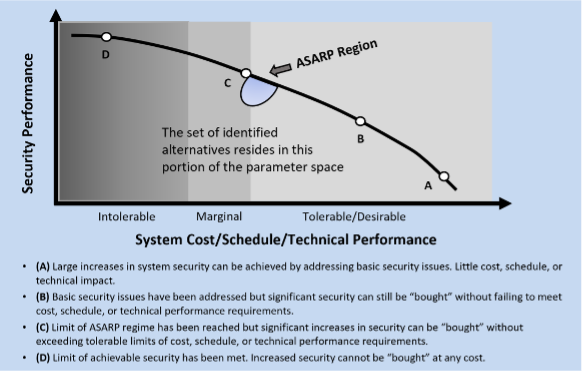
図1:システムセキュリティとコスト/スケジュール/その他の性能(Ross, Winstead, & McEvilley, 2022 - Public Domain)
System Security
Security is freedom from those conditions that may lead to loss of assets (anything of value) with undesired consequences (Ross, Winstead, & McEvilley 2022). Systems Security specifically is concerned with systems delivering capability (an asset) with intended and only intended behaviors and outcomes (no unacceptable consequences such as loss of asset integrity) in contested operational environments (cyberspace or physical).
セキュリティとは、望ましくない結果を伴う資産(価値のあるもの)の喪失につながり得る条件から免れていることである(Ross, Winstead, & McEvilley 2022)。とりわけシステムセキュリティが関心を向けるのは、敵対的な働きかけを受け得る運用環境(サイバー空間または物理的環境)において、意図された、かつ意図されたものに限られる振る舞いと結果をもって(資産の完全性の喪失のような許容できない結果を伴わずに)能力(資産)を提供するシステムである。
Restated, Systems Security is about engineering for intended and authorized system behavior and outcomes despite anticipated and unanticipated adversity, conditions that may cause loss (e.g., threats, attacks, hazards, disruptions, exposures). (McEvilley & Winstead 2022)
言い換えれば、システムセキュリティとは、想定内・想定外の逆境や、損失を引き起こし得る条件(例:脅威、攻撃、ハザード、機能中断、露出)があっても、意図され認可されたシステムの振る舞いと結果が得られるよう設計することである(McEvilley & Winstead 2022)。
Note: This is a completely new article inserted in SEBoK 2.9, replacing the previous version by Richard Fairley, Alice Squires, and Keith Willett which originally appeared in SEBoK 1.0 and was periodically updated through SEBoK 2.8.
注: これは SEBoK 2.9 で追加された完全に新しい記事であり、SEBoK 1.0 で初めて掲載され SEBoK 2.8 まで定期的に更新されてきた、Richard Fairley、Alice Squires、Keith Willett による旧版に代わるものである。
Secure systems ideally have three essential characteristics (Ross, Winstead, & McEvilley 2022):
セキュアなシステムは、理想的には次の3つの本質的な特性を備える(Ross, Winstead, & McEvilley 2022):
• Enable required system capability delivery despite intentional and unintentional forms of adversity.
• 意図的・非意図的な形態の逆境があっても、要求されるシステム能力を提供できるようにする。
• Enforce constraints to ensure only the desired behaviors and outcomes associated with the required capability are realized while realizing the first characteristic.
• 第1の特性を実現しながら、要求される能力に関連する望ましい振る舞いと結果のみが実現されることを確実にするために制約を実施する。
• Enforce constraints based on a set of rules defining the only authorized interactions and operations allowed to occur while satisfying the second characteristic.
• 第2の特性を満たしつつ、発生が許される認可された相互作用と運用のみを定める一連の規則に基づいて、制約を課す。
Desired behaviors and outcomes are those reflecting the delivery of the desired system capabilities and features without experiencing loss with undesired consequences, such as loss of information privacy.
望ましい振る舞いと結果とは、情報プライバシーの喪失のような望ましくない結果を伴う損失を被ることなく、望ましいシステム能力と特徴が提供されることを反映したものである。
While these characteristics are to be achieved to the extent practicable, gaps will occur between the ideal and what can be dependably achieved. A system should be as secure as reasonably practical (ASARP) while meeting minimum stakeholder expectations for security and optimized among other performance objectives and constraints, informed by the principle of commensurate trustworthiness – trustworthy to a level commensurate with the most significant adverse effect resulting from loss or failure. (Hild, McEvilley, & Winstead 2021)
これらの特性は実行可能な範囲で達成されるべきものだが、理想と確実に達成できるものとの間にはギャップが生じる。システムは、セキュリティに対するステークホルダーの最低限の期待を満たし、他の性能目的や制約との間で最適化されながら、合理的に実行可能な限りセキュアであるべきである(ASARP)。これは、見合ったトラストワージネス(commensurate trustworthiness)の原則——喪失や失敗から生じる最も重大な悪影響に見合った水準まで信頼に足ること——を踏まえたものである(Hild, McEvilley, & Winstead 2021)。
Secure systems ideally have three essential characteristics (Ross, Winstead, & McEvilley 2022):
セキュアなシステムは、理想的には次の3つの本質的な特性を備える(Ross, Winstead, & McEvilley 2022):
• Enable required system capability delivery despite intentional and unintentional forms of adversity.
• 意図的・非意図的な形態の逆境があっても、要求されるシステム能力を提供できるようにする。
• Enforce constraints to ensure only the desired behaviors and outcomes associated with the required capability are realized while realizing the first characteristic.
• 第1の特性を実現しながら、要求される能力に関連する望ましい振る舞いと結果のみが実現されることを確実にするために制約を実施する。
• Enforce constraints based on a set of rules defining the only authorized interactions and operations allowed to occur while satisfying the second characteristic.
• 第2の特性を満たしつつ、発生が許される認可された相互作用と運用のみを定める一連の規則に基づいて、制約を課す。
Desired behaviors and outcomes are those reflecting delivery of the desired system capabilities and features without experiencing loss with undesired consequences, such as loss of information privacy.
望ましい振る舞いと結果とは、情報プライバシーの喪失のような望ましくない結果を伴う損失を被ることなく、望ましいシステム能力と特徴が提供されることを反映したものである。
While these characteristics are to be achieved to the extent practicable, gaps will occur between the ideal and what can be dependably achieved. A system should be as secure as reasonably practical (ASARP) while meeting minimum stakeholder expectations for security and optimized among other performance objectives and constraints, informed by the principle of commensurate trustworthiness – trustworthy to a level commensurate with the most significant adverse effect resulting from loss or failure. (Hild, McEvilley, & Winstead 2021)
これらの特性は実行可能な範囲で達成されるべきものだが、理想と確実に達成できるものとの間にはギャップが生じる。システムは、セキュリティに対するステークホルダーの最低限の期待を満たし、他の性能目的や制約との間で最適化されながら、合理的に実行可能な限りセキュアであるべきである(ASARP)。これは、見合ったトラストワージネス(commensurate trustworthiness)の原則——喪失や失敗から生じる最も重大な悪影響に見合った水準まで信頼に足ること——を踏まえたものである(Hild, McEvilley, & Winstead 2021)。
図中の英語
To understand the optimization of security among other performance objectives, stakeholders need to be aligned and respectful of each other’s needs. As loss and loss effects or consequences are easily understood, a collaborative understanding of loss tolerances provides a means to alignment as well as forms a basis for metrics across the system lifecycle. (Dove, et al. 2023)
セキュリティを他の性能目的との間で最適化するという考え方を理解するには、ステークホルダー同士が連携し、互いのニーズを尊重する必要がある。損失や、損失の影響・結果は容易に理解できるため、損失の許容度について協働して理解を共有することは、連携の手段となるとともに、システムライフサイクル全体にわたる指標の基礎ともなる(Dove, et al. 2023)。
Security, one of 10 acknowledged areas of growing stakeholder expectations in INCOSE’s Systems Engineering Vision 2035, is recognized as needed to become a foundational perspective for system design. (INCOSE 2021) This growing expectation is motivated by increasing cyberspace-based attacks as evidenced by reports such as Security Magazine’s report for computers with Internet access, an attack occurred every 39 seconds in 2017 and has increased since (Security 2017) by observations from the conflict in Ukraine (Carnegie Endowment for International Peace 2023) including attacks on civilian targets such as critical infrastructure, and many well-publicized exploited vulnerable systems. (Agile IT 2023)
セキュリティは、INCOSE の Systems Engineering Vision 2035 においてステークホルダーの期待が高まっていると認められた10の領域の一つであり、システム設計の基礎的な観点となる必要があると認識されている(INCOSE 2021)。こうした期待の高まりの背景には、サイバー空間を介した攻撃の増加がある。そのことは、Security Magazine の報告——インターネットに接続されたコンピュータに対する攻撃は2017年に39秒に1回発生しており、その後も増加している(Security 2017)——や、ウクライナにおける紛争から得られた知見(Carnegie Endowment for International Peace 2023)(重要インフラのような民間の標的への攻撃を含む)、さらに広く報じられた多くの脆弱なシステムの悪用によって裏づけられている(Agile IT 2023)。
Adversity, conditions that can cause a loss of assets (e.g., threats, attacks, vulnerabilities, hazards, disruptions, and exposures), occurs throughout the system lifecycle. Such conditions are internal and external to the system, with internal conditions often the result of faults and defects (e.g., missing requirements, implementation errors). Consequently, system security’s scope matches systems engineering’s scope, and every systems engineering process and activity has security considerations. (Ross, Winstead, & McEvilley 2022)
逆境、すなわち資産の喪失を引き起こし得る条件(例:脅威、攻撃、脆弱性、ハザード、機能中断、露出)は、システムライフサイクル全体を通じて発生する。こうした条件はシステムの内部にも外部にも存在し、内部の条件は障害や欠陥(例:要求事項の欠落、実装エラー)に起因することが多い。したがって、システムセキュリティの範囲はシステムズエンジニアリングの範囲と一致し、システムズエンジニアリングのあらゆるプロセスと活動にセキュリティ上の考慮事項がある(Ross, Winstead, & McEvilley 2022)。
“Unless security is [engineered] into a system from its inception, there is little chance that it can be made secure by retrofit”. (Anderson 1972) Consequently, security must be a foundational perspective from concept exploration.
「セキュリティが当初からシステムに[設計]されていない限り、後付けでセキュアにできる見込みはほとんどない」(Anderson 1972)。したがって、セキュリティは概念探索の段階から基礎的な観点でなければならない。
An asset is an item of value to a stakeholder. Ross, Winstead, & McEvilley (2022) identified broad asset classes, summarized in Table 1.
資産とは、ステークホルダーにとって価値のある品目である。Ross, Winstead, & McEvilley(2022)は大まかな資産クラスを特定しており、その概要を表1に示す。
表1. 一般的な資産クラス(Ross, Winstead, and McEvilley, 2022 - Public Domain)
| +Table 1. Common Asset Classes (Ross, Winstead, and McEvilley, 2022 - Public Domain)''' |
| Class |
|---|
| Description |
| Loss Protection Criteria |
| Material Resources and Infrastructure |
| Includes |
| Material resources are protected from loss if they are not stolen, damaged, or destroyed or are able to function or be used as intended, as needed, and when needed. |
| System Capability |
| The set of capabilities and services provided by a system |
| System capability is protected from loss when it meets its performance expectations while delivering only the authorized and intended capability and producing only the authorized and intended outcomes. |
| Human Resources |
| Personnel who are part of the system and personnel affected by the system |
| Human resources are protected from loss if they are not injured, suffer illness, or killed. |
| Intellectual Property |
| Trade secrets, recipes, technology, and other items that constitute an advantage over competitors |
| Intellectual property is protected from loss if it is not stolen, corrupted, destroyed, copied, substituted in an unauthorized manner, or reverse-engineered in an unauthorized manner. |
| Data and Information |
| Includes all types of data and information and all encodings and representations of data and information |
| Data and information are protected from loss due to unauthorized alteration, exfiltration, infiltration, and destruction. |
| Derivative Non-Tangible |
| Includes image, reputation, and trust. Such assets are affected by the success or failure to protect other assets |
| Non-tangible assets are protected from loss by ensuring the adequate protection of assets in the other classes. |
| クラス | 説明 | 損失保護の基準 |
|---|---|---|
| 物的資源とインフラストラクチャ | 以下を含む;物理的財産(例:建物、施設、設備);物理的資源(例:水、燃料);活動や、エンタープライズ・社会の運営に必要な基本的な物理的・組織的構造と施設(すなわちインフラストラクチャ)。インフラストラクチャは一般に、一国の国家空域インフラストラクチャのような資産から構成され、そこにはその国の空港が含まれる | 物的資源は、盗まれず、損傷せず、破壊されない場合、または意図したとおりに、必要に応じて、必要なときに機能または使用できる場合に、損失から保護される。インフラストラクチャは、認可され意図された能力のみを提供し、認可され意図された結果のみを生み出しつつ、性能の期待を満たす場合に、損失から保護される |
| システム能力 | システムが提供する能力とサービスの集合 | システム能力は、認可され意図された能力のみを提供し、認可され意図された結果のみを生み出しつつ、その性能の期待を満たす場合に、損失から保護される |
| 人的資源 | システムの一部である人員と、システムの影響を受ける人員 | 人的資源は、負傷せず、病気にならず、死亡しない場合に、損失から保護される |
| 知的財産 | 企業秘密、レシピ、技術など、競合他社に対する優位性となる品目 | 知的財産は、盗まれず、破損せず、破壊されず、複製されず、認可されない方法で置き換えられず、認可されない方法でリバースエンジニアリングされない場合に、損失から保護される |
| データと情報 | あらゆる種類のデータと情報、およびデータと情報のあらゆるエンコーディングと表現を含む | データと情報は、認可されない改変、流出、侵入、破壊による損失から保護される |
| 派生的な非有形 | イメージ、評判、信頼を含む。こうした資産は、他の資産の保護の成否に影響される | 非有形資産は、他のクラスの資産が適切に保護されるようにすることで、損失から保護される |
Systems thinking is the practice of thinking holistically about systems: relating systems behaviors and concepts to principles based on patterns. It is flexible, conceptual, and strategic in nature: hence generally adapted in systems architecture work. Systems thinking focuses not on immediate cause and effect, but also examines the dynamics of a system to identify secondary effects on behaviors and choices. (Goodman 2018)
システム思考(systems thinking)とは、システムを全体的に捉えて考える実践であり、システムの振る舞いや概念を、パターンに基づく原則と関連づけることである。システム思考は本質的に柔軟で、概念的かつ戦略的である。そのため、一般にシステムアーキテクチャの作業に適用される。システム思考は、直接的な原因と結果に焦点を当てるだけでなく、システムのダイナミクスも調べて、振る舞いや選択に及ぶ二次的な効果を特定する(Goodman 2018)。
Security, especially cybersecurity, has suffered from being treated as a tactics problem, focusing on threat defense and incident response. Security has also become a forensics exercise, steeped in root cause analysis, to add to the known threat defense. Systems thinking realizes the greater objective is assuring a systems’ ability to produce the capability (functions and services) that users depend on the system for and contributing to business and mission needs and produce that capability in an acceptable manner (i.e., no harm to stakeholder assets). The need is to focus less on efforts to defend against adversarial action beyond the control of the systems engineer and more on assuring the system performs and protects stakeholder assets, controlling the system from effects of loss, to include avoiding vulnerability that leads to loss when practical. (Young & Leveson 2013) Systems thinking brings security back into the conceptual, design, and implementation of systems capabilities.
セキュリティ、とりわけサイバーセキュリティは、脅威からの防御やインシデント対応に焦点を当てた戦術上の問題として扱われてきたことで弊害を被ってきた。また、セキュリティは、既知の脅威防御に知見を加えるための、根本原因分析に深く浸かったフォレンジクスの演習にもなってきた。システム思考は、より大きな目的が次の点にあると捉える。すなわち、ユーザーがシステムに頼って得ている能力(機能とサービス)を生み出すシステムの能力を保証し、事業やミッションのニーズに寄与し、しかもその能力を許容可能な方法で(すなわち、ステークホルダーの資産に危害を与えずに)生み出すことである。必要なのは、システムエンジニアの制御が及ばない敵対的行動に対する防御の取り組みへの比重を減らし、システムが機能を遂行してステークホルダーの資産を保護することを保証し、システムが損失の影響を受けないよう制御することに、より比重を置くことである。これには、実行可能な場合に、損失につながる脆弱性を回避することが含まれる(Young & Leveson 2013)。システム思考は、セキュリティをシステム能力の概念、設計、実装の中に取り戻す。
Consequently, the need is to focus on a system’s trustworthiness rather than singularly focus on risk. (Dove, et al. 2021) Quality evidence such as that generated by verification and validation activities feed assurance arguments that merit trustworthiness, providing a basis for trust by stakeholders. Without such assurance, security functionality is a form of veneer security (Saydjari 2018), providing an unmerited sense of trustworthiness.
したがって、必要なのは、リスクだけに焦点を当てるのではなく、システムのトラストワージネスに焦点を当てることである(Dove, et al. 2021)。検証や妥当性確認の活動によって生成されるような質の高い証拠は、トラストワージネスに値する保証の論拠を支え、ステークホルダーが信頼を置くための基礎となる。そのような保証がなければ、セキュリティ機能は上辺だけのセキュリティ(veneer security)の一形態であり、実態に見合わない信頼感を与える(Saydjari 2018)。
Loss, the experience of having an asset taken away or destroyed or the failure to keep or to continue to have an asset in a desired state or form (Ross, Winstead, & McEvilley 2022), provides language understood by all stakeholders (Dove, et al. 2023). Stakeholder concern is typically the effects of loss caused by adversity, not the adversity itself, and their priorities driven by consequences (e.g., impact to mission). Their needs and requirements can thus be expressed in terms of loss, loss scenarios, loss tolerance, and acceptable loss.
Addressing loss must consider loss results from combinations of adverse events or conditions that cause or lead to unacceptable ramifications, consequences, or impacts. Due to uncertainty (including uncertainty about adversity), guaranteeing a loss will not occur is not possible. The focus must be on controlling loss effects, including cascading or ripple events; e.g., the effect causes additional losses to occur. (Ross, Winstead, & McEvilley 2022)
Loss control objectives frame addressing loss. Loss can be addressed by use of historically-informed practices (known good things to do) and assessing specific loss scenarios for opportunities to address conditions and the potential loss itself.
損失とは、資産を奪われたり破壊されたりする経験、あるいは資産を望ましい状態や形態で保持し続けられない、または持ち続けられないことである(Ross, Winstead, & McEvilley 2022)。損失は、すべてのステークホルダーが理解できる言葉を提供する(Dove, et al. 2023)。ステークホルダーの関心は通常、逆境そのものではなく、逆境によって引き起こされる損失の影響にあり、その優先事項は結果(例:ミッションへの影響)によって左右される。したがって、ステークホルダーのニーズと要求事項は、損失、損失シナリオ、損失の許容度、許容可能な損失という観点で表現できる。
損失に対処するには、損失が、許容できない余波、結果、影響を引き起こす、あるいはそれらにつながる不利な事象や条件の組み合わせから生じることを考慮しなければならない。不確実性(逆境に関する不確実性を含む)があるため、損失が発生しないと保証することはできない。焦点は、連鎖的・波及的な事象も含めて、損失の影響を制御することに置かなければならない。例えば、ある影響がさらなる損失の発生を引き起こす場合である(Ross, Winstead, & McEvilley 2022)。
損失制御の目的は、損失に対処するための枠組みとなる。損失には、過去の経験に裏づけられた実践(行うべきと分かっている良いこと)を用いることと、具体的な損失シナリオを評価して、条件や潜在的な損失そのものに対処する機会を見いだすことによって対処できる。
表2. 損失制御の目的(Ross, Winstead, and McEvilley, 2022 - Public Domain)
| +Table 2. Los Control Objectives (Ross, Winstead, and McEvilley, 2022 - Public Domain)''' |
| Loss Control Objective |
|---|
| Discussion |
| Prevent the Loss from Occurring |
| *Loss is avoided. Despite the presence of adversity: |
| Limit the Extent of Loss |
| *Loss can or has occurred. The loss effect extent is to be limited. |
| 損失制御の目的 | 議論 |
|---|---|
| 損失の発生を防ぐ | 損失は回避される。逆境が存在しても;システムは意図された振る舞いのみを提供し、意図された結果のみを生み出す;システムと資産の望ましい特性が保持される。以下の組み合わせによって達成される;損失を引き起こす事象を防止または除去する;損失の発生を可能にする条件を防止または除去する;事象や条件があっても悪影響を被らない(例:フォールトトレランス) |
| 損失の程度を制限する | 損失が発生し得る、またはすでに発生している。損失の影響の程度を制限する。以下の組み合わせによって達成される;拡がりを制限する(例:伝播、波及、連鎖効果);期間を制限する(例:ミリ秒、分、日);容量を制限する(例:サービスや能力の低下);量を制限する(例:データ/情報のビットやバイト)。損失の程度を制限する決定には、一連の損失の中で何を許容可能な損失とするかの優先順位づけが必要になることがある(すなわち、ある資産の損失を制限するには、他の資産のある程度の損失を受け入れる必要がある)。損失の回復と損失の遅延は、損失を制限する2つの手段である;損失の回復:システム自体によって、またはシステムが可能にすることによって、機能する能力の一部または全部を回復し、システムが使用する資産を回復するための行動が取られる。資産の復旧により、損失の拡がり、期間、容量、量を制限できる;損失の遅延:悪影響が軽減されるまで、あるいは遅延によってより堅牢な対応やより迅速な回復が可能になる場合に、損失事象は回避される |
Loss scenarios describe the events and conditions that lead to unacceptable outcomes. These scenarios do not necessarily lead back to “root causes” in each case, but must capture the internal system (e.g., system states, internal faults) and the external environmental conditions (e.g., loss of power, presence of malicious insider threat) that may lead to a loss, including unauthorized system use (e.g., loss of control). See Figure 2.
損失シナリオは、許容できない結果につながる事象と条件を記述する。これらのシナリオは、必ずしも各ケースで「根本原因」までさかのぼる必要はないが、損失につながり得るシステム内部の条件(例:システムの状態、内部の故障)と外部の環境条件(例:電力の喪失、悪意ある内部者の脅威の存在)を、認可されないシステムの使用(例:制御の喪失)も含めて捉えなければならない。図2を参照。
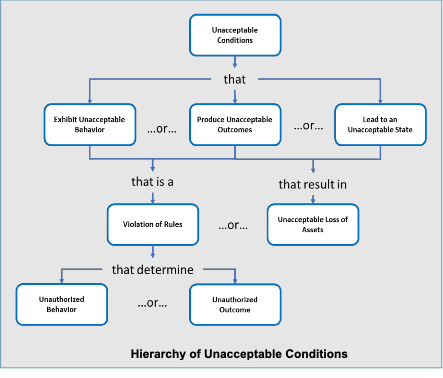
図中の英語
Loss scenarios may be analyzed to inform requirements definition and derivation and analyze design alternatives, as well as inform tailoring of historically-informed practice usage.
損失シナリオを分析して、要求事項の定義と導出や設計代替案の分析に役立てるとともに、過去の経験に裏づけられた実践の適用方法の調整に役立てることがある。
Most systems are part of a larger system of systems or enterprises. Adversity often comes through or from these connected systems.
ほとんどのシステムは、より大きなシステム・オブ・システムズやエンタープライズの一部である。逆境は多くの場合、こうした接続されたシステムを経由して、あるいはそれら自体からもたらされる。
Systems engineering must balance a system’s self-protection capability with opportunities for mutual collaborative protection (Dove, et al. 2021) with trustworthy systems within an enterprise. Enterprises may have dedicated systems for protection, often within network operations and security centers (NOSCs). (Knerler, Parker, & Zimmerman 2022) Systems may also collaborate by sharing situational awareness, with one system alerting others of suspicious activity that may indicate malicious actions others may experience.
システムズエンジニアリングでは、システムの自己保護能力と、エンタープライズ内の信頼できるシステムとの相互的・協働的な保護の機会とのバランスを取らなければならない(Dove, et al. 2021)。エンタープライズは保護専用のシステムを持つことがあり、それらはネットワーク運用・セキュリティセンター(NOSC)内に置かれていることが多い(Knerler, Parker, & Zimmerman 2022)。システム同士は状況認識を共有することでも協働でき、あるシステムが、他のシステムが経験し得る悪意ある行動を示しているかもしれない疑わしい活動を、他のシステムに警告する。
Systems Security has commonality and synergy with many other disciplines, such as safety; quality management; reliability, availability, and maintenance (RAM); survivability; operational risk management; and resilience. Overlapping concerns exist with assets, losses, and adversities considered; requirements; and various engineering processes and analyses similarities and opportunities; e.g., System Theoretic Process Analysis, or STPA (Young & Leveson 2013). Some considerations for pursuing these commonalities and synergies were explored in Brtis (2020).
システムセキュリティは、安全性;品質マネジメント;信頼性、可用性、保全性(RAM);残存性;運用的リスクマネジメント;レジリエンスなど、他の多くの分野と共通性と相乗効果を持つ。考慮される資産・損失・逆境;要求;さまざまな工学プロセスや分析の類似性と機会について、関心事が重なっている。その一例が、システム理論的プロセス分析、すなわち STPA(Young & Leveson 2013)である。これらの共通性と相乗効果を追求するためのいくつかの考慮事項が、Brtis(2020)で検討されている。
Systems security engineering is a sub-discipline of systems engineering, defined in Ross, Winstead, & McEvilley (2022) as a transdisciplinary and integrative approach to enable the successful secure realization, use, and retirement of engineered systems using systems, security, and other principles and concepts, as well as scientific, technological, and management methods. Systems security engineers are part of the systems engineering teams.
システムセキュリティ工学はシステムズエンジニアリングの一分野であり、Ross, Winstead, & McEvilley(2022)では、システム、セキュリティ、その他の原則と概念、ならびに科学的、技術的、マネジメント的な手法を用いて、工学的に設計されたシステムの成功裏でセキュアな実現、使用、廃止を可能にする、超学際的で統合的なアプローチと定義されている。システムセキュリティエンジニアは、システムズエンジニアリングチームの一員である。
But as security is demonstrated in a system’s behaviors and outcomes, systems engineering responsibility, the systems engineer is ultimately responsible for a system’s security. (Thomas 2013) However, reflecting the maxim “Security is everyone’s job”, all engineering disciplines have security responsibilities (Dove, et al. 2021), not just the systems engineer and various specialists in areas like supply chain assurance, hardware assurance, software assurance, cybersecurity, and physical security.
しかし、セキュリティはシステムの振る舞いと結果において示されるものであり、それはシステムズエンジニアリングの責任であるため、システムのセキュリティに最終的な責任を負うのはシステムエンジニアである(Thomas 2013)。とはいえ、「セキュリティは全員の仕事」という格言が示すとおり、すべての工学分野がセキュリティに対する責任を負っている(Dove, et al. 2021)。責任を負うのは、システムエンジニアや、サプライチェーン保証、ハードウェア保証、ソフトウェア保証、サイバーセキュリティ、物理的セキュリティといった領域のさまざまな専門家だけではない。
The INCOSE SE Vision 2035 sets an aim that security “will be as foundational a perspective in systems design as system performance and safety are today”. (INCOSE 2021) To that end and other aims for security within the Vision, the INCOSE Systems Security Engineering Working Group has set objectives and roadmap concepts (Dove 2022).
INCOSE SE Vision 2035 は、セキュリティが「今日のシステム性能と安全性と同様に、システム設計における基礎的な観点になる」という目標を掲げている(INCOSE 2021)。この目標と、Vision に掲げられたセキュリティに関するその他の目標に向けて、INCOSE Systems Security Engineering Working Group は目的とロードマップの概念を定めた(Dove 2022)。
表3. FuSE セキュリティ概念の概要(Dove, Setting Current Context for Security in the Future of Systems Engineering, 2022)
| Roadmap Concept |
|---|
| General Needs to Fill |
| Security Proficiency in the Systems Engineering Team |
| System security and its evolution effectively enabled by systems engineering activity. |
| Education and Competency Development |
| Education at all levels focused on security of cyber-physical systems. |
| Stakeholder Alignment |
| Common security vision and knowledge among all stakeholders. |
| Loss-Driven Engineering |
| Standard metrics and abstractions relevant to all system lifecycle phases. |
| Architectural Agility |
| Readily composable and re-composable security with feature variants. |
| Operational Agility |
| Ability for cyber-relevant response to attack and potential threat; resilience in security system. |
| Capability-Based Security Engineering |
| Top-down approach to security starting with desired results/value. |
| Security as a Functional Requirement |
| Systems engineering responsibility for the security of systems. |
| Modeled Trustworthiness |
| Reinvigorate formal modeling of system trust as a core aspect of system security engineering; address issues of scale with model-based tools and automation. |
| Security Orchestration |
| Tightly coupled coordinated system defense in cyber-relevant time. |
| Collaborative Mutual Protection |
| Augmented detection and mitigation of known and unknown attacks with components collaborating for mutual protection. |
| ロードマップの概念 | 満たすべき一般的なニーズ |
|---|---|
| システムズエンジニアリングチームにおけるセキュリティの熟達 | システムズエンジニアリング活動によって、システムセキュリティとその進化が効果的に可能となる |
| 教育とコンピテンシーの開発 | サイバーフィジカルシステムのセキュリティに焦点を当てた、あらゆるレベルの教育 |
| ステークホルダーの連携 | すべてのステークホルダー間での、セキュリティに関する共通のビジョンと知識 |
| 損失駆動工学 | システムライフサイクルのすべてのフェーズに関連する標準的な指標と抽象化 |
| アーキテクチャの敏捷性 | 特徴のバリエーションを伴う、容易に構成・再構成できるセキュリティ |
| 運用の敏捷性 | 攻撃や潜在的な脅威に対してサイバー関連の対応を行う能力;セキュリティシステムにおけるレジリエンス |
| 能力ベースのセキュリティ工学 | 望ましい結果/価値から出発する、トップダウンのセキュリティアプローチ |
| 機能要求としてのセキュリティ | システムのセキュリティに対するシステムズエンジニアリングの責任 |
| モデル化されたトラストワージネス | システムセキュリティ工学の中核的な側面として、システムの信頼の形式的なモデル化を再び活性化する;モデルベースのツールと自動化によって規模の問題に対処する |
| セキュリティのオーケストレーション | サイバー事象に間に合う時間尺度での、緊密に結合され協調したシステム防御 |
| 協働的な相互保護 | 相互保護のために協働する構成要素による、既知および未知の攻撃の検出と緩和の強化 |
The challenging problems for system security are numerous. Some of this is a result of neglecting the addressing of security early in the system life cycle as recognized by the Systems Engineering Vision call for security to be a foundational perspective – as Carl Landwehr wrote “This whole economic boom in [security] seems largely to be a consequence of poor engineering” (Landwehr 2015).
システムセキュリティにとって困難な問題は数多い。その一部は、システムライフサイクルの早い段階でセキュリティへの対処を怠ってきたことの結果であり、そのことは Systems Engineering Vision がセキュリティを基礎的な観点とするよう求めていることからも認識されている——Carl Landwehr が「[セキュリティ]におけるこの経済的ブーム全体は、主として拙い工学の結果であるように見える」と書いたとおりである(Landwehr 2015)。
For example, system of systems engineering security faces challenges in part to not knowing or trusting the component systems which may not have been engineered with security in mind, or at least did not consider documenting the evidence that informs trustworthiness. Another system of systems challenge comes as formerly isolated cyber-physical systems (CPSs) are increasingly connected to form larger system of systems, negating assumptions impacting security if security was considered at all. Additionally, legacy CPSs were not built thinking of the need to update the software; i.e. use sustainable security (Rosser 2023)), which creates a challenge in upgrading software to reflect revised assumptions and security models for the CPS in question.
例えば、システム・オブ・システムズ工学のセキュリティが課題に直面する一因は、構成システムについて知らないこと、あるいはそれを信頼しないことにある。構成システムは、セキュリティを念頭に置いて設計されていなかったかもしれないし、少なくともトラストワージネスの判断材料となる証拠を文書化することは考慮していなかった。システム・オブ・システムズのもう一つの課題は、以前は孤立していたサイバーフィジカルシステム(CPS)がますます接続され、より大きなシステム・オブ・システムズを形成するようになることで生じる。これにより、セキュリティがそもそも考慮されていた場合でも、セキュリティに影響する前提が無効になる。加えて、レガシーの CPS は、ソフトウェアを更新する必要性、すなわち持続可能なセキュリティを用いること(Rosser 2023)を想定して構築されていなかった。このことが、当該 CPS について改訂された前提とセキュリティモデルを反映するようにソフトウェアをアップグレードする際の課題を生んでいる。
Another challenge comes with the advancing use of Artificial Intelligence (AI). Any new technology presents security challenges until its usage matures, but AI introduces complexity and decreases predictability (INCOSE 2021). Managing complexity and uncertainty is necessary for security (Ross, Winstead, & McEvilley 2022), and AI increasing of both compounds the problem space for systems engineering security.
もう一つの課題は、人工知能(AI)の利用の進展に伴って生じる。どのような新技術も、その利用が成熟するまではセキュリティ上の課題をもたらすが、AI は複雑さを持ち込み、予測可能性を低下させる(INCOSE 2021)。複雑さと不確実性の管理はセキュリティに必要であり(Ross, Winstead, & McEvilley 2022)、AI がその両方を増大させることで、システムズエンジニアリングにおけるセキュリティの問題空間はさらに複雑になる。
Agile IT. n.d.. The Top 10 Biggest Cyberattacks of 2022. Accessed September 15, 2023. Available at https://www.agileit.com/news/biggest-cyberattacks-2022/.
Anderson, J. 1972. Computer Security Technology Planning Study, Technical Report ESD-TR-73-51. October 1, 1972. Hanscom AFB: Air Force Electronic Systems Division. Accessed September 15, 2023. Available at https://apps.dtic.mil/sti/citations/AD0758206.
Brtis, J. (ed). 2020. Loss-Driven Systems Engineering. INCOSE Insight, 23(4):7-8. Wiley. Accessed September 15, 2023. Available at https://incose.onlinelibrary.wiley.com/doi/abs/10.1002/inst.12312.
Carnegie Endowment for International Peace. n.d.. Cyber Conflict in the Russia-Ukraine War. Accessed September 15, 2023. Available at https://carnegieendowment.org/programs/technology/cyberconflictintherussiaukrainewar/.
Dove, R. 2022. “Setting Current Context for Security in the Future of Systems Engineering”. INCOSE Insight, 25(2):8-10.
Dove, R., K. Willett, T. McDermott, H. Dunlap, H, D.P. MacNamara, and C. Ocker. 2021. “Security in the Future of Systems Engineering (FuSE), a Roadmap of Foundational Concepts”. Proceedings of the 31st INCOSE International Symposium, July 17-22. Virtual only,
Dove, R., M. Winstead, H. Dunlap, M. Hause, A. Scalco, A. Scalco, A. Williams, and B. Wilson. 2023. “Democratizing Systems Security”. Proceedings of the 33rd INCOSE International Symposium. July 15-20. Honolulu, Hawaii: Wiley.
Goodman, M. 2018. Systems Thinking: What, Why, When, Where, and How? Accessed September 15, 2023. Available at https://thesystemsthinker.com/systems-thinking-what-why-when-where-and-how/
Hild, D., M. McEvilley, and M. Winstead. 2021. Principles for Trustworthy Design of Cyber-Physical Systems. MITRE Technical Report, MTR210263.
INCOSE. 2021. INCOSE Systems Engineering Vision 2035. Accessed September 15, 2023. Available at https://www.incose.org/about-systems-engineering/se-vision-2035
Knerler, K., I. Parker, and C. Zimmerman. 2022. 11 Strategies of a World-Class Cybersecurity Operations Center (2nd ed.). McLean, VA: MITRE. Accessed September 15, 2023. Available at https://www.mitre.org/sites/default/files/2022-04/11-strategies-of-a-world-class-cybersecurity-operations-center.pdf
Landwehr, C. 2015. “We Need a Building Code for Building Code”. Communcations of the ACM, 58(2):24-26. Accessed September 15, 2023. Available at doi:https://doi.org/10.1145/2700341
McEvilley, M., and M. Winstead. 2022. “Functionally Interpreting Security”. INCOSE Insight, 25(2):15-17. Wiley. Accessed September 15, 2023. Available at https://incose.onlinelibrary.wiley.com/doi/abs/10.1002/inst.12380
OUSD(R&E). 2022. Security and Resilience Interpretation 1.0. Prepared by MITRE. Accessed September 2023. Available at https://www.crws-bok.org/asset/83a0d3528e6e27272a52b7e2c3758facc16773fd
Ross, R., M. Winstead, M., M. McEvilley. 2022. Engineering Trustworthy Secure Systems. NIST SP 800-160 Volume 1 Revision 1. Gaithersburg, MD: NIST. Accessed September 15, 2023. Available at https://csrc.nist.gov/pubs/sp/800/160/v1/r1/final
Rosser, L.A. 2023. “Applying Agility for Sustainable Security”. INCOSE Insight, 26(2):45-52. Wiley. Accessed September 15, 2023. Available at https://incose.onlinelibrary.wiley.com/doi/abs/10.1002/inst.12445
Saydjari, O.S. (ed.). 2018. Engineering Trustworthy Systems: Get Cybersecurity Design Right the First Time. New York: McGraw Hill. Accessed September 15, 2023. Available at https://www.amazon.com/Engineering-Trustworthy-Systems-Cybersecurity-Design/dp/1260118177
Security. 2017. Hackers Attack Every 39 Seconds. Accessed September 15, 2023. Available at https://www.securitymagazine.com/articles/87787-hackers-attack-every-39-seconds
Thomas, J.A. 2013. “Critical System Behaviors of The Future”. INCOSE Insight, 16(2):3-5. Wiley.
Young, W. and N. Leveson. 2013. “Systems Thinking for Safety and Security”. Proceedings of the 29th Annual Computer Security Applications Conference (ACSAC '13), pp. 31-35. Accessed September 15, 2023. Available at https://dspace.mit.edu/handle/1721.1/96965
Anderson, R. 2020. Security Engineering: A Guide to Building Dependable Distributed Systems (3rd Edition). Wiley. Accessed September 15, 2023. Available at https://www.amazon.com/Security-Engineering-Building-Dependable-Distributed/dp/1119642787
Neumann P. 2004. Principled Assuredly Trustworthy Composable Architectures, CDRL A001 Final Report, SRI International, Menlo Park, CA. Accessed September 15, 2023. Available at https://ieeexplore.ieee.org/document/1335465
Ross, R., M. Winstead, M., and M. McEvilley. 2022. Engineering Trustworthy Secure Systems. NIST SP 800-160 Volume 1 Revision 1. Gaithersburg, MD: NIST. Accessed September 15, 2023. Available at https://csrc.nist.gov/pubs/sp/800/160/v1/r1/final
Avizienis A., J. Laprie, B. Randell. and C. Landwehr C. “Basic Concepts and Taxonomy of Dependable and Secure Computing”. IEEE Transactions on Dependable and Secure Computing 1(1):11-33. Accessed September 15, 2023. Available at https://www.csl.sri.com/users/neumann/chats4.pdf
DoD. 1983. DoD Standard 5200.28-STD Trusted Computer System Evaluation Criteria. Accessed September 15, 2023. Available at https://www.csl.sri.com/users/neumann/chats4.pdf
National Security Agency. 2002. Information Assurance Technical Framework (IATF), Release 3.1. Accessed September 15, 2023. Available at https://ntrl.ntis.gov/NTRL/dashboard/searchResults/titleDetail/ADA606355.xhtml
Schroeder M.D., D.D. Clark, and J.H. Saltzer. 1977. “The Multics Kernel Design Project”. Proceedings of Sixth ACM Symposium on Operating Systems Principles. Accessed September 15, 2023. Available at https://dl.acm.org/doi/pdf/10.1145/800214.806546
Keith Willett previously authored a series of videos that explain aspects of systems security. They are not referenced in the above article, but remain quite relevant and interesting viewing.
<gallery> File:Arch the Future of Security.mp4|thumb|Architecture for the Future of Society. By Keith Willett. Used with Permission. Uploaded 17 May 2021. File:SEBoK F Security Concepts Part 1.mp4|thumb|SEBoK F Security Concepts Part 1. By Keith Willett. Used with Permission. Uploaded 17 May 2021. File:SEBoK F Security Concepts Part 2.mp4|thumb|SEBoK F Security Concepts Part 2. By Keith Willett. Used with Permission. Uploaded 17 May 2021. File:SEBoK L Sys Think Security.mp4|thumb|SEBoK L Systems Thinking and Security. By Keith Willett. Used with Permission. Uploaded 17 May 2021. File:SEBoK N Sec Ops Workflow.mp4|thumb|SEBoK N Security Operations Workflow. By Keith Willett. Used with Permission. Uploaded 17 May 2021. File:SEBoK O1 LDSE Intro.mp4|thumb|SEBoK O1 LDSE Intro. By Keith Willett. Used with Permission. Uploaded 17 May 2021. File:SEBoK O2 ODSE Intro.mp4|thumb|SEBoK O2 OSDE Intro. By Keith Willett. Used with Permission. Uploaded 17 May 2021.
</gallery>
Keith Willett は以前、システムセキュリティの側面を説明する一連の動画を著した。それらは上記の記事では参照されていないが、非常に関連性が高く、興味深い視聴であり続けている。