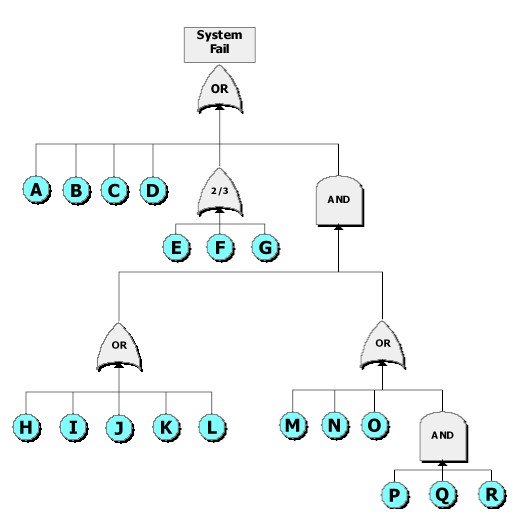
図1. フォールトツリー。(SEBoK Original)
System Reliability, Availability, and Maintainability
Reliability, availability, and maintainability (RAM) are three system attributes that are of tremendous interest to systems engineers, logisticians, and users. They are often studied together. Collectively, they affect economic life-cycle costs of a system and its utility.
信頼性、可用性、保全性(reliability, availability, and maintainability、RAM)は、システムズエンジニア、ロジスティシャン、ユーザーにとってきわめて大きな関心事となる3つのシステム属性である。これらはまとめて研究されることが多い。これらは全体として、システムの経済的なライフサイクルコストとその効用に影響を及ぼす。
Reliability, maintainability, and availability (RAM) are three system attributes that are of great interest to systems engineers, logisticians, and users. Collectively, they affect both the utility and the life-cycle costs of a product or system. The origins of contemporary reliability engineering can be traced to World War II. The discipline’s first concerns were electronic and mechanical components. (Ebeling 2010) However, current trends point to a dramatic rise in the number of industrial, military, and consumer products with integrated computing functions. Because of the rapidly increasing integration of computers into products and systems used by consumers, industry, governments, and the military, reliability must consider both hardware, and software.
信頼性、保全性、可用性(RAM)は、システムズエンジニア、ロジスティシャン、ユーザーにとって大きな関心事となる3つのシステム属性である。これらは全体として、製品やシステムの効用とライフサイクルコストの両方に影響を及ぼす。現代の信頼性工学の起源は、第二次世界大戦にまで遡ることができる。この分野が当初対象としていたのは、電子コンポーネントと機械コンポーネントであった(Ebeling 2010)。しかし、現在の傾向は、統合されたコンピューティング機能を持つ工業製品、軍事製品、消費者製品の数の劇的な増加を示している。消費者、産業界、政府、軍が使用する製品やシステムへのコンピュータの組み込みが急速に進んでいるため、信頼性ではハードウェアとソフトウェアの両方を考慮しなければならない。
Maintainability models present some interesting challenges. The time to repair an item is the sum of the time required for evacuation, diagnosis, assembly of resources (parts, bays, tool, and mechanics), repair, inspection, and return. Administrative delay (such as holidays) can also affect repair times. Often these sub-processes have a minimum time to complete that is not zero, resulting in the distributions used to model maintainability having a threshold parameter.
保全性モデルには、いくつか興味深い課題がある。品目の修理時間は、搬出、診断、リソース(部品、ベイ、工具、整備士)の集結、修理、検査、返却に要する時間の合計である。管理上の遅延(休日など)も修理時間に影響し得る。これらのサブプロセスには、ゼロではない完了までの最小時間がしばしばあり、その結果、保全性のモデル化に用いる分布はしきい値パラメータ(threshold parameter)を持つことになる。
A threshold parameter is defined as the minimum probable time to repair. Estimation of maintainability can be further complicated by queuing effects, resulting in times to repair that are not independent. This dependency frequently makes analytical solution of problems involving maintainability intractable and promotes the use of simulation to support analysis.
しきい値パラメータは、修理に要する最小の見込み時間として定義される。保全性の推定は待ち行列効果によってさらに複雑になることがあり、その結果、修理に要する時間は互いに独立でなくなる。この依存性のために、保全性に関わる問題を解析的に解くことはしばしば困難になり、解析を支援するシミュレーションの活用が促される。
This section sets forth basic definitions, briefly describes probability distributions, and then discusses the role of RAM engineering during system development and operation. The final subsection lists the more common reliability test methods that span development and operation.
本節では、基本的な定義を示し、確率分布を簡単に説明したうえで、システム開発と運用における RAM 工学の役割を論じる。最後のサブセクションでは、開発から運用までにわたって用いられる、より一般的な信頼性試験方法を列挙する。
Reliability is defined as the probability of a product performing its intended function under stated conditions without failure for a given period of time. (ASQ 2022) A precise definition must include a detailed description of the function, the environment, the time scale, and what constitutes a failure. Each can be surprisingly difficult to define precisely.
信頼度は、製品が、明示された条件の下で、所定の期間、故障することなく意図した機能を果たす確率として定義される(ASQ 2022)。正確に定義するには、機能、環境、時間尺度、そして何をもって故障とするかを詳細に記述しなければならない。これらはいずれも、正確に定義するのが意外なほど難しい場合がある。
The probability that a given maintenance action for an item under given usage conditions can be performed within a stated time interval when the maintenance is performed under stated conditions using stated procedures and resources. Maintainability has two categories: serviceability (the ease of conducting scheduled inspections and servicing) and repairability (the ease of restoring service after a failure). (ASQ 2022)
与えられた使用条件の下にある品目に対する所定の保全活動を、明示された条件の下で、明示された手順とリソースを用いて保全を行う場合に、明示された時間間隔内に実施できる確率。保全性には2つのカテゴリがある。サービスアビリティ(serviceability、計画された点検と整備を実施する容易さ)とリペアラビリティ(repairability、故障後にサービスを復旧する容易さ)である(ASQ 2022)。
Defined as the probability that a repairable system or system element is operational at a given point in time under a given set of environmental conditions. Availability depends on reliability and maintainability and is discussed in detail later in this topic. (ASQ 2011)
修理可能なシステムまたはシステム要素が、与えられた一連の環境条件の下で、与えられた時点に運用可能である確率として定義される。可用性は信頼性と保全性に依存するものであり、本トピックの後段で詳しく論じる(ASQ 2011)。
A failure is the event(s), or inoperable state, in which any item or part of an item does not, or would not, perform as specified. (GEIA 2008) The failure mechanism is the physical, chemical, electrical, thermal, or other process that results in failure (GEIA 2008). In computerized systems, a software defect or fault can be the cause of a failure (Laprie 1992) which may have been preceded by an error which was internal to the item. The failure mode is the way or the consequence of the mechanism through which an item fails. (GEIA 2008, Laprie 1992) The severity of the failure mode is the magnitude of its impact. (Laprie 1992)
故障とは、品目または品目の一部が仕様どおりに機能しない、または機能しないであろう事象、あるいは動作不能な状態をいう(GEIA 2008)。故障メカニズムとは、故障をもたらす物理的、化学的、電気的、熱的、またはその他のプロセスである(GEIA 2008)。コンピュータ化されたシステムでは、ソフトウェアの欠陥やフォールトが故障の原因となることがあり(Laprie 1992)、その前には品目の内部にあったエラーが先行している場合がある。故障モードとは、品目が故障に至るメカニズムの様式または帰結である(GEIA 2008, Laprie 1992)。故障モードの重大度(severity)とは、その影響の大きさである(Laprie 1992)。
Reliability can be thought of as the probability of the survival of a component until time t. Its complement is the probability of failure before or at time t. If we define a random variable T as the time to failure, then:
信頼度は、時刻 t までのコンポーネントの生存の確率と考えることができる。それと相補的な確率は、時刻 t までに故障する確率である。確率変数 T を故障までの時間と定義すると、次のようになる。
<math> R(t)=P(T>t)=1-F(t) </math>
R(t) = P(T > t) = 1 − F(t)
where R(t) is the reliability and F(t) is the failure probability. The failure probability is the cumulative distribution function (CDF) of a mathematical probability distribution. Continuous distributions used for this purpose include exponential, Weibull, log-normal, and generalized gamma. Discrete distributions such as the Bernoulli, Binomial, and Poisson are used for calculating the expected number of failures or for single probabilities of success.
ここで、R(t) は信頼度、F(t) は故障確率である。故障確率は、数学的確率分布の累積分布関数(cumulative distribution function、CDF)である。この目的に用いられる連続分布には、指数分布、ワイブル分布、対数正規分布、一般化ガンマ分布がある。ベルヌーイ分布、二項分布、ポアソン分布のような離散分布は、故障の期待数の計算や、単一の成功確率の算出に用いられる。
The same continuous distributions used for reliability can also be used for maintainability although the interpretation is different (i.e., probability that a failed component is restored to service prior to time t). However, predictions of maintainability may have to account for processes such as administrative delays, travel time, sparing, and staffing and can therefore be extremely complex.
信頼度に用いるのと同じ連続分布は保全性にも使用できるが、その解釈は異なる(すなわち、故障したコンポーネントが時刻 t より前にサービスに復旧される確率となる)。しかし、保全性の予測では、管理上の遅延、移動時間、スペアリング(sparing)、人員配置といったプロセスを考慮しなければならない場合があり、そのため極めて複雑になり得る。
The probability distributions used in reliability and maintainability estimation are referred to as models because they only provide estimates of the true failure and restoration of the items under evaluation. Ideally, the values of the parameters used in these models would be estimated from life testing or operating experience. However, performing such tests or collecting credible operating data once items are fielded can be costly. Therefore, approximations sometimes use data from “similar systems”, “engineering judgment”, and other methods. As a result, those estimates based on limited data may be very imprecise. Testing methods to gather such data are discussed below.
信頼度と保全性の推定に用いられる確率分布は、評価対象の品目の真の故障と復旧について推定値を与えるにすぎないため、モデルと呼ばれる。理想的には、これらのモデルで用いるパラメータの値は、寿命試験や運用経験から推定される。しかし、そうした試験を実施したり、品目の配備後に信頼できる運用データを収集したりするには、コストがかかり得る。そのため、近似には「類似システム(similar systems)」のデータや「エンジニアリング判断(engineering judgment)」、その他の方法が用いられることがある。その結果、限られたデータに基づくそれらの推定値は、非常に不正確な場合がある。そうしたデータを収集するための試験方法については後述する。
RAM are inherent product or system attributes that should be considered throughout the development lifecycle. Reliability standards, textbook authors, and others have proposed multiple development process models. (O’Connor 2014, Kapur 2014, Ebeling 2010, DoD 2005) The discussion in this section relies on a standard developed by a joint effort by the Electronic Industry Association and the U.S. Government and adopted by the U.S. Department of Defense (GEIA 2008) that defines 4 processes: understanding user requirements and constraints, design for reliability, production for reliability, and monitoring during operation and use (discussed in the next section).
RAM は製品やシステムに固有の属性であり、開発ライフサイクル全体を通じて考慮すべきものである。信頼性規格や教科書の著者などが、複数の開発プロセスモデルを提案してきた(O’Connor 2014, Kapur 2014, Ebeling 2010, DoD 2005)。本節の議論は、Electronic Industry Association と米国政府の共同の取り組みによって策定され、米国防総省が採用した規格(GEIA 2008)に基づく。この規格は4つのプロセス、すなわちユーザー要求と制約の理解、信頼性のための設計、信頼性のための生産、運用と使用における監視(次節で論じる)を定義している。
Understanding user requirements involves eliciting information about functional requirements, constraints (e.g., mass, power consumption, spatial footprint, life cycle cost), and needs that correspondent to RAM requirements. From these emerge system requirements that should include specifications for reliability, maintainability, and availability, and each should be conditioned on the projected operating environments. RAM requirements definition is as challenging but as essential to development success as the definition of general functional requirements.
ユーザー要求の理解には、機能要求、制約(例:質量、消費電力、空間的フットプリント、ライフサイクルコスト)、および RAM 要求事項に対応するニーズに関する情報を引き出すことが含まれる。これらからシステム要求事項が導かれる。システム要求事項には信頼性、保全性、可用性の仕様を含めるべきであり、それぞれの仕様は想定される運用環境を条件として定めるべきである。RAM 要求事項の定義は、一般的な機能要求の定義と同様に困難であるが、開発の成功には同様に不可欠である。
System designs based on user requirements and system design alternatives can then be formulated and evaluated. Reliability engineering during this phase seeks to increase system robustness through measures such as redundancy, diversity, built-in testing, advanced diagnostics, and modularity to enable rapid physical replacement. In addition, it may be possible to reduce failure rates through measures such as use of higher strength materials, increasing the quality components, moderating extreme environmental conditions, or shortened maintenance, inspection, or overhaul intervals. Design analyses may include mechanical stress, corrosion, and radiation analyses for mechanical components, thermal analyses for mechanical and electrical components, and Electromagnetic Interference (EMI) analyses or measurements for electrical components and subsystems.
次に、ユーザー要求とシステム設計の代替案に基づいて、システム設計を策定し評価できる。このフェーズの信頼性工学は、冗長性、多様性、ビルトインテスト、高度な診断、迅速な物理的交換を可能にするモジュール性といった手段を通じて、システムの堅牢性を高めることを目指す。加えて、より高強度の材料の使用、コンポーネントの品質向上、極端な環境条件の緩和、保全・検査・オーバーホール間隔の短縮といった手段によって、故障率を低減できる場合がある。設計解析には、機械コンポーネントに対する機械的応力・腐食・放射線の解析、機械コンポーネントと電気コンポーネントに対する熱解析、電気コンポーネントとサブシステムに対する電磁干渉(Electromagnetic Interference、EMI)の解析または測定が含まれることがある。
In most computer-based systems, hardware mean time between failures are hundreds of thousands of hours so that most system design measures to increase system reliability are focused on software. The most obvious way to improve software reliability is by improving its quality through more disciplined development efforts and tests. Methods for doing so are in the scope of software engineering but not in the scope of this section. However, reliability and availability can also be increased through architectural redundancy, independence, and diversity. Redundancy must be accompanied by measures to ensure data consistency, and managed failure detection and switchover. Within the software architecture, measures such as watchdog timers, flow control, data integrity checks (e.g., hashing or cyclic redundancy checks), input and output validity checking, retries, and restarts can increase reliability and failure detection coverage (Shooman 2002).
ほとんどのコンピュータベースのシステムでは、ハードウェアの平均故障間隔が数十万時間に及ぶため、システム信頼性を高める設計上の手段の大半はソフトウェアに向けられる。ソフトウェア信頼性を改善する最も明白な方法は、より規律ある開発の取り組みとテストによってその品質を改善することである。その方法はソフトウェア工学の範囲に属し、本節の範囲外である。しかし、信頼性と可用性は、アーキテクチャ上の冗長性、独立性、多様性によっても高めることができる。冗長性には、データの一貫性を確保する手段と、管理された故障検出および切り替えが伴わなければならない。ソフトウェアアーキテクチャにおいては、ウォッチドッグタイマ、フロー制御、データ完全性チェック(例:ハッシュや巡回冗長検査)、入出力の妥当性チェック、リトライ、再起動といった手段によって、信頼性と故障検出カバレッジを高めることができる(Shooman 2002)。
System RAM characteristics should be continuously evaluated as the design progresses. Where failure rates are not known (as is often the case for unique or custom developed components, assemblies, or software), developmental testing may be undertaken to assess the reliability of custom-developed components. Evaluations based on quantitative analyses assess the numerical reliability and availability of the system and are usually based on reliability block diagrams, fault trees, Markov models, and Petri nets. (O’Connor 2011) Markov models and Petri nets are of particular value for computer-based systems that use redundancy. Evaluations based on qualitative analyses assess vulnerability to single points of failure, failure containment, recovery, and maintainability. The primary qualitative methods are the failure mode effects and criticality analyses (FMECA). (Kececioglu 1991) The development program Discrepancy Reporting (DR) or Failure Reporting and Corrective Action System (FRACAS) should also be used to identify failure modes which may not have been anticipated by the FMECA and to identify common problems that can be corrected through an improved design or development process.
システムの RAM 特性は、設計の進行に合わせて継続的に評価すべきである。故障率が知られていない場合(固有の、またはカスタム開発されたコンポーネント、アセンブリ、ソフトウェアではしばしばそうである)には、カスタム開発されたコンポーネントの信頼度を評価するために開発試験を実施することがある。定量的解析に基づく評価では、システムの信頼度と可用性を数値的に評価し、通常は信頼性ブロック図、フォールトツリー、マルコフモデル、ペトリネットに基づく(O’Connor 2011)。マルコフモデルとペトリネットは、冗長性を用いるコンピュータベースのシステムにとって特に価値が高い。定性的解析に基づく評価では、単一障害点に対する脆弱性、故障の封じ込め、復旧、保全性を評価する。主な定性的方法は、故障モード影響・致命度解析(failure mode effects and criticality analyses、FMECA)である(Kececioglu 1991)。開発プログラムの不具合報告(Discrepancy Reporting、DR)や故障報告・是正処置システム(Failure Reporting and Corrective Action System、FRACAS)も活用し、FMECA では予測されていなかった可能性のある故障モードを特定するとともに、設計や開発プロセスの改善によって是正できる共通の問題を特定すべきである。
Analyses from related disciplines during design time also affect RAM. Human factor analyses are necessary to ensure that operators and maintainers can interact with the system in a manner that minimizes failures and the restoration times when they occur. There is also a strong link between RAM and cybersecurity in computer-based systems. On the one hand, defensive measures reduce the frequency of failures due to malicious events. On the other hand, devices such as firewalls, policy enforcement devices, and access/authentication serves (also known as “directory servers”) can also become single points of failure or performance bottlenecks that reduce system reliability and availability.
設計時における関連分野の解析も RAM に影響する。ヒューマンファクタ解析は、運用者と保全者がシステムとやり取りする際に、故障を最小限に抑え、故障が発生した場合の復旧時間も最小化できるようにするために必要である。コンピュータベースのシステムでは、RAM とサイバーセキュリティの間にも強い結びつきがある。一方で、防御手段は悪意ある事象による故障の頻度を低減する。他方で、ファイアウォール、ポリシー実施デバイス、アクセス/認証サーバ(「ディレクトリサーバ」とも呼ばれる)のようなデバイスは、単一障害点や性能のボトルネックとなって、システムの信頼性と可用性を低下させることもあり得る。
Many production issues associated with RAM are related to quality. The most important of these are ensuring repeatability and uniformity of production processes and complete unambiguous specifications for items from the supply chain. Other are related to design for manufacturability, storage, and transportation. (Kapur 2014; Eberlin 2010) Large software intensive information systems are affected by issues related to configuration management, integration testing, and installation testing. Testing and recording of failures in the problem reporting and corrective action systems (PRACAS) or the FRACAS capture data on failures and improvements to correct failures. Depending on organizational considerations, this may be the same or a separate system as used during the design.
RAM に関連する生産上の問題の多くは品質に関わるものである。そのうち最も重要なのは、生産プロセスの再現性と均一性を確保すること、そしてサプライチェーンから調達する品目に対して完全で曖昧さのない仕様を定めることである。その他の問題は、製造性のための設計、保管、輸送に関連する(Kapur 2014; Eberlin 2010)。大規模なソフトウェア集約型情報システムは、構成管理、統合テスト、設置テストに関連する問題の影響を受ける。問題報告・是正処置システム(problem reporting and corrective action systems、PRACAS)や FRACAS におけるテストと故障の記録は、故障と、故障を是正するための改善に関するデータを捉える。組織上の事情によっては、これは設計時に使用したものと同じシステムである場合もあれば、別のシステムである場合もある。
After systems are fielded, their reliability and availability are monitored to assess whether the system or product has met its RAM objectives, identify unexpected failure modes, record fixes, and assess the utilization of maintenance resources and the operating environment. The FRACAS or a maintenance management database may be used for this purpose. In order to assess RAM, it is necessary to maintain an accurate record not only of failures but also of operating time and the duration of outages. Systems that report only on repair actions and outage incidents may not be sufficient for this purpose.
システムが配備された後は、システムや製品が RAM 目標を満たしたかどうかを評価し、予期しない故障モードを特定し、修正を記録し、保全リソースの利用状況と運用環境を評価するために、その信頼性と可用性を監視する。この目的には、FRACAS や保全管理データベースを使用することがある。RAM を評価するには、故障だけでなく、運用時間と停止の継続時間についても正確な記録を維持する必要がある。修理活動と停止インシデントのみを報告するシステムでは、この目的に十分でない場合がある。
An organization should have an integrated data system that allows reliability data to be considered with logistical data, such as parts, personnel, tools, bays, transportation and evacuation, queues, and costs, allowing a total awareness of the interplay of logistical and RAM issues. These issues in turn must be integrated with management and operational systems to allow the organization to reap the benefits that can occur from complete situational awareness with respect to RAM.
組織は、信頼性データを部品、人員、工具、ベイ、輸送と搬出、待ち行列、コストといったロジスティクスデータとあわせて検討できる統合データシステムを備えるべきであり、それによってロジスティクスと RAM の問題の相互作用を全体的に把握できる。さらにこれらの問題は、組織が RAM に関する完全な状況認識から得られる利益を享受できるよう、マネジメントシステムと運用システムに統合されなければならない。
Reliability Testing can be performed at the component, subsystem, and system level throughout the product or system lifecycle. Examples of hardware related categories of reliability testing are detailed in Ebeling (2010) and O’Connor (2014).
信頼性試験は、製品やシステムのライフサイクル全体を通じて、コンポーネント、サブシステム、システムの各レベルで実施できる。ハードウェア関連の信頼性試験のカテゴリの例は、Ebeling (2010) と O’Connor (2014) に詳述されている。
*Reliability Life Tests: Reliability life tests are used to empirically assess the time to failure for non-repairable products and systems and the times between failure for repairable or restorable systems. Termination criteria for such tests can be based on a planned duration or planned number of failures. Methods to account for “censoring” of the failures or the surviving units enable a more accurate estimate of reliability. (Meeker, Escobar, Pascual 2022)
• 信頼性寿命試験(Reliability Life Tests): 信頼性寿命試験は、修理不可能な製品やシステムについては故障までの時間を、修理可能または復旧可能なシステムについては故障間隔を、経験的に評価するために用いられる。こうした試験の終了基準は、計画された期間や計画された故障数に基づいて定めることができる。故障や生存ユニットの「打切り(censoring)」を考慮する方法を用いることで、信頼度をより正確に推定できる(Meeker, Escobar, Pascual 2022)。
*Accelerated Life Tests: Accelerated life testing is performed by subjecting the items under test (usually electronic parts) to increased stress well above the expecting operating range and extrapolating results using model such as an Arrhenius relation (temperature acceleration), inverse power law (voltage), or a cumulative damage model (non-constant stress). (Meeker, Escobar, Pascual 2022)
• 加速寿命試験(Accelerated Life Tests): 加速寿命試験は、被試験品目(通常は電子部品)に予想される運用範囲を大きく上回る高いストレスを加え、アレニウス関係(温度加速)、逆累乗則(電圧)、累積損傷モデル(非一定ストレス)といったモデルを用いて結果を外挿することで実施される(Meeker, Escobar, Pascual 2022)。
*Highly Accelerated Life Testing/Highly Accelerated Stress Testing (HALT/HASS): is performed by subjecting units under test (components or subassemblies) to extreme temperature and vibration tests with the objective of identifying failure modes, margins, and design weaknesses.
• 高加速寿命試験/高加速ストレス試験(Highly Accelerated Life Testing/Highly Accelerated Stress Testing、HALT/HASS): 被試験ユニット(コンポーネントやサブアセンブリ)を極端な温度・振動の試験にかけ、故障モード、マージン、設計上の弱点を特定することを目的として実施される。
*Parts Screening: Parts screening is not really a test but a procedure to operate components for a duration beyond the “infant mortality” period during which less durable items fail and the more durable parts that remain are then assembled into the final product or system. This is also known as "burn-in."
• 部品スクリーニング(Parts Screening): 部品スクリーニングは厳密には試験ではなく、耐久性の低い品目が故障する「初期故障(infant mortality)」期間を超えてコンポーネントを動作させ、残ったより耐久性の高い部品を最終製品やシステムに組み込む手順である。これは「バーンイン(burn-in)」とも呼ばれる。
*System Level Testing: Examples of system level testing (including both hardware and software) are detailed in O’Connor (2014) and Ebeling (2010).
• システムレベル試験(System Level Testing): システムレベル試験(ハードウェアとソフトウェアの両方を含む)の例は、O’Connor (2014) と Ebeling (2010) に詳述されている。
*Stability Tests: Stability tests are life tests for integrated hardware and software systems. The goal of such testing is to determine the integrated system failure rate and assess operational suitability. Test conditions must include accurate simulation of the operating environment (including workload) and a means of identifying and recording failures.
• 安定性試験(Stability Tests): 安定性試験は、統合されたハードウェアとソフトウェアのシステムを対象とする寿命試験である。こうした試験の目標は、統合システムの故障率を求め、運用適合性を評価することである。試験条件には、運用環境(作業負荷を含む)の正確なシミュレーションと、故障を特定し記録する手段を含めなければならない。
*Reliability Growth Tests: Reliability growth testing is part of a reliability growth program in which items are tested throughout the development and early production cycle with the intent of assessing reliability increases due to improvements in the manufacturing process (for hardware) or software quality (for software). Also known as "Test-Analyze-And-Fix (TAAF)." (NRC 2015)
• 信頼性成長試験(Reliability Growth Tests): 信頼性成長試験は信頼性成長プログラムの一部であり、製造プロセス(ハードウェアの場合)やソフトウェア品質(ソフトウェアの場合)の改善による信頼性の向上を評価する目的で、開発から初期生産までのサイクル全体を通じて品目を試験する。「試験・解析・修正(Test-Analyze-And-Fix、TAAF)」とも呼ばれる(NRC 2015)。
*Failure/Recovery Tests: Such testing assesses the fault tolerance of a system by measuring probability of switchover for redundant systems. Failures are simulated and the ability of the hardware and software to detect the condition and reconfigure the system to remain operational are tested.
• 故障/復旧試験(Failure/Recovery Tests): こうした試験は、冗長システムの切り替え確率を測定することで、システムのフォールトトレランスを評価する。故障をシミュレーションし、ハードウェアとソフトウェアがその状態を検出し、システムを運用可能な状態に維持するよう再構成する能力を試験する。
*Maintainability Tests: Such testing assesses the system diagnostics capabilities, physical accessibility, and maintainer training by simulating hardware or software failures that require maintainer action for restoration.
• 保全性試験(Maintainability Tests): こうした試験は、復旧に保全者の作業を要するハードウェアやソフトウェアの故障をシミュレーションすることで、システムの診断ケイパビリティ、物理的アクセス可能性、保全者の訓練を評価する。
Because of its potential impact on cost and schedule, reliability testing should be coordinated with the overall system engineering effort. Test planning considerations include the number of test units, duration of the tests, environmental conditions, and the means of detecting failures.
信頼性試験はコストとスケジュールに影響を及ぼす可能性があるため、システムズエンジニアリングの取り組み全体と調整すべきである。試験計画で考慮すべき事項には、試験ユニットの数、試験の期間、環境条件、故障を検出する手段がある。
True RAM models for a system are generally never known. Data on a given system is assumed or collected, used to select a distribution for a model, and then used to fit the parameters of the distribution. This process differs significantly from the one usually taught in an introductory statistics course.
システムの真の RAM モデルは、一般に決して知られることはない。与えられたシステムに関するデータは、仮定されるか収集されたうえで、モデルの分布の選択に用いられ、さらにその分布のパラメータのフィッティングに用いられる。このプロセスは、統計学の入門コースで通常教えられるものとは大きく異なる。
First, the normal distribution is seldom used as a life distribution, since it is defined for all negative times. Second, and more importantly, reliability data is different from classic experimental data. Reliability data is often censored, biased, observational, and missing information about covariates such as environmental conditions. Data from testing is often expensive, resulting in small sample sizes. These problems with reliability data require sophisticated strategies and processes to mitigate them.
第一に、正規分布は負の時間全体にわたって定義されるため、寿命分布として用いられることはめったにない。第二に、より重要な点として、信頼性データは古典的な実験データとは異なる。信頼性データは、打切りがあり、バイアスを含み、観測的であり、環境条件などの共変量に関する情報を欠いていることが多い。試験から得られるデータは高コストであることが多く、その結果サンプルサイズは小さくなる。信頼性データのこうした問題を緩和するには、洗練された戦略とプロセスが必要である。
One consequence of these issues is that estimates based on limited data can be and usually are very imprecise.
こうした問題の帰結の一つとして、限られたデータに基づく推定値は非常に不正確になり得るし、通常は実際にそうなる。
In most large programs, RAM experts report to the system engineering organization. At project or product conception, top level goals are defined for RAM based on operational needs, lifecycle cost projections, and warranty cost estimates. These lead to RAM derived requirements and allocations that are approved and managed by the system engineering requirements management function. RAM testing is coordinated with other product or system testing through the testing organization, and test failures are evaluated by the RAM function through joint meetings such as a Failure Review Board. In some cases, the RAM function may recommend design or development process changes as a result of evaluation of test results or software discrepancy reports, and these proposals must be adjudicated by the system engineering organization, or in some cases, the acquiring customer if cost increases are involved.
ほとんどの大規模プログラムでは、RAM の専門家はシステムズエンジニアリング組織に報告する立場にある。プロジェクトや製品の構想段階で、運用上のニーズ、ライフサイクルコストの予測、保証コストの見積もりに基づいて、RAM のトップレベルの目標を定義する。これらの目標から、システムズエンジニアリングの要求管理機能が承認・管理する RAM の派生要求事項と配分が導かれる。RAM 試験は、試験組織を通じて製品やシステムの他の試験と調整され、試験で発生した故障は、故障審査会(Failure Review Board)のような合同会議を通じて RAM 機能が評価する。場合によっては、RAM 機能が試験結果やソフトウェア不具合報告の評価に基づいて設計や開発プロセスの変更を推奨することがある。これらの提案は、システムズエンジニアリング組織によって、あるいは場合によってはコスト増加が伴う場合は調達側の顧客によって、裁定されなければならない。
Once a system is fielded, its reliability and availability should be tracked. Doing so allows the producer/owner to verify that the design has met its RAM objectives, to identify unexpected failure modes, to record fixes, to assess the utilization of maintenance resources, and to assess the operating environment.
システムが配備されたら、その信頼性と可用性を追跡すべきである。そうすることで、生産者/所有者は、設計が RAM 目標を満たしたことを検証し、予期しない故障モードを特定し、修正を記録し、保全リソースの利用状況を評価し、運用環境を評価できる。
One such tracking system is generically known as a FRACAS system (Failure Reporting and Corrective Action System). Such a system captures data on failures and improvements to correct failures. This database is separate from a warranty database, which is typically run by the financial function of an organization and tracks costs only.
そうした追跡システムの一つが、一般に FRACAS システム(故障報告・是正処置システム、Failure Reporting and Corrective Action System)と呼ばれるものである。このシステムは、故障と、故障を是正するための改善に関するデータを捉える。このデータベースは保証データベースとは別物である。保証データベースは通常、組織の財務部門が運用し、コストのみを追跡する。
A FRACAS for an organization is a system, and itself should be designed following systems engineering principles. In particular, a FRACAS system supports later analyses, and those analyses impose data requirements. Unfortunately, the lack of careful consideration of the backward flow from decision to analysis to model to required data too often leads to inadequate data collection systems and missing essential information. Proper prior planning prevents this poor performance.
組織にとっての FRACAS はそれ自体が一つのシステムであり、システムズエンジニアリングの原則に従って設計すべきものである。特に、FRACAS システムは後の解析を支援するものであり、それらの解析がデータ要求を課す。残念ながら、意思決定から解析へ、解析からモデルへ、モデルから必要なデータへと遡る流れを十分に検討しないことが、あまりにも多くの場合、不十分なデータ収集システムと必須情報の欠落を招いている。適切な事前計画が、この拙い性能を防ぐ。
Of particular importance is a plan to track data on units that have not failed. Units whose precise times of failure are unknown are referred to as censored units. Inexperienced analysts frequently do not know how to analyze censored data, and they omit the censored units as a result. This can bias an analysis.
特に重要なのは、故障していないユニットのデータを追跡する計画である。正確な故障時刻がわからないユニットは、打切りユニット(censored unit)と呼ばれる。経験の浅い分析者は打切りデータの解析方法を知らないことが多く、そのため打切りユニットを除外してしまう。これにより解析にバイアスが生じるおそれがある。
An organization should have an integrated data system that allows reliability data to be considered with logistical data, such as parts, personnel, tools, bays, transportation and evacuation, queues, and costs, allowing a total awareness of the interplay of logistical and RAM issues. These issues in turn must be integrated with management and operational systems to allow the organization to reap the benefits that can occur from complete situational awareness with respect to RAM.
組織は、信頼性データを部品、人員、工具、ベイ、輸送と搬出、待ち行列、コストといったロジスティクスデータとあわせて検討できる統合データシステムを備えるべきであり、それによってロジスティクスと RAM の問題の相互作用を全体的に把握できる。さらにこれらの問題は、組織が RAM に関する完全な状況認識から得られる利益を享受できるよう、マネジメントシステムと運用システムに統合されなければならない。
RAM interacts with nearly all aspects of the system development effort. Specific dependencies and interactions include:
RAM は、システム開発の取り組みのほぼすべての側面と相互作用する。具体的な依存関係と相互作用には、以下のものがある。
*Systems Engineering: RAM interacts with systems engineering as described in the previous section.
• システムズエンジニアリング(Systems Engineering): RAM は、前節で述べたようにシステムズエンジニアリングと相互作用する。
*Product Management (Life Cycle Cost and Warranty): RAM interacts with the product or system lifecycle cost and warranty management organizations by assisting in the calculation of expected repair rates, downtimes, and warranty costs. RAM may work with those organizations to perform trade-off analyses to determine the most cost-efficient solution and to price service contracts.
• 製品マネジメント(ライフサイクルコストと保証)(Product Management (Life Cycle Cost and Warranty)): RAM は、予想される修理率、ダウンタイム、保証コストの算出を支援することで、製品やシステムのライフサイクルコストと保証を管理する組織と相互作用する。RAM は、これらの組織と協働してトレードオフ解析を行い、最も費用効率の高いソリューションを決定したり、サービス契約の価格を設定したりすることがある。
*Quality Assurance: RAM may also interact with the procurement and quality assurance organizations with respect to selection and evaluation of materials, components, and subsystems.
• 品質保証(Quality Assurance): RAM は、材料、コンポーネント、サブシステムの選定と評価に関して、調達組織や品質保証組織と相互作用することもある。
*Systems Safety: RAM and system safety engineers have many common concerns with respect to managing the failure behavior of a system (i.e., single points of failure and failure propagation). RAM and safety engineers use similar analysis techniques, with safety being concerned about failures affecting life or unique property and RAM being concerned with those failures as well as lower severity events that disrupt operations. RAM and system safety are both concerned with failures occurring during development and test – FRACAS is the primary methodology used for RAM; hazard tracking is the methodology used for system safety.
• システム安全(Systems Safety): RAM エンジニアとシステム安全エンジニアは、システムの故障挙動の管理(すなわち、単一障害点と故障の伝播)に関して多くの懸念を共有している。RAM エンジニアと安全エンジニアは類似の解析技法を用いるが、安全が人命や固有の財産に影響する故障を対象とするのに対し、RAM はそうした故障に加えて、運用を中断させるより重大度の低い事象も対象とする。RAM とシステム安全はいずれも、開発中および試験中に発生する故障に関心を持つ。FRACAS は RAM で用いられる主要な方法論であり、ハザードトラッキングはシステム安全で用いられる方法論である。
*Cybersecurity: In systems or products integrating computers and software, cybersecurity and RAM engineers have common concerns relating to the availability of cyber defenses and system event monitoring. However, there are also trade-offs with respect to access control, boundary devices, and authentication where security device failures could impact the availability of the product or system to users.
• サイバーセキュリティ(Cybersecurity): コンピュータとソフトウェアを組み込んだシステムや製品では、サイバーセキュリティエンジニアと RAM エンジニアは、サイバー防御の可用性とシステム事象の監視に関して共通の懸念を持つ。しかし、アクセス制御、境界デバイス、認証に関してはトレードオフも存在し、セキュリティデバイスの故障が、ユーザーに対する製品やシステムの可用性に影響を及ぼし得る。
*Software and Hardware Engineering: Design and RAM engineers have a common goal of creating dependable products and systems. RAM interacts with the software and hardware reliability functions through design analyses such as failure modes and effects analyses, reliability predictions, thermal analyses, reliability measurement, and component specific analyses. RAM may recommend design changes as a result of these analyses that may have to be adjudicated by program management, the customer, or systems engineering if there are cost or schedule impacts.
• ソフトウェア工学とハードウェア工学(Software and Hardware Engineering): 設計エンジニアと RAM エンジニアは、信頼できる(dependable)製品とシステムを生み出すという共通の目標を持つ。RAM は、故障モード影響解析、信頼性予測、熱解析、信頼性測定、コンポーネント固有の解析といった設計解析を通じて、ソフトウェアとハードウェアの信頼性機能と相互作用する。RAM はこれらの解析の結果に基づいて設計変更を推奨することがあり、コストやスケジュールへの影響がある場合には、その変更をプログラムマネジメント、顧客、またはシステムズエンジニアリングが裁定しなければならないことがある。
*Testing: RAM interacts with the testing program during planning to assess the most efficient (or feasible) test events to perform life testing, failure/recovery testing, and stability testing as well as to coordinate requirements for reliability or stress tests. RAM also interacts with the testing organization to assess test results and analyze failures for the implications on product or system RAM.
• 試験(Testing): RAM は計画段階で試験プログラムと相互作用し、寿命試験、故障/復旧試験、安定性試験を実施するうえで最も効率的な(または実施可能な)試験事象を評価するとともに、信頼性試験やストレス試験の要求事項を調整する。RAM はまた、試験結果を評価し、故障が製品やシステムの RAM に及ぼす影響を解析するために、試験組織と相互作用する。
*Logistics: RAM works with logistics in providing expected failure rates and downtime constraints in order for logistics engineers to determine staffing, sparing, and special maintenance equipment requirements.
• ロジスティクス(Logistics): RAM は、予想される故障率とダウンタイムの制約を提供することでロジスティクスと協働し、ロジスティクスエンジニアが人員配置、スペアリング、特殊な保全機器の要求を決定できるようにする。
Because of the importance of reliability, availability, and maintainability, as well as related attributes, there are hundreds of standards associated. Some are general but more are specific to domains such as automotive, aviation, electric power distribution, nuclear energy, rail transportation, software, etc.Standards are produced by both governmental agencies, professional associations and international standards bodies such as:
*The International Electrotechnical Commission (IEC), Geneva, Switzerland and the closely associated International Organization for Standardization (ISO)
*The Society of Automotive Engineers (SAE), Warrendale, PA, USA
*Governmental Agencies – primarily in military and space systems
The following table lists selected standards from each of these agencies. Because of differences in domains and because many standards handle the same topic in slightly different ways, selection of the appropriate standards requires consideration of previous practices (often documented as contractual requirements), domain specific considerations, certification agency requirements, end user requirements (if different from the acquisition or producing organization), and product or system characteristics.
信頼性、可用性、保全性、およびそれらに関連する属性は重要であるため、関連する規格は数百に上る。汎用的なものもあるが、より多くは、自動車、航空、配電、原子力エネルギー、鉄道輸送、ソフトウェアなどの分野に固有のものである。規格は、政府機関、専門家協会、国際標準化機関によって作成されており、例えば以下がある。
次の表に、これらの各機関の規格から選んだものを示す。分野ごとの違いがあり、また多くの規格が同じトピックを少しずつ異なる方法で扱っているため、適切な規格を選択するには、過去の実践(しばしば契約上の要求事項として文書化される)、分野固有の考慮事項、認証機関の要求事項、エンドユーザーの要求(調達側または生産側の組織と異なる場合)、製品やシステムの特性を考慮する必要がある。
表1. 信頼性、可用性、保全性の選ばれた規格。(SEBoK Original)
| +Table 1. Selected Reliability, Availability, Maintainability standards (SEBoK Original) |
| Organization |
|---|
| Number, Title, and Year |
| Domain |
| Comment |
| IEC |
| IEC 60812, Analysis techniques for system reliability - Procedure for failure mode |
| General |
| IEC |
| IEC 61703 Ed 2.0, Mathematical expressions for reliability, availability, maintainability and maintenance support terms, 2016 |
| General |
| IEC |
| IEC 62308, Equipment reliability - Reliability assessment methods, 2006 |
| General |
| IEC |
| IEC 62347, Guidance on system dependability specifications, 2006 |
| General |
| IEC |
| IEC 62278, Railway applications – Specification and demonstration of reliability, |
| Railways |
| IEEE |
| IEEE Std 352-2016, IEEE Guide for General Principles of Reliability Analysis of Nuclear Power Generating Station Safety Systems and Other Nuclear Facilities, 2016 |
| Nuclear |
| IEEE |
| IEEE Std 1044-2009, IEEE Standard Classification for Software Anomalies, 2009 |
| Software |
| IEEE |
| IEEE Std 1633-2008, IEEE Recommended Practice on Software Reliability, 2016 |
| Software |
| SAE |
| ARP 4754A, Guidelines for the Development of Civil Aircraft and Systems, 2010 |
| Aviation |
| SAE |
| ARP 5890B, Guidelines for Preparing Reliability AssessmentPlans for Electronic Engine Controls, 2018 |
| Aviation |
| SAE |
| J2940_202002, Use of Model Verification and Validation in Product Reliability and Confidence Assessments, 2020 |
| General |
| SAE |
| SAE-GEIA-STD-0009A, Reliability Program Standard for SystemsDesign, Development, and Manufacturing, 2020 |
| General |
| Used by the U.S. Dept. of Defense as the primary reliability standard (replaces MIL-STD-785B) |
| SAE |
| JA 1002_201205, Software Reliability Program Standard, |
| Software |
| U.S. |
| NASA-STD-8729.1A, Planning, Developing and Managing an Effective Reliability And Maintainability (R&M) Program, 2017 |
| Space |
| U.S. |
| MIL HDBK 470A, Designing and Developing Maintainable Products and Systems, 1997 |
| Defense |
| U.S. |
| MIL HDBK 217F (Notice 2), Reliability Prediction of Electronic Equipment, 1995 |
| Defense |
| Although formally titled a “Handbook” and more than 2 decades old, the values and methods constitute a de facto standard for some U.S. military acquisitions |
| U.S. |
| MIL-STD-1629A (Notice 3), Procedures for Performing a Failure Mode Effects and Criticality Analysis -Revision A, 1998 |
| The parent of FMEA standards produced by the IEEE, SAE, ISO, and many other agencies. Still valid and in use after 4 decades. |
| 組織 | 番号、タイトル、年 | 分野 | コメント |
|---|---|---|---|
| IEC | IEC 60812, Analysis techniques for system reliability - Procedure for failure mode and effects analysis (FMEA), 2006 | 一般 | |
| IEC | IEC 61703 Ed 2.0, Mathematical expressions for reliability, availability, maintainability and maintenance support terms, 2016 | 一般 | |
| IEC | IEC 62308, Equipment reliability - Reliability assessment methods, 2006 | 一般 | |
| IEC | IEC 62347, Guidance on system dependability specifications, 2006 | 一般 | |
| IEC | IEC 62278, Railway applications – Specification and demonstration of reliability, availability, maintainability and safety (RAMS), 2002 | 鉄道 | |
| IEEE | IEEE Std 352-2016, IEEE Guide for General Principles of Reliability Analysis of Nuclear Power Generating Station Safety Systems and Other Nuclear Facilities, 2016 | 原子力エネルギー | |
| IEEE | IEEE Std 1044-2009, IEEE Standard Classification for Software Anomalies, 2009 | ソフトウェア | |
| IEEE | IEEE Std 1633-2008, IEEE Recommended Practice on Software Reliability, 2016 | ソフトウェア | |
| SAE | ARP 4754A, Guidelines for the Development of Civil Aircraft and Systems, 2010 | 航空 | |
| SAE | ARP 5890B, Guidelines for Preparing Reliability AssessmentPlans for Electronic Engine Controls, 2018 | 航空 | |
| SAE | J2940_202002, Use of Model Verification and Validation in Product Reliability and Confidence Assessments, 2020 | 一般 | |
| SAE | SAE-GEIA-STD-0009A, Reliability Program Standard for SystemsDesign, Development, and Manufacturing, 2020 | 一般 | 米国防総省が主要な信頼性規格として使用する(MIL-STD-785B を置き換える) |
| SAE | JA 1002_201205, Software Reliability Program Standard, 2012 | ソフトウェア | |
| 米国政府 | NASA-STD-8729.1A, Planning, Developing and Managing an Effective Reliability And Maintainability (R&M) Program, 2017 | 宇宙システム | |
| 米国政府 | MIL HDBK 470A, Designing and Developing Maintainable Products and Systems, 1997 | 防衛システム | |
| 米国政府 | MIL HDBK 217F (Notice 2), Reliability Prediction of Electronic Equipment, 1995 | 防衛システム | 正式には「ハンドブック」と題され、2 decades を超える年月を経たものであるが、その値と方法は一部の米国軍事調達にとって事実上の標準を構成する |
| 米国政府 | MIL-STD-1629A (Notice 3), Procedures for Performing a Failure Mode Effects and Criticality Analysis - Revision A, 1998 | IEEE、SAE、ISO、その他多くの機関が作成した FMEA 規格の親。4 decades を経た今も有効で使用されている |
Becoming a reliability engineer requires education in probability and statistics as well as the specific engineering domain of the product or system under development or in operation. A number of universities throughout the world have departments of reliability engineering (which also address maintainability and availability) and more have research groups and courses in reliability and safety – often within the context of another discipline such as computer science, systems engineering, civil engineering, mechanical engineering, or bioengineering. Because most academic engineering programs do not have a full reliability department, most engineers working in reliability have been educated in other disciplines and acquire the additional skills through additional coursework or by working with other qualified engineers. A certification in reliability engineering is available from the American Society for Quality (ASQ 2016). However, only a minority of engineers working in the discipline have this certification.
信頼性エンジニアになるには、確率と統計に加え、開発中または運用中の製品やシステムが属する特定の工学分野の教育を受ける必要がある。世界の多くの大学には信頼性工学の学科(保全性と可用性も扱う)があり、さらに多くの大学には、しばしばコンピュータサイエンス、システムズエンジニアリング、土木工学、機械工学、生物工学といった別の分野の枠内で、信頼性と安全性の研究グループとコースが設けられている。ほとんどの工学系の学術プログラムには本格的な信頼性学科がないため、信頼性の業務に携わるエンジニアのほとんどは他分野で教育を受けており、追加の授業履修や、資格を持つ他のエンジニアとの協働を通じて追加のスキルを身につけている。信頼性工学の認定(certification)は、American Society for Quality から取得できる(ASQ 2016)。しかし、この分野で働くエンジニアのうち、この認定を持つのは少数派にすぎない。
The three basic metrics of RAM are (not surprisingly) Reliability, Maintainability, and Availability. Reliability can be characterized in terms of the parameters, mean, or any percentile of a reliability distribution. However, in most cases, the exponential distribution is used, and a single value, the mean time to failure (MTTF) for non-restorable systems, or mean time between failures (MTBF for restorable systems are used). The metric is defined as:
<math> \left \{ MTTF|MTBF \right \} = \frac{T_{op,Tot}}{n_{fails}} </math>
where <math>T_{op},T_{ot}</math> is the total operating time and <math>n_{fails}</math> is the number of failures.
Maintainability is often characterized in terms of the exponential distribution and the mean time to repair and be similarly calculated, i.e.,
<math> MTTR = \frac{T_{down,Tot}}{n_{outages}} </math>
Where <math>T_{down,Tot}</math> is the total down time and <math>n_{outages}</math> is the number of outages.
As was noted above, accounting for downtime requires definitions and specificity. Down time might be counted only for corrective maintenance actions, or it may include both corrective and preventive maintenance actions. Where the lognormal rather than the exponential distribution is used, a mean down time can still be calculated, but both the log of the downtimes and the variance must be known in order to fully characterize maintainability. Availability can be calculated from the total operating time and the downtime, or in the alternative, as a function of MTBF and MTTR (Mean Time To Repair.)
<math> A = \frac{T_{op,Tot}}{T_{down,tot} + T_{op,tot}} = \frac{MTBF}{MTBF + MTTR} </math>
As was the case with maintainability, availability may be qualified as to whether it includes only unplanned failures and repairs (inherent availability) or downtime due to all causes including administrative delays, staffing outages, or spares inventory deficiencies (operational availability).
Probabilistic metrics describe system performance for RAM. Quantiles, means, and modes of the distributions used to model RAM are also useful.
Availability has some additional definitions, characterizing what downtime is counted against a system. For inherent availability, only downtime associated with corrective maintenance counts against the system. For achieved availability, downtime associated with both corrective and preventive maintenance counts against a system. Finally, operational availability counts all sources of downtime, including logistical and administrative, against a system.
Availability can also be calculated instantaneously, averaged over an interval, or reported as an asymptotic value. Asymptotic availability can be calculated easily, but care must be taken to analyze whether or not a system settles down or settles up to the asymptotic value, as well as how long it takes until the system approaches that asymptotic value.
Reliability importance measures the effect on the system reliability of a small improvement in a component’s reliability. It is defined as the partial derivative of the system reliability with respect to the reliability of a component.
Criticality is the product of a component’s reliability, the consequences of a component failure, and the frequency with which a component failure results in a system failure. Criticality is a guide to prioritizing reliability improvement efforts.
Many of these metrics cannot be calculated directly because the integrals involved are intractable. They are usually estimated using simulation.
RAM の3つの基本的なメトリクスは、(当然ながら)信頼性、保全性、可用性である。信頼性は、信頼性分布のパラメータ、平均、または任意のパーセンタイルによって特徴づけることができる。しかし、ほとんどの場合は指数分布が用いられ、単一の値、すなわち復旧不可能なシステムでは平均故障時間(mean time to failure、MTTF)、復旧可能なシステムでは平均故障間隔(mean time between failures、MTBF)が用いられる。このメトリクスは次のように定義される。
{MTTF | MTBF} = T_op,Tot / n_fails
ここで、T_op,Tot は総運用時間、n_fails は故障の回数である。
保全性は、指数分布と平均修理時間(mean time to repair)によって特徴づけられることが多く、同様に計算できる。すなわち、
MTTR = T_down,Tot / n_outages
ここで、T_down,Tot は総ダウン時間、n_outages は停止の回数である。
前述のとおり、ダウン時間を計上するには定義と具体性が必要である。ダウン時間は、是正保全活動についてのみ計上される場合もあれば、是正保全と予防保全の両方の活動を含む場合もある。指数分布ではなく対数正規分布を用いる場合でも平均ダウン時間は計算できるが、保全性を完全に特徴づけるには、ダウン時間の対数と分散の両方がわかっていなければならない。
可用性は、総運用時間とダウン時間から計算することも、MTBF と MTTR(Mean Time To Repair)の関数として計算することもできる。
A = T_op,Tot / (T_down,tot + T_op,tot) = MTBF / (MTBF + MTTR)
保全性の場合と同様に、可用性は、計画外の故障と修理のみを含むのか(固有可用性、inherent availability)、それとも管理上の遅延、人員の不在、スペア在庫の不足を含むあらゆる原因によるダウンタイムを含むのか(運用可用性、operational availability)によって区別される場合がある。
確率的メトリクスは、RAM に関するシステム性能を記述する。RAM のモデル化に用いられる分布の分位点、平均、最頻値も有用である。
可用性には、どのダウン時間をシステムに計上するかを特徴づける追加の定義がある。固有可用性(inherent availability)では、是正保全に関連するダウン時間のみをシステムに計上する。達成可用性(achieved availability)では、是正保全と予防保全の両方に関連するダウン時間をシステムに計上する。最後に、運用可用性(operational availability)では、ロジスティクスや管理に起因するものを含め、あらゆるダウン時間の発生源をシステムに計上する。
可用性は、瞬時値として計算することも、区間にわたる平均として求めることも、漸近値として報告することもできる。漸近可用性(asymptotic availability)は容易に計算できるが、システムが漸近値まで下がって落ち着くのか(settle down)、上がって落ち着くのか(settle up)、またその漸近値に近づくまでにどれくらいの時間がかかるのかを、注意して解析しなければならない。
信頼度重要度(reliability importance)は、コンポーネントの信頼度をわずかに改善したときにシステム信頼度に生じる効果を測る指標である。これは、コンポーネントの信頼度に関するシステム信頼度の偏微分として定義される。
致命度(criticality)は、コンポーネントの信頼度、コンポーネント故障の帰結、およびコンポーネント故障がシステム故障につながる頻度の積である。致命度は、信頼性改善の取り組みに優先順位を付ける際の指針となる。
これらのメトリクスの多くは、関係する積分が扱いにくいため、直接計算することができない。通常はシミュレーションを用いて推定される。
There are a wide range of models that estimate and predict reliability (Meeker, Escobar, Pascual 2022). Simple models, such as exponential distribution, can be useful for “back of the envelope” calculations.
信頼度を推定・予測するモデルは多岐にわたる(Meeker, Escobar, Pascual 2022)。指数分布のような単純なモデルは、「封筒の裏(back of the envelope)」程度の概算に役立つことがある。
System models are used to (1) combine probabilities or their surrogates, failure rates and restoration times, at the component level to find a system level probability or (2) to evaluate a system for maintainability, single points of failure, and failure propagation. The three most common are reliability block diagrams, fault trees, and failure modes and effects analyses.
システムモデルは、(1)コンポーネントレベルで確率またはその代替物、故障率、復旧時間を組み合わせてシステムレベルの確率を求めるため、または(2)保全性、単一障害点、故障の伝播の観点からシステムを評価するために用いられる。最も一般的な3つは、信頼性ブロック図、フォールトツリー、故障モード影響解析である。
There are more sophisticated probability models used for life data analysis. These are best characterized by their failure rate behavior, which is defined as the probability that a unit fails in the next small interval of time, given it has lived until the beginning of the interval, and divided by the length of the interval.
寿命データ解析には、より洗練された確率モデルも用いられる。これらのモデルは、故障率の挙動によって最もよく特徴づけられる。故障率は、ユニットが区間の開始時点まで生存していたという条件の下で、次の微小な時間区間に故障する確率を、その区間の長さで割ったものとして定義される。
Models can be considered for a fixed environmental condition. They can also be extended to include the effect of environmental conditions on system life. Such extended models can in turn be used for accelerated life testing (ALT), where a system is deliberately and carefully overstressed to induce failures more quickly. The data is then extrapolated to usual use conditions. This is often the only way to obtain estimates of the life of highly reliable products in a reasonable amount of time. (Nelson 1990)
モデルは、固定された環境条件を想定して考えることができる。また、環境条件がシステム寿命に与える影響を含むように拡張することもできる。そうした拡張モデルは、加速寿命試験(accelerated life testing、ALT)に用いることができる。ALT では、故障をより速く誘発するために、システムに意図的かつ慎重に過大なストレスを加える。その後、得られたデータを通常の使用条件に外挿する。これは、高信頼性製品の寿命の推定値を合理的な時間内に得る唯一の方法であることが多い(Nelson 1990)。
Also useful are degradation models, where some characteristic of the system is associated with the propensity of the unit to fail (Nelson 1990). As that characteristic degrades, we can estimate times of failure before they occur.
劣化モデル(degradation model)も有用である。劣化モデルでは、システムのある特性を、ユニットの故障しやすさと関連付ける(Nelson 1990)。その特性が劣化していくにつれて、故障が発生する前に故障時刻を推定できる。
The initial developmental units of a system often do not meet their RAM specifications. Reliability growth models allow estimation of resources (particularly testing time) necessary before a system will mature to meet those goals. (Meeker, Escobar, and Pascual 2022, NRC 2015)
システムの初期の開発ユニットは、RAM 仕様を満たさないことが多い。信頼性成長モデル(reliability growth model)を用いると、システムが成熟してそれらの目標を満たすまでに必要なリソース(特に試験時間)を推定できる(Meeker, Escobar, and Pascual 2022, NRC 2015)。
Maintainability models describe the time necessary to return a failed repairable system to service. They are usually the sum of a set of models describing different aspects of the maintenance process (e.g., diagnosis, repair, inspection, reporting, and evacuation). These models often have threshold parameters, which are minimum times until an event can occur.
保全性モデル(maintainability model)は、故障した修理可能なシステムをサービスに復旧させるのに必要な時間を記述する。通常は、保全プロセスのさまざまな側面(例:診断、修理、検査、報告、搬出)を記述するモデル群の合計として表される。これらのモデルはしきい値パラメータを持つことが多く、これは事象が発生し得るまでの最小時間である。
Logistical support models attempt to describe flows through a logistics system and quantify the interaction between maintenance activities and the resources available to support those activities. Queue delays, in particular, are a major source of down time for a repairable system. A logistical support model allows one to explore the trade space between resources and availability.
ロジスティクス支援モデル(logistical support model)は、ロジスティクスシステムを通る流れを記述し、保全活動とそれを支援するために利用可能なリソースとの相互作用を定量化しようとするものである。特に待ち行列による遅延は、修理可能なシステムにおけるダウン時間の主要な発生源である。ロジスティクス支援モデルを用いると、リソースと可用性の間のトレード空間を探ることができる。
All these models are abstractions of reality, and so at best approximations to reality. To the extent they provide useful insights, they are still very valuable. The more complicated the model, the more data necessary to estimate it precisely. The greater the extrapolation required for a prediction, the greater the imprecision.
これらのモデルはすべて現実を抽象化したものであり、したがってせいぜい現実の近似にすぎない。それでも、有用な洞察を与える限りにおいて、非常に価値がある。モデルが複雑になるほど、それを正確に推定するのに必要なデータは多くなる。予測に必要な外挿が大きいほど、不正確さも大きくなる。
Extrapolation is often unavoidable, because high reliability equipment typically can have long life and the amount of time required to observe failures may exceed test times. This requires strong assumptions be made about future life (such as the absence of masked failure modes) and that these assumptions increase uncertainty about predictions. The uncertainty introduced by strong model assumptions is often not quantified and presents an unavoidable risk to the system engineer.
外挿はしばしば避けられない。高信頼性の機器は典型的には長寿命となり得るうえ、故障を観察するのに必要な時間が試験時間を超える場合があるためである。そのため、将来の寿命について強い仮定(隠れた故障モードが存在しないことなど)を置く必要があり、こうした仮定は予測に関する不確実性を増大させる。強いモデル仮定によって持ち込まれる不確実性は定量化されないことが多く、システムエンジニアにとって避けられないリスクとなる。
There are many ways to characterize the reliability of a system, including fault trees, reliability block diagrams, and failure mode effects analysis.
システムの信頼性を特徴づける方法は数多くあり、フォールトツリー、信頼性ブロック図、故障モード影響解析などがある。
A Fault Tree (Kececioglu 1991) is a graphical representation of the failure modes of a system. It is constructed using logical gates, with AND, OR, NOT, and K of N gates predominating. Fault trees can be complete or partial; a partial fault tree focuses on a failure mode or modes of interest. They allow “drill down” to see the dependencies of systems on nested systems and system elements. Fault trees were pioneered by Bell Labs in the 1960s.
フォールトツリー(Fault Tree)(Kececioglu 1991)は、システムの故障モードを図で表現したものである。論理ゲートを用いて構築され、主に AND、OR、NOT、K of N ゲートが用いられる。フォールトツリーには完全なものと部分的なものがあり、部分的なフォールトツリーは関心のある故障モードに焦点を当てる。フォールトツリーを用いると、「ドリルダウン」によって、入れ子になったシステムやシステム要素に対するシステムの依存関係を確認できる。フォールトツリーは、1960年代にベル研究所(Bell Labs)によって開拓された。
A Failure Mode Effects Analysis is a table that lists the possible failure modes for a system, their likelihood, and the effects of the failure. A Failure Modes Effects Criticality Analysis scores the effects by the magnitude of the product of the consequence and likelihood, allowing ranking of the severity of failure modes. (Kececioglu 1991)
故障モード影響解析(Failure Mode Effects Analysis)は、システムで起こり得る故障モード、その起こりやすさ、故障の影響を列挙した表である。故障モード影響致命度解析(Failure Modes Effects Criticality Analysis)は、帰結と起こりやすさの積の大きさによって影響をスコア化し、故障モードを重大度で順位付けできるようにする(Kececioglu 1991)。
図中の英語
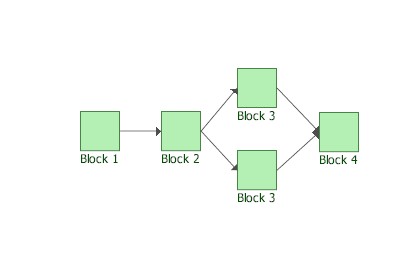
A Reliability Block Diagram (RBD) (DOD, 1998) is a graphical representation of the reliability dependence of a system on its components. It is a directed, acyclic graph. Each path through the graph represents a subset of system components. As long as the components in that path are operational, the system is operational. Component lives are usually assumed to be independent in an RBD. Simple topologies include a series system, a parallel system, a k of n system, and combinations of these.
信頼性ブロック図(Reliability Block Diagram、RBD)(DOD, 1998)は、システムの信頼性がそのコンポーネントにどう依存しているかを図で表現したものである。RBD は有向非循環グラフである。グラフを通る各経路は、システムコンポーネントの部分集合を表す。その経路内のコンポーネントが運用可能である限り、システムは運用可能である。RBD では通常、コンポーネントの寿命は互いに独立であると仮定される。単純なトポロジには、直列システム、並列システム、k of n システム、およびそれらの組み合わせがある。
RBDs are often nested, with one RBD serving as a component in a higher-level model. These hierarchical models allow the analyst to have the appropriate resolution of detail while still permitting abstraction.
RBD はしばしば入れ子構造をとり、ある RBD がより上位のモデルのコンポーネントとして機能する。こうした階層モデルにより、分析者は、抽象化を依然として許しながら、適切な詳細度で解析できる。
RBDs depict paths that lead to success, while fault trees depict paths that lead to failure.
RBD は成功に至る経路を描き、フォールトツリーは故障に至る経路を描く。
図中の英語
A Failure Mode Effects Analysis is a table that lists the possible failure modes for a system, their likelihood, and the effects of the failure. A Failure Modes Effects Criticality Analysis scores the effects by the magnitude of the product of the consequence and likelihood, allowing ranking of the severity of failure modes. (Kececioglu 1991)
故障モード影響解析(Failure Mode Effects Analysis)は、システムで起こり得る故障モード、その起こりやすさ、故障の影響を列挙した表である。故障モード影響致命度解析(Failure Modes Effects Criticality Analysis)は、帰結と起こりやすさの積の大きさによって影響をスコア化し、故障モードを重大度で順位付けできるようにする(Kececioglu 1991)。
System models require even more data to fit them well. “Garbage in, garbage out” (GIGO) particularly applies in the case of system models.
システムモデルを適切にフィットさせるには、より多くのデータが必要である。「ゴミを入れればゴミが出る(Garbage in, garbage out、GIGO)」という言葉は、システムモデルに特によく当てはまる。
The specialized analyses required for RAM drive the need for specialized software. While general purpose statistical languages or spreadsheets can, with sufficient effort, be used for reliability analysis, almost every serious practitioner uses specialized software.
RAM に必要な専門的な解析には、専門的なソフトウェアが必要となる。汎用の統計言語やスプレッドシートも、十分な労力をかければ信頼性解析に使用できるが、本格的な実務家のほぼ全員が専門的なソフトウェアを使用している。
Minitab (versions 13 and later) includes functions for life data analysis. Win Smith is a specialized package that fits reliability models to life data and can be extended for reliability growth analysis and other analyses. Relex has an extensive historical database of component reliability data and is useful for estimating system reliability in the design phase.
Minitab(バージョン13以降)には、寿命データ解析のための関数が含まれている。Win Smith は、信頼度モデルを寿命データにフィットさせる専門的なパッケージであり、信頼性成長解析などの解析にも拡張できる。Relex は、コンポーネント信頼性データの広範な履歴データベースを備え、設計フェーズにおけるシステム信頼度の推定に役立つ。
There is also a suite of products from ReliaSoft (2007) that is useful in specialized analyses. Weibull++ fits life models to life data. ALTA fits accelerated life models to accelerated life test data. BlockSim models system reliability, given component data.
ReliaSoft(2007)の製品スイートも、専門的な解析に有用である。Weibull++ は寿命モデルを寿命データにフィットさせる。ALTA は加速寿命モデルを加速寿命試験データにフィットさせる。BlockSim は、コンポーネントデータに基づいてシステム信頼度をモデル化する。
Reliasoft and PTC Windchill Product Risk and Reliability produce a comprehensive family of tools for component reliability prediction, system reliability predictions (both reliability block diagrams and fault trees), reliability growth analysis, failure modes and effects analyses, FRACAS databases, and other specialized analyses. In addition to these comprehensive tool families, there are more narrowly scoped tools. Minitab (versions 13 and later) includes functions for life data analysis.
Reliasoft と PTC Windchill Product Risk and Reliability は、コンポーネント信頼性予測、システム信頼性予測(信頼性ブロック図とフォールトツリーの両方)、信頼性成長解析、故障モード影響解析、FRACAS データベース、その他の専門的な解析のための包括的なツールファミリを提供している。こうした包括的なツールファミリのほかに、より対象範囲の狭いツールもある。Minitab(バージョン13以降)には、寿命データ解析のための関数が含まれている。
Some general-purpose statistical analysis software includes functions for reliability data analysis. Minitab has a module for reliability and survival analysis. SuperSmith is a more specialized package that fits reliability models to life data and can be extended for reliability growth analysis and other analyses.
汎用統計解析ソフトウェアの中には、信頼性データ解析のための関数を備えたものがある。Minitab には、信頼性と生存解析のためのモジュールがある。SuperSmith はより専門的なパッケージであり、信頼性モデルを寿命データにフィットさせ、信頼性成長解析などの解析にも拡張できる。
R is a widely used open source and well-supported general purpose statistical language with specialized packages that can be used for fitting reliability models, Bayesian analysis, and Markov modeling.
R は、広く使われ、サポートも充実したオープンソースの汎用統計言語であり、信頼性モデルのフィッティング、ベイズ解析、マルコフモデリングに使用できる専門的なパッケージを備えている。
Fault tree generation and analysis tools include CAFTA from the Electric Power Research Institute and OpenFTA , an open source software tool originally developed by Auvation Software.
フォールトツリーの作成と解析のためのツールには、Electric Power Research Institute の CAFTA や、もともと Auvation Software が開発したオープンソースソフトウェアツールである OpenFTA がある。
PRISM is an open source probabilistic model checker that can be used for Markov modeling (both continuous and discrete time) as well as for more elaborate analyses of system (more specifically, “timed automata”) behaviors such as communication protocols with uncertainty.
PRISM はオープンソースの確率的モデルチェッカであり、マルコフモデリング(連続時間と離散時間の両方)に加え、不確実性を伴う通信プロトコルのようなシステム(より具体的には「時間オートマトン(timed automata)」)の振る舞いの、より精緻な解析にも使用できる。
American Society for Quality (ASQ). 2022. Glossary: Reliability. Accessed on May 9, 2022. Available at https://asq.org/glossary/r.html.
American Society for Quality (ASQ). 2016. Reliability Engineering Certification – CRE. Accessed May 9, 2022. Available at https://asq.org/cert/reliability-engineer.
DoD. 2005. DOD Guide for Achieving Reliability, Availability, and Maintainability. Arlington, VA, USA: U.S. Department of Defense (DoD). Accessed on May 9, 2022. Available at https://www.acqnotes.com/Attachments/DoD%20Reliability%20Availability%20and%20Maintainability%20(RAM)%20Guide.pdf
Ebeling, C.E., 2010. An Introduction to Reliability and Maintainability Engineering. Long Grove Illinois, U.S.A: Waveland Press.
GEIA. 2008. Reliability Program Standard for Systems Design, Development, and Manufacturing. Warrendale, PA, USA: Society of Automotive Engineers (SAE), SAE-GEIA-STD-0009.
IEEE. 2008. IEEE Recommended Practice on Software Reliability. New York, NY, USA: Institute of Electrical and Electronic Engineers (IEEE). IEEE Std 1633-2008.
Kececioglu, D. 1991. Reliability Engineering Handbook, Volume 2. Upper Saddle River, NJ, USA: Prentice Hall.
Laprie, J.C., A. Avizienis, and B. Randell. 1992. Dependability: Basic Concepts and Terminology. Vienna, Austria: Springer-Verlag.
Meeker, W., Escobar, L., and Pascual, F. 2022 Statistical Methods for Reliability Data. 2nd ed. Hoboken, NJ: Wiley.
Nelson, W. 1990. Accelerated Testing: Statistical Models, Test Plans, and Data Analysis. New York, NY, USA: Wiley and Sons.
NRC. 2015. Reliability Growth: Enhancing Defense System Reliability. Washington, DC: National Academy Press. Access May 25, 2023. Available at https://nap.nationalacademies.org/catalog/18987/reliability-growth-enhancing-defense-system-reliability.
O’Connor, D.T., and A. Kleyner. 2012. Practical Reliability Engineering, 5th Edition. Chichester, UK: J. Wiley & Sons, Ltd.
ReliaSoft. 2007. Failure Modes and Effects Analysis (FMEA) and Failure Modes, Effects and Criticality Analysis (FMECA). Accessed May 9, 2022. Available at https://www.weibull.com/basics/fmea.htm.
Shooman, Martin. 2002. Reliability of Computer Systems and Networks. New York, NY, USA: John Wiley & Sons.
Blischke, W.R. and D.N. Prabhakar Murthy. 2000. Reliability Modeling, Prediction, and Optimization. New York, NY, USA: Wiley and Sons.
Dezfuli, H, D. Kelly, C. Smith, K. Vedros, and W. Galyean. 2009. “Bayesian Inference for NASA Risk and Reliability Analysis”, National Aeronautics and Space Administration, NASA/SP-2009-569. Accessed on May 25, 2023. Available at https://ntrs.nasa.gov/citations/20090023159.
DoD. 2005. DOD Guide for Achieving Reliability, Availability, and Maintainability. Arlington, VA, USA: U.S. Department of Defense (DoD). Accessed September 11, 2011. Available at https://www.acq.osd.mil/se/docs/RAM_Guide_080305.pdf.
Kececioglu, D. 1991. Reliability Engineering Handbook, Volume 2. Upper Saddle River, NJ, USA: Prentice Hall.
Lawless, J.F. 1982. Statistical Models and Methods for Lifetime Data. New York, NY, USA: Wiley and Sons.
Lyu, M. 1996. ‘’Software Reliability Engineering’’. New York, NY: IEEE-Wiley Press. Accessed May 9, 2022. Available at https://www.cse.cuhk.edu.hk/~lyu/book/reliability/index.html.
Martz, H.F. and R.A. Waller. 1991. Bayesian Reliability Analysis. Malabar, FL, USA: Kreiger.
Meeker, W., Escobar, L., and Pascual, F. 2022 Statistical Methods for Reliability Data. 2nd ed. Hoboken, NJ: Wiley.
NRC. 2015. Reliability Growth: Enhancing Defense System Reliability. Washington, DC: National Academy Press.
DoD. 2011. ‘’MIL-HDBK-189C, Department of Defense Handbook: Reliability Growth Management (14 JUN 2011).’’ Arlington, VA, USA: U.S. Department of Defense (DoD). Accessed May 9, 2022. Available at https://everyspec.com/MIL-HDBK/MIL-HDBK-0099-0199/MIL-HDBK-189C_34842.
DOD. 1998. ‘’MIL-HDBK-338B, Electronic Reliability Design Handbook’’ U.S. Department of Defense Air Force Research Laboratory IFTB. Accessed May 9, 2022.Available at https://www.weibull.com/mil_std/mil_hdbk_338b.pdf.
U.S. Naval Surface Weapons Center Carderock Division, NSWC-11. ‘’Handbook of Reliability Prediction Procedures for Mechanical Equipment.’’ Accessed May 9, 2022. Available at https://everyspec.com/USN/NSWC/download.php?spec=NSWC-10_RELIABILITY_HDBK_JAN2010.045818.pdf.
IEEE. 2013. IEEE Recommended Practice for Collecting Data for Use in Reliability, Availability, and Maintainability Assessments of Industrial and Commercial Power Systems, IEEE Std 3006.9-2013. New York, NY, USA: IEEE.
NIST/SEMATECH Engineering Statistics Handbook 2013. Accessed May 9, 2022. Available at https://www.itl.nist.gov/div898/handbook/.
Olwell, D.H. 2001. "Reliability Leadership." Proceedings of the 2001 IEEE Reliability and Maintainability Symposium. Philadelphia, PA, USA: IEEE. Accessed May 9, 2022. Available at https://ieeexplore.ieee.org/stamp/stamp.jsp?arnumber=902431.
Reliability Analytics Toolkit. n.d. web page containing 31 reliability and statistical analyses calculation aids. Seymour Morris, Reliability Analytics. Accessed May 9, 2022. A.vailable at https://reliabilityanalyticstoolkit.appspot.com/
ReliaSoft. 2007. "Availability." Accessed May 9, 2022. Available at https://reliawiki.com/index.php/Introduction_to_Repairable_Systems#Availability.
SAE. 2000a. Aerospace Recommended Practice ARP5580: Recommended Failure Modes and Effects Analysis (FMEA) Practices for Non-Automobile Applications. Warrendale, PA, USA: Society of Automotive Engineers (SAE) International.
SAE. 2000b. Surface Vehicle Recommended Practice J1739: (R) Potential Failure Mode and Effects Analysis in Design (Design FMEA), Potential Failure Mode and Effects Analysis in Manufacturing and Assembly Processes (Process FMEA), and Potential Failure Mode and Effects Analysis for Machinery (Machinery FMEA). Warrendale, PA, USA: Society of Automotive Engineers (SAE) International.
*Availability *Reliability, Availability