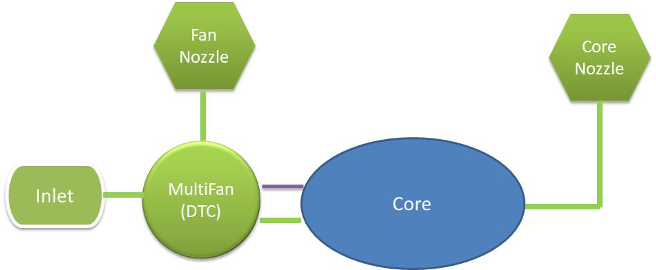
図1:選定されたエンジンアーキテクチャ3
System Adaptability
To adapt means “to make fit (as for a new use) often by modification” (Merriam-Webster, Inc. n.d.). The term adaptation is traditionally used in natural ecosystems as the “modification of an organism or its parts that makes it more fit for existence under the conditions of its environment” where the conditions can be either positive or negative (Andersen and Gronau 2005). Following from the dictionary definition, System Adaptability is a system’s ability to satisfy mission and requirement changes, with or without modifications (Zhu 2015) (Jackson 2016). One common way to judge whether a system is more adaptable than another is if it is able to support mission and requirement changes at lower cost – an indication of how difficult a system is to adapt. Note that the term cost here may not necessarily be financial. It may include time, fuel, complexity as adopted in Zhu, et al. (2016) or any metric that designers, users, and other stakeholders value with regard to the difficulty of modifications.
「適応する(adapt)」とは、「(新しい用途などに)しばしば変更を加えて適合させること」という意味である(Merriam-Webster, Inc. n.d.)。適応(adaptation)という用語は、伝統的に自然の生態系について、「生物またはその部分を、その環境の条件下での生存により適したものにする変化」という意味で用いられてきた。ここでいう条件は、好ましいものである場合も好ましくないものである場合もある(Andersen and Gronau 2005)。この辞書的な定義に従えば、システム適応性(System Adaptability)とは、変更の有無を問わず、ミッションと要求事項の変更に応えるシステムの能力である(Zhu 2015)(Jackson 2016)。あるシステムが別のシステムより適応性が高いかどうかを判断する一般的な方法の一つは、より低いコストでミッションと要求事項の変更に対応できるかどうかを見ることである。これは、そのシステムを適応させるのがどれほど難しいかを示す指標となる。なお、ここでいう「コスト」は必ずしも金銭的なものとは限らない。Zhu, et al.(2016)で採用されているような時間、燃料、複雑さのほか、変更の難しさに関して設計者、ユーザー、その他のステークホルダーが重視するあらゆる指標が含まれ得る。
The adaptability concept is applicable to both real and conceptual systems as defined in Sillitto, Hillary, et al. (2017). Many concepts are related to system adaptability such as system resilience, flexible design, and design reuse.
適応性の概念は、Sillitto, Hillary, et al.(2017)で定義されている実在のシステムと概念的なシステムのいずれにも適用できる。システム適応性には、システムレジリエンス、柔軟な設計、設計の再利用など、多くの概念が関連している。
• System resilience has traditionally focused on graceful degradation and recovery of a system's performance, triggered by adverse events and planned for in advance. (see System Resilience) System adaptability focuses on solutions for changes caused by either adversarial or beneficial events.
• システムレジリエンスは従来、不利な事象を契機として生じ、あらかじめ計画された、システム性能の優美縮退と回復に焦点を当ててきた(システムレジリエンスを見よ)。システム適応性は、敵対的な事象と有益な事象のどちらによって引き起こされる変化にも対処する解決策に焦点を当てる。
• Flexible design in industrial engineering (Saleh, et al. 2009) often requires up-front investment and justification of redundant design components or facilities, with more than 50 kinds of flexibilities defined and studied.
• 産業工学における柔軟な設計(Saleh, et al. 2009)では、冗長な設計構成要素や施設に対する事前の投資と正当化が必要になることが多く、50種類を超える柔軟性が定義・研究されている。
• System adaptability looks into future changes to inform current design choices for reduction of unnecessarily redundant design components. System adaptability encourages reuse, but generally does not promote it at the expense of higher cost.
• システム適応性は、将来の変化を見通すことで現在の設計上の選択に判断材料を与え、不必要に冗長な設計構成要素を減らす。システム適応性は再利用を奨励するが、一般に、コストの増大を代償にしてまで再利用を推し進めることはない。
Comparing adaptability among different systems relies on three fundamental factors:
異なるシステム間の適応性の比較は、次の3つの基本要因に基づく:
• Mission and Requirement Evaluation Space (MRES)
• ミッションと要求事項の評価空間(Mission and Requirement Evaluation Space, MRES)
• Design Space
• 設計空間(Design Space)
• Switching Cost
• 切り替えコスト(Switching Cost)
These factors are explained in the next three subsections.
これらの要因については、以下の3つの小節で説明する。
Common development practice assumes each requirement is for current needs and is often subject to budget constraint perceptions. MRES differs in that it uses systems thinking (see Systems Thinking) to project into the future and identifies requirements with high risk of change. These uncertain requirements come from stakeholder decisions, market changes, technology progression, engineering uncertainties, and other sources. They are potential needs that can optionally be considered. (Zhu, 2023) MRES is a collection of current needs (i.e. requirements and missions) and optional potential needs. These projections into the future offer valuable information when designing for adaptability. Of course, predicting possible future needs is an uncertain task and itself incurs costs. Important optional potential needs could be overlooked or poorly stated. Under cost and schedule pressure, developing optional potential needs could be shortchanged. Nevertheless, anticipating optional possible future needs and their potential impact on design is a valuable systems engineering (SE) activity.
一般的な開発実務では、各要求事項は現在のニーズに対するものだと仮定されており、予算制約に対する認識に左右されることも多い。これに対して MRES は、システム思考(systems thinking)を用いて将来を見通し、変更のリスクが高い要求事項を特定する点が異なる(システム思考を見よ)。こうした不確実な要求事項は、ステークホルダーの決定、市場の変化、技術の進歩、工学上の不確実性、その他の要因から生じる。これらは、考慮するかどうかを任意に選べる潜在的なニーズである(Zhu, 2023)。MRES は、現在のニーズ(すなわち要求事項とミッション)と任意の潜在的ニーズから成る集合である。こうした将来の予測は、適応性を目指した設計を行う際に貴重な情報となる。もちろん、将来起こり得るニーズの予測は不確実な作業であり、それ自体にコストがかかる。重要な任意の潜在的ニーズが見落とされたり、不十分にしか記述されなかったりすることもある。コストやスケジュールの圧力の下では、任意の潜在的ニーズの策定がおろそかになることもある。それでも、任意の将来起こり得るニーズと、それが設計に及ぼし得る影響を予期することは、システムズエンジニアリング(SE)の貴重なアクティビティである。
SE normally includes developing alternative possible designs and comparing them to pick the best one among the alternatives. A collection of different possible system designs is called the design space or trade space in which tradeoff studies or trade studies are performed to pick the one that will be implemented. (Cilli & Parnell 2014) (NASA 2016) In modern design approaches, design spaces can be enormous with automated and semi-automated means to conduct the trade study. (Raz, et al. 2018) The trade study is based on a set of decision factors, which can include system adaptability.
SE には通常、考えられる代替設計を開発し、それらを比較して代替案の中から最良のものを選ぶことが含まれる。考えられるさまざまなシステム設計の集合は設計空間またはトレード空間と呼ばれ、実装する設計を選ぶために、その中でトレードオフスタディまたはトレードスタディが実施される(Cilli & Parnell 2014)(NASA 2016)。現代の設計アプローチでは、設計空間は膨大になり得て、トレードスタディを実施する自動化および半自動化された手段を伴う(Raz, et al. 2018)。トレードスタディは一連の決定要因に基づいて行われ、そこにはシステム適応性が含まれることもある。
If adapting the system requires modifying it, the ease of modification indicates the degree of adaptability. The cost of switching from one system design/state to another design/state is called the switching cost which is a good indicator of how difficult it is to adapt. As stated at the beginning of this article, the term cost here may not necessarily be financial.
システムを適応させるために変更が必要な場合は、変更のしやすさが適応性の度合いを表す。あるシステム設計/状態から別の設計/状態へ切り替えるコストを切り替えコストと呼ぶ。これは、適応させることがどれほど難しいかを示す良い指標となる。本記事の冒頭で述べたとおり、ここでいう「コスト」は必ずしも金銭的なものとは限らない。
Traditional financial cost estimation assumes a system is developed from scratch, which in reality is rarely done. Many products are developed by modifying designs from prior products, where the cost is actually a switching cost. Methods of estimating switching cost for a complete generic system, rather than individual components or systems of a specific kind, were initiated mainly by two research teams: a process-based method was developed and later reported in Zhu (2018) and a parametric approach was developed in COSYSMO (Alstad 2019).
従来の財務的なコスト見積もりはシステムをゼロから開発することを前提としているが、実際にそうした開発が行われることはめったにない。多くの製品は先行製品の設計に変更を加えて開発されており、その場合のコストは実質的には切り替えコストである。個々の構成要素や特定の種類のシステムではなく、汎用的なシステム全体を対象として切り替えコストを見積もる手法は、主に2つの研究チームによって始められた。一つはプロセスベースの手法で、開発後に Zhu(2018)で報告された。もう一つはパラメトリックなアプローチで、COSYSMO において開発された(Alstad 2019)。
Two major prior works on system adaptability were authored by Gu, Hashemian, and Nee (2004) and by Ross, Rhodes, and Hastings (2007). The first defines adaptability as a normalized savings in switching from one product to another, emphasizing the costs as the main consideration. In Ross, Rhodes, and Hastings (2007), for two designs A and B, if A can be modified to become B, then a link is created between them. They define the adaptability of a design as the outdegree or filtered outdegree from that design. A design’s outdegree counts the links from this design to the other designs.
システム適応性に関する2つの主要な先行研究として、Gu, Hashemian, and Nee(2004)と Ross, Rhodes, and Hastings(2007)がある。前者は、適応性をある製品から別の製品へ切り替える際の正規化された節約として定義し、主な考慮事項としてコストを重視している。Ross, Rhodes, and Hastings(2007)では、2つの設計 A と B について、A に変更を加えて B にできる場合に、両者の間にリンクが張られる。彼らは、設計の適応性を、その設計からの外向き次数(outdegree)またはフィルタ済みの外向き次数として定義している。設計の外向き次数とは、その設計から他の設計へ向かうリンクの数である。
In a design space, some designs support the mission better than others. Without considering the support to missions or requirements, measuring the cost to switch to another design (Gu, Hashemian, & Nee 2004) or how many other designs one design can switch to (Ross, Rhodes, & Hastings 2007) can result in inverted measures, where an entity that would receive a higher value of the measurement result than another entity receives with a lower value result. A design that is able to switch with low cost to many other designs that are of no or low value for missions may receive a higher adaptability score than another design that actually supports the needed missions. Fundamentally, these two works capture only two of the three fundamental factors described in section Mission and Requirements Evaluation Space above - the MRES factor, which is needed to prevent inverted measures.
設計空間の中には、他の設計よりもミッションにうまく対応する設計がある。ミッションや要求事項への対応を考慮せずに、別の設計への切り替えコスト(Gu, Hashemian, & Nee 2004)や、ある設計から切り替え可能な他の設計の数(Ross, Rhodes, & Hastings 2007)を測定すると、測定量の値の順位が逆転し、本来は別の対象よりも高い測定結果を得るはずの対象が、かえって低い結果を得ることがある。すなわち、ミッションにとって価値がないか低い価値しかない他の多くの設計へ低コストで切り替えられる設計が、実際に必要なミッションに対応する別の設計よりも高い適応性スコアを得ることがある。根本的には、これら2つの研究は、上記「ミッションと要求の評価空間」の節で述べた3つの基本要因のうち2つしか取り込んでいない。欠けているのは、測定量の値の順位の逆転を防ぐために必要な MRES 要因である。
In an eco-system, a species adapts in order to survive and exist longer. In SE, being able to support future missions/requirement needs prolongs the service life of the system and extends its existence, which is well aligned with the eco-system definition of adaptability.
生態系において、種は生き残り、より長く存続するために適応する。SE においては、将来のミッション/要求事項のニーズに対応できれば、システムの耐用年数が延び、その存続期間も長くなる。これは、生態系における適応性の定義とよく合致する。
There are also domain-specific definitions of adaptability and switching costs in such domains as IT, control, and self-adaptive systems areas. (Zhu, et al. 2016).
また、IT、制御、自律適応システムといった領域には、適応性と切り替えコストについて領域固有の定義も存在する(Zhu, et al. 2016)。
In the following example, a high-level abstraction of an aircraft engine is used to illustrate how to evaluate the adaptability of system designs (Zhu, et al., 2016) using the three critical factors: MRES, Design Space, and Switching Costs.
以下の例では、航空機エンジンを高い抽象度でモデル化したものを用いて、システム設計の適応性を評価する方法を示す(Zhu, et al., 2016)。その際には、3つの重要な要因である MRES、設計空間、切り替えコストを用いる。
Capturing flight missions for the engine example is the first step. The following operations set the stage for key mission requirements: #One engine inoperative #Takeoff Gradient of Climb #Climb Rate #Cruise Range
Three typical types of aircraft are used in commercial airline operations: *a city-to-city short range aircraft *a regional jet *a transatlantic jet
Support for one engine becoming inoperative is required by aviation regulations. In addition, Takeoff Gradient of Climb, Climb Rates, and Cruise Range are as indicated in Table 1.
<center>
最初のステップは、このエンジンの例における飛行ミッションの把握である。主要なミッション要求事項の枠組みとなるのは、以下の運用である:
商用航空の運航では、典型的な3つのタイプの航空機が用いられる:
エンジン1基が作動不能になった場合への対応は、航空規制で義務付けられている。加えて、離陸上昇勾配、上昇率、巡航航続距離は表1に示すとおりである。
表1. ミッションパラメータ。(SEBoK Original)
| +Table 1. Mission Parameters. (SEBoK Original) |
| Aircraft Type |
|---|
| Takeoff Gradient |
| Climb Rate (Ft/Min) |
| Cruise Range (Nautical Miles) |
| City-to-City Aircraft |
| 1.2% (low) |
| 1000 (low) |
| 700 (short-range) |
| Regional Jet |
| 1.2% (low) |
| 1500 (high) |
| 2000 (mid-range) |
| Transatlantic Jet |
| 1.2% (low) |
| 1500 (high) |
| 4000 (long-range) |
| 航空機タイプ | 離陸勾配 | 上昇率(Ft/Min) | 巡航航続距離(海里) |
|---|---|---|---|
| 都市間航空機 | 1.2%(低) | 1000(低) | 700(短距離) |
| リージョナルジェット | 1.2%(低) | 1500(高) | 2000(中距離) |
| 大西洋横断ジェット | 1.2%(低) | 1500(高) | 4000(長距離) |
</center>
Suppose a customer wants to build a customized aircraft that has different mission preferences beyond the three regular types of aircraft, and the engine supplier is asked to design an engine to support that customization. Enumerating all possible values for each mission parameter, where each parameter takes three values (low, median and high), would produce 27 missions. However, here the customer prefers to consider only the 6 missions described in Table 2. The remaining 21 missions are deemed not needed and omitted from the design space. In this table, “optional” preferences refer to possible future mission needs such as fuel economy.
<center>
ある顧客が、通常の3つのタイプの航空機の枠を超えた、異なるミッション選好を持つカスタマイズ機を作りたいと考え、エンジン供給者がそのカスタマイズに対応するエンジンの設計を求められたとする。各パラメータが3つの値(低、中、高)を取るとして、各ミッションパラメータの取り得る値をすべて列挙すると、27のミッションが生成されることになる。しかしここでは、顧客は表2に示す6つのミッションだけを考慮したいと考えている。残りの21のミッションは不要と見なされ、設計空間から除外される。表中の「任意」という選好は、燃費のような将来起こり得るミッションニーズを指す。
表2. ミッションと要求事項の評価空間。(SEBoK Original)
| +Table 2. Mission and Requirement Evaluation Space. (SEBoK Original) |
| Missions |
|---|
| 1 |
| 2 |
| 3 |
| 4 |
| 5 |
| 6 |
| Takeoff Gradient |
| low |
| low |
| low |
| high |
| high |
| high |
| Climb Rate |
| low |
| low |
| low |
| low |
| low |
| low |
| Cruise Range |
| long-range |
| mid-range |
| short-range |
| long-range |
| mid-range |
| short-range |
| Preference |
| optional |
| required |
| required |
| optional |
| optional |
| optional |
| ミッション | 1 | 2 | 3 | 4 | 5 | 6 |
|---|---|---|---|---|---|---|
| 離陸勾配 | 低 | 低 | 低 | 高 | 高 | 高 |
| 上昇率 | 低 | 低 | 低 | 低 | 低 | 低 |
| 巡航航続距離 | 長距離 | 中距離 | 短距離 | 長距離 | 中距離 | 短距離 |
| 選好 | 任意 | 必須 | 必須 | 任意 | 任意 | 任意 |
</center>
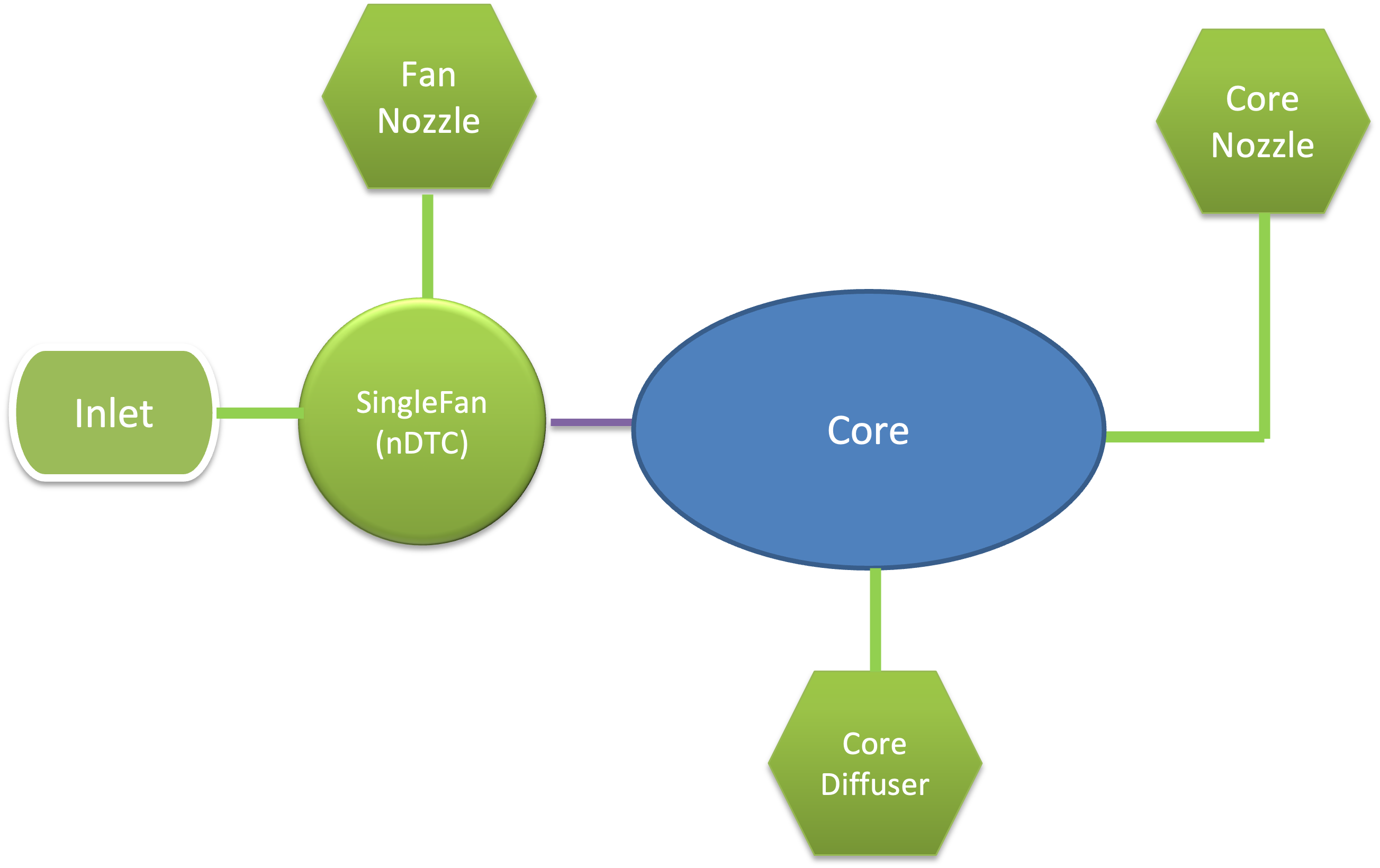
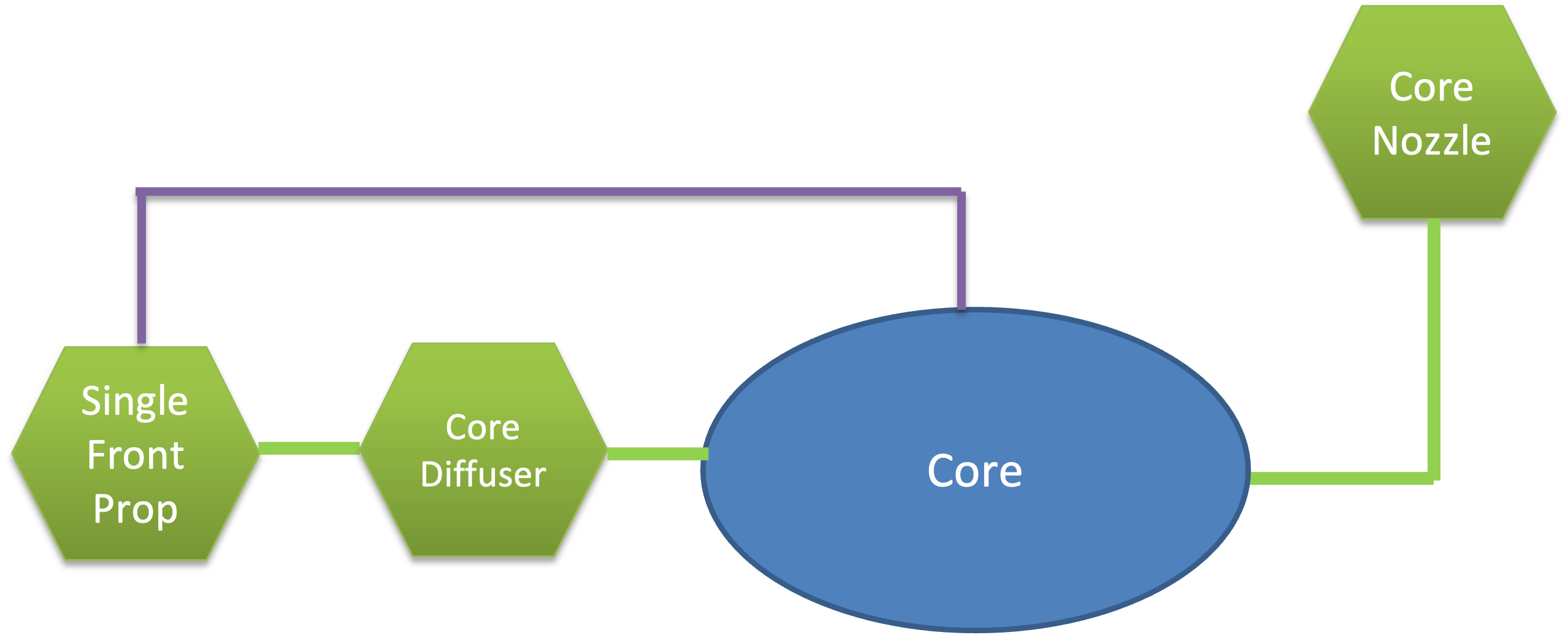
In this top abstraction level, an exhaustive search for all possible engine designs is conducted, and 12 design architectures are found. Each engine architecture may support one or more of these 6 missions. To simplify the discussion, three representative architectures were selected and shown in Figures 1, 2, and 3 which will be used to illustrate how architecture optimization is performed.
この最上位の抽象度では、考えられるすべてのエンジン設計を網羅的に探索した結果、12の設計アーキテクチャが見出される。各エンジンアーキテクチャは、これら6つのミッションのうち一つ以上に対応し得る。議論を簡単にするため、代表的な3つのアーキテクチャを選定して図1、図2、図3に示す。これらを用いて、アーキテクチャの最適化がどのように行われるかを説明する。
図中の英語
図中の英語
図中の英語
Here, purple links represent the mechanical path and green links represent the gas path.
図中の紫のリンクは機械的経路を、緑のリンクはガス経路を表す。
In this aircraft engine example, the costs of switching from each architecture to each of the other 11 architectures would be estimated.
この航空機エンジンの例では、各アーキテクチャから他の11のアーキテクチャそれぞれへの切り替えコストを見積もることになる。
When deciding which architecture to pick, a naïve approach would be picking the one that supports most of the missions in MRES. This often leads to a costly design that requires significant investment upfront that is undesirable. One of the advantages of developing a system with adaptability in mind is that it does not require significant upfront investment. For example, assume Architecture 3 and 6 can both meet the current needs, but there is a reasonable chance that changes may be needed such that only Architecture 9 is capable of supporting the future needs. If Architecture 3 and 6 are both acceptable in cost, but the switching cost from Architecture 6 to Architecture 9 is much higher than the switching from Architecture 3 to Architecture 9, one might want to choose Architecture 3. Note, however, that this discussion only considers system adaptability. It is likely other factors, such as schedule or company strategy, are also important and would be included in the trade study.
どのアーキテクチャを選ぶかを決める際の素朴なアプローチは、MRES のミッションの大部分に対応できるものを選ぶことだろう。しかしこれは、多額の事前投資を要する高コストの設計につながることが多く、望ましくない。適応性を念頭に置いてシステムを開発する利点の一つは、多額の事前投資を必要としないことである。例えば、アーキテクチャ3とアーキテクチャ6はいずれも現在のニーズを満たせるが、変更が必要になる可能性が相応にあり、その場合に将来のニーズに対応できるのはアーキテクチャ9だけだとする。アーキテクチャ3と6がいずれもコスト面で許容できるとしても、アーキテクチャ6からアーキテクチャ9への切り替えコストがアーキテクチャ3からアーキテクチャ9への切り替えコストよりはるかに高ければ、アーキテクチャ3を選びたいと考えるかもしれない。ただし、この議論で考慮しているのはシステム適応性だけである点に注意されたい。スケジュールや企業戦略などの他の要因も重要である可能性が高く、それらもトレードスタディに含めることになる。
System adaptability can be quantified. One such adaptability metric was developed by Zhu, et al. (2016), which can be conveniently used as a rule of thumb for engineers to judge how adaptable their system design is. This metric has a range of [0, 1] where a higher value indicates the system is more adaptable. The actual value is based on a function that considers both a weighting of the MRES missions/requirements as well as the switching costs to achieve the optional future missions/requirements. A design that can support all current and optional possible future missions/requirements within the cost threshold has an adaptability score of 1. A design that can support none of the optional missions/requirements within the cost threshold has an adaptability score of 0. All other designs have scores ranging between 0 and 1. Using the algorithm found in Zhu, et al. (2016), for the above aircraft engine example, Architecture 9 is perfectly adaptable with a score of 1, Architecture 3 is mostly adaptable with a score of 0.6, and architecture 6 is partially adaptable with a score of 0.25.
システム適応性は定量化できる。そうした適応性指標の一つが Zhu, et al.(2016)によって開発されており、エンジニアが自らのシステム設計の適応性の程度を判断するための経験則として手軽に使える。この指標は [0, 1] の範囲の値をとり、値が高いほどシステムの適応性が高いことを示す。実際の値は、MRES のミッション/要求事項に対する重み付けと、任意の将来のミッション/要求事項を達成するための切り替えコストの両方を考慮した関数に基づいて求められる。コストの閾値内で、現在のミッション/要求事項と任意の将来起こり得るミッション/要求事項のすべてに対応できる設計の適応性スコアは1である。コストの閾値内で、任意のミッション/要求事項のいずれにも対応できない設計の適応性スコアは0である。それ以外の設計はすべて、0と1の間のスコアとなる。上記の航空機エンジンの例に Zhu, et al.(2016)のアルゴリズムを適用すると、アーキテクチャ9はスコア1で「完全に」適応可能、アーキテクチャ3はスコア0.6で「おおむね」適応可能、アーキテクチャ6はスコア0.25で「部分的に」適応可能となる。
The same concept can be applied to any other system domain, such as Heating, Ventilation and Air Conditioning (HVAC) systems (Zhu, 2019), medical systems, transportation systems or social systems.
同じ概念は、暖房、換気、空調(HVAC)システム(Zhu, 2019)、医療システム、輸送システム、社会システムなど、他のあらゆるシステム領域にも適用できる。
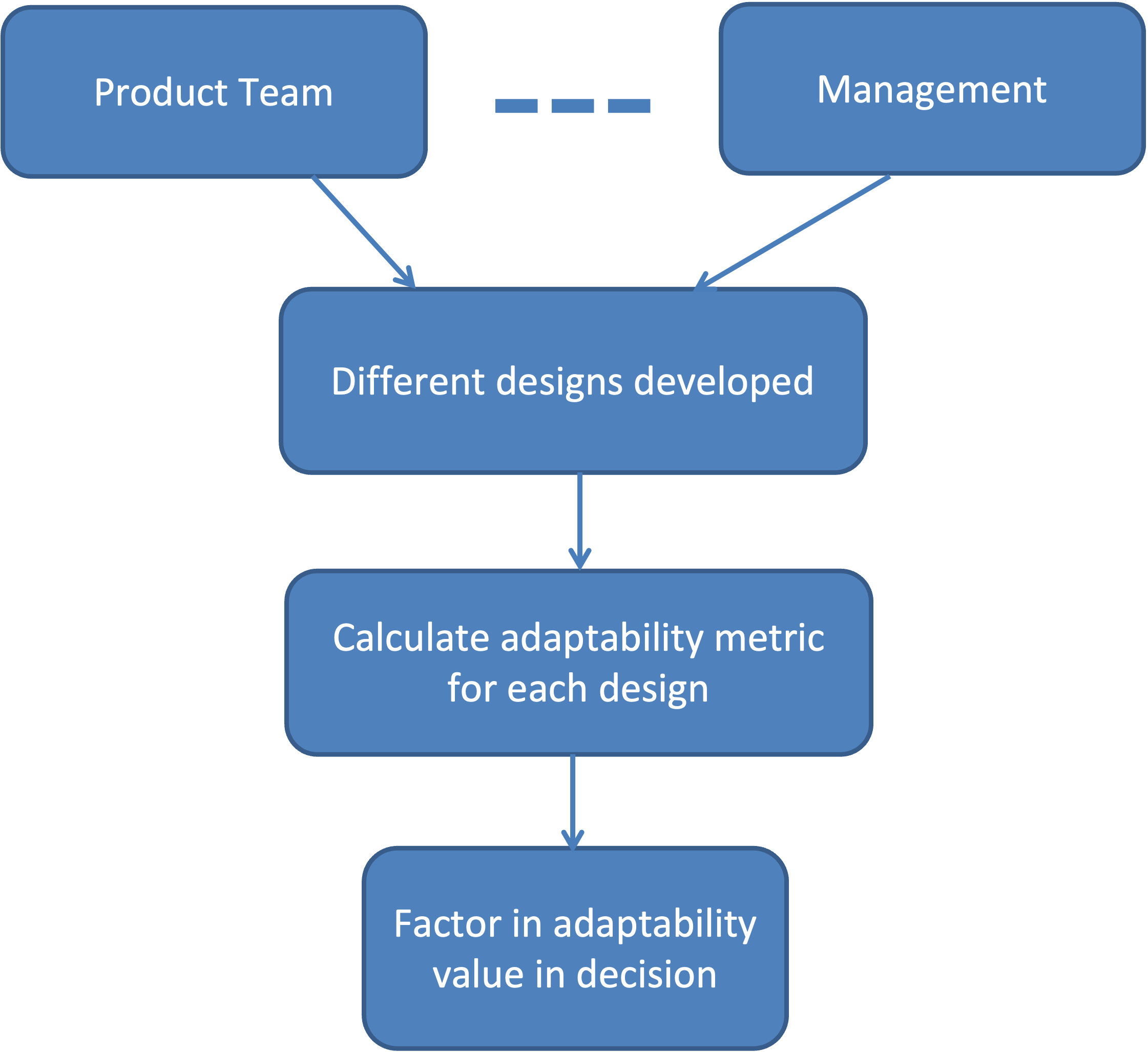
An adaptability metric is useful in system development and management whereby each design’s adaptability metric is calculated and factored into trade studies for down-selections. (Zhu 2015) “Switching costs also significantly influence managerial decisions. They have been shown to influence the competitive strategies that managers adopt” as summarized by Whitten (2009) from Eliashberg and Robertson (1988). The adaptable design process in Figure 4 evolves with varying stakeholders, e.g. management, customers and technical teams. At the beginning of defining a system design, information such as requirements, financial budget information, management vision and a roadmap are generated. Current and optional possible missions and requirements are collected into MRES. The technical team then generates different designs within the design space and calculates the adaptability metric value for each design. That value can then influence design selection. This approach can be applied by both commercial and government organizations not only to internal development but also to acquisition from external organizations.
適応性指標はシステムの開発とマネジメントに役立つものであり、各設計について適応性指標を計算し、ダウンセレクションのためのトレードスタディに織り込む(Zhu 2015)。Whitten(2009)は Eliashberg and Robertson(1988)を要約して、「切り替えコストは経営上の意思決定にも大きな影響を及ぼす。マネージャーが採用する競争戦略に影響することが示されている」と述べている。図4に示す適応可能な設計プロセスは、マネジメント、顧客、技術チームなど、さまざまなステークホルダーとともに進化する。システム設計の定義を始める段階で、要求事項、財務予算情報、マネジメントのビジョン、ロードマップといった情報が作成される。現在のミッションと要求事項、および任意の起こり得るミッションと要求事項は、MRES に集約される。次に技術チームが設計空間の中でさまざまな設計を作成し、各設計の適応性指標の値を計算する。その値が、設計の選定に影響を与え得る。このアプローチは、商業組織でも政府組織でも、内部開発だけでなく外部組織からの取得にも適用できる。
図中の英語
Also, agile, spiral, incremental and similar modern development lifecycles offer an opportunity to revisit both current and optional possible needs, allowing the then current architecture and design to be revisited in the context of system adaptability.
また、アジャイル、スパイラル、インクリメンタル、その他これらに類する現代的な開発ライフサイクルは、現在のニーズと任意の起こり得るニーズの両方を見直す機会を与え、その時点でのアーキテクチャと設計をシステム適応性の観点から見直すことを可能にする。
Alstad, J. P. "Development of COSYSMO 3.0: An Extended, Unified Cost Estimating Model for Systems Engineering". Procedia Computer Science, Volume 153: 55-62. 2019. https://www.sciencedirect.com/science/article/pii/S1877050919307148.
Andersen, K. and N. Gronau. "An Approach to Increase Adaptability in ERP Systems: Managing Modern Organizations with Information Technology". Information Resources Management Association International Conference. 2005. https://www.researchgate.net/publication/316125861_An_Approach_to_Increase_Adaptability_in_ERP_Systems.
Cilli, M. V. and G. S. Parnell. "Systems Engineering Tradeoff Study Process Framework". Proceedings of the INCOSE International Symposium, Philadelphia, PA. 2014. https://www.researchgate.net/publication/268820833_431_Systems_Engineering_Tradeoff_Study_Process_Framework.
Eliashberg, J. and T. S. Robertson. New product preannouncing behavior: A market signaling study. Journal of Marketing Research. 1998.
Gu, P., M. Hashemian, and A. Nee. "Adaptable Design". CIRP Annals 53, no. 2 (2004): 539-557.
Jackson, S. Evaluation of resilience principles for engineered systems. A thesis submitted for the degree of Doctor of Philosophy from the University of South Australia. 2016. https://www.researchgate.net/publication/310480574_Evaluation_of_Resilience_Principles_for_Engineered_Systems.
Merriam-Webster, Inc. Merriam-Webster Dictionary. Merriam-Webster, Inc. Accessed May 15, 2023. https://www.merriam-webster.com/dictionary/adapt.
NASA. NASA Systems Engineering Handbook, Revision 2. Washington, DC: National Aeronautics and Space Administration (NASA). NASA SP-2016-6105 Rev2 supersedes NASA/SP-2007-6105. 2016. https://www.nasa.gov/sites/default/files/atoms/files/nasa_systems_engineering_handbook_0.pdf.
Raz, A., C. R. Kenley, and D. A. DeLaurentis. "System Architecting and Design Space Characterization". INCOSE Systems Engineering 21, no. 3 (2018): 227-242. https://incose.onlinelibrary.wiley.com/doi/abs/10.1002/sys.21439.
Ross, A. M., D. H. Rhodes, and D. E. Hastings. "Defining System Changeability: Reconciling Flexibility, Adaptability, Scalability, and Robustness for Maintaining System Lifecycle Value". Proceedings of the INCOSE International Symposium. June 24-28, 2007, San Diego, CA. https://incose.onlinelibrary.wiley.com/doi/abs/10.1002/sys.20098.
Saleh, J. H., G. Mark, and N. C. Jord. "Flexibility: a multi-disciplinary literature review and a research agenda for designing flexible engineering systems". Journal of Engineering Design 20 no. 3 (2009): 307-323. https://www.tandfonline.com/doi/full/10.1080/09544820701870813.
Sillitto, Hillary, et al. "Defining 'system': A comprehensive approach". Proceedings of the INCOSE International Symposium. July 15-20, 2017, Adelaide, Australia. https://www.researchgate.net/publication/318601827_Defining_System_a_Comprehensive_Approach.
Whitten, D. "Adaptability in IT Sourcing: The Impact of Switching Costs". Americas Conference on Information Systems (AMCIS). Texas A & M University. 2009. https://core.ac.uk/download/pdf/301347338.pdf.
Zhu, H. "Designing Systems with Adaptability in Mind". Proceedings of the International Conference in Complex System Design and Management (CSD&M). Paris. 2015. https://link.springer.com/chapter/10.1007/978-3-319-26109-6_20.
Zhu, H. "Developing Case‐Based Costs Estimation: A Recursive Approach and Case Study". Proceedings of the INCOSE International Symposium 28, no. 1 (2018): 1362-1374. https://incose.onlinelibrary.wiley.com/doi/abs/10.1002/j.2334-5837.2018.00553.x.
Zhu, H. "Controlling Costs and Margins of Engineered Systems". INCOSE INSIGHT Magazine 22, no. 1 (2019): 37-40. https://incose.onlinelibrary.wiley.com/doi/full/10.1002/inst.12236.
Zhu, H. "A Development Procedure for Discovering Uncertaint Requirements". Proceedings of the IEEE Systems Conference. April 17-20, 2023, Vancouver, Canada.
Zhu, H., B. Murray, O. de Weck, R. Skelding, N. Shougarian, L. Zeidner, et al. "Adaptability Metric Analysis for Multi‐Mission Design of Manufactured Products and Systems". Proceedings of the INCOSE International Symposium, 29 no. 1 (2016): 2316-2330. Accessed May 18, 2023. https://incose.onlinelibrary.wiley.com/doi/abs/10.1002/j.2334-5837.2016.00297.x.
Alstad, J. P. "Development of COSYSMO 3.0: An Extended, Unified Cost Estimating Model for Systems Engineering." Procedia Computer Science, Volume 153 (2019): 55-62. https://www.sciencedirect.com/science/article/pii/S1877050919307148.
Martin H, J. A., J. de Lope, D. Maravall. "Adaptation, Anticipation and Rationality in Natural and Artificial Systems: Computational Paradigms Mimicking Nature". Natural Computing. 8 (2009): 757-775. https://link.springer.com/article/10.1007/s11047-008-9096-6.
Zhu, H. "Designing Systems with Adaptability in Mind. Proceedings of the International Conference in Complex System Design and Management (CSD&M)". Paris. 2015. https://link.springer.com/chapter/10.1007/978-3-319-26109-6_20.
Zhu, H., B.Murray, O. de Weck, R. Skelding, N. Shougarian, L. Zeidner, et al. "Adaptability Metric Analysis for Multi‐Mission Design of Manufactured Products and Systems". Proceedings of the INCOSE International Symposium 29, no. 1 (2016): 2316-2330. https://incose.onlinelibrary.wiley.com/doi/abs/10.1002/j.2334-5837.2016.00297.x.
Zhu, H. "Developing Case‐Based Costs Estimation: A Recursive Approach and Case Study". Proceedings of the INCOSE International Symposium 28 no. 1 (2018): 1362-1374. https://incose.onlinelibrary.wiley.com/doi/abs/10.1002/j.2334-5837.2018.00553.x.
Chan, H. and F. Chan. "Comparative Study on Flexibility and Adaptability in Decision Support Systems". Decision Support Systems 48 no. 2 (2010): 331-341. https://www.sciencedirect.com/getaccess/pii/S0167923609002073/purchase.
Horbach, S., et al. Building blocks for adaptable factory systems. Robotics and Computer-integrated Manufacturing 27, no. 4 (2011): 735-740. https://www.sciencedirect.com/science/article/abs/pii/S0736584511000123.
Shaw, G. B., D. W. Miller, and D. E. Hastings. "Development of the Quantitative Generalized Information Network Analysis Methodology for Satellite Systems". Journal of Spacecraft and Rockets 38, no. 2 (2001): 257-269. https://arc.aiaa.org/doi/pdf/10.2514/2.3679.
Silver, M. and O. de Weck. "Time-Expanded Decision Networks: A Framework for Designing Evolvable Complex Systems". INCOSE Systems Engineering 10, no. 2 (2007): 167-186.
Wang, G., et al. "Harmonizing Systems and Software Cost Estimation". INCOSE International Symposium 19, no. 1 (2009): 232-252. https://web.mst.edu/lib-circ/files/Special%20Collections/INCOSE/Harmonizing%20Systems%20and%20Software%20Cost%20Estimation.pdf.
Wang, G., R. Valerdi, and J. Fortune. "Reuse in Systems Engineering". IEEE Systems Journal 4, no. 3 (2010): 376-384. https://dspace.mit.edu/bitstream/handle/1721.1/69897/Wang-2010-Reuse%20in%20Systems%20Eng.pdf?sequence=2&isAllowed=y.