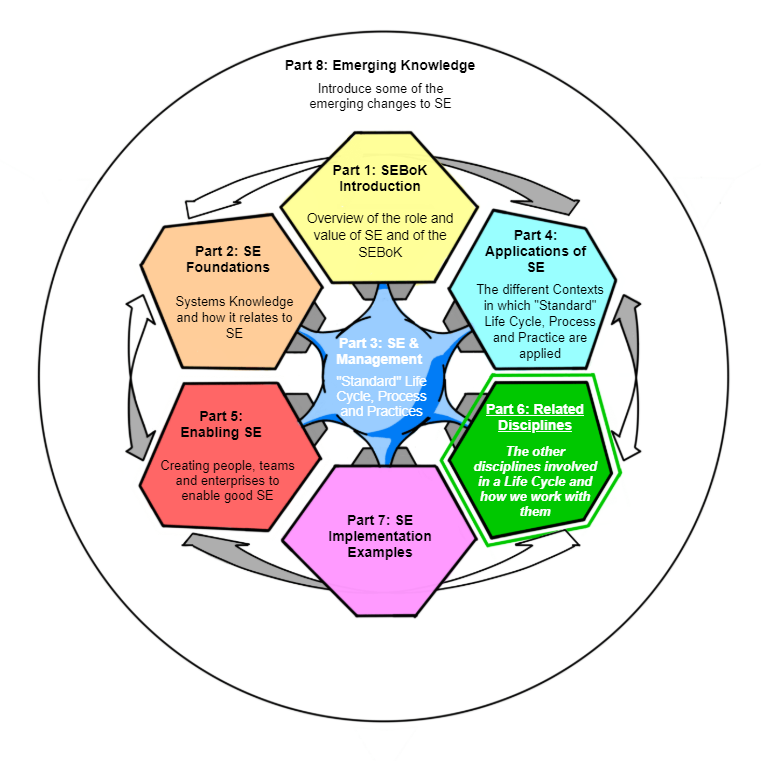
図1:文脈における SEBoK Part 6(SEBoK Original)。詳細については、SEBoK の構造を参照。
Related Disciplines
One of the most fundamental tenets of systems engineering (SE) is that of approaching systems from an integrated, holistic perspective (INCOSE 2023), with an eye towards how sets of interconnected components and their surrounding environments interface and interact with each other to shape the nature, characteristics, and dynamics of systems of interest (SoIs). In a similar fashion, it is possible to regard systems engineering itself as a system, which interacts and intersects with adjoining and related disciplines, communities of practice, and areas of study. These related fields form the systems context in which the field of systems engineering exists, and play a critical role in not only facilitating the effective use of systems engineering in various application areas, but also in shaping the current nature and future evolution of systems engineering as drivers of the overall operational environment in which systems engineering exists (Singam 2022a). Part 6 of the (SEBoK) provides the reader with an overview of many of these related disciplines, discussion on how these disciplines help enrich and enliven systems engineering, and vice versa.
システムズエンジニアリング(systems engineering, SE)の最も基本的な信条の一つは、システムを統合された全体論的な視点から捉えることであり(INCOSE 2023)、相互に接続された構成要素の集合とその周囲の環境がどのように接し相互作用して、対象システム(systems of interest, SoI)の性質、特性、動態を形作るかに目を向けることである。同様に、システムズエンジニアリングそのものを、隣接する関連分野、実践コミュニティ、研究領域と相互作用し交差する一つのシステムと見なすこともできる。これらの関連分野は、システムズエンジニアリングという分野が存在するシステムコンテキスト(systems context)を形成し、さまざまな応用領域におけるシステムズエンジニアリングの効果的な活用を促すだけでなく、システムズエンジニアリングが存在する運用環境(operational environment)全体の駆動要因として、システムズエンジニアリングの現在のあり方と将来の進化を形作るうえでも重要な役割を果たす(Singam 2022a)。SEBoK の Part 6 は、これらの関連分野の多くについての概観を、それらの分野がシステムズエンジニアリングをどのように豊かにし活気づけるのか、またその逆はどうかについての議論とともに、読者に提供する。
Systems engineering (SE) is a fundamentally transdisciplinary endeavor (INCOSE 2019): its principles and practices are sufficiently abstract and generic as to be readily applicable to any system, regardless of application area or associated discipline(s) relevant to the system of interest (Kossiakoff et al. 2011). The flexibility and versatility of the SE toolkit is part of what makes it such a valuable asset on projects, especially those involving large or complex systems which require the integration of various disparate elements and technical disciplines into a single, unified system (INCOSE 2023, Elm et. al. 2008). In order to realize that versatility, though, SE practitioners need to have a wide range of technical knowledge that extends beyond that of "pure" SE and across the various disciplines relative to the system(s) of interest. A systems engineer who has responsibility for overseeing the interface between a mechanical subsystem and an electrical subsystem in a biomedical device, for instance, would at minimum need knowledge of mechanical engineering and electrical engineering topics in order to perform a systems engineering task such as setting interface requirements. However, in the context of a biomedical device for human use, familiarity with concepts in biology, safety engineering, electromagnetic interference, human-systems integration, and law/policy - just to name a few - are likely to also become relevant in order for the systems engineer to appropriately communicate and integrate information from across the project, as well as ensure that the interface is fit-for-purpose and within acceptable parameters. It thus behooves the well-prepared systems engineer to maintain familiarity with a broad selection of related disciplines.
システムズエンジニアリング(SE)は本質的に超学際的な(transdisciplinary)営みである(INCOSE 2019)。その原則と実践は十分に抽象的かつ汎用的であるため、応用領域や対象システムに関連する分野を問わず、あらゆるシステムに容易に適用できる(Kossiakoff et al. 2011)。SE のツールキットが持つ柔軟性と汎用性は、それがプロジェクト、とりわけ多種多様な要素や技術分野を単一の統合されたシステムへとまとめ上げる必要のある大規模または複雑なシステムを伴うプロジェクトにおいて、これほど貴重な資産となっている理由の一端である(INCOSE 2023, Elm et. al. 2008)。しかし、その汎用性を発揮するには、SE の実践者は「純粋な」SE の枠を超え、対象システムに関わるさまざまな分野にまたがる幅広い技術知識を備えている必要がある。例えば、生物医学デバイスにおける機械サブシステムと電気サブシステムの間のインターフェースの監督を担うシステムエンジニアは、インターフェース要求の設定といったシステムズエンジニアリングのタスクを遂行するために、少なくとも機械工学と電気工学のトピックに関する知識が必要となるだろう。しかし、ヒトが使用する生物医学デバイスという文脈では、システムエンジニアがプロジェクトの各所から得られる情報を適切に伝達・統合し、インターフェースが目的に適合し許容可能なパラメータの範囲内にあることを保証するために、生物学、安全工学(safety engineering)、電磁干渉(electromagnetic interference)、人間-システム統合(human-systems integration)、法律/政策といった概念(これらはほんの一例である)に通じていることも、おそらく意味を持ってくるだろう。したがって、十分に備えたシステムエンジニアは、幅広い関連分野に通じた状態を保っておくことが望ましい。
Part 6 of the SEBoK intends to aid systems practitioners and other individuals with an interest in SE in augmenting their technical knowledge of subjects relevant to systems engineering practice, and providing a foundation for independent exploration of associated topics via relevant resources.
SEBoK の Part 6 は、SE の実践者および SE に関心を持つその他の人々が、システムズエンジニアリングの実践に関わる主題についての技術知識を拡充するのを支援し、関連リソースを通じて関連トピックを自ら探求するための基盤を提供することを意図している。
Part 6's purview encompasses the many fields and topics which enrich the discipline of SE, inclusive of both commonly-discussed disciplines such as those classified under the science, technology, engineering, and mathematics (STEM) quartet, as well as oft-overlooked disciplines of relevance in the arts and humanities. Part 6 is therefore arguably the most expansive section of the SEBoK in terms of potential scope, as it extends beyond the boundaries of formal SE and SE application areas, and across the breadth of academic and practical knowledge. Even so, the disciplines discussed in this section are only a subset of the full expanse of those which relate to systems engineering: it is, after all, neigh impossible to find a topic or discipline which does not involve or reckon with system(s), and thus systems engineering, in some way (Singam 2022b). Consequently, rather than attempting a full census of the adjacent or related knowledge areas (KAs) that abut the edges of formal systems engineering, Part 6 instead seeks to proffer a curated smörgåsbord of the many related disciplines which bear relevance to systems engineering, with a focus on KAs that are most likely to be of relevance to a diverse, multi-disciplinary audience of systems-minded professionals, learners, and educators.
Part 6 が扱う範囲は、SE という分野を豊かにする多くの分野やトピックに及び、科学・技術・工学・数学(STEM)の四領域に分類されるような一般によく論じられる分野だけでなく、芸術や人文科学のうち、関連性がありながら見過ごされがちな分野も含む。したがって Part 6 は、潜在的な範囲という点では SEBoK の中で最も広範なセクションと言ってよいだろう。正式な専門領域としての SE や SE の応用領域の境界を超え、学術的・実践的な知識の広がり全体に及ぶからである。とはいえ、このセクションで論じる分野は、システムズエンジニアリングに関わる分野の全体像のうちの一部にすぎない。結局のところ、システム、ひいてはシステムズエンジニアリングを何らかの形で含まない、あるいはそれと関わらないトピックや分野を見つけることは、ほとんど不可能である(Singam 2022b)。そのため Part 6 は、正式な専門領域としてのシステムズエンジニアリングの周縁に接する隣接または関連の知識領域(KA)を網羅的に調査しようとするのではなく、システム思考を持つ専門家、学習者、教育者からなる多様で多分野にわたる読者にとって最も関連する可能性が高い KA に焦点を当て、システムズエンジニアリングに関わる多くの関連分野を厳選した盛り合わせ(smörgåsbord)として提供しようとするものである。
図中の英語
The KAs covered in Part 6 are all distinct areas of study or practice (i.e., disciplines which are commonly recognized as separate from systems engineering) that meet one or more of the following descriptors:
Part 6 で扱う KA はいずれも、以下の記述のうち一つ以上に当てはまる、別個の研究または実践の領域(すなわち、一般にシステムズエンジニアリングとは別個のものとして認識されている分野)である。
1. disciplines which are independent from, but overlap with, formal SE practice and/or the core SE body of knowledge (e.g., project management);
1. 体系化された SE の実践および/または SE の中核的な知識体系から独立しているが、それらと重なり合う分野(例:プロジェクトマネジメント(project management))。
2. specialized disciplines focused on in-depth exploration of specific topics that abut or extend beyond the scope of the core/non-specialist SE body of knowledge (e.g., quality engineering);
2. SE の中核的/非専門的な知識体系の範囲に接する、あるいはそれを超えて広がる特定のトピックを深く探求することに焦点を当てた専門分野(例:品質工学(quality engineering))。
3. specialist disciplines which are commonly used to describe or govern the characteristics, dynamics, or life cycle of the composite elements of interdisciplinary or multi-disciplinary systems (e.g., physics, biology, mechanical engineering, software engineering, etc.);
3. 学際的または多分野のシステムを構成する要素の特性、動態、ライフサイクルを記述または統制するために一般に用いられる専門分野(例:物理学、生物学、機械工学(mechanical engineering)、ソフトウェア工学(software engineering)など)。
4. disciplines which are frequently relevant to the effective and/or ethical practice of SE in a commonly encountered system context (e.g., environmental engineering, information technology (IT) for enterprise systems, law);
4. よく遭遇するシステムコンテキストにおいて、SE を効果的および/または倫理的に実践するうえでしばしば関係する分野(例:環境工学(environmental engineering)、エンタープライズシステムのための情報技術(information technology (IT) for enterprise systems)、法律)。
5. specialized disciplines which frequently utilize systems engineering methodologies or have a substantial systems engineering/systems science community of practice (e.g., geospatial engineering), and which can provide new generalizable insights into the improvement and evolution of systems engineering as a field;
5. システムズエンジニアリングの方法論を頻繁に利用する、またはシステムズエンジニアリング/システム科学の相応の規模の実践コミュニティを持つ専門分野(例:地理空間工学(geospatial engineering))であって、一つの分野としてのシステムズエンジニアリングの改善と進化について、一般化可能な新たな洞察をもたらし得るもの。
6. other specialized disciplines which are of substantial interest in non-specialist contexts.
6. 非専門的な文脈において大きな関心が持たれているその他の専門分野。
At present, Part 6 is organized into the following sub-sections, each representing a key KA:
現時点で、Part 6 は以下のサブセクションで構成されており、それぞれが主要な KA に対応している。
• Systems Engineering and Environmental Engineering
• Systems Engineering and Geospatial/Geodetic Engineering
• Systems Engineering and Industrial Engineering
• Systems Engineering and Project Management
** Other sub-topics: project structure and governance; procurement and acquisition; portfolio management
- Other sub-topics: project structure and governance; procurement and acquisition; portfolio management
• Systems Engineering and Software Engineering
• Systems Engineering and Mechanical Engineering
• Systems Engineering and Enterprise IT
• Systems Engineering and Quality Attributes (This encompasses quality engineering, but is also the home of the disciplines focused on characteristics of systems, sometimes referred to as "-ilities".)
• Systems Engineering and Quality Attributes(これは品質工学を包含するが、システムの特性に焦点を当てた分野(「-ilities」と呼ばれることもある)の本拠地でもある。)
** Other subtopics: human-systems integration (HSI); manufacturability and producibility; adaptability; affordability; hardware assurance; reliability/availability/maintainability; resilience; resistance to electromagnetic interference; safety; security
- Other subtopics: human-systems integration (HSI); manufacturability and producibility; adaptability; affordability; hardware assurance; reliability/availability/maintainability; resilience; resistance to electromagnetic interference; safety; security
As reflected by the sub-section titles within Part 6 ("Systems Engineering and...."), each main KA is focused on the intersection between systems engineering and a given topic, and contains at least one article discussing aspects of that KA that would be of import to a systems engineer from outside that particular specialty. Some of the broader KAs, such as those on project management and quality attributes, also include articles on KA-relevant sub-topics alongside the KA overview articles, as per the categorization listed above.
Part 6 のサブセクションのタイトル(「Systems Engineering and....」)が示すとおり、各主要 KA はシステムズエンジニアリングと特定のトピックとの交点に焦点を当てており、その専門分野の外にいるシステムエンジニアにとって重要となる、その KA の側面を論じる記事を少なくとも1本含んでいる。プロジェクトマネジメントや品質属性に関する KA のような比較的広い KA の中には、上記の分類に従い、KA の概要記事に加えて、その KA に関連するサブトピックの記事を含むものもある。
Astute readers may note that pre-existing content in Part 6 is almost exclusively focused on areas of specialist engineering; as Part 6's content continues to evolve, it is planned that the KAs covered in this section will be updated to better reflect the current range of SE-adjacent knowledge and practice across across various related disciplines, in accordance with broadened interest from both academia and industry (Han et. al. 2023) in exploring interdisciplinary and cross-disciplinary KAs. In particular, it is planned that future versions of Part 6 will include content on related disciplines that are often overlooked in overviews of SE-relevant subject matter, such as topics in the arts and humanities.
目ざとい読者は、Part 6 の既存の内容がほぼ例外なく専門工学の領域に焦点を当てていることに気付くかもしれない。Part 6 の内容は今後も進化を続け、それに伴い、学際的および分野横断的な KA の探求に対する学術界と産業界双方の関心の広がり(Han et. al. 2023)に応じて、このセクションで扱う KA を、さまざまな関連分野にわたる SE に隣接する知識と実践の現在の範囲をよりよく反映するよう更新することが計画されている。特に、将来の版の Part 6 には、芸術や人文科学のトピックなど、SE に関連する主題を概観する際に見過ごされがちな関連分野についての内容を盛り込むことが計画されている。
Elm, J. P., D.R. Goldenson, K. El Emam, N. Donatelli, and A. Neisa. 2008. A Survey of Systems Engineering Effectiveness-Initial Results (with Detailed Survey Response Data). Pittsburgh, PA, USA: Software Engineering Institute, CMU/SEI-2008-SR-034. December 2008.
Han, Siqi, Jack LaViolette, Chad Borkenhagen, William McAllister, and Peter S. Bearman. 2023. “Interdisciplinary College Curriculum and Its Labor Market Implications.” Proceedings of the National Academy of Sciences of the United States of America 120 (43): e2221915120. <nowiki>https://doi.org/10.1073/pnas.2221915120</nowiki>.
Han, Siqi, Jack LaViolette, Chad Borkenhagen, William McAllister, and Peter S. Bearman. 2023. “Interdisciplinary College Curriculum and Its Labor Market Implications.” Proceedings of the National Academy of Sciences of the United States of America 120 (43): e2221915120. https://doi.org/10.1073/pnas.2221915120.
INCOSE. 2019. Systems Engineering and System Definitions, version 1.0. San Diego, CA, USA: INCOSE. INCOSE-TP-2020-002-06.
INCOSE. 2023. Systems Engineering Handbook: A Guide for System Life Cycle Processes and Activities, version 5.0. Hoboken, NJ, USA: John Wiley and Sons, Inc, ISBN: 978-1-119-81429-0.
ISO/IEC/IEEE. 2023. Systems and Software Engineering -- System Life Cycle Processes. Geneva, Switzerland: International Organisation for Standardisation / International Electrotechnical Commissions / Institute of Electrical and Electronics Engineers. ISO/IEC/IEEE 15288:2023.
Kossiakoff, Alexander, William N. Sweet, Samuel J. Seymour, and Steven M. Biemer. 2011. Systems Engineering Principles and Practice. John Wiley & Sons.
Singam, Caitlyn A. K. 2022. “A Critical Analysis of the Systems Engineering Leadership Pipeline: Closing the Gender Gap.” In Emerging Trends in Systems Engineering Leadership: Practical Research from Women Leaders, edited by Alice F. Squires, Marilee J. Wheaton, and Heather J. Feli, 195–236. Women in Engineering and Science. Cham: Springer International Publishing. <nowiki>https://doi.org/10.1007/978-3-031-08950-3_7</nowiki>.
Singam, Caitlyn A. K. 2022. “A Critical Analysis of the Systems Engineering Leadership Pipeline: Closing the Gender Gap.” In Emerging Trends in Systems Engineering Leadership: Practical Research from Women Leaders, edited by Alice F. Squires, Marilee J. Wheaton, and Heather J. Feli, 195–236. Women in Engineering and Science. Cham: Springer International Publishing. https://doi.org/10.1007/978-3-031-08950-3_7.
Singam, Caitlyn A. K. 2022. “A Vision for Universal and Standardized Access to Systems Competency Education.” INSIGHT 25 (3): 30–34. <nowiki>https://doi.org/10.1002/inst.12395</nowiki>.
Singam, Caitlyn A. K. 2022. “A Vision for Universal and Standardized Access to Systems Competency Education.” INSIGHT 25 (3): 30–34. https://doi.org/10.1002/inst.12395.
None.
None.