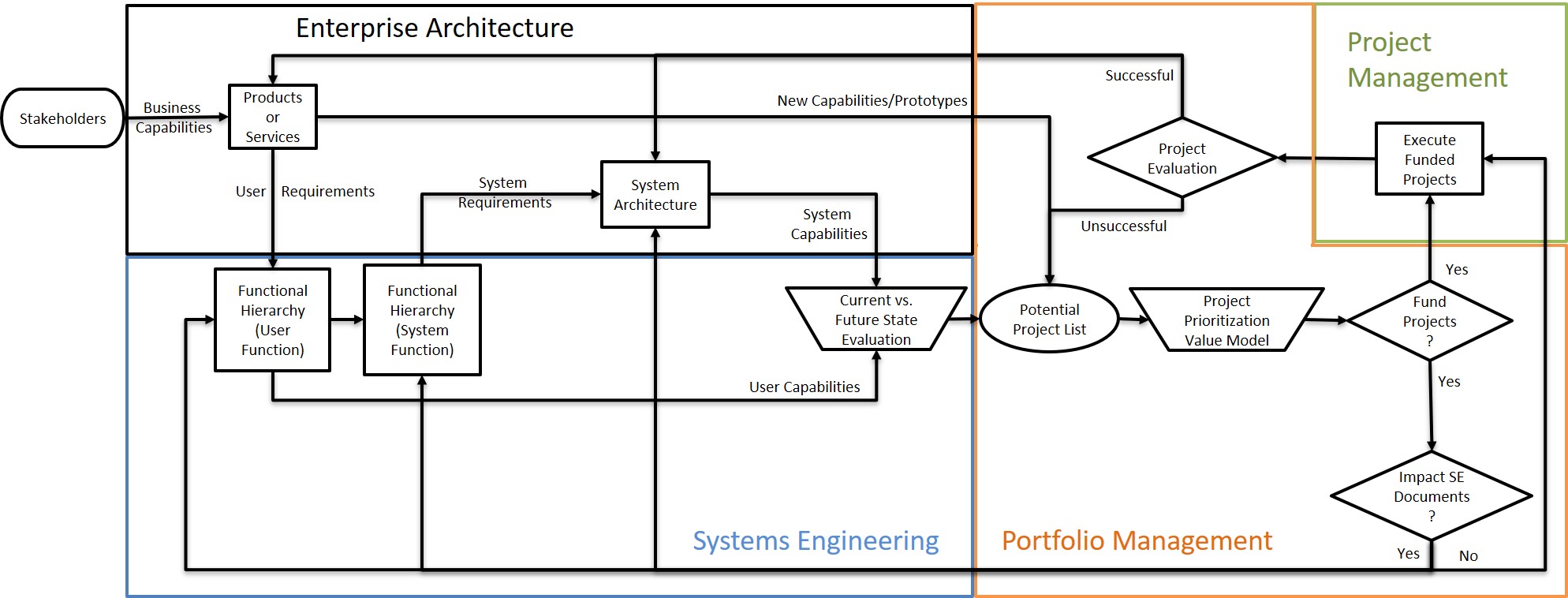
図1:DevOps 環境におけるシステムズエンジニアリング、プロジェクトマネジメント、ポートフォリオマネジメントの役割
Portfolio Management
Systems engineers need to be aware of and understand the role of systems engineering in project, program, and portfolio management (PfM) processes to achieve maximum stakeholder value. In general, program and project management practices help ensure that organizations execute programs and projects the “right” way. Portfolio management can help to ensure they select the “right” programs and projects, and systems engineering ensures they use the “right” systems thinking (Specking et al. 2020). Not using portfolio management practices increases organizational risk and could decrease stakeholder value.
This article provides: *a description of the ISO/IEC/IEEE 15288 activities and tasks with regards to portfolio management; *a description of the Project Management Institute's (PMI’s) portfolio life cycle process based on PMI’s Guide to the Project Management Body of Knowledge (PMI 2017a); *the connection of the PMI’s portfolio life cycle process to ISO/IEC/IEEE 15288; *a reference to the principles of portfolio management from the PfM Standard; *a realignment of the SE Handbook’s common approaches/tips with the PfM Standard’s six domains; *a discussion to better clarify systems engineering’s relationship to portfolio management, as well as systems engineering’s relationship to other topics, such as project management and program management; and *a description of the systems engineer's role to support portfolio managers that explicitly states how a systems engineer (a) helps evaluate the value of projects to authorize, continue, or terminate enterprise projects and (b) manages their portfolio of systems engineering activities to support portfolio managers and to support enterprise processes, products, and services.
システムエンジニアは、ステークホルダー価値を最大化するために、プロジェクト(project)、プログラム、ポートフォリオマネジメント(portfolio management、PfM)の各プロセスにおいてシステムズエンジニアリングが果たす役割を認識し、理解しておく必要がある。一般に、プログラムとプロジェクトのマネジメント実践は、組織がプログラムとプロジェクトを「正しい」方法で実行することを確実にする助けとなる。ポートフォリオマネジメントは、組織が「正しい」プログラムとプロジェクトを選択することを確実にする助けとなり、システムズエンジニアリングは、組織が確実に「正しい」システム思考を用いるようにする(Specking et al. 2020)。ポートフォリオマネジメントの実践を用いなければ、組織のリスクは高まり、ステークホルダー価値も低下しかねない。
本記事が提供する内容は次のとおりである。
ISO/IEC/IEEE 15288 (ISO/IEC/IEEE 2015) establishes portfolio management’s importance to systems engineering by including it as an organizational project-enabling process. This organizational project-enabling process uses an organization’s strategic plan, portfolio direction and constraints, supply strategy, and project status report as inputs, while a portfolio management plan, organization infrastructure needs, project direction, project portfolio, organization lessons learned, portfolio management report, and portfolio management records are outputs (INCOSE 2015). Portfolio management uses these inputs to perform processes that help enterprises define and authorize projects; evaluate the portfolio of projects and programs; and terminate projects to develop the portfolio management outputs. These activities take place throughout the portfolio life cycle, which includes optimization, initiation, planning, and execution (PMI 2017b).
ISO/IEC/IEEE 15288(ISO/IEC/IEEE 2015)は、ポートフォリオマネジメントを組織のプロジェクトイネーブリングプロセスとして含めることによって、システムズエンジニアリングにとってのポートフォリオマネジメントの重要性を確立している。この組織のプロジェクトイネーブリングプロセスは、組織の戦略計画、ポートフォリオ(portfolio)の方向性と制約、供給戦略、プロジェクト状況報告を入力とし、ポートフォリオマネジメント計画、組織インフラストラクチャのニーズ、プロジェクトの方向性、プロジェクトポートフォリオ、組織の教訓、ポートフォリオマネジメント報告、ポートフォリオマネジメント記録を出力とする(INCOSE 2015)。ポートフォリオマネジメントは、これらの入力を用いて、出力を作成するためのプロセスを実施する。そのプロセスは、エンタープライズによるプロジェクトの定義と認可、プロジェクトとプログラムのポートフォリオの評価、プロジェクトの終了を支援する。これらのアクティビティは、最適化、立上げ、計画、実行を含むポートフォリオライフサイクル全体にわたって行われる(PMI 2017b)。
The proper implementation of portfolio management processes results in seven major portfolio management outcomes: 1) qualification and prioritization of business venture opportunities, investments, or necessities; 2) identification of projects; 3) allocation of project resources and budgets; 4) description of project management responsibilities, accountability, and authorities; 5) sustainment of project meeting agreement and stakeholder requirements; 6) redirection or termination of unsatisfactory projects; and 7) closure of successfully completed projects (ISO/IEC/IEEE, 2015). A project should continue if it contributes to organizational strategy; makes progress on achieving its pre-established goals; obeys organizational project directives; is executed according to its pre-approved plan; and continues to add value to the organization with acceptable returns (INCOSE 2015).
Organizations can increase portfolio value by successfully implementing portfolio management processes through six performance management domains throughout the portfolio life cycle (PMI 2017b). These domains, described in Table 1, include portfolio strategic management, portfolio governance, portfolio capacity and capability management, portfolio stakeholder engagement, portfolio value management, and portfolio risk management.
ポートフォリオマネジメントプロセスを適切に実装すると、ポートフォリオマネジメントの主要な成果が7つ得られる。すなわち、1)事業ベンチャーの機会、投資、または必要事項の適格性判定と優先順位付け、2)プロジェクトの特定、3)プロジェクトの資源と予算の配分、4)プロジェクトマネジメントの責任、説明責任、権限の記述、5)合意事項とステークホルダー要求事項を満たすプロジェクトの維持、6)満足のいかないプロジェクトの方向転換または終了、7)首尾よく完了したプロジェクトの終結である(ISO/IEC/IEEE, 2015)。プロジェクトは、組織戦略に貢献し、事前に設定された目標の達成に向けて進捗しており、組織のプロジェクト指令に従い、事前に承認された計画どおりに実行され、許容可能なリターンをもって組織に価値を付加し続けている場合に、継続すべきである(INCOSE 2015)。
組織は、ポートフォリオライフサイクル全体を通じて、6つのパフォーマンスマネジメントドメインによってポートフォリオマネジメントプロセスを首尾よく実装することで、ポートフォリオ価値を高めることができる(PMI 2017b)。表1で説明するこれらのドメインには、ポートフォリオ戦略マネジメント、ポートフォリオガバナンス、ポートフォリオ能力・キャパシティマネジメント、ポートフォリオステークホルダーエンゲージメント、ポートフォリオ価値マネジメント、ポートフォリオリスクマネジメントが含まれる。
表1:ポートフォリオマネジメントにおけるパフォーマンスマネジメントドメインの説明(Specking et al. 2020)
| + Table 1. Performance Management Domain Descriptions for Portfolio Management (Specking et al. 2020) |
| Domain |
|---|
| Description |
| Portfolio Strategic Management |
| Align portfolio components to one or more strategic objectives and monitor impact |
| Portfolio Governance |
| “Through open and transparent governance, including processes for categorizing, prioritizing, selecting, and approving portfolio components, key stakeholders are more likely to accept the decisions and agree with the process, even when they may not fully endorse the decisions made” (PMI 2017b). |
| Portfolio Capacity and Capability Management |
| “The selection of portfolio components and the roadmap for their implementation is balanced against the organization’s current capacity and capability with the potential of bringing in additional resources” (PMI 2017b). |
| Portfolio Stakeholder Engagement |
| “Key portfolio stakeholders require active expectation management” (PMI 2017b). |
| Portfolio Value Management |
| Use the organizational strategy to enable investment in a portfolio with the expectation of a pre-determined return |
| Portfolio Risk Management |
| Evaluate risk (positive/opportunities, negative/threats) and consider how those risks might impact accomplishing the portfolio strategic plan and objectives |
| ドメイン | 説明 |
|---|---|
| ポートフォリオ戦略マネジメント | ポートフォリオ構成要素を1つ以上の戦略目標に整合させ、その影響を監視する |
| ポートフォリオガバナンス | 「ポートフォリオ構成要素の分類、優先順位付け、選定、承認のプロセスを含む、オープンで透明なガバナンスによって、主要なステークホルダーは、下された決定を全面的には支持していない場合でも、その決定を受け入れ、プロセスに同意する可能性が高くなる」(PMI 2017b)。 |
| ポートフォリオ能力・キャパシティマネジメント | 「ポートフォリオ構成要素の選定とその実装に向けたロードマップは、追加の資源を導入する可能性を視野に入れつつ、組織の現在のキャパシティと能力とのバランスが取られている」(PMI 2017b)。 |
| ポートフォリオステークホルダーエンゲージメント | 「主要なポートフォリオステークホルダーには、能動的な期待マネジメントが必要である」(PMI 2017b)。 |
| ポートフォリオ価値マネジメント | 事前に定めたリターンを見込んだポートフォリオへの投資を可能にするために、組織戦略を用いる |
| ポートフォリオリスクマネジメント | リスク(ポジティブ/機会、ネガティブ/脅威)を評価し、それらのリスクがポートフォリオの戦略計画と目標の達成にどのような影響を及ぼし得るかを検討する |
These domains use some or all of the seven PMI fundamental principles for portfolio management (PMI 2017b). The seven PMI fundamental principles for portfolio management include:
*Strive to achieve excellence in strategic execution; *Enhance transparency, responsibility, accountability, sustainability, and fairness; *Balance portfolio value against overall risks; *Ensure that investments in portfolio components are aligned with the organization’s strategy; *Obtain and maintain the sponsorship and engagement of senior management and key stakeholders; *Exercise active and decisive leadership for the optimization of resource utilization; *Foster a culture that embraces change and risk; and *Navigate complexity to enable successful outcomes.
これらのドメインでは、ポートフォリオマネジメントに関する7つの PMI 基本原則の一部またはすべてが用いられる(PMI 2017b)。ポートフォリオマネジメントに関する7つの PMI 基本原則には、次のものがある。
INCOSE's Systems Engineering Handbook (INCOSE 2015) provides several best practices for performing portfolio management processes. These best practices connect to one or more of the six performance management domains seen in Table 2.
INCOSE の Systems Engineering Handbook(INCOSE 2015)は、ポートフォリオマネジメントプロセスを実施するための優れた実践をいくつか示している。これらの優れた実践は、表2に示すとおり、6つのパフォーマンスマネジメントドメインのうち1つ以上と結びついている。
表2:ポートフォリオマネジメントに関する SE Handbook の優れた実践((Specking et al. 2020)から修正)
| + Table 2. SE Handbook Best Practices for Portfolio Management (Modified from (Specking et al. 2020)) |
| Performance Management Domain for Portfolio Management |
|---|
| Key Word for Best Practice |
| Description of Best Practices |
| Right Stakeholders |
| Include relevant stakeholders when developing the organization’s business area plan to enable the organization to determine present and future strategic objectives for focusing resources |
| Measurable Criteria |
| Prioritize opportunities based upon measurable criteria that contains a stated threshold of acceptable performance |
| Progress Assessment |
| Base expected project outcomes on defined, measurable criteria with specific investment assessment information to enable an impartial progress assessment |
| Coordinate Interactions |
| Use some type of coordination organization, such as a program office, to manage the interactions among active projects |
| Consider Products and Systems |
| Use a product line approach for scenarios where multiple customers need the same/similar system but customize the system as necessary |
| Assess Risk |
| Assess risk during current project evaluation and cancel/suspend projects with risks that outweigh the investment |
| Align with Strategy |
| Perform opportunity assessments of ongoing projects and avoid opportunities that contain unacceptable levels of risks, resource demands, or uncertainties or does not aligned with organization capabilities, strategic goals, or strategic objectives |
| Allocate Resources |
| Allocate resources based upon project requirements |
| Effective Governance |
| Use effective governance processes, which support investment decision making and project management communications |
| ポートフォリオマネジメントのパフォーマンスマネジメントドメイン | 優れた実践のキーワード | 優れた実践の説明 |
|---|---|---|
| ポートフォリオ戦略マネジメント、ポートフォリオ戦略エンゲージメント、ポートフォリオ価値マネジメント | 適切なステークホルダー | 組織の事業分野計画を策定する際に関連するステークホルダーを参画させ、資源を集中させるべき現在および将来の戦略目標を組織が判断できるようにする |
| ポートフォリオ価値マネジメント、ポートフォリオガバナンス | 測定可能な基準 | 明示された許容可能な性能の閾値を含む、測定可能な基準に基づいて機会に優先順位を付ける |
| ポートフォリオ価値マネジメント、ポートフォリオガバナンス、ポートフォリオ能力・キャパシティマネジメント | 進捗評価 | 公平な進捗評価を可能にするために、期待されるプロジェクト成果を、具体的な投資評価情報を伴う、定義済みの測定可能な基準に基づいて設定する |
| ポートフォリオガバナンス | プロジェクト間の連携を調整する | 進行中のプロジェクト同士の連携を管理するために、プログラムオフィスなど何らかの調整組織を用いる |
| ポートフォリオガバナンス | 製品とシステムを考慮する | 複数の顧客が同じ/類似のシステムを必要とするが、必要に応じてシステムをカスタマイズするシナリオのために、プロダクトラインアプローチを用いる |
| ポートフォリオリスクマネジメント | リスクを評価する | 現在のプロジェクト評価においてリスクを評価し、投資を上回るリスクを抱えるプロジェクトを中止/中断する |
| ポートフォリオ戦略マネジメント、ポートフォリオ能力・キャパシティマネジメント | 戦略に整合させる | 進行中のプロジェクトの機会評価を実施し、許容できないレベルのリスク、資源要求、不確実性を含む機会や、組織の能力、戦略目標、戦略的目的と整合しない機会を避ける |
| ポートフォリオ価値マネジメント、ポートフォリオガバナンス | 資源を配分する | プロジェクトの要求事項に基づいて資源を配分する |
| ポートフォリオガバナンス | 効果的なガバナンス | 投資の意思決定とプロジェクトマネジメントのコミュニケーションを支える、効果的なガバナンスプロセスを用いる |
It is often difficult for systems engineers to understand the relationships between systems engineering, portfolio management, and project management because of their overlapping processes and the use of similar tools. Figure 1 shows the role of project management, systems engineering, and portfolio management for developing and improving an enterprise architecture to provide products or services to many stakeholders. Project and program managers and systems engineers all interact with stakeholders and the enterprise architecture, which consists of products or services and the systems that make them. Systems engineers use the enterprise architecture to develop user and system functional hierarchies, which enable capability development. These capabilities help systems engineers evaluate the enterprise’s current and future states. From this evaluation, the Project Management Office (portfolio managers) can develop a potential list of projects or programs to fund. Portfolio managers use best practices in decision analysis (Parnell et al. 2013) to develop a project prioritization value model (e.g. single or multiple objective decision analysis model). Portfolio managers then use optimization techniques to determine which projects or programs to fund based upon the prioritization value model. Project managers then execute the funded projects to ensure that the projects stay on schedule and within budget constraints while meeting desired performance metrics. Information impacting systems engineering documentation discovered from the funded projects updates the functional hierarchies and system architecture. Throughout the project, portfolio managers receive updates from project managers on project progress. Portfolio managers use progress information to evaluate the project for continuation or termination. If the project is terminated upon successful completion of the project, the project’s outcomes update the enterprises’ architecture. Otherwise (i.e. terminated early or upon an unsuccessful completion), portfolio managers update their list of potential projects and/or programs for reprioritization. This cycle continues and evolves with time based upon the enterprise’s strategy.
システムエンジニアにとって、システムズエンジニアリング、ポートフォリオマネジメント、プロジェクトマネジメントの関係を理解するのは、それぞれのプロセスが重なり合い、類似のツールが使われることから、しばしば困難である。図1は、多くのステークホルダーに製品やサービスを提供するためのエンタープライズアーキテクチャの開発と改善において、プロジェクトマネジメント、システムズエンジニアリング、ポートフォリオマネジメントが果たす役割を示している。プロジェクトマネージャ、プログラムマネージャ、システムエンジニアはいずれも、ステークホルダーや、製品・サービスとそれらを生み出すシステムから成るエンタープライズアーキテクチャと相互に関わり合う。システムエンジニアは、エンタープライズアーキテクチャを用いて、能力開発を可能にするユーザーとシステムの機能階層を策定する。これらの能力は、システムエンジニアがエンタープライズの現在の状態と将来の状態を評価するのに役立つ。この評価をもとに、プロジェクトマネジメントオフィス(ポートフォリオマネージャ)は、資金提供すべきプロジェクトやプログラムの候補リストを作成できる。ポートフォリオマネージャは、意思決定分析における優れた実践(Parnell et al. 2013)を用いて、プロジェクト優先順位付け価値モデル(例えば単一目的または複数目的の意思決定分析モデル)を構築する。次にポートフォリオマネージャは、最適化技法を用い、優先順位付け価値モデルに基づいて、どのプロジェクトやプログラムに資金提供するかを決定する。続いてプロジェクトマネージャが資金提供されたプロジェクトを実行し、プロジェクトが望ましい性能指標を満たしつつ、スケジュールどおりかつ予算制約内で確実に進むようにする。資金提供されたプロジェクトから判明した、システムズエンジニアリング文書に影響する情報によって、機能階層とシステムアーキテクチャが更新される。プロジェクトの全期間を通じて、ポートフォリオマネージャはプロジェクトマネージャからプロジェクトの進捗に関する最新情報を受け取る。ポートフォリオマネージャは、この進捗情報を用いて、プロジェクトを継続するか終了するかを評価する。プロジェクトが首尾よく完了して終了した場合、そのプロジェクトの成果によってエンタープライズアーキテクチャが更新される。そうでない場合(すなわち、早期に終了した場合や、不成功のまま完了して終了した場合)、ポートフォリオマネージャは、再優先順位付けのために、候補となるプロジェクトやプログラムのリストを更新する。このサイクルは、エンタープライズの戦略に基づき、時間とともに継続し、進化していく。
図中の英語
In addition to helping systems engineers understand the roles of systems engineering, portfolio management, and project management, Figure 1 provides insights into the relationships between the processes from an enterprise DevOps environment perspective.
図1は、システムエンジニアがシステムズエンジニアリング、ポートフォリオマネジメント、プロジェクトマネジメントの役割を理解するのに役立つだけでなく、エンタープライズの DevOps 環境の観点から、それらのプロセス間の関係についての洞察も提供する。
International Council on Systems Engineering (INCOSE). Systems Engineering Handbook: A Guide for System Life Cycle Processes and Activities. Edited by David Walden, Garry Roedler, Kevin Forsberg, Douglas Hamelin, and Thomas Shortell. 4th ed. John Wiley & Sons, Inc. 2015.
ISO/IEC/IEEE. Systems and Software Engineering -- System Life Cycle Processes. Geneva, Switzerland: International Organization for Standardization / International Electrotechnical Commissions / Institute of Electrical and Electronics Engineers. ISO/IEC/IEEE 15288:2015. 2015.
Parnell G. S., T. A. Bresnic, S. N. Tani, E. R. Johnson. Handbook of Decision Analysis. Hoboken, NJ. John Wiley and Sons, Inc. 2013.
Project Management Institute (PMI). The Guide to the Project Management Body of Knowledge. 6th ed. Project Management Institute. 2017. https://www.pmi.org/pmbok-guide-standards/foundational/pmbok.
PMI. The Standard for Portfolio Management. 3rd ed. Project Management Institute. https://www.pmi.org/pmbok-guide-standards/foundational/standard-for-portfolio-management.
Specking, E., G. Parnell, E. Pohl. “Comparing INCOSE and PMI portfolio management practices,” 30th Annual INCOSE International Symposium, 2020.
Specking, E., G. Parnell, E. Pohl. "Comparing INCOSE and PMI portfolio management practices," 30th Annual INCOSE International Symposium, 2020.
INCOSE. Systems Engineering Handbook: A Guide for System Life Cycle Processes and Activities. Edited by David Walden, Garry Roedler, Kevin Forsberg, Douglas Hamelin,, and Thomas Shortell. 4th ed. John Wiley & Sons, Inc. 2015.
ISO/IEC/IEEE. Systems and Software Engineering – System Life Cycle Processes. Geneva, Switzerland: International Organization for Standardization / International Electrotechnical Commissions / Institute of Electrical and Electronics Engineers. ISO/IEC/IEEE 15288:2015. 2015.
Project Management Institute (PMI). The Guide to the Project Management Body of Knowledge. 6th ed. Project Management Institute. 2017. https://www.pmi.org/pmbok-guide-standards/foundational/pmbok.
PMI. The Standard for Portfolio Management. 3rd ed. Project Management Institute. https://www.pmi.org/pmbok-guide-standards/foundational/standard-for-portfolio-management.
None.