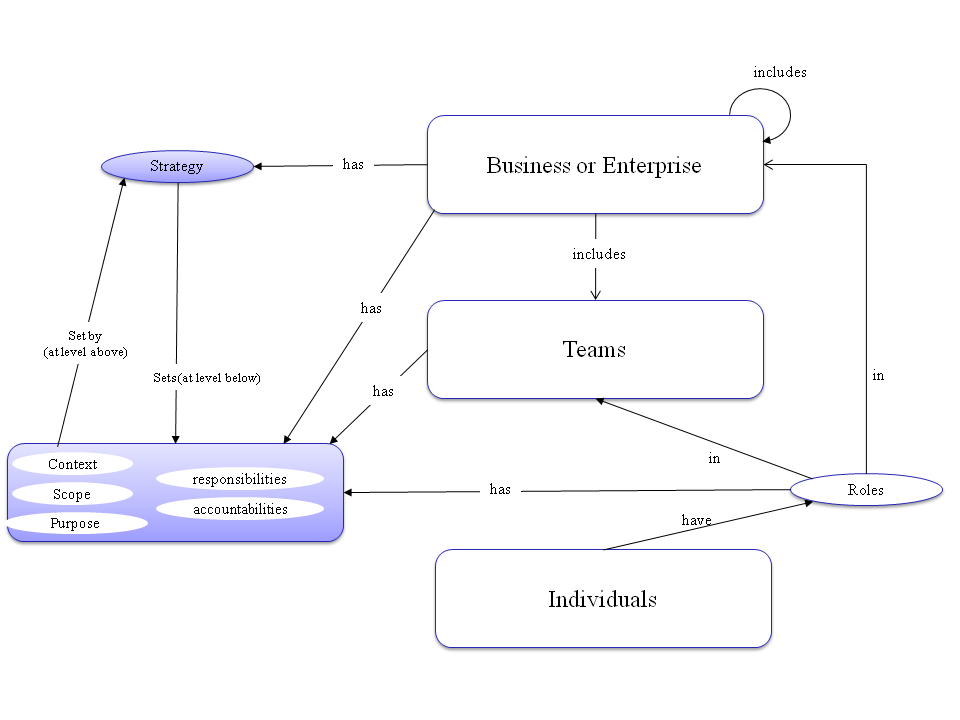
図1. SE におけるビジネス、チーム、個人。(SEBoK Original)
Organizing Business and Enterprises to Perform Systems Engineering
In order for a business or enterprise to perform systems engineering (SE) well, the team must decide which specific SE capabilities the business or enterprise needs in order to be successful and then organizing to deliver those capabilities. (In the rest of this article, business or enterprise is usually abbreviated to just "business", because a business is a specific type of enterprise that has sufficiently strong central authority and motivation to take steps to enable SE).
ビジネス(business)やエンタープライズ(enterprise)がシステムズエンジニアリング(systems engineering、SE)をうまく実施するには、チームは、そのビジネスやエンタープライズが成功するために具体的にどのような SE 能力を必要とするかを決定し、そのうえでそれらの能力を提供できるよう組織化しなければならない。(本記事の以降の部分では、ビジネスまたはエンタープライズを通常は単に「ビジネス」と略記する。ビジネスは、SE を可能にするための措置を講じるだけの十分に強い中央の権限と動機を持つ、特定のタイプのエンタープライズだからである。)
SE capabilities and organizational approach should support the Systems Engineering Organizational Strategy and reflect the nature of the business, its products and services, various stakeholders, business leadership focus, etc. This topic, which is part of Part 5, Enabling Businesses and Enterprises, summarizes the factors used to organize a business to perform SE.
SE 能力と組織的アプローチは、Systems Engineering Organizational Strategy を支援するとともに、ビジネスの性質、その製品やサービス、多様なステークホルダー、ビジネスのリーダーシップが重視する点などを反映すべきである。本トピックは Part 5 の Enabling Businesses and Enterprises の一部であり、SE を実施するためにビジネスを組織化する際に用いられる要因を要約する。
The way SE is managed is described in Systems Engineering Organizational Strategy, which both impacts and responds to the SE culture and approach.
SE の管理のあり方は Systems Engineering Organizational Strategy に記述されている。それは SE の文化(culture)とアプローチの双方に影響を与えるとともに、それらに呼応もする。
Knowledge and Information are key assets in a business, and their management is critical. Fasser and Brettner (2002) discuss knowledge management extensively. They assert that “We may think that knowledge transfer is just an information technology issue, but in actuality, it is also a psychological, cultural, and managerial issue – in short a human issue” and “Only information in action can create knowledge”.
Organizations need to manage SE know-how, integration of SE with other organizational processes and activities, and knowledge of their business domain. The INCOSE Intelligent Enterprise Working Group's work on knowledge management in an SE context led to the publication of a “Concept of Operations for a Systems Engineering Educational Community” (Ring et al. 2004).
Information has to be both shared and protected in complex organizations. Sharing is key to effective collaboration and is constrained by the need to protect intellectual property, as well as commercially and nationally sensitive material. Different cultures and personal styles use information in different ways and in different orders. (Levels of abstraction, big picture first or detail, principles first or practical examples, etc.) Sillitto (2011b) describes the knowledge management challenges for large, multi-national organizations.
Projects need to manage project information and establish configuration control over formal contractual information, as well as the information that defines the product/service being developed, supplied, or operated. A key role of systems engineers is to “language the project” (Ring et al. 2004). Good data management and tool support will allow people to document once, use many times, and ensures consistency of information over time and between different teams.
System information needs to be maintained throughout the life of the system and made available to relevant stakeholders – including those designing new systems that must interface to the system-of-interest - to allow system management, maintenance, reconfiguration, upgrade and disposal, and forensics after accidents and near-misses. Elliott et al. (2008) suggest that information management is the dominant problem in SE in service systems, and that the cost and difficulty of establishing current state and legacy constraints before starting to implement a change is often underestimated.
"Infostructure" (information infrastructure) to support the system lifecycle will include the following: *Information assets such as process libraries, document templates, preferred parts lists, component re-use libraries, as-specified and as-tested information about legacy systems, capitalized metrics for organizational performance on previous similar projects, all with appropriate configuration control *Modeling and simulation tools, data sets and run-time environments *Shared working environments – workspaces for co-located teams, areas for people to interact with each other to develop ideas and explore concepts, work areas suitable for analysis tasks, meeting rooms, access control provision, etc. *IT facilities - computer file structures, software licenses, IT equipment, computer and wall displays to support collaborative working, printers, all with appropriate security provision and back-up facilities, procedures for efficient use, and acceptable performance and usability *Security provisions to protect own, customer, supplier and third party IPR and enforce necessary protective working practices while allowing efficient access to information for those with a need to know
SE is a knowledge activity. Systems engineers need appropriate facilities for accessing, sharing and capturing knowledge, as well as for interacting effectively with the whole set of stakeholders. Warfield (2006) describes collaborative workspaces, environments and processes for developing a shared understanding of a problem situation.
知識と情報はビジネスにおける主要な資産であり、その管理はきわめて重要である。Fasser and Brettner(2002)は知識管理について詳しく論じている。彼らは、「知識の移転は単なる情報技術の問題だと考えがちだが、実際には心理的、文化的、管理的な問題でもある。要するに人間の問題なのである」、また「行動に移された情報だけが知識を生み出すことができる」と主張している。
組織は、SE のノウハウ、SE と組織の他のプロセスやアクティビティとの統合、そして自らのビジネス領域に関する知識を管理する必要がある。SE の文脈における知識管理に関する INCOSE Intelligent Enterprise Working Group の取り組みは、「Concept of Operations for a Systems Engineering Educational Community」の公表へとつながった(Ring et al. 2004)。
複雑な組織では、情報を共有すると同時に保護しなければならない。共有は効果的な協働の鍵であり、知的財産や、商業的・国家的に機微な資料を保護する必要性によって制約される。文化や個人のスタイルが異なれば、情報の使い方も使う順序も異なる。(抽象化のレベル、全体像から入るか詳細から入るか、原則から入るか実践的な例から入るか、など。)Sillitto(2011b)は、大規模な多国籍組織における知識管理の課題を述べている。
プロジェクトは、プロジェクト情報を管理するとともに、正式な契約情報、ならびに開発・供給・運用される製品/サービスを定義する情報を対象に、構成変更管理の仕組みを確立する必要がある。システムズエンジニアの主要な役割は、プロジェクトを「言語化する」ことである(Ring et al. 2004)。優れたデータ管理とツールの支援があれば、人々は一度文書化したものを何度も使うことができ、時間が経っても、また異なるチームの間でも、情報の一貫性が確保される。
システム情報は、システムの寿命全体を通じて維持され、関連するステークホルダーが利用できるようにしておかなければならない。ここでいうステークホルダーには、対象システム(system-of-interest)とインタフェースしなければならない新しいシステムを設計する人々も含まれる。これにより、システムの管理、保守、再構成、アップグレード、廃棄、そして事故やニアミスの後の調査が可能になる。Elliott et al.(2008)は、運用中のシステムに SE を適用する際、情報管理が最も大きな課題であり、変更の実装に着手する前に現在の状態とレガシーの制約を確定するためのコストと困難さはしばしば過小評価されている、と示唆している。
システムライフサイクルを支援する「情報基盤(infostructure)」(情報インフラストラクチャ)には、以下のものが含まれる:
SE は知識のアクティビティである。システムズエンジニアには、知識にアクセスし、共有し、取り込むための適切な施設と、ステークホルダー全体と効果的に交流するための施設が必要である。Warfield(2006)は、問題状況についての共通理解を築くための協働ワークスペース、環境、プロセスを述べている。
The ISO/IEC 15288 (ISO 2008) Infrastructure Management Process provides the enabling infrastructure and services to support organization and project objectives throughout the life cycle. Infrastructure to support the system life cycle will often include the following:
*Integration and test environment – bench and lab facilities, facilities for development testing as well as acceptance testing at various levels of integration, calibration and configuration management of test environments *Trials and validation environment – access to test ranges, test tracks, calibrated targets, support and storage for trials – equipment, harbor, airfield and road facilities, safe storage for fuel, ordinance, etc. *Training and support infrastructure – training simulators, embedded training, tools and test equipment for operational support and maintenance, etc.
ISO/IEC 15288(ISO 2008)のインフラストラクチャ管理プロセスは、ライフサイクル全体を通じて組織とプロジェクトの目的を支援する実現インフラストラクチャとサービスを提供する。システムライフサイクルを支援するインフラストラクチャには、多くの場合以下が含まれる:
The roles people fill are typically defined by the business/enterprise (see Determining Needed Systems Engineering Capabilities in Businesses and Enterprises), although those decisions may be pushed down to teams. Enabling Teams explains how people are used in teams; Enabling Individuals describes the development of an individual's SE competence.
The implementation of these roles needs further consideration. Sheard (1996) lists twelve system engineering roles. Sheard (2000) draws an important distinction between roles involved in the discovery phase, characterized by a high level of uncertainty, the program phase, which is more deterministic and defined, and the overall systems engineering approach. Kasser et al. (2009) identify five types of systems engineer distinguished by the need to work at increasing levels of abstraction, ambiguity, scope and innovation. Sillitto (2011a) discusses a number of SE roles and the characteristics required of them, in the context of the wider engineering and business professional landscape.
Systems engineering exists within an enterprise “ecosystem.” Two key aspects to consider: *How much should the business/enterprise nurture and value the systems engineer? *How much should the business/enterprise pull value from systems engineers, rather than wait for systems engineers to "push" value on the business/enterprise?
人々が担う役割は通常、ビジネス/エンタープライズが定義する(Determining Needed Systems Engineering Capabilities in Businesses and Enterprises を参照)。ただし、その決定がチームに委ねられることもある。Enabling Teams では人々がチームの中でどのように活用されるかを説明し、Enabling Individuals では個人の SE 力量の開発について述べる。
これらの役割をどう実装するかについては、さらなる検討が必要である。Sheard(1996)は12のシステムズエンジニアリングの役割を挙げている。Sheard(2000)は、不確かさの高さを特徴とする発見フェーズで担う役割、より決定論的で明確に定義されたプログラムフェーズで担う役割、SE アプローチ全体に関わる役割を区別している。Kasser et al.(2009)は、抽象化、曖昧さ、範囲、革新の増大する水準で働く必要性によって区別される、5つのタイプのシステムズエンジニアを特定している。Sillitto(2011a)は、より広いエンジニアリングとビジネスの専門職の全体像という文脈の中で、多くの SE の役割とそれらに求められる特性を論じている。
システムズエンジニアリングは、エンタープライズの「生態系」の中に存在する。考慮すべき主要な側面は2つある:
Many SE organizations maintain a set of organizational standard processes which are integrated in their quality and business management system, adapted to their business, and with tailoring guidelines used to help projects apply the standard processes to their unique circumstances. Guidance on organizational process management is provided by such frameworks as the Capability Maturity Model Integration (CMMI) (SEI 2010), which has two process areas on organizational process: Organizational Process Development (OPD) is concerned with organizational definition and tailoring of the SE lifecycle processes (discussed in detail elsewhere in this document) and Organizational Process Focus (OPF), which is concerned with establishing a process culture in an organization.
多くの SE 組織は、組織標準プロセスの集合を維持している。これらのプロセスは品質・ビジネスマネジメントシステムに統合され、自らのビジネスに合わせて適合されており、プロジェクトが標準プロセスを固有の状況に適用するのを助けるテーラリング指針も備えている。組織のプロセス管理に関する指針は、能力成熟度モデル統合(CMMI)(SEI 2010)のような枠組みによって提供されている。CMMI には組織プロセスに関するプロセス領域が2つある。組織プロセス開発(OPD)は、SE ライフサイクルプロセスの組織的な定義とテーラリングを扱い(本書の他の箇所で詳しく論じる)、組織プロセスフォーカス(OPF)は、組織にプロセス文化を確立することを扱う。
To document, assess, and improve SE processes, businesses often establish a systems engineering process group. Members of such groups often create standard process assets and may mentor teams and business units on how to adopt those standard processes and assess how effective those processes are working. There is a large body of literature on SE process improvement based on various process improvement models. Two of the most popular are ISO/IEC 9000 (2000) and CMMI (SEI 2010). The Software Engineering Institute, which created the CMMI, offers many free technical reports and other documents on CMMI at https://www.sei.cmu.edu/cmmi.
SE プロセスを文書化し、評価し、改善するために、ビジネスはしばしばシステムズエンジニアリングプロセスグループを設置する。そうしたグループのメンバーは、多くの場合、標準プロセス資産を作成するほか、チームやビジネスユニットに、標準プロセスを採用する方法や、どの程度有効に機能しているかを評価する方法を指導することもある。さまざまなプロセス改善モデルに基づく SE プロセス改善については、膨大な文献がある。最も人気のある2つは ISO/IEC 9000(2000)と CMMI(SEI 2010)である。CMMI を策定した Software Engineering Institute は、https://www.sei.cmu.edu/cmmi で CMMI に関する多数の無料の技術報告書やその他の文書を提供している。
Assessment and measuring process performance is covered in Assessing Systems Engineering Performance of Business and Enterprises.
プロセスパフォーマンスの評価と測定については、Assessing Systems Engineering Performance of Business and Enterprises で扱う。
SE organizations often invest in SE tools and models, develop their own, and/or integrate off-the-shelf tools into their particular business/enterprise processes. Tools require great attention to culture and training; to developing a consistent “style” of use so that people can understand each others’ work; and proper configuration and management of the information so that people are working on common and correct information.
SE 組織はしばしば SE のツールやモデルに投資し、独自に開発し、および/または市販のツールを自らの特定のビジネス/エンタープライズのプロセスに統合する。ツールは、文化と訓練への大きな注意を要求する。人々が互いの作業を理解できるように一貫した使用の「様式」を発展させること、そして、人々が共通で正しい情報に基づいて作業するよう、情報の適切な構成と管理である。
It is important that methods are used as well as tools, particularly to support Systems Thinking.
特にシステム思考(Systems Thinking)を支援するためには、ツールだけでなく方法も用いることが重要である。
It is common practice in large SE organizations to have a tool support infrastructure which ensures that tools support the organizational standard processes and are fully integrated with training, and that projects and teams can use the tools to do their job and are not distracted by tool management issues that are more efficiently handled centrally. Smaller SE organizations often operate more informally.
大規模な SE 組織では、ツール支援インフラストラクチャを持つのが一般的である。このインフラストラクチャによって、ツールが組織標準プロセスを支援し、訓練と完全に統合されること、そしてプロジェクトやチームがツールを使って自らの仕事を行うことができ、中央で扱うほうが効率的なツール管理の問題に煩わされないことが確実になる。より小規模な SE 組織は、より非公式に運営されることが多い。
The concept map in Figure 1 below shows the relationships between the various aspects of organization, resource, responsibility, and governance.
下の図1のコンセプトマップは、組織、資源、責任、ガバナンスに関するさまざまな側面の間の関係を示している。
図中の英語
Enterprises manage SE resources in many different ways. A key driver is the extent to which they seek to optimize use of resources (people, knowledge, and assets) across teams and across the enterprise as a whole. Five common ways of organizing resources to support multiple projects are: project; matrix; functional; integrated; and product centered (CM Guide 2009, Handy 1985, PMI 2013, section 2.1.3). A large enterprise would likely apply some combination of these five ways across its constituent sub-enterprises and teams. Browning (2009) offers a way to optimize project organizational structure. Eisner (2008) offers a good overview of different organizational models.
エンタープライズは SE の資源をさまざまな方法で管理する。主要な決定要因は、チームを横断して、またエンタープライズ全体として、資源(人、知識、資産)の使用をどの程度最適化しようとするかである。複数のプロジェクトを支援するために資源を組織化する一般的な方法には、プロジェクト、マトリクス、機能別、統合、製品中心の5つがある(CM Guide 2009, Handy 1985, PMI 2013, section 2.1.3)。大規模なエンタープライズは、それを構成するサブエンタープライズやチームを横断して、これら5つの方法を何らかの形で組み合わせて適用する可能性が高い。Browning(2009)は、プロジェクトの組織構造を最適化する方法を示している。Eisner(2008)は、さまざまな組織モデルについて優れた概観を提供している。
A project organization is one extreme in which projects are responsible for hiring, training, and terminating staff, as well as managing all assets required for delivery. In this model, systems engineers on a project report to the project manager and resources are optimized for the delivery of the project. This model has the advantage of strongly aligning the authority and responsibility of the project with the project manager. However, it operates at the expense of sub-optimizing how the staff is deployed across the larger enterprise, how technology choices are made across projects, etc. Systems Engineering Fundamentals (DAU 2001) offers a DoD view of good practice project organizations.
プロジェクト組織は一方の極にあたり、プロジェクトがスタッフの採用、訓練、解雇に責任を負うとともに、成果の引渡しに必要なすべての資産を管理する。このモデルでは、プロジェクトに所属するシステムズエンジニアは、プロジェクトマネージャーの指揮下に置かれ、資源は当該プロジェクトの遂行と成果の引渡しに向けて最適化される。このモデルには、プロジェクトの権限と責任をプロジェクトマネージャーに強く結び付けられるという利点がある。しかしその代償として、より大きなエンタープライズ全体でのスタッフの配置方法や、プロジェクトをまたがる技術選択の方法などが部分最適にとどまる。Systems Engineering Fundamentals(DAU 2001)は、優れたプラクティスに基づくプロジェクト組織について、国防総省の見解を示している。
A functional organization demonstrates the opposite extreme. In a functional organization, projects delegate almost all their work to functional groups, such as the software group, the radar group or the communications group. This is appropriate when the functional skill is fast-evolving and dependent on complex infrastructure. This method is often used for manufacturing, test engineering, software development, financial, purchasing, commercial, and legal functions.
機能別組織は、その反対の極にあたる。機能別組織では、プロジェクトは作業のほぼすべてを、ソフトウェアグループ、レーダーグループ、通信グループといった機能グループに委ねる。これは、機能的なスキルが急速に進化し、かつ複雑なインフラストラクチャに依存している場合に適している。この方法は、製造、テストエンジニアリング、ソフトウェア開発、財務、購買、商業、法務といった機能でよく用いられる。
A matrix organization is used to give systems engineers a “home” between project assignments. Typically, a SE functional lead is responsible for career development of the systems engineers in the organization, a factor that influences the diversity and length of individual project assignments.
マトリクス組織は、プロジェクトへの配属の合間にシステムズエンジニアに「ホーム」を与えるために用いられる。典型的には、SE の機能リードが組織内のシステムズエンジニアのキャリア開発に責任を負い、これが個人のプロジェクト割り当ての多様性と長さに影響する要因となる。
In an integrated organization, people do assigned jobs without specific functional allegiance. Those that perform SE tasks are primarily identified as another type of engineer, such as a civil or electrical engineer. They know systems engineering and use it in their daily activities as required.
統合組織では、人々は特定の機能に帰属することなく、割り当てられた仕事を行う。SE タスクを実施する人々は、主として土木エンジニアや電気エンジニアといった別の種類のエンジニアとして認識されている。彼らはシステムズエンジニアリングを理解しており、必要に応じて日々のアクティビティの中でそれを用いる。
In accordance with the heuristic that “the product and the process must match” (Rechtin 1991, 132), a common method for creating an organizational structure is to make it match the system breakdown structure (SBS). According to Browning (2009), at each element of the SBS there is an assigned integrated product team (IPT). Each IPT consists of members of the technical disciplines needed to design the product system. The purpose of the IPT is to assure that the interactions among all the technical disciplines are accounted for in the design and that undesirable interactions are avoided.
「製品とプロセスは一致しなければならない」というヒューリスティック(heuristic)(Rechtin 1991, 132)に従い、組織構造を作る一般的な方法は、それをシステム分解構造(system breakdown structure、SBS)に一致させることである。Browning(2009)によれば、SBS の各要素には統合プロダクトチーム(IPT)が割り当てられている。各 IPT は、製品システムの設計に必要な技術分野のメンバーで構成される。IPT の目的は、すべての技術分野間の相互作用が設計において考慮され、望ましくない相互作用が回避されることを保証することである。
Outside official engineering and SE organizations within an enterprise, there are other organizations whose charter is not technical. Nevertheless, these organizations have an important SE role.
エンタープライズ内の公式なエンジニアリング組織や SE 組織の外側には、その任務が技術的ではない他の組織がある。それでも、これらの組織は重要な SE の役割を担っている。
*Customer Interface Organizations: These are organizations with titles such as Marketing and Customer Engineering. They have the most direct interface with current or potential clientele. Their role is to determine customer needs and communicate these needs to the SE organization for conversion to product requirements and other system requirements. Kossiakoff and Sweet (2003, 173) discuss the importance of understanding customer needs.
• 顧客インタフェース組織: Marketing や Customer Engineering といった名称を持つ組織である。これらの組織は、現在の顧客や潜在的な顧客と最も直接的なインタフェースを持つ。その役割は、顧客のニーズを明らかにし、それを製品要求事項やその他のシステム要求事項に変換してもらうために SE 組織に伝えることである。Kossiakoff and Sweet(2003, 173)は、顧客のニーズを理解することの重要性を論じている。
*Contracts Organizations: These organizations interface with both customer and supplier organizations. Their role is to develop clearly stated contracts for the developer or the supplier. These contracts convey tasks and responsibilities for all SE roles of all parties. Technical specifications are attached to the contracts. Responsibilities for verification and validation are specified.
• 契約組織: これらの組織は、顧客組織とサプライヤー組織の双方とインタフェースする。その役割は、開発者またはサプライヤー向けに、明確に記述された契約を作成することである。これらの契約は、すべての当事者が担うすべての SE の役割について、タスクと責任を伝える。技術仕様書は契約に添付される。検証と妥当性確認の責任が規定される。
*Supplier Management Organizations: These organizations are responsible for selecting and managing suppliers and assuring that both contractual and technical products are in place. These organizations balance cost and risk to assure that supplier products are delivered, verified, and validated for quality product. Blanchard and Fabrycky (2005, 696-698) discuss the importance of supplier selection and agreement.
• サプライヤー管理組織: これらの組織は、サプライヤーを選定・管理し、契約上の成果物と技術上の成果物の双方が整っていることを保証する責任を負う。これらの組織は、サプライヤーの製品が納入され、検証され、品質を備えた製品として妥当性確認されることを保証するために、コストとリスクのバランスを取る。Blanchard and Fabrycky(2005, 696-698)は、サプライヤーの選定と合意の重要性を論じている。
Blanchard, B. and W. Fabrycky. 2005. Systems Engineering and Analysis, 4th ed. Upper Saddle River, NJ, USA: Prentice Hall.
Browning, T.R. 2009. "Using the Design Structure Matrix to Design Program Organizations." In A.P. Sage and W.B. Rouse (eds.), Handbook of Systems Engineering and Management, 2nd ed. Hoboken, NJ, USA: John Wiley & Sons.
Construction Management (CM) Guide. 2009. Project Organization Types. Accessed on September 14, 2011. Available at https://cmguide.org/archives/319.
DAU. 2001. Systems Engineering Fundamentals. Ft. Belvoir, VA, USA: Defense Acquisition University (DAU), U.S. Department of Defense (DoD). Accessed on September 14, 2011. Available at https://www.dau.mil/pubscats/PubsCats/SEFGuide%2001-01.pdf.
Eisner, H. 2008. Essentials of Project and Systems Engineering Management, 3rd ed. Hoboken, NJ, USA: John Wiley & Sons.
Elliott et al. 2008. INCOSE UK Chapter Working Group on Applying Systems Engineering to In-Service Systems. Final Report. Somerset, UK: INCOSE UK Chapter Working Group. Accessed September 6, 2011. Available at https://www.incoseonline.org.uk/Documents/Groups/InServiceSystems/is_tr_001_final_report_final_1_0.pdf.
Fasser, Y. and D. Brettner. 2002. Management for Quality in High-Technology Enterprises. Hoboken, NJ, USA: John Wiley & Sons.
ISO/IEC. 2000. International standards for quality management. Genève, Switzerland: International Organization for Standardization. ISO 9000:2000.
ISO/IEC. 2008. Systems and Software Engineering -- System Life Cycle Processes. Geneva, Switzerland: International Organisation for Standardisation / International Electrotechnical Commissions. ISO/IEC/IEEE 15288:2008.
Kasser, J., D. Hitchins, and T. Huynh. 2009. "Re-engineering Systems Engineering." Proceedings of the 3rd Annual Asia-Pacific Conference on Systems Engineering (APCOSE). 20-23 July 2009. Singapore.
Kossiakoff, A., and W.N. Sweet. 2003. Systems Engineering: Principles and Practice. Edited by A. Sage, Wiley Series in Systems Engineering and Management. Hoboken, NJ: John Wiley & Sons.
PMI. 2013. A Guide to the Project Management Body of Knowledge (PMBOK® Guide), 5th ed. Newtown Square, PA, USA: Project Management Institute (PMI).
Rechtin, E. 1991. Systems Architecting: Creating and Building Complex Systems. Englewood Cliffs, NJ, USA: CRC Press.
Ring, J. and A.W. Wymore (eds.). 2004. Concept of Operations (conops) of A Systems Engineering Education Community (SEEC). Seattle, WA, USA: INCOSE Education Measurement Working Group (EMWG), INCOSE-TP-2003-015-01.
SEI. 2010. Capability Maturity Model Integrated (CMMI) for Development, version 1.3. Pittsburgh, PA, USA: Software Engineering Institute (SEI)/Carnegie Mellon University (CMU).
Sheard, S. 1996. "12 Systems Engineering Roles." Paper presented at the Sixth Annual International Council on Systems Engineering (INCOSE) International Symposium. 7-11 July 1996. Boston, MA, USA.
Sheard, S. 2000. "The 12 Systems Engineering Roles Revisited." Paper presented at the INCOSE Mid-Atlantic Regional Conference. April 2000. Reston, VA, USA. p 5.2-1 - 5.2-9.
Sillitto, H. 2011a. "Unravelling Systems Engineers from Systems Engineering - Frameworks for Understanding the Extent, Variety and Ambiguity of Systems Engineering and Systems Engineers." Paper presented at the 21st Annual International Council on Systems Engineering (INCOSE) International Symposium. 20-23 June 2011. Denver, CO, USA.
Sillitto, H. 2011b. Sharing Systems Engineering Knowledge through INCOSE: INCOSE as An Ultra-Large-Scale System? INCOSE Insight. 14(1) (April): 20.
Warfield, J. 2006. An Introduction to Systems Science. Washington, DC, USA: The National Academies Press, World Scientific.
Eisner, H. 2008. Essentials of Project and Systems Engineering Management, 3rd ed. Hoboken, NJ, USA: John Wiley and Sons.
Kotter, J. 1995. "Leading Change: Why Transformation Efforts Fail." Harvard Business Review. 73(2): 59–67.
Sheard, S. 2000. "Systems Engineering Roles Revisited." Paper presented at the INCOSE Mid-Atlantic Regional Conference. April 5-8 2000. Reston, VA, USA. p 5.2-1 - 5.2-9.
Blanchard, B. and W. Fabrycky. 2005. Systems Engineering and Analysis, 4th edition. Upper Saddle River, NJ, USA: Prentice Hall.
Construction Management (CM) Guide. 2009. Project Organization Types. Accessed on September 6, 2011. Available at https://cmguide.org/archives/319.
Defense Acquisition University (DAU). 2001. Systems Engineering Fundamentals. Fort Belvoir, VA, USA: Defense Acquisition University Press. Accessed on September 6, 2011. Available at https://www.dau.mil/pubscats/PubsCats/SEFGuide%2001-01.pdf.
Handy, C.B. 1985. Understanding Organizations. London, UK: Penguin Business.