多くの組織にとって、継続的改善の追求は変わることのない営みである。Toyota に関する記述(Morgan and Liker 2006)、「完璧を追求する」というリーンの原則(Oppenheim et al. 2010)、「手を緩めるな」という原則(Kotter 1995)は、いずれも継続的改善の必要性を生み出している。
チームをそのライフサイクルを通じて管理する能力 — チームを迅速に動員し、適切な一連のプロセス、尺度、システムズエンジニアリング(systems engineering)計画を確立してテーラリングし、チームが高い水準のパフォーマンスを維持できるよう支援し、獲得した知識を資産として活用し、チームが解散するにつれてチームメンバーを迅速に再配置すること — は、プロジェクトと組織の効率と有効性に大きな影響力を持つ、主要な組織力量である。
エンタープライズは、チームに必要な資源、背景情報、施設、資金、支援サービス、ツールなどを提供する。また、チームが効果を発揮できる物理的、文化的(cultural)、ガバナンス(governance)的な環境も提供する。エンタープライズの主要な機能には、関連する資源を生み出して維持すること、それらをチームに配分すること、支援機能とガバナンス機能を提供すること、(プロセス、応用領域、ソリューション技術に関する)専門技能と知識を維持すること、チームが実施する仕事を確保すること、財務を整えること、エンタープライズの存続可能性を維持することが含まれる。
改善を持続させるには、改善が個人の中だけでなくエンタープライズの中に根付いていなければならない。そうすれば、人員が去っても改善は存続できる。このことは、能力成熟度モデル統合(CMMI)(SEI 2010)における「英雄文化」から「定量的に管理され最適化するプロセス」への進展に反映されている。
このトピックでは、能力開発と組織学習において考慮すべき問題を概説する。
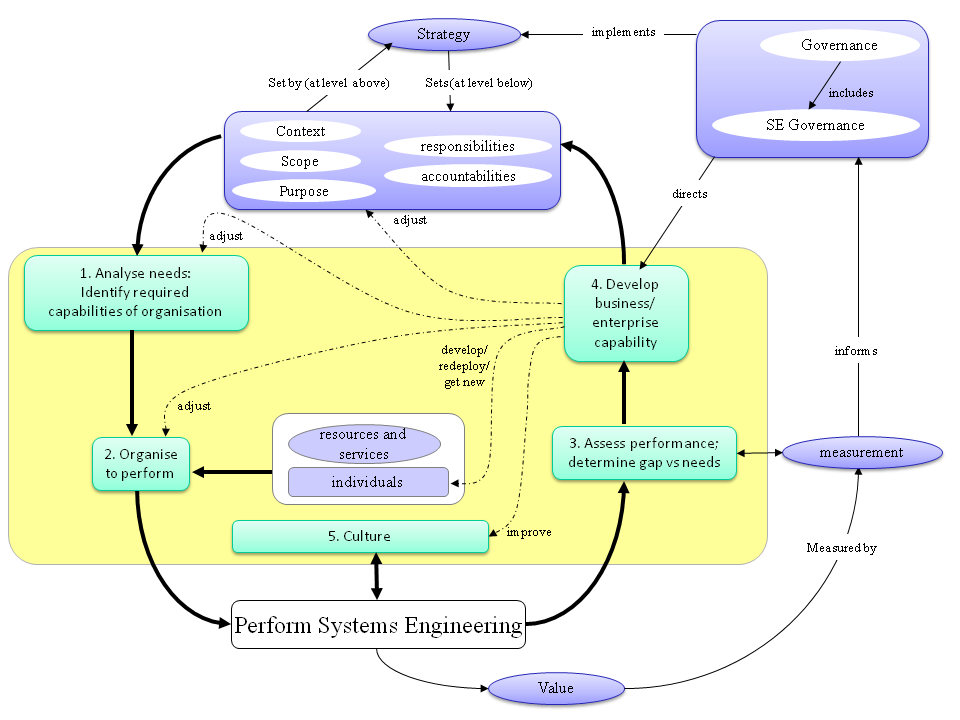
図1は「分析 — 組織化 — 実施 — 評価 — 開発」のサイクルを示している。これは本質的に、Deming(1994)の PDCA(計画・実施・確認・改善)サイクルを再定式化したものである。分析のステップでは、判断または予測できる範囲で、現在のニーズと将来のニーズの双方を扱うべきである。Assessing Systems Engineering Performance of Business and Enterprises で論じるように、目標を設定し、パフォーマンスを評価する際には、ビジネスのパフォーマンスと有効性を直接表す測定量や CMMI の能力成熟度モデルなど、さまざまな評価の枠組みに基づいて行うことができる。多くの組織がビジネスのパフォーマンスと CMMI のレベルの間に正の相関を見いだしているという証拠がある(SEI 2010)。この点については Economic Value of Systems Engineering でさらに論じる。
図中の英語
SE のマネージャーが SE の能力を開発するために用い得る変更レバーは数多くある。レバーを動かしてから効果が現れるまでの時間差は、レバーの種類、エンタープライズの規模、エンタープライズの文化、その他の要因によって異なる。
他の変更レバーで望ましい効果が得られない場合、ビジネスやエンタープライズは、上位の戦略とミッションに対する自らの貢献を再交渉しなければならないことがある。
初期の分析では、必要な能力を過大または過小に見積もっていた可能性がある。計画の前提が依然として妥当であることを確かめるため、サイクルが一巡するたびに必要性を再評価すべきである。
「適切な人々が適切な事柄を行っている」状態になるよう組織と責任を調整し、組織が彼らの知識とスキルを最大限に活用していることを確実にすることは、多くの場合、最も実施しやすい変更である(そして、最も早く効果が現れ得る変更でもある)。
潜在的なリスクは、組織の変動が多すぎると関係が混乱し、組織を不安定にし、パフォーマンスを損なうことである。思慮に欠けた再組織化によってプロセス改善が後退することがあり、組織が取得した、プロセス能力やパフォーマンスを示す認証が危うくなることもある。
資源、サービス、個人には、Organizing Business and Enterprises to Perform Systems Engineering で列挙した組織の SE 能力の構成要素のいずれもが含まれ得る。
レバーには、作業要素の下請け化、情報の流れの改善、施設のアップグレード、短期の訓練プログラムおよび/または長期のスタッフ育成プログラムの開始が含まれる。多くの組織は、こうした改善への取り組み方を専有情報と見なしているが、NASA などの組織は自らの APPEL ウェブサイトで知見を提供している(NASA 2012)。
個人の育成については Enabling Individuals で論じる。
文化(Culture)の変更は非常に重要かつ強力であるが、長期戦として取り組み、長期的にコミットする必要がある。
測定(measurement)は振る舞いを左右する。全員が共通の目的に向かって働くよう、ビジネス/エンタープライズの各部分の目標とインセンティブの整合を高めることは、ビジネス/エンタープライズのパフォーマンスを改善する非常に効果的で強力な方法となり得る。この整合には、何らかのトップダウンの指針、おそらくはトップダウンの全体的なアプローチが必要であり、その際にはビジネス/エンタープライズを一つのシステムと見なし、エンタープライズ能力の要素がどのように相互作用して相乗的な価値を生み出すかを明確に理解する(Assessing Systems Engineering Performance of Business and Enterprises を参照)。組織が CMMI に照らして自らのプロセスを改善していくにつれて、尺度と測定へのアプローチも進化しなければならないことが一般に報告されている。
カイゼン、Deming の PDCA(Deming 1994)、リーン(Womack and Jones 2003, Oppenheim et al. 2010)、Six-Sigma(Harry 1997)、CMMI など、豊富な情報源と技法がある。
バリューストリームマッピングは、インタフェースにおける流れと引き継ぎを改善する方法を見いだすための、強力なリーンの技法である。
ハイテク産業では、多くの問題が次のような原因で生じる。すなわち、技術が成熟する前に新しい技術を製品やシステムへ移行させようとすること、技術の実証から製品における再現性と信頼性のあるパフォーマンスへと進むのに必要な労力を十分に見込まないこと、あるいは既存製品の再利用可能性を過大評価することである。NASA の TRL(技術準備レベル)という概念は、1995年に John Mankins によって初めて提案されたもので(Mankins 1995)、技術移行のリスクを理解し軽減するために広く、かつ成功裏に用いられている。米国国防総省など、NASA 以外のいくつかの組織は、エンジニアによる技術の準備の評価を支援する自動化の仕組みさえ備えている。
TRL のバリエーションも登場しており、例えばシステム準備レベル(SRL)(Sauser et al. 2006)がある。これは、システムをうまく提供できるかどうかは、技術基盤の成熟度に加え、それ以外の多くの要因にも左右されることを認識したものである。例えば、個々には比較的成熟しているものの、これまで統合されたことのない2つの技術を用いる場合には、思いがけないリスクが伴う可能性がある。
計画された変更には以下が含まれ得る:
CMMI は、システムズエンジニアリングの文脈で計画された変更を行うための枠組みとして広く用いられている。計画された変更では、人(知識、スキル、文化、能力、動機)、プロセス、測定、ツールを首尾一貫した全体として捉える全体的なアプローチを取る必要がある。今日では、ツールとプロセスはスキルと経験の代わりにはならないと広く考えられている。むしろ、それらは、熟練し意欲のある人々がより効果を発揮できる枠組みを提供するにすぎない。したがって、変更はツールではなく人から始めるべきである。
変更に着手する前に、現在のビジネスのパフォーマンスと SE 能力のベースラインを確立し、変更が望ましい効果を上げているかどうかを早い段階で示す尺度を設けておくことが推奨される。
機能中断は、内部から課される場合も外部から課される場合もある。外部から課される機能中断は、以下によって引き起こされ得る:
内部で生じる、あるいは自ら招く機能中断には、以下が含まれ得る:
SE の文脈では、より高い CMMI のレベル、リーンと安全の文化(culture)など、達成した改善を維持するには持続的な努力が必要である。役立つ変更モデルはいくつかあり、その中には Kotter の変更の8フェーズ(Kotter 1995)も含まれる:
最初の6つのステップは容易な部分である。カオスモデル(Zuijderhoudt 1990; 2002)は複雑性理論に基づき、短期的な成果を固め、制度化し、定着させなければ、後退が起こりやすいことを示している。これにより、組織が数多くの変更イニシアチブに手を広げるものの、前のものが定着する前に関心が次のものへ移ってしまうため、どれも定着しないという、よく見られる現象が説明できる。
SE のリーダー(ディレクター、機能マネージャー、チームリーダー、専門家)は、組織のビジネスモデルと構造に応じて異なる責任と、その責任を果たすために使える管理手段を持つ。彼らの時間とエネルギーの多くは、短期・中期・長期の組織目標を追求する中での変更の管理に費やされる。すなわち、「日々の事柄をより良く行う」こと、変更を起こすこと、変更を組み込んで恩恵をもたらすこと、機能中断の影響に対処することである。合併、買収、プロジェクトの立ち上げ、フェーズの変更、「発見」フェーズから「提供」フェーズへの移行、運用への移行、資金水準の急変はいずれも、チーム、プロセス、文化(culture)、パフォーマンスを不安定にしかねない急激な変更を組織に課すことがある。下の表1には、一般的な管理の文献と、システムズエンジニアリングに特有の知識の双方を示す。
表1. 変更管理 — ビジネスと SE の参考文献。(SEBoK Original)
| 領域 | ビジネスの参考文献 | SE の参考文献 |
|---|---|---|
| 日々の事柄をより良く行う | Kaizen; Lean (Womack and Jones 2003); 6-Sigma (Harry 1997)/Four Competencies of Learning Organisation – Absorb, Diffuse, Generate, Exploit (Sprenger and Ten Have 1996)/The Seven Habits of Very Effective People (Covey 1989) | CMMI/Visualizing Project Management (Forsberg and Mooz 2005)/INCOSE IEWG "Conops for a Systems Engineering Educational Community" (Ring and Wymore 2004)/INCOSE Lean Enablers for SE (Oppenhein et al. 2010) |
| 計画外の機能中断への対処 | Managing Crises Before They Happen (Mitroff and Anagnos 2005)/Scenarios: Uncharted Waters Ahead (Wack 1985)/Scenario Planning: Managing for the Future (Ringland 1988) | Architecting Resilient Systems (Jackson 2010)/Design Principles for Ultra-Large-Scale Systems (Sillitto 2010) |
| 破壊的革新の駆動 | The Innovator's Dilemma (Christensen 1997)/Rise and Fall of Strategic Planning, (Mintzberg 2000)/BS7000, Standard for Innovation Management (BSI 2008) | |
| 予期しない機会の活用 | Rise and Fall of Strategic Planning (Mintzberg 2000)/Mission Command (military), Auftragstechnik (Bungay 2002, 32) | Architecting for Flexibility and Resilience (Jackson 2010)/Open System Architectures; Lean SE; (Oppenheim et al. 2010)/Agile Methodologies |
| 計画された変更の実装と定着 | Kotter's Eight Phases of Change (Kotter 1995)/Berenschot's Seven Forces (ten Have et al. 2003)/Levers of Control (Simons 1995) – Tension between Control, Creativity, Initiative and Risk Taking/Chaos Model from "Complexity Theory Applied to Change Processes in Organisations"; (Zuiderhoudt and Ten Have 1999)/Business Process Re-engineering (Hammer and Champy 1993)/The 5th Discipline (Senge 2006)/Change Quadrants (Amsterdam 1999) | Doing it differently - Systems for Rethinking Construction (Blockley and Godfrey 2000)/INCOSE UK Chapter Z-guides: Z-2, Introducing SE to an Organisation (Farncombe and Woodcock 2009); Z-7, Systems Thinking (Godfrey and Woodcock 2010) |
| 人々の動機、振る舞いの理解 | Maslow's Hierarchy of Needs/Myers-Briggs Type Indicator/NLP (Neuro-Linguistic Programming) (See for example: Knight 2009)/Performance by Design: Sociotechnical Systems in North America (Taylor and Felten 1993)/Core Quadrants, (Offman 2001) | INCOSE Intelligent Enterprise Working Group – "Enthusiasm", Stretch Goals (Ring and Wymore 2004)/Sociotechnical Systems Engineering, Responsibility Mapping, from "Deriving Information Requirements from Responsibility Models" (Sommerville et al. 2009) |
| 文化の理解 | Cultural Dimensions, from "Culture's Consequences" (Hofstede 1994)/Compliance Typology, from "A Comparative Analysis of Complex Organizations" (Etzione 1961) | |
| 個人が変更に対処するのを助ける | 5 C's of Individual Change, and Rational/Emotional Axes, Kets De Vries, quoted in "Key Management Models" (Ten Have et al. 2003) | Rational/Emotional, NLP and Other Methods, from "Relationships Made Easy" (Fraser 2010) |
Blockley, D. and P. Godfrey. 2000. Doing It Differently – Systems for Rethinking Construction. London, UK: Thomas Telford, Ltd.
Bungay, S. 2002. Alamein. London, UK: Aurum press. First published 2002, Paperback 2003.
BSI. 2008. Design Management Systems. Guide to Managing Innovation. London, UK: British Standards Institution (BSI). BS 7000-1:2008.
Christensen, C. 1997. The Innovator's Dilemma: When New Technologies Cause Great Firms to Fail. Cambridge, MA, USA: Harvard Business School Press.
Covey, S.R. 1989. The Seven Habits of Highly Effective People. Also released as a 15th Anniversary Edition (2004). New York, NY, USA: Simon & Schuster, 1989.
Deming, W.E. 1994. The New Economics. Cambridge, MA, USA: Massachusetts Institute of Technology, Centre for Advanced Educational Services.
Etzione, A. 1961. A Comparative Analysis of Complex Organizations. On Power, Involvement and their Correlates. New York, NY, USA: The Free Press of Glencoe, Inc.
Farncombe, A. and H. Woodcock. 2009. ‘’Enabling Systems Engineering.’’ Somerset, UK: INCOSE UK Chapter. Z-2 Guide, Issue 2.0 (March 2009). Accessed September 14, 2011. Available at https://www.incoseonline.org.uk/Documents/zGuides/Z2_Enabling_SE.pdf.
Forsberg, K. and H. Mooz. 2005. Visualizing Program Management, Models and Frameworks for Mastering Complex Systems, 3rd ed. New York, NY, USA: Wiley and Sons, Inc.
Fraser, D. 2010. Relationships Made Easy: How to Get on with The People You Need to Get on with...and Stay Friends with Everyone Else. Worcestershire, UK: HotHive Publishing.
Godfrey, P. and H. Woodcock. 2010. ‘’What is Systems Thinking?’’ Somerset, UK: INCOSE UK Chapter, Z-7 Guide, Issue 1.0 (March 2010). Accessed on September 7, 2011. Available at https://www.incoseonline.org.uk/Documents/zGuides/Z7_Systems_Thinking_WEB.pdf.
Hammer, M. and J.A. Champy. 1993. Reengineering the Corporation: A Manifesto for Business Revolution. New York, NY, USA: Harper Business Books.
Harry, M.J. 1997. The Nature of Six Sigma Quality. Schaumburg, IL, USA: Motorola University Press.
Hofstede, G. 1984. Culture’s Consequences: International Differences in Work-Related Values. Newbury Park, CA, USA and London, UK: Sage Publications Inc.
Jackson, S. 2010. Architecting Resilient Systems: Accident Avoidance and Survival and Recovery from Disruptions. A. P. Sage (ed.). Wiley Series in Systems Engineering and Management. New York, NY, USA: Wiley & Sons, Inc.
Knight, S. 2009. NLP at Work - Neuro Linguistic Programming The Essence of Excellence, 1st edition 1995. 3rd edition 2009. London, UK and Boston, MA, USA: Nicholas Brealey Publishing.
Kotter, J. 1995. ‘’Leading Change: Why Transformation Efforts Fail’’. “Harvard Business Review.” (March-April 1995).
Mintzberg, H. 2000. The Rise and Fall of Strategic Planning. Upper Saddle River, NJ, USA: Pearson Education.
Mitroff, I. and G. Anagnos. 2005. Managing Crises Before They Happen: What Every Executive and Manager Needs to Know about Crisis Management. New York, NY, USA: AMACOM Press.
Morgan, J. and J. Liker. 2006. The Toyota Product Development System: Integrating People, Process and Technology. New York, NY, USA: Productivity Press.
NASA. 2012. ‘’APPEL: Academy of Program/Project & Engineering Leadership.’’ Accessed on September 9, 2012. Available at https://www.nasa.gov/offices/oce/appel/seldp/nasa-se/index.html.
Offman, D.D. 2001. Inspiration and Quality in Organizations, (Original title (Dutch): Bezieling en Kwaliteit in Organisaties), 12th Edition. Utrecht, The Netherlands: Kosmos-Z&K.
Oppenheim, B., E. Murman, and D. Sekor. 2010. Lean Enablers for Systems Engineering. Systems Engineering. 14(1). New York, NY, USA: Wiley and Sons, Inc.
Ring, J. and A.W. Wymore (eds.) 2004. Concept of Operations (conops) of A Systems Engineering Education Community (SEEC). Seattle, WA, USA: INCOSE Education Measurement Working Group (EMWG), INCOSE-TP-2003-015-01.
Ringland, G. 1998. Scenario Planning: Managing for the Future. New York, NY, USA: Wiley and Sons, Inc.
Sauser, B., D. Verma, J. Ramirez-Marque and R. Gove 2006. ‘’From TRL to SRL: The Concept of System Readiness Levels.’’ Proceedings of the Conference on Systems Engineering Research (CSER), Los Angeles, CA.
SEI. 2010. Capability Maturity Model Integrated (CMMI) for Development, version 1.3. Pittsburgh, PA, USA: Software Engineering Institute (SEI)/Carnegie Mellon University (CMU).
Senge, P.M. 2006. The Fifth Discipline: The Art and Practice of the Learning Organization, 2nd ed. New York, NY, USA: Doubleday/Currency.
Simons, R. 1995. Levers of Control, How Managers Use Innovative Control Systems to Drive Strategic Renewal. Boston, MA, USA: Harvard Business School Press.
Sillitto, H. 2010. ‘’Design Principles for Ultra-Large-Scale Systems.’’ Paper in 20th Annual International Council on Systems Engineering (INCOSE) International Symposium. 12-15 July 2010. Chicago, IL, USA. (Reprinted in The Singapore Engineer, IES, April 2011).
Sommerville, I., R. Lock, T. Storer, and J.E. Dobson. 2009. ''Deriving Information Requirements from Responsibility Models''. Paper in the 21st International Conference on Advanced Information Systems Engineering (CAiSE). June 2009. Amsterdam, Netherlands. p. 515-529.''
Sprenger, C. and S. Ten Have. 1996. ‘’4 Competencies of a Learning Organisation.’’ (Original title (Dutch): Kennismanagement Als Moter van Delerende Organisatie), Holland Management Review, (Sept–Oct): 73–89.
Taylor, J.C. and D.F. Felten. 1993. Performance by Design: Sociotechnical Systems in North America. Englewood Cliffs, NJ, USA:Pearson Education Ltd. (Formerly Prentice Hall).
ten Have, S., W.T. Have, F. Stevens, and M. van der Elst. 2003. Key Management Models - The Management Tools and Practices That Will Improve Your Business. Upper Saddle River, NJ, USA: Pearson Education Ltd. (Formerly Prentice Hall).
Wack, P. 1985. ‘’Scenarios: Uncharted Waters Ahead.’’ “Harvard Business Review:. (September-October 1985).
Womack, J. and D. Jones. 2003. Lean Thinking: Banish Waste and Create Wealth in Your Corporation, Revised Edition. New York, NY, USA: Simon & Schuster.
Zuiderhoudt, W. and B. Ten Have. 1999. Complexity Theory Applied to Change Processes in Organisations.
Kotter, J. 1995. Leading Change: Why Transformation Efforts Fail. “Harvard Business Review.” (March-April 1995).
Oppenheim, B., E. Murman, and D. Sekor. 2010. Lean Enablers for Systems Engineering. “Systems Engineering.” 14(1). New York, NY, USA: Wiley and Sons, Inc.
SEI. 2010. Capability Maturity Model Integrated (CMMI) for Development, version 1.3. Pittsburgh, PA, USA: Software Engineering Institute (SEI)/Carnegie Mellon University (CMU).
Senge, P.M. 2006. The Fifth Discipline: The Art and Practice of the Learning Organization, 2nd ed. New York, NY, USA: Doubleday/Currency.
None.