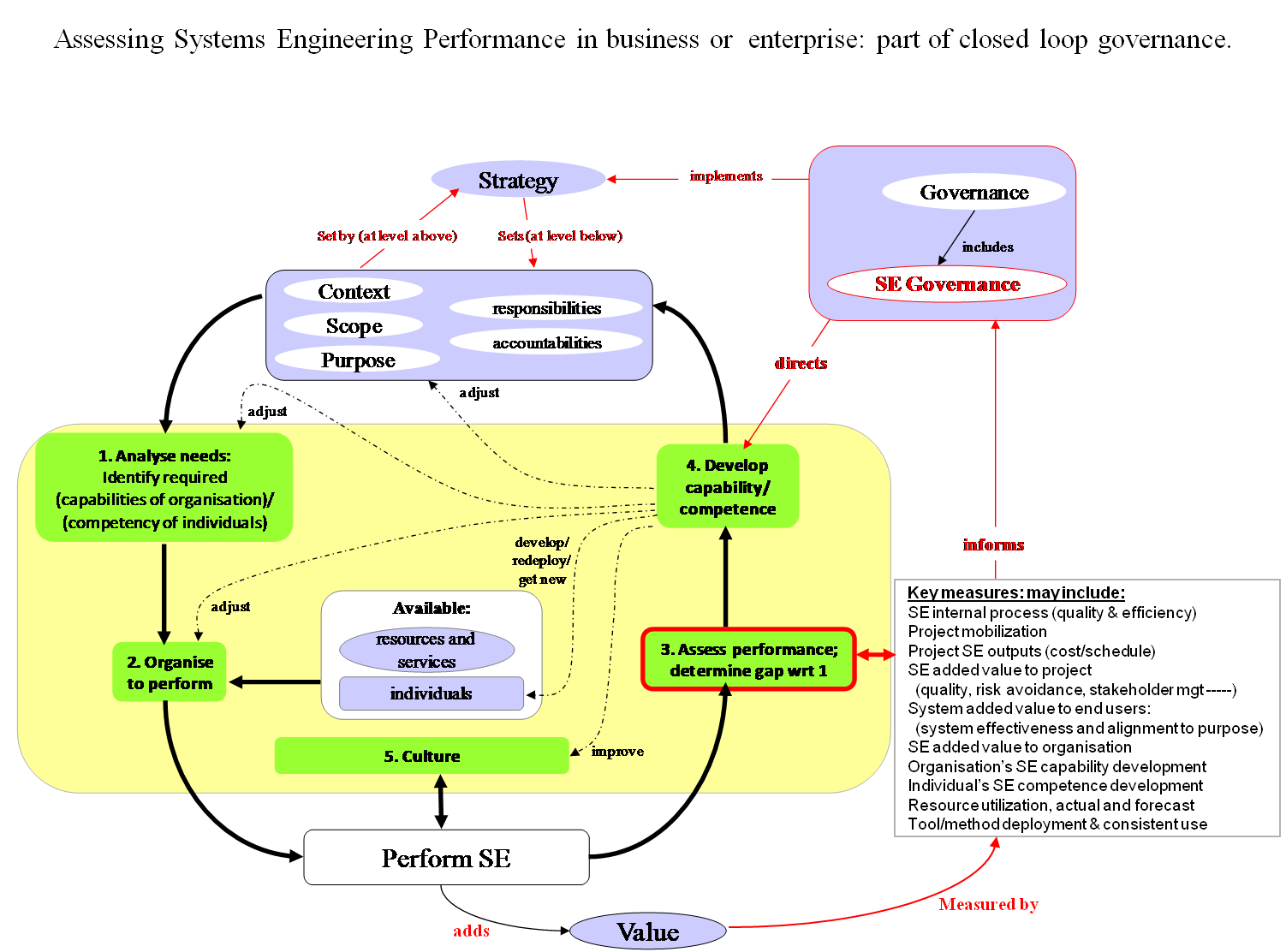
図1. ビジネスまたはエンタープライズにおけるシステムズエンジニアリングパフォーマンスの評価:閉ループガバナンスの一部。(SEBoK Original)
Assessing Systems Engineering Performance of Business and Enterprises
At the project level, systems engineering (SE) measurement focuses on indicators of project and system success that are relevant to the project and its stakeholders. At the enterprise level there are additional concerns. SE governance should ensure that the performance of systems engineering within the enterprise adds value to the organization, is aligned to the organization's purpose, and implements the relevant parts of the organization's strategy.
プロジェクトレベルでは、システムズエンジニアリング(systems engineering、SE)の測定(measurement)は、プロジェクトとそのステークホルダーに関わる、プロジェクトとシステムの成功を示す指標に焦点を当てる。エンタープライズレベルでは、これに加えて別の懸念事項がある。SE のガバナンス(governance)は、エンタープライズ内でのシステムズエンジニアリングのパフォーマンスが、組織に価値を付加し、組織の目的に整合し、組織の戦略の該当部分を実装するものとなるよう確保すべきである。
For enterprises that are traditional businesses this is easier, because such organizations typically have more control levers than more loosely structured enterprises. The governance levers that can be used to improve performance include people (selection, training, culture, incentives), process, tools and infrastructure, and organization; therefore, the assessment of systems engineering performance in an enterprise should cover these dimensions.
伝統的なビジネス(business)であるエンタープライズの場合、これはより容易である。そうした組織は通常、より緩やかに構造化されたエンタープライズよりも多くの統制レバーを持っているからである。パフォーマンスの改善に用い得るガバナンスのレバーには、人(選定、訓練、文化、インセンティブ)、プロセス、ツールとインフラストラクチャ、組織がある。したがって、エンタープライズにおけるシステムズエンジニアリングパフォーマンスの評価は、これらの次元を網羅すべきである。
Being able to aggregate high quality data about the performance of teams with respect to SE activities is certainly of benefit when trying to guide team activities. Having access to comparable data, however, is often difficult, especially in organizations that are relatively autonomous, use different technologies and tools, build products in different domains, have different types of customers, etc. Even if there is limited ability to reliably collect and aggregate data across teams, having a policy that consciously decides how the enterprise will address data collection and analysis is valuable.
SE アクティビティに関するチームのパフォーマンスについて質の高いデータを集約できれば、チームの活動を導こうとする際に確かに役立つ。しかし、比較可能なデータを入手するのは難しい場合が多い。とりわけ、比較的自律的で、異なる技術やツールを使い、異なる領域で製品を構築し、異なるタイプの顧客を持つといった組織ではそうである。チームを横断してデータを確実に収集し集約する能力が限られていても、エンタープライズとしてデータの収集と分析にどう取り組むかを意識的に定める方針を持つことには価値がある。
Typical measures for assessing SE performance of an enterprise include the following:
*Effectiveness of SE process *Ability to mobilize the right resources at the right time for a new project or new project phase *Quality of SE process outputs *Timeliness of SE process outputs *SE added value to project *System added value to end users *SE added value to organization *Organization's SE capability development *Individuals' SE competence development *Resource utilization, current and forecast *Productivity of systems engineers *Deployment and consistent usage of tools and methods
エンタープライズの SE パフォーマンスを評価するための典型的な測定量には、以下のものがある:
Since collecting data and analyzing it takes effort that is often significant, measurement is best done when its purpose is clear and is part of an overall strategy. The "goal, question, metric" paradigm (Basili 1992) should be applied, in which measurement data is collected to answer specific questions, the answer to which helps achieve a goal, such as decreasing the cost of creating a system architecture or increasing the value of a system to a particular stakeholder. Figure 1 shows one way in which appropriate measures inform enterprise level governance and drive an improvement cycle such as the Six Sigma DMAIC (Define, Measure, Analyze, Improve, Control) model.
データの収集と分析には相当な労力を要することが多いため、測定は、その目的が明確で、全体戦略の一部となっている場合に行うのが最もよい。「目標、質問、尺度(goal, question, metric)」パラダイム(Basili 1992)を適用すべきである。このパラダイムでは、具体的な質問に答えるために測定データを収集し、その答えが、システムアーキテクチャを作成するコストの削減や、特定のステークホルダーにとってのシステムの価値の増大といった目標の達成に役立つ。図1は、適切な測定量がエンタープライズレベルのガバナンスに情報を提供し、Six Sigma の DMAIC(定義、測定、分析、改善、管理)モデルのような改善サイクルを駆動する一つの方法を示している。
図中の英語
A is a "set of interrelated or interacting activities which transforms inputs into outputs." The SEI CMMI Capability Maturity Model (SEI 2010) provides a structured way for businesses and enterprises to assess their SE processes. In the CMMI, a process area is a cluster of related practices in an area that, when implemented collectively, satisfies a set of goals considered important for making improvement in that area. There are CMMI models for acquisition, for development, and for services (SEI 2010, 11). CMMI defines how to assess individual process areas against Capability Levels on a scale from 0 to 3, and overall organizational maturity on a scale from 1 to 5.
プロセス(process)とは、「入力を出力に変換する、相互に関連する、または相互作用するアクティビティの集合」である。SEI の CMMI 能力成熟度モデル(SEI 2010)は、ビジネスやエンタープライズが自らの SE プロセスを評価するための構造化された方法を提供する。CMMI におけるプロセス領域とは、ある領域の関連するプラクティスをまとめたものであり、それらを一体として実装すると、その領域の改善に重要と考えられる一連の目標が満たされる。CMMI には、取得向け、開発向け、サービス向けのモデルがある(SEI 2010, 11)。CMMI は、個々のプロセス領域を 0 から 3 のスケールの能力レベルに照らして評価する方法と、組織全体の成熟度を 1 から 5 のスケールで評価する方法を定めている。
Successful and timely project initiation and execution depends on having the right people available at the right time. If key resources are deployed elsewhere, they cannot be applied to new projects at the early stages when these resources make the most difference. Queuing theory shows that if a resource pool is running at or close to capacity, delays and queues are inevitable.
The ability to manage teams through their lifecycle is an organizational capability that has substantial leverage on project and organizational efficiency and effectiveness. This includes being able to *mobilize teams rapidly; *establish and tailor an appropriate set of processes, metrics and systems engineering plans; *support them to maintain a high level of performance; *capitalize acquired knowledge; and *redeploy team members expeditiously as the team winds down.
Specialists and experts are used to a review process, critiquing solutions, creating novel solutions, and solving critical problems. Specialists and experts are usually a scarce resource. Few businesses have the luxury of having enough experts with all the necessary skills and behaviors on tap to allocate to all teams just when needed. If the skills are core to the business' competitive position or governance approach, then it makes sense to manage them through a governance process that ensures their skills are applied to greatest effect across the business.
Businesses typically find themselves balancing between having enough headroom to keep projects on schedule when things do not go as planned and utilizing resources efficiently.
プロジェクトを首尾よく適時に開始し実行できるかどうかは、適切な人材を適切な時期に確保できるかどうかにかかっている。主要な資源が他所に配備されていれば、それらの資源が最も大きな違いを生む初期段階に、新しいプロジェクトへ投入することはできない。待ち行列理論によれば、資源プールが容量一杯かそれに近い状態で稼働していると、遅延と待ち行列は避けられない。
チームをそのライフサイクル全体にわたって管理する能力は、プロジェクトと組織の効率と有効性に大きな影響力を持つ組織能力である。これには、次のことができる能力が含まれる:
専門家やエキスパートは、レビューを行い、ソリューションを批判的に評価し、新しいソリューションを考案し、重大な問題を解くことに慣れている。専門家とエキスパートは通常、希少な資源である。必要なスキルと振る舞いをすべて備えた十分な数のエキスパートを常に確保し、必要なまさにそのときにすべてのチームへ割り当てられるだけの余裕があるビジネスはほとんどない。そうしたスキルがビジネスの競争上の地位やガバナンスアプローチの中核をなす場合は、そのスキルがビジネス全体を通じて最大の効果を発揮するよう適用されることを確実にするガバナンスプロセスを通じて、それらを管理するのが理にかなっている。
ビジネスは通常、物事が計画どおりに進まないときでもプロジェクトをスケジュールどおりに保てるだけの十分な余裕を持つことと、資源を効率的に利用することとの間で、バランスを取ることになる。
Many SE outputs in a project are produced early in the life cycle to enable downstream activities. Hidden defects in the early phase SE work products may not become fully apparent until the project hits problems in integration, verification and validation, or transition to operations. Intensive peer review and rigorous modeling are the normal ways of detecting and correcting defects in and lack of coherence between SE work products.
プロジェクトにおける SE アウトプットの多くは、下流のアクティビティを可能にするため、ライフサイクルの早期に作成される。初期フェーズの SE 作業成果物に潜む欠陥は、プロジェクトが統合、検証と妥当性確認、または運用への移行の段階で問題に突き当たるまで、完全には明らかにならないことがある。集中的なピアレビューと厳密なモデリングは、SE 作業成果物内の欠陥や、作業成果物間の一貫性の欠如を検出し修正するための通常の方法である。
Leading indicators could be monitored at the organizational level to help direct support to projects or teams heading for trouble. For example, the INCOSE Leading Indicators report (Roedler et al. 2010) offers a set of indicators that is useful at the project level. Lean Sigma provides a tool for assessing benefit delivery throughout an enterprise value stream. Lean Enablers for Systems Engineering are now being developed (Oppenheim et al. 2010). An emerging good practice is to use to aid the optimization of project plans and process application.
問題に向かいつつあるプロジェクトやチームへの支援を方向づける助けとして、先行指標を組織レベルで監視することができる。例えば、国際システムズエンジニアリング協議会(INCOSE)の先行指標の報告書(Roedler et al. 2010)は、プロジェクトレベルで有用な指標一式を提供している。Lean Sigma は、エンタープライズのバリューストリーム全体にわたって便益の提供を評価するためのツールを提供する。システムズエンジニアリングのためのリーンイネーブラ(Lean Enablers for Systems Engineering)は現在開発が進められている(Oppenheim et al. 2010)。台頭しつつある優れたプラクティスは、プロジェクト計画とプロセス適用の最適化を助けるためにリーンバリューストリームマッピング(lean value stream mapping)を用いることである。
In a mature organization, one good measure of SE quality is the number of defects that have to be corrected "out of phase"; i.e., at a later phase in the life cycle than the one in which the defect was introduced. This gives a good measure of process performance and the quality of SE outputs. Within a single project, the Work Product Approval, Review Action Closure, and Defect Error trends contain information that allows residual defect densities to be estimated (Roedler et al. 2010; Davies and Hunter 2001).
成熟した組織において、SE の品質(Quality Management)の良い測定量の一つは、「フェーズ外で」修正しなければならない欠陥の数である。つまり、欠陥が混入したフェーズよりも後のライフサイクルフェーズで修正しなければならない欠陥である。これは、プロセスパフォーマンスと SE アウトプットの品質を測る良い測定量となる。単一のプロジェクト内では、作業成果物の承認、レビューアクションの完了、欠陥エラーの傾向に、残存欠陥密度の推定を可能にする情報が含まれている(Roedler et al. 2010; Davies and Hunter 2001)。
Because of the leverage of front-end SE on overall project performance, it is important to focus on quality and timeliness of SE deliverables (Woodcock 2009).
フロントエンドの SE がプロジェクト全体のパフォーマンスに与える影響力のために、SE 成果物の品質と適時性に焦点を当てることが重要である(Woodcock 2009)。
SE that is properly managed and performed should add value to the project in terms of quality, risk avoidance, improved coherence, better management of issues and dependencies, right-first-time integration and formal verification, stakeholder management, and effective scope management. Because quality and quantity of SE are not the only factors that influence these outcomes, and because the effect is a delayed one (good SE early in the project pays off in later phases) there has been a significant amount of research to establish evidence to underpin the asserted benefits of SE in projects.
適切に管理され(Systems Engineering Management)実施される SE は、品質、リスク回避、一貫性の向上、課題と依存関係のより良い管理、一度で正しい統合と正式な検証、ステークホルダー管理、効果的なスコープ管理といった観点から、プロジェクトに価値を付加するはずである。SE の質と量だけがこれらの成果に影響する要因ではなく、しかもその効果は遅れて現れる(プロジェクト早期の良い SE が後のフェーズで実を結ぶ)ため、プロジェクトにおいて SE がもたらすとされる恩恵を裏付ける証拠を確立しようと、相当な量の研究が行われてきた。
A summary of the main results is provided in the Economic Value of Systems Engineering article.
主な結果の要約は Economic Value of Systems Engineering の記事に示されている。
System-added value to end users depends on system effectiveness and on alignment of the requirements and design to the end users' purpose and mission. System end users are often only involved indirectly in the procurement process.
Research on the value proposition of SE shows that good project outcomes do not necessarily correlate with good end user experience. Sometimes systems developers are discouraged from talking to end users because the acquirer is afraid of requirements creep. There is experience to the contrary – that end user involvement can result in more successful and simpler system solutions.
Two possible measures indicative of end user satisfaction are:
#The use of user-validated mission scenarios (both nominal and "rainy day" situations) to validate requirements, drive trade-offs and organize testing and acceptance; #The use of Measure of Effectiveness (MoE) (glossary) / Technical Performance Measure (TPM) (glossary)"''. A typical TPM progress plot is shown in Figure 2.
エンドユーザーにとってのシステムの付加価値は、システムの有効性と、エンドユーザーの目的とミッションへの要求事項と設計の整合に依存する。システムのエンドユーザーは、調達プロセスに間接的にしか関与しないことが多い。
SE の価値提案に関する研究は、良いプロジェクト成果が必ずしも良いエンドユーザー体験と相関するわけではないことを示している。時には、取得者が要求事項のなし崩しの増加を恐れるために、システム開発者がエンドユーザーと話すことを思いとどまらされることもある。逆の経験、すなわちエンドユーザーの関与によって、より成功した、より単純なシステムソリューションが得られ得るという経験もある。
エンドユーザーの満足を示す可能性のある測定量として、次の2つがある:
Figure 2. Technical Performance Measure (TPM) Tracking (Roedler et al. 2010). This material is reprinted with permission from the International Council on Systems Engineering (INCOSE). All other rights are reserved by the copyright owner.
図2. 技術的性能評価測定量(TPM)の追跡(Roedler et al. 2010)。This material is reprinted with permission from the International Council on Systems Engineering (INCOSE). All other rights are reserved by the copyright owner.
この図は原典のページに掲載されています。権利の都合により本サイトでは省略しています。原典で見る
SE at the business/enterprise level aims to develop, deploy and enable effective SE to add value to the organization’s business. The SE function in the business/enterprise should understand the part it has to play in the bigger picture and identify appropriate performance measures - derived from the business or enterprise goals, and coherent with those of other parts of the organization - so that it can optimize its contribution.
ビジネス/エンタープライズレベルでの SE は、組織のビジネスに価値を付加するために、効果的な SE を開発し、配備し、可能にすることを目指す。ビジネス/エンタープライズにおける SE 機能は、より大きな全体像の中で自らが果たすべき役割を理解し、適切なパフォーマンス測定量 — ビジネスやエンタープライズの目標から導かれ、組織の他の部分の測定量と首尾一貫したもの — を特定し、自らの貢献を最適化できるようにすべきである。
The CMMI (SEI 2010) provides a means of assessing the process capability and maturity of businesses and enterprises. The higher CMMI levels are concerned with systemic integration of capabilities across the business or enterprise.
CMMI(SEI 2010)は、ビジネスやエンタープライズのプロセス能力と成熟度を評価する手段を提供する。CMMI の上位レベルは、ビジネスやエンタープライズ全体で能力を統合し、一つのシステムとして機能させることを扱う。
CMMI measures one important dimension of capability development, but CMMI maturity level is not a direct measure of business effectiveness unless the SE measures are properly integrated with business performance measures. These may include bid success rate, market share, position in value chain, development cycle time and cost, level of innovation and re-use, and the effectiveness with which SE capabilities are applied to the specific problem and solution space of interest to the business.
CMMI は能力開発の重要な次元の一つを測定するが、SE の測定量がビジネスのパフォーマンス測定量と適切に統合されていない限り、CMMI の成熟度レベルはビジネスの有効性を直接測る測定量とはならない。これらには、入札の成功率、市場シェア、バリューチェーンにおける位置、開発サイクル時間とコスト、革新と再利用の水準、そして、ビジネスが関心を持つ具体的な問題空間とソリューション空間に SE の能力がどれだけ有効に適用されているかが含まれ得る。
Assessment of Individuals' SE competence development is described in Assessing Individuals.
個人の SE 力量開発の評価については Assessing Individuals で述べられている。
Roedler et al. (2010, 58) offer various metrics for staff ramp-up and use on a project. Across the business or enterprise, key indicators include the overall manpower trend across the projects, the stability of the forward load, levels of overtime, the resource headroom (if any), staff turnover, level of training, and the period of time for which key resources are committed.
Roedler et al.(2010, 58)は、プロジェクトの人員の段階的な増強と活用に関するさまざまな測定量を提供している。ビジネスやエンタープライズ全体では、主要な指標として、プロジェクト横断での全体的な人員の傾向、将来の負荷の安定性、残業の水準、資源の余裕(もしあれば)、スタッフの離職率、訓練の水準、主要な資源が拘束される期間が挙げられる。
It is common practice to use a range of software tools in an effort to manage the complexity of system development and in-service management. These range from simple office suites to complex logical, virtual reality and physics-based modeling environments.
システム開発と就役中の管理の複雑さに対処しようとして、さまざまなソフトウェアツールを用いるのが一般的である。これらは、単純なオフィススイートから、複雑な論理的、仮想現実、物理ベースのモデリング環境にまで及ぶ。
Deployment of SE tools requires careful consideration of purpose, business objectives, business effectiveness, training, aptitude, method, style, business effectiveness, infrastructure, support, integration of the tool with the existing or revised SE process, and approaches to ensure consistency, longevity and appropriate configuration management of information. Systems may be in service for upwards of 50 years, but storage media and file formats that are 10-15 years old are unreadable on most modern computers. It is desirable for many users to be able to work with a single common model; it can be that two engineers sitting next to each other using the same tool use sufficiently different modeling styles that they cannot work on or re-use each others' models.
SE ツールを配備するには、目的、ビジネス目標、ビジネスの有効性、訓練、適性、方法、様式、ビジネスの有効性、インフラストラクチャ、支援、既存または改訂後の SE プロセスとのツールの統合、そして、情報の一貫性、長寿命、適切な構成管理を確保するアプローチについて、慎重に検討する必要がある。システムは50年以上にわたって就役し得るが、10-15年前の記憶媒体やファイル形式は、ほとんどの現代のコンピュータでは読み取れない。多くのユーザーが単一の共通モデルで作業できることが望ましい。隣り合って座り同じツールを使っている2人のエンジニアが、互いのモデルで作業したり再利用したりできないほど異なるモデリング様式を用いていることもあり得る。
License usage over time and across sites and projects is a key indicator of extent and efficiency of tool deployment. More difficult to assess is the consistency of usage. Roedler et al. (2010, 73) recommend metrics on "facilities and equipment availability".
時間の経過に伴う、また拠点やプロジェクトをまたいだライセンスの使用状況は、ツール配備の程度と効率を示す主要な指標である。より評価が難しいのは使用の一貫性である。Roedler et al.(2010, 73)は、「施設と機器の可用性」に関する尺度を推奨している。
Assessment of SE performance at the business/enterprise level is complex and needs to consider soft issues as well as hard issues. Stakeholder concerns and satisfaction criteria may not be obvious or explicit. Clear and explicit reciprocal expectations and alignment of purpose, values, goals and incentives help to achieve synergy across the organization and avoid misunderstanding.
ビジネス/エンタープライズレベルでの SE パフォーマンスの評価は複雑であり、ソフトな問題とハードな問題の双方を考慮する必要がある。ステークホルダーの懸念や満足の基準は、明白でも明示的でもない場合がある。互いに何を期待するかを明確に示し、目的、価値、目標、インセンティブを整合させることは、組織全体で相乗効果を達成し、誤解を避けるのに役立つ。
"What gets measured gets done." Because metrics drive behavior, it is important to ensure that metrics used to manage the organization reflect its purpose and values, and that they do not drive perverse behaviors (Roedler et al. 2010).
「測定されるものは実行される。」尺度は振る舞いを駆動するため、組織の管理に用いる尺度が組織の目的と価値を反映し、歪んだ振る舞いを引き起こさないよう確保することが重要である(Roedler et al. 2010)。
Process and measurement cost money and time, so it is important to get the right amount of process definition and the right balance of investment between process, measurement, people and skills. Any process flexible enough to allow innovation will also be flexible enough to allow mistakes. If process is seen as excessively restrictive or prescriptive, it may inhibit innovation and demotivate the innovators in an effort to prevent mistakes, leading to excessive risk avoidance.
プロセスと測定にはコストと時間がかかるため、プロセスを適切な程度まで定義し、プロセス、測定、人、スキルの間で投資の適切なバランスを取ることが重要である。どのようなプロセスも、革新を許すほど柔軟であれば、間違いを許すほどにも柔軟である。プロセスが過度に制限的または規範的だと見なされると、間違いを防ごうとする中で革新を阻害し、革新者の意欲を削ぎ、過度なリスク回避につながることがある。
It is possible for a process improvement effort to become an end in itself rather than a means to improve business performance (Sheard 2003). To guard against this, it is advisable to remain clearly focused on purpose (Blockley and Godfrey 2000) and on added value (Oppenheim et al. 2010) as well as to ensure clear and sustained top management commitment to driving the process improvement approach to achieve the required business benefits. Good process improvement is as much about establishing a performance culture as about process.
プロセス改善の取り組みが、ビジネスのパフォーマンスを改善する手段ではなく、それ自体が目的化してしまうことがある(Sheard 2003)。これを防ぐには、目的(Blockley and Godfrey 2000)と付加価値(Oppenheim et al. 2010)に明確に焦点を当て続けるとともに、要求されるビジネス上の恩恵を達成するためにプロセス改善のアプローチを推進することへの、明確で持続的なトップマネジメントのコミットメントを確保することが推奨される。優れたプロセス改善とは、プロセスに関わるものであるのと同じくらい、パフォーマンスの文化を確立することに関わるものである。
<blockquote> The Systems Engineering process is an essential complement to, and is not a substitute for, individual skill, creativity, intuition, judgment etc. Innovative people need to understand the process and how to make it work for them, and neither ignore it nor be slaves to it. Systems Engineering measurement shows where invention and creativity need to be applied. SE process creates a framework to leverage creativity and innovation to deliver results that surpass the capability of the creative individuals – results that are the emergent properties of process, organisation, and leadership. (Sillitto 2011)</blockquote>
システムズエンジニアリングのプロセスは、個人のスキル、創造性、直観、判断などを補完する不可欠なものであり、それらに取って代わるものではない。革新的な人々は、プロセスと、それを自らに役立たせる方法を理解する必要があり、プロセスを無視することも、その奴隷になることもあってはならない。システムズエンジニアリングの測定は、発明と創造性をどこに適用すべきかを示す。SE プロセスは、創造性と革新を活用して、創造的な個人の能力を超える結果 — プロセス、組織、リーダーシップの創発特性である結果 — を生み出すための枠組みを作る。(Sillitto 2011)
Basili, V. 1992. "Software Modeling and Measurement: The Goal/Question/Metric Paradigm" Technical Report CS-TR-2956. University of Maryland: College Park, MD, USA. Accessed on August 28, 2012. Available at https://www.cs.umd.edu/~basili/publications/technical/T78.pdf.
Blockley, D. and P. Godfrey. 2000. Doing It Differently – Systems for Rethinking Construction. London, UK: Thomas Telford Ltd.
Davies, P. and N. Hunter. 2001. "System Test Metrics on a Development-Intensive Project." Paper presented at the 11th Annual International Council on System Engineering (INCOSE) International Symposium. 1-5 July 2001. Melbourne, Australia.
Oppenheim, B., E. Murman, and D. Sekor. 2010. Lean Enablers for Systems Engineering. Systems Engineering. 14(1). New York, NY, USA: Wiley and Sons, Inc.
Roedler, G. D. Rhodes, H. Schimmoller, and C. Jones (eds.). 2010. Systems Engineering Leading Indicators Guide, version 2.0. January 29, 2010, Published jointly by LAI, SEARI, INCOSE, and PSM. INCOSE-TP-2005-001-03. Accessed on September 14, 2011. Available at https://seari.mit.edu/documents/SELI-Guide-Rev2.pdf.
SEI. 2010. CMMI for Development, version 1.3. Pittsburgh, PA, USA: Software Engineering Institute/Carnegie Mellon University. CMU/SEI-2010-TR-033. Accessed on September 14, 2011. Available at https://www.sei.cmu.edu/reports/10tr033.pdf.
Sheard, S, 2003. "The Lifecycle of a Silver Bullet." Crosstalk: The Journal of Defense Software Engineering. (July 2003). Accessed on September 14, 2011. Available at https://www.crosstalkonline.org/storage/issue-archives/2003/200307/200307-Sheard.pdf.
Sillitto, H. 2011. Panel on "People or Process, Which is More Important". Presented at the 21st Annual International Council on Systems Engineering (INCOSE) International Symposium. 20-23 June 2011. Denver, CO, USA.
Woodcock, H. 2009. "Why Invest in Systems Engineering." INCOSE UK Chapter. Z-3 Guide, Issue 3.0. March 2009. Accessed on September 14, 2011. Available at https://www.incoseonline.org.uk/Documents/zGuides/Z3_Why_invest_in_SE.pdf.
Basili, V. 1992. "Software Modeling and Measurement: The Goal/Question/Metric Paradigm". College Park, MD, USA: University of Maryland. Technical Report CS-TR-2956. Accessed on August 28, 2012. Available at https://www.cs.umd.edu/~basili/publications/technical/T78.pdf.
Frenz, P., et al. 2010. Systems Engineering Measurement Primer: A Basic Introduction to Measurement Concepts and Use for Systems Engineering, version 2.0. San Diego, CA, USA: International Council on System Engineering (INCOSE). INCOSE–TP–2010–005–02.
Oppenheim, B., E. Murman, and D. Sekor. 2010. Lean Enablers for Systems Engineering. Systems Engineering. 14(1). New York, NY, USA: Wiley and Sons, Inc.
Roedler, G., D. Rhodes, H. Schimmoller, and C. Jones (eds.). 2010. Systems Engineering Leading Indicators Guide, version 2.0. January 29, 2010, Published jointly by LAI, SEARI, INCOSE, PSM. INCOSE-TP-2005-001-03. Accessed on September 14, 2011. Available at https://seari.mit.edu/documents/SELI-Guide-Rev2.pdf.
Jelinski, Z. and P.B. Moranda. 1972. "Software Reliability Research". In W. Freiberger. (ed.), Statistical Computer Performance Evaluation. New York, NY, USA: Academic Press. p. 465-484.
Alhazmi O.H. and Y.K. Malaiya. 2005. Modeling the Vulnerability Discovery Process. 16th IEEE International Symposium on Software Reliability Engineering (ISSRE'05). 8-11 November 2005. Chicago, IL, USA.
Alhazmi, O.H. and Y.K. Malaiya. 2006. "Prediction Capabilities of Vulnerability Discovery Models." Paper presented at Annual Reliability and Maintainability Symposium (RAMS). 23-26 January 2006. p 86-91. Newport Beach, CA, USA. Accessed on September 14, 2011. Available at https://ieeexplore.ieee.org/stamp/stamp.jsp?tp=&arnumber=1677355&isnumber=34933.