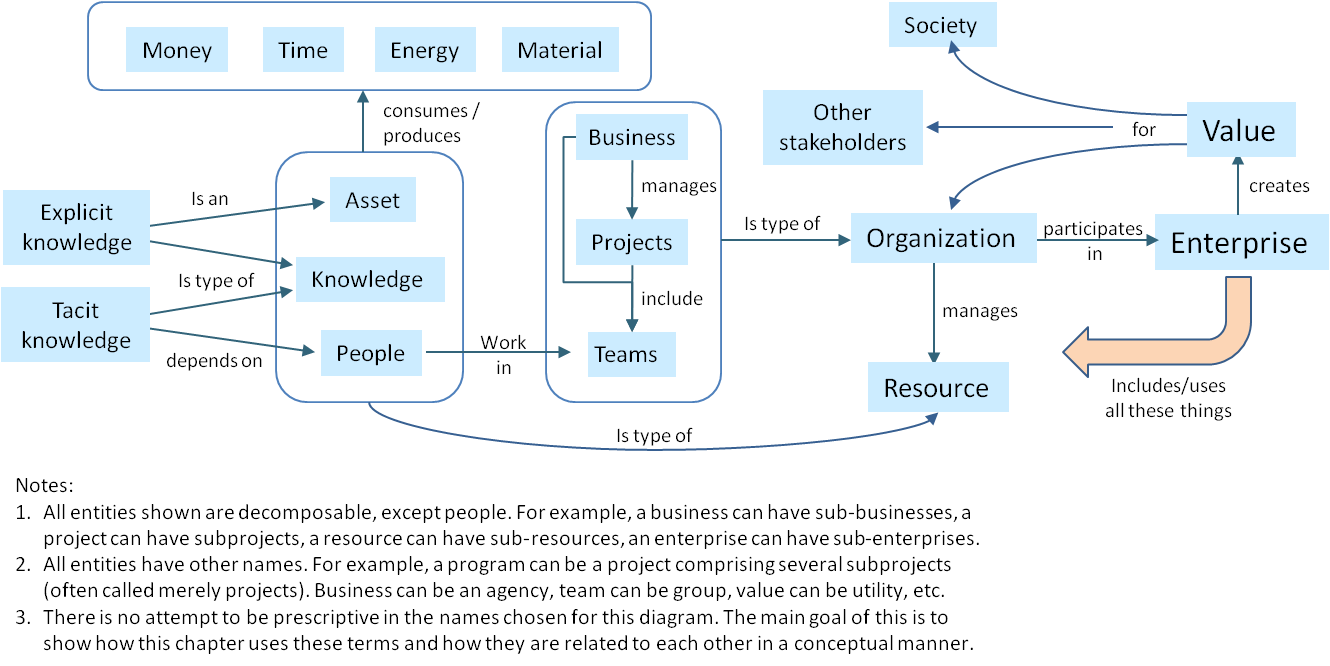
図1. 組織は資源を管理してエンタープライズ価値を創造する。(SEBoK Original)
The Enterprise as a System
To enable more efficient and effective System (glossary)|system,” rather than as a collection of functions connected solely by information systems and shared facilities (Rouse 2005 and 2009; Lawson 2010). What distinguishes the component (glossary) of the system, not merely as a user/operator of the system.
より効率的かつ効果的なエンタープライズ変革を可能にするには、エンタープライズを、情報システムと共有施設によってのみ結び付けられた機能の集合としてではなく、「システムとして」捉える必要がある(Rouse 2005 and 2009; Lawson 2010)。エンタープライズシステムの設計(design)が製品システムの設計と異なるのは、人をシステムの単なるユーザー/運用者としてではなく、システムの構成要素(component)として含む点にある。
<blockquote>''The term 'enterprise system' has taken on a narrow meaning of only the information system an organization uses. Research and project experience has taught us that to design a good enterprise system, we need to adopt a much broader understanding of enterprise systems. The greater view of enterprise systems is inclusive of the processes the system supports, the people who work in the system, and the information [and knowledge] content of the system.'' (Giachetti 2010) </blockquote>
「『エンタープライズシステム』という用語は、組織が使用する情報システムだけを指す狭い意味を帯びるようになった。我々は研究とプロジェクトの経験から、優れたエンタープライズシステムを設計するには、エンタープライズシステムをはるかに広く理解する必要があることを学んだ。エンタープライズシステムをより大きく捉えれば、そこには、システムが支援するプロセス、システムの中で働く人々、そしてシステムが持つ情報[と知識]の内容が含まれる。」(Giachetti 2010)
It is worth noting that the concept of "service" systems also includes people in the system. The thoughts above do not take this into account, primarily since their perspectives come mainly from a product system experience. The practice of service systems engineering is relatively new and is an emerging discipline. For more information on this, see the articles on Service Systems Engineering.
注目すべきは、「サービス」システムの概念もシステムの中に人を含むという点である。上記の考えはこれを考慮に入れていないが、それは主として、その視点がおもに製品システムの経験に由来するためである。サービスシステムズエンジニアリングの実践は比較的新しく、新興の学問分野である。詳しくは、Service Systems Engineeringに関する記事を参照されたい。
The primary purpose of an enterprise is to create value for society, other stakeholders, and for the organizations that participate in that enterprise. This is illustrated in Figure 1 that shows all the key elements that contribute to this value creation process. These elements in the enterprise can be treated as a "system" and the processes, methods, and tools ESE can be applied.
エンタープライズの第一の目的は、社会、その他のステークホルダー、およびそのエンタープライズに参加する組織のために価値を創造することである。これを表したのが図1であり、この価値創造プロセスに寄与する主要な要素がすべて示されている。エンタープライズにおけるこれらの要素は「システム」として扱うことができ、ESEのプロセス、手法、ツールを適用できる。
There are three types of organizations of interest: businesses, projects, and teams (see note 1). A typical business participates in multiple enterprises through its portfolio of projects. Large SE projects can be enterprises in their own right, with participation by many different businesses, and may be organized as a number of sub-projects.
対象となる組織のタイプは、ビジネス、プロジェクト、チームの3つである(注1参照)。典型的なビジネスは、自らのプロジェクトのポートフォリオを通じて複数のエンタープライズに参加する。大規模なSEプロジェクトは、多くの異なるビジネスが参加する、それ自体で一つのエンタープライズとなり得るものであり、複数のサブプロジェクトとして組織化されることもある。
:<I>Note 1. The use of the word “business” is not intended to mean only for-profit commercial ventures. As used here, it also includes government agencies and not-for-profit organizations, as well as commercial ventures. Business is the activity of providing goods and services involving financial, commercial, and industrial aspects.</I>
注1:「ビジネス」という語は、営利目的の商業的事業のみを指す意図で用いているのではない。ここでは、商業的事業に加えて、政府機関や非営利組織も含む。ビジネスとは、財務的・商業的・産業的側面を伴う、財やサービスを提供する活動である。
図中の英語
A key choice for businesses that conduct SE is to what extent, if at all, they seek to optimize their use of resources (people, knowledge, assets) across teams, projects, and business units. Optimization of resources is not the goal in itself, but rather a means to achieve the goal of maximizing value for the enterprise and its stakeholders. At one extreme, in a product-oriented organization, projects may be responsible for hiring, training, and firing their own staff, as well as managing all assets required for their delivery of products or services. (The term "product-oriented organization" is not meant in the sense of product-oriented SE, but rather in the sense of this being one of the basic constructs available when formulating organizational strategy.)
SEを実施するビジネスにとっての重要な選択は、チーム、プロジェクト、ビジネスユニットをまたいで資源(人、知識、資産)の使用をどの程度最適化しようとするか、あるいはそもそも最適化しようとするかどうかである。資源の最適化はそれ自体が目標なのではなく、エンタープライズとそのステークホルダーにとっての価値を最大化するという目標を達成するための手段である。一方の極である製品指向の組織では、プロジェクトが自らのスタッフの採用・訓練・解雇に責任を負い、製品やサービスの提供に必要なすべての資産も管理する場合がある。(「製品指向の組織」という用語は、製品指向SEという意味ではなく、組織戦略を策定する際に利用できる基本的な構成要素の一つという意味で用いている。)
At the other extreme, in a functional organization, the projects delegate almost all their work to functional groups. In between these two extremes is a matrix organization that is used to give functional specialists a “home” between project assignments. A full discussion of organizational approaches and situations along with their applicability in enabling SE for the organization is provided in the article called Systems Engineering Organizational Strategy.
もう一方の極である機能別組織では、プロジェクトは作業のほぼすべてを機能グループに委ねる。この2つの極の中間に位置するのがマトリクス組織であり、機能の専門家に、プロジェクトへの配属と配属の合間の「ホーム」を与えるために用いられる。組織のアプローチと状況について、組織においてSEを可能にする上での適用可能性も含めた十分な議論は、Systems Engineering Organizational Strategyという記事で示されている。
The optimization debate can be handled as described in the book called "Enterprise Architecture as Strategy" (Ross, Weill, and Robertson 2006). In other words, an enterprise can choose (or not) to unify its operations and can choose (or not) to unify its information base. There are different strategies the enterprise might adopt to achieve and sustain value creation (and how ESE helps an enterprise to choose). This is further addressed in the section on Enterprise Architecture Formulation & Assessment in the article called Enterprise Capability Management.
最適化に関する議論は、「Enterprise Architecture as Strategy」(Ross, Weill, and Robertson 2006)という本に記述されている方法で扱うことができる。つまり、エンタープライズは、運用を統合するかどうか、また情報基盤を統合するかどうかを選択できる。エンタープライズが価値創造を達成し維持するために採用し得る戦略はさまざまであり(ESEがエンタープライズの選択をどのように支援するかという点もある)、これについては、Enterprise Capability Managementという記事の、エンタープライズアーキテクチャの策定と評価に関する節でさらに扱っている。
SE skills, techniques, and resources are relevant to many enterprise functions, and a well-founded SE capability can make a substantial contribution at the enterprise level, as well as at the project level. The article called Systems Engineering Organizational Strategy discusses enabling SE in the organization, while the article called Enabling Businesses and Enterprises focuses on the cross-organizational functions at the business and enterprise levels. The competence of individuals is discussed in the article called Enabling Individuals.
SEのスキル、技法、資源は多くのエンタープライズ機能に関わっており、確固たる基盤を持つSEの能力(capability)は、プロジェクトレベルと同様に、エンタープライズレベルでも実質的な貢献をなし得る。Systems Engineering Organizational Strategyという記事では組織におけるSEの実現について論じ、Enabling Businesses and Enterprisesという記事では、ビジネスレベルとエンタープライズレベルにおける組織横断的な機能に焦点を当てている。個人の力量(competence)については、Enabling Individualsという記事で論じている。
Knowledge is a key resource for ESE. There are generally two kinds of knowledge: explicit and tacit. Explicit knowledge can be written down or incorporated in computer codes. Much of the relevant knowledge, however, is “tacit knowledge” that only exists within the heads of people and in the context of relationships that people form with each other (e.g., team, project, and business level knowledge). The ability of an organization to create value is critically dependent on the people it employs, on what they know, how they work together, and how well they are organized and motivated to contribute to the organization’s purpose.
知識はESEにとって主要な資源である。知識には一般に、形式知と暗黙知の2種類がある。形式知は、書き留めたり、コンピュータのコードに組み込んだりできる。しかし、関連する知識の多くは「暗黙知」であり、人々の頭の中と、人々が互いに築く関係のコンテキストの中にのみ存在する(例えば、チーム、プロジェクト、ビジネスの各レベルの知識)。組織が価値を創造する能力は、組織が雇用する人々、彼らが何を知っているか、どのように協力し合うか、そして組織の目的に貢献するようにどれだけうまく組織化され動機付けられているかに、決定的に依存している。
The term “program” is used in various ways in different domains. In some domains a team can be called a program (e.g., a customer support team is their customer relationship "program"). In others, an entire business is called a program (e.g., a wireless communications business unit program), and in others the whole enterprise is called a program (e.g., the Joint Strike Fighter program and the Apollo Space program). And in many cases, the terms project and program are used interchangeably with no discernible distinction in their meaning or scope. Typically, but not always, there are program managers who have profit and loss (P&L) responsibility and are the ultimate program decision makers. A program manager may have a portfolio of items (services, products, facilities, intellectual property, etc.) that are usually provided, implemented, or acquired through projects.
The Office of Government Commerce provides a useful distinction between programs and projects: <BLOCKQUOTE> The ultimate goal of a Programme is to realise outcomes and benefits of strategic relevance. To achieve this a programme is designed as a temporary flexible organisation structure created to coordinate, direct and oversee the implementation of a set of related projects and activities in order to deliver outcomes and benefits related to the organisation’s strategic objectives... </BLOCKQUOTE>
<BLOCKQUOTE> A programme is likely to have a life that spans several years. A Project is usually of shorter duration (a few months perhaps) and will be focussed on the creation of a set of deliverables within agreed cost, time and quality parameters. (OGC 2010) </BLOCKQUOTE>
「プログラム(program)」という用語は、領域によってさまざまに使われる。ある領域では、チームがプログラムと呼ばれることがある(例えば、顧客サポートチームはその顧客関係「プログラム」である)。事業全体がプログラムと呼ばれる領域もあれば(例えば、無線通信事業ユニットのプログラム)、エンタープライズ全体がプログラムと呼ばれる領域もある(例えば、Joint Strike FighterプログラムやApollo Spaceプログラム)。また多くの場合、「プロジェクト(project)」と「プログラム」という用語は、意味や範囲に見分けられるほどの区別がないまま、互換的に用いられる。典型的には(常にではないが)、損益(P&L)の責任を負い、プログラムの最終的な意思決定者であるプログラムマネージャーが存在する。プログラムマネージャーは、品目(サービス、製品、施設、知的財産など)のポートフォリオを持つことがあり、それらは通常、プロジェクトを通じて提供、実施、または獲得される。
Office of Government Commerceは、プログラムとプロジェクトを区別する有用な考え方を示している。
「プログラムの究極の目標は、戦略的な関連性を持つ成果と便益を実現することである。これを達成するために、プログラムは、組織の戦略目標に関連する成果と便益を提供するべく、一連の関連するプロジェクトとアクティビティの実施を調整し、指揮し、監督するために作られる、一時的で柔軟な組織構造として設計される…」
「プログラムは、数年にわたる存続期間を持つ可能性が高い。プロジェクトは通常それより期間が短く(おそらく数か月)、合意されたコスト、時間、品質のパラメータの範囲内で、一連の成果物を作成することに焦点を当てる。」(OGC 2010)
ESE, by virtue of its inherent trans-disciplinarity (Sage 2000, 158-169) in dealing with problems that are large in scale and scope, can better enable the enterprise to become more effective and efficient. The complex nature of many enterprise problems and situations usually goes beyond the abilities of standard tools and techniques provided to business school graduates (See also Emergence and Complexity). ESE can augment the standard business management methods using the tools and methods from the SE discipline to more robustly analyze and evaluate the enterprise as a holistic system. A more general viewpoint, or “view,” for dealing with the enterprise consisting of scale, granularity, mindset, and time frame is provided by White (2007) and by McCarter and White (2009, 71-105).
ESE can provide the enablers to address the concerns of enterprise executives as shown in Table 1 (Rouse 2009). The methods for dealing with, and the special characteristics of, complex adaptive systems must be properly considered when adapting traditional systems engineering (TSE) practices for use at the enterprise level—many of which come out of the systems science and systems thinking domains (von Bertalanffy 1968; Weinberg and Weinberg 1988; Miller and Page 2007; Rouse 2008, 17-25). For an approach to complex adaptive systems (CAS) engineering, refer to White (2009, 1-16) and to McCarter and White (2009, 71-105).
ESEは、大規模で広範な問題に対処する上で本来備わっている超学際性(trans-disciplinarity)により(Sage 2000, 158-169)、エンタープライズがより効果的かつ効率的になることを、よりよく可能にすることができる。多くのエンタープライズの問題や状況の複雑な性質は、通常、ビジネススクールの卒業生に提供される標準的なツールや技法の能力を超えている(Emergence and Complexityも参照)。ESEは、SEという学問分野のツールと手法を用いて、エンタープライズを全体論的なシステムとしてより堅牢に分析・評価することで、標準的なビジネスマネジメント手法を補強できる。スケール、粒度、考え方、時間枠から成る、エンタープライズに対処するためのより一般的な視点、すなわち「見方」は、White(2007)とMcCarter and White(2009, 71-105)に示されている。
ESEは、表1に示すように、エンタープライズの経営幹部の懸念に対処するための実現手段を提供できる(Rouse 2009)。伝統的システムズエンジニアリング(TSE)の実践をエンタープライズレベルで使えるよう適応させる際には、複雑適応システムに対処するための方法と、その特殊な特性を適切に考慮しなければならず、それらの多くはシステム科学とシステム思考の領域に由来する(von Bertalanffy 1968; Weinberg and Weinberg 1988; Miller and Page 2007; Rouse 2008, 17-25)。複雑適応システム(complex adaptive systems、CAS)のエンジニアリングへのアプローチについては、White(2009, 1-16)とMcCarter and White(2009, 71-105)を参照されたい。
表1. 経営幹部の懸念とSEの実現手段(Rouse 2009)。 John Wiley & Sons Inc. の許可を得て転載。その他のすべての権利は著作権者が留保する。
| +Table 1. Executive Concerns and SE Enablers (Rouse 2009). Reprinted with permission of John Wiley & Sons Inc. All other rights are reserved by the copyright owner. |
| Executive Concerns |
|---|
| SE Enablers |
| Identifying ends, means, and scope and candidate changes |
| System complexity analysis to compare "as is" and "to be" enterprises |
| Evaluating changes in terms of process behaviors and performance |
| Organizational simulation of process flows and relationships |
| Assessing economics in terms of investments, operating costs, and returns |
| Economic modeling in terms of cash flows, volatility, and options |
| Defining the new enterprise in terms of processes and their integration |
| Enterprise architecting in terms of workflow, processes, and levels of maturity |
| Designing a strategy to change the culture for selected changes |
| Organizational and cultural change via leadership, vision, strategy, and incentives |
| Developing transformation action plans in terms of what, when, and who |
| Implementation planning in terms of tasks, schedule, people, and information |
| 経営幹部の懸念 | SEの実現手段 |
|---|---|
| 目的、手段、範囲、および変更候補の特定 | 「現状(as is)」と「あるべき姿(to be)」のエンタープライズを比較するためのシステム複雑性分析 |
| 変更をプロセスの振る舞いと性能の観点から評価すること | 組織内のプロセスの流れと相互関係のシミュレーション |
| 投資、運用コスト、リターンの観点から経済性を評価すること | キャッシュフロー、変動性、オプションの観点からの経済モデリング |
| 新しいエンタープライズをプロセスとその統合の観点から定義すること | ワークフロー、プロセス、成熟度レベルの観点からのエンタープライズアーキテクティング |
| 選択した変更に向けて文化を変える戦略を設計すること | リーダーシップ、ビジョン、戦略、インセンティブを通じた組織的・文化的変更 |
| 「何を」「いつ」「誰が」の観点から変革の行動計画を策定すること | タスク、スケジュール、人、情報の観点からの実施計画 |
Another distinction is that “enterprise design does not occur at a single point in time like the design of most systems. Instead, enterprises evolve over time and are constantly changing, or are constantly being designed” (Giachetti 2010) [emphasis in original]. Giachetti calls this new discipline “enterprise engineering.” We consider the enterprise engineering set of practices to be equivalent to what we call enterprise systems engineering (ESE) in this article.
もう一つの区別として、「エンタープライズの設計は、ほとんどのシステムの設計のように単一の時点で行われるのではない。むしろ、エンタープライズは時間とともに進化し、絶えず変化している。すなわち、絶えず『設計され続けている』」(Giachetti 2010)[強調は原文]という点がある。Giachettiは、この新しい学問分野を「エンタープライズエンジニアリング」と呼ぶ。我々は、エンタープライズエンジニアリングの一連の実践が、本記事でエンタープライズシステムズエンジニアリング(ESE)と呼ぶものと等価であると考えている。
<BLOCKQUOTE> The body of knowledge for enterprise engineering is evolving under such titles as enterprise engineering, business engineering, and enterprise architecture . . . . Many systems and software engineering principles are applicable to enterprise engineering, but enterprise engineering’s unique complexities require additional principles…. Enterprise engineering’s intent is to deliver a targeted level of enterprise performance in terms of shareholder value or customer satisfaction . . . . Enterprise engineering methods include modeling; simulation; total quality management; change management; and bottleneck, cost, workflow, and value-added analysis. (Joannou 2007) </BLOCKQUOTE>
「エンタープライズエンジニアリングの知識体系は、エンタープライズエンジニアリング、ビジネスエンジニアリング、エンタープライズアーキテクチャ(enterprise architecture)といった名称のもとで進化しつつある…。システムズエンジニアリングおよびソフトウェアエンジニアリングの原則の多くはエンタープライズエンジニアリングに適用できるが、エンタープライズエンジニアリング特有の複雑さには追加の原則が必要である…。エンタープライズエンジニアリングの意図は、株主価値または顧客満足の観点から、目標とする水準のエンタープライズ性能を提供することにある…。エンタープライズエンジニアリングの手法には、モデリング、シミュレーション、総合的品質管理、変更管理、そしてボトルネック・コスト・ワークフロー・付加価値の分析が含まれる。」(Joannou 2007)
The phrase "system of systems” (SoS) is commonly used, but there is no widespread agreement on its exact meaning, nor on how it can be distinguished from a conventional system. A system is generally understood to be a collection of elements that interact in such a manner that it exhibits behavior that the elements themselves cannot exhibit. Each element (or component) of the system can be regarded as a system in its own right. Therefore, the phrase “system of systems” can technically be used for any system and, as such, would be a superfluous term. However, the meaning of this phrase has been examined in detail by (Maier 1998, 267-284), and his definition has been adopted by some people (AFSAB 2005). Maier provides this definition:
<blockquote>A SoS is an assemblage of components which individually may be regarded as systems, and which possess two additional properties: *<B>Operational Independence of the Components:</B> If the system-of-systems is disassembled into its component systems the component systems must be able to usefully operate independently. That is, the components fulfill customer-operator purposes on their own; and *<B>Managerial Independence of the Components:</B> The component systems not only can operate independently, they do operate independently. The component systems are separately acquired and integrated but maintain a continuing operational existence independent of the system-of-systems. (Maier 1998, 267-284) </blockquote>
Maier goes on further saying that “the commonly cited characteristics of systems-of-systems (complexity of the component systems and geographic distribution) are not the appropriate taxonomic classifiers” (Maier 1998, 267-284). Four kinds of SoS have been defined (Dahmann, Lane, and Rebovich 2008).
For further details on SoS, see the Systems Engineering Guide for SoS developed by the US Department of Defense (DoD) (DUS(AT) 2008). Also, see the Systems of Systems (SoS) knowledge area.
「システム・オブ・システムズ(system of systems)」(SoS)という句は一般的に用いられているが、その正確な意味についても、従来のシステムとどのように区別できるかについても、広く合意された見解はない。システムは一般に、要素それ自体では示すことのできない振る舞いを示すような仕方で相互作用する要素の集合であると理解されている。システムの各要素(または構成要素)は、それ自体を一つのシステムとみなすことができる。したがって、「システム・オブ・システムズ」という句は、厳密にはいかなるシステムにも用いることができ、その意味では余分な用語ということになろう。しかし、この句の意味は(Maier 1998, 267-284)によって詳細に検討されており、その定義は一部の人々に採用されてきた(AFSAB 2005)。Maierは次のように定義している。
「SoSは、個々にはシステムとみなし得る構成要素の集合体であり、次の2つの追加の特性を持つ。
Maierはさらに、「システム・オブ・システムズの特性として一般に挙げられるもの(構成要素システムの複雑さと地理的分散)は、適切な分類学的分類子ではない」と述べている(Maier 1998, 267-284)。SoSについては、4つの種類が定義されている(Dahmann, Lane, and Rebovich 2008)。
SoSの詳細については、米国国防総省(DoD)が作成した「Systems Engineering Guide for SoS」を参照されたい(DUS(AT) 2008)。また、Systems of Systems (SoS)の知識領域も参照されたい。
Different from the SoS concept, but related to it in several ways, is the concept called “federation of systems” (FoS). This concept might apply when there is a very limited amount of centralized control and authority (Sage and Cuppan 2001, 325-345; Sage and Rouse 2009). Each system in an FoS is very strongly in control of its own destiny, but “chooses” to participate in the FoS for its own good and the good of the “country,” so to speak. It is a coalition of the willing. An FoS is generally characterized by significant autonomy, heterogeneity, and geographic distribution or dispersion (Krygiel 1999). Krygiel defined a taxonomy of systems showing the relationships among conventional systems, SoSs, and FOSs.
This taxonomy has three dimensions: autonomy, heterogeneity, and dispersion. A FoS would have a larger value on each of these three dimensions than a non-federated SoS. An “Enterprise System,” as described above, could be considered to be an FoS if it rates highly on these three dimensions. However, it is possible for an enterprise to have components that are not highly autonomous, that are relatively homogeneous, and are geographically close together. Therefore, it would be incorrect to say that an enterprise is necessarily the same as an FoS.
Dove points out that in order for a large enterprise to survive in the twenty-first century, it must be more agile and robust (Dove 1999 and 2001). Handy (1992, 59-67) describes a federalist approach called “New Federalism” which identifies the need for structuring of loosely coupled organizations to help them adapt to the rapid changes inherent in the Information Age. This leads to the need for virtual organizations where alliances can be quickly formed to handle the challenges of newly identified threats and a rapidly changing marketplace (Handy 1995, 2-8). Handy sets out to define a number of federalist political principles that could be applicable to an FoS. Handy’s principles have been tailored to the domain of systems engineering (SE) and management by Sage and Cuppan (2001, 325-345): *Subsidiarity, *Interdependence, *Uniform and standardized way of doing business, *Separation of powers, *Dual citizenship, and *Scales of SE.
SoSの概念とは異なるものの、いくつかの点でそれと関連するのが、「システムの連合(federation of systems)」(FoS)と呼ばれる概念である。この概念は、集中的な統制と権限がごく限られている場合に適用されることがある(Sage and Cuppan 2001, 325-345; Sage and Rouse 2009)。FoSを構成する各システムは、自らの行く末を自ら決められるが、いわば自らの利益と「国」の利益のために、FoSへの参加を「選択」する。それは有志による連合である。FoSは一般に、かなりの自律性、異質性、そして地理的な分散または拡散によって特徴付けられる(Krygiel 1999)。Krygielは、従来のシステム、SoS、FoSの間の関係を示すシステムの分類法を定義した。
この分類法には、自律性、異質性、分散という3つの次元がある。FoSは、これら3つの次元のそれぞれにおいて、連合していないSoSよりも大きな値を持つ。上述の「エンタープライズシステム」は、これら3つの次元で高く評価されるならば、FoSとみなすことができる。しかし、エンタープライズが、自律性がそれほど高くなく、比較的均質で、地理的に互いに近い構成要素を持つこともあり得る。したがって、エンタープライズが必ずしもFoSと同じであると言うのは正しくない。
Doveは、大規模なエンタープライズが21世紀を生き抜くためには、よりアジャイル(agile)で堅牢(robust)でなければならないと指摘している(Dove 1999 and 2001)。Handy(1992, 59-67)は「新連邦主義」と呼ばれる連邦主義的アプローチを記述しており、そこでは、情報時代に固有の急速な変化に適応する助けとなるよう、緩く結合した(loosely coupled)組織を構造化する必要性が示されている。これにより、新たに特定された脅威(threat)や急速に変化する市場に対処するために、同盟を迅速に形成できる仮想組織が必要となる(Handy 1995, 2-8)。Handyは、FoSに適用し得る連邦主義の政治的原則をいくつか定義しようとしている。Handyの原則は、Sage and Cuppan(2001, 325-345)によって、システムズエンジニアリング(SE)とマネジメントの領域向けに調整されている。
According to Maier’s definition, not every enterprise would be called a SoS since the systems within the enterprise do not usually meet the criteria of operational and managerial independence. In fact, one of the key purposes of an enterprise is to explicitly establish operational dependence between systems that the enterprise owns and/or operates in order to maximize the efficiency and effectiveness of the enterprise as a whole. Therefore, it is more proper to treat an enterprise system and an SoS as different types of things, with different properties and characteristics. This distinction is illustrated in the figure below, where three corresponding categories of SE are shown (DeRosa 2005; Swarz et al. 2006).
Maierの定義によれば、エンタープライズ内のシステムは通常、運用上および管理上の独立性の基準を満たさないため、すべてのエンタープライズがSoSと呼ばれるわけではない。実際、エンタープライズの主要な目的の一つは、エンタープライズ全体の効率と有効性を最大化するために、自らが所有および/または運用するシステムの間に、運用上の依存関係を明示的に確立することである。したがって、エンタープライズシステムとSoSは、異なる特性と特徴を持つ別種のものとして扱う方が適切である。この区別を示したのが以下の図であり、そこには対応する3つのカテゴリのSEが示されている(DeRosa 2005; Swarz et al. 2006)。
It is true that an enterprise can be treated as a system itself and is comprised of many systems within the enterprise, but this discussion will reserve the term SoS to those systems that meet the criteria of operational and managerial independence. This distinction was also used within the MITRE Corporation in their ESE Office (Rebovich and White 2011).
エンタープライズそれ自体を一つのシステムとして扱うことができ、エンタープライズ内の多くのシステムから構成されているのは事実であるが、本議論では、SoSという用語を、運用上および管理上の独立性の基準を満たすシステムに限って用いる。この区別は、MITRE CorporationのESE Officeでも用いられていた(Rebovich and White 2011)。
Figure 2. Different Groupings and Patterns Revealed at Different Scales (DeRosa 2005). Reprinted with permission of © 2011. The MITRE Corporation. All Rights Reserved. All other rights are reserved by the copyright owner.
図2. 異なるスケールで明らかになる異なるグルーピングとパターン(DeRosa 2005)。The MITRE Corporation の許可を得て転載。© 2011 The MITRE Corporation. All Rights Reserved.。その他のすべての権利は著作権者が留保する。
この図は原典のページに掲載されています。権利の都合により本サイトでは省略しています。原典で見る
An enterprise may require a particular operational capability that is brought into being by connecting together a chain of systems that together achieve that capability. Any one of these systems in the chain cannot by itself provide this capability. The desired capability is the emergent property of this chain of systems. This chain of systems is sometimes called an SoS. However, the enterprise that requires this capability rarely has direct control over all the systems necessary to provide this full capability. This situation is illustrated in the figure below (Martin 2010).
エンタープライズは、複数のシステムを連鎖状につなぎ、それらが一体としてその能力(capability)を達成することによって生み出される、特定の運用能力(operational capability)を必要とすることがある。この連鎖のどのシステムも、単独ではこの能力を提供できない。望ましい能力は、このシステムの連鎖の創発特性である。このシステムの連鎖は、SoSと呼ばれることがある。しかし、この能力を必要とするエンタープライズが、この能力を完全に提供するのに必要なすべてのシステムを直接統制できることは稀である。この状況を以下の図に示す(Martin 2010)。
Figure 3. Relationships Between an Enterprise and SoSs (Martin 2010). Reprinted with permission of The Aerospace Corporation. All other rights are reserved by the copyright owner.
図3. エンタープライズとSoSの関係(Martin 2010)。The Aerospace Corporation の許可を得て転載。その他のすべての権利は著作権者が留保する。
この図は原典のページに掲載されています。権利の都合により本サイトでは省略しています。原典で見る
Enterprise E1 (in the example above) has full control over SoS2, but not full control over SoS1. TSE can be applied to the individual systems (S1, S2, …, S53) shown within each enterprise, but needs to be augmented with additional activities to handle SoS and enterprise kinds of issues.
(上記の例における)エンタープライズE1は、SoS2を全面的に統制できるが、SoS1への統制は限定される。TSEは、各エンタープライズ内に示された個々のシステム(S1、S2、…、S53)に適用できるが、SoSやエンタープライズといった種類の問題を扱うには、追加のアクティビティで補強する必要がある。
There is a general issue regarding dealing with enterprises in this situation: there are at least two enterprises related to any particular SoS. First, there is the enterprise of builders/developers comprising projects and programs, which have to be organized appropriately and adopt special types of architectural principles. Second, there is the enterprise of users (those who use the products and service provided by the first enterprise), which has to exercise its own sort of agility. How the first enterprise designs systems to allow the second to operate is the core issue.
この状況においてエンタープライズをどう扱うかについては、一般的な問題がある。すなわち、どのSoSにも、少なくとも2つのエンタープライズが関係している。第一は、適切に組織化され、特殊なタイプのアーキテクチャ原則を採用しなければならない、プロジェクトとプログラムから構成される構築者/開発者のエンタープライズである。第二は、(第一のエンタープライズが提供する製品とサービスを使用する)利用者のエンタープライズであり、独自の俊敏さを発揮しなければならない。構築・開発側のエンタープライズが、利用者側のエンタープライズが活動できるようにシステムをどのように設計するかが、核心の問題である。
AFSAB. 2005. Report on System-of-Systems Engineering for Air Force Capability Development. Washington, DC: US Air Force Scientific Advisory Board (AFSAB), US Air Force. SAB-TR-05-04.
Dahmann, J.S., J.A. Lane, and G. Rebovich. 2008. "Systems Engineering for Capabilities." CROSSTALK: The Journal of Defense Software Engineering. 21 (11): 4–9.
DeRosa, J.K. 2005. "Enterprise Systems Engineering." Presented at Air Force Association, Industry Day, Day 1, August 4, 2005, Danvers, MA, USA.
Dove, R. 2001. Response Ability: The Language, Structure, and Culture of the Agile Organization. New York, NY, USA: John Wiley & Sons.
Dove, R. 1999. "Knowledge Management, Response Ability, and the Agile Enterprise," in Paradigm Shift International [database online]. Accessed September 6, 2011. Available: https://www.parshift.com/docs/KmRaAeX.htm.
DUS(AT). 2008. Systems Engineering Guide for Systems of Systems, version 1.0. Washington, DC, USA: Deputy Under Secretary of Defense for Acquisition and Technology (DUS(AT)) / US Department of Defense (DoD). Accessed September 6, 2011. Available: https://www.acq.osd.mil/se/docs/SE-Guide-for-SoS.pdf.
Giachetti, R.E. 2010. Design of Enterprise Systems: Theory, Architecture, and Methods. Boca Raton, FL, USA: CRC Press, Taylor and Francis Group.
Handy, C. 1995. "Trust and the Virtual Organization." Harvard Business Review. 73 (3): 2-8.
Handy, C. 1992. "Balancing Corporate Power: A New Federalist Paper." Harvard Business Review. 70 (6): 59-67.
Joannou, P. 2007. "Enterprise, Systems, and Software—The Need for Integration." Computer. 40 (5): 103-105.
Krygiel, A.J. 1999. ''Behind the Wizard's Curtain: An Integration Environment for a System of Systems''. Arlington, VA, USA: C4ISR Cooperative Research Program (CCRP).
Krygiel, A.J. 1999. Behind the Wizard's Curtain: An Integration Environment for a System of Systems. Arlington, VA, USA: C4ISR Cooperative Research Program (CCRP).
Lawson, H. 2010. A Journey Through the Systems Landscape. Kings College, UK: College Publications.
Maier, M.W. 1998. "Architecting Principles for Systems-of-Systems." ''Systems Engineering, the Journal of the International Council on Systems Engineering (INCOSE). 1 (4): 267-84.
Maier, M.W. 1998. "Architecting Principles for Systems-of-Systems." *Systems Engineering, the Journal of the International Council on Systems Engineering (INCOSE). 1 (4): 267-84.
Martin, J.N. 2010. "An Enterprise Systems Engineering Framework." Presented at 20th Anniversary International Council on Systems Engineering (INCOSE) International Symposium, July 12-15, 2010, Chicago, IL, USA.
McCarter, B.G., and B.E. White. 2009. "Emergence of SoS, sociocognitive aspects," in Systems of systems engineering: Principles and applications, edited by M. Jamshidi. Boca Raton, FL, USA: CRC Press, Taylor & Francis Group. p. 71-105.
OGC (Office of Government Commerce). 2010. Guidelines for Managing Programmes: Understanding programmes and programme management. London, UK: The Stationery Office.
Ross, J.W., P. Weill, and D. Robertson. 2006. Enterprise Architecture As Strategy: Creating a Foundation for Business Execution. Boston, MA, USA: Harvard Business Review Press.
Rouse, W.B. 2009. "Engineering the Enterprise as a System," in Handbook of systems engineering and management, 2nd ed., edited by A.P. Sage and W.B. Rouse. New York, NY, USA: Wiley and Sons, Inc.
Rouse, W.B. 2008. "Health Care as a Complex Adaptive System: Implications for design and management." The Bridge, National Academy of Engineering. 38 (1): 17-25.
Rouse, W.B. 2005. "Enterprise as Systems: Essential Challenges and Enterprise Transformation." Systems Engineering. 8 (2): 138-50.
Sage, A.P. 2000. "Transdisciplinarity Perspectives in Systems Engineering and Management." in Transdiciplinarity: Recreating Integrated Knowledge, edited by M.A. Somerville and D. Rappaport. Oxford, UK: EOLSS Publishers. p. 158-169.
Sage, A., and C. Cuppan. 2001. "On the Systems Engineering and Management of Systems of Systems and Federations of Systems." Information-Knowledge-Systems Management Journal. 2 (4): 325-345.
Sage, A.P., and W.B. Rouse (eds). 2009. Handbook of System Engineering and Management, 2nd ed. New York, NY, USA: John Wiley & Sons.
Swarz, R.S., J.K. DeRosa, and G. Rebovich. 2006. "An Enterprise Systems Engineering Model." Proceedings of the INCOSE International Symposium, July 9-13, 2006, Orlando, FL, USA.
von Bertalanffy, L. 1968. General System Theory: Foundations, Development, Applications, revised ed. New York, NY, USA: Braziller.
Weinberg, G., and D. Weinberg. 1988. General Principles of Systems Design. New York, NY: Dorset House Publishing Company.
White, B.E. 2007. "On Interpreting Scale (or View) and Emergence in Complex Systems Engineering." Presented at 1st Annual IEEE Systems Conference, 9-12 April, 2007, Honolulu, HI, USA.
Giachetti, R.E. 2010. Design of Enterprise Systems: Theory, Architecture, and Methods. Boca Raton, FL, USA: CRC Press, Taylor and Francis Group.
Joannou, P. 2007. "Enterprise, Systems, and Software—The Need for Integration." Computer. 40 (5): 103-105.
Rouse, W.B. 2009. "Engineering the Enterprise as a System," in Handbook of systems engineering and management, 2nd ed., edited by A.P. Sage and W.B. Rouse. New York, NY, USA: Wiley and Sons, Inc.
Rouse, W.B. 2005. "Enterprise as Systems: Essential Challenges and Enterprise Transformation." Systems Engineering. 8 (2): 138-50.
Arnold, S., and H. Lawson. 2004. "Viewing Systems From a Business Management Perspective." Systems Engineering. 7 (3): 229.
Beimans, F.P.M., M.M. Lankhorst, W.B. Teeuw, and R.G. van de Wetering. 2001. "Dealing with the Complexity of Business Systems Architecting." Systems Engineering. 4 (2): 118-33.
Nightingale, D., and D. Rhodes. 2004. "Enterprise systems architecting: Emerging art and science within engineering systems." Presented at Engineering Systems Symposium, Massachusetts Institute of Technology (MIT), 29-31 March, 2004, Boston, MA, USA.
Rebovich, G. 2006. "Systems Thinking for the Enterprise: New & Emerging Perspectives." Presented at IEEE/SMC International Conference on System of Systems Engineering, April 2006, Los Angeles, CA, USA.
Rechtin, E. 1999. ''Systems Architecting of Organizations: Why Eagles can't Swim''. Boca Raton, FL, USA: CRC Press, Taylor and Francis Group.
Rechtin, E. 1999. Systems Architecting of Organizations: Why Eagles can't Swim. Boca Raton, FL, USA: CRC Press, Taylor and Francis Group.
Ring, J. 2004. "Intelligent Enterprises." INCOSE INSIGHT. 6 (2).
Ring, J. 2004. "Seeing an Enterprise as a System." INCOSE INSIGHT. 6(2).
Valerdi, R., D. Nightingale, and C. Blackburn. 2009. "Enterprises as Systems: Context, Boundaries, and Practical Implications." Information-Knowledge-Systems Management Journal. 7 (4): 377-399.