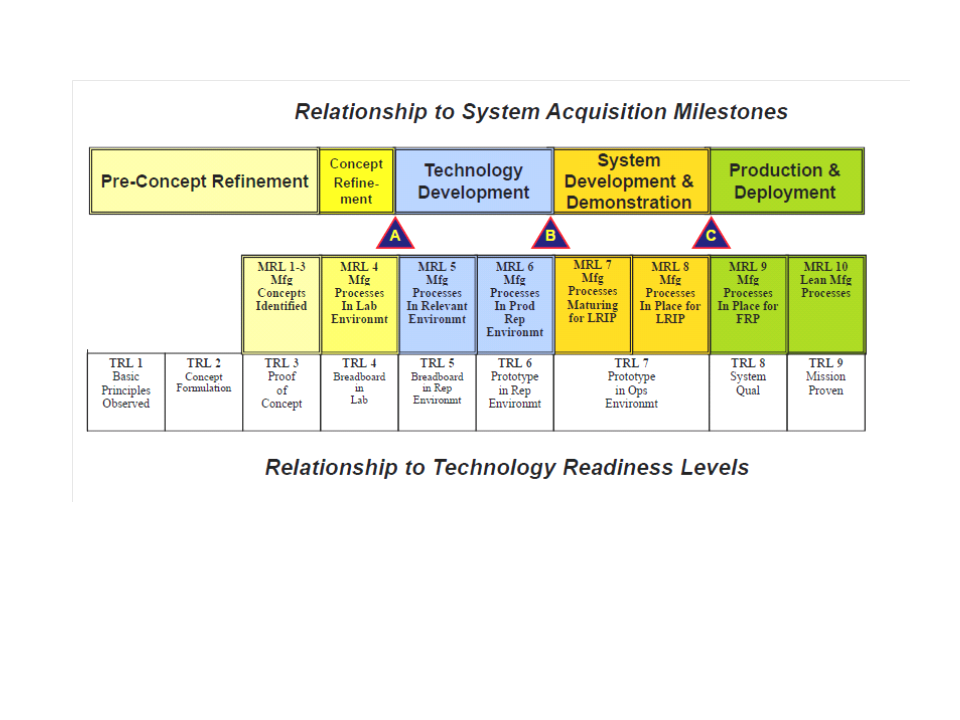
図1.技術準備レベルとシステム取得マイルストーンとの関係(Morgan 2008)。United States Air Force の Manufacturing Technology Division により公開。
Product Systems Engineering Special Activities
The "Product Systems Engineering" knowledge area is graciously sponsored by PPI.
「Product Systems Engineering」の知識領域は PPI の厚意によりスポンサードされている。
この図は原典のページに掲載されています。権利の都合により本サイトでは省略しています。原典で見る
Product systems engineering has activities that are unique to products. This article discusses many of them.
製品システムズエンジニアリングには、製品に固有のアクティビティがある。本記事では、そのうちの多くについて論じる。
As a new system is developed, it is essential to verify and validate that the developed system is mature enough to be released as an operational product or service. Technology readiness assessments (TRA) are established tools used to qualify technology development and help make investment decisions within complex development programs in order to deploy systems or elements of technology to an end user in a timely fashion.
This notion of maturity was formalized by the US National Aeronautics and Space Administration (NASA) (Mankins 1995) and later modified for use by the Department of Defense (DoD), the Air Force Research Laboratory (AFRL), and the US Department of Energy (DoE), as well as a growing number of non-governmental organizations. Technology readiness levels (TRL) are a metric developed to summarize the degree of maturity of a technology. The original NASA TRL scale has nine different levels from the basic principles observed and reported (TRL 1) to actual systems "flight proven" through successful mission operations (TRL 9). The TRL scale utilized by the DoD is portrayed in Table 1.
新しいシステムを開発する際には、開発したシステムが運用製品またはサービスとしてリリースできるほど十分に成熟していることを、検証し妥当性確認することが不可欠である。技術準備レベル評価(technology readiness assessments、TRA)は、システムまたは技術の要素を適時に最終利用者へ配備するために、複雑な開発プログラムにおいて技術開発を適格と認め、投資の意思決定を支援する目的で用いられる、確立したツールである。
この成熟の考え方は、US National Aeronautics and Space Administration(NASA)によって形式化され(Mankins 1995)、その後、Department of Defense(DoD)、Air Force Research Laboratory(AFRL)、US Department of Energy(DoE)、さらに増えつつある非政府組織でも利用できるように修正された。技術準備レベル(technology readiness levels、TRL)は、技術の成熟度を要約するために開発された尺度である。NASA の当初の TRL スケールは、『基本原理が観測され報告される』(TRL 1)から『実システムがミッション運用の成功により「飛行で証明される」』(TRL 9)までの、9つの異なるレベルからなる。DoD が使う TRL スケールを表1に示す。
表1.重要技術の評価のための技術準備レベル(Mankins 1995)。 Released by the Advanced Concept Office, Office of Space Access and Technology, NASA.
| +Table 1. Technology Readiness Levels for Assessing Critical Technologies (Mankins 1995). Released by the Advanced Concept Office, Office of Space Access and Technology, NASA. |
| Technology Readiness Level |
|---|
| Description |
| + |
| 1. Basic principles observed and reported. |
| Lowest level of technology readiness. Examples might include paper studies of a technology's basic properties. |
| + |
| 2. Technology concept and/or application formulated. |
| Invention begins. Examples are limited to analytic studies. |
| + |
| 3. An analytical and experimental critical function and/or characteristic proof of concept. |
| Includes analytical and lab studies to physically validate predictions of separate elements of the technology. Examples include components not yet integrated. |
| + |
| 4. Component validation in laboratory environment. |
| Basic technological components are integrated. This is relatively "low fidelity" compared to the eventual system. |
| + |
| 5. Component validation in relevant environment. |
| Basic technological components are integrated with reasonably realistic supporting elements so it can be tested in a simulated environment. |
| + |
| 6. Prototype demonstration in a relevant environment. |
| Representative prototype system tested in a relevant environment. Represents a major step up in a technology's demonstrated readiness. Examples include testing a prototype in a high-fidelity laboratory environment or in simulated operational environment. |
| + |
| 7. Prototype demonstration in an operational environment. |
| Prototype near, or at, planned operational system. Represents a major set up from TRL 6, requiring demonstration of an actual system prototype in an operational environment. |
| + |
| 8. System qualified through test and demonstration. |
| Technology proven to work in its final form and under expected conditions. Represents the end of true system development. Examples include developmental test and evaluation of the system. |
| + |
| 9. System proven through successful mission operations. |
| Actual application of the technology in its final form and under mission conditions, such as those encountered in operational test and evaluation. |
| 技術準備レベル | 説明 |
|---|---|
| 1. 基本原理が観測され報告される。 | 技術準備の最も低いレベル。例としては、技術の基本特性に関する机上研究が含まれ得る。 |
| 2. 技術コンセプトおよび/または適用が策定される。 | 発明が始まる。例は解析的研究に限られる。 |
| 3. 解析的・実験的な重要機能および/または特性の概念実証。 | 技術の個別要素に関する予測を物理的に妥当性確認するための、解析的研究と実験室での研究を含む。例として、まだ統合されていない構成要素が含まれる。 |
| 4. 実験室環境における構成要素の妥当性確認。 | 基本的な技術構成要素が統合される。これは最終システムと比べて相対的に「低忠実度」である。 |
| 5. 関連環境における構成要素の妥当性確認。 | 基本的な技術構成要素が相応に現実的な支援要素と統合され、シミュレーション環境でテストできるようになる。 |
| 6. 関連環境におけるプロトタイプの実証。 | 代表的なプロトタイプシステムが関連環境でテストされる。技術の実証された準備度における大きな前進を表す。例として、高忠実度の実験室環境やシミュレーションされた運用環境でのプロトタイプのテストが含まれる。 |
| 7. 運用環境におけるプロトタイプの実証。 | 計画された運用システムに近い、またはその水準に達したプロトタイプ。TRL 6 からの大きな前進を表し、運用環境で実システムのプロトタイプを実証することが求められる。 |
| 8. テストと実証により適格とされるシステム。 | 技術が最終形態で、想定される条件下で機能することが証明される。真のシステム開発の終わりを表す。例として、システムの開発テスト・評価が含まれる。 |
| 9. ミッション運用の成功により証明されるシステム。 | 運用テスト・評価で遭遇するようなミッション条件下で、最終形態の技術を実際に適用する。 |
The utilization of TRLs has an impact on the structure and operation of life cycles as described in Part 3; they allow better management and control of risks inherent with technology, as well as better control of costs and the schedule of program development. However, TRLs do not provide an assessment of the programmatic influence on a TRL, technology criticality and priority, software aging and readiness context, as pointed out by Smith (2005). While TRLs have proven to be useful in evaluating a technology’s performance, as demonstrated in the laboratory or in a test environment, they do not inform one whether or not the technology product can actually be produced in an affordable manner. The concept of manufacturing readiness levels (MRL) has been incorporated to expand the TRL idea so that it can incorporate producibility concerns. The MRL approach addresses questions such as the level of technology reproducibility, the cost of production, and technology manufacturing production environment early in the development phase (GAO 2003, DoD 2011).
TRL の利用は、Part 3 で記述されるライフサイクルの構造と運用に影響を与える。TRL により、技術に固有のリスクをより適切にマネジメントし管理できるようになるとともに、プログラム開発のコストとスケジュールもより適切に管理できるようになる。しかし Smith(2005)が指摘したように、TRL は、TRL に対するプログラム上の影響や、技術の重要度と優先度、ソフトウェアの老朽化と準備のコンテキストを評価するものではない。TRL は、実験室やテスト環境で実証される技術の性能を評価するうえで有用であることが証明されてきたが、その技術製品を実際に負担可能なコストで生産できるかどうかは示さない。製造準備レベル(manufacturing readiness levels、MRL)の考え方は、TRL の考え方を拡張し、生産可能性に関する懸念を取り込めるようにするために導入された。MRL のアプローチは、技術の再現可能性の水準、生産のコスト、技術の製造生産環境といった問題に、開発フェーズの早い段階で取り組む(GAO 2003、DoD 2011)。
図中の英語
Readiness levels are an active research area within academia and government agencies in regards to the integration of technology components into complex systems (integration readiness levels (IRLs)) to address interface maturity among existing and maturing technology developments. TRLs apply to the critical enabling technologies, which are usually embodied at the subsystem, assembly level, or system component level. Systems readiness levels (SRL) are used when going from individual technologies to the whole system. The SRL model is a function of the individual TRLs in a system and their subsequent integration points with other technologies, the IRL (Sauser 2006).
準備レベルは、既存の技術開発と成熟途上の技術開発の間のインタフェースの成熟度に取り組むため、複雑なシステムへの技術構成要素の統合に関して(統合準備レベル(integration readiness levels、IRL))、学術界と政府機関において活発に研究されている領域である。TRL は、通常はサブシステム、アセンブリの水準、またはシステム構成要素の水準で具現化される、重要な実現技術に適用される。システム準備レベル(systems readiness levels、SRL)は、個別の技術からシステム全体へと移行する際に用いられる。SRL モデルは、システム内の各技術の TRL と、その技術を他の技術と統合する各点の IRL を変数とする(Sauser 2006)。
Another maturity aspect is related to the provisioning of products that are readily available and referred to as commercial off-the-shelf (COTS). Such products, be they hardware, software, or a mixture of both, have hopefully achieved the degree of maturity so that those acquiring them can rely upon their operational properties and that the documentation of the COTS products is sufficient to provide the proper guidance in their use.
もう一つの成熟の側面は、すぐに入手でき、市販品(commercial off-the-shelf、COTS)と呼ばれる製品の提供に関係する。そのような製品は、ハードウェアであれ、ソフトウェアであれ、両者の混合であれ、うまくいけば、それを取得する人々がその運用特性を信頼でき、かつ COTS 製品の文書がその使用について適切な指針となるのに十分な程度まで成熟している。
The PSE should realize that the TRL assessment for COTS changes dramatically if the operational environment or other requirements are imposed that exceed the design limits of the COTS product (e.g., operations at very high or very cold temperatures, high shock, or vibration levels).
PSE は、COTS 製品の設計限界を超える運用環境やその他の要求事項が課される場合(例えば、非常に高い温度や非常に低い温度での運用、高い衝撃や振動の水準)には、COTS に対する TRL 評価が劇的に変わることを認識すべきである。
Product certifications are both domain and product specific, and typically relate to human safety and health, the need to meet a specific government regulation, or are required by underwriters for insurance purposes. Certifications are performed by a third party (independent of the developer) who provides a guarantee of the quality, safety, and reliability of the product to the customer or user.
製品認証はドメインにも製品にも固有のものであり、典型的には、人間の安全と健康や、特定の政府規制を満たす必要性に関係するか、保険上の目的で引受人から要求されるものである。認証は、顧客または利用者に対して製品の品質、安全性、信頼性を保証する第三者(開発者から独立した者)によって実施される。
The INCOSE SE Handbook defines product certification as "the process of certifying that a certain product has passed performance or quality assurance tests or qualification requirements stipulated in regulations such as a building code or nationally accredited test standards, or that it complies with a set of regulations governing quality or minimum performance requirements." (INCOSE 2012)
国際システムズエンジニアリング協議会(INCOSE)の『SE Handbook』は、製品認証を「ある製品が、建築基準などの規制や国家認定のテスト標準に規定された性能試験もしくは品質保証試験に合格したか、または適格性に関する要求事項を満たしたこと、あるいは品質や最低性能要求事項を規定する一連の規制に適合していることを証明するプロセス」と定義している。(INCOSE 2012)
The INCOSE SE Handbook also defines four methods for verification: inspection, analysis, demonstration, and testing (INCOSE 2012). In addition, it defines certification as a fifth verification method, which is defined as verification against legal or industrial standards by an outside authority without direction to that authority as to how the requirements are to be verified. For example, electronic devices require a CE certification in Europe, and a UL certification in the US and Canada (INCOSE 2012).
INCOSE の『SE Handbook』はまた、検証の方法として、検査、解析、実証、テストの4つを定義している(INCOSE 2012)。さらに、認証を第5の検証方法として定義しており、これは、要求事項をどのように検証すべきかを外部当局に指示することなく、外部当局が法的または産業的な標準に照らして検証することと定義される。例えば電子機器には、ヨーロッパでは CE 認証が、US とカナダでは UL 認証が必要である(INCOSE 2012)。
The best known certification is the airworthiness certification, which relates to the safety of flight for aircraft. In the US, the test for this certification is performed by the Federal Aviation Administration (FAA). Government certifications are also common in the medical systems field where the Federal Drug Administration (FDA) is the primary certification agency. Some certifications are based on standards defined by technical societies, such as the American Society of Mechanical Engineers (ASME). The combination of the technical standards and a certification allows product developers to perform certifications that meet government standards without having the government directly involved in the process.
最もよく知られた認証は、航空機の飛行安全に関わる耐空性認証である。US では、この認証のためのテストを Federal Aviation Administration(FAA)が実施する。政府による認証は医療システムの分野でも一般的であり、そこでは Federal Drug Administration(FDA)が主要な認証機関となっている。一部の認証は、American Society of Mechanical Engineers(ASME)のような技術学会が定める標準に基づいている。技術標準と認証を組み合わせることで、製品開発者は、政府がそのプロセスに直接関与しなくても、政府標準を満たす認証を実施できる。
There are equivalent government organizations in other countries and for other regulated areas, such as communications, building safety, nuclear systems, transportation systems to include ships, trains and automobiles, environmental impact, and energy use. Systems engineers must be aware of the certifications that are required for the domain and product being developed. Certification agencies must be involved early in the development effort to ensure the necessary certifications are included in the system requirements, the system development plan, and the funding provided to accomplish the development. When system changes and upgrades are necessary, the systems engineers must determine if product re-certification is necessary and include it in the plans and funding for the system upgrade.
同等の政府組織は、他の国々にも、また通信、建物の安全、原子力システム、船舶・列車・自動車を含む輸送システム、環境影響、エネルギー使用といった他の規制分野にも存在する。システムズエンジニアは、開発対象のドメインと製品に求められる認証を把握していなければならない。認証機関は、必要な認証がシステム要求事項、システム開発計画、および開発の遂行に充てられる資金に確実に盛り込まれるよう、開発作業の早い段階から関与しなければならない。システムの変更やアップグレードが必要になった場合、システムズエンジニアは製品の再認証が必要かどうかを判断し、それをシステムアップグレードの計画と資金に含めなければならない。
There may be other certifications for enabling products that must be considered and appreciated by PSE, such as an operator certification of airplane pilots to ensure flight safety, and certification of nuclear plant operators to ensure prevention or mitigation of nuclear radiation effects. An example of this is shown in the certification program by the North American Electric Reliability Corporation (NERC):
PSE が考慮し、評価しなければならないイネーブリング製品の認証が、ほかにもあり得る。例えば、飛行の安全を確保するための飛行機パイロットの操縦者認証や、核放射線の影響の防止または緩和を確実にするための原子力発電所運転員の認証である。その一例は、North American Electric Reliability Corporation(NERC)の認証プログラムに見ることができる。
<blockquote>In support of NERC’s mission, the System Operator Certification Program’s mission is to ensure that employers have a workforce of system operators that meet minimum qualifications. These minimum qualifications are set through internationally recognized processes and procedures for agencies that certify persons. The Certification Program promotes excellence in the area of system operator performance and encourages system operators to be inquisitive and informed. (NERC 2012) </blockquote>
『NERC の使命を支援するため、System Operator Certification Program の使命は、雇用者が、最低限の資格を満たすシステム運転員の人材を確保することを確実にすることである。これらの最低限の資格は、個人を認証する機関のための、国際的に認められたプロセスと手順を通じて設定される。Certification Program は、システム運転員のパフォーマンスの分野における卓越性を促進し、システム運転員が探究心を持ち、十分な情報を得ていることを奨励する。』(NERC 2012)
Production qualification testing (PQT) is another type of certification which DAU (2005) describes as:
生産適格性テスト(production qualification testing、PQT)も認証の一種であり、DAU(2005)はこれを次のように記述している。
<blockquote>A technical test completed prior to the full-rate production (FRP) decision to ensure the effectiveness of the manufacturing process, equipment, and procedures. This testing also serves the purpose of providing data for the independent evaluation required for materiel release so that the evaluator can address the adequacy of the materiel with respect to the stated requirements. These tests are conducted on a number of samples taken at random from the first production lot, and are repeated if the process or design is changed significantly and when a second or alternative source is brought online. </blockquote>
『全規模生産(full-rate production、FRP)の決定に先立って完了する技術テストであり、製造プロセス、装備、手順の有効性を確実にするためのものである。このテストは、装備品の引き渡し承認に必要な独立評価のためのデータを提供するという目的も果たし、それによって評価者は、明示された要求事項に照らした装備品の適切性を検討できる。これらのテストは、最初の生産ロットから無作為に抽出した複数のサンプルに対して実施され、プロセスや設計が大きく変更された場合や、第2の供給源または代替供給源が稼働を開始した場合に繰り返される。』
Security certification and accreditation (C&A) is often required for the deployment of computing and networking equipment in a classified environment. Facility certification may be required to ensure that a building housing the equipment can provide the proper environment for safe and efficient operation of the equipment. High-altitude electromagnetic pulse (HEMP) certification may be required to ensure that a building and its equipment can withstand the effects of HEMP from nuclear weapons. A similar type of certification to HEMP is TEMPEST testing to ensure that sensitive electronic emissions are not allowed to leave high security facilities. TEMPEST is a code name referring to investigations and studies of compromising emission, and is not an acronym.
セキュリティの認証と認定(certification and accreditation、C&A)は、機密環境にコンピューティング機器やネットワーキング機器を配備する際にしばしば求められる。施設の認証は、装備を収容する建物が、その装備を安全かつ効率的に運用するための適切な環境を提供できることを確実にするために必要となる場合がある。高高度電磁パルス(high-altitude electromagnetic pulse、HEMP)の認証は、建物とその装備が核兵器による HEMP の影響に耐えられることを確実にするために必要となる場合がある。HEMP と類似したタイプの認証として、機密性の高い電子的放射が高度なセキュリティ施設の外へ漏れないことを確実にするための TEMPEST テストがある。TEMPEST は、漏洩放射の調査と研究を指すコードネームであり、頭字語ではない。
Technology planning can be an enterprise function or a program function. Technology planning as an enterprise function typically occurs on an annual basis to determine the funding necessary for independent research and development in the coming year. Technology planning as a program function occurs early in the program and often continues throughout the life of the system. The design of the product system is highly dependent on the availability of technologies that have acceptable risks and that meet the customer's cost, schedule, and performance requirements. These critical technologies will only be available when necessary if the systems engineers perform concept designs, technology assessments, and trade studies that define the critical technologies and the capabilities necessary before the system development activities that will use the critical technologies begin.
技術計画は、エンタープライズの機能である場合も、プログラムの機能である場合もある。エンタープライズの機能としての技術計画は、典型的には、翌年に必要となる独立研究開発の資金を決めるために毎年行われる。プログラムの機能としての技術計画は、プログラムの早い段階で行われ、しばしばシステムの寿命全体にわたって続く。製品システムの設計は、許容可能なリスクを持ち、かつ顧客のコスト、スケジュール、性能の要求事項を満たす技術を入手できるかどうかに大きく依存する。これらの重要技術が必要なときに利用可能となるのは、重要技術を使うシステム開発アクティビティが始まる前に、システムズエンジニアがコンセプト設計、技術評価、トレードスタディを実施し、重要技術と必要な能力を定義した場合に限られる。
The MITRE Systems Engineering Guide (MITRE 2011) provides the following definition for technology planning:
MITRE の『Systems Engineering Guide』(MITRE 2011)は、技術計画を次のように定義している。
<blockquote>Technology Planning is the process of planning the technical evolution of a program or system to achieve its future vision or end-state. Technology planning may include desired customer outcomes, technology forecasting and schedule projections, technology maturation requirements and planning, and technology insertion points. The goal is a defined technical end-state enabled by technology insertion over time.</blockquote>
『技術計画とは、プログラムやシステムの技術的な進化を計画し、その将来ビジョンや最終状態を達成するプロセスである。技術計画には、顧客にとって望ましい成果、技術予測とスケジュール予測、技術成熟の要求事項と計画、技術導入のポイントが含まれ得る。目標は、時間の経過に伴う技術導入によって実現される、定義された技術的最終状態である。』
Systems engineers who participate in technical planning must understand the future vision and system requirements, and relate these to the current and expected future technologies that can be applied to the system design during current development stages, as well as for potential future upgrades to the system. To do this, systems engineers must acquire and maintain knowledge of the existing and developing technology in their design domain. The systems engineer will also provide the essential connection between the system user and research communities to provide alignment between the technology developers and the system designers.
技術計画に参加するシステムズエンジニアは、将来ビジョンとシステム要求事項を理解し、それらを、現在の開発段階におけるシステム設計、およびシステムの潜在的な将来のアップグレードに適用できる、現在および将来に予想される技術と関連付けなければならない。そのために、システムズエンジニアは、自らの設計ドメインにおける既存の技術と発展途上の技術に関する知識を習得し、維持しなければならない。システムズエンジニアはまた、システム利用者と研究コミュニティとを結ぶ不可欠なつなぎ役となり、技術開発者とシステム設計者の整合を図る。
Technology planning and insertion usually requires that the systems engineer perform technology readiness assessments that rate the maturity levels and the risks associated with the planned technologies. Immature, risky technologies require risk reduction activities that include prototyping and product development and test activities that provide quantification of the capabilities and risks. The risk reduction activities provide the data necessary to assess and update the design to reduce its risk.
技術計画と技術導入では通常、計画された技術に関連する成熟レベルとリスクを評定する技術準備レベル評価を、システムズエンジニアが実施することが求められる。未成熟でリスクの高い技術には、能力とリスクを定量化するプロトタイピングや製品開発・テストアクティビティを含む、リスク低減アクティビティが必要である。リスク低減活動は、設計を評価・更新してそのリスクを低減するために必要なデータを提供する。
Product road maps provide an outline that shows when products are scheduled for release and include an overview of the product's primary and secondary features. Both internal and external product road maps should be created. The form of the road map will depend on the development methodology being used. Waterfall, iterative, and spiral development models result in different road maps and release plans. The systems engineer must be an integral member of the team that creates road maps. Requirements should be mapped onto each of the planned releases. Test plans must be adapted to the development model and the release plans.
製品ロードマップは、製品のリリース予定時期を示すアウトラインであり、製品の主要な特徴と副次的な特徴の概要を含む。内部向けと外部向けの両方の製品ロードマップを作成すべきである。ロードマップの形式は、採用する開発方法論によって異なる。ウォーターフォール、反復型、スパイラルの各開発モデルでは、それぞれ異なるロードマップとリリース計画となる。システムズエンジニアは、ロードマップを作成するチームに不可欠なメンバーでなければならない。要求事項は、計画された各リリースにマッピングすべきである。テスト計画は、開発モデルとリリース計画に合わせて調整しなければならない。
Product road maps should be aligned with the technology road maps that are applicable to the product. Technology maturity should be accomplished before the technologies are included in the product development plans and the road map for the product release that includes those technologies.
製品ロードマップは、その製品に適用可能な技術ロードマップと整合すべきである。技術の成熟は、その技術を製品開発計画と、その技術を含む製品リリースのロードマップに組み込む前に達成しておくべきである。
Product road maps are essential for software intensive systems that have many releases of software and capability upgrades. The identification of the requirements, the test plans, and the features provided for each release are an essential driver of the product development process. Clear definition of these items can make the difference between delivering the capabilities the customer is looking for and will support, or a product that fails to meet the needs of the customer and is abandoned.
製品ロードマップは、ソフトウェアのリリースや能力のアップグレードが多いソフトウェア集約型システムにとって不可欠である。要求事項とテスト計画、および各リリースで提供する機能を明確にすることは、製品開発プロセスの本質的な推進力となる。これらの項目を明確に定義できるかどうかが、顧客が求め、支援する能力を提供できるか、それとも顧客のニーズを満たせずに見捨てられる製品になるかの分かれ目となり得る。
Systems engineers must also manage intellectual property as part of their job. Existing systems engineering literature rarely covers this topic. However, there are many textbooks and management related literature that provide additional information, such as “Intellectual Property Rights for Engineers” (Irish 2005). Intellectual property may be considered as intangible output of the rational thought process that has some intellectual or informational value and is normally protected via using copyrights, patents, and/or trade secrets (Irish 2005). Listed below are some of the more important intellectual property types with brief explanations:
システムズエンジニアは、職務の一環として知的財産も管理しなければならない。既存のシステムズエンジニアリングの文献がこの話題を扱うことはまれである。しかし、追加の情報を提供する教科書やマネジメント関連の文献は多く、例えば『Intellectual Property Rights for Engineers』(Irish 2005)がある。知的財産は、『何らかの知的価値または情報的価値を持ち、通常は著作権、特許、かつ/または企業秘密によって保護される、合理的思考プロセスの無形の出力』と考えることができる(Irish 2005)。以下に、より重要な知的財産のタイプのいくつかを、簡単な説明とともに挙げる。
*Proprietary Information: Any information which gives a company (or enterprise) an advantage over its competitors is usually proprietary. *Patents: A patent is the principle mechanism for protecting rights for an invention or discovery. In exchange for a full disclosure of how to practice it, the issuing government will grant the right to exclude others from practicing the invention for a limited amount of time, usually 15 to 20 years (in the US, a patent usually lasts for 17 years from the date of issue). *Design Patents: In some countries, these are referred to by the more appropriate term design registrations or some other name. They protect rights in ornamental designs, provided the designs are new and inventive, i.e., non-obvious at the time they are made. In the US, the maximum length of a design patent is 14 years. *Trademarks: A trademark identifies the source of origin for goods in commerce, and is not stronger than the actual use to which it has been put to and the diligence with which it has been protected from infringement, encroachment, or dilution. Under some circumstances, a trademark may be registered with governmental agencies. Among a company's most valuable assets is the corporate name, which also is the company's primary trademark. *Copyrights: A claim of copyright protects such works as writings, musical compositions, and works of art from being copied by others, i.e., from plagiarism. A notice of claim of copyright must be made in the manner prescribed by law at the time of a protected work’s first publication.
専有情報:競争者に対して会社(またはエンタープライズ)に優位を与えるあらゆる情報は、通常は専有である。 特許:特許は、発明や発見に対する権利を保護するための主要な仕組みである。その実施方法を完全に開示することと引き換えに、特許を発行する政府は、限られた期間(通常15年から20年。US では、特許は通常、発行日から17年間存続する)、他者がその発明を実施することを排除する権利を与える。 意匠特許:一部の国では、より適切な用語である『意匠登録』や、その他の名称で呼ばれる。装飾的な意匠に関する権利を保護するもので、その意匠が創作された時点で新規かつ創作的、すなわち『自明でない』ことが条件となる。US では、意匠特許の存続期間は最長14年である。 商標:商標は、商取引における商品の出所を識別するものであり、その強さは、実際に使用されてきた実績と、不正使用、侵害、希釈化から保護してきた注意深さを超えるものではない。状況によっては、商標を政府機関に登録できる。会社の最も価値ある資産の一つは、会社の主要な商標でもある商号である。 * 著作権:著作権の主張は、著作物、楽曲、芸術作品などの作品を、他者による複製、すなわち盗用から保護する。著作権の主張の通知は、保護される作品の最初の公表時に、法律が定める方法で行わなければならない。
The consequences of mission failure or an inability to deploy the system on time due to parts, materials, and process (PM&P) issues needs to be clearly understood by the systems engineer since these elements are fundamental to the overall mission reliability and program success. PM&P management is especially important in harsh environments (like outer space and underwater) and in situations where system failure can have catastrophic impacts on public safety (like nuclear power, bridges and tunnels, and chemical processing plants).
Generally, original equipment manufacturers (OEMs) engaged in the design and fabrication of electronic systems have a documented policy that deals with PM&P, sometimes in the form of a PM&P Management Manual. The elements of a PM&P control program include things such as *PM&P requirements that apply to a system; *the generation number of a program or project approved parts list (PAPL); *the appointment of a PM&P control board (PMPCB); *the development of a part stress derating policy and a part parameter derating policy for end of life use; and *a definition of the minimum qualifications, quality controls, and screening requirements for parts.
PM&P management guidance is provided by MIL-HDBK-512 (DoD 2001) and ANSI/AIAA R-100 (2001), which identify the overall management process elements of a PM&P program. Additional issues to be addressed by PM&P include the following: hazardous materials, rare earth elements, conflict materials, and counterfeit materials.
部品、材料、プロセス(parts, materials, and process、PM&P)の問題による、ミッションの失敗や、システムを適時に配備できないことの結果を、システムズエンジニアは明確に理解しておく必要がある。これらの要素は、ミッション全体の信頼性とプログラムの成功の基盤だからである。PM&P マネジメントは、過酷な環境(宇宙空間や水中など)や、システムの故障が公共の安全に壊滅的な影響を及ぼし得る状況(原子力発電、橋梁やトンネル、化学処理プラントなど)において特に重要である。
一般に、電子システムを設計・製造する完成品メーカー(original equipment manufacturers、OEM)は、PM&P を扱う文書化された方針を持っており、それが PM&P Management Manual の形をとることもある。PM&P 管理プログラムの要素には、次のようなものがある。
システムに適用される PM&P の要求事項 プログラムまたはプロジェクトの承認部品リスト(program or project approved parts list、PAPL)の世代番号 PM&P 管理委員会(PM&P control board、PMPCB)の任命 寿命末期の使用を想定した、部品ストレス・ディレーティング方針と部品パラメータ・ディレーティング方針の策定 * 部品に対する、最低限の適格性、品質管理、スクリーニングの要求事項の定義
PM&P マネジメントの指針は MIL-HDBK-512(DoD 2001)と ANSI/AIAA R-100(2001)で示されており、これらは PM&P プログラム全体のマネジメントプロセスの要素を特定している。PM&P が取り組むべき追加の問題としては、危険な材料、レアアース元素、紛争材料、偽造材料がある。
ANSI/AIAA. 2001. Recommended Practice for Parts Management. Philadelphia, PA, USA: American National Standards Institute (ANSI)/American Institute of Aeronautics and Astronautics (AIAA), ANSI/AIAA R-100A-2001.
DAU. 2005. Glossary of Defense Acquisition Acronyms & Terms, 12th ed. Ft. Belvoir, VA, USA: Defense Acquisition University (DAU)/US Department of Defense (DoD). Available at: https://www.dau.mil/pubscats/PubsCats/13th_Edition_Glossary.pdf.
DoD. 2000. Department of Defense Directive (DoD-D) 5000.01: The Defense Acquisition System. Arlington, VA, USA: US Department of Defense, Acquisition, Technology, and Logistics (AT&L). Available at: https://www.dtic.mil/whs/directives/corres/pdf/500001p.pdf.
DoD. 2001. Department of Defense Handbook: Parts Management. Arlington, VA, USA: Department of Defense (DoD). MIL-HDBK-512A.
DoD. 2011 Department of Defense Technology Readiness Assessment (TRA) Guidance, Assistant Secretary of Defense for Research and Engineering (ASD(R&E)), May 2011.
FAA. 2011. Airworthiness Certificates Overview. Washington, DC, USA: Federal Aviation Administration (FAA). Available at: https://www.faa.gov/aircraft/air_cert/airworthiness_certification/aw_overview/.
GAO. 2003. Defense acquisitions: Assessments of Major Weapon Programs, GAO-03-476, US Government Accountability Office, May 2003.
INCOSE. 2012. Systems Engineering Handbook: A Guide for System Life Cycle Processes and Activities, version 3.2.2. San Diego, CA, USA: International Council on Systems Engineering (INCOSE), INCOSE-TP-2003-002-03.2.2.
Irish, V. 2005. Intellectual Property Rights for Engineers, 2nd ed. Herts, UK: Institution of Engineering and Technology (IET).
Mankins, J. 1995. Technology Readiness Levels—A White Paper. Washington, DC, USA: Advanced Concepts Office, Office of Space Access and Technology, National Aeronautics and Space Administration (NASA).
MITRE. 2011. "Systems Engineering Guide." Accessed September 11, 2012. Available at: https://www.mitre.org/work/systems_engineering/guide/.
Morgan, J 2007. Manufacturing Readiness Levels (MRLs) and Manufacturing Readiness Assessments (MRAs). ADA510027 Air Force Research Lab Wright-patterson Afb Oh Manufacturing Technology Directorate. September 2007. Accessed 06 November 2014 at Defense Technical Information Center https://www.dtic.mil/get-tr-doc/pdf?AD=ADA510027
NERC. 2012. "North American Electric Reliability Corporation (NERC)." Accessed September 11, 2012. Available at: https://www.nerc.com.
Sauser, B., D. Verma, J. Ramirez-Marquez, and R. Gove. 2006. From TRL to SRL: The Concept of System Readiness Levels. Proceedings of the Conference on Systems Engineering Research (CSER), April 7-8, 2006, Los Angeles, CA, USA.
Smith, J. 2005. An Alternative to Technology Readiness Levels for Non-Developmental Item (NDI) Software. Proceedings of the 38th Hawaii International Conference on Systems Sciences, January 3-6, 2005, Island of Hawaii, USA.
Mankins, J. 1995. Technology Readiness Levels—A White Paper. Washington, DC, USA: Advanced Concepts Office, Office of Space Access and Technology, National Aeronautics and Space Administration (NASA).
MITRE. "Systems Engineering Guide." Available at https://www.mitre.org/work/systems_engineering/guide/
Sauser, B., D. Verma, J. Ramirez-Marquez, and R. Gove. 2006. From TRL to SRL: The Concept of System Readiness Levels. Proceedings of the Conference on Systems Engineering Research (CSER), Los Angeles, CA, April 7-8, 2006.
ANSI/AIAA. 2001. Recommended Practice for Parts Management. Philadelphia, PA, USA: American National Standards Institute (ANSI)/American Institute of Aeronautics and Astronautics (AIAA), ANSI/AIAA R-100A-2001.
DoD. 2000. Department of Defense Directive (DoD-D) 5000.01: The Defense Acquisition System. Arlington, VA, USA: US Department of Defense, Acquisition, Technology, and Logistics (AT&L). Available at: https://www.dtic.mil/whs/directives/corres/pdf/500001p.pdf.
DoD. 2001. Department of Defense Handbook: Parts Management. Arlington, VA, USA: Department of Defense (DoD). MIL-HDBK-512A.
FAA. 2011. "Airworthiness Certificates Overview." Washington, DC, USA: Federal Aviation Administration (FAA). Available at: https://www.faa.gov/aircraft/air_cert/airworthiness_certification/aw_overview/.
Irish, V. 2005. Intellectual Property Rights for Engineers, 2nd ed. Herts, UK: Institution of Engineering and Technology (IET).
Smith, J. 2005. An Alternative to Technology Readiness Levels for Non-Developmental Item (NDI) Software. Proceedings of the 38th Hawaii International Conference on Systems Sciences, January 3-6, 2005, Island of Hawaii, USA.