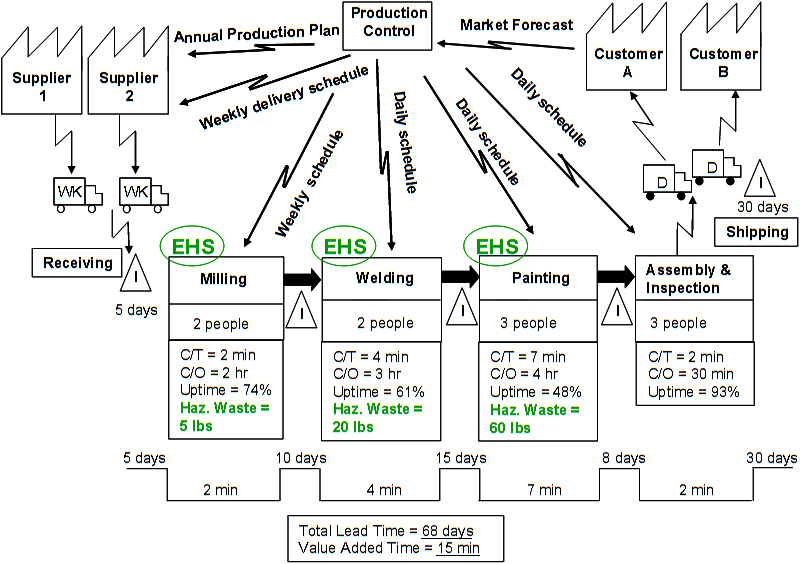
図1. バリューストリームの例。(出典:https://en.wikipedia.org/wiki/Value_stream_mapping 2010年9月6日アクセス。US EPA Lean and Environment Toolkit、パブリックドメイン。)
Enterprise Systems Engineering Process Activities
The application of the key concepts of Enterprise Systems Engineering requires processes. These processes span and can transform the enterprise.
エンタープライズシステムズエンジニアリングの主要な概念を適用するには、プロセスが必要である。これらのプロセスはエンタープライズ全体にまたがり、エンタープライズを変革することができる。
The systems engineering (SE) process as applied to the enterprise as a whole could be used as the “means for producing change in the enterprise … [where the] … Seven Levels of change in an organization [are defined] as effectiveness, efficiency, improving, cutting, copying, differentiating and achieving the impossible” (McCaughin and DeRosa 2006). The essential nature of enterprise systems engineering (ESE) is that it “determines the balance between complexity and order and in turn the balance between effectiveness and efficiency. When viewed as the fundamental mechanism for change, it goes beyond efficiency and drives adaptation of the enterprise” (McCaughin and DeRosa 2006). McCaughin and DeRosa (2006) provide a reasonably good definition for an enterprise that captures this notion of balance: <BLOCKQUOTE> Enterprise: People, processes and technology interacting with other people, processes and technology, serving some combination of their own objectives, those of their individual organizations and those of the enterprise as a whole. </BLOCKQUOTE>
エンタープライズ全体に適用されるシステムズエンジニアリング(SE)プロセスは、「エンタープライズに変化を生み出す手段…[ここで]…組織における変化の7つのレベルは、有効性(effectiveness)、効率性、改善、削減、模倣、差別化、不可能の達成として[定義される]」として用いることができる(McCaughin and DeRosa 2006)。エンタープライズシステムズエンジニアリング(ESE)の本質は、それが「複雑さ(complexity)と秩序のバランスを決定し、ひいては有効性と効率性のバランスを決定する。変化のための基本的な仕組みとして捉えれば、それは効率性の枠を越えて、エンタープライズの適応を推進する」という点にある(McCaughin and DeRosa 2006)。McCaughin and DeRosa(2006)は、このバランスの概念を捉えた、エンタープライズのおおむね妥当な定義を示している。
「エンタープライズ:自らの目的、各自が属する組織の目的、エンタープライズ全体の目的の何らかの組み合わせに奉仕しながら、他の人々、プロセス、技術と相互作用する、人々、プロセス、技術。」
Ackoff tells us that: <BLOCKQUOTE> Data, information, knowledge and understanding enable us to increase efficiency, not effectiveness. The value of the objective pursued is not relevant in determining efficiency, but it is relevant in determining effectiveness. Effectiveness is evaluated efficiency. It is efficiency multiplied by value. Intelligence is the ability to increase efficiency; wisdom is the ability to increase effectiveness. </BLOCKQUOTE>
<BLOCKQUOTE> The difference between efficiency and effectiveness is reflected in the difference between development and growth. Growth does not require an increase in value; development does. Therefore, development requires an increase in wisdom as well as understanding, knowledge and information. ((Ackoff 1989, 3-9), emphasis added) </BLOCKQUOTE>
ESE has a key role to play in establishing the right balance between effectiveness and efficiency in enterprise operations and management. Value stream analysis is one technique, among others, that can help ESE determine where inefficiencies exist or ineffective results are being achieved.
Ackoffは次のように述べている。
「データ、情報、知識、理解によって、効率性を高めることはできるが、有効性を高めることはできない。追求される目的の価値(value)は、効率性を決定する際には関係しないが、有効性を決定する際には関係する。有効性とは、評価された効率性である。それは、効率性に価値を掛けたものである。知性(intelligence)とは効率性を高める能力であり、知恵(wisdom)とは有効性を高める能力である。」
「効率性と有効性の違いは、発展と成長の違いに反映されている。成長は価値の増加を必要としないが、発展はそれを必要とする。したがって、発展には、理解、知識、情報だけでなく知恵の増加が必要となる。」((Ackoff 1989, 3-9)、強調は引用者)
ESEは、エンタープライズの運用とマネジメントにおいて有効性と効率性の適切なバランスを確立するうえで、重要な役割を担う。バリューストリーム分析は、非効率が存在する箇所や、効果のない結果が生じている箇所をESEが特定するのに役立つ、数ある手法の1つである。
Value stream analysis is one way of treating the enterprise as a system. It provides insights regarding where in the sequence of enterprise activities value is added as it moves towards the final delivery to customer or user (Rother and Shook 1999). It relates each step to the costs entailed in that step in terms of resource consumption (i.e., money, time, energy, and materials). In addition to direct costs, there may also be indirect costs due to overhead factors or infrastructure elements. This activity commonly involves drawing a flowchart of the value stream for the enterprise as illustrated in the figure below.
バリューストリーム分析は、エンタープライズをシステムとして扱う方法の1つである。この分析により、顧客またはユーザーへの最終的な提供に向けて価値が流れていく過程で、エンタープライズの一連のアクティビティのどこで価値が付加されるかについての洞察が得られる(Rother and Shook 1999)。また、各ステップを、資源消費(すなわち、資金、時間、エネルギー、資材)の観点から、そのステップに伴うコストと結び付ける。直接コストに加えて、間接費の要因やインフラストラクチャの要素による間接コストが生じることもある。この活動には一般に、以下の図に示すような、エンタープライズのバリューストリームのフローチャートを描くことが含まれる。
図中の英語
Analysis of this value stream diagram can highlight unnecessary space, excessive distance traveled, processing inefficiencies, and so on. Value stream mapping is associated with so-called “lean enterprise” initiatives. At Toyota, where the technique originated, it is known as “material and information mapping” (Rother 2009). Various value stream mapping tools are available (Hines and Rich 1997).
このバリューストリーム図を分析すると、不要なスペース、過剰な移動距離、処理の非効率などを浮き彫りにできる。バリューストリームマッピングは、いわゆる「リーン(lean)エンタープライズ」の取り組みと結び付いている。この手法が生まれたトヨタでは、これは「モノと情報の流れ図」として知られている(Rother 2009)。バリューストリームマッピングのツールは、さまざまなものが利用できる(Hines and Rich 1997)。
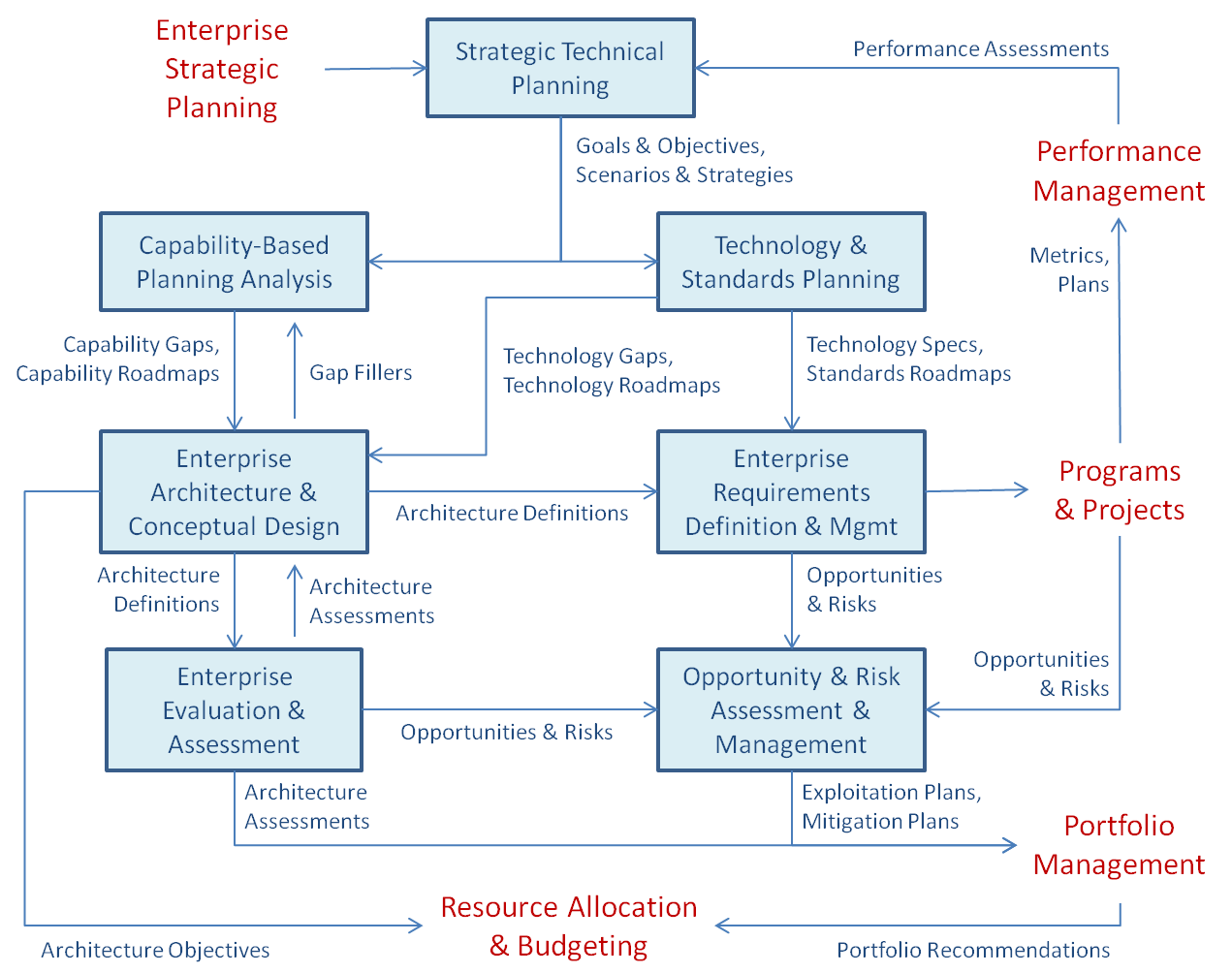
Martin (2010) has determined that the following four processes are needed in ESE beyond the traditional SE processes in support of enterprise management activities: #Strategic technical planning, #Capability-based planning analysis, #Technology and standards planning, and #Enterprise evaluation and assessment.
The interactions between these four processes are illustrated below, along with their interactions with other processes that deal with architecture, requirements, risk, and opportunity.
Martin(2010)は、エンタープライズマネジメントアクティビティを支援するために、ESEでは伝統的なSEプロセスに加えて、次の4つのプロセスが必要であると判断している。
これら4つのプロセス間の相互作用を、アーキテクチャ、要求事項、リスク、機会を扱う他のプロセスとの相互作用とあわせて以下に示す。
図中の英語
The purpose of strategic technical planning (STP) is to establish the overall technical strategy for the enterprise. It creates the balance between the adoption of standards (see also Systems Engineering Standards) and the use of new technologies, along with consideration of the people aspects driven by the relevant trans-disciplinary technical principles and practices from psychology, sociology, organizational change management, etc.
戦略的技術計画(STP)の目的は、エンタープライズの全体的な技術戦略を確立することである。STPは、規格の採用(Systems Engineering Standardsも参照)と新しい技術の使用との間のバランスを生み出すとともに、心理学、社会学、組織変革マネジメントなどに由来する、関連する超学際的な技術原理と実践によって駆動される、人に関する側面の考慮も行う。
This process uses the roadmaps developed during technology and standards planning (TSP). It then maps these technologies and standards against the capabilities roadmap to determine potential alignment and synergy. Furthermore, lack of alignment and synergy is identified as a risk to avoid or an opportunity to pursue in the technical strategy. The technical strategy is defined in terms of implementation guidance for the programs and projects.
このプロセスでは、技術・規格計画(TSP)の中で策定されたロードマップを用いる。次に、それらの技術と規格を能力(capabilities)ロードマップと対応付け、潜在的な整合性と相乗効果を見極める。さらに、整合性と相乗効果の欠如は、技術戦略において回避すべきリスク(risk)または追求すべき機会(opportunity)として特定される。技術戦略は、プログラムとプロジェクト(projects)に向けた実施指針という形で定義される。
One reason that STP and TSP are separate processes is that they are often done by different groups in the enterprise and they involve different skill sets. TSP is often done by the technology and science groups. TSP is done closer to (if not in) the chief architect and budget planning groups. Sometimes the great technology proposed by TSP just doesn’t line up with the capabilities needed in the requisite time frame. STP does this balancing between technology push and capability pull.
STPとTSPが別々のプロセスである理由の1つは、両者がエンタープライズ内の異なるグループによって実施されることが多く、求められるスキルセットも異なることである。TSPは、しばしば技術・科学グループによって行われる。TSPは、チーフアーキテクトと予算計画グループに近いところで(その内部でないとしても)実施される。TSPが提案する優れた技術が、必要な時間枠の中で求められる能力とうまく合致しないこともある。STPは、こうした技術プッシュと能力プルの間のバランスを取る。
The purpose of Capability-based Planning Analysis is to translate the enterprise vision and goals into a set of current and future capabilities that helps achieve those goals. Current missions are analyzed to determine their suitability in supporting the enterprise goals. Potential future missions are examined to determine how they can help achieve the vision. Current and projected capabilities are assessed to identify capability gaps that prevent the vision and technical strategy from being achieved. These capability gaps are then used to assess program, project, and system opportunities that should be pursued by the enterprise. This is defined in terms of success criteria of what the enterprise is desired to achieve.
能力ベースの計画分析(Capability-based Planning Analysis)の目的は、エンタープライズのビジョンと目標を、それらの目標の達成に役立つ、現在および将来の能力の集合へと変換することである。現在のミッション(missions)は、エンタープライズの目標を支援するうえでの適合性を判断するために分析される。潜在的な将来のミッションは、それらがビジョンの達成にどのように役立ちうるかを判断するために検討される。現在の能力と予測される能力は、ビジョンと技術戦略の達成を妨げる能力ギャップを特定するために評価される。次に、これらの能力ギャップを用いて、エンタープライズが追求すべきプログラム、プロジェクト、システムの機会(opportunities)を評価する。これは、エンタープライズが達成することが望まれることの成功基準の観点から定義される。
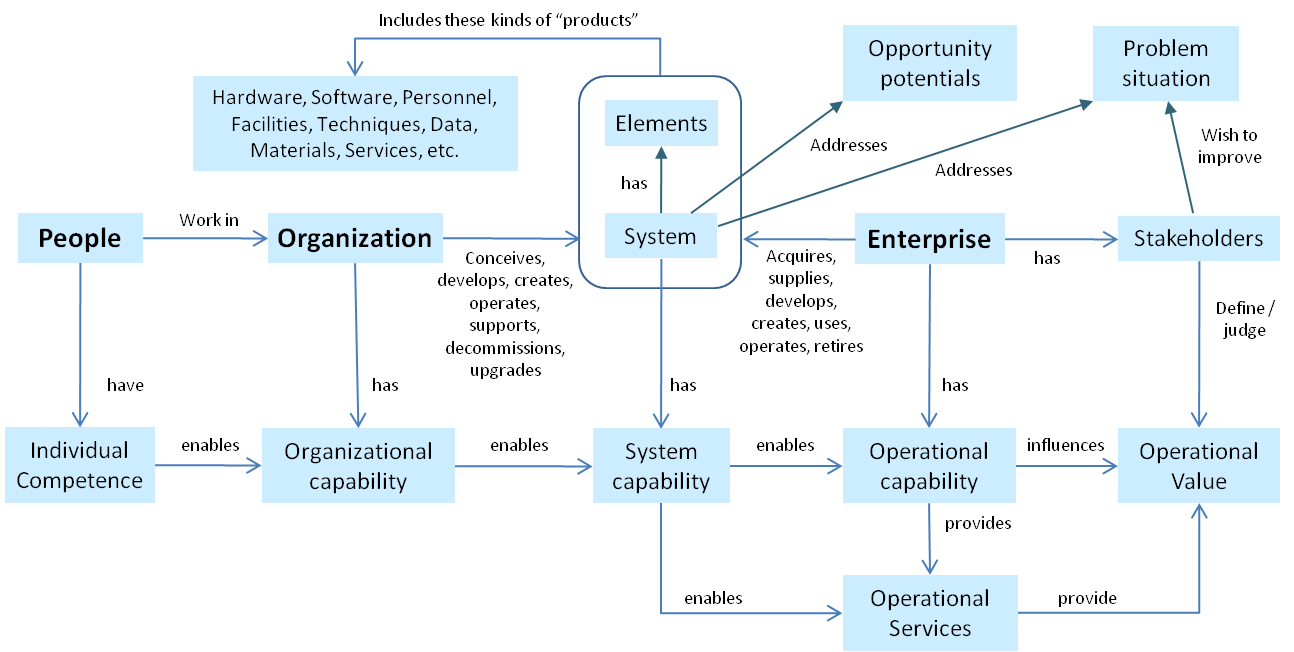
There are different types of capabilities, as shown in the figure below. It is common practice to describe capabilities in the form of capability hierarchies and capability roadmaps. Technology roadmaps (discussed below under Technology Planning) are usually related to the system capabilities while business capability roadmaps (BCRMs) are related to the operational capabilities of the enterprise as a whole (ref: Business-Capability Mapping: Staying Ahead of the Joneses, https://msdn.microsoft.com/en-us/library/bb402954.aspx). The BCRM development is usually done as part of enterprise strategic planning, which is one level higher than, and a key driver for, the strategic technical planning activity described above.
以下の図に示すように、能力にはさまざまなタイプがある。能力を能力階層や能力ロードマップの形で記述するのは、一般的な実践である。技術ロードマップ(後述の技術計画の項で論じる)は通常、システム能力に関連し、ビジネス能力ロードマップ(BCRM)はエンタープライズ全体の運用能力に関連する(参照:Business-Capability Mapping: Staying Ahead of the Joneses、https://msdn.microsoft.com/en-us/library/bb402954.aspx)。BCRMの策定は通常、エンタープライズの戦略計画の一部として行われ、この戦略計画は、上述した戦略的技術計画アクティビティより1つ上のレベルに位置し、その主要な推進力となっている。
In some domains there may be competency roadmaps dealing with the organizational capabilities, with perhaps the desired competency levels of individuals mapped out in terms of the jobs or roles used in the enterprise or perhaps in terms of the knowledge and skills required for certain activities. (For more information on systems engineering competency, see the Enabling Individuals article.)
一部の領域では、組織能力を扱うコンピテンシー(competency)ロードマップが存在し、個人に望まれるコンピテンシーレベルが、エンタープライズで用いられる職務や役割の観点から、あるいは特定のアクティビティに必要な知識とスキルの観点から示されることがある。(システムズエンジニアリングのコンピテンシーの詳細については、Enabling Individualsの記事を参照。)
図中の英語
The purpose of Technology Planning is to characterize technology trends in the commercial marketplace and the research community. This activity covers not just trend identification and analysis, but also technology development and transition of technology into programs and projects. It identifies current, and predicts future, technology readiness levels for the key technologies of interest. Using this information, it defines technology roadmaps. This activity helps establish the technical strategy and implementation guidance in the strategic technical plan. The business capabilities roadmap (BCRM) from the strategic planning activity is used to identify which technologies can contribute to achieved targeted levels of performance improvements.
技術計画(Technology Planning)の目的は、商業市場と研究コミュニティにおける技術動向の特徴を明らかにすることである。このアクティビティは、動向の特定と分析だけでなく、技術開発や、プログラムやプロジェクトへの技術の移行も対象とする。このアクティビティでは、関心のある主要な技術について、現在の技術成熟度レベルを特定し、将来のレベルを予測する。そしてこの情報を用いて、技術ロードマップを定義する。このアクティビティは、戦略的技術計画における技術戦略と実施指針の確立に役立つ。戦略計画活動から得られるビジネス能力ロードマップ(BCRM)は、目標とする水準の性能向上の達成にどの技術が貢献できるかを特定するために用いられる。
The purpose of Standards Planning is to assess technical standards to determine how they inhibit or enhance the incorporation of new technologies into systems development projects. The future of key standards is forecast to determine where they are headed and the alignment of these new standards with the life cycles for the systems in the enterprise’s current and projected future portfolios. The needs for new or updated standards are defined and resources are identified that can address these needs. Standardization activities that can support development of new or updated standards are identified (See also Systems Engineering Standards).
規格計画(Standards Planning)の目的は、技術規格を評価し、新しい技術をシステム開発プロジェクトに組み込むことを技術規格がどのように阻害し、あるいは促進するかを判断することである。主要な規格の将来を予測して、それらがどこへ向かっているのかと、これらの新しい規格が、エンタープライズの現在および予測される将来のポートフォリオ(portfolios)内のシステムのライフサイクル(life cycles)と整合しているかが決定される。新規または更新された規格の必要性を定義し、その必要性に対処できる資源を特定する。新規または更新された規格の開発を支援できる標準化アクティビティを特定する(Systems Engineering Standardsも参照)。
The purpose of enterprise evaluation and assessment (EE&A) is to determine if the enterprise is heading in the right direction. It does this by measuring progress towards realizing the enterprise vision. This process helps to “shape the environment” and to select among the program, project, and system opportunities. This is the primary means by which the technical dimensions of the enterprise are integrated into the business decisions.
This process establishes a measurement program as the means for collecting data for use in the evaluation and assessment of the enterprise. These measures help determine whether the strategy and its implementation are working as intended. Measures are projected into the future as the basis for determining discrepancies between what is observed and what had been predicted to occur. This process helps to identify risks and opportunities, diagnose problems, and prescribe appropriate actions. Sensitivity analysis is performed to determine the degree of robustness and agility of the enterprise.
Roberts states that EE&A must go beyond traditional system evaluation and assessment practices (Roberts 2006). He says that this process area: <BLOCKQUOTE>must de-emphasize the utility of comparing detailed metrics against specific individual requirement values, whether the metrics are derived from measurement, simulation or estimation… [it] must instead look for break points where capabilities are either significantly enhanced or totally disabled.</BLOCKQUOTE> Key characteristics of this activity are the following: <BLOCKQUOTE> *Multi-scale analysis, *Early and continuous operational involvement, *Lightweight command and control (C2) capability representations, *Developmental versions available for assessment, *Minimal infrastructure, *Flexible modeling and simulation (M&S), operator-in-the-loop (OITL), and hardware-in-the-loop (HWIL) capabilities, and *In-line, continuous performance monitoring and selective forensics. (Roberts 2006)</BLOCKQUOTE>
Enterprise architecture (EA) can be used as a primary tool in support of evaluation and assessment. EA can be used to provide a model to understand how the parts of the enterprise fit together (or do not) (Giachetti 2010). The structure and contents of the EA should be driven by the key business decisions (or, as shown in the six-step process presented by Martin (2005), the architecture should be driven by the “business questions” to be addressed by the architecture).
The evaluation and assessment success measures can be put into the EA models and views directly and mapped to the elements that are being measured. An example of this can be seen in the US National Oceanographic and Atmospheric Agency (NOAA) EA shown by Martin (2003a and 2003b). The measures are shown, in this example, as success factors, key performance indicators, and information needs in the business strategy layer of the architecture.
EA can be viewed as either the set of artifacts developed as “views” of the enterprise, or as a set of activities that create, use, and maintain these artifacts. The literature uses these terms in both senses and it is not always clear in each case which sense is intended.
エンタープライズの評価と査定(EE&A)の目的は、エンタープライズが正しい方向へ進んでいるかどうかを判断することである。EE&Aは、エンタープライズのビジョンの実現に向けた進捗を測定することによってこれを行う。このプロセスは、「環境を形作る」ことや、プログラム、プロジェクト、システムの機会の中から選択を行うことに役立つ。これは、エンタープライズの技術的な側面をビジネス上の意思決定に統合するための主要な手段である。
このプロセスでは、エンタープライズの評価と査定に用いるデータを収集する手段として、測定(measurement)プログラムを確立する。これらの測定量(measures)は、戦略とその実施が意図したとおりに機能しているかどうかを判断するのに役立つ。これらの測定量の将来値を予測し、実測値とのずれを判断するための基準とする。このプロセスは、リスクと機会の特定、問題の診断、適切な行動の処方に役立つ。エンタープライズの堅牢性(robustness)と俊敏性(agility)の程度を判断するために、感度分析が行われる。
Robertsは、EE&Aは伝統的なシステムの評価と査定の実践を越えなければならないと述べている(Roberts 2006)。彼によれば、このプロセス領域は次のようでなければならない。
「詳細な指標(metrics)を特定の個々の要求事項(requirement)の値(values)と比較することには、指標が測定、シミュレーション(simulation)、推定のいずれから導かれるかにかかわらず、重点を置きすぎないようにしなければならない…[それは]代わりに、能力が大きく強化されるか、完全に無効化される分岐点を探さなければならない。」
このアクティビティの主要な特徴は次のとおりである。
エンタープライズアーキテクチャ(EA)は、評価と査定を支援する主要なツールとして用いることができる。EAは、エンタープライズの各部分がどのように組み合わさるのか(あるいは組み合わさらないのか)を理解するためのモデル(model)を提供するために用いることができる(Giachetti 2010)。EAの構造(structure)と内容は、主要なビジネス上の意思決定に基づいて決まるべきである(あるいは、Martin(2005)が提示した6ステップのプロセスに示されているように、アーキテクチャは、そのアーキテクチャが対処すべき「ビジネスの質問」に基づいて決まるべきである)。
評価・査定で成功度を測る測定量は、EAのモデルとビューに直接組み込み、測定対象の要素に対応付けることができる。その例は、Martin(2003a and 2003b)が示した米国海洋大気庁(NOAA)のEAに見ることができる。この例では、測定量は、アーキテクチャ(architecture)のビジネス戦略レイヤにおける成功要因、主要業績評価指標、情報ニーズとして示されている。
EAは、エンタープライズの「ビュー」として作成された成果物の集合と見ることも、それらの成果物を作成、使用、維持するアクティビティの集合と見ることもできる。文献ではこれらの用語が両方の意味で用いられており、個々の場合にどちらの意味が意図されているかは、必ずしも明確ではない。
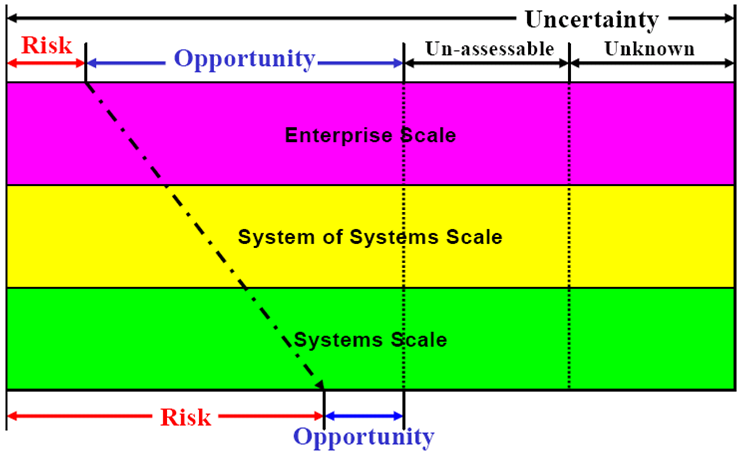
The management activities dealing with opportunities (as opposed to just risk) are included in ESE. According to White (2006), the “greatest enterprise risk may be in not pursuing enterprise opportunities.” Hillson believes there is: <BLOCKQUOTE> a systemic weakness in risk management as undertaken on most projects. The standard risk process is limited to dealing only with uncertainties that might have negative impact (threats). This means that risk management as currently practiced is failing to address around half of the potential uncertainties—the ones with positive impact (opportunities). (Hillson 2004) </BLOCKQUOTE> White claims that “in systems engineering at an enterprise scale the focus should be on opportunity, and that enterprise risk should be viewed more as something that threatens the pursuit of enterprise opportunities” (White 2006). The figure below (Rebovich and White 2011, chapter 5) shows the relative importance of opportunity and risk at the different scales of an individual system, a system of systems (SoS), and an enterprise. The implication is that, at the enterprise level, there should be more focus on opportunity management than on risk management.
ESEには、(単にリスクだけでなく)機会を扱うマネジメントアクティビティが含まれる。White(2006)によれば、「最大のエンタープライズリスクは、エンタープライズの機会を追求しないことにあるのかもしれない」。Hillsonは次のように考えている。
「ほとんどのプロジェクト(projects)で実施されているリスクマネジメント(risk management)には、構造的な弱点がある。標準的なリスクプロセスは、悪影響を及ぼす可能性のある不確実性(脅威(threats))への対処だけに限定されている。これは、現在実践されているリスクマネジメントが、潜在的な不確実性の約半分、すなわち好ましい影響を持つもの(機会)に対処できていないことを意味する。」(Hillson 2004)
Whiteは、「エンタープライズ規模のシステムズエンジニアリングにおいては、焦点は機会に置かれるべきであり、エンタープライズリスクは、むしろエンタープライズの機会の追求を脅かすものとして捉えられるべきである」と主張している(White 2006)。以下の図(Rebovich and White 2011, chapter 5)は、個々のシステム、システムオブシステムズ(SoS)、エンタープライズという異なる規模における、機会とリスクの相対的な重要性を示している。ここから示唆されるのは、エンタープライズレベルでは、リスクマネジメントよりも機会マネジメントにより重点を置くべきだということである。
図中の英語
EA goes above and beyond the technical components of product systems to include additional items such as strategic goals and objectives, operators and users, organizations and other stakeholders, funding sources and methods, policies and practices, processes and procedures, facilities and platforms, infrastructure, and real estate. EA can be used to provide a model to understand how the parts of the enterprise fit together (or don’t) (Giachetti 2010). The EA is not strictly the province of the chief information officer (CIO), and is not only concerned with information technology. Likewise, enterprise requirements need to focus on the cross-cutting measures necessary to ensure overall enterprise success. Some of these enterprise requirements will apply to product systems, but they may also apply to business processes, inter-organizational commitments, hiring practices, investment directions, and so on (Bernus, Nemes, and Schmidt 2003).
EAは、製品(product)システムの技術的構成要素にとどまらず、戦略目標と目的、運用者とユーザー(users)、組織とその他のステークホルダー(stakeholders)、資金源と資金調達方法、方針と実践、プロセスと手順、施設とプラットフォーム、インフラストラクチャ、不動産といった追加の項目も含む。EAは、エンタープライズの各部分がどのように組み合わさるのか(あるいは組み合わさらないのか)を理解するためのモデルを提供するために用いることができる(Giachetti 2010)。EAは、厳密には最高情報責任者(CIO)の専管事項ではなく、情報技術だけに関わるものでもない。同様に、エンタープライズの要求事項は、エンタープライズ全体の成功に必要な、分野横断的な施策に焦点を当てる必要がある。これらのエンタープライズ要求事項の一部は製品システムに適用されるが、ビジネスプロセス、組織間のコミットメント、採用慣行、投資の方向性などにも適用されうる(Bernus, Nemes, and Schmidt 2003)。
Architecture descriptions following the guidelines of an architecture framework have been used to standardize the views and models used in architecting efforts (Zachman 1987 and 1992; Spewak 1992). Architecture descriptions have also been developed using a business-question based approach (Martin 2003b; Martin 2006). The standard on Architecture Description Practices (ISO/IEC 42010) (ISO/IEC 2011) has expanded its scope to include requirements on architecture frameworks.
アーキテクチャフレームワークのガイドラインに従ったアーキテクチャ記述は、アーキテクティングの取り組みで用いられるビューとモデルを標準化するために用いられてきた(Zachman 1987 and 1992; Spewak 1992)。ビジネスの質問に基づくアプローチを用いたアーキテクチャ記述も開発されてきた(Martin 2003b; Martin 2006)。アーキテクチャ記述の実践に関する規格(ISO/IEC 42010)(ISO/IEC 2011)は、その適用範囲を拡大し、アーキテクチャフレームワークに対する要求事項も含むようになっている。
Government agencies have been increasingly turning to SE to solve some of their agency-level (i.e., enterprise) problems. This has sometimes led to the use of an architecture-based investment process, especially for information technology procurements. This approach imposes a requirement for linking business strategies to the development of EAs. The Federal Enterprise Architecture Framework (FEAF) (CIO Council 1999) and the DoD Architecture Framework (DoDAF) (DoD 2010) were developed to support such an architecture-based investment process. There have been several other architecture frameworks also developed for this purpose (ISO 2000; ISO/IEC 1998; NATO 2004; TOGAF 2009; MOD 2010; TRAK 2010).
政府機関は、その機関レベル(すなわちエンタープライズ)の問題の一部を解決するために、ますますSEに頼るようになっている。その結果、特に情報技術の調達において、アーキテクチャに基づく投資プロセスが用いられるようになった場合もある。このアプローチでは、ビジネス戦略をEAの開発に結び付けることが求められる。連邦エンタープライズアーキテクチャフレームワーク(FEAF)(CIO Council 1999)と国防総省アーキテクチャフレームワーク(DoDAF)(DoD 2010)は、そうしたアーキテクチャに基づく投資プロセスを支援するために開発された。このほかにも、この目的のために開発されたアーキテクチャフレームワークがいくつかある(ISO 2000; ISO/IEC 1998; NATO 2004; TOGAF 2009; MOD 2010; TRAK 2010)。
As a result of the synthesis outlined above, the ESE process elements to be used at the enterprise scale are as follows: #Strategic Technical Planning, #Capability-Based Planning Analysis, #Technology and Standards Planning, #Enterprise Evaluation and Assessment, #Opportunity and Risk Assessment and Management, #Enterprise Architecture and Conceptual Design, #Enterprise Requirements Definition and Management, #Program and Project Detailed Design and Implementation, #Program Integration and Interfaces, #Program Validation and Verification, #Portfolio and Program Deployment and Post Deployment, and #Portfolio and Program Life Cycle Support.
The first seven of these elements were described in some detail above. The others are more self-evident and are not discussed in this article.
上に概説した統合の結果として、エンタープライズ規模で用いられるESEプロセス要素は次のとおりである。
これらの要素のうち最初の7つについては、上である程度詳しく述べた。残りの要素はより自明なものであり、この記事では論じない。
Ackoff, R.L. 1989. "From Data to Wisdom." Journal of Applied Systems Analysis. 16 (1): 3-9.
Bernus, P., L. Nemes, and G. Schmidt (eds.). 2003. Handbook on Enterprise Architecture. Berlin and Heidelberg, Germany: Springer-Verlag.
CIO Council. 1999. Federal Enterprise Architecture Framework (FEAF), Version 1.1. Washington, DC, USA: Federal Chief Information Officers Council.
DoD. 2010. DoD architecture framework (DoDAF), version 2.0. Washington, DC: US Department of Defense (DoD).
Giachetti, R.E. 2010. Design of Enterprise Systems: Theory, Architecture, and Methods. Boca Raton, FL, USA: CRC Press, Taylor & Francis Group.
Hillson, D. 2004. Effective Opportunity Management for Projects: Exploiting Positive Risk. Petersfield, Hampshire, UK; New York, NY, USA: Rick Doctor & Partners; Marcel Dekker, Inc.
Hines, P., and N. Rich. 1997. "The Seven Value Stream Mapping Tools." International Journal of Operations & Production Management. 1 (17): 46-64.
ISO. 2000. ISO 15704:2000, Industrial Automation Systems — Requirements for Enterprise-Reference Architectures and Methodologies. Geneva, Switzerland: International Organization for Standardization (ISO).
ISO/IEC/IEEE. 2011. Systems and software engineering - Architecture description. Geneva, Switzerland: International Organization for Standardization (ISO)/International Electrotechnical Commission (IEC)/Institute of Electrical and Electronics Engineers (IEEE), ISO/IEC/IEEE 42010.
ISO/IEC. 1998. ISO/IEC 10746:1998, Information Technology — Open Distributed Processing — Reference Model: Architecture. Geneva, Switzerland: International Organization for Standardization (ISO)/International Electrotechnical Commission (IEC).
Martin, J.N. 2010. "An Enterprise Systems Engineering Framework." Presented at 20th Anniversary International Council on Systems Engineering (INCOSE) International Symposium, July 12-15, 2010, Chicago, IL, USA.
Martin, J.N. 2006. "An Enterprise Architecture Process Incorporating Knowledge Modeling Methods." PhD dissertation. Fairfax, VA, USA: George Mason University.
Martin, J.N. 2005. "Using an Enterprise Architecture to Assess the Societal Benefits of Earth Science Research." Presented at 15th Annual International Council on Systems Engineering (INCOSE) International Symposium, 2005, Rochester, NY, USA.
Martin, J.N. 2003a. "An Integrated Tool Suite for the NOAA Observing System Architecture." Presented at 13th Annual International Council on Systems Engineering (INCOSE) International Symposium, 2003, Arlington, VA, USA.
Martin, J.N. 2003b. "On the Use of Knowledge Modeling Tools and Techniques to Characterize the NOAA Observing System Architecture." Presented at 13th Annual International Council on Systems Engineering (INCOSE) International Symposium, 2003, Arlington, VA, USA.
McCaughin, K., and J.K. DeRosa. 2006. "Process in Enterprise Systems Engineering." Presented at 16th Annual International Council on Systems Engineering (INCOSE) International Symposium, July 9-13, 2006, Orlando, FL, USA.
MOD. 2010. Ministry of Defence Architecture Framework (MODAF), version 1.2.004. London, England, UK: UK Ministry of Defence. Accessed September 8, 2011. Available: https://www.mod.uk/NR/rdonlyres/04B5FB3F-8BBC-4A39-96D8-AFA05E500E4A/0/20100602MODAFDownload12004.pdf.
NATO. 2010. NATO Architecture Framework (NAF), version 3.1. Brussels, Belgium: North Atlantic Treaty Organization.
Rebovich, G., and B.E. White (eds.). 2011. Enterprise Systems Engineering: Advances in the Theory and Practice. Boca Raton, FL, USA: CRC Press, Taylor & Francis Group, Auerbach.
Roberts, J.L. 2006. "Enterprise Analysis and Assessment." Presented at 16th Annual International Council on Systems Engineering (INCOSE) International Symposium, July 9-13, 2006, Orlando, FL, USA.
Rother, M. 2009. Toyota Kata: Managing People for Improvement, Adaptiveness, and Superior Results. New York, NY, USA: McGraw-Hill.
Rother, M., and J. Shook. 1999. Learning to See: Value-Stream Mapping to Create Value and Eliminate MUDA. Cambridge, MA, USA: Lean Enterprise Institute.
Spewak, S.H. 1992. Enterprise Architecture Planning: Developing a Blueprint for Data, Applications and Technology. New York, NY, USA: Wiley and Sons, Inc.
TOGAF. 2009. "The Open Group Architecture Framework," version 9. Accessed September 2, 2011. Available: https://www.opengroup.org/togaf.
TRAK. 2011. "TRAK Enterprise Architecture Framework." Accessed September 7, 2011. Available: https://trak.sourceforge.net/index.html.
White, B.E. 2006. "Enterprise Opportunity and Risk." Presented at 16th Annual International Council on Systems Engineering (INCOSE) International Symposium, July 9-13, 2010, Orlando, FL, USA.
Zachman, J.A. 1992. "Extending and Formalizing the Framework for Information Systems Architecture." IBM Systems Journal. 31 (3): 590-616.
Zachman, J.A. 1987. "A Framework for Information Systems Architectures." IBM Systems Journal. 26 (3): 276-292.
Giachetti, R.E. 2010. Design of Enterprise Systems: Theory, Architecture, and Methods. Boca Raton, FL, USA: CRC Press, Taylor & Francis Group.
Martin, J.N. 2010. "An Enterprise Systems Engineering Framework." Presented at 20th Anniversary International Council on Systems Engineering (INCOSE) International Symposium, July 12-15, 2010, Chicago, IL, USA.
Rebovich, G., and B.E. White (eds.). 2011. Enterprise Systems Engineering: Advances in the Theory and Practice. Boca Raton, FL, USA: CRC Press, Taylor & Francis Group, Auerbach.
DeRosa, J.K. 2005. "Enterprise Systems Engineering." Presented at Air Force Association, Industry Day, Day 1, August 4, 2005, Danvers, MA, USA.
Holt, J., and S. Perry. 2010. Modelling enterprise architectures. Stevenage, England, UK: Institution of Engineering and Technology (IET).
Kaplan, R., and D. Norton. 1996. The Balanced Scorecard: Translating Strategy into Action. Cambridge, MA, USA: Harvard Business School Press.
McGovern, J., S. Ambler, M. Stevens, J. Linn, V. Sharan, and E. Jo. 2004. A Practical Guide to Enterprise Architecture. New York, NY, USA: Prentice Hall.
Swarz, R.S., J.K. DeRosa, and G. Rebovich. 2006. "An Enterprise Systems Engineering Model." INCOSE Symposium Proceedings, July 9-13, 2006, Orlando, FL, USA.