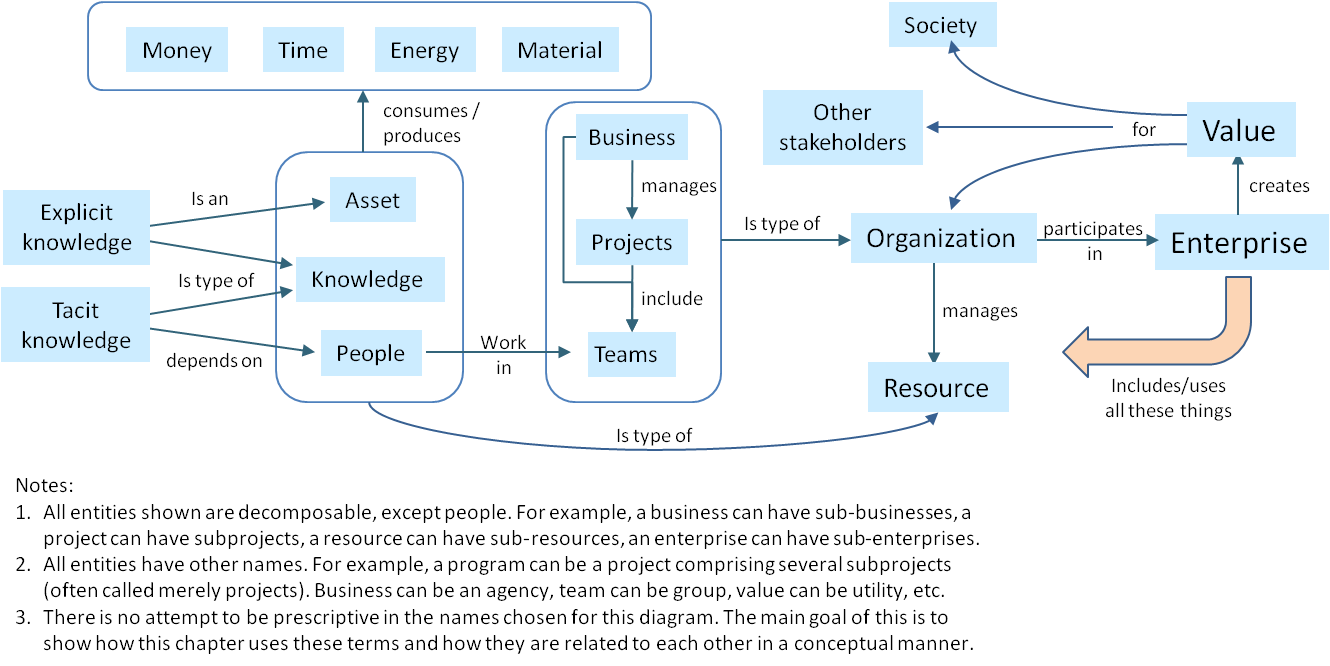
図1. 組織は資源を管理してエンタープライズ価値を創造する。(SEBoK Original)
Enterprise Systems Engineering
Enterprise systems engineering (ESE) is the application of systems engineering principles, concepts, and methods to the planning, design, improvement, and operation of an enterprise.
エンタープライズシステムズエンジニアリング(enterprise systems engineering、ESE)とは、エンタープライズの計画、設計、改善、運用に、システムズエンジニアリングの原則、概念、手法を適用することである。
This knowledge area provides an introduction to systems engineering (SE) at the enterprise level in contrast to “traditional” SE (TSE) (sometimes called “conventional” or “classical” SE) performed in a development project or to “product” engineering (often called product development in the SE literature).
この知識領域は、開発プロジェクトで実施される「伝統的」システムズエンジニアリング(TSE)(「従来型」または「古典的」SEと呼ばれることもある)や、「製品」エンジニアリング(SEの文献では製品開発と呼ばれることが多い)と対比しつつ、エンタープライズレベルのシステムズエンジニアリング(systems engineering、SE)への入門となるものである。
The concept of enterprise was instrumental in the great expansion of world trade in the 17th century (see note 1) and again during the Industrial Revolution of the 18th and 19th centuries. The world may be at the cusp of another global revolution enabled by the information age and the technologies and cultures of the Internet (see note 2). The discipline of SE now has the unique opportunity of providing the tools and methods for the next round of enterprise transformations.
エンタープライズという概念は、17世紀の世界貿易の大拡大(注1参照)において、さらに18世紀から19世紀にかけての産業革命においても重要な役割を果たした。世界は、情報時代とインターネットの技術および文化によって可能となる、もう一つの地球規模の革命の入り口に立っているのかもしれない(注2参照)。SEという学問分野には今や、次なるエンタープライズ変革の波に向けてツールと手法を提供する、またとない機会がある。
:<I>Note 1. “The Dutch East India Company… was a chartered company established in 1602, when the States-General of the Netherlands granted it a 21-year monopoly to carry out colonial activities in Asia. It was the <u>first multinational corporation</u> in the world and the first company to issue stock. It was also arguably the '''world's first mega-corporation''', possessing quasi-governmental powers, including the ability to wage war, negotiate treaties, coin money, and establish colonies.” (emphasis added, National Library of the Netherlands 2010)
注1:「オランダ東インド会社は…1602年に設立された特許会社であり、このときオランダの連邦議会(States-General)は同社に、アジアで植民地活動を行うための21年間の独占権を与えた。同社は世界初の多国籍企業であり、株式を発行した最初の会社であった。また、戦争の遂行、条約の交渉、貨幣の鋳造、植民地の建設を行う能力を含む準政府的な権限を有しており、世界初の巨大企業だったとも言える。」(強調は追加、National Library of the Netherlands 2010)
:Note 2. This new revolution is being enabled by cheap and easily usable technology, global availability of information and knowledge, and increased mobility and adaptability of human capital. The enterprise level of analysis is only feasible now because organizations can work together to form enterprises in a much more fluid manner. </I>
注2:この新たな革命を可能にしているのは、安価で使いやすい技術、情報と知識が地球規模で入手できること、そして人材の移動性と適応性の向上である。エンタープライズレベルの分析が今になって実現可能となったのは、組織がはるかに流動的な形で協力し合い、エンタープライズを形成できるようになったためである。
ESE is an emerging discipline that focuses on frameworks, tools, and problem-solving approaches for dealing with the inherent complexities of the enterprise. Furthermore, ESE addresses more than just solving problems; it also deals with the exploitation of opportunities for better ways to achieve the enterprise goals. A good overall description of ESE is provided by in the book by Rebovich and White (2011).
ESEは新興の学問分野であり、エンタープライズに固有の複雑さに対処するための枠組み、ツール、問題解決アプローチに焦点を当てている。さらにESEは、問題の解決だけにとどまらず、エンタープライズの目標をより良い方法で達成する機会を活かすことも扱う。ESEを全体的に概観した優れた解説としては、Rebovich and White(2011)の著書がある。
An enterprise consists of a purposeful combination (e.g., a network) of interdependent resources (e.g., people, processes, organizations, supporting technologies, and funding) that interact with
エンタープライズは、相互に依存する資源(例えば、人、プロセス、組織、支援技術、資金)を目的をもって組み合わせたもの(例えば、ネットワーク)から成り、それらの資源は、
• each other to coordinate functions, share information, allocate funding, create workflows, and make decisions, etc.; and
• 機能の調整、情報の共有、資金の配分、ワークフローの作成、意思決定などを行うために、互いに相互作用し、
• their environment(s) to achieve business and operational goals through a complex web of interactions distributed across geography and time (Rebovich and White 2011, 4-35).
• ビジネス上および運用上の目標を達成するために、地理的にも時間的にも分散した複雑な相互作用の網を通じて、その環境と相互作用する(Rebovich and White 2011, 4-35)。
The term enterprise has been defined as follows:
エンタープライズという用語は、これまで以下のように定義されている。
<blockquote>(1) One or more organizations sharing a definite mission, goals, and objectives to offer an output such as a product or service. (ISO 2000);</blockquote>
(1)「明確なミッション、目標、目的を共有し、製品やサービスなどのアウトプットを提供する、1つまたは複数の組織。」(ISO 2000)
<blockquote>(2) An organization (or cross organizational entity) supporting a defined business scope and mission that includes interdependent resources (people, organizations and technologies) that must coordinate their functions and share information in support of a common mission (or set of related missions). (CIO Council 1999);</blockquote>
(2)「定められたビジネス範囲とミッションを支援する組織(または組織横断的な実体)であり、共通のミッション(または一連の関連するミッション)を支援するために機能を調整し、情報を共有しなければならない、相互に依存する資源(人、組織、技術)を含む。」(CIO Council 1999)
<blockquote>(3) The term enterprise can be defined in one of two ways. The first is when the entity being considered is tightly bounded and directed by a single executive function. The second is when organizational boundaries are less well defined and where there may be multiple owners in terms of direction of the resources being employed. The common factor is that both entities exist to achieve specified outcomes. (MOD 2004); and </blockquote>
(3)「エンタープライズという用語は、2つの方法のいずれかで定義できる。第一は、検討対象の実体が緊密に区切られ、単一の執行機能によって指揮される場合である。第二は、組織の境界がそれほど明確でなく、投入される資源の指揮に関して複数の所有者が存在し得る場合である。共通するのは、いずれの実体も、指定された成果を達成するために存在するという点である。」(MOD 2004)
<blockquote>(4) A complex, (adaptive) socio-technical system that comprises interdependent resources of people, processes, information, and technology that must interact with each other and their environment in support of a common mission. (Giachetti 2010) </blockquote>
(4)「共通のミッションを支援するために、互いに、また環境と相互作用しなければならない、人、プロセス、情報、技術という相互に依存する資源から構成される、複雑な(適応的な)社会技術システム。」(Giachetti 2010)
An enterprise must do two things: (1) develop things within the enterprise to serve as either external offerings or as internal mechanisms to enable achievement of enterprise operations, and (2) transform the enterprise itself so that it can most effectively and efficiently perform its operations and survive in its competitive and constrained environment.
エンタープライズは2つのことを行わなければならない。(1)外部への提供物として、あるいはエンタープライズの運用の達成を可能にする内部の仕組みとして機能するものを、エンタープライズの内部で開発すること、(2)競争と制約のある環境の中で、最も効果的かつ効率的に運用を行い、生き残ることができるよう、エンタープライズ自体を変革することである。
It is worth noting that an enterprise is not equivalent to an "organization” according to the definition above. This is a frequent misuse of the term enterprise. The figure below shows that an enterprise includes not only the organizations that participate in it, but also people, knowledge, and other assets such as processes, principles, policies, practices, doctrine, theories, beliefs, facilities, land, intellectual property, and so on.
上の定義に従えば、エンタープライズは「組織」と同じものではない、という点は押さえておく価値がある。これは、エンタープライズという用語によく見られる誤用である。下図は、エンタープライズには、それに参加する組織だけでなく、人、知識、さらにはプロセス、原則、方針、慣行、ドクトリン、理論、信念、施設、土地、知的財産などのその他の資産も含まれることを示している。
Some enterprises are organizations, but not all enterprises are organizations. Likewise, not all organizations are enterprises. Some enterprises have no readily identifiable "organizations" in them. Some enterprises are self-organizing (i.e., not organized by mandate) in that the sentient beings in the enterprise will find for themselves some way in which they can interact to produce greater results than can be done by the individuals alone. Self-organizing enterprises are often more flexible and agile than if they were organized from above (Dyer and Ericksen 2009; Stacey 2006).
組織であるエンタープライズもあるが、すべてのエンタープライズが組織であるわけではない。同様に、すべての組織がエンタープライズであるわけでもない。容易に識別できる「組織」を内部に持たないエンタープライズもある。また、自己組織化する(すなわち、命令によって組織化されたのではない)エンタープライズもある。そうしたエンタープライズでは、その中にいる知性を持つ存在が、個人単独で達成できる以上の成果を生み出すために、互いに相互作用する何らかの方法を自ら見いだす。自己組織化するエンタープライズは、上から組織化された場合よりも柔軟でアジャイルであることが多い(Dyer and Ericksen 2009; Stacey 2006)。
<blockquote> One type of enterprise architecture that supports agility is a non-hierarchical organization without a single point of control. Individuals function autonomously, constantly interacting with each other to define the vision and aims, maintain a common understanding of requirements and monitor the work that needs to be done. Roles and responsibilities are not predetermined but rather emerge from individuals’ self-organizing activities and are constantly in flux. Similarly, projects are generated everywhere in the enterprise, sometimes even from outside affiliates. Key decisions are made collaboratively, on the spot, and on the fly. Because of this, knowledge, power, and intelligence are spread through the enterprise, making it uniquely capable of quickly recovering and adapting to the loss of any key enterprise component. (https://en.wikipedia.org/wiki/Business_agility) </blockquote>
「アジリティ(agility)を支えるエンタープライズアーキテクチャの一つのタイプとして、指揮・統括の権限が一か所に集中しない非階層型の組織がある。個人は自律的に機能し、ビジョンと狙いを定め、要求事項について共通理解を保ち、実施すべき作業を監視するために、絶えず互いに相互作用する。役割と責任はあらかじめ定められているのではなく、個人の自己組織化活動から創発(emergence)するものであり、常に流動的である。同様に、プロジェクトはエンタープライズの至る所で生まれ、時には外部の関係者から生まれることさえある。主要な意思決定は、協働で、その場で、即興に行われる。このため、知識、権限、知性はエンタープライズ全体に行き渡り、エンタープライズの主要な構成要素のどれが失われても迅速に回復し適応できるという、独自の能力をエンタープライズにもたらしている。」(https://en.wikipedia.org/wiki/Business_agility)
In spite of this lack of "organization" in some enterprises, SE can still contribute much in the engineering of the enterprise, as described in the articles below. However, SE must be prepared to apply some non-traditional approaches in doing so. Hence the need for embracing the new discipline called enterprise systems engineering (ESE).
一部のエンタープライズにはこのように「組織」が欠けているにもかかわらず、以下の記事で述べるように、SEはエンタープライズのエンジニアリングに多くの貢献をなし得る。しかし、そのためにはSEは、いくつかの非伝統的なアプローチを適用する備えをしなければならない。それゆえ、エンタープライズシステムズエンジニアリング(ESE)と呼ばれる新しい学問分野を受け入れる必要がある。
Giachetti (2010) distinguishes between enterprise and organization by saying that an organization is a view of the enterprise. The organization view defines the structure and relationships of the organizational units, people, and other actors in an enterprise. Using this definition, we would say that all enterprises have some type of organization, whether formal, informal, hierarchical or self-organizing network.
Giachetti(2010)は、組織とはエンタープライズの一つの見方であると述べることで、エンタープライズと組織を区別している。組織という見方は、エンタープライズにおける組織単位、人、その他のアクターの構造と関係を定義する。この定義に従えば、公式か非公式か、階層型か自己組織化するネットワークかを問わず、すべてのエンタープライズには何らかのタイプの組織があると言える。
Sometimes it is prudent to consider a broader scope than merely the "boundaries" of the organizations involved in an enterprise. In some cases, it is necessary (and wise) to consider the "extended enterprise" in modeling, assessment, and decision making. This could include upstream suppliers, downstream consumers, and end user organizations, and perhaps even "sidestream" partners and key stakeholders. The extended enterprise can be defined as: <blockquote> Wider organization representing all associated entities - customers, employees, suppliers, distributors, etc. - who directly or indirectly, formally or informally, collaborate in the design, development, production, and delivery of a product (or service) to the end user. (https://www.businessdictionary.com) </blockquote>
エンタープライズに関与する組織の「境界」だけにとどまらず、より広い範囲を検討するのが賢明な場合もある。モデリング、評価、意思決定において「拡張エンタープライズ」を検討することが必要な(そして賢明な)ケースもあり、そこには、上流のサプライヤー、下流の消費者、最終ユーザーの組織、さらには「側流」のパートナーや主要なステークホルダーも含まれ得る。拡張エンタープライズ(extended enterprise)は、以下のように定義できる。
「製品(またはサービス)の設計、開発、生産、および最終ユーザーへの提供において、直接的または間接的に、公式または非公式に協力する、顧客、従業員、サプライヤー、販売業者など、すべての関連する実体を表す、より広い組織。」(https://www.businessdictionary.com)
Enterprise systems engineering (ESE), for the purpose of this article, is defined as the application of SE principles, concepts, and methods to the planning, design, improvement, and operation of an enterprise (see note 3). To enable more efficient and effective enterprise transformation, the enterprise needs to be looked at “as a system,” rather than merely as a collection of functions connected solely by information systems and shared facilities (Rouse 2009). While a systems perspective is required for dealing with the enterprise, this is rarely the task or responsibility of people who call themselves systems engineers.
本記事では、エンタープライズシステムズエンジニアリング(ESE)を、エンタープライズの計画、設計、改善、運用にSEの原則、概念、手法を適用することと定義する(注3参照)。より効率的で効果的なエンタープライズ変革を可能にするには、エンタープライズを、情報システムと共有施設によってのみ結び付けられた機能の単なる集合としてではなく、「システムとして」捉える必要がある(Rouse 2009)。エンタープライズに対処するにはシステムの視点が必要であるが、それが自らをシステムズエンジニアと称する人々の仕事や責任であることはまれである。
:<I>Note 3. This form of systems engineering (i.e., ESE) includes (1) those traditional principles, concepts, and methods that work well in an enterprise environment, plus (2) an evolving set of newer ideas, precepts, and initiatives derived from complexity theory and the behavior of complex systems (such as those observed in nature and human languages).</I>
注3:この形態のシステムズエンジニアリング(すなわちESE)には、(1)エンタープライズ環境においてうまく機能する伝統的な原則、概念、手法と、(2)複雑性理論や、(自然界や人間の言語に見られるような)複雑システムの振る舞いから導かれた、進化を続ける新しいアイデア、指針、取り組みの集合が含まれる。
The primary purpose of an enterprise is to create value for society, other stakeholders, and for the organizations that participate in that enterprise. This is illustrated in Figure 1 that shows all the key elements that contribute to this value creation process.
エンタープライズの第一の目的は、社会、その他のステークホルダー、そしてそのエンタープライズに参加する組織のために価値を創造することである。これを表したのが図1であり、この価値創造プロセスに寄与する主要な要素がすべて示されている。
There are three types of organizations of interest: businesses, projects, and teams (see note 4). A typical business participates in multiple enterprises through its portfolio of projects. Large SE projects can be enterprises in their own right, with participation by many different businesses, and may be organized as a number of sub-projects.
関心の対象となる組織のタイプは、ビジネス、プロジェクト、チームの3つである(注4参照)。典型的なビジネスは、自らのプロジェクトのポートフォリオを通じて複数のエンタープライズに参加する。大規模なSEプロジェクトは、それ自体がエンタープライズとなり得て、多くの異なるビジネスが参加し、多数のサブプロジェクトとして組織化されることもある。
:<I>Note 4. The use of the word “business” is not intended to mean only for-profit commercial ventures. As used here, it also includes government agencies and not-for-profit organizations, as well as commercial ventures. Business is the activity of providing goods and services involving financial, commercial, and industrial aspects.</I>
注4:「ビジネス」という語は、営利目的の商業的事業だけを意味するものではない。ここでは、商業的事業に加えて、政府機関や非営利組織も含む。ビジネスとは、財務的、商業的、産業的な側面を伴う、財やサービスを提供する活動である。
図中の英語
A key choice for businesses that conduct SE is to what extent, if at all, they seek to optimize their use of resources (people, knowledge, assets) across teams, projects, and business units. Optimization of resources is not the goal in itself, but rather a means to achieve the goal of maximizing value for the enterprise and its stakeholders. At one extreme, in a product-oriented organization, projects may be responsible for hiring, training, and firing their own staff, as well as managing all assets required for their delivery of products or services. (The term "product-oriented organization" is not meant in the sense of product-oriented SE, but rather in the sense of this being one of the basic constructs available when formulating organizational strategy.)
SEを実施するビジネスにとって重要な選択は、チーム、プロジェクト、ビジネスユニットをまたいで資源(人、知識、資産)の使用をどの程度最適化しようとするのか、あるいはそもそも最適化しようとするのかという点である。資源の最適化はそれ自体が目標なのではなく、エンタープライズとそのステークホルダーにとっての価値を最大化するという目標を達成するための手段である。一方の極では、製品指向の組織において、プロジェクトが自らのスタッフの採用、訓練、解雇に責任を負い、製品やサービスの提供に必要なすべての資産も管理することがある。(「製品指向の組織」という用語は、製品指向SEという意味ではなく、組織戦略を策定する際に利用できる基本的な構成要素の一つという意味で用いている。)
At the other extreme, in a functional organization, the projects delegate almost all their work to functional groups. In between these two extremes is a matrix organization that is used to give functional specialists a “home” between project assignments. A full discussion of organizational approaches and situations along with their applicability in enabling SE for the organization is provided in the article called Systems Engineering Organizational Strategy.
もう一方の極では、機能別組織において、プロジェクトは作業のほぼすべてを機能グループに委ねる。これら2つの極の間に位置するのがマトリクス組織であり、機能の専門家に、プロジェクトへの配属の合間の「ホーム」を与えるために用いられる。組織のアプローチと状況、および組織のためにSEを可能にするうえでのそれらの適用可能性については、Systems Engineering Organizational Strategyと呼ばれる記事で詳しく論じられている。
The optimization debate can be handled as described in the book called "Enterprise Architecture as Strategy" (Ross, Weill, and Robertson 2006). In other words, an enterprise can choose (or not) to unify its operations and can choose (or not) to unify its information base. There are different strategies the enterprise might adopt to achieve and sustain value creation (and how ESE helps an enterprise to choose). This is further addressed in the section on Enterprise Architecture Formulation & Assessment in the article called Enterprise Capability Management.
最適化をめぐる議論は、「Enterprise Architecture as Strategy」(Ross, Weill, and Robertson 2006)という本に記述されているように扱うことができる。言い換えれば、エンタープライズは、自らの運用を統合するかどうか、また情報基盤を統合するかどうかを選択できる。エンタープライズが価値創造を達成し維持するために採用し得る戦略はさまざまであり(そしてESEがエンタープライズの選択をどのように支援するか)、この点については、Enterprise Capability Managementと呼ばれる記事のうち、エンタープライズアーキテクチャの策定と評価に関する節でさらに扱う。
SE skills, techniques, and resources are relevant to many enterprise functions, and a well-founded SE capability can make a substantial contribution at the enterprise level, as well as at the project level. The article called Systems Engineering Organizational Strategy discusses enabling SE in the organization, while the article called Enabling Businesses and Enterprises focuses on the cross-organizational functions at the business and enterprise levels. The competence of individuals is discussed in the article called Enabling Individuals.
SEのスキル、技法、資源は多くのエンタープライズ機能に関係しており、しっかりとした基盤を持つSEの能力(capability)は、プロジェクトレベルと同様に、エンタープライズレベルでも実質的な貢献をなし得る。Systems Engineering Organizational Strategyと呼ばれる記事では組織におけるSEの実現を論じ、Enabling Businesses and Enterprisesと呼ばれる記事では、ビジネスレベルとエンタープライズレベルにおける組織横断的な機能に焦点を当てる。個人の力量(competence)については、Enabling Individualsと呼ばれる記事で論じる。
Knowledge is a key resource for ESE. There are generally two kinds of knowledge: explicit and tacit. Explicit knowledge can be written down or incorporated in computer codes. Much of the relevant knowledge, however, is “tacit knowledge” that only exists within the heads of people and in the context of relationships that people form with each other (e.g., team, project, and business level knowledge). The ability of an organization to create value is critically dependent on the people it employs, on what they know, how they work together, and how well they are organized and motivated to contribute to the organization’s purpose.
知識はESEにとって主要な資源である。知識には一般に、形式知と暗黙知の2種類がある。形式知は、書き留めたり、コンピュータコードに組み込んだりすることができる。しかし、関連する知識の多くは「暗黙知」であり、人々の頭の中や、人々が互いに築く関係のコンテキストの中にのみ存在する(例えば、チーム、プロジェクト、ビジネスレベルの知識)。組織が価値を創造する能力は、組織が雇用する人々、彼らが何を知っているか、どのように協力し合うか、そして組織の目的に貢献するようどれだけうまく組織化され動機付けられているかに、決定的に依存している。
The term “program” is used in various ways in different domains. In some domains a team can be called a program (e.g., a customer support team is their customer relationship "program"). In others, an entire business is called a program (e.g., a wireless communications business unit program), and in others the whole enterprise is called a program (e.g., the Joint Strike Fighter program and the Apollo Space program). And in many cases, the terms project and program are used interchangeably with no discernible distinction in their meaning or scope. Typically, but not always, there are program managers who have profit and loss (P&L) responsibility and are the ultimate program decision makers. A program manager may have a portfolio of items (services, products, facilities, intellectual property, etc.) that are usually provided, implemented, or acquired through projects.
The Office of Government Commerce provides a useful distinction between programs and projects: <BLOCKQUOTE> The ultimate goal of a Programme is to realise outcomes and benefits of strategic relevance. To achieve this a programme is designed as a temporary flexible organisation structure created to coordinate, direct and oversee the implementation of a set of related projects and activities in order to deliver outcomes and benefits related to the organisation’s strategic objectives...</BLOCKQUOTE>
<BLOCKQUOTE> A programme is likely to have a life that spans several years. A Project is usually of shorter duration (a few months perhaps) and will be focussed on the creation of a set of deliverables within agreed cost, time and quality parameters. (OGC 2010) </BLOCKQUOTE>
「プログラム(program)」という用語は、領域によってさまざまに使われる。ある領域では、チームがプログラムと呼ばれることがある(例えば、顧客サポートチームはその顧客関係「プログラム」である)。別の領域では、事業全体がプログラムと呼ばれる(例えば、無線通信事業ユニットのプログラム)。さらに別の領域では、エンタープライズ全体がプログラムと呼ばれる(例えば、Joint Strike FighterプログラムやApollo Spaceプログラム)。そして多くの場合、「プロジェクト(project)」と「プログラム」という用語は、意味や範囲に見分けられるほどの区別もなく、互換的に用いられている。常にというわけではないが、典型的には、損益(P&L)の責任を負い、プログラムに関する最終的な意思決定者となるプログラムマネージャーが存在する。プログラムマネージャーは、通常はプロジェクトを通じて提供、実施、または獲得される品目(サービス、製品、施設、知的財産など)のポートフォリオを持つことがある。
Office of Government Commerceは、プログラムとプロジェクトを区別するうえで有用な説明を示している。
「プログラムの究極の目標は、戦略的な意義を持つ成果と便益を実現することである。これを達成するために、プログラムは、組織の戦略目標に関連する成果と便益を提供すべく、一連の関連するプロジェクトとアクティビティの実施を調整し、指揮し、監督するために作られた、一時的で柔軟な組織構造として設計される…」
「プログラムは数年にわたって存続する可能性が高い。プロジェクトは通常それより期間が短く(おそらく数か月)、合意されたコスト、時間、品質のパラメータの範囲内で、一連の成果物を作成することに焦点を当てる。」(OGC 2010)
When it comes to performing SE at the enterprise level, there are several good practices to keep in mind (Rebovich and White 2011): *Set enterprise fitness as the key measure of system success. Leverage game theory and ecology, along with the practices of satisfying and governing the commons. *Deal with uncertainty and conflict in the enterprise through adaptation: variety, selection, exploration, and experimentation. *Leverage the practice of layered architectures with loose couplers and the theory of order and chaos in networks.
Enterprise governance involves shaping the political, operational, economic, and technical (POET) landscape. One should not try to control the enterprise like one would in a TSE effort at the project level.
エンタープライズレベルでSEを実施するにあたっては、心に留めておくべき優れた実践がいくつかある(Rebovich and White 2011)。
エンタープライズのガバナンス(governance)には、政治的、運用的、経済的、技術的(POET)な状況を形作ることが含まれる。プロジェクトレベルのTSEの取り組みと同じやり方で、エンタープライズを管理しようとすべきではない。
BusinessDictionary.com, "Extended Enterprise." Accessed September 12, 2012. Available: https://www.businessdictionary.com/definition/extended-enterprise.html.
CIO Council. 1999. Federal Enterprise Architecture Framework (FEAF). Washington, DC, USA: Chief Information Officer (CIO) Council.
Dyer, L., and J. Ericksen. 2009. "Complexity-based Agile Enterprises: Putting Self-Organizing Emergence to Work," in The Sage Handbook of Human Resource Management, edited by A. Wilkinson et al. London, UK: Sage. p. 436–457.
Giachetti, R.E. 2010. Design of Enterprise Systems: Theory, Architecture, and Methods. Boca Raton, FL, USA: CRC Press, Taylor and Francis Group.
ISO. 2000. ISO 15704:2000, Industrial Automation Systems -- Requirements for Enterprise-Reference Architectures and Methodologies. Geneva, Switzerland: International Organization for Standardization (ISO).
MOD. 2004. Ministry of Defence Architecture Framework (MODAF), version 2. London, UK: UK Ministry of Defence.
National Library of the Netherlands. 2010. "Dossier VOC (1602-1799)." Accessed September 12, 2012. Available: https://www.kb.nl/dossiers/voc/voc.html (in Dutch).
OGC (Office of Government Commerce). 2010. Guidelines for Managing Programmes: Understanding programmes and programme management. London, UK: The Stationery Office.
Rebovich, G., and B.E. White (eds.). 2011. Enterprise Systems Engineering: Advances in the Theory and Practice. Boca Raton, FL, USA: CRC Press, Taylor & Francis Group, Auerbach.
Ross, J.W., P. Weill, and D. Robertson. 2006. Enterprise Architecture As Strategy: Creating a Foundation for Business Execution. Boston, MA, USA: Harvard Business Review Press.
Rouse, W.B. 2009. "Engineering the Enterprise as a System," in Handbook of Systems Engineering and Management, 2nd ed., edited by A.P. Sage and W. B. Rouse. New York, NY, USA: Wiley and Sons, Inc.
Stacey, R. 2006. "The Science of Complexity: An Alternative Perspective for Strategic Change Processes," in Complexity and Organization: Readings and Conversations, edited by R. MacIntosh et al. London, UK: Routledge. p. 74–100.
Wikipedia contributors, "Business agility," Wikipedia, The Free Encyclopedia. Accessed November 28, 2012. Available: https://en.wikipedia.org/w/index.php?title=Business_agility&oldid=503858042.
Bernus, P., L. Nemes, and G. Schmidt (eds.). 2003. Handbook on Enterprise Architecture. Berlin and Heidelberg, Germany: Springer-Verlag.
Rebovich, G., and B.E. White (eds.). 2011. Enterprise Systems Engineering: Advances in the Theory and Practice. Boca Raton, FL, USA: CRC Press, Taylor & Francis Group, Auerbach.
Rouse, W.B. 2005. "Enterprise as Systems: Essential Challenges and Enterprise Transformation." Systems Engineering, the Journal of the International Council on Systems Engineering (INCOSE). 8 (2): 138-50.
Rouse, W.B. 2009. "Engineering the Enterprise as a System," in Handbook of Systems Engineering and Management, 2nd ed., edited by A.P. Sage and W.B. Rouse. New York, NY, USA: Wiley and Sons, Inc.
Valerdi, R. and D.J. Nightingale. 2011. "An Introduction to the Journal of Enterprise Transformation." Journal of Enterprise Transformation. 1 (1): 1-6.
Drucker, P.F. 1994. "The theory of business." Harvard Business Review. 72 (5): 95-104.
Fox, M., J.F. Chionglo, and F.G. Fadel. 1993. "A common sense model of the enterprise." Presented at the 3rd Industrial Engineering Research Conference, 1993, Norcross, GA, USA.
Joannou, P. 2007. "Enterprise, systems, and software—the need for integration." Computer. 40 (5): 103-105.
Journal of Enterprise Architecture. Available: https://www.globalaea.org/?page=JEAOverview.
MITRE. 2012. "Enterprise Engineering," in Systems Engineering Guide, MITRE Corporation. Accessed 8 July 2012. Available: https://www.mitre.org/work/systems_engineering/guide/enterprise_engineering/.
Nightingale, D., and J. Srinivasan. 2011. Beyond the Lean Revolution: Achieving Successful and Sustainable Enterprise Transformation. New York, NY, USA: AMACOM Press.
Nightingale, D., and R. Valerdi (eds). Journal of Enterprise Transformation. London, UK: Taylor & Francis. Available: https://www.tandf.co.uk/journals/UJET.
Saenz, O.A. 2005. "Framework for Enterprise Systems Engineering," in FIU Electronic Theses and Dissertations. Miami, FL, USA: Florida International University. Accessed September 12, 2012. Available: https://digitalcommons.fiu.edu/cgi/viewcontent.cgi?article=1055&context=etd.