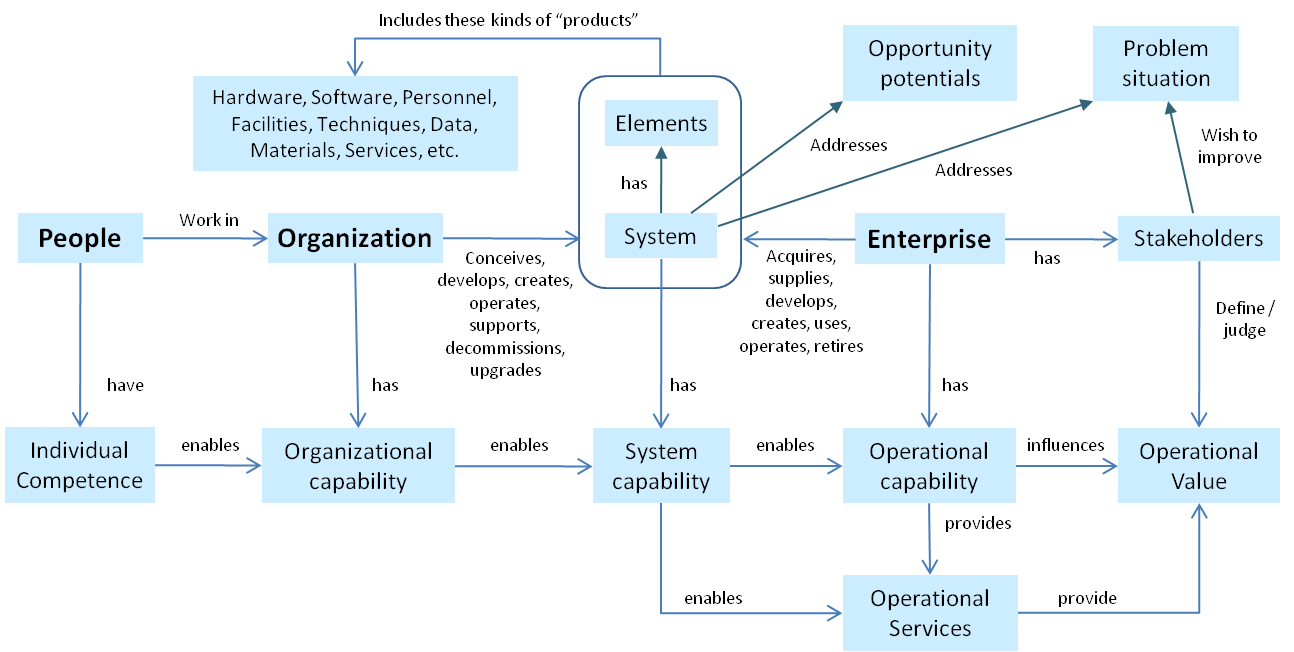
図1. 個人の力量が組織、システム、運用の能力につながる。(SEBoK Original)
Enterprise Systems Engineering Background
This article provides a common context for the succeeding topics in the knowledge area.
本記事は、この知識領域で後に続くトピックに共通するコンテキストを提供する。
The enterprise acquires or develops systems or individual elements of a system. The enterprise can also create, supply, use, and operate systems or system elements. Since there could possibly be several organizations involved in this enterprise venture, each organization could be responsible for particular systems or perhaps for certain kinds of elements. Each organization brings their own organizational capability with them and the unique combination of these organizations leads to the overall operational capability of the whole enterprise. These concepts are illustrated below.
エンタープライズは、システム、またはシステムの個々の要素を獲得または開発する。エンタープライズはまた、システムやシステム要素を創造し、供給し、使用し、運用することもできる。このエンタープライズ事業には複数の組織が関与する可能性があるため、各組織が特定のシステム、あるいは特定の種類の要素に責任を負うこともあり得る。各組織はそれぞれ自らの組織の能力を持ち込み、それらの組織の独自の組み合わせが、エンタープライズ全体の運用能力につながる。これらの概念を以下に図示する。
図中の英語
Organizational capabilities are addressed in the article on Systems Engineering Organizational Strategy, and individual competencies are addressed in the article on Enabling Individuals as they relate to the principles, theories, and practices of organizational behavior.
組織の能力についてはSystems Engineering Organizational Strategyの記事で扱い、個人の力量については、組織の振る舞い(behavior)の原則、理論、実践との関連において、Enabling Individualsの記事で扱う。
The word "capability" is used in systems engineering (SE) in the sense of “the ability to do something useful under a particular set of conditions.” This article discusses three different kinds of capabilities: organizational capability, system capability, and operational capability. It uses the word “competence” to refer to the ability of people relative to the SE task. Individual competence, (sometimes called "competency"), contributes to, but is not the sole determinant of, organizational capability. This competence is translated to organizational capabilities through the work practices that are adopted by the organizations. New systems (with new or enhanced system capabilities) are developed to enhance enterprise operational capability in response to stakeholder’s concerns about a problem situation.
「能力(capability)」という語は、システムズエンジニアリング(SE)においては、「特定の一連の条件の下で何か有用なことを行う能力」という意味で用いられる。本記事では、組織の能力(organizational capability)、システムの能力(system capability)、運用能力(operational capability)という3つの異なる種類の能力について論じる。また、SEのタスクに関する人々の能力を指す語として「力量(competence)」を用いる。個人の力量(individual competence)(「competency」と呼ばれることもある)は、組織の能力に寄与するが、その唯一の決定要因ではない。この力量は、組織が採用する作業慣行を通じて、組織の能力へと変換される。新しいシステム(新たな、または強化されたシステムの能力を備えたもの)は、問題状況に関するステークホルダーの懸念に応えて、エンタープライズの運用能力を強化するために開発される。
Enterprise stakeholders are the ultimate arbiters of Architecture (glossary)|architecture modeling and analysis as part of the activities described in the article called Enterprise Capability Management. “Capability engineering” is an emerging discipline that could enhance the effectiveness of enterprise systems engineering (ESE), which is further discussed in the article on Systems of Systems (SoS).
エンタープライズのステークホルダーは、提供されるシステムの価値(value)を最終的に判定する存在である。組織、システム、運用の各能力は、互いに切り離して設計し、改善し、実施することはできない。能力間の依存関係を理解する鍵となるのは、Enterprise Capability Managementの記事で述べるアクティビティの一環として行う、アーキテクチャ(architecture)のモデリングと分析である。「能力エンジニアリング」は、エンタープライズシステムズエンジニアリング(ESE)の有効性(effectiveness)を高める可能性のある新興の学問分野であり、Systems of Systems (SoS)の記事でさらに論じられている。
The competencies of individuals are important to the overall organizational capability as discussed in the article on Enabling Individuals. The organizational capability is also a function of how the people, teams, projects, and businesses are organized. The organizational design should specify the roles, authorities, responsibilities, and accountabilities (RARA) of the organizational units to ensure the most efficient and effective operations. Effectiveness of enterprise operations is certainly driven by management principles, concepts, and approaches, but it is also largely driven by its leadership principles, concepts, and approaches. These factors are discussed in the article on Systems Engineering Organizational Strategy that discusses how to organize for effective performance of SE.
Enabling Individualsの記事で論じられているように、個人の力量は組織の能力全体にとって重要である。組織の能力はまた、人、チーム、プロジェクト、ビジネスをどのように組織化するかによっても左右される。組織設計(design)は、最も効率的で効果的な運用を確保するために、組織単位の役割、権限、責任、説明責任(RARA)を規定すべきである。エンタープライズの運用の有効性は、確かにマネジメントの原則、概念、アプローチに左右されるが、リーダーシップの原則、概念、アプローチにも大きく左右される。これらの要因については、SEを効果的に実施するための組織化の方法を論じたSystems Engineering Organizational Strategyの記事で取り上げている。
Organizational structure is tightly tied to creating value for the enterprise’s various stakeholders. Since the enterprise is made up of various elements including people, processes, technologies, and assets, the organizational structure of the people and the allocation of responsibilities for executing portions of the value stream is a “design decision” for the enterprise and hence is a key element of properly performing ESE. Organizational design is increasingly influenced by the portfolio of products and services and the degree of coupling between them. This organizational design will be based on organizational design patterns and their trade-offs, as discussed in the article on Systems Engineering Organizational Strategy. Browning (2009) discusses one approach for modeling and analysis of an organization.
組織構造(structure)は、エンタープライズのさまざまなステークホルダーに向けた価値の創造と密接に結び付いている。エンタープライズは、人、プロセス、技術、資産を含むさまざまな要素から構成されるため、人の組織構造と、バリューストリームの一部を実施する責任の配分は、エンタープライズにとっての「設計上の決定」であり、したがってESEを適切に実施するうえでの主要な要素となる。組織設計は、製品とサービスのポートフォリオや、それらの間の結合度から、ますます影響を受けるようになっている。この組織設計は、Systems Engineering Organizational Strategyの記事で論じられているように、組織設計パターンとそのトレードオフに基づくものとなる。Browning(2009)は、組織のモデリングと分析のための一つのアプローチを論じている。
As you can see in this figure, operational capabilities provide operational services that are enabled by system capabilities. These system capabilities are inherent in the system that is conceived, developed, created and/or operated by an enterprise. ESE concentrates its efforts on maximizing operational value for various stakeholders, some of whom may be interested in the improvement of some problem situation.
この図から分かるように、運用能力は、システムの能力によって可能になる運用サービスを提供する。これらのシステムの能力は、エンタープライズが構想、開発、創造、かつ/または運用するシステムに本来備わっているものである。ESEは、さまざまなステークホルダーにとっての運用価値を最大化することに力を注いでおり、そうしたステークホルダーの中には、何らかの問題状況の改善に関心を持つ者がいる場合もある。
ESE, however, addresses more than just solving problems; it also deals with the exploitation of opportunities for better ways to achieve the enterprise goals. This opportunity might involve lowering of operating costs, increasing market share, decreasing deployment risk, reducing time to market, and any number of other enterprise goals. The importance of addressing opportunity potentials should not be underestimated in the execution of ESE practices.
しかし、ESEが扱うのは問題の解決にとどまらず、エンタープライズの目標をより良い方法で達成するための機会(opportunity)の活用にも及ぶ。この機会には、運用コスト(cost)の削減、市場シェアの拡大、展開リスクの低減、市場投入までの期間の短縮、その他数多くのエンタープライズの目標が関わり得る。ESEの実践を遂行するうえで、機会の可能性に対処することの重要性を過小評価すべきではない。
This article focuses on the operational capabilities of an enterprise and the contribution of these capabilities to operational value (as perceived by the stakeholders). Notice that the organization or enterprise can deal with either the system as a whole or with only one (or a few) of its elements. These elements are not necessarily hard items, like hardware and software, but can also include “soft” items, like people, processes, principles, policies, practices, organizations, doctrine, theories, beliefs, and so on.
本記事では、エンタープライズの「運用能力」と、それらの能力が(ステークホルダーが知覚する)「運用価値」にどう寄与するかに焦点を当てる。組織またはエンタープライズは、システム全体を扱うことも、その要素の一つ(または少数)だけを扱うこともできる点に留意されたい。これらの要素は、ハードウェアやソフトウェアのような「ハード」な品目であるとは限らず、人、プロセス、原則、方針、慣行、組織、ドクトリン、理論、信念などの「ソフト」な品目も含み得る。
A service system is a collection of items (or entities) that perform the operations, administration, management and provisioning (OAM&P) of resources that together provide the opportunities to co-create by both the service provider and the service consumer.
サービスシステム(service system)とは、サービス提供者とサービス消費者の双方による価値の共創の機会を共に提供する資源について、その運用、管理、マネジメント、プロビジョニング(OAM&P)を実施する品目(または実体)の集合である。
A collection of services is not necessarily a service system. In fact, this collection of services is often merely a product system that is one of the resources being OAM&P'ed by the service system. A product system can be composed of hardware, software, personnel (see note 1), facilities, data, materials, techniques, and even services. Each of these product system elements can be "engineered."
サービスの集合が、必ずしもサービスシステムであるとは限らない。実際には、こうしたサービスの集合は、サービスシステムがOAM&Pの対象とする資源の一つである製品システムにすぎないことが多い。製品システムは、ハードウェア、ソフトウェア、人員(注1参照)、施設、データ、資材、技法、さらにはサービスから構成され得る。これらの製品システムの要素(system element)は、いずれも「エンジニアリング」することができる。
:<I>Note 1. Even personnel are engineered in the sense that their roles and responsibilities are specified precisely and trade-offs are made about which functions are performed by these people versus by hardware or software. People are "produced" in the sense that untrained people are trained to perform their allocated system functions, unknowledgeable people are educated to find or create the information they need to do their assigned task, and uninformed people are taught how to get access to the data they need, and how to extract relevant information from that data.</I>
注1:人員でさえも、その役割と責任が厳密に規定され、どの機能を人が担い、どの機能をハードウェアやソフトウェアが担うかについてトレードオフが行われるという意味で、エンジニアリングされる。人は、訓練を受けていない人が、割り当てられたシステム機能を実施できるよう訓練され、知識のない人が、割り当てられたタスクを行うのに必要な情報を見つけたり作り出したりできるよう教育され、情報を持たない人が、必要なデータへのアクセス方法と、そのデータから関連する情報を抽出する方法を教わるという意味で、「生産」される。
It is important to understand the difference between the services "enabled" by a service system versus the services that are the elements of a service system entity. See the Service Systems Engineering article for more information about services and how they are engineered.
サービスシステムによって「可能になる」サービスと、サービスシステム実体の要素であるサービスとの違いを理解することが重要である。サービスと、それをどのようにエンジニアリングするかについての詳細は、Service Systems Engineeringの記事を参照されたい。
Likewise, a collection of services is not necessarily an enterprise system. An enterprise may be composed of service systems, along with product systems, as well as policies, procedures, properties, knowledge, financial capital, intellectual capital, and so on. An enterprise might even contain sub-enterprises. Enterprise SE must do the engineering not only across the enterprise itself, but may also get involved in the engineering of the service systems and products systems that the enterprise depends on in order to achieve its goals.
同様に、サービスの集合が、必ずしもエンタープライズシステムであるとは限らない。エンタープライズは、サービスシステムと製品システムに加えて、方針、手続き、資産、知識、金融資本、知的資本などから構成され得る。エンタープライズが、サブエンタープライズを含むことさえあり得る。エンタープライズSEは、エンタープライズそのものを横断するエンジニアリングを行わなければならないだけでなく、エンタープライズが目標を達成するうえで依存するサービスシステムや製品システムのエンジニアリングにも関与することがある。
The above depictions of enterprise-related things do not show the components of an enterprise. The components of an enterprise when it is viewed as a “system” are different than the components of a product or service system (which is the focus of most literature on systems engineering). The figure below shows the typical kinds of components (shown here as “domains”) in an enterprise (Troux 2010) that could be utilized in achieving the desired enterprise <I>operational capability</I> as shown in Figure 1. It is this operational capability that drives ultimate value for the enterprise’s customers and other stakeholders. Further discussion on enterprise components is provided by Reese (2010) and Lawson (2010, chap. 8).
上述したエンタープライズ関連の事柄の描写は、エンタープライズの構成要素(component)を示してはいない。「システム」として見た場合のエンタープライズの構成要素は、製品やサービスシステムの構成要素(システムズエンジニアリングに関する文献の大半が焦点を当てているもの)とは異なる。以下の図は、図1に示した望ましいエンタープライズの「運用能力」を達成するために活用し得る、エンタープライズにおける典型的な構成要素の種類(ここでは「ドメイン」として示す)(Troux 2010)を示している。エンタープライズの顧客やその他のステークホルダーにとっての究極の価値を生み出す原動力となるのは、この運用能力である。エンタープライズの構成要素については、Reese(2010)とLawson(2010, chap. 8)でさらに論じられている。
Figure 2. Categories of Enterprise Components (Troux Technologies, 2010). Reprinted with permission of Copyright © 2010 Troux Technologies. All other rights are reserved by the copyright owner.
図2. エンタープライズ構成要素のカテゴリ(Troux Technologies, 2010)。Copyright © 2010 Troux Technologies の許可を得て転載。その他のすべての権利は著作権者が留保する。
この図は原典のページに掲載されています。権利の都合により本サイトでは省略しています。原典で見る
The application/software and infrastructure/hardware domains (shown above) are likely the most familiar to systems engineers. The application/software domain contains things like the deployed software itself plus applications, modules, servers, patches, functions, and messages. The infrastructure/hardware domain contains things like the hardware itself plus networks and different kinds of hardware like computing hardware, cabinets, and network devices. There might be different subtypes of computing hardware like computers, servers, desktops, laptops, and mainframes.
(上に示した)アプリケーション/ソフトウェアとインフラストラクチャ/ハードウェアのドメインは、システムズエンジニアにとって最も馴染み深いものと思われる。アプリケーション/ソフトウェアドメインには、展開されたソフトウェア自体に加えて、アプリケーション、モジュール、サーバー、パッチ、機能、メッセージなどが含まれる。インフラストラクチャ/ハードウェアドメインには、ハードウェア自体に加えて、ネットワークや、コンピューティングハードウェア、キャビネット、ネットワークデバイスといったさまざまな種類のハードウェアなどが含まれる。コンピューティングハードウェアには、コンピュータ、サーバー、デスクトップ、ラップトップ、メインフレームといったさまざまなサブタイプがあり得る。
This particular "semantic model" had its origins in the area of information technology (IT) management but has been successfully expanded beyond the IT domain (Martin 2003 and 2005). You can see from this elaboration of these domains that an enterprise architecture "schema" can be quite extensive in the kinds of things it can model. The less technical domains would be things like policy, market, strategy, transition, financial, knowledge and skill, and analysis. In a typical enterprise architecture schema like this there could be over a hundred types of modeling objects grouped into these domains.
この特定の「意味モデル」は、もともと情報技術(IT)マネジメントの領域で生まれたものだが、ITドメインの外へもうまく拡張されてきた(Martin 2003 and 2005)。これらのドメインの詳細から分かるように、エンタープライズアーキテクチャの「スキーマ」は、モデル化できる対象の種類がかなり広範に及び得る。技術色の比較的薄いドメインとしては、方針、市場、戦略、移行、財務、知識とスキル、分析などが挙げられる。このような典型的なエンタープライズアーキテクチャのスキーマには、これらのドメインにグループ化された百を超える種類のモデリングオブジェクトが含まれ得る。
Various tools used in modeling the enterprise are described at https://www.enterprise-architecture.info/EA_Tools.htm (IEAD 2011). The TOGAF metamodel (https://pubs.opengroup.org/architecture/togaf9-doc/arch/chap34.html) used in The Open Group Architecture Framework (TOGAF) is another useful depiction of the various modeling entities involved in modeling the enterprise (TOGAF 2009).
エンタープライズのモデリングに用いられるさまざまなツールは、https://www.enterprise-architecture.info/EA_Tools.htm に記載されている(IEAD 2011)。The Open Group Architecture Framework(TOGAF)で用いられるTOGAFメタモデル(https://pubs.opengroup.org/architecture/togaf9-doc/arch/chap34.html)は、エンタープライズのモデリングに関わるさまざまなモデリング実体を描いた、もう一つの有用な表現である(TOGAF 2009)。
Computer and communications technologies make it easier to integrate activities across the enterprise, but this does not necessarily make the enterprise more effective and efficient. To enable this to happen, one needs to look at the whole enterprise as a system, rather than as a collection of functions connected solely by information systems and shared facilities.
コンピュータ技術と通信技術により、エンタープライズ全体にわたるアクティビティの統合は容易になるが、それによってエンタープライズがより効果的で効率的になるとは限らない。これを実現するには、エンタープライズ全体を、情報システムと共有施設だけで結び付けられた機能の集合としてではなく、システムとして捉える必要がある。
Enterprises face strategic challenges that are essential to address in order to ensure that the enterprise will succeed (Rouse 2009): *Growth: Increasing impact, perhaps in saturated/declining “markets”, *Value: Enhancing relationships of processes to benefits and costs, *Focus: Pursuing opportunities and avoiding diversions, *Change: Competing creatively while maintaining continuity, *Future: Investing in inherently unpredictable outcomes, *Knowledge: Transforming information to insights to programs, and *Time: Carefully allocating the organization’s scarcest resource.
To address these challenges, one recognizes that the central source of value in the enterprise is in its people. “Understanding and supporting the interests of an enterprise’s diverse stakeholders — and finding the ‘sweet spot’ among the many competing interests — is a central aspect of discerning the work of the enterprise as a system and creating mechanisms to enhance this work” (Rouse 2009).
エンタープライズは、自らの成功を確実にするために対処が不可欠な戦略的課題に直面している(Rouse 2009)。
これらの課題に対処するにあたっては、エンタープライズにおける価値の中心的な源泉がそこで働く人々にあることが認識される。「エンタープライズの多様なステークホルダーの関心を理解し支援すること、そして競合する数多くの関心の間で『スイートスポット』を見いだすことは、エンタープライズの仕事をシステムとして見極め、その仕事を高める仕組みを作るうえでの中心的な側面である」(Rouse 2009)。
Enterprises are constantly transforming, whether at the individual level (wherein individuals alter their work practices) or at the enterprise level (large-scale planned strategic changes) (Srinivasan 2010). These changes are a response on the part of the enterprise to evolving opportunities and emerging threats. It is not merely a matter of doing work better, but doing different work, which is often a more important result. Value is created through the execution of business processes. However, not all processes necessarily contribute to overall value (Rouse 2005, 138-150). It is important to focus on process and how they contribute to the overall value stream.
エンタープライズは、個人レベル(個人が自らの作業慣行を変える)であれ、エンタープライズレベル(計画に基づく大規模な戦略的変更)であれ、絶えず変革を続けている(Srinivasan 2010)。これらの変更は、移り変わる機会と新たに現れる脅威(threat)に対する、エンタープライズ側の応答である。それは単に仕事をより良く行うという問題ではなく、異なる仕事を行うことであり、後者の方がより重要な結果となることが多い。価値は、ビジネスプロセスの実行を通じて創造される。しかし、すべてのプロセスが全体の価値に寄与するとは限らない(Rouse 2005, 138-150)。プロセスと、それらが全体のバリューストリームにどのように寄与するかに焦点を当てることが重要である。
After gaining a good understanding of business processes, the next main concern is how best to deploy and manage the enterprise’s human, financial, and physical assets. The key challenge in transforming an enterprise is, in the midst of all this change, continuing to satisfice key stakeholders (see note 2).
ビジネスプロセスを十分に理解した後の、次の主な関心事は、エンタープライズの人的、財務的、物理的資産をいかに最適に展開し管理するかである。エンタープライズを変革するうえでの主要な課題は、これらすべての変化のただ中にあって、主要なステークホルダーが受け入れられる最低限の水準を満たし(satisfice)続けることである(注2参照)。
:<I>Note 2. “Satisfice” means to decide on and pursue a course of action satisfying the minimum requirements to achieve a goal. For the enterprise as a whole, it is often impossible to completely satisfy all stakeholders given their competing and conflicting concerns and interests. Therefore, the concept of “satisficing” is a very important element in the execution of ESE practices. It has less stringent criteria than the concept of "satisfaction," which is commonly used in product/service systems engineering.</I>
注2:「satisfice」とは、目標を達成するための最小限の要求を満たす行動方針を決め、それを追求することを意味する。エンタープライズ全体については、競合し対立する懸念と関心を持つすべてのステークホルダーを完全に満足させることは、しばしば不可能である。したがって、「満足化(satisficing)」の概念は、ESEの実践を遂行するうえで非常に重要な要素となる。この概念は、製品/サービスシステムズエンジニアリングで一般的に用いられる「satisfaction(満足)」の概念よりも緩やかな基準を持つ。
Systems engineers have to respond to an increased recognition of the ‘connectedness’ of products and systems, brought about by a number of trends, for example: the capability of (mainly digital) technology, working across multiple systems, to transform businesses and operational systems; the need to create systems in families to increase product diversity and reuse technology, in order to reduce development and operating costs; and the need to build systems which can be brought together flexibly in operations, even if such co-operation was not foreseen at the time of development.
システムズエンジニアは、製品やシステムの「つながり」に対する認識の高まりに対応しなければならなくなっている。この認識の高まりは、例えば次のような数多くの傾向によってもたらされた。複数のシステムにまたがって機能し、ビジネスや運用システムを変革する、(主にデジタルの)技術の能力。開発コストと運用コストを削減するために、製品の多様性を高めて技術を再利用すべく、システムをファミリーとして作る必要性。そして、開発時点ではそのような協働が予見されていなかったとしても、運用時に柔軟に結び付けることのできるシステムを構築する必要性である。
There has also been an increase in collaborative systems development activities, often spanning national boundaries. This has proceeded alongside a growth in the development of what might be called meta-systems, that is systems comprising parts which would previously have been considered as complex in their own right a generation ago, now conceived of and developed as a whole, and thus requiring fresh approaches, of the adaption of old ones.
国境を越えることも多い、協働的なシステム開発アクティビティも増えている。この動きは、「メタシステム」とでも呼べるものの開発の拡大と並行して進んできた。メタシステムとは、一世代前であればそれ自体が複雑であると見なされたであろう部分から構成されるシステムであり、今や全体として構想・開発されるため、新しいアプローチを採るか、従来のアプローチを対象に合わせて調整する必要があるものである。
Tackling these issues requires an approach that transcends the technical and process domain. ESE needs to address integration at the organizational and value chain level.
これらの問題に取り組むには、技術とプロセスの領域を超えたアプローチが必要である。ESEは、組織レベルとバリューチェーンレベルにおける統合に対処する必要がある。
Enterprise transformation occurs in the external context of the economy and markets as shown in the figure below (Rouse 2009). The “market” for the enterprise can be thought of as the context in which the enterprise operates. Of course, in the public sector, the enterprise’s “market” is commonly known as its “constituency.”
エンタープライズの変革は、以下の図に示すように、経済と市場という外部コンテキストの中で起こる(Rouse 2009)。エンタープライズにとっての「市場」は、エンタープライズが活動するコンテキストと考えることができる。もちろん、公共部門では、エンタープライズの『市場』に当たる人々の層は一般に『対象住民などの関係層(constituency)』と呼ばれる。
Figure 3. Context for Enterprise Transformation (Rouse 2009). Reprinted with permission of John Wiley & Sons Inc. All other rights are reserved by the copyright owner.
図3. エンタープライズ変革のコンテキスト(Rouse 2009)。John Wiley & Sons Inc. の許可を得て転載。その他のすべての権利は著作権者が留保する。
この図は原典のページに掲載されています。権利の都合により本サイトでは省略しています。原典で見る
The term “intraprise” is used here to denote the many systems internal to the enterprise. This includes "information systems such as... ERP [enterprise resource planning] systems, as well as social and cultural systems. More specifically, work assignments are pursued via work processes and yield work products, incurring costs" (Rouse 2009). The social and cultural aspects of an enterprise are addressed further in the article called Enabling Businesses and Enterprises.
ここでは、エンタープライズ内部の多数のシステムを表す用語として「イントラプライズ(intraprise)」を用いる。これには、「…ERP[企業資源計画]システムのような情報システムだけでなく、社会的・文化的なシステムも含まれる。より具体的には、割り当てられた作業は作業プロセスを通じて遂行され、作業成果物を生み出すとともにコストを発生させる」(Rouse 2009)。エンタープライズの社会的・文化的な側面については、Enabling Businesses and Enterprisesの記事でさらに取り上げている。
Models of the enterprise can serve as the basis for understanding the enterprise in its context of markets and economies. The figure below shows the various drivers (or inputs) of an enterprise and its potential outcomes (or outputs) (Rouse 2009). Enterprise architecture can be a key enabler for modeling and can serve as a basis for transformation (Vernadat 1996; Bernus, Laszlo, and Schmidt 2003; Nightingale and Rhodes 2004). Enterprise architecture can be used to provide a model to understand how the parts of the enterprise fit together (or do not) (Giachetti 2010) (See also Representing Systems with Models). For a good review of the subject see Lillehagen and Krogstie (2008).
エンタープライズのモデル(model)は、市場と経済のコンテキストの中でエンタープライズを理解するための基礎となり得る。以下の図は、エンタープライズのさまざまな駆動要因(または入力)と、その潜在的な成果(または出力)を示している(Rouse 2009)。エンタープライズアーキテクチャ(enterprise architecture)は、モデリングを実現する主要な手段となり得るとともに、変革の基礎ともなり得る(Vernadat 1996; Bernus, Laszlo, and Schmidt 2003; Nightingale and Rhodes 2004)。エンタープライズアーキテクチャは、エンタープライズの各部分がどのように噛み合うか(あるいは噛み合わないか)を理解するためのモデルを提供するのに用いることができる(Giachetti 2010)(Representing Systems with Modelsも参照)。この主題に関する優れたレビューとしては、Lillehagen and Krogstie(2008)を参照されたい。
Figure 4. Drivers and Outcomes for the Enterprise (Rouse 2009). Reprinted with permission of John Wiley & Sons Inc. All other rights are reserved by the copyright owner.
図4. エンタープライズの駆動要因と成果(Rouse 2009)。John Wiley & Sons Inc. の許可を得て転載。その他のすべての権利は著作権者が留保する。
この図は原典のページに掲載されています。権利の都合により本サイトでは省略しています。原典で見る
Based on his theory of enterprise transformation, Rouse (2005, 279-295) has identified four alternative perspectives that tend to drive the need for transformation: #Value Opportunities: The lure of greater success via market and/or technology opportunities prompts transformation initiatives. #Value Threats: The danger of anticipated failure due to market and/or technology threats prompts transformation initiatives. #Value Competition: Other players’ transformation initiatives prompt recognition that transformation is necessary to continued success. #Value Crises: Steadily declining market performance, cash flow problems, etc., prompt recognition that transformation is necessary for the enterprise to survive.
Work processes can be enhanced, streamlined, eliminated, and invented to help in the pursuit of enhanced value. These process changes should be aligned with enterprise strategy to maximize value produced by the enterprise (Hammer and Champy 1993). As shown below, there are many entities involved in helping the enterprise create value for society, participating organizations, and other stakeholders.
Rouse(2005, 279-295)は、自身のエンタープライズ変革の理論に基づき、変革の必要性を駆り立てる傾向のある4つの代替的な視点を特定した。
作業プロセスを強化し、合理化し、廃止し、新たに考案することで、より高い価値の追求に役立てることができる。これらのプロセスの変更は、エンタープライズが生み出す価値を最大化するために、エンタープライズ戦略と整合させるべきである(Hammer and Champy 1993)。以下に示すように、エンタープライズが社会、参加組織、その他のステークホルダーのために価値を創造するのを支援する実体は数多くある。
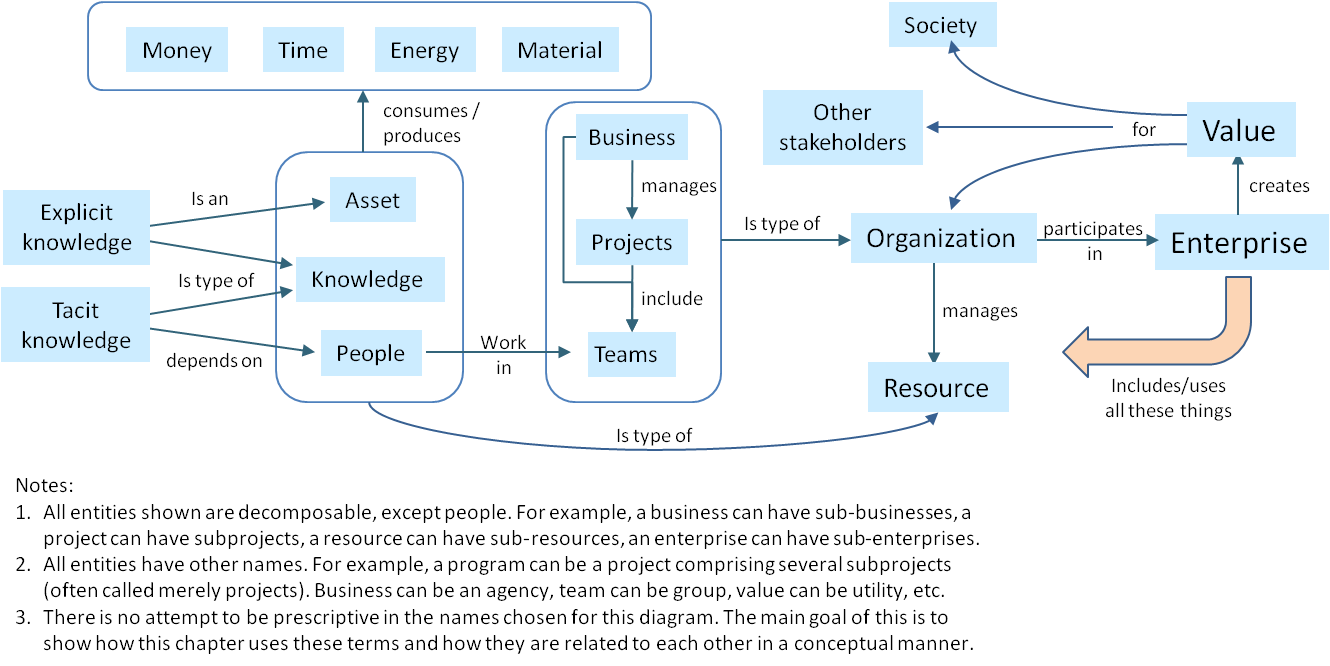
図中の英語
Browning, T.R. 2009. "Using the Design Structure Matrix to Design Program Organizations," in Handbook of Systems Engineering and Management, 2nd ed., edited by A.P. Sage and W.B. Rouse. New York, NY: Wiley and Sons, Inc.
Giachetti, R.E. 2010. Design of Enterprise Systems: Theory, Architecture, and Methods. Boca Raton, FL, USA: CRC Press, Taylor & Francis Group.
Hammer, M., and J. Champy. 1993. Reengineering the Corporation: A Manifesto for Business Revolution. New York, NY: Harper Business, HarperCollins Publishers.
IEAD. 2011. "Enterprise Architecture Tools." Institute for Enterprise Architecture Developments. Accessed September 12, 2012. Available: https://www.enterprise-architecture.info/EA_Tools.htm.
Lawson, H. 2010. A Journey Through the Systems Landscape. Kings College, UK: College Publications.
Lillehagen, F., and J. Krogstie. 2008. "Chapter 4: State of the Art of Enterprise Modelling," in Active Knowledge Management of Enterprises. New York, NY, USA: Springer.
Martin, J.N. 2003. "On the Use of Knowledge Modeling Tools and Techniques to Characterize the NOAA Observing System Architecture." Presented at 13th Annual International Council on Systems Engineering (INCOSE) International Symposium, 2003, Arlington, VA, USA.
Martin, J.N. 2005. "Using an Enterprise Architecture to Assess the Societal Benefits of Earth Science Research." Presented at 15th Annual International Council on Systems Engineering (INCOSE) International Symposium, 2005, Rochester, NY, USA.
Miller, J., and S. Page. 2007. Complex Adaptive Systems: An Introduction to Computational Models of Social Life. Princeton, NJ, USA: Princeton University Press.
Reese, R.J. 2010. Troux Enterprise Architecture Solutions. Birmingham, UK: Packt Publishing Ltd.
Rouse, W.B. 2005. "Enterprise as Systems: Essential Challenges and Enterprise Transformation." Systems Engineering, the Journal of the International Council on Systems Engineering (INCOSE). 8 (2): 138-150.
Rouse, W.B. 2009. "Engineering the Enterprise as a System," in Handbook of Systems Engineering and Management, 2nd ed., edited by A.P. Sage and W.B. Rouse. New York, NY: Wiley and Sons, Inc.
Srinivasan, J. 2010. "Towards a Theory Sensitive Approach to Planning Enterprise Transformation." Presented at 5th European Institute for Advanced Studies in Management (EIASM) Workshop on Organizational Change and Development, September 23-24, 2010, Vienna, Austria.
TOGAF 2009. "The Open Group Architecture Framework," version 9. The Open Architecture Group. Accessed September 2, 2011. Available: https://www.opengroup.org/togaf.
Troux. 2010. Metamodeling and modeling with Troux Semantics, version 9. Austin, TX, USA: Troux Technologies.
White, B.E. 2009. "Complex Adaptive Systems Engineering (CASE)." Presented at IEEE Systems Conference, March 23-26, 2009, Vancouver, Canada.
Giachetti, R.E. 2010. Design of Enterprise Systems: Theory, Architecture, and Methods. Boca Raton, FL, USA: CRC Press, Taylor & Francis Group.
Rouse, W.B. 2009. "Engineering the Enterprise as a System," in Handbook of Systems Engineering and Management, 2nd ed., edited by A.P. Sage and W.B. Rouse. New York, NY: Wiley and Sons, Inc.
Srinivasan, J. 2010. "Towards a Theory Sensitive Approach to Planning Enterprise Transformation." Presented at 5th European Institute for Advanced Studies in Management (EIASM) Workshop on Organizational Change and Development, September 23-24, 2010, Vienna, Austria.
White, B.E. 2009. "Complex Adaptive Systems Engineering (CASE)." Presented at IEEE Systems Conference, March 23-26, 2009, Vancouver, Canada.
McCarter, B.G., and B.E. White. 2009. "Emergence of SoS, sociocognitive aspects," in Systems of systems engineering: Principles and applications, edited by M. Jamshidi. Boca Raton, FL, USA: CRC Press, Taylor & Francis Group. p. 71-105.
Rouse, W.B. 2008. "Health Care as a Complex Adaptive System: Implications for design and management." The Bridge, National Academy of Engineering. 38 (1): 17-25.
Sage, A.P. 2000. "Transdisciplinarity Perspectives in Systems Engineering and Management," in Transdisciplinarity: Recreating Integrated Knowledge, edited by M.A. Somerville and D. Rappaport. Oxford, UK: EOLSS Publishers. p. 158-169.
von Bertalanffy, L. 1968. General System Theory: Foundations, Development, Applications, revised ed. New York, NY, USA: Braziller.
Weinberg, G., and D. Weinberg. 1988. General Principles of Systems Design. New York, NY, USA: Dorset House Publishing Company.
White, B.E. 2007. "On Interpreting Scale (or View) and Emergence in Complex Systems Engineering." Presented at 1st Annual IEEE Systems Conference, April 9-12, 2007, Honolulu, HI, USA.