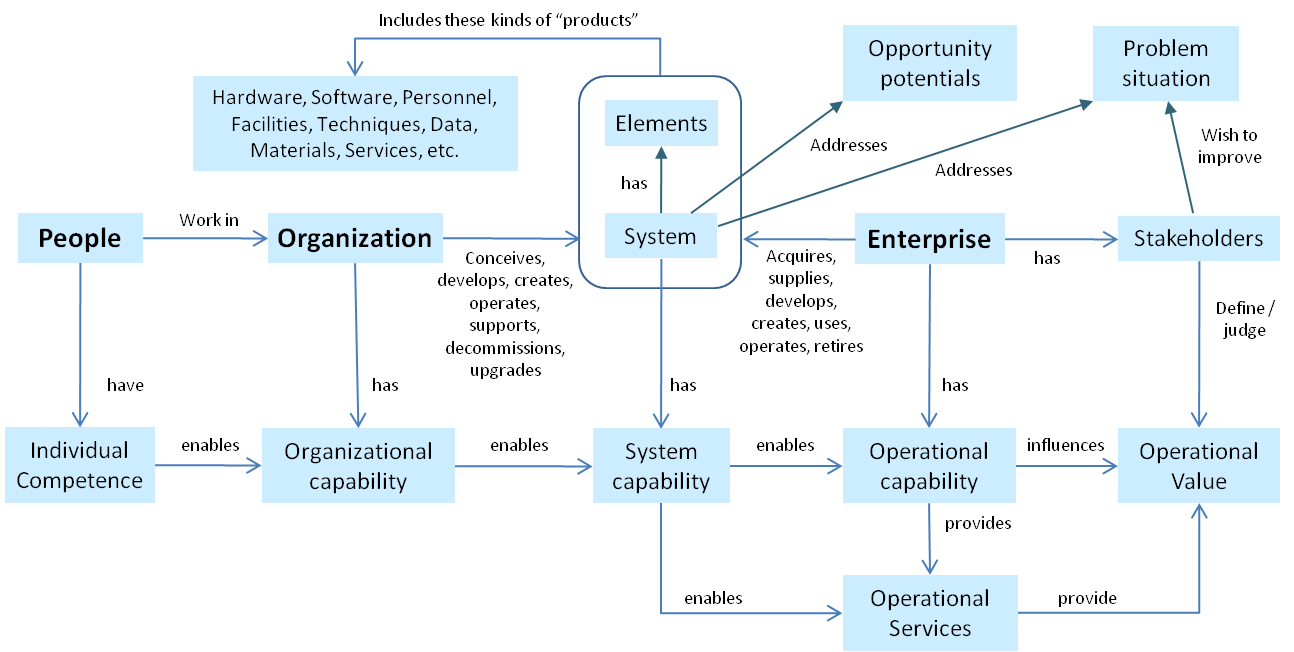
図1. エンタープライズにおける3種類の能力:組織能力、システム能力、運用能力。(SEBoK Original)
Enterprise Capability Management
There are three different kinds of capability: organizational capability, system capability, and operational capability. Management of organizational capability is addressed in the article called Enabling Businesses and Enterprises. Management of system capability is addressed by the Systems Engineering (SE) management activities described in the articles called Technical Management Processes and Product and Service Life Management. Management of operational capability is described herein.
能力(capability)には、組織能力(organizational capability)、システム能力(system capability)、運用能力(operational capability)という3つの異なる種類がある。組織能力のマネジメントは、Enabling Businesses and Enterprisesという記事で扱われている。システム能力のマネジメントは、Technical Management ProcessesおよびProduct and Service Life Managementという記事で述べられているシステムズエンジニアリング(SE)のマネジメントアクティビティによって扱われる。運用能力のマネジメントについては、本記事で述べる。
図中の英語
The baseline (glossary)|baseline) operational capability, based on its past activities and on its current plans for change. The purpose of the enterprise capability management function is to ensure the possibility of “vectoring” the enterprise away from the current baseline trajectory to a more desirable position where it can better meet its enterprise strategic goals and objectives, given all its resource constraints and other limitations.
エンタープライズは、過去のアクティビティと、変更に向けた現在の計画(plans)に基づいて、現在および計画された(ベースライン(baseline))運用能力を持つ。エンタープライズの能力マネジメント(capability management)機能の目的は、あらゆる資源の制約(constraints)やその他の制限を前提としたうえで、エンタープライズを現在のベースラインの軌道から「方向転換」させ、エンタープライズの戦略目標と目的をよりよく満たせる、より望ましい位置へと向かわせる可能性を確保することである。
Operational capability may need to include elements identified in the Information Technology Infrastructure Library (ITIL) best practices for operations management, starting with strategic operation planning (OGC 2009).
運用能力には、戦略的運用計画を出発点として、運用マネジメントに関する情報技術インフラストラクチャライブラリ(ITIL)のベストプラクティスで特定された要素を含める必要が生じる場合がある(OGC 2009)。
<BLOCKQUOTE> The ITIL is a set of practices for IT service management (ITSM) that focuses on aligning IT services with the needs of business. In its current form …, ITIL is published in a series of five core publications, each of which covers an ITSM lifecycle stage. </BLOCKQUOTE>
「ITILは、ITサービスをビジネスのニーズに整合させることに重点を置いた、ITサービスマネジメント(ITSM)のための実践の集合である。現在の形では…、ITILは5つの中核的な出版物からなるシリーズとして発行されており、それぞれがITSMライフサイクルの1つの段階を扱っている。」
<BLOCKQUOTE> ITIL describes procedures, tasks and checklists that are not organization-specific, used by an organization for establishing a minimum level of competency. It allows the organization to establish a baseline from which it can plan, implement, and measure. It is used to demonstrate compliance and to measure improvement. (https://en.wikipedia.org/wiki/Information_Technology_Infrastructure_Library). </BLOCKQUOTE>
「ITILは、組織に固有ではない手順、タスク、チェックリストを記述したものであり、組織はこれを用いて最低限のコンピテンシーレベルを確立する。ITILによって、組織は計画、実施、測定の基準となるベースラインを確立できる。ITILは、コンプライアンスを実証し、改善を測定するために用いられる。」(https://en.wikipedia.org/wiki/Information_Technology_Infrastructure_Library)
The enterprise has key stakeholders that have user (glossary) activities. End user activities include such things as retail sales, entertainment, food services, and travel. An example of an operational need is: “Provide transportation services to commuters in the metropolitan area of London.”
エンタープライズには、エンタープライズに対処してほしい運用的(operational)ニーズを持つ主要なステークホルダー(stakeholders)が存在する。これらの運用ニーズは、エンタープライズとの関連性、ならびにニーズ相互間およびエンタープライズ自体の優先事項と比べた相対的な優先順位という観点から、特定し評価しなければならない。エンタープライズは、これらのニーズを満たすために存在する。運用ニーズとは、エンタープライズの最終ユーザー(user)アクティビティを直接支援する、望ましい事柄の表現である。最終ユーザーアクティビティには、小売販売、娯楽、飲食サービス、ビジネス(business)出張などが含まれる。運用ニーズの例としては、「ロンドン大都市圏の通勤者に交通サービスを提供する」が挙げられる。
Enterprise needs can be much more than eliminating waste, and the challenge for ESE might relate to any or all of the following: countering a perceived threat (business or military), meeting a policy goal (as in government), doing existing business more efficiently, taking advantage of technological opportunities, meeting new operational needs, replacing obsolete systems, creating integrated enterprises with others (on a temporary or permanent basis), and so on.
エンタープライズのニーズは、無駄の排除をはるかに超えるものになり得る。ESEにとっての課題は、次のいずれかまたはすべてに関わり得る:知覚された脅威(ビジネス上または軍事上)に対抗すること、政策目標を達成すること(政府の場合のように)、既存のビジネスをより効率的に行うこと、技術的機会を活用すること、新たな運用ニーズを満たすこと、陳腐化したシステムを置き換えること、他者と統合されたエンタープライズを創り出すこと(一時的または恒久的に)、などである。
In addition to operational needs, there are enterprise needs that relate to enabling assets the enterprise has in place that allow the mission to be accomplished. Enabling assets are things such as personnel, facilities, communication networks, computing facilities, policies and practices, tools and methods, funding and partnerships, equipment and supplies, and so on. An enterprise need is an expression of something desirable in direct support of the enterprise’s internal activities. Internal activities include such things as market forecast, business development, development, manufacturing, and service delivery.
運用ニーズに加えて、ミッション(mission)の達成を可能にする、エンタープライズが備えている実現資産に関連する、エンタープライズのニーズもある。実現資産とは、人員、施設、通信ネットワーク(networks)、コンピューティング施設、方針と実践、ツールと手法、資金とパートナーシップ、設備と供給品などである。エンタープライズのニーズとは、エンタープライズの内部アクティビティを直接支援する、望ましい事柄の表現である。内部アクティビティには、市場予測、事業開発、製品(product)開発、製造、サービス提供などが含まれる。
The purpose of the enterprise’s enabling assets is to effect state changes to relevant elements of the enterprise necessary to achieve targeted levels of performance. The enterprise “state” shown in the figure below is a Process (glossary)|processes use these enabling assets to accomplish their work objectives in order to achieve the desired future states. Enterprise architecture (EA) can be used to these states and the relative impact each enabling asset has on the desired state changes.
エンタープライズの実現資産の目的は、目標とする業績レベルの達成に必要な状態変化を、エンタープライズの関連要素にもたらすことである。以下の図に示すエンタープライズの「状態」は、過去、現在、将来の状態が織りなす複雑(complex)な網である(Rouse 2009)。エンタープライズの作業プロセス(processes)は、これらの実現資産を用いて作業目標を達成し、望ましい将来の状態を実現する。エンタープライズアーキテクチャ(EA)は、これらの状態と、各実現資産が望ましい状態変化に及ぼす相対的な影響をモデル化(model)するために用いることができる。
Figure 2. Enterprise State Changes Through Work Process Activities (Rouse 2009). Reprinted with permission of John Wiley & Sons Inc. All other rights are reserved by the copyright owner.
図2. 作業プロセスアクティビティを通じたエンタープライズの状態変化(Rouse 2009)。John Wiley & Sons Inc. の許可を得て転載。その他のすべての権利は著作権者が留保する。
この図は原典のページに掲載されています。権利の都合により本サイトでは省略しています。原典で見る
Enterprise needs are related to the enterprise efficiencies achieved through the performance of enterprise activities. The main goal of enterprise needs is to maximize the efficient utilization of enterprise assets, or in other words, enhance productivity, and find and eliminate waste. Waste represents that which does not contribute to the enterprise mission or that cannot reasonably be expected to be accomplished by the enterprise. An example of an enterprise need is: “Decrease power required for operation of enterprise data centers.” (Power is a limited asset that consumes scarce enterprise funds that could be used for delivery of other more valuable services to its customers.)
エンタープライズのニーズは、エンタープライズアクティビティの遂行を通じて達成されるエンタープライズの効率性に関わる。エンタープライズのニーズの主な目標は、エンタープライズ資産の効率的な活用を最大化すること、言い換えれば、生産性を高め、無駄を見つけて排除することである。無駄とは、エンタープライズのミッションに貢献しないもの、あるいはエンタープライズが達成すると合理的に期待できないものを指す。エンタープライズのニーズの例としては、「エンタープライズのデータセンター(data centers)の運用に必要な電力を削減する」が挙げられる。(電力は限られた資産であり、顧客に対する他のより価値の高いサービスの提供に充てることもできる、希少なエンタープライズ資金を消費する。)
The capabilities of an enterprise should exist for the sole purpose of meeting mission and enterprise needs. Hence, there will be both mission and enterprise capabilities to identify and assess how well they meet these needs. An example of an operational capability is: “Transport 150,000 passengers per hour among 27 nodes in the network.” A supporting enterprise capability might be: “Process 200,000 tickets per hour during peak loading.” There is a baseline capability due to capability development up to that point in time, plus any additional capability planned for the future. The desired levels of capability (based on needs assessment) are compared to the baseline capability to determine the capability gaps for the enterprise. This activity will also determine points of excess capability.
エンタープライズの能力は、ミッションとエンタープライズのニーズを満たすという唯一の目的のために存在すべきである。したがって、ミッション能力とエンタープライズ能力の双方が存在し、それらを特定するとともに、これらのニーズをどの程度満たしているかを評価することになる。運用能力の例としては、「ネットワーク内の27のノード間で、1時間当たり150,000人の乗客を輸送する」が挙げられる。これを支援するエンタープライズ能力としては、「負荷のピーク時に、1時間当たり200,000枚のチケットを処理する」が考えられる。能力には、その時点までの能力開発によって得られたベースライン能力と、将来に向けて計画された追加の能力がある。望ましい能力レベル(ニーズ評価に基づく)をベースライン能力と比較して、エンタープライズの能力ギャップを決定する。このアクティビティでは、能力が過剰な箇所も決定される。
The gaps should be filled and the excesses should be eliminated. The projected gaps and excesses are sometimes mapped into several future timeframes to get a better understanding of the relative timing and intensity of change that might be required. It is typical to use time “buckets” like near-term, mid-term, and far-term, which, for some long-lasting capabilities, might correspond to five, ten, and twenty years out respectively. Of course, for fast-changing capabilities (like consumer products) these timeframes would necessarily be shorter in duration, for example, one, two and three years out.
ギャップは埋め、過剰は排除すべきである。予測されるギャップと過剰は、必要となり得る変化の相対的なタイミングと強度をよりよく理解するために、将来のいくつかの時間枠に割り当てられることがある。短期、中期、長期といった時間の「バケット」を用いるのが典型的であり、一部の長続きする能力については、これらはそれぞれ5年先、10年先、20年先に相当し得る。もちろん、急速に変化する能力(消費者製品など)の場合、これらの時間枠は必然的にもっと短くなり、たとえば1年先、2年先、3年先となる。
Enterprise architecture analysis can be used to determine how best to fill these capability gaps and minimize the excess capabilities (or “capacities”). Usually a baseline architecture is characterized for the purpose of understanding what one currently has and where the enterprise is headed under the current business plans. The needs and gaps are used to determine where in the architecture elements need to be added, dropped, or changed. Each modification represents a potential benefit to various stakeholders, along with associated costs and risks for introducing that modification. Enterprise architecture can be used to provide a model to understand how the parts of the enterprise fit together (or do not) (Giachetti 2010).
エンタープライズアーキテクチャの分析は、これらの能力ギャップを埋め、過剰な能力(または「キャパシティ」)を最小化する最善の方法を決定するために用いることができる。通常、ベースラインアーキテクチャは、現在何を保有しているか、また現在のビジネスの計画(plans)のもとでエンタープライズがどこへ向かっているかを理解する目的で特徴付けられる。ニーズとギャップは、アーキテクチャのどこで要素を追加、削除、変更する必要があるかを決定するために用いられる。各変更は、さまざまなステークホルダーにとっての潜在的な便益を表すと同時に、その変更の導入に伴うコスト(costs)とリスク(risks)も伴う。エンタープライズアーキテクチャは、エンタープライズの各部分がどのように組み合わさるか(あるいは組み合わさらないか)を理解するためのモデルを提供するのに用いることができる(Giachetti 2010)。
The enterprise architecture effort supports the entire capability management activity with enterprise-wide views of strategy, priorities, plans, resources, activities, locations, facilities, products, services, and so on (ISO/IEC/IEEE 15288 (ISO/IEC/IEEE 2015) and architectural design process: ISO/IEC 42010 (ISO/IEC 2011) and ISO 15704 (ISO 2000)).
エンタープライズアーキテクチャの取り組みは、戦略、優先事項、計画、資源、アクティビティ、場所、施設、製品、サービスなどについてのエンタープライズ全体にわたるビューによって、能力マネジメントアクティビティ全体を支援する(ISO/IEC/IEEE 15288(ISO/IEC/IEEE 2015)とアーキテクチャ設計プロセス:ISO/IEC 42010(ISO/IEC 2011)とISO 15704(ISO 2000))。
The enterprise architecture is used to help identify opportunities for improvement. Usually these opportunities require the investment of time, money, facilities, personnel, and so on. There might also be opportunities for “divestment,” which could involve selling of assets, reducing capacity, canceling projects, and so on. Each opportunity can be assessed on its own merits, but usually these opportunities have dependencies and interfaces with other opportunities, with the current activities and operations of the enterprise, and with the enterprise's partners. Therefore, the opportunities may need to be assessed as a “portfolio,” or, at least, as sets of related opportunities. Typically, a business case assessment is required for each opportunity or set of opportunities.
エンタープライズアーキテクチャは、改善の機会を特定する助けとして用いられる。通常、これらの機会には、時間、資金、施設、人員などの投資が必要となる。「投資の縮小・撤退(divestment)」の機会(opportunities)も考えられ、これには資産の売却、キャパシティ(capacity)の削減、プロジェクトの中止などが含まれ得る。各機会はそれ自体の価値に基づいて評価できるが、通常、これらの機会は、他の機会、エンタープライズの現在のアクティビティや運用、そしてエンタープライズのパートナーとの間に、依存関係とインターフェースを持つ。したがって、機会は「ポートフォリオ(portfolio)」として、あるいは少なくとも関連する機会の集合として評価する必要がある場合がある。一般に、各機会または機会の集合について、ビジネスケースの評価が必要となる。
If the set of opportunities is large or has complicated relationships, it may be necessary to employ portfolio management techniques. The portfolio elements could be bids, projects, products, services, technologies, intellectual property, etc., or any combination of these items. Examples of an enterprise portfolio captured in an architecture modeling tool can be found in Martin (2005), Martin et al. (2004), and Martin (2003). See Kaplan's work (2009) for more information on portfolio management, and ISO/IEC (2008) for information on projects portfolio management process.
機会の集合が大きい場合や複雑な関係を持つ場合には、ポートフォリオマネジメントの手法を用いる必要が生じることがある。ポートフォリオの要素は、入札、プロジェクト、製品、サービス、技術、知的財産など、またはこれらの任意の組み合わせであり得る。アーキテクチャのモデリングツール(modeling tool)で捉えたエンタープライズのポートフォリオの例は、Martin(2005)、Martin et al.(2004)、Martin(2003)に見られる。ポートフォリオマネジメントの詳細についてはKaplanの著作(2009)を、プロジェクトのポートフォリオマネジメントプロセスについてはISO/IEC(2008)を参照されたい。
The results of the opportunity assessment are compiled and laid out in an enterprise plan that considers all relevant factors, including system capabilities, organizational capabilities, funding constraints, legal commitments and obligations, partner arrangements, intellectual property ownership, personnel development and retention, and so on. The plan usually goes out to some long horizon, typically more than a decade, depending on the nature of the enterprise’s business environment, technology volatility, market intensity, and so on. The enterprise plan needs to be in alignment with the enterprise’s strategic goals and objectives and with leadership priorities.
機会評価の結果は、システム能力、組織能力、資金制約、法的なコミットメントと義務、パートナーとの取り決め、知的財産の所有、人員の育成と定着など、関連するあらゆる要因を考慮したエンタープライズ計画に取りまとめられ、整理される。計画は通常、ある長い期間、典型的には10年を超える範囲に及ぶが、それはエンタープライズのビジネスの環境(environment)、技術の変動性、市場の激しさなどによって異なる。エンタープライズ計画は、エンタープライズの戦略目標と目的、およびリーダーシップの優先事項と整合している必要がある。
The planned improvements are implemented across the enterprise and in parts of the extended enterprise (glossary) where appropriate, such as suppliers in the supply chain, distributors in the distribution chain, financiers in the investment arena, and so on. The planned changes should have associated performance targets and these metrics should be monitored to ensure that progress is being made against the plan and that the intended improvements are being implemented. As necessary, the plan is adjusted to account for unforeseen circumstances and outcomes. Performance management of enterprise personnel is a key element of the improvement efforts.
計画された改善は、エンタープライズ全体にわたって実施されるとともに、適切な場合には、サプライチェーンにおけるサプライヤー、流通チェーンにおける流通業者、投資の場における資金提供者など、拡張エンタープライズ(extended enterprise)の部分においても実施される。計画された変更には関連する業績目標を設けるべきであり、計画に照らして進捗していること、および意図した改善が実施されていることを確実にするために、これらの指標(metrics)を監視すべきである。必要に応じて、予期していなかった状況や結果を踏まえて計画を調整する。エンタープライズの人員の業績マネジメントは、改善の取り組みの重要な要素である。
In an operational threat (glossary) environment. In an industrial context, capability refers to the ability to manage certain classes of product and service through those parts of their life cycle that are relevant to the business. Changes to enterprise capability should be carefully managed to ensure that current operations are not adversely affected (where possible) and that the long term viability of the enterprise is maintained. The following seven lenses can be used to facilitate change management: strategic objectives, stakeholders, processes, performance metrics, current state alignment, resources, and maturity assessment (Nightingale and Srinivasan 2011).
運用的なコンテキスト(context)(特に防衛分野)では、「能力マネジメント」という用語は、所与の脅威(threat)環境において特定の種類のミッションを遂行する能力について、そのあらゆる側面を開発し維持することと結び付けられている。産業的なコンテキストでは、能力とは、特定のクラスの製品とサービスを、そのライフサイクル(life cycle)のうちビジネスに関係する部分を通じて管理する能力を指す。エンタープライズ能力への変更は、現在の運用が(可能な場合)悪影響を受けないこと、およびエンタープライズの長期的な存続可能性が維持されることを確実にするために、慎重に管理すべきである。変更管理を容易にするために、次の7つのレンズを用いることができる:戦略目標、ステークホルダー、プロセス、業績指標、現在の状態との整合、資源、成熟度評価(Nightingale and Srinivasan 2011)。
Capability management is becoming more often recognized as a key component of the business management tool suite:
能力マネジメントは、ビジネスマネジメントのツール群の重要な構成要素として、よりしばしば認識されるようになっている。
<BLOCKQUOTE> ''Capability management aims to balance economy in meeting current operational requirements, with the sustainable use of current capabilities, and the development of future capabilities, to meet the sometimes competing strategic and current operational objectives of an enterprise. Accordingly, effective capability management assists organizations to better understand, and effectively integrate, re-align and apply the total enterprise ability or capacity to achieve strategic and current operational objectives; and develops and provides innovative solutions that focus on the holistic management of the defined array of interlinking functions and activities in the enterprise's strategic and current operational contexts.'' (Saxena 2009, 1) </BLOCKQUOTE>
「能力マネジメントは、現在の運用要求事項を満たすうえでの経済性と、現在の能力の持続可能な使用、そして将来の能力の開発との間でバランスを取り、エンタープライズの戦略的目的と現在の運用目的という、時に競合する目的を満たすことを目指す。したがって、効果的な能力マネジメントは、組織が戦略的目標と現在の運用目標を達成するために、エンタープライズ全体の能力またはキャパシティをよりよく理解し、効果的に統合し、再整合し、適用することを支援するとともに、エンタープライズの戦略的および現在の運用コンテキストにおける、互いに結び付いた、定義済みの一連の機能とアクティビティの全体論的なマネジメントに焦点を当てる革新的な解決策を開発し、提供する。」(Saxena 2009, 1)
There is a widespread perception that capability management is only relevant to defense and aerospace domains. However, it is becoming more widely recognized as key to commercial and civil government efforts.
能力マネジメントは防衛と航空宇宙の領域にのみ関係するという認識が広まっている。しかし、能力マネジメントは商業分野や政府の非軍事部門の取り組みにとっても重要であると、より広く認識されるようになっている。
Giachetti, R.E. 2010. Design of Enterprise Systems: Theory, Architecture, and Methods. Boca Raton, FL, USA: CRC Press, Taylor & Francis Group.
ISO. 2000. ISO 15704:2000, Industrial Automation Systems — Requirements for Enterprise — Reference Architectures and Methodologies. Geneva, Switzerland: International Organization for Standardization (ISO).
ISO/IEC/IEEE. 2011. Systems and software engineering - Architecture description. Geneva, Switzerland: International Organization for Standardization (ISO)/International Electrotechnical Commission (IEC)/Institute of Electrical and Electronics Engineers (IEEE), ISO/IEC/IEEE 42010.
ISO/IEC/IEEE. 2015.Systems and software engineering - system life cycle processes.Geneva, Switzerland: International Organization for Standardization (ISO)/International Electrotechnical Commission (IEC), Institute of Electrical and Electronics Engineers.ISO/IEC 15288:2015.
Kaplan, J. 2009. Strategic IT Portfolio Management: Governing Enterprise Transformation. Waltham, MA, USA: Pittiglio, Rabin, Todd & McGrath, Inc. (PRTM).
Martin, J.N. 2005. "Using an Enterprise Architecture to Assess the Societal Benefits of Earth Science Research." Presented at 15th Annual International Council on Systems Engineering (INCOSE) International Symposium, 2005, Rochester, NY, USA.
Martin, J.N. 2003. "On the Use of Knowledge Modeling Tools and Techniques to Characterize the NOAA Observing System Architecture." Presented at 13th Annual International Council on Systems Engineering (INCOSE) International Symposium, 2003, Arlington, VA, USA.
Martin, J.N., J. Conklin, J. Evans, C. Robinson, L. Doggrell, and J. Diehl. 2004. "The Capability Integration Framework: A New Way of doing Enterprise Architecture." Presented at 14th Annual International Council on Systems Engineering (INCOSE) International Symposium, June 20-24, 2004, Toulouse, France.
Nightingale, D., and J. Srinivasan. 2011. Beyond the Lean Revolution: Achieving Successful and Sustainable Enterprise Transformation. New York, NY, USA: AMACOM Press.
OGC (Office of Government Commerce). 2009. ITIL Lifecycle Publication Suite Books. London, UK: The Stationery Office.
Rouse, W.B. 2009. "Engineering the Enterprise as a System," in Handbook of Systems Engineering and Management, 2nd ed., edited by A.P. Sage and W.B. Rouse. New York, NY, USA: Wiley and Sons, Inc.
Saxena, M.S. 2009. Capability Management: Monitoring & Improving Capabilities. New Dehli: Global India Publications Pvt Ltd.
Wikipedia contributors. "Information Technology Infrastructure Library." Wikipedia, The Free Encyclopedia. Accessed November 28, 2012. Available at: https://en.wikipedia.org/wiki/Information_Technology_Infrastructure_Library.
Kaplan, J. 2009. Strategic IT Portfolio Management: Governing Enterprise Transformation. Waltham, MA, USA: Pittiglio, Rabin, Todd & McGrath, Inc. (PRTM).
Nightingale, D., and J. Srinivasan. 2011. Beyond the Lean Revolution: Achieving Successful and Sustainable Enterprise Transformation. New York, NY, USA: AMACOM Press.
Rouse, W.B. 2009. "Engineering the Enterprise as a System," in Handbook of Systems Engineering and Management, 2nd ed., edited by A.P. Sage and W.B. Rouse. New York, NY, USA: Wiley and Sons, Inc.
Dahmann, J.S., J.A. Lane, and G. Rebovich. 2008. "Systems Engineering for Capabilities." CROSSTALK: The Journal of Defense Software Engineering 21 (11): 4-9.
Hillson, D. 2004. Effective Opportunity Management for Projects: Exploiting Positive Risk. Petersfield, Hampshire, UK; New York, NY: Rick Doctor & Partners; Marcel Dekker, Inc.
Lillehagen, F., J. Kostie, S. Inella, H.G. Solheim, and D. Karlsen. 2003. "From enterprise modeling to enterprise visual scenes." Presented at International Society for Pharmaceutical Engineering (ISPE) Conference on Concurrent Engineering (CE), July 26-30, 2003, Madeira Island, Portugal.
McGovern, J., S. Ambler, M. Stevens, J. Linn, V. Sharan, and E. Jo. 2004. A Practical Guide to Enterprise Architecture. New York, NY: Prentice Hall.
Rechtin, E. 1999. ''Systems Architecting of Organizations: Why Eagles Can't Swim''. Boca Raton, FL, USA: CRC Press, Taylor and Francis Group.
Rechtin, E. 1999. Systems Architecting of Organizations: Why Eagles Can't Swim. Boca Raton, FL, USA: CRC Press, Taylor and Francis Group.
Roberts, J.L. 2006. "Enterprise Analysis and Assessment." Presented at 16th Annual International Council on Systems Engineering (INCOSE) International Symposium, July 9-13, 2006, Orlando, FL, USA.