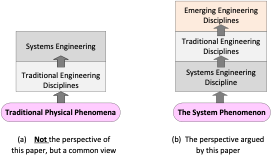
図1:システムズエンジニアリングの2つの異なる見方。(SEBoK Original)
Systems Engineering STEM Overview
Engineering disciplines (ME, EE, CE, ChE) sometimes argue their fields have “real physical phenomena”, “hard science” based laws, and first principles, claiming Systems Engineering lacks equivalent phenomenological foundation. Here we argue the opposite, and how replanting systems engineering in MBSE/PBSE supports emergence of new hard sciences and phenomena-based domain disciplines with deep historical roots. Supporting this perspective is the System Phenomenon, wellspring of engineering opportunities and challenges. Governed by Hamilton’s Principle, it is a traditional path for derivation of equations of motion or physical laws of so-called “fundamental” physical phenomena of mechanics, electromagnetics, chemistry, and thermodynamics.
We argue that laws and phenomena of traditional disciplines are less fundamental than the System Phenomenon from which they spring—an historical fact that was well-known and equally remarkable 200 years earlier to the pioneers of mathematical physics. This is a practical reminder of emerging higher disciplines, with their own phenomena, first principles, and physical laws. Contemporary examples include ground vehicles, aircraft, marine vessels, and biochemical networks; ahead are health care, distribution networks, market systems, ecologies, and the IoT.
工学分野(ME、EE、CE、ChE)は、自分たちの分野には「本物の物理現象」や「ハードサイエンス」に基づく法則、第一原理があると主張し、システムズエンジニアリングには現象に基づく同等の基盤がないと主張することがある。ここではその逆を論じるとともに、システムズエンジニアリングを MBSE/PBSE に植え直すことが、深い歴史的根源を持つ新しいハードサイエンスと現象ベースの領域分野の出現をいかに支えるかを述べる。
この視点を支えるのは、工学における機会と課題の源泉であるシステム現象(System Phenomenon)である。システム現象はハミルトンの原理(Hamilton's Principle)に支配されており、力学、電磁気学、化学、熱力学のいわゆる「基本的な」物理現象について、運動方程式や物理法則を導出するための伝統的な経路となっている。
伝統的分野の法則や現象は、それらを生み出すシステム現象ほど基本的なものではない、とわれわれは主張する。これは歴史的事実であり、200年前の数理物理学の先駆者たちにとって、すでによく知られ、同様に注目すべきことであった。これは、独自の現象、第一原理、物理法則を持つ、より高次の新興分野に対する実践的な注意喚起である。現代の例としては、地上車両、航空機、船舶、生化学ネットワークがある。その先には、医療、流通ネットワーク、市場システム、生態系、IoT が控えている。
As a formal body of knowledge and practice, Systems Engineering is much younger than the more established engineering disciplines, such as Civil, Mechanical, Chemical, and Electrical Engineering. Comparing their underlying scientific foundations to some equivalent in Systems Engineering sometimes arises as a dispute, concerning whose profession is “real” engineering based on (or at least later explained by) hard science, with tangible physical phenomena, and accompanied by physical laws and first principles. This paper summarizes the argument for a different perspective altogether (Figure 1), and the reader exploring this paper is warned to avoid the trap of the seemingly familiar in parsing the message. A more complete discussion is provided in (Schindel 2016) and (Schindel 2019).
形式的な知識・実践の体系としてのシステムズエンジニアリングは、土木、機械、化学、電気工学といった、より確立された工学分野よりもはるかに若い。それらの分野の基礎にある科学的基盤を、システムズエンジニアリングにおける何らかの等価物と比較しようとすると、論争になることがある。どの職業が、ハードサイエンスに基づき(あるいは少なくとも後からハードサイエンスによって説明され)、具体的な物理現象を伴い、物理法則と第一原理を備えた「本物の」工学なのか、という論争である。本稿は、まったく異なる視点を支持する議論を要約する(図1)。本稿を読み進める読者には、そのメッセージを読み解く際に、一見なじみのあるものに見えるという罠に陥らないよう警告しておく。より完全な議論は (Schindel 2016) と (Schindel 2019) で示されている。
図中の英語
Beyond that argument, this paper addresses a more pragmatic goal—the means of identifying and representing the tangible physical phenomena that emerge in new system domains, along with their respective physical laws and first principles. This is of more than philosophical or professional significance. Challenged by numerous issues in emerging systems, society has an interest in organizing successful approaches to the scientific understanding of laws and first principles about, and engineering harnessing of, the related phenomena. Individuals entering or navigating the technical professions likewise have personal interests in this evolving roadmap.
その議論にとどまらず、本稿はより実践的な目標、すなわち新しいシステム領域に現れる具体的な物理現象を、それぞれの物理法則や第一原理とともに特定し表現する手段を扱う。これは、哲学的・職業的な意義にとどまるものではない。新興システムにおける数多くの課題に直面している社会は、関連する現象についての法則と第一原理の科学的理解と、その工学的活用のための、成功するアプローチを編成することに関心を持っている。技術職に就こうとする人や、その中でキャリアを進めていく人もまた、この進化するロードマップに個人的な関心を持っている。
While recognizing the formidable works of systems theorists in these still early days of systems engineering (Ashby 1956; Bertalanffy 1969; Braha et al 2006; Cowan et al 1994; Holland 1998; Prigogine 1980; Warfield 2006; Wymore 1967), this paper focuses on even earlier contributions of science and mathematics to the flowering of engineering’s impact over the last three centuries. We will extract the “System Phenomenon” at the center of that foundation and consider its impacts and implications for systems engineering practice. This perspective helps us understand the phase change that Systems Engineering is going through, as model-based representations enable the framework that has already had profound impact in the traditional science/engineering paired disciplines.
まだ黎明期にあるシステムズエンジニアリングにおけるシステム理論家たちの目覚ましい業績(Ashby 1956; Bertalanffy 1969; Braha et al 2006; Cowan et al 1994; Holland 1998; Prigogine 1980; Warfield 2006; Wymore 1967)を認めつつも、本稿は、過去3世紀にわたって工学の影響力が開花するうえで科学と数学が果たした、さらに初期の貢献に焦点を当てる。その基盤の中心にある「システム現象」を抽出し、それがシステムズエンジニアリングの実践に与える影響と含意を考察する。この視点は、伝統的な科学/工学の対となる分野ですでに深い影響を与えてきたフレームワークをモデルベースの表現が可能にしつつある中で、システムズエンジニアリングが経験している相転移を理解する助けとなる。
Our pragmatic argument is based on assessing the impact of the physical sciences and mathematics on engineering by their joint efficacy in improving the human condition. In a matter of 300 years (from around Newton), the accelerating emergence of Science, Technology, Engineering, and Mathematics (STEM) has lifted the possibility, quality, and length of life for a large portion of humanity, while dramatically increasing human future potential (Mokyr 2009; Morris 2012; Rogers 2003). By the close of the Twentieth Century, the learning and impacts of STEM along with other factors (e.g., market capitalism as a driver of prosperity, as in (Friedman 1980)) were increasingly recognized as critical to individual and collective human prosperity. During that same period, the human-populated world has become vastly more interconnected, complex, and challenging. New opportunities and threats have emerged, in part out of less positive impacts of human applications of STEM. Understanding and harnessing the possibilities have become even more important than before, from the smallest known constituents of matter and life to the largest scale complexities of networks, economies, the natural environment, and living systems
われわれの実践的な議論は、物理科学と数学が人間の境遇の改善に共同で果たしてきた有効性によって、それらが工学に与えた影響を評価することに基づいている。わずか300年(ニュートンの頃から)のうちに、科学、技術、工学、数学(STEM)の加速度的な出現は、人類の多くの人々にとって人生の可能性、質、長さを高めるとともに、人類の将来の潜在力を劇的に増大させた(Mokyr 2009; Morris 2012; Rogers 2003)。20世紀の終わりまでに、STEM の学習と影響は、他の要因(例:(Friedman 1980) にあるような、繁栄の駆動要因としての市場資本主義)とともに、個人と集団の人間の繁栄にとって不可欠であると、ますます認識されるようになった。同じ期間に、人間が住む世界ははるかに相互接続が進み、複雑で、困難なものになった。新たな機会と脅威が現れたが、それは一部には、人間による STEM の応用がもたらした、あまり好ましくない影響から生じたものである。物質や生命について知られている最小の構成要素から、ネットワーク、経済、自然環境、生命システムの最大規模の複雑性に至るまで、その可能性を理解し活用することは、以前にも増して重要になっている。
Over those three centuries, the “hard sciences”, along with the engineering disciplines and technologies based on those sciences, are credited with much of this amazing societal progress, as well as some related challenges (Mokyr 2009; Morris 2012; Rogers 2003). Our point here is the enormous impact of these “traditional” (at least, over 300 short years) disciplines, as their foundations emerged in understanding of physical phenomena and related predictive and explanatory models.
その3世紀を通じて、「ハードサイエンス」は、それに基づく工学分野や技術とともに、この驚くべき社会の進歩の多くと、それに関連する課題の一部をもたらしたとされている(Mokyr 2009; Morris 2012; Rogers 2003)。ここでのわれわれの論点は、これらの「伝統的な」(少なくとも、わずか300年という期間で見れば)分野がもたらした甚大な影響であり、その基盤は、物理現象の理解と、それに関連する予測的・説明的モデルの中から生まれた。
How can the foundational roots of Systems Engineering be compared to engineering disciplines already seen as based on the “hard sciences”? The traditional engineering disciplines (ME, EE, ChE, CE) have their technical bases and quantitative foundations in what emerged as physical sciences of what came to be understood as physical phenomena.
システムズエンジニアリングの基礎的な根源を、すでに「ハードサイエンス」に基づくと見なされている工学分野と、どのように比較すればよいのだろうか。伝統的な工学分野(ME、EE、ChE、CE)の技術的基盤と定量的基盤は、物理現象として理解されるようになったものを扱う物理科学として成立したものの中にある。
It wasn’t always this way, as seen from the shift that began to occur just three centuries ago. It is informative to remember the “phase changes” that occurred in what are now considered the traditional disciplines, by recalling the history of physics before Newton, chemistry before Lavoisier and Mendeleev, and electrical science before Faraday, Hertz, and Maxwell, versus what followed for each. (Cardwell 1971; Forbes et al 2014; Pauling 1960; Servos 1996; Westfall 1980) All of these domains had earlier, less effective, bodies of thought, generated by those attempting to answer questions and, in some cases, provide practical benefits. Instead of dismissing alchemy, astrology, pre-Copernican cosmology, and their counterparts, we can instead see them as grappling with phenomena without the benefit of sufficiently powerful physical-mathematical representation and the verification mechanisms of experiment and refutation to test against reality what we would now call models.
常にそうだったわけではない。それは、ちょうど3世紀前に始まった転換を見ればわかる。現在では伝統的分野と考えられているものに起こった「相転移」を思い起こすことは有益である。ニュートン以前の物理学、ラヴォアジエとメンデレーエフ以前の化学、ファラデー、ヘルツ、マクスウェル以前の電気科学の歴史を、それぞれについてその後に続いたものと比べて思い起こせばよい(Cardwell 1971; Forbes et al 2014; Pauling 1960; Servos 1996; Westfall 1980)。これらの領域はすべて、問いに答えようとし、場合によっては実践的な利益をもたらそうとした人々が生み出した、より初期の、より効果の小さい思想体系を持っていた。錬金術、占星術、コペルニクス以前の宇宙論やそれらに類するものを退けるのではなく、むしろそれらを、十分に強力な物理数学的表現も、われわれが今日モデルと呼ぶものを現実に照らして検証する、実験と反証という検証の仕組みもないまま、現象と格闘していたものとして見ることができる。
Contemporary specialists in individual engineering disciplines (e.g., ME, EE, CE, ChE) sometimes argue that their fields are based on “real physical phenomena”, founded on physical laws based in the “hard sciences” and first principles. One sometimes hears claims that Systems Engineering lacks the equivalent phenomena-based theoretical foundations. In that telling, Systems Engineering is instead critically portrayed as emphasizing (1) process and procedure, (2) critical and systems thinking and good writing skills, and (3) organizing and accounting for information and risk in particular ways—valuable, but not as based on an underlying “hard science”.
個々の工学分野(例:ME、EE、CE、ChE)の現代の専門家は、自分たちの分野は「本物の物理現象」に基づいており、「ハードサイエンス」に根差した物理法則と第一原理の上に成り立っている、と主張することがある。システムズエンジニアリングにはそれに相当する現象ベースの理論的基盤がない、という主張を耳にすることもある。そうした語り口では、システムズエンジニアリングはむしろ、(1)プロセスと手順、(2)批判的思考とシステム思考、優れた文章力、(3)情報とリスクを特定の方法で整理し、考慮に入れることを強調するものとして批判的に描かれる。それらは価値はあるが、基礎となる「ハードサイエンス」に基づくものではない、というのである。
That view is understandable, given the initial trajectory of the first 50 years of Systems Engineering. (Adcock 2015; Checkland 1981; Walden et al 2015) “Science” or “phenomenon” of generalized systems have for the most part been described on an intuitive or qualitative basis, with limited reference to a “physical phenomenon” that might be called the basis of systems science and systems engineering. Some systemic phenomena (e.g., requisite variety, emergence of structure, complexity, chaos theory, etc.) have received attention, but it is challenging to argue that these insights have had as great an impact (yet) on the human condition and engineering practice as the broader STEM illustrations cited above for the most recent three centuries of physical sciences and mathematics. However, INCOSE’s own stated vision (Friedenthal et al 2014) calls upon systems engineering for such a result.
システムズエンジニアリングの最初の50年の初期の軌跡を考えれば、そうした見方も理解できる(Adcock 2015; Checkland 1981; Walden et al 2015)。一般化されたシステムの「科学」あるいは「現象」は、ほとんどの場合、直観的あるいは定性的に記述されてきており、システム科学やシステムズエンジニアリングの基盤と呼べるような「物理現象」への言及は限られていた。一部のシステム的な現象(例:必要多様性、構造の創発(emergence)、複雑性、カオス理論など)は注目を集めてきたが、これらの洞察が、物理科学と数学の直近3世紀について上で挙げた、より広範な STEM の実例ほど大きな影響を人間の境遇や工学実践に(まだ)与えてきたと主張するのは難しい。しかし、INCOSE 自身が表明したビジョン(Friedenthal et al 2014)は、システムズエンジニアリングにそのような成果を求めている。
Respectful of the contributions of those early thinkers in systems engineering, we also note that their contributions can in some cases be expressed as manifestations of the modeled System Phenomenon described below, advancing the scientific foundations of systems engineering.
システムズエンジニアリングの初期の思想家たちの貢献に敬意を払いつつ、われわれはまた、その貢献が場合によっては、以下で述べるモデル化されたシステム現象の現れとして表現でき、システムズエンジニアリングの科学的基盤を前進させるものであることも指摘しておく。
In the case of systems engineering, a key part of the story is that the role that quantitative system models have played, or not played, during its initial history. Most recently, the broader INCOSE-encouraged role for model-based methods offers to eventually accelerate the “phase change” that the successful earlier history of science, mathematics, and other engineering disciplines suggest is now in progress.
Models are certainly not new to segments of engineering practice. However, we are representing an increasingly fraction of our overall understanding of systems, from stakeholder trade space, to required functionality and performance, to design, and to risk, using explicit and increasingly integrated system models. As in Newton’s day, this also puts pressure on the approaches to model representations, in order that they effectively represent the key ideas concerning the real things they are intended to describe. “Effective” meant these models described observable phenomena, offered explanatory theories of cause, provided verifiable (or falsifiable) predictions, and increased human understanding. In many cases, this understanding was harnessed by practicing engineers to improve human life. The progress of physical sciences did not arise from models that only could describe single unique instances of systems, but instead represented what came to be understood as more general patterns that recur across broad families of systems. Likewise, there is an increasing effort in systems engineering to recognize that these models must often describe patterns of similarity and parameterized variation. The increasing use of explicit model-based patterns in these representations is a part of this phase change (INCOSE Patterns WG 2015; INCOSE MBSE Initiative 2015). Pattern-Based Systems Engineering (PBSE) as an extension of Model-Based Systems Engineering (MBSE) increases emphasis on representation.
This is a more significant change than just the emergence of standards for systems modeling languages and IT toolsets, even though those are valuable steps. We need underlying model structures that are strong enough--remember physics before the calculus of Newton & Leibniz. As a test of “strong enough”, we suggest the ability to have the kinds of impact on humankind summarized in Section 2—beginning with clearer focus on what phenomena are being represented.
Although this sounds challenging, it is not necessary for emerging systems models to “start from scratch” in their search for new system phenomena, and further argue that what is already known from the earlier phase change of Section 2 helps suggest what aspects of our systems models need to be strengthened during the phase change in systems engineering. PBSE further reminds us of a practical lesson from the STEM revolution. Once validated patterns emerge, we (mostly) need to learn and apply those patterns (laws, principles), not how to re-derive them from earlier knowledge. Examples include the Periodic Table and the Gas Laws. While it may be controversial, “learn the model, not modeling” is advice worth considering, in a time when modeling from scratch seems carry more excitement.
システムズエンジニアリングの場合、物語の重要な部分は、その初期の歴史において定量的なシステムモデルが果たしてきた役割、あるいは果たしてこなかった役割である。最近では、INCOSE が奨励する、モデルベースの手法のより広い役割が、「相転移」をやがて加速させる可能性をもたらしている。この「相転移」が現在進行中であることは、科学、数学、他の工学分野がたどった成功した初期の歴史から示唆される。
モデルは、工学実践の各部門にとって確かに新しいものではない。しかし、われわれは、ステークホルダー(stakeholder)のトレードスペースから、要求される機能性と性能、設計、リスクに至るまで、システムに関する全体的な理解のうち、ますます大きな割合を、明示的で統合度を増していくシステムモデルを用いて表現するようになっている。ニュートンの時代と同様に、これはモデル表現のアプローチにも、モデルが記述しようとする実在の事物に関する主要な考えを効果的に表現できるよう、圧力をかけている。ここで「効果的」とは、これらのモデルが観測可能な現象を記述し、原因についての説明理論を示し、検証可能な(あるいは反証可能な)予測を提供し、人間の理解を深めたことを意味していた。多くの場合、この理解は、実務に携わるエンジニアによって人間の生活を改善するために活用された。
物理科学の進歩は、システムの単一で固有の事例しか記述できないモデルから生まれたのではない。進歩をもたらしたのは、システムの広いファミリーにわたって繰り返し現れる、より一般的なパターンとして理解されるようになったものを表現できるモデルであった。同様に、システムズエンジニアリングでも、これらのモデルがしばしば類似性のパターンとパラメータ化された変動を記述しなければならないことを認識しようとする取り組みが増えている。こうした表現において明示的なモデルベースのパターンの使用が増えていることは、この相転移の一部である(INCOSE Patterns WG 2015; INCOSE MBSE Initiative 2015)。モデルベースシステムズエンジニアリング(MBSE)の拡張としてのパターンベースシステムズエンジニアリング(PBSE)は、表現への重点をさらに高める。
これは、システムモデリング言語や IT ツールセットの標準が出現するというだけの変化よりも大きな変化である。われわれには、十分に強い基礎となるモデル構造が必要である。ニュートンとライプニッツの微積分以前の物理学を思い出してほしい。「十分に強い」かどうかの試金石として、われわれは、第2節で要約したような人類への影響を与えうる能力を提案する。それは何よりもまず、表現されている現象が何であるかに、より明確に焦点を当てることから始まる。
困難に聞こえるが、新興のシステムモデルが新しいシステム現象を探索する際に「ゼロから始める」必要はない。さらに、第2節で見た初期の相転移からすでに知られていることが、システムズエンジニアリングの相転移の間にわれわれのシステムモデルのどの側面を強化する必要があるかを示唆する助けになる、とわれわれは論じる。PBSE はさらに、STEM 革命から得られる実践的な教訓を思い起こさせてくれる。妥当性が確認されたパターンがひとたび現れたなら、われわれは(ほとんどの場合)それらのパターン(法則、原理)を学んで適用する必要があり、それらをより初期の知識から再導出する方法を学ぶ必要はない。その例には、周期表や気体の法則がある。異論はあるかもしれないが、「モデリングではなくモデルを学ぶ」は、ゼロからモデリングすることのほうが刺激的に思える時代にあって、検討に値する助言である。
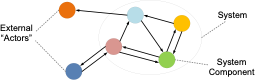
The perspective used in this paper defines a system as a collecting of interacting components, where interactions involve the exchange of energy, force, mass, or information, through which one component impacts the state of another component, and in which the state of a component impacts its behavior in future interactions (Schindel 2011).
本稿で用いる視点では、システムを相互作用する構成要素の集合として定義する。ここで相互作用とは、エネルギー、力、質量、あるいは情報の交換を伴うものであり、それを通じてある構成要素が別の構成要素の状態に影響を与え、また構成要素の状態が将来の相互作用におけるその振る舞いに影響を与える(Schindel 2011)。
In this framework, all behavior is expressed through physical interactions (Figure 2). This perspective emphasizes physical interactions as the context in which all the laws of the hard sciences are expressed. (Schindel 2013)
このフレームワークでは、すべての振る舞いは物理的相互作用を通じて表現される(図2)。この視点は、ハードサイエンスのあらゆる法則が表現される文脈として、物理的相互作用を重視する。(Schindel 2013)
図中の英語
The traditional “Phenomena” of the hard sciences are all cases of the following System Phenomenon: #Each component has a specific behavior during a given interaction type, determined by the component’s state. (See (4) below for the source of that component’s behavioral characteristics.) #The combined behaviors of the set of interacting components determine a combined system state space trajectory. #That trajectory is a collective property of the system components and interaction, and accordingly is not simply the description of possible behaviors of the individual components. For the systems discussed in this paper, by Hamilton’s Principle (Levi 2014; Sussman et al 2001; Hankins 2004), the emergent interaction-based behavior of the larger system is a “stationary” trajectory X = X(t) of the action integral, based on the Lagrangian L of the combined system:
ハードサイエンスの伝統的な「現象」は、いずれも次のシステム現象の事例である。
#The behavioral characteristics of each interacting component in (1) above are in turn determined by its internal (“subsystem”) components, themselves interacting.
Reduced to simplest forms, the resulting equations of motion (or if not known or solvable, empirically observed paths) provide “physical laws” (or recurring observable behaviors) subject to verification.
Instead of Systems Engineering lacking the kind of theoretical foundation that the “hard sciences” bring to other engineering disciplines, we therefore assert that: *It turns out that all those other engineering disciplines’ foundations are themselves dependent upon the System Phenomenon, and emerge from it. *The related underlying math and science of systems (dating to at least Hamilton) provides the theoretical basis already used by all the hard sciences and their respective engineering disciplines. *It is not Systems Engineering that lacks its own foundation—instead, it has been providing the foundation for the other disciplines! (Refer to Figure 6.) *This insight was well-known and remarkable to the sciences 200 years ago, and has continued to be remarked upon by leading scientists for its surprising coverage ever since: “It [science] has as its highest principle and most coveted aim the solution of the problem to condense all natural phenomena which have been observed and are still to be observed into one simple principle, that allows the computation of past and more especially of future processes from present ones. ...Amid the more or less general laws which mark the achievements of physical science during the course of the last centuries, the principle of least action is perhaps that which, as regards form and content, may claim to come nearest to that ideal final aim of theoretical research.” (Kline, 1981)
最も単純な形にまで還元すると、結果として得られる運動方程式(あるいは、それが知られていないか解けない場合には、経験的に観測された経路)が、検証の対象となる「物理法則」(あるいは繰り返し観測される振る舞い)を与える。
したがって、われわれの主張は、システムズエンジニアリングが、ハードサイエンスが他の工学分野にもたらしているような理論的基盤を欠いているということではなく、次のとおりである。
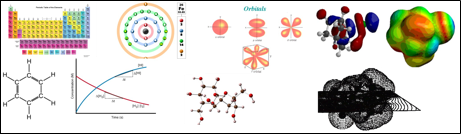
Chemists, and Chemical Engineers, justifiably consider their disciplines to be based on the “hard phenomena” of Chemistry (Pauling 1960; Servos 1996): *This perspective emerged from the scientific discovery and verification of phenomena and laws of Chemistry. *Prominent among these was the discovery of the individual Chemical Elements and their Chemical Properties, organized by the discovered patterns of the Periodic Table. *Emerging understanding of related phenomena and behaviors included Chemical Bonds, Chemical Reactions, Reaction Rates, Chemical Energy, and Conservation of Mass and Energy. *Upon that structure grew further understanding of Chemical Compounds and their Properties:
化学者と化学エンジニアは、自分たちの分野が化学の「ハードな現象」に基づいていると考えており、それには正当な理由がある(Pauling 1960; Servos 1996):
図中の英語
Even though these chemical phenomena and laws seemed very fundamental: *All those chemical properties and behaviors are emergent consequences of interactions that occur between atoms’ orbiting electrons (or their quantum equivalents), along with limited properties (e.g., atomic weights) of the rest of the atoms they orbit. *These lower interactions give rise to visible higher-level Chemical behavior patterns, their own higher-level properties and relationships, expressing “hard science” laws of Chemistry.
This illustrates: *The “fundamental phenomena” of Chemistry, along with the scientifically-discovered / verified “fundamental laws / first principles” are in fact . . . *Higher level emergent system patterns and . . . *Chemistry and Chemical Engineering study and apply those system patterns.
これらの化学的現象と法則は、非常に基本的なものに見えたが:
このことは、次のことを示している:
Illustrated by Figure 4, the discovered and verified laws of gases and of compressible and incompressible fluid flow by Boyle, Avogadro, Charles, Gay-Lussac, Bernoulli, and others are rightly viewed as fundamental to science and engineering disciplines. (Cardwell 1971) However, all those fluid and gaseous properties and behaviors are emergent consequences of interactions that occur between atoms or molecules, the containers they occupy, and their external thermal environment. These lower-level interactions give rise to patterns that have their own higher-level properties and relationships, expressed as “hard sciences” laws. So, the “fundamental phenomena” of gases, along with the scientifically-discovered and verified “fundamental laws and first principles” are in fact higher level emergent system patterns. And so, Mechanical Engineers, Thermodynamicists, and Aerospace Engineers can study and apply those system patterns.
図4に示すように、ボイル、アヴォガドロ、シャルル、ゲイ=リュサック、ベルヌーイらが発見し検証した、気体の法則や、圧縮性・非圧縮性流体の流れの法則は、科学と工学の分野にとって基本的なものと正しく見なされている。(Cardwell 1971)
しかし、それらの流体と気体の特性と振る舞いはすべて、原子あるいは分子、それらが占める容器、そしてそれらの外部の熱的環境の間で起こる相互作用から創発する帰結である。これらの低水準の相互作用は、独自の高水準の特性と関係を持つパターンを生み出し、それは「ハードサイエンス」の法則として表現される。したがって、気体の「基本的な現象」は、科学的に発見され検証された「基本的な法則と第一原理」とともに、実は高水準の創発的なシステムパターンなのである。そして、機械エンジニア、熱力学研究者、航空宇宙エンジニアは、それらのシステムパターンを研究し適用することができる。
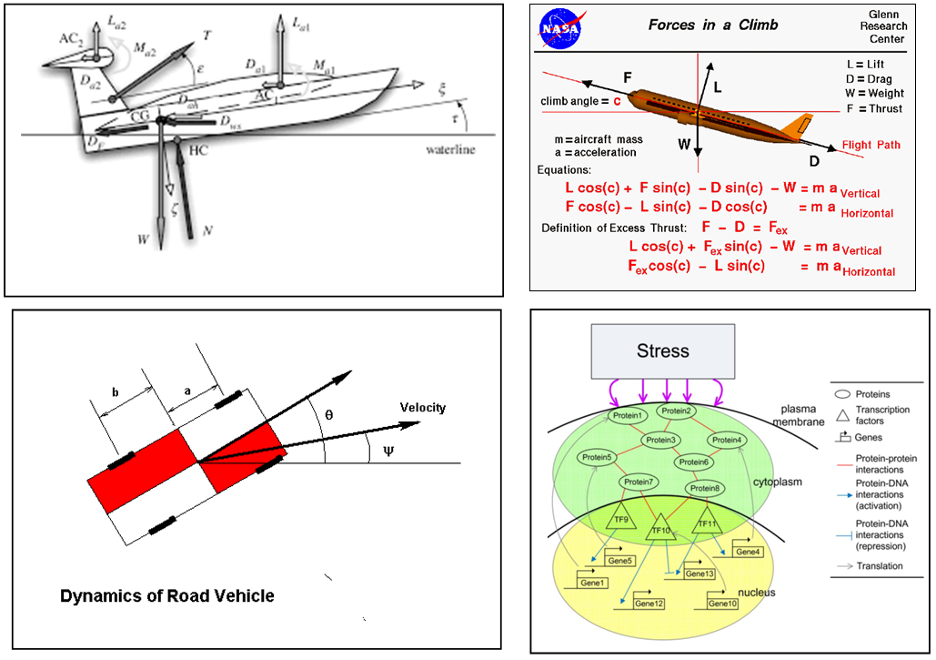
The practical point of this paper is to emphasize the constant emergence of new scientific and engineering disciplines, in domains arising from higher level system interactions. These include domains that have been important to society, even though they arose later than the more fundamental domains from which they spring. The discovery and exploitation of these higher-level phenomena, principles, and laws is important to future progress and innovation, including enterprises, careers of individuals, and society. These more recent emergent domains, in which formal system patterns are being recognized as describing higher-level phenomena and laws, are illustrated by examples of Figure 8: #Ground Vehicles: As in the dynamical laws of vehicle stability that enable vehicular stability controls (Guiggiani 2014) #Aircraft: Including the dynamical laws at the aircraft level that enable advanced aircraft design for dynamic performance and top-level flight controls (Pratt 2000) #Marine Vessels: Facilitating the design of more efficient hulls and special purpose craft, as well as bulk transports (Perez et al 2007) #Biological Regulatory Networks: Advancing our understanding of immune reactions and other regulatory paths in connection with pathologies as well as therapies (Davidson and Levine 2005).
For example, in the case of ground vehicles, dynamical laws of vehicle stability arise from the interactions, modulated through control algorithms, of the distributed mass of the vehicle in motion with the driving surface, transmitted through tractional forces of braking, acceleration, or steering, as further impacted by road surface and tire conditions, along with other factors. It is the overall system interaction of all these domain elements that leads to emergent vehicular laws of motion.
Students of complexity (Cowan et al 1994) will note that nonlinearity, the onset of chaos, and extreme interdependencies are not reasons to avoid representing the interactions manifesting that behavior. Indeed, they provide further reasons to understand those very interactions.
本稿が強調するのは、高次のシステム相互作用から生じる領域で、新たな科学・工学分野が絶えず出現していることである。その中には、基礎となる領域より後から生じ、社会にとって重要な役割を果たしてきた領域もある。これらの高水準の現象、原理、法則の発見と活用は、エンタープライズ、個人のキャリア、社会を含め、将来の進歩と革新にとって重要である。
形式的なシステムパターンがより高水準の現象と法則を記述するものとして認識されつつある、これらの比較的最近の創発的な領域は、図8の例によって示される:
例えば地上車両の場合、車両安定性の動的法則は、走行中の車両の分布した質量と走行路面との相互作用から生じる。この相互作用は制御アルゴリズムによって調整され、制動、加速、操舵の際にタイヤと路面の間で働く力を通じて伝わり、さらに路面やタイヤの状態、その他の要因の影響を受ける。車両に創発する運動法則をもたらすのは、これらすべての領域要素の全体的なシステム相互作用なのである。
複雑性の研究者(Cowan et al 1994)は、非線形性、カオスの発生、極端な相互依存性が、そうした振る舞いを現す相互作用の表現を避ける理由にはならないことに気づくであろう。実際、それらはまさにその相互作用を理解すべきさらなる理由となる。
図中の英語
Examples that call out for improved future efficacy in systems engineering include: #Utility and other distribution networks: Society depends upon rapidly evolving, often global, networks for distribution of goods and services, in the form of materials, energy, communication, and information services. What are the network-level phenomena, laws, and principles of these networks, bearing on their effectiveness and resiliency? (Perez-Arriaaga et al 2013) #Market systems, economies, and human-imposed regulatory frameworks: These systems clearly have direct impact on society and individuals. The “designed” systems of top-down regulation imposed upon them include such prominent examples as regulation of banking, securities markets, development of medical devices and compounds, and delivery of health care. What are the system-level phenomena, laws, and principles of these systems, bearing on their effectiveness and resiliency? (Friedman 1980) #Living ecologies: The emergent habitats of living things include rain forests, coral reefs, the human microbiome, and the biosphere as a whole. These demonstrate characteristics that include regulatory stability within limits, along with pathologies. What are the system-level phenomena, laws, and principles of these systems? (MacArthur & Wilson 2001) #Health care delivery: These systems, including a number of important challenges, are much in the public eye. The very definition of effective health care is necessarily dynamic because of the evolving frontiers of medical science. The means of effectively delivering care, financing its costs, and (Hippocratically) protecting patients from harm are all subject of study as to system-level phenomena and principles. (Holdren et al 2014) #Product development, general innovation, and related agility: This system domain is the “home court” of INCOSE and our systems engineering profession. While there is a large body of descriptions of the related systems, the study of these systems as modelled technical systems is mostly new or in the future. One such project is the INCOSE Agile Systems Engineering Life Cycle Model Project. (Braha et al 2007; Schindel and Dove 2016; Hoffman 2015)
システムズエンジニアリングにおいて将来の有効性の向上が求められる例には、次のものがある:
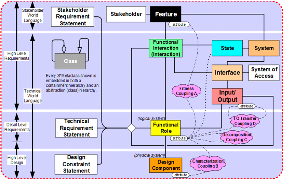
Like mechanics pre-Newton, models of MBSE require an underlying framework to effectively describe the System Phenomenon in domains of practice. MBSE requires a strong enough underlying Metamodel to support phenomenon-based systems science. As discussed in (Schindel 2013), Interactions play a central role in such frameworks, inspired by Hamilton and three hundred years of pioneers in the emergence of science and engineering. Interactions are acknowledged by and can be modelled in some current system modelling frameworks, but typical practice and underlying structures need related improvement. Figure 9 illustrates a related, Interaction-centric, extract from the S*Metamodel (Schindel 2011).
ニュートン以前の力学と同様に、MBSE のモデルには、実践の領域においてシステム現象を効果的に記述するための基礎となるフレームワークが必要である。MBSE には、現象ベースのシステム科学を支えられるだけの強さを持つ、基礎となるメタモデルが必要である。
(Schindel 2013)で論じられているように、こうしたフレームワークでは相互作用が中心的な役割を果たす。これは、ハミルトンと、科学と工学の出現における300年にわたる先駆者たちに触発された考え方である。相互作用は、現在のシステムモデリングフレームワークの一部では認識されており、モデル化することもできるが、典型的な実践と基礎となる構造には、それに関連する改善が必要である。図9は、S*メタモデル(Schindel 2011)から、相互作用を中心とした関連部分を抜粋して示したものである。
図中の英語
This is more than model semantics or ontology alone. It means recognizing that the models we pursue are models of the real physical systems they are about, and not just models of information about business processes concerned with those systems. While that might seem obvious to the physical scientist, a different perspective than that is embedded in forty years of enterprise information system practice. In that history, the traditional (and relatively successful) paradigm is construction of information models that describe information transactions or documents (e.g., purchase of air travel tickets). Symptomatic of that paradigm, today we still encounter MBSE models and human interpretations of them that include notions of databases, “calls”, “methods”, and other successful software notions that are not the same as modeling physical systems.
これは、モデルの意味論やオントロジーだけの問題ではない。それは、われわれが追求するモデルが、システムに関わるビジネスプロセスについての情報だけのモデルではなく、そのモデルが対象とする実在の物理システムのモデルであると認識することを意味する。物理科学者には自明に思えるかもしれないが、40年にわたるエンタープライズ情報システムの実践には、それとは異なる視点が埋め込まれている。その歴史において、伝統的な(そして比較的成功した)パラダイムは、情報の取引や文書(例:航空券の購入)を記述する情報モデルを構築することである。そのパラダイムを反映した症状として、今日でもわれわれは、データベース、「呼び出し」、「メソッド」、その他物理システムのモデリングとは同じではない成功したソフトウェアの概念を含む MBSE モデルや、それらについての人間の解釈に遭遇する。
#Like the other engineering disciplines, Systems Engineering can be viewed as founded on “real” physical phenomena—the System Phenomenon—for which experimentally verified, mathematically modeled hard science, laws, and first principles have existed for over 150 years, dating to Hamilton, or earlier, to Newton. #Systems Engineering not only has its own phenomenon, but the phenomena upon which the traditional engineering disciplines (ME, CE, ChE, EE) are based can themselves all be seen to be derivable from the System Phenomenon. It is SE that has the more fundamental foundation, while the other disciplines are special cases of both the phenomena and mathematics. #The System Phenomenon supports the emergence of hard sciences, laws, and first principles for higher level phenomena of critical importance to humankind. #Systems Engineering, along with its related scientific foundations, is a young and still emerging discipline. The re-planting of Systems Engineering in a model-based framework is an important step toward strengthening the discipline, but requires a stronger model framework for that to occur, and the System Phenomenon points the way to a key part of that framework. #A practical implication for practicing systems engineers and their educators: All models of behavior should be based on interactions. Nature offers no “naked” behavior outside interactions, but current practice and training often seem to overlook this. #Systems research emphasis would benefit from more attention to specific emergent domains, each of which will have their own phenomena, instead of over-emphasizing abstract generic systems. This is a well-described but often overlooked observation, as noted in (Anderson 1972) #There are additional phenomena in this space. For a discussion of the Value Selection Phenomenon and Group Learning and Model Trust Phenomenon, see (Schindel 2020).
Adcock, Rick, ed., “Guide to the Systems Engineering Body of Knowledge (SEBoK)”, retrieve from: https://sebokwiki.org/wiki/Guide_to_the_Systems_Engineering_Body_of_Knowledge_(SEBoK)
Anderson, P.W., “More Is Different”, Science, v177, No. 4047. (Aug. 4, 1972), pp. 393-396.
Ashby, William Ross, An Introduction to Cybernetics, Wiley, 1956.
Bertalanffy, L. von, (1969). General System Theory: Foundations, Development, Applications, George Braziller Inc.; Revised edition, 1969.
Braha, D., A. Minai, Yaneer Bar-Yam, eds. 2006. Complex engineered systems: Science meets technology, City: Springer.
Braha, Dan, and Bar-Yam, Yaneer, “The Statistical Mechanics of Complex Product Development: Empirical and Analytical Results”, Management Science, Vol. 53, No. 7, July 2007, pp. 1127–1145.
Cardwell, D.S.L. From Watt to Clausius: The Rise of Thermodynamics in the Early Industrial Age. London: Heinemann, 1971. Checkland, P., System Thinking, System Practice, Wiley, 1999.
Cowan, George, Pines, David, and Meltzer, David, Complexity: Metaphors, Models, and Reality, Proceedings Volume XIX, Santa Fe Institute Studies in Science of Complexity, Addison-Wesley, 1994.
Davidson, E., Levine, M., eds, “Gene Regulatory Networks”, Proc Natl Acad Sci USA. Apr 5 2005; 102(14): 4935. Retrieve from-- https://www.ncbi.nlm.nih.gov/pmc/articles/PMC556010/
Forbes, Nancy, and Mahon, Basil, Faraday, Maxwell, and the Electromagnetic Field: How Two Men Revolutionized Physics, Prometheus Books, 2014.
Friedenthal et al, “A World in Motion: Systems Engineering Vision 2025”, International Council on Systems Engineering, 2014. Friedman, Milton and Friedman, Rose, Free to Choose: A Personal Statement, Harcourt, 1980.
Guiggiani, Massimo, The Science of Vehicle Dynamics: Handling, Braking, and Ride of Road and Race Cars, Springer, 2014.
Hankins, T., Sir William Rowan Hamilton, Johns Hopkins University Press, 2011.
Holdren, John P., Lander, Eric S., et al, “Report to the President--Better Health Care and Lower Costs: Accelerating Improvement Through Systems Engineering”, Executive Office of the President, President’s Council of Advisors on Science and Technology, May 2014. https://www.whitehouse.gov/ostp/pcast
Hoffman, C. and Schindel, W., “Systems Engineering Community of Practice Social Network Pattern”, Proc. of INCOSE Great Lakes Regional Conference, 2015.
Holland, John H., Emergence: From Chaos to Order, Perseus, 1998.
INCOSE MBSE Initiative Patterns Working Group web site, at https://www.omgwiki.org/MBSE/doku.php?id=mbse:patterns:patterns
INCOSE MBSE Patterns Working Group, “MBSE Methodology Summary: Pattern‐Based Systems Engineering (PBSE), Based On S*MBSE Models”, V1.6.1,
INCOSE PBSE Working Group, 2019: https://www.omgwiki.org/MBSE/lib/exe/fetch.php?media=mbse:patterns:pbse_extension_of_mbse-- methodology_summary_v1.6.1.pdf
INCOSE, Systems Engineering Handbook: A Guide for System Life Cycle Processes and Activities, Fifth Edition, John Wiley and Sons, Inc., Hoboken, NJ, 2023, ISBN: 978-1-119-81429-0.
Kline, Morris. Mathematics and the Physical World. Dover, 1981.
Levi, M., Classical Mechanics with Calculus of Variations and Optimal Control, American Mathematical Society, Providence, Rhode Island, 2014.
MacArthur R. H., and Wilson, E. O., The Theory of Island Biogeography, Princeton U. Press, 2001.
Mokyr, Joel, The Enlightened Economy: An Economic History of Britain 1700-1850, Yale University Press, 2009.
Morris, C. R., The Dawn of Innovation: The First American Industrial Revolution, Public Affairs, 2012.
Pauling, L., The Nature of the Chemical Bond and the Structure of Molecules and Crystals: An Introduction to Modern Structural Chemistry, 3rd edition, Cornell University Press; 1960
Perez, Tristan, and Fossen, Thor I., “Modelling and Simulation of Marine Surface Vessel Dynamics”, Tutorial, IFAC Conference on Control Applications in Marine Systems, Bol, Croatia, 2007.
Pérez-Arriaga, Ignacio, et al, “From Distribution Networks to Smart Distribution Systems: Rethinking the Regulation of European Electricity DSOs”, THINK Project Final Report, European University Institute, 2013.
Pratt, Roger W., ed., Flight Control Systems: Practical Issues in Design and Implementation, IEE Control Engineering, 2000.
Prigogine, Ilya, From Being to Becoming: Time and Complexity in the Physical Sciences, Freeman, 1980.
Rogers, Everett M. Roger, Diffusion of Innovations, Fifth Edition, Free Press, 2003.
Schindel, W., “Inputs to Theoretical Foundations Section of INCOSE Vision 2035”, April, 2020. Retrieve from-- https://www.omgwiki.org/MBSE/lib/exe/fetch.php?media=mbse:patterns:science_math_foundations_for_systems_and_systems_engineering--1_hr_awareness_v2.3.2a.pdf
Schindel, W., “Got Phenomena? Science-Based Disciplines for Emerging Systems Challenges”, in Proc. of INCOSE 2016 International Symposium, 2016.
Schindel, W., “System Interactions: Making the Heart of Systems More Visible”, Proc. of INCOSE Great Lakes Regional Conference, 2013.
Schindel, W., “What Is the Smallest Model of a System?”, Proc. of the INCOSE 2011 International Symposium, International Council on Systems Engineering (2011).
Schindel, W., and Dove, R., “Introduction to the Agile Systems Engineering Life Cycle MBSE Pattern”, in Proc. of INCOSE 2016 International Symposium, 2016.
Schindel, W., “Improving Design Review”, ICTT System Sciences, 2007. Servos, John W., Physical Chemistry from Ostwald to Pauling, Reprint Edition, Princeton University Press, 1996.
Sussman, G, and Wisdom, J., Structure and Interpretation of Classical Mechanics, Cambridge, MA: MIT Press, 2001.
Warfield, John N., An Introduction to Systems Science, World Scientific Publ., 2006.
Westfall, Richard S., Never at Rest: A Biography of Isaac Newton, Cambridge, 1980.
Wymore, A. Wayne, A Mathematical Theory of Systems Engineering: The Elements, Krieger, 1967.
None.
None.