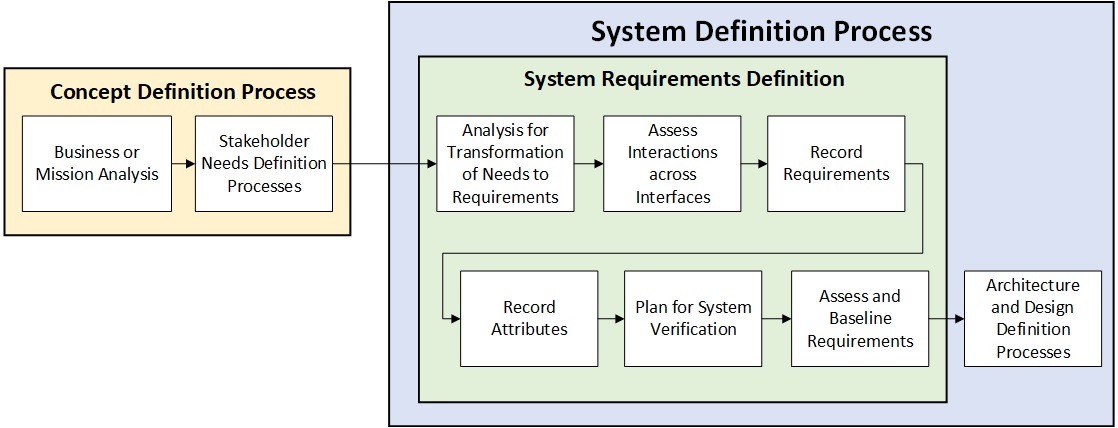
図1. システム要求定義は、システム定義プロセスにおける最初のアクティビティである。(ISO 15288-2023 から派生した SEBoK Original 図)
System Requirements Definition
The System Requirements Definition process transforms the view of desired into a technical, developer view of how the system can achieve those capabilities. System requirements describe requirements which the system-of-interest (SoI) must fulfill to satisfy the and are expressed in an appropriate combination of well-formed textual statements and supporting models or diagrams. Inputs into this process are the life cycle concepts and integrated set of needs generated during the System Concept Definition activities.
システム要求定義プロセスは、ステークホルダー(stakeholder)が望む能力(capabilities)に対するステークホルダーの視点を、それらの能力をシステムがどのように達成できるかという技術的・開発者の視点へと変換する。システム要求事項(System requirements)は、ステークホルダーニーズ(stakeholder needs)を満たすために対象システム(system-of-interest、SoI)が満たさなければならない要求事項を記述したものであり、よく形成されたテキストステートメントと、それを補うモデルや図とを適切に組み合わせて表される。このプロセスへの入力は、システムコンセプト定義(System Concept Definition)アクティビティで生成されるライフサイクルコンセプトと、統合されたニーズの集合である。
System requirements play major roles in systems engineering, as they:
システム要求事項は、システムズエンジニアリングにおいて次のような主要な役割を果たす。
• Form the basis of system architecture and design activities.
• システムのアーキテクチャ(architecture)アクティビティと設計(design)アクティビティの基礎となる。
• Form the basis of system Verification (glossary)|verification activities.
• システムの統合(Integration)アクティビティと検証(verification)アクティビティの基礎となる。
• Provide a means of communication between the various project team members that interact throughout the project.
• プロジェクトを通じて関わり合うさまざまなプロジェクトチームメンバーの間に、コミュニケーションの手段を提供する。
Outputs of the System Requirements Definition process serve as inputs to a number of other technical processes, which include System Design Definition, System Architecture Definition, and System Verification.
システム要求定義プロセスのアウトプットは、システム設計定義(System Design Definition)、システムアーキテクチャ定義(System Architecture Definition)、システム検証(System Verification)をはじめとする、他の多くの技術プロセスへの入力となる。
System Requirements Definition uses the outcome of the System Concept Definition activities to address what the system must do so that the integrated set of needs will be realized by the SoI. As shown in Figure 1, this information is then provided as input to the System Architecture Definition and System Design Definition processes, as well as the System Verification process.
システム要求定義は、システムコンセプト定義(System Concept Definition)アクティビティの成果を用いて、統合されたニーズの集合が SoI によって実現されるよう、システムが何をしなければならないかを扱う。図1に示すように、この情報はその後、システムアーキテクチャ定義(System Architecture Definition)プロセスとシステム設計定義(System Design Definition)プロセス、ならびにシステム検証プロセスへの入力として提供される。
図中の英語
Defining requirements is not only an exercise in writing it is also an exercise in engineering. Every requirement represents an engineering decision as to what the SoI must do, or a quality the system must have, to meet the needs from which they were transformed. Determination of what the system must do to meet a need is through a process of detailed requirement analysis, which can include the development and use of models, simulations, and prototypes.
要求事項の定義は、文章を書く作業であるだけでなく、エンジニアリングの作業でもある。すべての要求事項は、変換元のニーズを満たすために SoI が何をしなければならないか、あるいはシステムがどのような品質を持たなければならないかについての、エンジニアリング上の決定を表している。ニーズを満たすためにシステムが何をしなければならないかは、詳細な要求分析のプロセスを通じて判断される。このプロセスには、モデル、シミュレーション、プロトタイプの開発と使用が含まれ得る。
A requirement statement is the result of a "formal transformation of one or more needs or parent requirements into an agreed-to obligation for an entity to perform some or possess some quality within specified constraints with acceptable risk." (INCOSE NRM 2022). In this context the use of the term “quality” means an inherent feature or a distinguishing attribute.
要求ステートメントは、「1つ以上のニーズまたは親要求事項を、指定された制約の中で、許容可能なリスクのもとに何らかの機能(function)を実行する、または何らかの品質を備えるという、エンティティに対する合意された義務へと形式的に変換した」結果である(INCOSE NRM 2022)。この文脈における「品質」という用語は、本来備わっている特徴、または他と区別される属性を意味する。
There are many types of requirements; this article describes the requirements which are used as inputs into the System Architecture and System Design Definition processes. As such, these requirements can be referred to as design input requirements, which are defined iteratively and recursively as the integrated system is decomposed into subsystems and system elements (the SoI could exist at any level of a system architecture).
要求事項には多くの種類があるが、本記事では、システムアーキテクチャ定義およびシステム設計定義のプロセスへの入力として用いられる要求事項について述べる。したがって、これらの要求事項は設計入力要求事項と呼ぶことができる。設計入力要求事項は、統合されたシステムがサブシステムやシステム要素へと分解されていくのに伴い、反復的かつ再帰的に定義される(SoI はシステムアーキテクチャのどのレベルにも存在し得る)。
The System Requirement Definition activities begin with the transformation of the integrated set of needs into a set of requirements for the SoI. These requirements must be appropriate to the level that the SoI exists within the system architecture and communicate “what” the SoI must do to meet the needs, avoiding requirements that state implementation of “how” to achieve the design realization of the physical SoI.
システム要求定義アクティビティは、統合されたニーズの集合を、SoI に対する要求事項の集合へと変換することから始まる。これらの要求事項は、システムアーキテクチャ内で SoI が位置するレベルにふさわしいものでなければならない。また、ニーズを満たすために SoI が「何を」しなければならないかを伝えるものでなければならず、物理的な SoI の設計実現を「どのように」達成するかという実装を述べる要求事項は避けなければならない。
Needs communicate the stakeholder’s perspective concerning their expectations of what they need the system of interest (SoI) to do from an external, black box view.
ニーズは、対象システム(SoI)に何をしてもらう必要があるかという期待についてのステークホルダーの視点を、外部から見たブラックボックスの観点で伝える。
• Example: The user needs the coffee maker to stop heating water once the user-selected temperature has been achieved.
• 例:ユーザーは、自分が選択した温度に達したらコーヒーメーカーが水の加熱を止めることを必要としている。
The sources of needs are described in Stakeholder Needs Definition. These sources include the stakeholder expectations and needs, drivers and constraints, risk analysis, and life cycle concept analysis and maturation activities. These needs are treated as inputs to the System Requirement Definition process, which results in a set of design input requirements for the SoI.
ニーズの情報源については「ステークホルダーニーズ定義(Stakeholder Needs Definition)」で述べられている。これらの情報源には、ステークホルダーの期待とニーズ、ドライバと制約、リスク分析、ライフサイクルコンセプトの分析・成熟化アクティビティが含まれる。これらのニーズはシステム要求定義プロセスへの入力として扱われ、このプロセスの結果、SoI に対する設計入力要求事項の集合が得られる。
Requirements communicate the technical, developer perspective concerning what the SoI must do to meet the stakeholder needs from an internal white box view.
要求事項は、ステークホルダーニーズを満たすために SoI が何をしなければならないかについての技術的・開発者の視点を、内部から見たホワイトボックスの観点で伝える。
• Example: The Coffee Maker shall stop the heating function once the selected Brew Temperature has been achieved.
• 例:コーヒーメーカーは、選択された抽出温度に達したら、加熱機能を停止しなければならない。
The process of generating a requirement statement is more than changing the subject of the need statement, it is an analysis of what the system must do to achieve what is needed. There are many types of analyses and tools that are used to make this determination:
要求ステートメントを生成するプロセスは、ニーズステートメントの主語を入れ替えるだけのものではなく、必要とされていることを達成するためにシステムが何をしなければならないかを分析することである。この判断を行うには、多くの種類の分析やツールが用いられる:
• functional analysis,
• 機能分析
• interface analysis,
• インタフェース分析
• data flow diagrams,
• データフロー図
• performance analysis, and
• 性能分析
• needs to transformation matrix.
• ニーズから要求事項への変換マトリクス
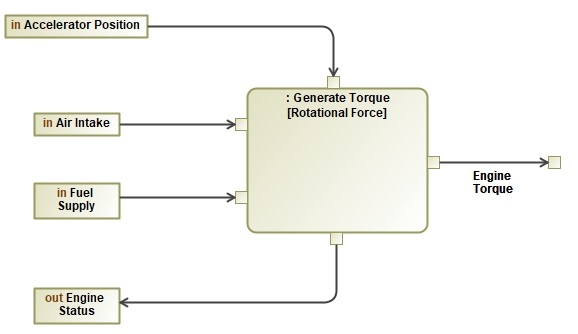
Requirement analysis for functions and performance can be performed by using system models (supported by Model-Based Systems Engineering (MBSE) applications). Key enabling model views include activity diagrams, sequence diagrams, state machine diagrams, and structure diagrams (for hierarchy and interfaces). An example functional analysis is shown in Figure 2.
機能と性能に関する要求分析は、システムモデルを用いて(モデルベースシステムズエンジニアリング(MBSE)アプリケーションの支援のもとで)行うことができる。実現のための主要なモデルビューには、アクティビティ図、シーケンス図、状態機械図、構造図(階層とインタフェースのため)がある。機能分析の例を図2に示す。
図中の英語
Close and frequent coordination with the stakeholders is necessary to ensure the transformation is accurate and traceability is maintained. This results in a set of system requirements communicating measurable characteristics which can form the basis for system realization. A detailed analysis of a single need statement may result in multiple requirements expressing what the system must do to meet it, including definition of measurable performance criteria (INCOSE NRM 2022).
変換を正確に行い、トレーサビリティ(traceability)を確実に維持するには、ステークホルダーとの緊密かつ頻繁な調整が必要である。これにより、システム実現(system realization)の基礎をなし得る、測定可能な特性を伝えるシステム要求事項の集合が得られる。単一のニーズステートメントを詳細に分析すると、それを満たすためにシステムが何をしなければならないかを表す複数の要求事項が、測定可能な性能基準の定義も含めて導かれることがある(INCOSE NRM 2022)。
An attribute is additional information associated with an entity which is used to aid in its definition and management. Well-chosen attributes, when properly defined and tracked, can enable correct interpretation and management of requirements throughout the system life cycle. There are several useful attributes to consider:
属性とは、エンティティに関連付けられた追加情報であり、そのエンティティの定義と管理を助けるために用いられる。適切に選ばれた属性は、正しく定義され追跡されれば、システムライフサイクルを通じて要求事項を正しく解釈し管理することを可能にし得る。考慮すべき有用な属性はいくつかある:
• rationale,
• 根拠
• trace to source or parent,
• 情報源または親へのトレース
• system verification success criteria,
• システム検証の成功基準
• owner,
• 所有者
• category,
• カテゴリ
• status,
• ステータス
• criticality, and
• 重要度
• priority.
• 優先度
The use of the rationale attribute helps communicate why the requirement is needed, any assumptions made, the source of numbers, the results of related design studies, or any other related supporting information. This supports further requirements analysis and decomposition, as well as identifying the source of any requirement value. Defining the system verification success criteria helps ensure the requirement is well-formed, is verifiable, and aids in the planning for the project's verification program (INCOSE NRM 2022).
根拠属性を用いると、要求事項がなぜ必要なのか、置かれた前提、数値の情報源、関連する設計検討の結果、その他の関連する裏付け情報を伝えやすくなる。これは、さらなる要求分析や分解を支援するとともに、要求値の情報源の特定にも役立つ。システム検証の成功基準を定義することは、要求事項がよく形成され検証可能であることを確実にするのに役立ち、プロジェクトの検証プログラムの計画にも役立つ(INCOSE NRM 2022)。
It is useful to organize the requirements into categories, grouping similar types of requirements together within a set. An example set of categories is shown in Table 1. While organizations may have different categorizations, for the set of requirements to be complete each category topic in Table 1 must be addressed.
要求事項をカテゴリに整理し、類似した種類の要求事項を集合の中でまとめておくことは有用である。カテゴリの集合の例を表1に示す。分類の仕方は組織によって異なる場合があるが、要求事項の集合が完全であるためには、表1の各カテゴリトピックに対処しなければならない。
表1. 要求カテゴリの種類の例。(INCOSE Needs and Requirements Manual から派生)
| +Table 1. Example Types of Requirement Categories. (Derived from the INCOSE Needs and Requirements Manual) |
| Category |
|---|
| Description |
| Function/ Performance |
| The primary functions and associated performance that the SoI needs to perform in terms of its intended use. The functions address the capabilities and features the stakeholders expect the SoI to have; performance addresses how well, how many, how fast attributes of the function. Many of the primary functions involve interactions (interfaces) between the SOI and systems external to the SOI. All critical and high priority needs would be included in this category. |
| Fit/Operational |
| Requirements dealing with functions that deal with a secondary or enabling capabilities, functions, and interactions between the SoI and external systems needed for the system to accomplish its primary functions. This includes functions concerning the ability of the system to interface with, interact with, connect to, operate within, and become an integral part of the macro system it is a part. Fit includes human system interactions and interfaces as well as both the induced and natural (conditions of operations, transportation, storage, maintenance). For example, needs associated with safety, security, power, cooling, transportation and handling, storage, maintenance, and disposal. |
| Form |
| Physical Characteristics. The shape, size, dimensions, mass, weight, and other observable parameters and characterizes that uniquely distinguish a system. For software, form could address programming language, lines of code, memory requirements. |
| Quality |
| Fitness for use. For example, various “-ilities” such as reliability, testability, operability, availability, maintainability, operability, supportability, manufacturability, and interoperability. |
| Compliance |
| Conformance with design and construction standards and regulations. |
| カテゴリ | 説明 |
|---|---|
| 機能/性能 | SoI がその意図された使用の観点から実行する必要のある主要な機能と、それに伴う性能。機能は、ステークホルダーが SoI に期待する能力と特徴を扱い、性能は、機能がどれだけうまく、どれだけ多く、どれだけ速く働くかという属性を扱う。主要な機能の多くは、SoI と SoI の外部にあるシステムとの間の相互作用(インタフェース)を伴う。重大性の高いニーズと優先度の高いニーズは、すべてこのカテゴリに含まれることになる。 |
| 適合/運用 | システムが主要な機能を達成するために必要な、二次的または実現のための能力、機能、および SoI と外部システムとの間の相互作用を扱う機能に関する要求事項。これには、システムが、自らがその一部であるマクロシステムとインタフェースし、相互作用し、接続し、その中で動作し、その不可分な一部となる能力に関する機能が含まれる。適合には、人間とシステムの相互作用とインタフェースに加え、誘発環境と自然環境(environment)の双方(運用、輸送、保管、保守の条件)が含まれる。例えば、安全、セキュリティ、電力、冷却、輸送と取扱い、保管、保守、廃棄に関連するニーズである。 |
| 形態 | 物理的特性。システムを一意に特徴づける、形状、サイズ、寸法、質量、重量、その他の観察可能なパラメータと特性。ソフトウェアの場合、形態はプログラミング言語、コード行数、メモリ要求を扱うことがある。 |
| 品質 | 使用への適合性。例えば、信頼性、試験可能性、運用可能性、可用性、保守性、運用可能性、支援可能性、製造可能性、相互運用可能性などのさまざまな「イリティ」。 |
| 準拠 | 設計・構築に関する標準および規制への適合。 |
See Table 2 for example requirement statements, attributes and categories.
要求ステートメント、属性、カテゴリの例を表2に示す。
表2. 要求ステートメントの例。(SEBoK Original)
| +Table 2. Example Requirement Statements. (SEBoK Original) |
| Reqt ID |
|---|
| Requirement Title |
| Requirement |
| Rationale |
| Category |
| R1 |
| Variable Temperature Settings |
| The Coffee Maker shall have two user-selectable settings for coffee brewing: Warm: 96°C +/- 2°C, Hot: 100°C+/- 2°C. |
| Based on focus group inputs for selectable temperature; values are from analysis associated with consumer research surveys and safety regulations. |
| Function/Performance |
| R2 |
| Prohibit Brew if Container Missing |
| If coffee container is not fully inserted into the brew location, the Coffee Maker shall prohibit brew function. |
| Protective measure related to off-nominal use case. |
| Function/Performance |
| R3 |
| Operational Life |
| The Coffee Maker shall have an operational life greater than or equal to 3 years. |
| Analysis shows expected operational service of 1,000 hours over three years of usage, ensuring appliance lasts through the warranty period. |
| Quality |
| R4 |
| User Inputs |
| The Coffee Maker shall limit the number of user inputs to: Power On, Brew Temperature, Brew Size, Brew Start. |
| User inputs are assessed from focus groups to minimum set of inputs to achieve coffee maker full set of life cycle concepts. |
| Fit/Operation |
| 要求ID | 要求タイトル | 要求事項 | 根拠 | カテゴリ |
|---|---|---|---|---|
| R1 | 可変温度設定 | コーヒーメーカーは、コーヒー抽出用に、ユーザーが選択可能な2つの設定を持たなければならない:温かい:96°C ±2°C、熱い:100°C ±2°C。 | 選択可能な温度に関するフォーカスグループの意見に基づく。値は、消費者調査と安全規制に関連する分析から得たものである。 | 機能/性能 |
| R2 | 容器がない場合は抽出を禁止 | コーヒー容器が抽出位置に完全には挿入されていない場合、コーヒーメーカーは抽出機能を禁止しなければならない。 | オフノミナルなユースケースに関連する保護措置。 | 機能/性能 |
| R3 | 運用寿命 | コーヒーメーカーは、3年以上の運用寿命を持たなければならない。 | 分析によれば、3年間の使用で1,000時間の運用サービスが見込まれ、機器が保証期間を通じてもつことが確実になる。 | 品質 |
| R4 | ユーザー入力 | コーヒーメーカーは、ユーザー入力を、電源オン、抽出温度、抽出量、抽出開始の4項目に限定しなければならない。 | ユーザー入力は、コーヒーメーカーのライフサイクルコンセプトの完全な集合を達成するための最小限の入力の集合となるよう、フォーカスグループをもとに評価される。 | 適合/運用 |
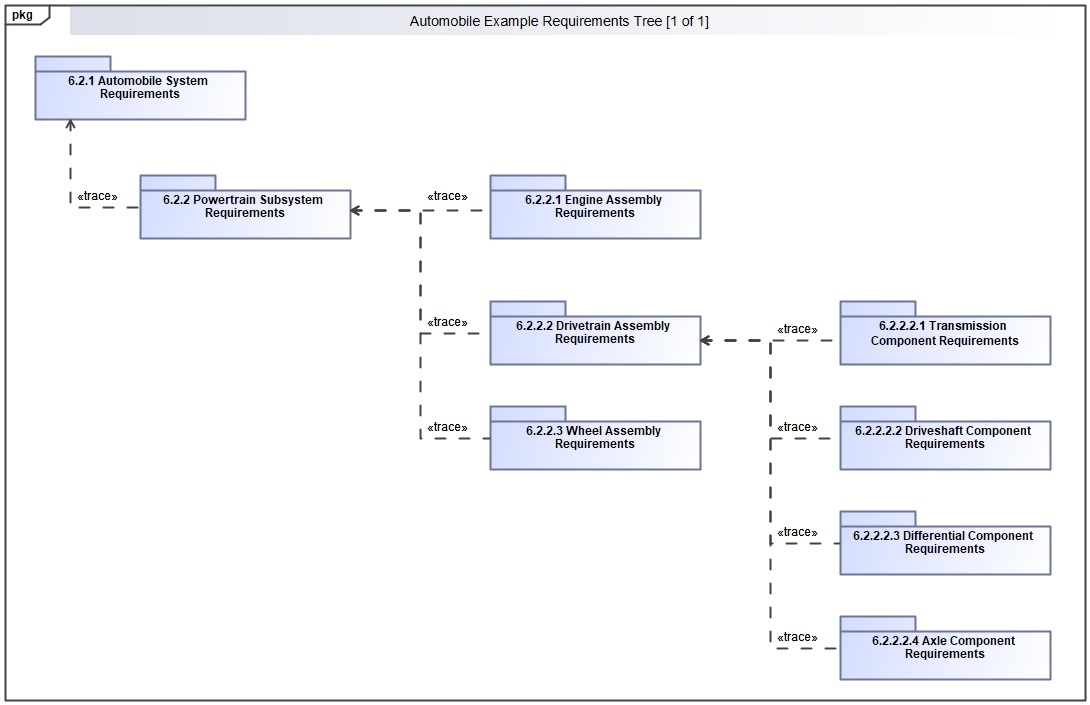
Requirements definition is an iterative and recursive process performed concurrently with the Architecture Definition Process. Upon determination of the system hierarchy, a requirement tree can be established showing the system level requirements and the supporting requirements at the lower-level elements of the hierarchy. Figure 3 shows an example flow from system requirement to lower-level requirements, and an example requirement tree is shown in Figure 4.
要求定義は、アーキテクチャ定義(Architecture Definition)プロセスと並行して行われる、反復的かつ再帰的なプロセスである。システム階層が決まれば、システムレベルの要求事項と、それらを支える下位レベルの要素の要求事項とを示す要求ツリーを確立できる。図3はシステム要求事項から下位レベルの要求事項へのフローの例を示し、図4は要求ツリーの例を示す。
Figure 3. Example Flow of System Requirements with to Lower-level Requirements. This figure is reprinted with permission of Lou Wheatcraft. All other rights are reserved by the copyright owner.
図3. システム要求事項から下位レベルの要求事項へのフローの例。本図は Lou Wheatcraft の許可を得て転載した。その他のすべての権利は著作権者が留保する。
この図は原典のページに掲載されています。権利の都合により本サイトでは省略しています。原典で見る
図中の英語
Allocation is the process by which the requirements at one level of the physical architecture are assigned to those entities at the next lower level of the architecture that have a role in the implementation of the allocated requirement. This involves an analysis where the project team determines what “role”, if any, each subsystem or system element at the next level of the architecture has in the implementation of the requirement being allocated. Requirements generated at the lower level are referred to as child requirements of an allocated parent requirement.
割り当てとは、物理アーキテクチャのあるレベルの要求事項を、一段下のレベルのアーキテクチャのエンティティのうち、割り当てられた要求事項の実装において役割を持つものに割り振るプロセスである。これには、一段下のレベルのアーキテクチャの各サブシステムまたはシステム要素が、割り当てられる要求事項の実装においてどのような「役割」を持つか(持つとすれば)をプロジェクトチームが判断する分析が含まれる。下位レベルで生成された要求事項は、割り当てられた親要求事項の子要求事項と呼ばれる。
An important concept associated with allocation is budgeting. Budget refers to the total value of a parameter defined at the system level. The system requirement value may be decomposed to ensure the lower-level elements contribute their portion, enabling the system level to achieve its total value. Budgeted quantities result in requirements that have a dependency - a change in one will result in the need to change another. Budgeted values can include mass (weight), power usage, bandwidth, time, and quality attributes).
割り当てに関連する重要な概念として、予算配分がある。予算とは、システムレベルで定義されたパラメータの総値を指す。システム要求値は、下位レベルの要素がその分担に寄与することを確実にするために分解でき、それによってシステムレベルで総値を達成できるようになる。予算配分された量は、依存関係を持つ要求事項を生む。1つが変更されると、もう1つを変更する必要が生じる。予算配分される値には、質量(重量)、電力使用量、帯域幅、時間、品質属性が含まれ得る。
For each part of the architecture, an external diagram provides the ability to address interactions between the SoI and external systems (Figure 5).
アーキテクチャの各部分について、外部インタフェース(interface)図は、SoI と外部システムとの間の相互作用を扱うことを可能にする(図5)。
Figure 5. Interfaces Address Interactions between Systems. This figure is reprinted with permission of Lou Wheatcraft. All other rights are reserved by the copyright owner.
図5. インタフェースはシステム間の相互作用を扱う。本図は Lou Wheatcraft の許可を得て転載した。その他のすべての権利は著作権者が留保する。
この図は原典のページに掲載されています。権利の都合により本サイトでは省略しています。原典で見る
The phrase “interface requirement” refers to the specific form or template for a functional requirement that deals with an interaction of a system across an interface boundary with another system. Writing interface requirements is a three-step process (INCOSE NRM 2022):
「インタフェース要求」という語句は、別のシステムとのインタフェース境界をまたぐシステムの相互作用を扱う機能要求の、特定の形式またはテンプレートを指す。インタフェース要求の作成は、3ステップのプロセスである(INCOSE NRM 2022):
1. Identify the interface boundaries and interactions across those boundaries.
1. インタフェース境界と、それらの境界をまたぐ相互作用を特定する。
2. Define the interactions across the interface boundaries (the characteristics of what is crossing the boundary, and media involved).
2. インタフェース境界をまたぐ相互作用(境界を越えるものの特性と、関与する媒体)を定義する。
3. Write the interface requirements.
3. インタフェース要求を書く。
Example interface requirement:
インタフェース要求の例:
• The System shall send telemetry to the Ground System as defined in ICD 123, Table X.
• システムは、ICD 123 の表Xで定義されるとおりに、地上システムへテレメトリを送信しなければならない。
Requirements can be recorded and managed via a document, database, or in the form of a model:
要求事項は、文書、データベース、またはモデルの形で記録・管理できる:
• Models provide the capability to address completeness in terms of functions, inputs to those functions, sources of those inputs, outputs, and customers (destinations/users) for those outputs.
• モデルは、機能、それらの機能への入力、それらの入力の情報源、出力、それらの出力の顧客(宛先/ユーザー)という観点から、完全性を扱うことを可能にする。
• Models help facilitate communication by making complex systems and processes easier to understand (a picture is worth a thousand words….).
• モデルは、複雑なシステムやプロセスを理解しやすくすることで、コミュニケーションを円滑にするのに役立つ(1枚の絵は千の言葉に値する……)。
• Models enable the capture of interdependencies of requirements to other aspects of the system dataset, such as inputs, needs, architecture, test cases, etc.
• モデルは、要求事項と、入力、ニーズ、アーキテクチャ、テストケースなど、システムデータセットの他の側面との相互依存関係を取り込むことを可能にする。
• Models enable quantitative analyses and execution of simulations.
• モデルは、定量的な分析やシミュレーションの実行を可能にする。
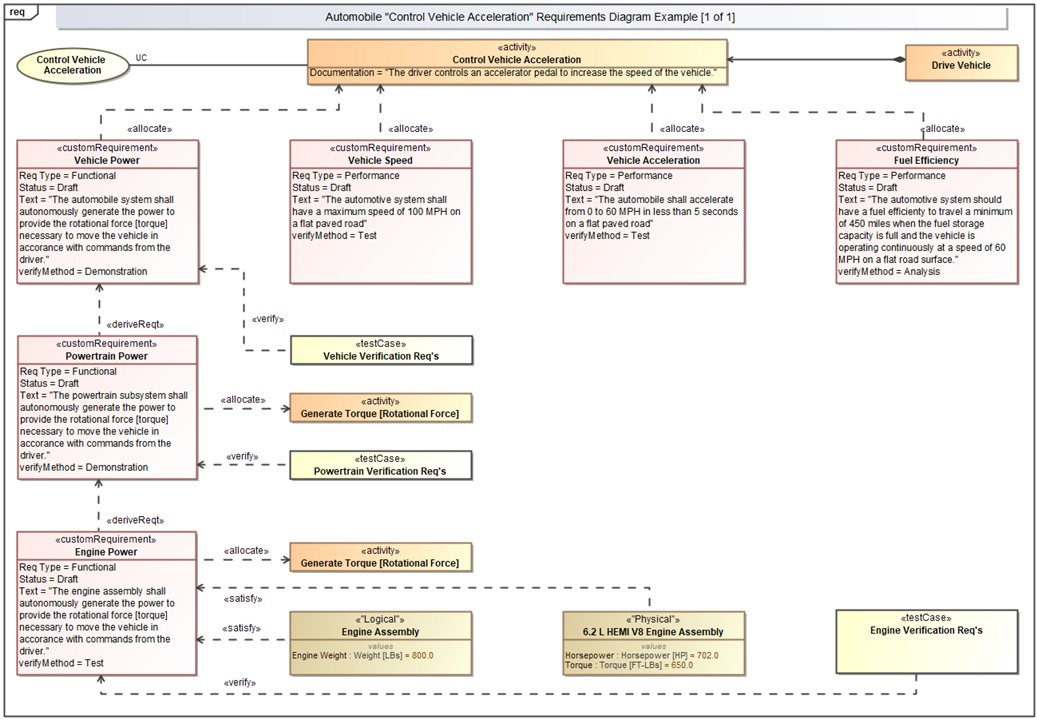
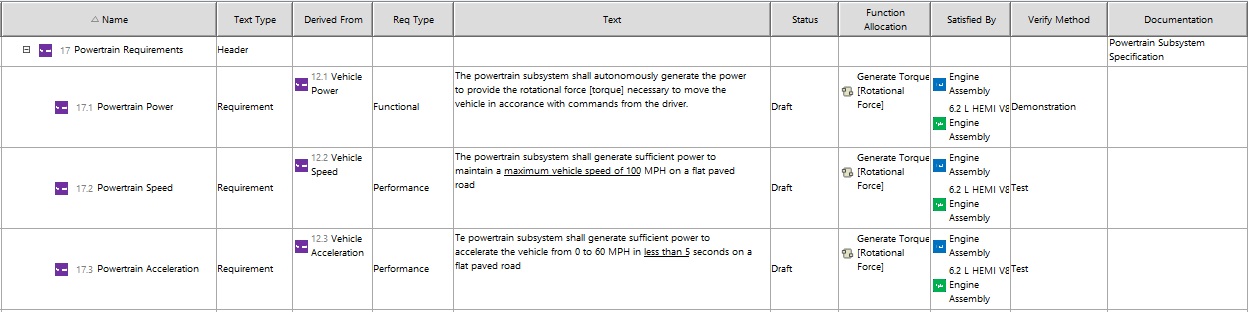
In MBSE, the model form of requirements can be expressed as a diagram (Figure 6) or within a table in the modeling tool (Figure 7), using well-formed textual statements as part of a requirement model element. Refer to Requirements Management for further guidance on usage of tools associated with textual and model requirements.
MBSE では、要求事項のモデル形式は、要求モデル要素の一部としてよく形成されたテキストステートメントを用いて、図(図6)として、あるいはモデリングツール内の表(図7)として表すことができる。テキスト形式とモデル形式の要求事項に関連するツールの使い方についてのさらなる指針は、「要求管理(Requirements Management)」を参照のこと。
図中の英語
図中の英語
When initially generating a set of requirements, there is often a set of parameters which may require future analysis to determine their actual value. One common method to do this is to use a placeholder in the requirement statement to indicate the requirement is drafted, yet further work is needed before it is considered complete. When a value is unknown, a common approach is to use the "To Be Determined" (TBD) indication within the requirement statement, in place of an actual value. When a value is determined but confidence is low (e.g., feasibility has not been assessed), a method to reflect this is to use the "To Be Resolved" (TBR) indication next to the value. Together, TBRs and TBDs are referred to generically as "TBXs". Keeping track of TBXs allows for awareness of the maturity of the requirements throughout the life cycle and is a valuable metric to evaluate completion and maturity of the integrated set of needs and set of design input requirements.
要求事項の集合を最初に生成する時点では、実際の値を決めるために今後の分析を必要とし得る一連のパラメータが存在することが多い。これに対処する一般的な方法の1つは、要求ステートメントの中にプレースホルダを用いて、その要求事項は起草済みではあるものの、完全とみなされるまでにはさらなる作業が必要であることを示すことである。値が未知の場合の一般的なアプローチは、実際の値の代わりに、要求ステートメントの中で「未決定(To Be Determined)」(TBD)という表示を用いることである。値は決まっているが、その値の妥当性に確信が持てない場合(例えば、実現可能性が評価されていない場合)、これを反映するには、値の横に「未解決(To Be Resolved)」(TBR)という表示を用いる方法がある。TBR と TBD は総称して「TBX」と呼ばれる。TBX を追跡することで、ライフサイクルを通じて要求事項の成熟度を把握でき、これは統合されたニーズの集合と設計入力要求事項の集合の完成度と成熟度を評価するための貴重なメトリクスとなる。
TBXs can lead to risk if not addressed by the project team prior to significant work in establishing the design solution. TBX management is the process of identifying the TBXs in a requirement set, establishing the work needed to resolve closure of the issue, identifying the owner of the work, and systematically iterating through and completing the actions to enable removal of these placeholders in the requirements.
TBX は、設計ソリューションの確立に向けた重要な作業に入る前にプロジェクトチームが対処しておかないと、リスクにつながり得る。TBX 管理とは、要求事項の集合の中の TBX を特定し、課題をクローズするために必要な作業を定め、その作業の所有者を特定し、要求事項の中のこれらのプレースホルダを除去できるよう、アクションを体系的に繰り返し実施して完了させるプロセスである。
Traceability is a powerful way to manage the design input requirements, especially across levels and across subsystems and system elements within a specific level as well as manage the requirements across the life cycle. Traceability helps ensure the requirements trace to their needs, and that they are correct and complete. Traceability also helps identify allocation of requirements to lower-level system elements of the architecture. Traceability is used to access any impacts of changes to requirements or other types of data across the life cycle, enabling insight into whether that change is beneficial or costly.
トレーサビリティは設計入力要求事項を管理する強力な方法であり、特にレベルをまたいで、また特定のレベル内のサブシステムやシステム要素をまたいで要求事項を管理するのに役立つほか、ライフサイクルを通じた要求事項の管理にも役立つ。トレーサビリティは、要求事項がそのニーズへトレースされていること、そして要求事項が正しく完全であることを確実にするのに役立つ。また、トレーサビリティは、アーキテクチャの下位レベルのシステム要素への要求事項の割り当てを特定するのにも役立つ。トレーサビリティは、ライフサイクルを通じて要求事項やその他のデータへの変更が及ぼす影響を評価するために用いられ、その変更が有益なのか、それともコストがかさむのかを見通せるようにする。
Defining a traceability relationship model at the beginning of the project enables an understanding of which relationships will be established and managed via traceability throughout the development of the SoI. An example traceability model is shown in Figure 8 (INCOSE NRM 2022).
プロジェクトの開始時にトレーサビリティ関係モデルを定義しておくことで、SoI の開発を通じて、どの関係をトレーサビリティによって確立し管理するのかを理解できる。トレーサビリティモデルの例を図8に示す(INCOSE NRM 2022)。
Figure 8. Example Traceability Model. This figure is reprinted with permission of Lou Wheatcraft. All other rights are reserved by the copyright owner.
図8. トレーサビリティモデルの例。本図は Lou Wheatcraft の許可を得て転載した。その他のすべての権利は著作権者が留保する。
この図は原典のページに掲載されています。権利の都合により本サイトでは省略しています。原典で見る
A best practice is to do early planning for how the project will perform system verification. Defining the system verification success criteria, strategy, and method when the requirements are generated helps ensure the requirement statements are worded properly, are within the scope of the project plans, and demonstrate they have the characteristic of "verifiable". This information can be captured within the attributes defined for the requirement.
ベストプラクティスは、プロジェクトがシステム検証(system verification)をどのように行うかを早期に計画することである。要求事項を生成する際にシステム検証の成功基準、戦略、方法を定義することは、要求ステートメントが適切に表現され、プロジェクト計画のスコープ内にあり、「検証可能」という特性を備えていることを示すのに役立つ。この情報は、要求事項に対して定義された属性の中に取り込むことができる。
Requirements should be assessed to gauge whether they are well-formed and that they meet the intent of the needs from which they were transformed. Concepts behind assessment of the requirements are captured with the terms "requirement verification" and "requirement validation", which are not the same concepts described for system verification and system validation.
要求事項は、よく形成されているか、また変換元のニーズの意図を満たしているかを測るために評価されるべきである。要求事項の評価の背後にある概念は、「要求検証」と「要求妥当性確認」という用語で捉えられる。これらは、システム検証とシステム妥当性確認について述べられた概念とは同じではない。
• Requirement verification activities address: Are the requirements well-formed, i.e., do the individual requirements and sets of requirements have the characteristics and follow the rules defined in the organizations criteria for well-formed requirements?
• 要求検証アクティビティは次の問いを扱う:要求事項はよく形成されているか。すなわち、個々の要求事項と要求事項の集合は、よく形成された要求事項に関する組織の基準で定められた特性を備え、規則に従っているか。
• Requirement validation activities address: Do we have the right requirements, i.e., do the requirements clearly communicate the intent of the needs, parent requirements, and other sources from which they were transformed, in a language understandable by the architectural definition, design definition, and manufacturing/coding teams? Validation addresses if the requirements are correct and are also achievable.
• 要求妥当性確認アクティビティは次の問いを扱う:正しい要求事項を持っているか。すなわち、要求事項は、変換元のニーズ、親要求事項、その他の情報源の意図を、アーキテクチャ定義、設計定義、製造/コーディングの各チームが理解できる言葉で明確に伝えているか。妥当性確認は、要求事項が正しく、かつ達成可能であるかを扱う。
There are several methods that can be used to verify and validate requirements, such as standard peer review techniques and comparison of each requirement against a set of requirements characteristics and the integrated set of needs. For requirements communicated in a textual form, guidelines exist for writing well-formed requirements; they include recommendations about the syntax of requirements statements, wording (exclusions, representation of concepts, etc.), and characteristics (specific, measurable, achievable, feasible, testable, etc.) (INCOSE GtWR 2023).
要求事項を検証し妥当性確認するために用いることのできる方法はいくつかあり、標準的なピアレビュー技法や、各要求事項を要求特性の集合および統合されたニーズの集合と照らし合わせる方法などがある。テキスト形式で伝えられる要求事項については、よく形成された要求事項を書くためのガイドラインがあり、そこには要求ステートメントの構文、文言(除外、概念の表現など)、特性(具体的、測定可能、達成可能、実現可能、テスト可能など)に関する推奨事項が含まれている(INCOSE GtWR 2023)。
The System Requirements Definition process results in a variety of artifacts:
システム要求定義プロセスからは、さまざまな成果物が得られる:
• well-formed requirements recorded in models, databases, or documentation,
• モデル、データベース、または文書に記録された、よく形成された要求事項
• requirement tree,
• 要求ツリー
• traceability of requirements to other data,
• 要求事項から他のデータへのトレーサビリティ
• defined interactions across boundaries,
• 境界をまたぐ、定義された相互作用
• performance budgets, and
• 性能予算
• initial system verification plans.
• 初期のシステム検証計画
Requirements Management (RM) is performed to ensure alignment of the system, subsystem, and system element requirements with other representations, analyses, and artifacts of the system across the life cycle. It includes providing an understanding of the requirements, obtaining commitment, managing changes, maintaining bi-directional traceability among the requirements and with the rest of the system definition, and alignment with project resources and schedule. The Requirements Management article provides additional guidance on methods for performing requirements management.
要求管理(Requirements Management、RM)は、システム、サブシステム、システム要素の要求事項と、ライフサイクルを通じたシステムの他の表現、分析、成果物との整合を確実にするために行われる。これには、要求事項に対する理解をもたらすこと、コミットメントを得ること、変更を管理すること、要求事項間およびシステム定義の他の部分との双方向トレーサビリティを維持すること、プロジェクトのリソースやスケジュールとの整合を図ることが含まれる。「要求管理(Requirements Management)」の記事では、要求管理を行う方法に関する追加の指針を提供している。
INCOSE. 2022. INCOSE Needs and Requirements Manual (NRM), version 1.1. INCOSE-TP-2021-002-01.
INCOSE. 2023. INCOSE Guide to Writing Requirements (GtWR), version 4. INCOSE-TP-2006-004-04.
ISO/IEC/IEEE. 2018. Systems and Software Engineering - Requirements Engineering. Geneva, Switzerland: International Organization for Standardization (ISO)/International Electrotechnical Commission (IEC)/ Institute of Electrical and Electronics Engineers (IEEE), ISO/IEC/IEEE 29148.
ISO/IEC/IEEE. 2023.Systems and Software Engineering - System Life Cycle Processes. Geneva, Switzerland: International Organization for Standardization (ISO)/International Electrotechnical Commission (IEC), Institute of Electrical and Electronics Engineers (IEEE). ISO/IEC/IEEE 15288:2023.
INCOSE. 2023. Systems Engineering Handbook: A Guide for System Life Cycle Processes and Activities, version 5.0. Hoboken, NJ, USA: John Wiley and Sons, Inc, ISBN: 978-1-118-99940-0.
INCOSE. 2022. INCOSE Needs and Requirements Manual (NRM), version 1.1. INCOSE-TP-2021-002-01.
INCOSE. 2022. INCOSE Guide to Needs and Requirements (GtNR), version 1. INCOSE-TP-2021-003-01.
INCOSE. 2023. INCOSE Guide to Writing Requirements (GtWR), version 4. INCOSE-TP-2006-004-04.
INCOSE. 2022. INCOSE Guide to Verification and Validation (GtVV), version 1. INCOSE-TP-2021-004-01.
*INCOSE Requirements Working Group YouTube Channel
• [INCOSE Requirements Working Group YouTube Channel](https://www.youtube.com/@incoserwg891)