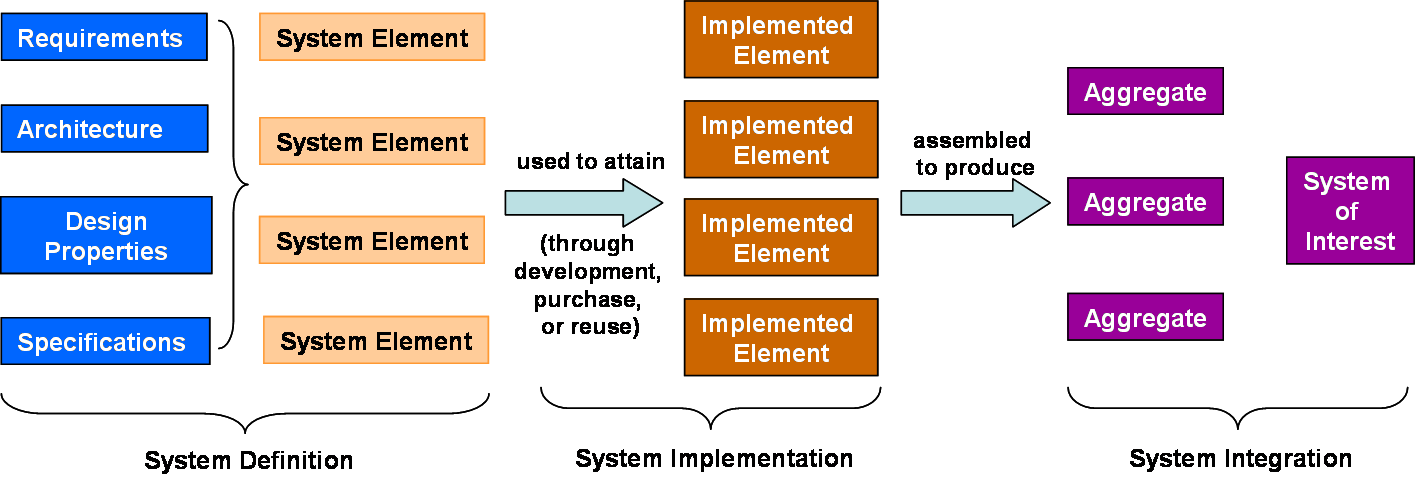
図1. システム定義の出力とシステム実装との関係の単純化。システム実装は、システムとサブシステムを生み出すために必要なシステム要素を生み出す。(SEBoK Original)
System Implementation
System Implementation uses the structure created during architectural design and the results of system analysis to construct system elements that meet the stakeholder needs and requirements and system requirements developed in the early life cycle phases. These system elements are then integrated to form intermediate aggregates and finally the complete system-of-interest (SoI). See System Integration.
システム実装(System Implementation)は、アーキテクチャ設計(architectural design)の際に作成された構造とシステム分析の結果を用いて、初期のライフサイクル(life cycle)フェーズで策定されたステークホルダーのニーズと要求事項(stakeholder needs and requirements)およびシステム要求事項(system requirements)を満たすシステム要素を構築する。これらのシステム要素はその後統合されて中間の集合体(aggregates)を形成し、最終的には完全な対象システム(system-of-interest、SoI)となる。システム統合を参照のこと。
Implementation is the process that actually yields the lowest-level system elements in the system hierarchy (system breakdown structure). System elements are made, bought, or reused. Production involves the hardware fabrication processes of forming, removing, joining, and finishing, the software realization processes of coding and testing, or the operational procedures development processes for operators' roles. If implementation involves a production process, a manufacturing system which uses the established technical and management processes may be required.
実装とは、システム階層(システム分解構造)における最下位レベルのシステム要素を実際に生み出すプロセスである。システム要素は、製作されるか、購入されるか、再利用される。生産には、成形、除去、接合、仕上げというハードウェア製造プロセス、コーディングとテストというソフトウェア実現プロセス、あるいはオペレータの役割のための運用手順開発プロセスが含まれる。実装が生産プロセスを伴う場合は、確立された技術プロセスと管理プロセスを用いる製造システムが必要になることがある。
The purpose of the implementation process is to design and create (or fabricate) a system element conforming to that element’s design properties and/or requirements. The element is constructed employing appropriate technologies and industry practices. This process bridges the system definition processes and the integration process. Figure 1 portrays how the outputs of system definition relate to system implementation, which produces the implemented (system) elements required to produce aggregates and the SoI.
実装プロセスの目的は、その要素の設計特性および/または要求事項に適合するシステム要素を設計し、作成(または製造)することである。その要素は、適切な技術と業界の慣行を用いて構築される。このプロセスは、システム定義プロセスと統合プロセスとの橋渡しをする。図1は、システム定義の出力がシステム実装とどのように関係するかを示している。システム実装は、集合体と SoI を生み出すのに必要な、実装された(システム)要素を生み出す。
図中の英語
During the implementation process, engineers apply the design properties and/or requirements allocated to a system element to design and produce a detailed description. They then fabricate, code, or build each individual element using specified materials, processes, physical or logical arrangements, standards, technologies, and/or information flows outlined in detailed descriptions (drawings or other design documentation). A system element will be verified against the detailed description of properties and validated against its requirements.
実装プロセスでは、エンジニアはシステム要素に割り当てられた設計特性および/または要求事項を適用して、その要素を設計し、詳細な設計記述を作成する。次に、詳細な記述(図面またはその他の設計文書)に示された所定の材料、プロセス、物理的または論理的な配置、標準、技術、および/または情報フローを用いて、個々の要素を製造、コーディング、または構築する。システム要素は、特性の詳細な記述に照らして検証され、その要求事項に照らして妥当性確認される。
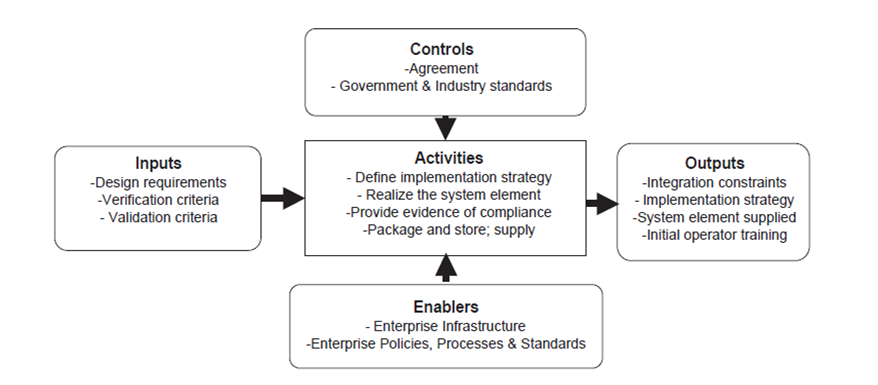
If subsequent verification and validation (V&V) actions or configuration audits reveal discrepancies, recursive interactions occur, which includes predecessor activities or processes, as required, to mitigate those discrepancies and to modify, repair, or correct the system element in question. Figure 2 provides the context for the implementation process from the perspective of the U.S. Defense Acquisition University (DAU).
その後の検証と妥当性確認(V&V)の活動や構成監査によって不一致が明らかになった場合は、必要に応じて先行する活動やプロセスを含む再帰的な相互作用が生じ、それらの不一致を軽減するとともに、当該システム要素を修正、修理、または是正する。図2は、米国国防取得大学(DAU)の観点から見た実装プロセスのコンテキストを示している。
図中の英語
Such figures provide a useful overview of the systems engineering (SE) community’s perspectives on what is required for implementation and what the general results of implementation may be. These are further supported by the discussion of implementation inputs, outputs, and activities found in the National Aeronautics and Space Association's (NASA's) Systems Engineering Handbook (NASA 2007). It is important to understand that these views are process -oriented. While this is a useful model, examining implementation only in terms of process can be limiting.
このような図は、実装に何が必要か、また実装の一般的な結果がどのようなものになり得るかについての、システムズエンジニアリング(systems engineering、SE)コミュニティの視点を概観するうえで有用である。これらはさらに、National Aeronautics and Space Association(NASA)の『Systems Engineering Handbook』(NASA 2007)における、実装の入力、出力、アクティビティに関する議論によって裏付けられている。これらの見方がプロセス指向であることを理解しておくことが重要である。これは有用なモデルではあるが、実装をプロセスの観点だけで検討するのは限定的になり得る。
Depending on the technologies and systems chosen when a decision is made to produce a system element, the implementation process outcomes may generate constraints to be applied on the architecture of the higher-level system; those constraints are normally identified as derived system requirements and added to the set of system requirements applicable to this higher-level system. The architectural design must take those constraints into account.
システム要素を生産すると決定した際に選択した技術とシステムによっては、実装プロセスの成果から、上位レベルシステムのアーキテクチャに適用すべき制約が生じる場合がある。それらの制約は通常、派生システム要求事項として特定され、この上位レベルシステムに適用可能なシステム要求事項の集合に追加される。アーキテクチャ設計では、それらの制約を考慮しなければならない。
If the decision is made to purchase or reuse an existing system element, it must be identified as a constraint or system requirement applicable to the architecture of the higher-level system. Conversely, the implementation process may involve some adaptation or adjustments to the system requirement in order to be integrated into a higher-level system or aggregate.
既存のシステム要素を購入または再利用すると決定した場合、その要素は、上位レベルシステムのアーキテクチャに適用可能な制約またはシステム要求事項として特定されなければならない。逆に、実装プロセスでは、上位レベルシステムまたは集合体に統合するために、システム要求事項に何らかの適応や調整を加える場合がある。
Implementation also involves packaging, handling, and storage, depending on the concerned technologies and where or when the system requirement needs to be integrated into a higher-level aggregate. Developing the supporting documentation for a system requirement, such as the manuals for operation, maintenance, and/or installation, is also a part of the implementation process; these artifacts are utilized in the system deployment and use phase. The system element requirements and the associated verification and validation criteria are inputs to this process; these inputs come from the architectural design process detailed outputs.
実装には、関係する技術と、システム要求事項が上位レベルの集合体に統合される場所や時期に応じて、梱包、取り扱い、保管も含まれる。運用、保守、および/または設置のためのマニュアルなど、システム要求事項を支援する文書の開発も実装プロセスの一部である。これらの成果物は、システムの配備と使用のフェーズで利用される。システム要素の要求事項と、それに関連する検証と妥当性確認の基準は、このプロセスへの入力である。これらの入力は、アーキテクチャ設計プロセスの詳細な出力から得られる。
Execution of the implementation process is governed by both industrial and government standards and the terms of all applicable agreements. This may include conditions for packaging and storage, as well as preparation for use activities, such as operator training. In addition, packaging, handling, storage, and transportation (PHS&T) considerations will constrain the implementation activities. For more information, refer to the discussion of PHS&T in the System Deployment and Use article. The developing or integrating organization will likely have enterprise-level safety practices and guidelines that must also be considered.
実装プロセスの実行は、業界標準と政府標準の両方、および適用可能なすべての合意の条件に従う。これには、梱包と保管の条件や、オペレータ訓練などの使用準備アクティビティが含まれる場合がある。さらに、梱包、取り扱い、保管、輸送(PHS&T)に関する考慮事項が実装アクティビティを制約する。詳細については、System Deployment and Use の記事における PHS&T の議論を参照のこと。開発または統合を行う組織は、エンタープライズレベルの安全慣行とガイドラインを持っている可能性が高く、それらも考慮しなければならない。
The following major activities and tasks are performed during this process:
このプロセスでは、以下の主要なアクティビティとタスクが実施される。
• Define the implementation strategy - Implementation process activities begin with detailed design and include developing an implementation strategy that defines fabrication and coding procedures, tools and equipment to be used, implementation tolerances, and the means and criteria for auditing configuration of resulting elements to the detailed design documentation. In the case of repeated system element implementations (such as for mass manufacturing or replacement elements), the implementation strategy is defined and refined to achieve consistent and repeatable element production; it is retained in the project decision database for future use. The implementation strategy contains the arrangements for packing, storing, and supplying the implemented element.
• 実装戦略を定義する - 実装プロセスのアクティビティは詳細設計から始まり、製造とコーディングの手順、使用するツールと設備、実装の公差、および結果として得られる要素の構成を詳細設計文書に照らして監査するための手段と基準を定義する実装戦略の策定を含む。システム要素の実装が繰り返される場合(大量生産や交換要素など)には、一貫した再現性のある要素生産を実現するために、実装戦略を定義し洗練させる。実装戦略は、将来の使用に備えてプロジェクトの決定データベースに保持される。実装戦略には、実装された要素の梱包、保管、供給に関する取り決めが含まれる。
• Realize the system element - Realize or adapt and produce the concerned system element using the implementation strategy items as defined above. Realization or adaptation is conducted with regard to standards that govern applicable safety, security, privacy, and environmental guidelines or legislation and the practices of the relevant implementation technology. This requires the fabrication of hardware elements, development of software elements, definition of training capabilities, drafting of training documentation, and the training of initial operators and maintainers.
• システム要素を実現する - 上記で定義した実装戦略の項目を用いて、当該システム要素を実現または適応させ、生産する。実現または適応は、適用可能な安全、セキュリティ、プライバシー、環境に関するガイドラインや法令を規定する標準、および関連する実装技術の慣行に配慮して行う。これには、ハードウェア要素の製造、ソフトウェア要素の開発、訓練能力の定義、訓練文書の起草、初期のオペレータと保守員の訓練が必要となる。
• Provide evidence of compliance - Record evidence that the system element meets its requirements and the associated verification and validation criteria as well as the legislation policy. This requires the conduction of peer reviews and unit testing, as well as inspection of operation and maintenance manuals. Acquire measured properties that characterize the implemented element (weight, capacities, effectiveness, level of performance, reliability, availability, etc.).
• 適合の証拠を提供する - システム要素が、その要求事項と関連する検証と妥当性確認の基準、および法令方針を満たしていることの証拠を記録する。これには、ピアレビューとユニットテストの実施、および運用マニュアルと保守マニュアルの検査が必要となる。実装された要素を特徴づける測定特性(重量、容量、有効性、性能レベル、信頼性、可用性など)を取得する。
• Package, store, and supply the implemented element - This should be defined in the implementation strategy.
• 実装された要素を梱包し、保管し、供給する - これは実装戦略の中で定義しておくべきである。
This process may create several artifacts such as:
*implementation tools
This process handles the ontology elements shown in Table 1 below.
このプロセスでは、以下のような複数の成果物が作成される場合がある。
このプロセスでは、下記の表1に示すオントロジー要素を扱う。
表1. システム要素の実装において扱われる主要なオントロジー要素。(SEBoK Original)
| +Table 1. Main Ontology Elements as Handled within System Element Implementation. (SEBoK Original) |
| Element |
|---|
| Definition |
| Implemented Element |
| An implemented element is a system element that has been implemented. In the case of hardware it is marked with a part/serial number. |
| Measured Property |
| A measured property is a characteristic of the implemented element established after its implementation. The measured properties characterize the implemented system element when it is completely realized, verified, and validated. If the implemented element complies with a design property, the measured property should equal the design property. Otherwise one must identify the difference or non-conformance which treatment could conclude to modify the design property and possibly the related requirements, or to modify (correct, repair) the implemented element, or to identify a deviation. |
| 要素 | 定義 | 属性(例) |
|---|---|---|
| 実装された要素 | 実装された要素とは、実装済みのシステム要素である。ハードウェアの場合は、部品番号/シリアル番号が付けられる。 | 識別子、名前、説明、タイプ(ハードウェア、ソフトウェアアプリケーション、ソフトウェア部品、機械部品、電気部品、電子部品、オペレータの役割、手順、プロトコル、マニュアルなど) |
| 測定特性 | 測定特性とは、実装後に確定される、実装された要素の特性である。測定特性は、実装されたシステム要素が完全に実現され、検証され、妥当性確認されたときに、その要素を特徴づける。実装された要素が設計特性に適合している場合、測定特性は設計特性と等しくなるはずである。そうでない場合は、差異または不適合を特定しなければならない。その処置の結果、設計特性と、場合によっては関連する要求事項を変更すること、実装された要素を変更(是正、修理)すること、または逸脱を特定することになり得る。 | 識別子、名前、説明、タイプ(有効性、可用性、信頼性、保全性、重量、容量など)、値、単位など |
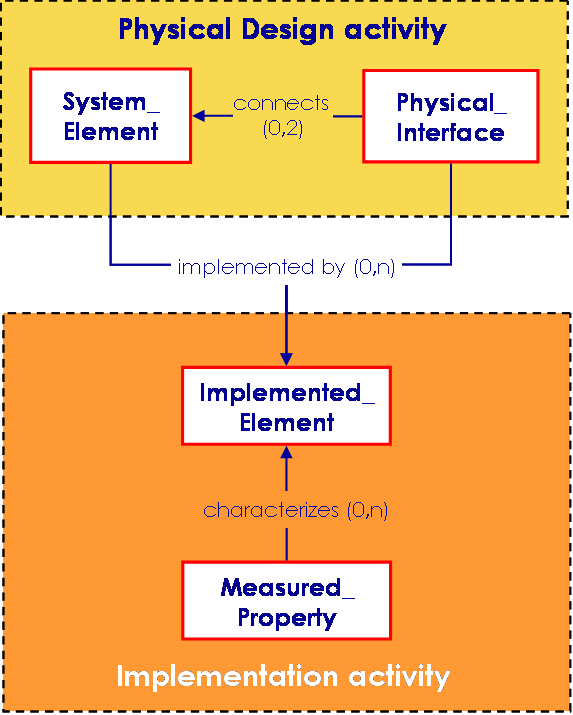
The main relationships between ontology elements are presented in Figure 3.
オントロジー要素間の主要な関係を図3に示す。
図中の英語
There are many software tools available in the implementation and integration phases. The most basic method would be the use of N-squared diagrams as discussed in Jeff Grady’s book System Integration (Grady 1994).
実装と統合のフェーズで利用できるソフトウェアツールは数多くある。最も基本的な手法は、Jeff Grady の著書『System Integration』(Grady 1994)で論じられている N-squared ダイアグラムを用いることだろう。
Proper implementation checking and correctness should include testing to determine if the implemented element (i.e., piece of software, hardware, or other product) works in its intended use. Testing could include mockups and breadboards, as well as modeling and simulation of a prototype or completed pieces of a system. Once this is completed successfully, the next process would be system integration.
適切な実装のチェックと正確性には、実装された要素(すなわち、ソフトウェア、ハードウェア、またはその他の製品の一部)が意図された用途で機能するかどうかを判断するためのテストが含まれるべきである。テストには、モックアップやブレッドボードのほか、プロトタイプやシステムの完成部分のモデリングとシミュレーションが含まれ得る。これが首尾よく完了すれば、次のプロセスはシステム統合となる。
DAU. February 19, 2010. Defense acquisition guidebook (DAG). Ft. Belvoir, VA, USA: Defense Acquisition University (DAU)/U.S. Department of Defense.
DAU. February 19, 2010. "Defense acquisition guidebook (DAG)". Ft. Belvoir, VA, USA: Defense Acquisition University (DAU)/U.S. Department of Defense.
Grady, J.O. 1994. System integration. Boca Raton, FL, USA: CRC Press, Inc.
Grady, J.O. 1994. "System integration." Boca Raton, FL, USA: CRC Press, Inc.
NASA. 2007. Systems Engineering Handbook. Washington, D.C.: National Aeronautics and Space Administration (NASA), NASA/SP-2007-6105.
NASA. 2007. "Systems Engineering Handbook." Washington, D.C.: National Aeronautics and Space Administration (NASA), NASA/SP-2007-6105.
DAU. 2010. Defense Acquisition Guidebook (DAG). Ft. Belvoir, VA, USA: Defense Acquisition University (DAU)/U.S. Department of Defense (DoD). February 19, 2010.
DAU. 2010. "Defense Acquisition Guidebook (DAG)". Ft. Belvoir, VA, USA: Defense Acquisition University (DAU)/U.S. Department of Defense (DoD). February 19, 2010.
Grady, J.O. 1994. System Integration. Boca Raton, FL, USA: CRC Press, Inc.
Grady, J.O. 1994. "System Integration". Boca Raton, FL, USA: CRC Press, Inc.
ISO/IEC/IEEE. 2015. Systems and Software Engineering - System Life Cycle Processes. Geneva, Switzerland: International Organization for Standardization (ISO)/International Electrotechnical Commission (IEC), Institute of Electrical and Electronics Engineers. ISO/IEC/IEEE 15288:2015.
ISO/IEC/IEEE. 2015. "Systems and Software Engineering - System Life Cycle Processes." Geneva, Switzerland: International Organization for Standardization (ISO)/International Electrotechnical Commission (IEC), Institute of Electrical and Electronics Engineers. ISO/IEC/IEEE 15288:2015.
NASA. 2007. Systems Engineering Handbook. Washington, D.C.: National Aeronautics and Space Administration (NASA), NASA/SP-2007-6105.
NASA. 2007. "Systems Engineering Handbook." Washington, D.C.: National Aeronautics and Space Administration (NASA), NASA/SP-2007-6105.
Faisandier, A. 2012. Systems Architecture and Design. Belberaud, France: Sinergy'Com.
Faisandier, A. 2012. "Systems Architecture and Design". Belberaud, France: Sinergy'Com.