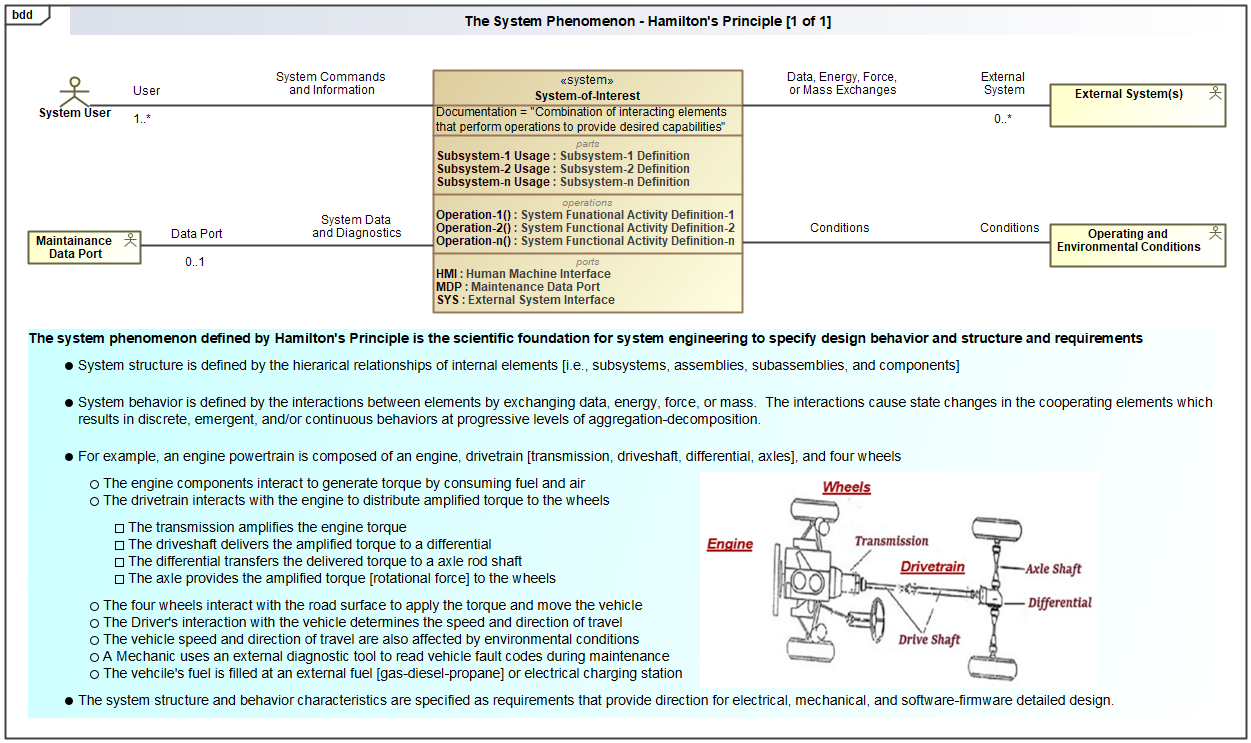
The System Phenomenon - Hamilton's Principle [1 of 1]
システム現象 ― ハミルトンの原理[1 / 1]
System User
システム利用者
User
利用者
1..*
1..*(1以上)
System Commands and Information
システムコマンドと情報
«system» System-of-Interest
«system» 対象システム
Documentation = Combination of interacting elements that perform operations to provide desired capabilities
ドキュメンテーション = 望ましい能力を提供する操作を実行する、相互作用する要素の組み合わせ
parts
部位(parts)
Subsystem-1 Usage : Subsystem-1 Definition
サブシステム1の使用:サブシステム1の定義
Subsystem-2 Usage : Subsystem-2 Definition
サブシステム2の使用:サブシステム2の定義
Subsystem-n Usage : Subsystem-n Definition
サブシステムnの使用:サブシステムnの定義
operations
操作(operations)
Operation-1() : System Funational Activity Definition-1
操作1():システム機能アクティビティ定義1
Operation-2() : System Functional Activity Definition-2
操作2():システム機能アクティビティ定義2
Operation-n() : System Functional Activity Definition-n
操作n():システム機能アクティビティ定義n
ports
ポート(ports)
HMI : Human Machine Interface
HMI:ヒューマンマシンインターフェース
MDP : Maintenance Data Port
MDP:保守データポート
SYS : External System Interface
SYS:外部システムインターフェース
Data, Energy, Force, or Mass Exchanges
データ、エネルギー、力、質量の交換
External System
外部システム
0..*
0..*(0以上)
External System(s)
外部システム(単数または複数)
Maintainance Data Port
保守データポート
Data Port
データポート
0..1
0..1(0または1)
System Data and Diagnostics
システムデータと診断
Conditions
条件
Operating and Environmental Conditions
運用条件と環境条件
The system phenomenon defined by Hamilton's Principle is the scientific foundation for system engineering to specify design behavior and structure and requirements
System behavior is defined by the interactions between elements by exchanging data, energy, force, or mass. The interactions cause state changes in the cooperating elements which results in discrete, emergent, and/or continuous behaviors at progressive levels of aggregation-decomposition.
The system structure and behavior characteristics are specified as requirements that provide direction for electrical, mechanical, and software-firmware detailed design.
本記事では、製品開発、統合、検証のために、システムモデリング言語(Systems Modeling Language)[SysML]を用いたモデルベースのシステムアーキテクチャ設計定義アプローチを述べる。このアプローチにより、デジタルトランスフォーメーションの設計イニシアチブは、他の設計工学分野[EE、ME、SW]と同様にモデルベースシステムズエンジニアリング(Model-Based System Engineering)[MBSE]のプラクティスを採用できるようになる。
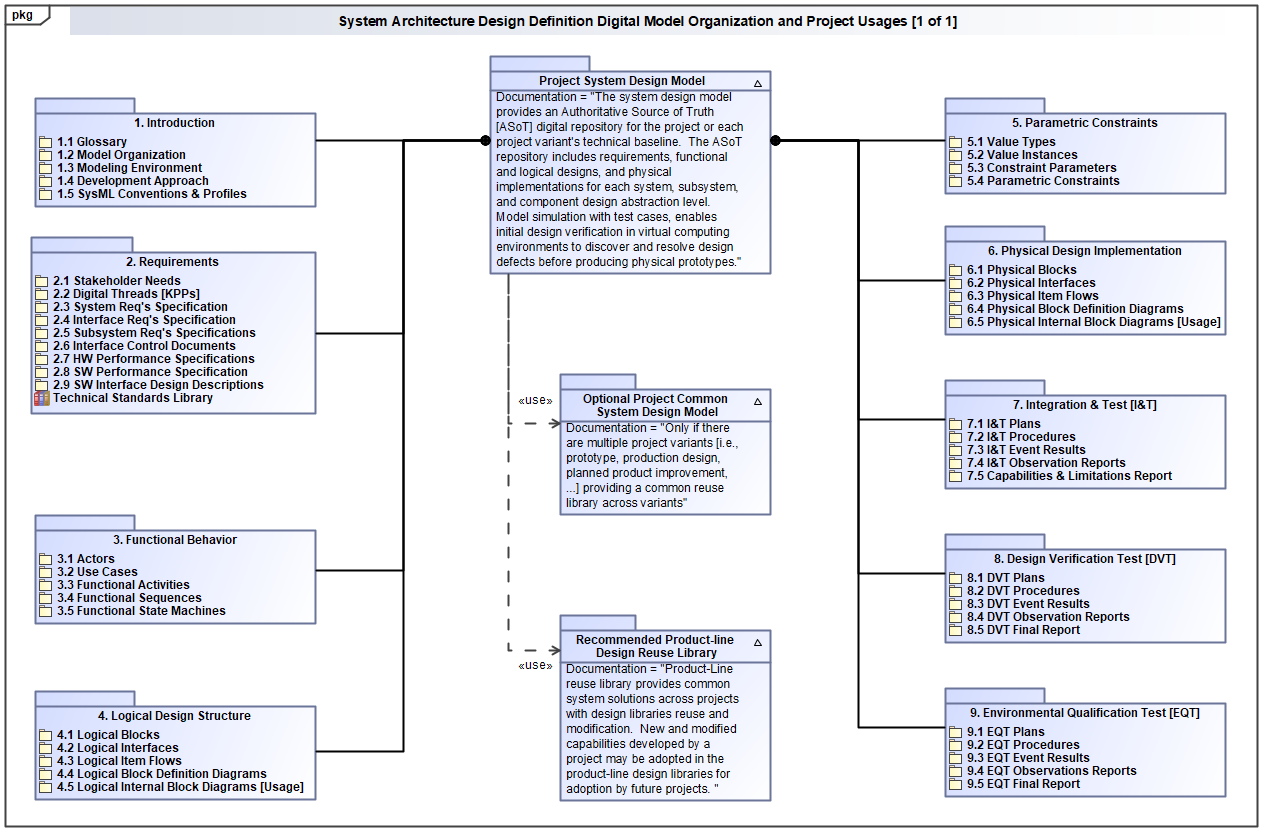
SysML は、関連する要求事項へのトレーサビリティを備えてシステム設計の要求事項、振る舞い、構造の特性を定義するための、形式的な意味論を持つ業界標準の図式表記法およびテキスト表記法[SysML-v2 で追加]を提供する。システム設計モデルは、システム、サブシステム、コンポーネントの各設計抽象レベルについて要求事項、機能、論理、物理の各設計表現を含む、プロジェクト技術ベースラインの正式な根拠となる情報源(Authoritative Source of Truth)[ASoT]デジタルリポジトリを提供する。エンドツーエンドのシステム「デジタルスレッド」の検証基準を備えた統合システム設計モデルシミュレーション機能により、主要性能パラメータを評価して、設計判断を検証したり、デジタル環境で設計欠陥を発見・解決したりできる。統合シミュレーション機能を備えたシステム設計モデルは、物理システムの権威ある表現としてのシステム「デジタルツイン」を提供する。これには、デジタルスレッドのエンドツーエンドシミュレーションと、システム設計をデジタルに最適化し、進化するミッションと脅威に対応するシステム改善のための設計代替案を探索するのに必要なすべてのデータ、モデル、インフラストラクチャが含まれる。このアプローチは、特定のプロジェクト目標を満たすようテーラリングできる。
System Architecture Design Definition Digital Model Organization and Project Usages [1 of 1]
システムアーキテクチャ設計定義デジタルモデルの構成とプロジェクトでの利用[1 / 1]
1. Introduction
1. 序論
1.1 Glossary
1.1 用語集
1.2 Model Organization
1.2 モデルの構成
1.3 Modeling Environment
1.3 モデリング環境
1.4 Development Approach
1.4 開発アプローチ
1.5 SysML Conventions & Profiles
1.5 SysML の規約とプロファイル
2. Requirements
2. 要求事項
2.1 Stakeholder Needs
2.1 ステークホルダーニーズ
2.2 Digital Threads [KPPs]
2.2 デジタルスレッド[KPP]
2.3 System Req's Specification
2.3 システム要求仕様
2.4 Interface Req's Specification
2.4 インターフェース要求仕様
2.5 Subsystem Req's Specifications
2.5 サブシステム要求仕様
2.6 Interface Control Documents
2.6 インターフェース管理文書
2.7 HW Performance Specifications
2.7 HW 性能仕様
2.8 SW Performance Specification
2.8 SW 性能仕様
2.9 SW Interface Design Descriptions
2.9 SW インターフェース設計記述
Technical Standards Library
技術標準ライブラリ
Project System Design Model
プロジェクトシステム設計モデル
Documentation = The system design model provides an Authoritative Source of Truth [ASoT] digital repository for the project or each project variant's technical baseline. The ASoT repository includes requirements, functional and logical designs, and physical implementations for each system, subsystem, and component design abstraction level. Model simulation with test cases, enables initial design verification in virtual computing environments to discover and resolve design defects before producing physical prototypes.
Documentation = Only if there are multiple project variants [i.e., prototype, production design, planned product improvement, ...] providing a common reuse library across variants
Documentation = Product-Line reuse library provides common system solutions across projects with design libraries reuse and modification. New and modified capabilities developed by a project may be adopted in the product-line design libraries for adoption by future projects.
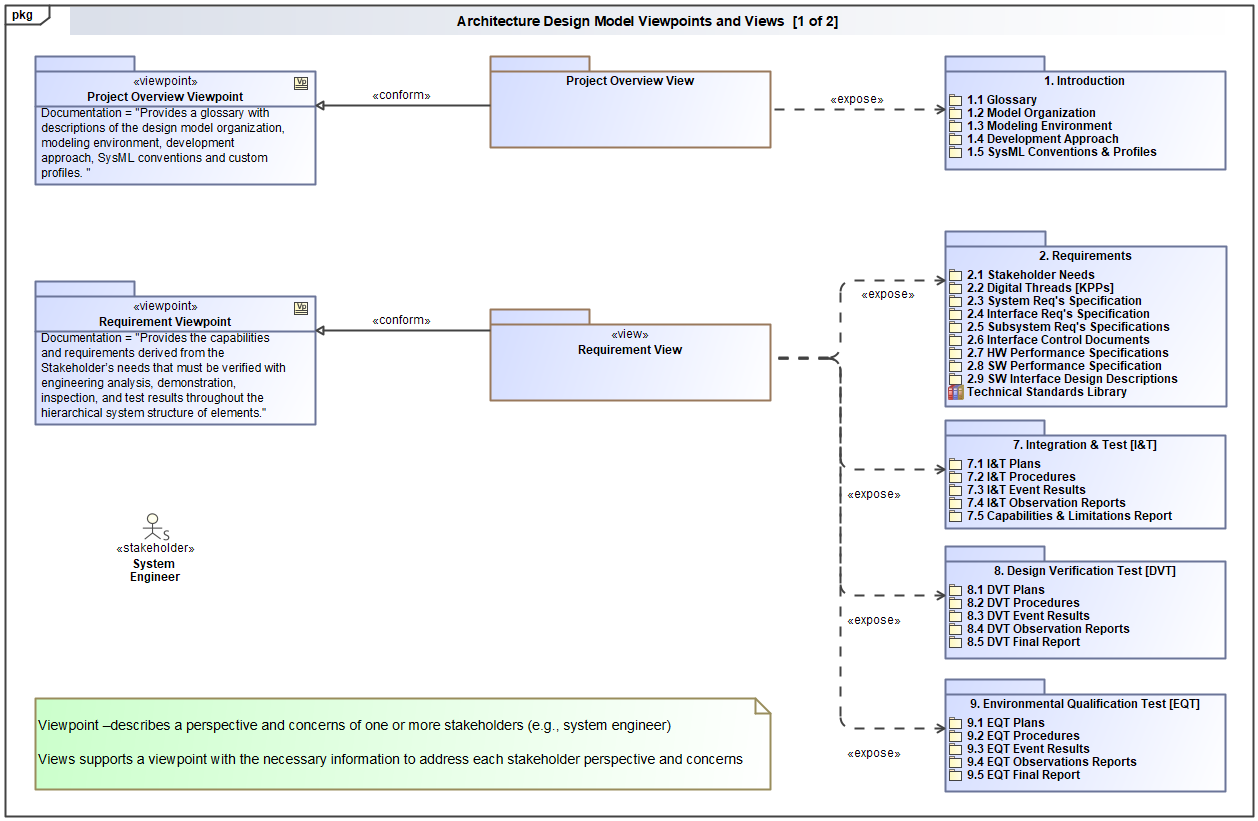
Architecture Design Model Viewpoints and Views [1 of 2]
アーキテクチャ設計モデルのビューポイントとビュー[2の1]
«viewpoint» Project Overview Viewpoint
«viewpoint» プロジェクト概要ビューポイント
Documentation = Provides a glossary with descriptions of the design model organization, modeling environment, development approach, SysML conventions and custom profiles.
Documentation = Provides the capabilities and requirements derived from the Stakeholder's needs that must be verified with engineering analysis, demonstration, inspection, and test results throughout the hierarchical system structure of elements.
Viewpoint –describes a perspective and concerns of one or more stakeholders (e.g., system engineer)
ビューポイント ― 1人以上のステークホルダー(例:システムエンジニア)の視点と関心を記述する
Views supports a viewpoint with the necessary information to address each stakeholder perspective and concerns
ビューは、各ステークホルダーの視点と関心に対処するために必要な情報でビューポイントを支援する
図4b:システムアーキテクチャ設計モデルのビューポイントとビュー。(SEBoK Original)
図中の英語
pkg
pkg(パッケージ図)
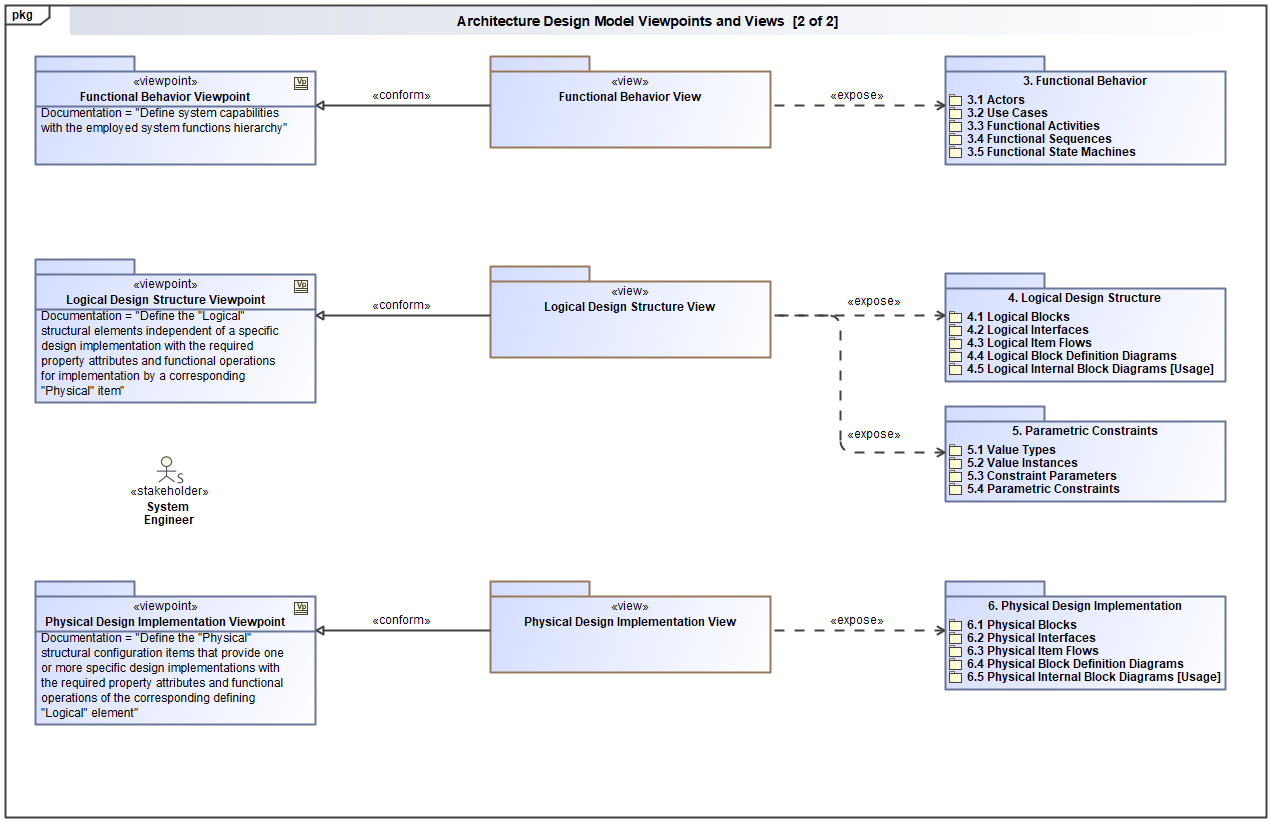
Architecture Design Model Viewpoints and Views [2 of 2]
アーキテクチャ設計モデルのビューポイントとビュー[2の2]
«viewpoint» Functional Behavior Viewpoint
«viewpoint» 機能的振る舞いビューポイント
Documentation = Define system capabilities with the employed system functions hierarchy
ドキュメンテーション = 採用されたシステム機能階層でシステム能力を定義する
«conform»
«conform»(適合)
«view» Functional Behavior View
«view» 機能的振る舞いビュー
«expose»
«expose»(公開)
3. Functional Behavior
3. 機能的振る舞い
3.1 Actors
3.1 アクター
3.2 Use Cases
3.2 ユースケース
3.3 Functional Activities
3.3 機能アクティビティ
3.4 Functional Sequences
3.4 機能シーケンス
3.5 Functional State Machines
3.5 機能ステートマシン
«viewpoint» Logical Design Structure Viewpoint
«viewpoint» 論理設計構造ビューポイント
Documentation = Define the Logical structural elements independent of a specific design implementation with the required property attributes and functional operations for implementation by a corresponding Physical item
Documentation = Define the Physical structural configuration items that provide one or more specific design implementations with the required property attributes and functional operations of the corresponding defining Logical element
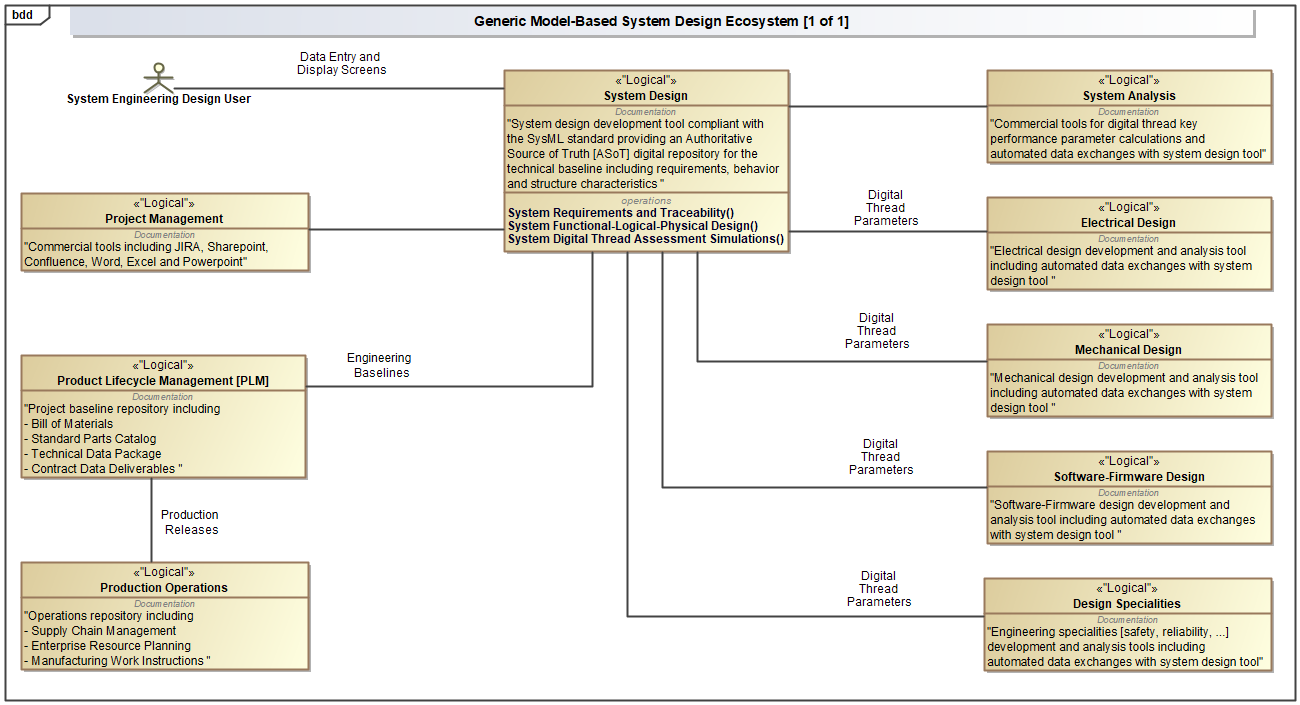
Generic Model-Based System Design Ecosystem [1 of 1]
汎用モデルベースシステム設計エコシステム[1 / 1]
System Engineering Design User
システムエンジニアリング設計利用者
Data Entry and Display Screens
データ入力と表示画面
«Logical» System Design
«Logical» システム設計
Documentation = System design development tool compliant with the SysML standard providing an Authoritative Source of Truth [ASoT] digital repository for the technical baseline including requirements, behavior and structure characteristics
Documentation = Project baseline repository including - Bill of Materials - Standard Parts Catalog - Technical Data Package - Contract Data Deliverables
Documentation = Engineering specialities [safety, reliability, ...] development and analysis tools including automated data exchanges with system design tool
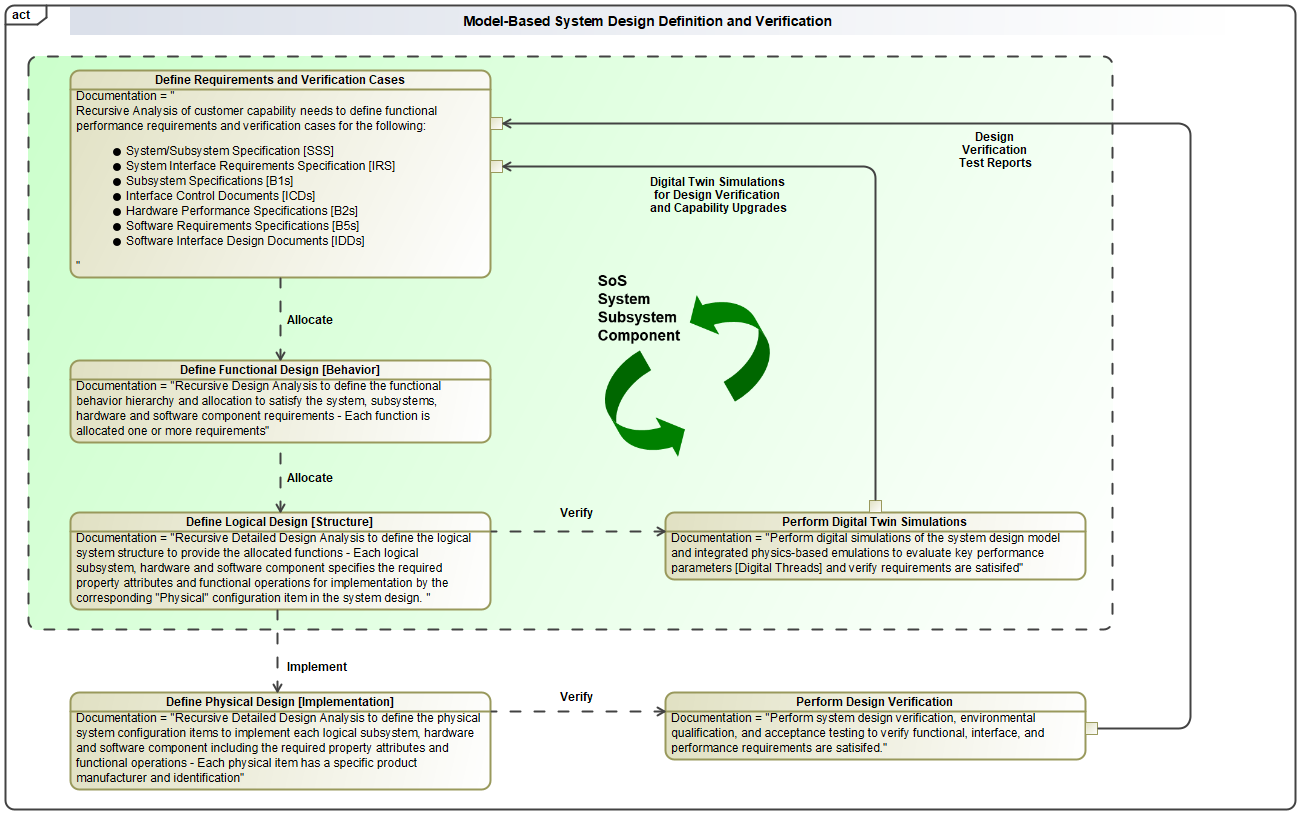
Model-Based System Design Definition and Verification
モデルベースシステム設計定義と検証
Define Requirements and Verification Cases
要求事項と検証ケースを定義する
Documentation = Recursive Analysis of customer capability needs to define functional performance requirements and verification cases for the following:
Documentation = Recursive Design Analysis to define the functional behavior hierarchy and allocation to satisfy the system, subsystems, hardware and software component requirements - Each function is allocated one or more requirements
Documentation = Recursive Detailed Design Analysis to define the logical system structure to provide the allocated functions - Each logical subsystem, hardware and software component specifies the required property attributes and functional operations for implementation by the corresponding Physical configuration item in the system design.
Documentation = Perform digital simulations of the system design model and integrated physics-based emulations to evaluate key performance parameters [Digital Threads] and verify requirements are satisfied
Digital Twin Simulations for Design Verification and Capability Upgrades
設計検証と能力アップグレードのためのデジタルツインシミュレーション
SoS System Subsystem Component
SoS、システム、サブシステム、コンポーネント
Design Verification Test Reports
設計検証試験レポート
Implement
実装する
Define Physical Design [Implementation]
物理設計を定義する[実装]
Documentation = Recursive Detailed Design Analysis to define the physical system configuration items to implement each logical subsystem, hardware and software component including the required property attributes and functional operations - Each physical item has a specific product manufacturer and identification
Documentation = Perform system design verification, environmental qualification, and acceptance testing to verify functional, interface, and performance requirements are satisfied.
Bill Schindel; ''SEBoK Part-3: Systems Engineering STEM Overview''
Will Roper. ''There is No Spoon: The New Digital Acquisition Reality''. US Air Force: Assistant Secretary of the Air Force, 07-October 2020
U.S. DOD; ''Digital Engineering Strategy''; Office of the Deputy Assistant Secretary of Defense for Systems Engineering. June 2018.
主要参考文献
INCOSE, ''Systems Engineering Handbook – 5<sup>th</sup> Edition: A Guide for System Life Cycle Processes and Activities'', John Wiley & Sons Ltd., 2023
ISO/IEC/IEEE-15288, ''Systems and Software Engineering: System Life Cycle Processes'', 2023
ISO/IEC/IEEE-42010; Software, ''Systems and Enterprise – Architecture Description''; 2022
OMG; ''Systems Modeling Language [SysML] Standard – v1.7''; August 2022
OMG; ''Systems Modeling Language [SysML] Standard – v2 beta 2''; April 2024
OMG; ''Model Driven Architecture Guide''; 2003
Lenny Delligatti; ''SysML Distilled: A brief Guide to the Systems Modeling Language'' Addison-Wesley Professional; 2013
Sanford Friedenthal, Alan Moore, Rick Steiner; ''A Practical Guide to SysML: The Systems Modeling Language – 3<sup>rd</sup> Edition''; Morgan Kaufmann; October 2014
Tim Weilkiens, Jesko G. Lamm, Stephan Roth, Markus Walker; ''Model-Based System Architecture – 2<sup>nd</sup> Edition''; John Wiley & Sons Ltd., 2023
Tim Weilkiens; ''Systems Engineering with SysML/UML: Modeling, Analysis, Design''; Morgan Kaufmann; 2011
Mark Maier; ''The Art of Systems Architecting – 3<sup>rd</sup> Edition''; CRC Press; 2009
Jon Holt, Simon Perry; ''SysML for Systems Engineering''; The Institution of Engineering and Technology; 2008
追加参考文献
Charles Wasson; ''System Analysis, Design, and Development – Concepts, Principles, and Practices''; John Wiley & Sons; 2006
Katsuhiko Ogata; ''Modern Control Engineering''; Prentice-Hall Inc; 1970