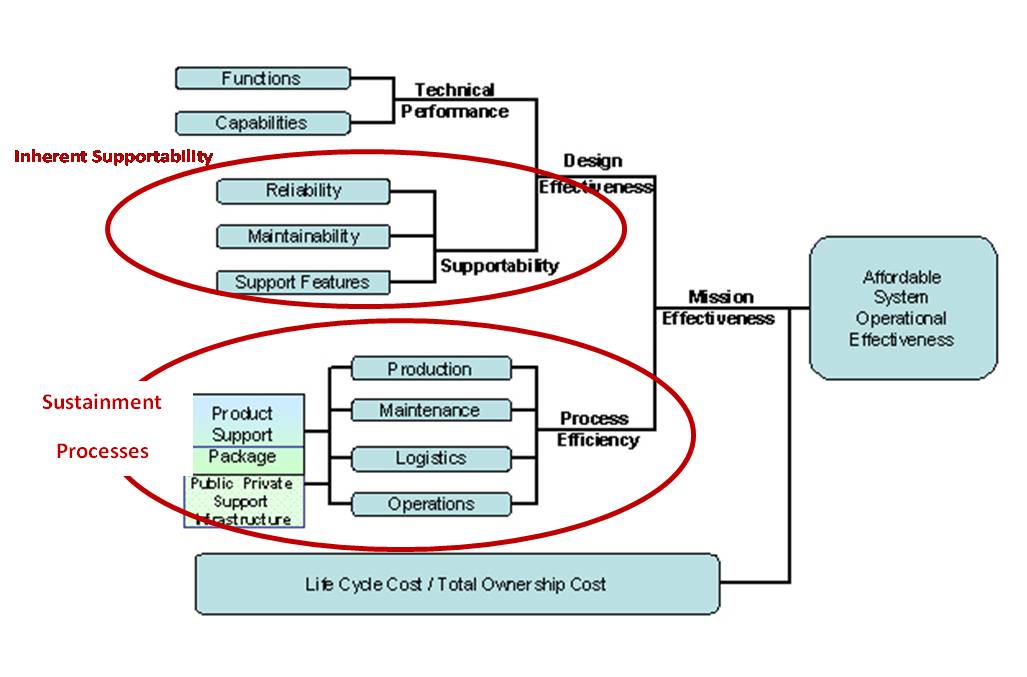
図1. 手頃なシステム運用有効性(DAU Guidebook 2010)。Defense Acquisition University(DAU)/米国国防総省(DoD)により公開。
Logistics
There are several definitions for logistics within systems engineering (SE) and the definition used will determine what activities are considered part of logistics. The SEBoK defines logistics as the science of planning and implementing the acquisition and use of the resources necessary to sustain the operation of a system.
ロジスティクス(logistics)には、システムズエンジニアリング(systems engineering、SE)においていくつかの定義があり、どの定義を用いるかによって、ロジスティクスの一部とみなされるアクティビティが決まる。SEBoK では、ロジスティクスを、システムの運用を維持するのに必要な資源の取得と使用を計画し、実施する科学と定義する。
The ability to sustain the operation of a system is determined by the inherent supportability of the system (a function of design) and the processes used to sustain the functions and capabilities of the system in the context of the end user. Figure 1, below, shows a Defense Acquisition University (DAU) model of the SE aspects for consideration in logistics and logistics planning (DAU 2010).
システムの運用を維持する能力は、システム本来の支援可能性(設計に依存する)と、エンドユーザーのコンテキストにおいてシステムの機能と能力を維持するために用いられるプロセスによって決まる。下の図1は、ロジスティクスおよびロジスティクス計画において考慮すべき SE の側面について、Defense Acquisition University(DAU)のモデルを示したものである(DAU 2010)。
図中の英語
The focus of sustainment planning is to influence the inherent supportability of the system and to plan the sustainment capabilities and processes that will be used to sustain system operations.
維持(sustainment)計画の焦点は、システム本来の支援可能性に影響を及ぼすことと、システム運用の維持に用いる維持の能力とプロセスを計画することにある。
Sustainment influence requires an understanding of the concept of operations (ConOps), system missions, mission profiles, and system capabilities to understand the rationale behind functional and performance priorities. Understanding the rationale paves the way for decisions about necessary trade-offs between system performance, availability, and life cycle cost (LCC), with impact on the cost effectiveness of system operation, maintenance, and logistics support. There is no single list of sustainment considerations or specific way of grouping them as they are highly inter-related. They include: compatibility, interoperability, transportability, reliability, maintainability, manpower, human factors, safety, natural environment effects (including occupational health, habitability; see Systems Engineering and Environmental Engineering); diagnostics & prognostics (including real-time maintenance data collection), and corrosion protection & mitigation. The following are key design considerations:
維持の観点から本来の支援可能性に働きかけるには、機能と性能の優先順位の背後にある根拠を理解するために、組織レベルの運用概念(Concept of Operations、ConOps)、システムのミッション(missions)、ミッションプロファイル、システム能力(system capabilities)の理解が必要である。根拠を理解することで、システム性能、可用性(availability)、ライフサイクルコスト(life cycle cost、LCC)の間で必要となるトレードオフに関する意思決定への道が開かれ、システム運用(system operation)、保全(maintenance)、ロジスティクス支援の費用対効果に影響が及ぶ。維持の考慮事項は相互に強く関連しているため、それらを示す単一のリストや、それらをグループ化する決まった方法は存在しない。考慮事項には、互換性、相互運用性(interoperability)、輸送性、信頼性(reliability)、保全性(maintainability)、人員(manpower)、人間要因(human factors)、安全性(safety)、自然環境の影響(職業衛生、居住性を含む。Systems Engineering and Environmental Engineering を参照)、診断と故障予測(リアルタイムの保全データ収集を含む)、腐食の防止と緩和が含まれる。主要な設計上の考慮事項は以下のとおりである。
• Architecture Considerations - The focus on openness, modularity, scalability, and upgradeability is critical to implementing an incremental acquisition strategy. In addition, the architecture attributes that expand system flexibility and affordability can pay dividends later when obsolescence and end-of-life issues are resolved through a concerted technology refreshment strategy. Trade-offs are often required relative to the extent each attribute is used.
• アーキテクチャの考慮事項(Architecture Considerations) - 開放性、モジュール性、拡張性、アップグレード性を重視することは、漸進的な取得戦略を実施するうえで極めて重要である。さらに、システムの柔軟性(flexibility)と手頃さを高めるアーキテクチャ属性は、陳腐化や寿命終了の問題を協調的な技術リフレッシュ戦略によって解決する際に、後になって利益をもたらし得る。各属性をどの程度用いるかについては、トレードオフが必要になることが多い。
• Reliability Considerations: - Reliability is critical because it contributes to a system's effectiveness as well as its suitability in terms of logistics burden and the cost to fix failures. For each system, there is a level of basic reliability that must be achieved for the system to be considered useful. Reliability is also one of the most critical elements in determining the logistics infrastructure and footprint. Consequently, system reliability should be a primary focus during design (along with system technical performance, functions, and capabilities). The primary objective is to achieve the necessary probability of operational success and minimize the risk of failure within defined availability, cost, schedule, weight, power, and volume constraints. While performing such analyses, trade-offs should be conducted and dependencies should be explored with system maintainability and integrated with the supportability analysis that addresses support event frequency (i.e. reliability), event duration, and event cost. Such a focus will play a significant role in minimizing the necessary logistics footprint, while maximizing system availability.
• 信頼性の考慮事項(Reliability Considerations) - 信頼性は、システムの有効性に寄与するとともに、ロジスティクスの負担や故障(failures)の修理コストという観点からの適合性にも寄与するため、極めて重要である。各システムには、有用とみなされるために達成しなければならない基本的な信頼性のレベルがある。信頼性はまた、ロジスティクスのインフラとフットプリントを決定するうえで最も重要な要素の1つでもある。したがって、設計段階では、システムの信頼性は、システムの技術的性能、機能、能力とともに、設計時の主要な重点事項とすべきである。第一の目的は、定義された可用性、コスト、スケジュール、重量、電力、体積の制約の中で、必要とされる運用成功の確率を達成し、故障のリスクを最小化することである。こうした分析を行う際には、トレードオフを実施し、システムの保全性との依存関係を探り、支援事象の頻度(すなわち信頼性)、事象の期間、事象のコストを扱う支援可能性分析と統合すべきである。このように焦点を当てることは、必要なロジスティクスのフットプリントを最小化しつつシステムの可用性を最大化するうえで、重要な役割を果たす。
• Maintainability Considerations - The design emphasis on maintainability is to reduce the maintenance burden and supply chain by reducing the time, personnel, tools, test equipment, training, facilities and cost to maintain the system. Maintainability engineering includes the activities, methods, and practices used to design minimal system maintenance requirements (designing out unnecessary and inefficient processes) and associated costs for preventive and corrective maintenance as well as servicing or calibration activities. Maintainability should be a designed-in capability and not an add-on option because good maintenance procedures cannot overcome poor system and equipment maintainability design. The primary objective is to reduce the time it takes for a properly trained maintainer to detect and isolate the failure (coverage and efficiency) and affect repair. Intrinsic factors contributing to maintainability are:
• 保全性の考慮事項(Maintainability Considerations) - 保全性に関する設計上の重点は、システムの保全に要する時間、人員、ツール、試験装置、訓練、施設、コストを削減することによって、保全の負担とサプライチェーンを削減することにある。保全性エンジニアリングには、不要または非効率な工程を設計段階で排除し、システムに必要な保全と、予防保全・事後保全・整備・較正に伴うコストを最小限に抑えるためのアクティビティ、手法、実践が含まれる。優れた保全手順をもってしても、システムや装置の保全性設計の劣悪さは克服できないため、保全性は後付けのオプションではなく、設計に組み込まれた能力であるべきである。第一の目的は、適切に訓練された保全担当者が故障を検出し、切り分け(検出・切り分けの範囲と効率を考慮する)、修理を行うまでの時間を短縮することである。保全性に寄与する本質的な要因は以下のとおりである。
** Modularity - Packaging of components such that they can be repaired via remove and replace action vs. on-board repair. Care should be taken not to over modularize, and trade-offs to evaluate replacement, transportation, and repair costs should be accomplished to determine the most cost-effective approach. ** Interoperability - The compatibility of components with standard interface protocols to facilitate rapid repair and enhancement/upgrade through black box technology using common interfaces. Physical interfaces should be designed so that mating between components can only happen correctly. ** Physical accessibility - The designed-in structural assurance that components which require more frequent monitoring, checkout, and maintenance can be easily accessed. This is especially important in low observable platforms. Maintenance points should be directly visible and accessible to maintainers, including access for corrosion inspection and mitigation. ** Designs that require minimum preventative maintenance including corrosion prevention and mitigation. Emphasis should be on balancing the maintenance requirement over the life cycle with minimal user workload. ** Embedded training and testing when it is determined to be the optimal solution from a total ownership cost (TOC) and materiel availability perspective. ** Human Systems Integration (HSI) to optimize total system performance and minimize life-cycle costs by designing systems and incorporating technologies that (a) require minimal manpower, (b) provide effective training, (c) can be operated and maintained by users, (d) are suitable (habitable and safe with minimal environmental and occupational health hazards), and (e) are survivable (for both the user and the equipment).
- モジュール性(Modularity) - コンポーネントを、機上修理ではなく取り外し・交換によって修理できるようにパッケージ化すること。過度にモジュール化しないよう注意すべきであり、最も費用対効果の高いアプローチを判断するために、交換、輸送、修理のコストを評価するトレードオフを実施すべきである。 - 相互運用性(Interoperability) - 共通のインタフェースを用いるブラックボックス技術によって迅速な修理と強化/アップグレードを容易にするための、標準インタフェースプロトコルとコンポーネントとの互換性。物理的インタフェースは、コンポーネント間の嵌合が正しくしか起こらないように設計すべきである。 - 物理的なアクセス可能性(Physical accessibility) - より頻繁な監視、チェックアウト、保全を必要とするコンポーネントに容易にアクセスできるという、設計に組み込まれた構造上の保証。これは低観測性プラットフォームで特に重要である。保全ポイントは、腐食の検査と緩和のためのアクセスも含め、保全担当者が直接目視でき、アクセスできるようにすべきである。 - 腐食の防止と緩和を含め、最小限の予防保全しか必要としない設計。利用者の作業負荷を最小限に抑えながら、ライフサイクル全体にわたる保全要求のバランスを取ることに重点を置くべきである。 - 総所有コスト(total ownership cost、TOC)と装備・補給品の可用性の観点から最適なソリューションであると判断される場合の、組み込みの訓練と試験(Embedded training and testing)。 - (a)必要な人員が最小限で、(b)効果的な訓練を提供し、(c)利用者が運用・保全でき、(d)適合性があり(環境と職業衛生の危険が最小限で、居住可能かつ安全)、(e)生存性がある(利用者と装置の両方にとって)システムを設計し、技術を取り入れることによって、システム全体の性能を最適化し、ライフサイクルコストを最小化するための人間システム統合(Human Systems Integration、HSI)。
• Support Considerations - Support features cannot be easily added-on after the design is established. Consequently, supportability should be a high priority early in the program's planning and integral to the system design and development process. Support features cut across reliability, maintainability, and the supply chain to facilitate detection, isolation, and timely repair/replacement of system anomalies. These include features for servicing and other activities necessary for operation and support including resources that contribute to the overall support of the system. Typical supportability features include diagnostics, prognostics (see CBM+ Guidebook), calibration requirements, many HSI issues (e.g. training, safety, HFE, occupational health, etc.), skill levels, documentation, maintenance data collection, compatibility, interoperability, transportability, handling (e.g., lift/hard/tie down points, etc.), packing requirements, facility requirements, accessibility, and other factors that contribute to an optimum environment for sustaining an operational system.
• 支援の考慮事項(Support Considerations) - 支援の特徴は、設計が確定した後で簡単に後付けできるものではない。したがって、支援可能性には、プログラム計画の早期段階から高い優先度を与えるべきであり、システムの設計・開発プロセスに不可欠な要素とすべきである。支援の特徴は、信頼性、保全性、サプライチェーンにまたがって、システムの異常の検出、切り分け、適時の修理/交換を容易にする。これには、整備のための特徴や、システム全体の支援に寄与する資源を含め、運用と支援に必要なその他の活動のための特徴が含まれる。典型的な支援可能性の特徴には、診断、予後(CBM+ Guidebook を参照)、較正の要求事項、多くの HSI の問題(例えば、訓練、安全性、HFE、職業衛生など)、技能レベル、文書、保全データ収集、互換性、相互運用性、輸送性、取り扱い(例えば、吊り上げ/固定/結束のポイントなど)、包装の要求事項、施設の要求事項、アクセス可能性のほか、運用システムを維持するための最適な環境に寄与するその他の要因が含まれる。
Process efficiency reflects how well the system can be produced, operated, serviced (including fueling) and maintained. It reflects the degree to which the logistics processes (including the supply chain), infrastructure, and footprint have been balanced to provide an agile, deployable, and operationally effective system.
プロセス効率は、システムをどれだけうまく生産、運用、整備(燃料補給を含む)、保全できるかを反映する。これは、機敏で、配備可能で、運用上有効なシステムを提供するために、ロジスティクスプロセス(サプライチェーンを含む)、インフラ、フットプリントがどの程度バランスよく整えられているかを反映する。
Achieving process efficiency requires early and continuing emphasis on the various logistics support processes along with the design considerations. The continued emphasis is important because processes present opportunities for improving operational effectiveness even after the design-in window has passed via lean-six sigma, supply chain optimization, or other continuous process improvement (CPI) techniques.
プロセス効率を達成するには、設計上の考慮事項とともに、さまざまなロジスティクス支援プロセスに早期から継続的に重点を置く必要がある。継続的な重点が重要なのは、設計で組み込む期間が過ぎた後でも、リーン・シックスシグマ、サプライチェーンの最適化、その他の継続的プロセス改善(continuous process improvement、CPI)の技法を通じて、プロセスが運用有効性を改善する機会をもたらすからである。
The product support package documents the output of supportability analysis and includes details related to the following twelve elements (links below are to excerpts from (NATO RTO 2001):
製品支援パッケージは、支援可能性分析の出力を文書化したものであり、以下の12の要素に関する詳細を含む(以下のリンク先は(NATO RTO 2001)からの抜粋である)。
• Product/information technology (IT) system/medical system support management (integrated life cycle sustainment planning)
• 製品/情報技術(IT)システム/医療システムの支援管理(統合されたライフサイクル維持計画)
** product/IT system/medical system support strategies ** life cycle sustainment planning ** requirements management ** total ownership costs (TOC)/life cycle costs (LCC) planning & management ** Integration and management of product support activities ** configuration management ** production & distribution ** energy, environmental, safety and health (EESH) management ** policies & guidance ** risk management
- 製品/IT システム/医療システムの支援戦略 - ライフサイクル維持計画 - 要求管理 - 総所有コスト(total ownership costs、TOC)/ライフサイクルコスト(life cycle costs、LCC)の計画と管理 - 製品支援アクティビティの統合(Integration)と管理 - 構成管理(configuration management) - 生産と流通 - エネルギー、環境、安全、健康(EESH)管理 - 方針と指針 - リスク管理(risk management)
• Design Interface
• 設計インタフェース(Design Interface)
** reliability ** maintainability ** supportability ** affordability ** configuration management ** safety requirements ** environmental and hazardous materials (HAZMAT) requirements ** human systems integration (HSI) ** calibration ** anti-tamper ** habitability ** disposal ** legal requirements
- 信頼性(reliability) - 保全性(maintainability) - 支援可能性 - 手頃さ - 構成管理(configuration management) - 安全に関する要求事項 - 環境と危険物(HAZMAT)の要求事項 - 人間システム統合(human systems integration、HSI) - 較正 - 改竄防止 - 居住性 - 廃棄 - 法的要求事項
• Sustainment Engineering
• 維持エンジニアリング(Sustainment Engineering)
** failure reporting, analysis, and corrective action system (FRACAS) ** value engineering ** diminishing manufacturing sources and material shortages (DMSMS)
- 故障報告、分析、是正アクションシステム(failure reporting, analysis, and corrective action system、FRACAS) - バリューエンジニアリング - 製造供給源の減少と材料不足(diminishing manufacturing sources and material shortages、DMSMS)
• Supply Support (materiel planning)
• 補給支援(Supply Support)(装備・補給品の計画)
• Maintenance Planning
• 保全計画(Maintenance Planning)
** reliability centered maintenance (RCM) ** maintenance concepts ** levels of maintenance (level of repair analysis) ** condition-based maintenance ** prognostics & health management
- 信頼性中心保全(reliability centered maintenance、RCM) - 保全コンセプト - 保全のレベル(修理レベル分析) - 状態基準保全 - 故障予測と健全性管理
• Support Equipment
• 支援装置(Support Equipment)
• Technical Data
• 技術データ(Technical Data)
• Manpower & Personnel
• 必要人員と要員(Manpower & Personnel)
• Training & Training Support
• 訓練と訓練支援(Training & Training Support)
• Facilities & Infrastructure
• 施設とインフラ(Facilities & Infrastructure)
• Packaging, Handling, Storage, & Transportation
• 包装、取り扱い、保管、輸送(Packaging, Handling, Storage, & Transportation)
• Computer Resources
• コンピュータ資源(Computer Resources)
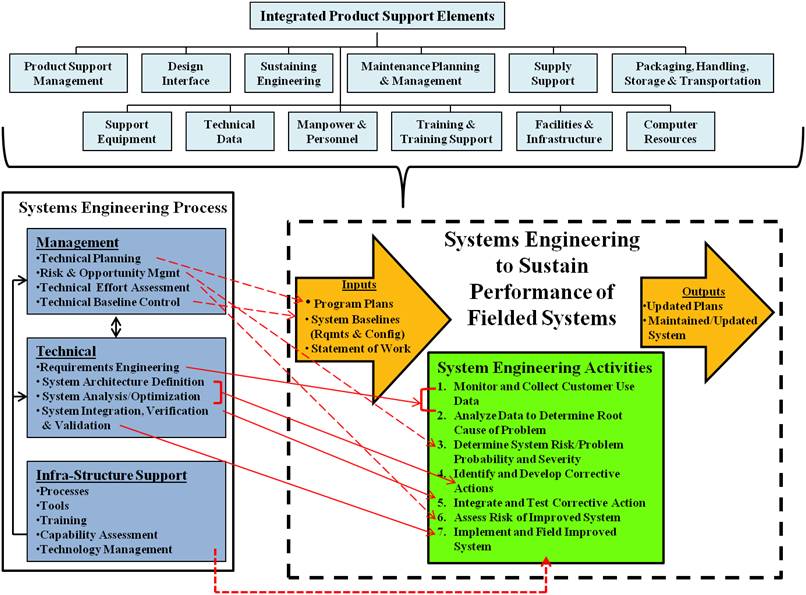
Once the system becomes operational, the results of sustainment planning efforts need to be implemented. SE supports the execution of the twelve integrated product support elements of a sustainment program that strives to ensure the system meets operational performance requirements in the most cost-effective manner over its total remaining life cycle, as illustrated in Figure 2.
システムが運用に入ったら、維持計画の取り組みの結果を実装する必要がある。SE は、図2に示すように、システムが残りのライフサイクル全体にわたって最も費用対効果の高い方法で運用性能の要求事項を満たすよう努める維持プログラムにおいて、12の統合製品支援要素の実行を支援する。
図中の英語
Once a system is put into use, SE is often required to correct problems that degrade continued use, and/or to add new capabilities to improve product performance in the current or a new environment. In the context of integrated product support, these SE activities correspond to the integrated product support (IPS) element Sustaining Engineering. Changes made to fielded systems to correct problems or increase performance should include any necessary adjustments to the IPS elements, and should consider the interrelationships and integration of the elements to maintain the effectiveness of the system’s support strategy.
システムが使用に供されると、SE は、継続使用に支障を来す問題を修正すること、かつ/または、現在の環境や新しい環境で製品性能を改善するために新しい能力を追加することを求められることが多い。統合製品支援の文脈では、これらの SE のアクティビティは、統合製品支援(integrated product support、IPS)要素である 維持エンジニアリング(Sustaining Engineering) に該当する。問題の修正や性能向上のために運用に供されたシステムに加える変更には、IPS 要素に対する必要な調整を含めるべきであり、また、システムの支援戦略の有効性を維持するために、要素間の相互関係と統合を考慮すべきである。
The degree of change required to the product support elements varies with the severity of the problem. Minor problems may require a simple adjustment to a maintenance procedure, a change of supplier, a training course modification or a change to a technical manual. In contrast, problems that require system or component redesign may require engineering change proposals and approvals, IPS element trade studies, business case analysis, and updates to the product support strategy. The focus is to correct problems that degrade continued use, regardless of the degree of severity.
製品支援要素に求められる変更の程度は、問題の重大さによって異なる。軽微な問題であれば、保全手順の簡単な調整、供給者の変更、訓練コースの修正、技術マニュアルの変更で済むことがある。一方、システムやコンポーネントの再設計を要する問題では、技術変更提案とその承認、IPS 要素のトレードスタディ、ビジネスケース分析、製品支援戦略の更新が必要になることがある。重大さの程度にかかわらず、焦点は継続使用に支障を来す問題を修正することにある。
Evolutionary systems provide a strategy for acquisition of mature technology; the system delivers capabilities incrementally, planning for future capability enhancements. A system of systems (SoS) perspective is required for these systems to synchronize the primary and sustainment systems.
進化型システムは、成熟した技術を取得するための戦略を提供する。システムは能力を漸進的に提供し、将来の能力強化を計画する。こうしたシステムでは、一次システムと維持システムを同期させるために、システムオブシステムズ(System of Systems、SoS)の観点が必要となる。
For more information refer to: An Enterprise Framework for Operationally Effective System of Systems Design (Bobinis and Herald 2012.).
詳細については、An Enterprise Framework for Operationally Effective System of Systems Design(Bobinis and Herald 2012)を参照のこと。
Bobinis, J. and T. Herald. 2012. “An enterprise framework for operationally effective system of systems design.” Journal of Enterprise Architecture. Vol. 8, no. 2, May 2012. Available at: https:// www.mendling.com/publications/JEA12-2.pdf.
DAU. 2010. Defense Acquisition Guidebook (DAG). Ft. Belvoir, VA, USA: Defense Acquisition University (DAU)/U.S. Department of Defense (DoD).
NATO RTO. 2001. Logistics Test and Evaluation in Flight Test. Flight Test Techniques Series – Volume 20. Quebec, Canada: North Atlantic Treaty Organization (NATO) Research and Technology Organization (RTO). RTO-AG-300 Vol. 20, AC/323(SCI-010)TP/38. Table of contents available at: https://ftp.rta.nato.int/public//PubFullText/RTO/AG/RTO-AG-300-V20///AG-300-V20-$$TOC.pdf
Blanchard, B.S. 1998. Logistics Engineering and Management. Upper Saddle River, NJ, USA: Prentice Hall.
Blanchard, B. and W. Fabrycky. 2011. Systems Engineering and Analysis, 5th Ed. Englewood Cliffs, NJ, USA: Prentice-Hall.
Bobinis, J. and T. Herald. 2012. “An enterprise framework for operationally effective system of systems design.” Journal of Enterprise Architecture. Vol. 8, no. 2, May 2012. Available at: https:// www.mendling.com/publications/JEA12-2.pdf.
Daganzo, C. 2005. Logistics Systems Analysis, 4th Edition. New York, NY, USA: Springer.
Fabrycky, W.J. and B.S. Blanchard. 1991. Life-Cycle Cost and Economic Analysis. Upper Saddle River, NJ, USA: Prentice-Hall.
Ghiani, G., G. Laporte, and R. Musmanno. 2004. Introduction to Logistics Systems Planning and Control. Hoboken, NJ, USA: Wiley-Interscience.
Jones, J.V. 1995. Integrated Logistics Support Handbook. New York, NY, USA: McGraw Hill.
Barros, L.L. 1998. "The optimization of repair decision using life-cycle cost parameters." IMA Journal of Management Mathematics. Vol. 9, no. 4, p. 403.
Berkowitz, D., J.N. Gupta, J.T. Simpson, and J.B. McWilliams. 2005. Defining and Implementing Performance-Based Logistics in Government. Washington, DC, USA: Defense Technical Information Center. Accessed 6 Sept 2011. Available at: https://handle.dtic.mil/100.2/ADP018510.
Gajpal, P.P., L.S. Ganesh, and C. Rajendran. 1994. "Criticality analysis of spare parts using the analytic hierarchy process." International Journal of Production Economics. Vol. 35, nos. 1-3 pp. 293-297.
MITRE. 2011. "Integrated logistics support." Systems Engineering Guide. Accessed 11 March 2012. Available at: https://www.mitre.org/work/systems_engineering/guide/acquisition_systems_engineering/integrated_logistics_support/.
Murthy, D.N.P. and W.R. Blischke. 2000. "Strategic warranty management: A life-cycle approach." Engineering Management. Vol. 47, no. 1, pp. 40-54.
Northrop Grumman Corporation. 2000. Logistics Systems Engineering. Accessed 6 Sept 2011. Available at: https://www.northropgrumman.com/Capabilities/NavigationSystemsLogisticsSystemsEngineering/Documents/nsd_logistics.pdf.
Solomon, R., P.A. Sandborn, and M.G. Pecht. 2000. "Electronic part life cycle concepts and obsolescence forecasting." IEEE Transactions on Components and Packaging Technologies. Vol. 23, no. 4, pp. 707-717.
Spengler, T. and M. Schroter. 2003. "Strategic management of spare parts in closed-loop supply chains: A system dynamics approach." Interfaces. pp. 7-17.