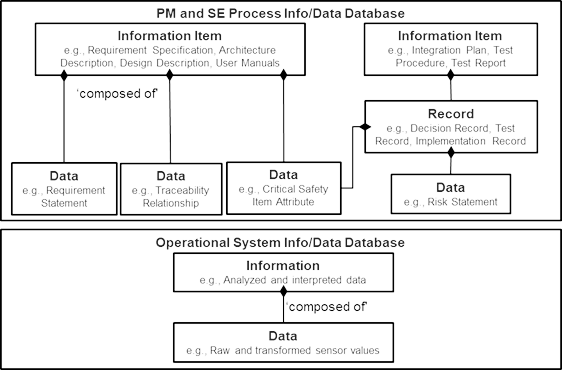
図1 – システムズエンジニアリング(SE)、プロジェクト管理(PM)、システム運用において見られる情報とデータの関係の例。(SEBoK Original)
Information Management
Information management (IM) helps teams access and manage information over its lifecycle, ensuring that the information is relevant, complete, verified, protected, distributed and managed. Simply put, IM is about maintaining a clear, accurate, and accessible picture of information to one or more audiences.
情報管理(Information Management、IM)は、チームが情報のライフサイクル全体を通じて情報にアクセスし、管理できるよう支援し、情報が関連性を持ち、完全で、検証され、保護され、配布され、管理された状態にあることを確実にする。簡単に言えば、IM とは、1つまたは複数の対象者に向けて、明確で正確かつアクセス可能な情報の全体像を維持することである。
As stated in ISO/IEC/IEEE 15288 (6.3.6.1): ’The purpose of the Information Management process is to generate, obtain, confirm, transform, retain, retrieve, disseminate, and dispose of information to designated stakeholders’.
ISO/IEC/IEEE 15288(6.3.6.1)に述べられているとおり、「情報管理プロセスの目的は、指定されたステークホルダーに向けて、情報を生成、入手、確認、変換、保持、取り出し、配布、廃棄することである」。
The INCOSE SE Handbook describes IM as the process that “plans, executes, and controls the provision of information to designated stakeholders that is unambiguous, complete, verifiable, consistent, traceable, and presentable”.
The IM process ensures that necessary information is created, stored, retained, protected, managed, and made easily available to those with a need and who are permitted access. It also ensures that information is disposed of when it is no longer relevant.
The scope of information to be considered is wide, addressing technical, project, organizational, integration, contractual, agreement and user information, and any other information deemed relevant for the organization, all of these designated as ‘information assets’ in this article.
Effective IM enables business objectives, as illustrated in Table 1 below:
INCOSE SE ハンドブックは、IM を「曖昧さがなく、完全で、検証可能で、一貫性があり、追跡可能で、提示可能な情報を、指定されたステークホルダーに提供を計画し、実行し、管理するプロセス」と記述している。
IM プロセスは、必要な情報が作成、保存、保持、保護、管理され、その情報を必要とし、かつアクセスを許可された人々が容易に利用できるようにすることを確実にする。また、情報がもはや関連性を持たなくなったときに廃棄されることも確実にする。
考慮すべき情報の範囲は広く、技術、プロジェクト、組織、統合、契約、合意、ユーザに関する情報のほか、組織にとって関連があると判断されるあらゆる情報を含む。本記事では、これらをすべて「情報資産(information assets)」と呼ぶ。
効果的な IM は、以下の表1に示すように、ビジネス目標の達成を可能にする。
表1. IM が可能にするビジネス目標(SEBoK Original)
| +Table 1: IM Enables Business Objectives (SEBoK Original) |
| Objective |
|---|
| How is IM enabling the objective |
| Operational efficiency |
| Through organizing secured processes for the collection, access and distribution of the information |
| Support analytics and decision-making |
| Through managing, in a controlled way, the tangible and intangible information assets and preserving them against uncontrolled modifications, threats and loss (cybersecurity dispositions against digital threats, resilient storage structures and pre-defined disaster recovery dispositions) |
| Quality and security |
| Through managing, in a controlled way, the tangible and intangible information assets and preserving them against uncontrolled modifications, threats and loss (cybersecurity dispositions against digital threats, resilient storage structures and pre-defined disaster recovery dispositions) |
| Competitiveness and innovation |
| Through providing access to the crucial information needed to make decisions and through the capability to extract meaningful insights from information analysis |
| Compliance |
| Through planning the adequate dispositions and access controls to comply with legal requirements, intellectual property and regulations applicable to information and data |
| 目標 | IM がその目標をどのように可能にするか |
|---|---|
| 運用効率 | 情報の収集、アクセス、配布のためのセキュアなプロセスを組織化することによって |
| 分析と意思決定の支援 | 有形・無形の情報資産を統制された方法で管理し、統制されない変更、脅威、損失からそれらを保全することによって(デジタル脅威に対するサイバーセキュリティ対策、回復力のある保存構造、事前に定義された災害復旧対策) |
| 品質とセキュリティ | 有形・無形の情報資産を統制された方法で管理し、統制されない変更、脅威、損失からそれらを保全することによって(デジタル脅威に対するサイバーセキュリティ対策、回復力のある保存構造、事前に定義された災害復旧対策) |
| 競争力とイノベーション | 意思決定に必要な重要情報へのアクセスを提供すること、および情報分析から意味のある洞察を引き出す能力を提供することによって |
| コンプライアンス | 情報とデータに適用される法的要求事項、知的財産、規制に適合するための適切な対策とアクセス制御を計画することによって |
From a business enterprise perspective, the systems engineer, as well as many other stakeholders involved in systems development, may be involved in several activities that support the management of information across the enterprise and its projects. It may include strategic planning, analyses of technology/business trends, development of applications, understanding operational disciplines, analytics supporting decision-making, resource control techniques, and assessment of organization structures.
ビジネスエンタープライズの観点から見ると、システムズエンジニアは、システム開発に関わる他の多くのステークホルダーと同様に、エンタープライズとそのプロジェクト全体にわたる情報管理を支援するいくつかのアクティビティに関与することがある。これには、戦略的計画策定、技術/ビジネス動向の分析、アプリケーション開発、運用分野の理解、意思決定を支援する分析、資源統制の技法、組織構造の評価が含まれ得る。
Terms like artifact, asset, work product, and documentation are commonly encountered in system engineering projects and are often used interchangeably to refer to information and data without regard to their difference.
アーティファクト(artifact)、資産(asset)、作業成果物(work product)、ドキュメンテーション(documentation)といった用語は、システムズエンジニアリングのプロジェクトでよく目にするものであり、両者の違いを考慮しないまま、情報(information)とデータ(data)のいずれを指す場合にも区別なく使われることが多い。
ISO/IEC/IEEE 15289 describes data as outputs of life cycle processes that can be individually recorded and managed, composable into a structure set and treated as a unit called a record, and part of information items (documentation). Information items (documentation) “are produced and communicated for human use and contain formal elements (such as purpose, scope, and summary), intended to make them usable by their intended audience”.
ISO/IEC/IEEE 15289 は、データを、ライフサイクルプロセスの出力であって、個別に記録・管理でき、構造化された集合にまとめてレコード(record)と呼ばれる単位として扱うことができ、情報項目(ドキュメンテーション)の一部をなすものとして記述している。情報項目(information items)(ドキュメンテーション)は、「人間が使用するために作成・伝達されるものであり、意図された利用者が使用できるようにするための形式的な要素(目的、スコープ、要約など)を含む」。
ISO/IEC/IEEE 15289 also describes the content for the general and specific information items that are inputs and outputs from life cycle processes. (Remark: U.S. DoD projects use MIL-STD-963C to describe the contents of information items).
ISO/IEC/IEEE 15289 は、ライフサイクルプロセスの入力および出力となる一般的な情報項目と固有の情報項目の内容についても記述している。(注:米国 DoD のプロジェクトでは、情報項目の内容を記述するために MIL-STD-963C を使用する)。
Similarly, GEIA- STD-927B defines data as “A representation of facts, concepts, or instructions in a formalized manner suitable for communication, interpretation, or processing by humans or by automatic means” and information as “Data organized in a form that can be interpreted by humans or computers. Note: these definitions are “frequently used to discriminate between uninterpreted measurements (data) and meanings derived from raw data through some form of analysis (information)”.
同様に、GEIA-STD-927B は、データを「人間または自動的手段による伝達、解釈、処理に適した形式化された方法で表された、事実、概念、または指示の表現」と定義し、情報を「人間またはコンピュータが解釈できる形式に組織化されたデータ」と定義している。注:これらの定義は、「解釈されていない測定値(データ)と、何らかの分析によって生データから導き出された意味(情報)とを区別するために頻繁に用いられる」。
Data Management Body of Knowledge (DMBOK) acknowledges that data and information can be differentiated in a similar way if it will better enable communication within an organization. An example of these relationships is shown in Figure 1. Conversely, GEIA-STD-859B defines data as “information that has been recorded in a form or format convenient to move or process”.
データマネジメント知識体系(Data Management Body of Knowledge、DMBOK)は、組織内のコミュニケーションがより円滑になるのであれば、データと情報を同様の方法で区別できることを認めている。これらの関係の例を図1に示す。これに対し、GEIA-STD-859B は、データを「移動または処理に都合のよい形式またはフォーマットで記録された情報」と定義している。
Figure 1 below shows examples of relationships between data and information items in a project. However, it should be noted that this figure only mentions a few examples of data and information items that may have a much broader scope in a project or organization.
以下の図1は、プロジェクトにおけるデータと情報項目の関係の例を示している。ただし、この図が取り上げているのはデータと情報項目のごく一部の例にすぎず、プロジェクトや組織においてはそれらがはるかに広い範囲に及び得ることに留意すべきである。
図中の英語
Using the above-mentioned standards, we can synthesize a convenient definition for information and data: data are raw unstructured values, and information is structured data in context that has been analyzed and interpreted.
上述の標準をもとに、情報とデータについて扱いやすい定義を導き出すことができる。すなわち、データは未加工の構造化されていない値であり、情報は分析・解釈された、文脈を伴う構造化されたデータである。
Even though information and data are different, some organizations may choose not to differentiate between management of the two. The definitions, relationships, use, and management of PM, SE or Operational System information and data should be described in the project’s management plans or system’s configuration information, respectively.
情報とデータは異なるものだが、組織によっては両者の管理を区別しないことを選ぶ場合もある。PM、SE、または運用システムの情報とデータの定義、関係、使用、管理は、それぞれプロジェクトの管理計画またはシステムの構成情報に記述すべきである。
An information asset is any piece or collection of information that must be managed independently.
The information items described by ISO/IEC/IEEE 15289 would be considered as information assets.
Information assets:
*can exist in many tangible or intangible forms in an organization, *are either related to a specific system development project or held at enterprise level and made available to projects as required: e.g., Product Line Engineering information, generic procedures and processes, *may be held in electronic format and/or in physical form: electronic or paper drawings or documentation, microfiche, photographic record, file, database…
Table 2 gives some examples of criteria that may be considered when choosing between formats:
情報資産(information asset)とは、独立して管理しなければならない、あらゆる情報の断片または情報の集まりである。
この定義に従えば、ISO/IEC/IEEE 15289 に記述されている情報項目は、情報資産に当たると考えられる。
情報資産は、
表2は、形式を選択する際に考慮し得る基準の例をいくつか示している。
表2. 電子形式と物理形式(SEBoK Original)
| +Table 2: Electronic Format Versus Physical Format (SEBoK Original) |
| Electronic Format |
|---|
| Physical Format |
| Pros |
| Cons |
| 電子形式 | 物理形式 | |
|---|---|---|
| 利点 | ・利害関係者によるアクセスのしやすさ ・検索可能性 ・保守可能性 ・情報へのリンクを使用できることによって高まる、多重利用のしやすさ | ・アクセス用ソフトウェアが不要 ・長期保存 ・破損やサイバー脅威に強い |
| 欠点 | ・データ破損の可能性があり、サイバー脅威の影響を受けやすい ・長期保存とアーカイブのソリューションを管理する必要がある ・アクセス用ソフトウェアの寿命を管理する必要がある | ・検索しにくい ・アクセス能力が物理的な場所に左右される ・媒体の長期保全が物理的な記録媒体に左右される |
Metadata can be thought of as ‘data about data.’ It consists of ’data’ that characterizes the information or data to be managed: for example, the title of the information, the author(s), the provenance, or the status of the information.
メタデータ(Metadata)は、「データに関するデータ」と考えることができる。メタデータは、管理対象の情報またはデータを特徴づける「データ」から構成される。例えば、情報のタイトル、著者、来歴、あるいは情報のステータスがこれにあたる。
Metadata is particularly useful to organize the information database, to use the information and to search and navigate across the information database. It plays a key role in the organization of the governance of the information and data and contributes to quality and integrity objectives of the IM process.
メタデータは、情報データベースを組織化し、情報を利用し、情報データベース全体を検索・ナビゲートするうえで特に有用である。また、情報とデータのガバナンスを組織化するうえで重要な役割を果たし、IM プロセスの品質と完全性の目標に寄与する。
According to SE HBK, Knowledge Management (KM) differs from Information Management (IM) as it is managed at Organization level and focused on providing the capability to re-apply existing knowledge.
However, KM is related to IM when it addresses explicit knowledge captured in information assets. Also, IM can be used to aid the objectives of KM by providing the means to manage the information regarding the knowledge assets.
Some examples of information assets, which may be considered as knowledge artifacts at the level of the organization, include:
*Technical content: leveraging and capitalizing on past engineering documentation, manufacturing processes, standard test procedures, design guides… *Architectural and Design patterns *Reusable content, i.e. product line information, generic analyses, previous documentation reusable pre-defined templates… *Process information: process definition documentation, instructions, “How-to” guidance, validation information for analytical tools (e.g. aero-thermo-mechanical analysis tools).
SE HBK によると、知識管理(Knowledge Management、KM)は、組織レベルで管理され、既存の知識を再適用する能力の提供に重点を置く点で、情報管理(IM)とは異なる。
しかし、KM は、情報資産に取り込まれた明示的知識を扱う場合には IM と関係する。また、IM は、知識資産に関する情報を管理する手段を提供することで、KM の目標を支援するために利用できる。
組織レベルで知識の成果物(アーティファクト)とみなされ得る情報資産の例としては、次のようなものがある。
Information Management (IM) and Configuration Management (CM) are closely interconnected: whenever information assets correspond to identified Configuration Information related to systems or products under Configuration Management, those information assets should be subject to CM.
情報管理(IM)と構成管理(Configuration Management、CM)は密接に関連し合っている。情報資産が、構成管理下にあるシステムや製品に関連する識別済みの構成情報に該当する場合は常に、その情報資産を CM の対象とすべきである。
As noted in SEBoK Configuration Management article, ‘CM is concerned with the significance and applicability of information in relation to the specific system elements with which it is associated, referred to as configuration information’, while the IM process deals with the management of information itself over its own lifecycle: information generation, collection, validation, transformation, dissemination, and disposal.
SEBoK の構成管理の記事に記されているとおり、「CM は、情報が関連付けられている特定のシステム要素との関係において、その情報が持つ重要性と適用可能性に関心を持ち、そのような情報は構成情報と呼ばれる」。一方、IM プロセスは、情報そのものをそのライフサイクル、すなわち情報の生成、収集、妥当性確認、変換、配布、廃棄にわたって管理することを扱う。
The IM process is also complementary to CM to ensure the traceability of information in Configuration Management perspective.
IM プロセスはまた、構成管理の観点で情報のトレーサビリティ(traceability)を確実にするために、CM を補完するものでもある。
IM incorporates the fundamental need to manage the security of information assets.
IM には、情報資産のセキュリティを管理するという基本的な必要性が組み込まれている。
Information security encompasses the mitigation of all kinds of breaches (digital and physical ones) that may expose personal, proprietary and industrial data, with associated consequences in terms of cost, image, and financial damages. It addresses a broader scope than cybersecurity, which focuses on electronic data, devices, and systems. It must consider all forms of storage, including information on physical formats and even knowledge held in the minds of stakeholders.
情報セキュリティは、個人データ、専有データ、産業データを露出させ得る、あらゆる種類の侵害(デジタルなものと物理的なもの)の緩和を包含し、そうした侵害にはコスト、イメージ、財務的損害の面での結果が伴う。情報セキュリティは、電子データ、デバイス、システムに焦点を当てるサイバーセキュリティよりも広い範囲を扱う。物理的なフォーマットの情報や、さらにはステークホルダーの頭の中にある知識までも含め、あらゆる保存形態を考慮しなければならない。
It must address the protection of intellectual property and trade secrets and comply with legal and regulatory requirements protecting privacy.
情報セキュリティは、知的財産と企業秘密の保護に取り組み、プライバシーを保護する法的・規制上の要求事項に適合しなければならない。
A simple approach for information security, inspired from the detailed methodology available in National Institute of Standards Special Publication 800-160v1r1, Engineering Trustworthy Secure Systems, should plan the 5 major steps explained below:
情報セキュリティのための簡易なアプローチでは、National Institute of Standards Special Publication 800-160v1r1『Engineering Trustworthy Secure Systems』に示されている詳細な方法論に着想を得て、以下に説明する5つの主要なステップを計画すべきである。
Determine the levels of Information sensitivity relative to pre-defined criteria, according to the nature of information to be managed and to the regulations and norms to comply with
管理する情報の性質と、適合すべき規制や規範に応じて、事前に定義した基準に照らして情報の機微性のレベルを決定する。
Examples: information aiming to identify an individual, health information, national security information, or competition sensitive information.
例:個人の識別を目的とする情報、健康情報、国家安全保障情報、競争上の機微情報。
Define a global classification dictionary with clear classification rules, in accordance with the levels of sensitivity and considering the whole set of stakeholders along the system lifecycle; these rules should consider the variability that may exist in case of large systems involving many organizations and countries.
機微性のレベルに従い、システムライフサイクル全体を通じたステークホルダー全体を考慮して、明確な分類ルールを備えたグローバルな分類辞書を定義する。これらのルールでは、多くの組織と国が関わる大規模なシステムの場合に生じ得るばらつきを考慮すべきである。
· Information encryption, for both use-cases of information at rest (stored or archived) and under distribution, with considering the induced cost, processing, network and coordination overhead
• 静止状態(保存またはアーカイブされた状態)の情報と配布中の情報の両方のユースケースに対する、情報の暗号化。これに伴って生じるコスト、処理、ネットワーク、調整のオーバーヘッドを考慮する。
· Digital signatures Distribution restrictions in accordance with the classification, enforced either by procedures or tools, including non-disclosure agreements (NDAs) between organizations, making them liable in case of disclosure of protected information
• デジタル署名。また、分類に従った配布制限は、手順またはツールによって実施され、組織間の秘密保持契約(NDA)を含み、保護された情報が開示された場合には組織に責任を負わせる。
· User security education with regular refresher training and monitoring
• 定期的な再教育研修と監視を伴う、ユーザのセキュリティ教育。
Ensure controls adapted to each sensitivity classification and to the phasing of the connections across organizations (either existing or under development), with the adequate planned tools and resources
各機微性分類と、組織間の接続の段階付け(既存のものも開発中のものも)に適合した管理策を、適切に計画されたツールと資源を用いて確実に実施する。
Ensure measures to provide insights and status about information security, taking advantage of existing cybersecurity dispositions when available.
利用可能な場合は既存のサイバーセキュリティ対策を活用しながら、情報セキュリティに関する洞察とステータスを提供するための措置を確実に実施する。
A dedicated Information Management system is needed to enable and support the IM process and its activities.
The IM system must comply with the involved organizations’ security policies along the full lifecycle of information assets.
A typical IMS includes capabilities to do or assist with the following functionalities:
*Collection and organization of data and information *Storage and retrieval of both raw data and information *Analysis of data to transform it into information *Creation of relevant reports/reporting of the results per appropriate context for decisions *Protection of data and information *Management of the access rights, responsibilities and authorities over the information database *Compliance with laws and regulations.
IM プロセスとそのアクティビティを可能にし、支援するためには、専用の情報管理システムが必要である。
IM システムは、情報資産のライフサイクル全体を通じて、関与する組織のセキュリティポリシーに適合しなければならない。
典型的な IMS は、以下の機能を実行する、または支援する能力を備えている。
The Information Management system (IMS) aims to ensure the functions identified in the previous section while guaranteeing information availability, reliability, provenance traceability, security.
情報管理システム(IMS)は、情報の可用性、信頼性、来歴のトレーサビリティ、セキュリティを保証しつつ、前節で特定した機能を確実に果たすことを目的とする。
The IMS stakeholders’ range may address a wide scope: project management, cybersecurity, systems engineering, specialty engineering disciplines, configuration management, quality management, industry, service functions, ... across one or several organizations.
IMS のステークホルダーは、1つまたは複数の組織にわたって、プロジェクト管理、サイバーセキュリティ、システムズエンジニアリング、専門エンジニアリング分野、構成管理、品質管理、産業界、サービス機能など、広い範囲に及び得る。
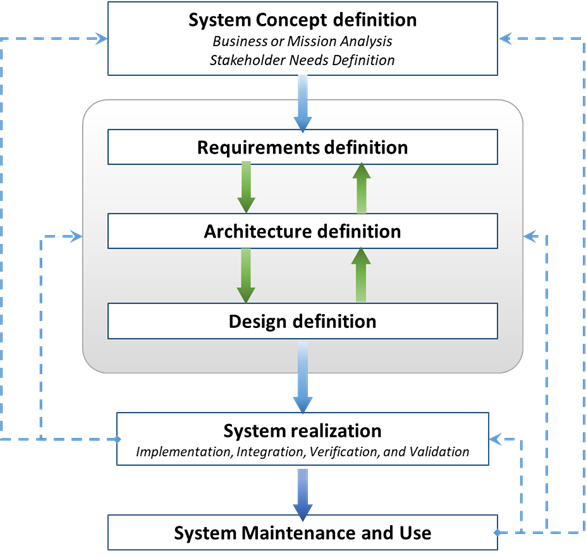
The life cycle processes can be used to engineer the IMS as the system in charge of answering to the organizational need to manage its information and data. An example of approach is shown in Figure 2:
ライフサイクルプロセスを用いて、情報とデータを管理するという組織のニーズに応える役割を担うシステムとして、IMS をエンジニアリングすることができる。アプローチの例を図2に示す。
図中の英語
Each major step in figure 2 includes several considerations of particular importance to IM: *In Concept Definition (Business or Mission Analysis and Stakeholder Needs Definition): **The involved stakeholders and organizations and their needs in terms of access controls **The needs for security boundaries **The needs for audits **The applicable regulations, laws, protection requirements **The information lifecycle requirements per type of information
*In Requirements Definition and System Architecture Definition: **The existing structures and their constraints: repositories, cybersecurity architectures **The existing information and configuration management processes (including problem reporting and change management), **The existing syntax and semantics **The disaster recovery dispositions *In Design definition: **Potential iterations when designing the IMS to consider changes to introduce new requirements for retrieval speed, archiving, metadata, data modelling, access rules *In Realization (Implementation, Integration, Verification, and Validation): **Incremental integration, verification, and validation of the IM system to enable a stepwise adoption of new processes **Application of information and configuration management rules **Involvement of stakeholders in tests to value their feedback **Coordination with IT and cybersecurity staff especially during initial implementation steps *In Maintenance and Utilization: **Needs to adapt the information lifecycle, always controlled by dedicated processes (information and/or configuration management workflows) **Regular disaster recovery and retrieval plan exercise **Performance and quality monitoring of a dedicated set of indicators **Stakeholders' feedback to maintain their involvement in the overall IMS quality.
図2の各主要ステップには、IM にとって特に重要な考慮事項がいくつか含まれる。
- 関与するステークホルダーと組織、およびアクセス制御の観点から見たそれらのニーズ - セキュリティ境界の必要性 - 監査の必要性 - 適用される規制、法律、保護要求事項 - 情報の種類ごとの情報ライフサイクルの要求事項
- 既存の構造とその制約:リポジトリ、サイバーセキュリティアーキテクチャ - 既存の情報管理プロセスと構成管理プロセス(問題報告と変更管理を含む) - 既存の構文と意味論 - 災害復旧対策
- 取り出し速度、アーカイブ、メタデータ、データモデリング、アクセスルールに関する新たな要求事項を導入するための変更を考慮して IMS を設計する際に生じ得る反復
- 新しいプロセスを段階的に採用できるようにするための、IM システムの漸進的な統合、検証、妥当性確認 - 情報管理ルールと構成管理ルールの適用 - ステークホルダーからのフィードバックを重視し、テストに参加してもらうこと - 特に初期の実装ステップにおける、IT およびサイバーセキュリティ担当スタッフとの調整
- 常に専用のプロセス(情報管理および/または構成管理のワークフロー)による統制の下で、情報ライフサイクルを適応させる必要性 - 災害復旧計画と取り出し計画の定期的な訓練 - 専用の指標群を用いた性能と品質の監視 - IMS 全体の品質へのステークホルダーの関与を維持するための、ステークホルダーからのフィードバック
The IM process relies on a defined approach that includes appropriate practices, methods, procedures, resources, and controls to establish and maintain a reliable source of Information.
IM プロセスは、信頼できる情報源を確立し維持するために、適切な実践、方法、手順、資源、統制を含む、定義されたアプローチに依拠する。
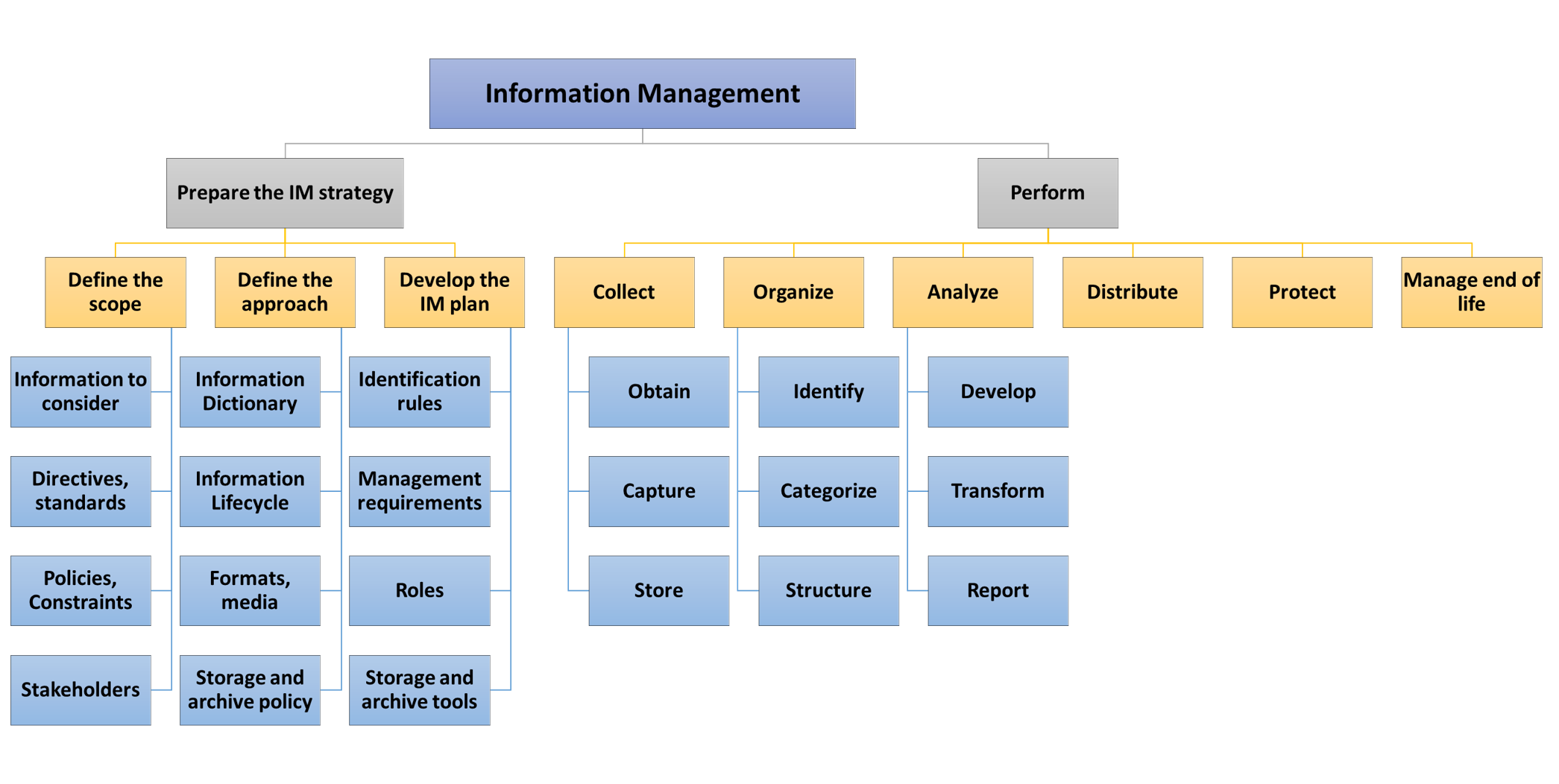
A decomposition is proposed below, inspired by the SE HBK IM section. Examples of decomposition could also be found in ISO/IEC/IEEE 15288 Clause 6.3.6, SAE 1001 Clause 5.2.5, ISO/IEC/IEEE 24748-7 Clause 6.3.6.
以下に、SE HBK の IM の節に着想を得た分解を提案する。分解の例は、ISO/IEC/IEEE 15288 第6.3.6項、SAE 1001 第5.2.5項、ISO/IEC/IEEE 24748-7 第6.3.6項にも見られる。
The benefits of the IM process are maximized when all activities are planned and executed. These activities are not sequential. They may be applied concurrently and iteratively as needed throughout the information life cycle.
IM プロセスの便益は、すべてのアクティビティが計画され実行されたときに最大となる。これらのアクティビティは逐次的なものではない。情報ライフサイクル全体を通じて、必要に応じて並行して、かつ反復的に適用され得る。
図中の英語
Here are some insights about the proposed sub-activities: *Prepare for information management (preparing the information management strategy): **Define the scope: ***Relevant information and valid sources to be considered (business processes which will provide information) ***Directives, standards to be considered, including customers' requirements, industry standards… ***Policies, constraints: organization internal policy and directives, external constraints (e.g. legal, environmental, geographical, regulations) ***Stakeholders **Define the approach: ***Information dictionary to consider the information to be managed (may be related to the project planning outputs in case of a system’s information) ***Information lifecycle: ****Stages and status of the information asset, from initialization until obsolescence and disposal ****Transition triggers between the lifecycle stages, defining workflows ****Change process to control the evolutions of the information, and when relevant, the traceable incorporation in Configuration Management baselines ****Authorized formats for capture, retention, transmission, retrieval, distribution ***Requests for adequate repositories and tools ***Storage and archive policy: retention duration, end of life disposal process, disaster recovery dispositions to prevent the loss of information in case of failure (back-up system, flawless recovery plan) **Develop the IM plan: ***Identification rules: identification schema, mandatory attributes and metadata aiming to ease of search, rules for identifiers evolution ***Management requirements ****applicable to information capture, storage, validation, release, retrieval, and distribution ****problem reporting and change management, for both configuration information and information out of configuration scope ****control and security rules per type of Information, e.g. export control, access or distribution control, Intellectual Property, segregation of information between projects… ****auditing capabilities on the information database ***Roles ****Responsibilities: roles providing, managing, consuming, distributing information (including external distribution to suppliers, customers, partners) ****Authorities: roles in charge of IM policy and governance inside the organization, roles defining the IM system requirements… ***Storage and archive tools, consistent with the policy identified in the approach
*Perform information management **Collect the information: obtain from the valid sources, capture and store according to the IM plan **Organize the information: identify and categorize, structure the information to identify their relationships with the system’s elements to which they are related **Analyze: develop or transform the information, report about the information to support decision-making **Distribute the information to designated stakeholders inside the organization and to the relevant external stakeholders in accordance with predefined processes **Protect the information: maintain integrity, security, privacy, in accordance with the applicable requirements **Manage end-of-life: control information obsolescence, identify obsolete information and assess whether it should be archived or disposed of; it aims to prevent the uncontrolled growth of the information asset database by retaining content that should be archived or destroyed in accordance with applicable policies or agreements.
以下に、提案したサブアクティビティについての洞察をいくつか示す。
- スコープの定義: - 考慮すべき関連情報と有効な情報源(情報を提供するビジネスプロセス) - 考慮すべき指令、標準(顧客の要求事項、業界標準などを含む) - ポリシー、制約:組織内部のポリシーと指令、外部の制約(例:法律、環境、地理、規制) - ステークホルダー - アプローチの定義: - 管理すべき情報を検討するための情報辞書(システムの情報の場合は、プロジェクト計画のアウトプットに関連し得る) - 情報ライフサイクル: - 初期化から陳腐化・廃棄に至るまでの、情報資産の段階とステータス - ワークフローを定義する、ライフサイクル段階間の遷移トリガー - 情報の変更を管理し、該当する場合には構成管理ベースラインへの取り込みを追跡可能にする変更プロセス - 取り込み、保持、伝送、取り出し、配布のために認可された形式 - 適切なリポジトリとツールの要求 - 保存とアーカイブのポリシー:保持期間、寿命末期の廃棄プロセス、障害発生時の情報損失を防ぐための災害復旧対策(バックアップシステム、万全な復旧計画) - IM 計画の策定: - 識別ルール:識別スキーマ、検索を容易にするための必須の属性とメタデータ、識別子の更新に関するルール - 管理要求事項 - 情報の取り込み、保存、妥当性確認、リリース、取り出し、配布に適用されるもの - 構成情報と構成スコープ外の情報の両方に対する、問題報告と変更管理 - 情報の種類ごとの統制とセキュリティのルール(例:輸出管理、アクセス制御または配布制御、知的財産、プロジェクト間の情報の分離など) - 情報データベースに対する監査能力 - 役割 - 責任:情報を提供、管理、消費、配布する役割(供給者、顧客、パートナーへの外部配布を含む) - 権限:組織内部で IM ポリシーとガバナンスを担当する役割、IM システム要求事項を定義する役割など - アプローチで特定したポリシーと整合した、保存とアーカイブのツール
- 情報の収集:有効な情報源から入手し、IM 計画に従って取り込み、保存する - 情報の組織化:情報を識別・分類し、関連するシステム要素との関係を識別できるように構造化する - 分析:情報を作成または変換し、意思決定を支援するために情報について報告する - 事前に定義されたプロセスに従って、組織内部の指定されたステークホルダーと、関連する外部のステークホルダーに情報を配布する - 情報の保護:適用される要求事項に従って、完全性、セキュリティ、プライバシーを維持する - 寿命末期の管理:情報の陳腐化を統制し、陳腐化した情報を識別して、それをアーカイブすべきか廃棄すべきかを評価する。その目的は、適用されるポリシーまたは合意にしたがってアーカイブまたは破棄されるべき内容を保持することによる、情報資産データベースの統制されない増大を防ぐことである。
Information Management is involved in the management and control of artifacts produced and modified throughout the system life cycle and across the organization.
情報管理は、システムライフサイクル全体および組織全体にわたって作成・変更される成果物の管理と統制に関わる。
The list of types of information assets to be managed and their cadence in the systems engineering and project lifecycle should be defined in the planning process and documented in the IM plan. For information assets related to configuration management, their cadence should be consistent with CM requirements.
管理すべき情報資産の種類の一覧と、システムズエンジニアリングおよびプロジェクトのライフサイクルにおけるそれらの頻度は、計画プロセスで定義し、IM 計画に文書化すべきである。構成管理に関連する情報資産については、その頻度を CM の要求事項と整合させるべきである。
The IM process is therefore linked to configuration management, project planning, project assessment and control, system analysis, system detailed design definition, system realization, system deployment and use, system operation and service life management.
したがって、IM プロセスは、構成管理、プロジェクト計画、プロジェクトの評価と管理、システム分析、システム詳細設計定義、システム実現、システム展開と利用、システム運用、サービスライフ管理と結びついている。
Key pitfalls and good practices related to IM are described in the next two sections.
IM に関連する主要な落とし穴とグッドプラクティスを、以下の2つの節で説明する。
Some of the key pitfalls encountered in planning and performing IM are provided in Table 3:
IM の計画と実行において遭遇する主要な落とし穴のいくつかを表3に示す。
表3. 情報管理の落とし穴。(SEBoK Original)
| +Table 3. Information Management Pitfalls. (SEBoK Original) |
| Pitfall Name |
|---|
| Pitfall Description |
| No Information / Data Dictionary |
| Not defining an information/data dictionary for the organization or for the project may result in inconsistencies in identification conventions for information, which reduces the accuracy and completeness of searches for information and adding search time performance. |
| No Information identification strategy |
| Not specifying the naming convention for information and identification rules may result in inconsistent information identification, difficulties to retrieve information and impossibility to ensure consistency of the information across the whole project or organization |
| No Metadata |
| Not defining the relevant metadata per type of information or tagging them inconsistently may result in ineffective searches based on metadata which are ineffective and can overlook key information. |
| No predefined Information / data lifecycle |
| Missing definition of the information lifecycle defining creation and validation workflow, release mechanism, obsolescence management, leading to uncontrolled creation and validation of information, overaccumulation of obsolete data |
| No security rules |
| Not defining the security classification levels nor the associated security protection mechanisms induce quickly high levels of risks of information leaks that could engage the legal responsibility of the organization |
| No clear information communication rules |
| Not defining the conditions for reception and distribution of information leads to lacks in traceability. Information should be considered as key assets and their communication across the stakeholders need to be organized |
| Missing content-obsolescence management |
| Not checking the currency and relevance of the information content, and not tagging obsolescent and obsolete information results in outdated information being retained and used inadequately, and induces an overload in the storage capacity needs |
| Missing access-obsolescence management |
| Not checking the currency and relevance of the access rights could lead to maintaining accesses to information that should no longer be proposed and lead to protection breaches |
| Missing information repositories-obsolescence management |
| Not considering the information management system applications maintenance and survey could lead to the loss of access to crucial information. The IM plan should include the management of the nominal repositories’ lifecycle, back-up solutions as well as a disaster recovery plan. |
| Inadequate back-up policy |
| Not ensuring that the information is backed up periodically in a back-up solution having the required retention durability and remains retrievable could lead to late discovery of information loss. The back-up policy should plan regular checks to ensure that information is not corrupted over time. |
| 落とし穴の名前 | 落とし穴の説明 |
|---|---|
| 情報/データ辞書がない | 組織またはプロジェクトの情報/データ辞書を定義しないと、情報の識別規約に不整合が生じ、情報検索の正確さと完全性が低下し、検索時間が増大する可能性がある。 |
| 情報識別戦略がない | 情報の命名規約と識別ルールを定めないと、情報の識別に不整合が生じ、情報の取り出しが困難になり、プロジェクトや組織全体で情報の一貫性を確保できなくなる可能性がある。 |
| メタデータがない | 情報の種類ごとに関連するメタデータを定義しなかったり、一貫性のないタグ付けをしたりすると、メタデータに基づく検索が効果を発揮せず、重要な情報を見落とす可能性がある。 |
| 事前に定義された情報/データライフサイクルがない | 作成と妥当性確認のワークフロー、リリースの仕組み、陳腐化の管理を定める情報ライフサイクルが定義されていないと、情報の統制されない作成と妥当性確認や、陳腐化したデータの過剰な蓄積につながる。 |
| セキュリティルールがない | セキュリティ分類レベルも、関連するセキュリティ保護の仕組みも定義しないと、組織の法的責任を問われかねない情報漏洩の高いリスクを急速に招く。 |
| 明確な情報伝達ルールがない | 情報の受領と配布の条件を定義しないと、トレーサビリティの欠如につながる。情報は重要な資産とみなすべきであり、ステークホルダー間での情報の伝達を組織化する必要がある。 |
| 内容の陳腐化管理の欠落 | 情報内容が現在も有効か、関連性を保っているかを確認せず、陳腐化しつつある情報や陳腐化した情報にタグを付けないと、古くなった情報が保持されて不適切に使われ、必要な保存容量の過大化を招く。 |
| アクセスの陳腐化管理の欠落 | アクセス権が現在も有効か、必要性が残っているかを確認しないと、もはや提示されるべきでない情報へのアクセスが維持され、保護の侵害につながる可能性がある。 |
| 情報リポジトリの陳腐化管理の欠落 | 情報管理システムのアプリケーションの保守と調査を考慮しないと、重要な情報にアクセスできなくなる可能性がある。IM 計画には、通常のリポジトリのライフサイクル管理、バックアップソリューション、災害復旧計画を含めるべきである。 |
| 不適切なバックアップポリシー | 必要な保持耐久性を備えたバックアップソリューションに情報が定期的にバックアップされ、取り出し可能な状態に保たれていることを確実にしないと、情報損失の発見が遅れる可能性がある。バックアップポリシーでは、情報が時間の経過とともに破損していないことを確かめるための定期的な確認を計画すべきである。 |
Some good practices gathered from the references are provided in Table 4:
参考文献から集めたグッドプラクティスのいくつかを表4に示す。
表4. 情報管理のグッドプラクティス。(SEBoK Original)
| +Table 4. Information Management Good Practices. (SEBoK Original) |
| Good Practice Name |
|---|
| Good Practice Description |
| Guidance |
| Information as an Asset |
| Recognize that information is a strategic asset for the organization and needs to be managed and protected. |
| Information Storage Capacity |
| Plan for the information storage capacity that is foreseen in your context, without forgetting to anticipate the increase of information volume based on the regular survey of the amount of information to be managed. |
| Effective Information Access |
| Ensure that the users are aware of the presence of the information and the relevant people access the information they need to know. Information that is not accessible or not used loses value that should come from the usage of the information. |
| Data Modeling |
| Quality Management |
| The cost impact of using poor quality information can be enormous. Be rigorous about managing the quality of information, including considering carefully the validation and release steps in the information lifecycle. |
| Information Repository Design |
| Uncontrolled modification prevention |
| Organize the information management life cycle and security to prevent from undesirable and/or untraced modification of the information. |
| グッドプラクティスの名前 | グッドプラクティスの説明 |
|---|---|
| ガイダンス | ・自らの領域または産業の文脈に適用可能な、該当するデータ管理のガイド、標準、規範を参照する。・該当する場合、DAMA のデータマネジメント知識体系ガイドは、プロジェクトレベルとエンタープライズレベルの両方における IM について、優れた詳細な概要を提供している。 |
| 資産としての情報 | 情報は組織にとっての戦略的資産であり、管理し保護する必要があることを認識する。 |
| 情報の保存容量 | 自らの文脈で見込まれる情報の保存容量を計画する。その際、管理すべき情報量の定期的な調査に基づいて、情報量の増加を予測することを忘れない。 |
| 効果的な情報アクセス | 利用者が情報の存在を認識し、関係する人々が知る必要のある情報にアクセスすることを確実にする。アクセスできない情報や使われない情報は、本来その使用から得られるはずの価値を失う。 |
| データモデリング | ・関与する組織の基盤となる構造と情報ニーズに整合したデータモデルの設計に、時間と労力を投資する。・組織をまたがるデータモデリングでは、意味論(用語やデータ項目の正確な意味)に重点を置くべきである。形式や表構造について合意するだけでは不十分である。用語は、組織が異なれば異なる意味を持つことが多い。・相互運用性を念頭に置いてモデル化する。データは、後に新しい異なるシステムとの統合に使用されると想定する。そのためには、識別子、メタデータ、来歴に重点を置くことと、組織の境界を越えて拡張できる構造が必要である。 |
| 品質管理 | 品質の低い情報を使用することによるコストへの影響は甚大になり得る。情報ライフサイクルにおける妥当性確認とリリースのステップを慎重に検討することも含め、情報の品質管理を厳格に行うこと。 |
| 情報リポジトリの設計 | ・情報を不適切に管理することの影響もまた甚大になり得る(例:知的財産や輸出管理のルールへの違反)。・IM の要求事項が情報リポジトリに取り込まれて実装されていること、そしてリポジトリのすべての利用者が、従うべきルールと違反時の罰則を認識していることを確実にする。 |
| 統制されない変更の防止 | 情報の望ましくない変更および/または追跡されない変更を防ぐために、情報管理のライフサイクルとセキュリティを組織化する。 |
ISO/IEC/IEEE. 2023. Systems and Software Engineering - System Life Cycle Processes. Geneva, Switzerland: International Organisation for Standardisation/International Electrotechnical Commissions. ISO/IEC/IEEE 15288:2023.
INCOSE. 2023. Systems Engineering Handbook: A Guide for System Life Cycle Processes and Activities, 5th Edition. Ed(s): D. Walden, T.M. Shortell, G.J. Roedler, B.A. Delicado, O. Mornas, Y. Yew-Seng, D. Endler. San Diego, CA: International Council on Systems Engineering (INCOSE). Available at https://www.incose.org/publications/se-handbook-v5.
DAMA international. 2024, DAMA International’s Guide to the Data Management Body of Knowledge (DAMA-DMBOK2). Data Administration Management Association International. https://technicspub.com/dmbok2/
Ilana Hamilton. 2025, Article ‘Information Security Vs. Cybersecurity: What’s The Difference?’. https://www.forbes.com/advisor/education/it-and-tech/information-security-vs-cybersecurity/
Shirley M. Radack, National Institute of Standards and Technology. 2009, The System Development Life Cycle (SDLC). https://www.nist.gov/publications/system-development-life-cycle-sdlc
ISO/IEC/IEEE15289. 2019. Systems and software engineering - Content of life-cycle information items (documentation). International Organization for Standardisation / International Electrotechnical Commissions / Institute of Electrical and Electronics Engineers. ISO/IEC/IEEE15289:2019
ANSI/GEIA-859B. 2022. Data Management GEIA-859B. Arlington, VA, USA: Government Electronics & Information Technology Association. GEIA-859B Data Management
ANSI/GEIAHB859. 2006. Implementation Guide for Data Management GEIAHB859 - Arlington, VA, USA: Government Electronics & Information Technology Association. GEIAHB859
ANSI/GEIA-STD-927B. 2013. Common Data Schema for Complex Systems GEIA-STD-927B. Arlington, VA, USA: Government Electronics & Information Technology Association. GEIASTD927B
ANSI/GEIAHB927. 2007. Implementation Guide for Common Data Schema for Complex Systems. Arlington, VA, USA: Government Electronics & Information Technology Association. GEIAHB927
U.S. Department of Defense. 2019. MIL-STD-963C Data Item Descriptions (DIDs). https://quicksearch.dla.mil/qsDocDetails.aspx?ident_number=202450
NIST Special Publication (SP) 800-160v1r1. 2022. Engineering Trustworthy Secure Systems, by Ron Ross, Mark Winstead, and Michael McEvilley. https://doi.org/10.6028/NIST.SP.800-160v1r1
ISO/IEC/IEEE. 2023. Systems and Software Engineering — System Life Cycle Processes. Geneva, Switzerland: International Organisation for Standardisation/International Electrotechnical Commissions. ISO/IEC/IEEE 15288:2023.
INCOSE. 2023. Systems Engineering Handbook: A Guide for System Life Cycle Processes and Activities 5th Edition. Ed(s): D. Walden, T.M. Shortell, G.J. Roedler, B.A. Del]icado, O. Mornas, Y. Yew-Seng, D. Endler. San Diego, CA: International Council on Systems Engineering (INCOSE). Available at https://www.incose.org/publications/se-handbook-v5.
ISO/IEC 27001. 2022. Information security, cybersecurity and privacy protection — Information security management systems — Requirements. International Organization for Standardisation / International Electrotechnical Commissions / Institute of Electrical and Electronics Engineers. https://www.iso.org/standard/27001
ISO/IEC/IEEE 15289. 2019. Systems and software engineering — Content of life-cycle information items (documentation). International Organization for Standardisation / International Electrotechnical Commissions / Institute of Electrical and Electronics Engineers. ISO/IEC/IEEE15289:2019
INCOSE. 2018. Integrated Data as a Foundation of SE. INCOSE Requirements working group. INCOSE-TP-2018-001-01.0.
ECSS-M-ST-40C Rev.1. 2009. Space project management — Configuration and information management. Noordwijk, The Netherlands: European Cooperation for Space Standardization (ECSS) - ECSS-M-ST-40C Rev.1
None.