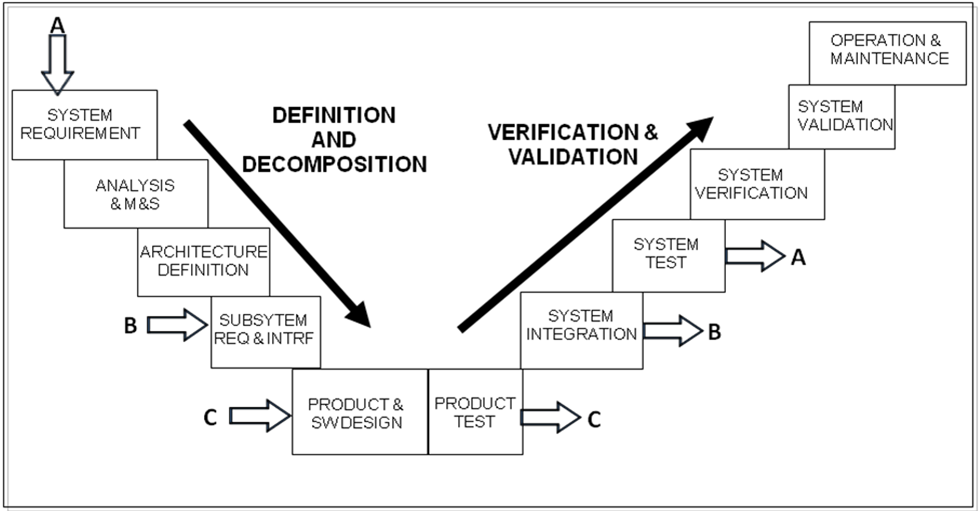
図1. 3つの異なるレベルにおける変更のための Vee モデル。(SEBoK Original)
Capability Updates, Upgrades, and Modernization
Modernization and upgrades involve changing the product or service to include new functions and interfaces, improve system performance, and/or improve system supportability. The logistic support of a product or service reaches a point in its life where system modernization is required to resolve supportability problems and to reduce operational costs. The INCOSE Systems Engineering Handbook (INCOSE 2012) and Systems Engineering and Analysis (Blanchard and Fabrycky 2005) both stress the importance of using life cycle costs (LCC) when determining if a product or service should be modernized. Systems can be modernized in the field or returned to a depot or factory for modification.
近代化とアップグレードは、新しい機能とインタフェースを含むように製品やサービスを変更し、システム性能を改善し、および/またはシステムの支援可能性を改善することを伴う。製品やサービスのロジスティクス支援は、そのライフの中で、支援可能性の問題を解決し運用コストを削減するためにシステムの近代化が必要となる時点を迎える。『INCOSE Systems Engineering Handbook』(INCOSE 2012)と『Systems Engineering and Analysis』(Blanchard and Fabrycky 2005)はいずれも、製品やサービスを近代化すべきかどうかを判断する際にライフサイクルコスト(life cycle cost、LCC)を用いることの重要性を強調している。システムは、現場で近代化することも、変更のためにデポや工場へ戻すこともできる。
Design for system modernization and upgrade is an important part of the system engineering process and should be considered as part of the early requirements and design activities. Engineering change proposals (ECPs) are used to initiate updates and modifications to the original system. Product and service upgrades can include new technology insertion, removing old equipment, or adding new equipment. Form, fit, function, and interface (F3I) is an important principle for upgrades where backward compatibility is a requirement.
システムの近代化とアップグレードを見据えた設計は、システムズエンジニアリングプロセスの重要な部分であり、初期の要求事項の定義および設計のアクティビティの一環として考慮すべきである。工学変更提案(Engineering Change Proposal、ECP)は、当初のシステムに対する更新や変更を開始するために用いられる。製品・サービスのアップグレードには、新技術の導入、古い機器の撤去、新しい機器の追加が含まれ得る。形状・適合・機能・インタフェース(Form, Fit, Function, and Interface、F3I)は、後方互換性が要求されるアップグレードにおける重要な原則である。
Product and service modernization involves the same systems engineering (SE) processes and principles that are employed during the upfront design, development, integration, and testing. The primary differences between product and service modernization are the various constraints imposed by the existing system architecture, design, and components. Modernizing a legacy system requires a detailed understanding of the product or service prior to making any changes. The constraints and the existence of design and test artifacts make it necessary for the systems engineers performing modernization to tailor the traditional development processes to fit the situation.
製品・サービスの近代化には、初期の設計、開発、統合、テストで用いられるものと同じシステムズエンジニアリング(SE)のプロセスと原則が用いられる。製品の近代化とサービスの近代化の主な違いは、既存のシステムアーキテクチャ、設計、構成要素によって課されるさまざまな制約である。レガシーシステム(legacy system)を近代化するには、いかなる変更であれ、それを行う前に製品やサービスを詳細に理解しておく必要がある。こうした制約があり、また設計・テストの成果物も存在するため、近代化を行うシステムズエンジニアは、従来の開発プロセスを状況に合わせてテーラリングする必要がある。
Product and service modernization occurs for many reasons, including the following:
製品・サービスの近代化は、以下を含む多くの理由で起こる。
1. The system or one of its subsystems is experiencing reduced performance, safety, or reliability.
1. システムまたはそのサブシステムの一つで、性能、安全性、または信頼性が低下している。
2. A customer or other stakeholder desires a new capability for the system.
2. 顧客またはその他のステークホルダー(stakeholder)が、システムに対する新しい能力(capability)を望んでいる。
3. Some system components may be experiencing obsolescence, including the lack of spare parts.
3. 一部のシステム構成要素で、スペアパーツの不足を含む陳腐化が生じている可能性がある。
4. New uses for the system require modification to add capabilities not built into the originally deployed system.
4. システムの新しい用途に対応するため、当初配備されたシステムには組み込まれていなかった能力を追加する変更が必要である。
The first three reasons above are discussed in more detail in Applying Systems Engineering to In-Service Systems: Supplementary Guidance to the INCOSE Systems Engineering Handbook. (INCOSE UK Chapter 2010).
上記の最初の3つの理由は、『Applying Systems Engineering to In-Service Systems: Supplementary Guidance to the INCOSE Systems Engineering Handbook』でより詳しく論じられている(INCOSE UK Chapter 2010)。
The UK chapter of the INCOSE developed Applying Systems Engineering to In-Service Systems: Supplementary Guidance to the INCOSE Systems Engineering Handbook (INCOSE UK Chapter 2010). This guidance document applies to any system for which multiple systems are produced. These systems may be buildings, transmission networks, aircraft, automobiles or military vehicles, trains, naval vessels, and mass transit systems.
INCOSE の英国支部は、『Applying Systems Engineering to In-Service Systems: Supplementary Guidance to the INCOSE Systems Engineering Handbook』を作成した(INCOSE UK Chapter 2010)。このガイダンス文書は、同じシステムが複数製造される場合には、その種類を問わず適用される。そうしたシステムとしては、建物、送電網、航空機、自動車や軍用車両、列車、海軍艦艇、大量輸送システムが考えられる。
Government and military products provide a comprehensive body of knowledge for system modernization and updates. Key references have been developed by the defense industry and can be particular to their needs.
政府・軍事製品は、システムの近代化と更新に関する包括的な知識体系を提供している。主要な参考文献は防衛産業によって作成されており、防衛産業のニーズに特化したものである場合がある。
Key factors and questions that must be considered by the systems engineer when making modifications and upgrades to a product or service include:
製品やサービスに変更やアップグレードを行う際にシステムズエンジニアが考慮しなければならない主要な要因と問いには、以下が含まれる。
• type of system (space, air, ground, maritime, and safety critical)
• システムのタイプ(宇宙、航空、地上、海上、安全上重要なもの)
• missions and scenarios of expected operational usage
• 想定される運用使用のミッションとシナリオ
• policy and legal requirements that are imposed by certain agencies or business markets
• 特定の機関やビジネス市場によって課される方針・法的要求事項
• product or service LCCs
• 製品やサービスの LCC
• electromagnetic spectrum usage expected, including change in RF emissions
• 無線周波(RF)放射の変化を含む、想定される電磁スペクトルの使用
• system original equipment manufacturer (OEM) and key suppliers, and availability of parts and subsystems
• そのシステムを当初製造したメーカー(original equipment manufacturer、OEM)と主要な供給業者、および部品とサブシステムの入手可能性
• understanding and documenting the functions, interfaces, and performance requirements, including environmental testing and validation
• 環境テストと妥当性確認を含む、機能、インタフェース、性能要求事項の理解と文書化
• system integration challenges posed by the prevalence of system-of-systems solutions and corresponding interoperability issues between legacy, modified, and new systems
• システム・オブ・システムズ・ソリューションの普及によって生じるシステム統合の課題と、それに対応するレガシーシステム、変更されたシステム、新しいシステムの間の相互運用性の問題
• amount of regression testing to be performed on the existing software
• 既存のソフトウェアに対して実施する回帰テストの量
Key processes and procedures that should be considered during product and service modernization include:
製品・サービスの近代化の際に考慮すべき主要なプロセスと手順には、以下が含まれる。
• legislative policy adherence review and certification
• 法令方針の遵守に関するレビューと認証
• safety critical review
• 安全上重要な事項のレビュー
• engineering change management and configuration control
• 工学変更管理と構成変更管理
• analysis of alternatives
• 代替案の分析
• warranty and product return process implementation
• 保証と製品返却プロセスの実施
• availability of manufacturing and supplier sources and products
• 製造元・供給元および製品の入手可能性
Product modernization involves understanding and managing a list of product deficiencies, prioritizing change requests, and handling customer issues associated with product usage. The INCOSE Systems Engineering Handbook emphasizes the use of Failure Modes, Effects, and Criticality Analysis (FMECA) to understand the root causes of product failures and provide the basis for making any product changes.
製品の近代化には、製品の欠陥リストを把握して管理すること、変更要求に優先順位を付けること、製品の使用に関連する顧客の問題に対処することが含まれる。『INCOSE Systems Engineering Handbook』は、製品故障の根本原因を理解し、あらゆる製品変更の基礎とするために、故障モード・影響・致命度解析(Failure Modes, Effects, and Criticality Analysis、FMECA)を用いることを強調している。
Product modernization uses the engineering change management principle of change control boards to review and implement product changes and improvements. The U.S. Office of the Under Secretary of Defense for Acquisition, Technology, and Logistics (OUSD AT&L) provides an online reference for product modernization and the use of an ECP to document planned product or service modernization efforts.
製品の近代化では、製品の変更と改善をレビューし実施するために、工学変更管理の原則である変更管理委員会を用いる。U.S. Office of the Under Secretary of Defense for Acquisition, Technology, and Logistics(OUSD AT&L)は、製品の近代化と、計画された製品・サービスの近代化の取り組みを文書化するための ECP の使用に関するオンライン参考文献を提供している。
Product modernization and upgrades require the use of system documentation. A key part of the product change process is to change the supporting system documentation functions, interfaces, modes, performance requirements, and limitations. Both INCOSE (2012) and Blanchard and Fabrycky (2005) stress the importance of understanding the intended usage of the product or service documented in the form of a concept of operations.
製品の近代化とアップグレードには、システム文書を用いる必要がある。製品変更プロセスの主要な部分は、機能、インタフェース、モード、性能要求事項、制限を記載した関連システム文書を更新することである。INCOSE(2012)と Blanchard and Fabrycky(2005)はいずれも、組織レベルの運用概念(ConOps)の形で文書化された、製品やサービスの意図された使用法を理解することの重要性を強調している。
If system documentation is not available, reverse engineering is required to capture the proper “as is configuration” of the system and to gain understanding of system behavior prior to making any changes. Seacord, Plakosh, and Lewis's Modernizing Legacy Systems (2003) explains the importance of documenting the existing architecture of a system, including documenting the software architecture prior to making any changes. Chapter 5 of Seacord, Plakosh, and Lewis provides a framework for understanding and documenting a legacy system (2003). The authors point out that the product or service software will undergo a transformation during modernization and upgrades. Chapter 5 introduces a horseshoe model that includes functional transformation, code transformation, and architecture transformation (Seacord, Plakosh, and Lewis 2005).
システム文書が入手できない場合は、いかなる変更であれ、それを行う前にシステムの適切な「現状の構成(as is configuration)」を捉え、システムの振る舞いを理解するために、リバースエンジニアリング(reverse engineering)が必要となる。Seacord, Plakosh, and Lewis の『Modernizing Legacy Systems』(2003)は、いかなる変更であれ、それを行う前に、ソフトウェアアーキテクチャの文書化を含め、システムの既存のアーキテクチャを文書化しておくことの重要性を説明している。Seacord, Plakosh, and Lewis の第5章は、レガシーシステムを理解し文書化するためのフレームワークを提供している(2003)。著者らは、製品やサービスのソフトウェアが、近代化とアップグレードの過程で変容を遂げることを指摘している。第5章では、機能の変容、コードの変容、アーキテクチャの変容を含む蹄鉄モデル(horseshoe model)が紹介されている(Seacord, Plakosh, and Lewis 2005)。
During system verification and validation (after product change), it is important to perform regression testing on the portions of the system that were not modified to confirm that upgrades did not impact the existing functions and behaviors of the system. The degree and amount of regression testing depends on the type of change made to the system and whether the upgrade includes any changes to those functions or interfaces involved with system safety. INCOSE (2012) recommends the use of a requirements verification traceability matrix to assist the systems engineer during regression testing.
システムの検証と妥当性確認(製品変更後)の際には、アップグレードがシステムの既存の機能と振る舞いに影響を与えていないことを確認するために、システムのうち変更されなかった部分に対して回帰テストを実施することが重要である。回帰テストの程度と量は、システムに対して行われた変更のタイプと、アップグレードにシステム安全性に関わる機能やインタフェースへの変更が含まれるかどうかによって決まる。INCOSE(2012)は、回帰テストの際にシステムズエンジニアを支援するものとして、要求事項の検証トレーサビリティマトリックスを用いることを推奨している。
It is important to consider changes to the system support environment. Change may require modification or additions to the system test equipment and other support elements such as packaging and transportation.
システム支援環境の変更を考慮することが重要である。変更に伴い、システムのテスト機器や、梱包や輸送などのその他の支援要素について、変更や追加が必要となる場合がある。
Some commercial products contain components and subsystems where modernization activities cannot be performed. An example of these types of commercial systems can be seen by looking at consumer electronics, such as radios and computer components. The purchase price of these commercial systems is low enough that upgrades are not economical and are considered cost prohibitive.
一部の商用製品には、近代化活動を実施できない構成要素やサブシステムが含まれている。この種の商用システムの例は、ラジオやコンピュータの構成要素などの家電製品に見ることができる。これらの商用システムは購入価格が十分に低いため、アップグレードは費用に見合わず、費用が高すぎて実施できないと判断される。
Service system modernization may require regulatory changes to allow the use of new technologies and new materials. Service system modernization requires backward compatibility to previous provided service capability during the period of change. Service system modernization also generally spans large geographical areas, requiring a phase-based change and implementation strategy. Transportation systems, such as highways, provide service to many different types of consumers and span large geographical areas. Modernization of transportation systems often requires reverse engineering prior to making changes to understand how traffic monitoring devices such as metering, cameras, and toll tags interface with the rest of the system. The California Department of Transportation's (CDOT's) Systems Engineering Guidebook for Intelligent Transportation Systems (ITS) (2005) adds reverse engineering to the process steps for system upgrade. In addition, this reference points out the need to maintain system integrity and defines integrity to include the accurate documentation of the system's functional, performance, and physical requirements in the form of requirements, design, and support specifications.
サービスシステムの近代化では、新しい技術や新しい材料を使用できるようにするために、規制の変更が必要となる場合がある。サービスシステムの近代化には、変更期間中、それまで提供されてきたサービス能力との後方互換性が必要である。サービスシステムの近代化は一般に広大な地理的範囲にわたるため、フェーズベースの変更・実施戦略が必要である。高速道路などの輸送システムは、多種多様な消費者にサービスを提供し、広大な地理的範囲にわたる。輸送システムの近代化では、交通量の計測機器、カメラ、通行料金タグなどの交通監視装置がシステムの他の部分とどのようにインタフェースしているかを理解するために、変更を行う前にリバースエンジニアリングが必要となることが多い。California Department of Transportation(CDOT)の『Systems Engineering Guidebook for Intelligent Transportation Systems (ITS)』(2005)は、システムアップグレードのプロセスステップにリバースエンジニアリングを加えている。さらに、この参考文献は、システムの完全性(integrity)を維持する必要性を指摘し、完全性には、要求、設計、支援の仕様の形でシステムの機能要求事項、性能要求事項、物理的要求事項を正確に文書化することが含まれると定義している。
Software modernization is discussed in the Guide to the Software Engineering Body of Knowledge (SWEBOK) (Bourque and Fairley, 2014).
ソフトウェアの近代化は、『Guide to the Software Engineering Body of Knowledge (SWEBOK)』で論じられている(Bourque and Fairley, 2014)。
Enterprise system modernization must consider the location of the modification and the conditions under which the work will be performed. The largest challenge is implementing the changes while the system remains operational. In these cases, disruption of ongoing operations is a serious risk. For some systems, the transition between the old and new configuration is particularly important and must be carefully planned.
エンタープライズシステムの近代化では、変更を行う場所と、作業が実施される条件を考慮しなければならない。最大の課題は、システムの運用を継続したまま変更を実施することである。このような場合、継続中の運用機能の中断は深刻なリスクとなる。一部のシステムでは、旧構成と新構成の間の移行が特に重要であり、慎重に計画しなければならない。
Enterprise system modernization may require coordination of changes across international boundaries. Enterprise modifications normally occur at a lower level of the system hierarchy. Change in requirements at the system level would normally constitute a new system or a new model of a system.
エンタープライズシステムの近代化では、国境を越えた変更の調整が必要となる場合がある。エンタープライズの変更は通常、システム階層のより低いレベルで行われる。システムレベルで要求事項が変更されれば、通常は新しいシステム、またはシステムの新しいモデルに相当することになる。
The INCOSE UK Chapter Supplementary Guidance (2010) discusses the change to the architecture of the system. In cases where a component is added or changed, this change will constitute a change to the architecture. As an example, the global positioning system (GPS) is an enterprise system implemented by the United States military but used by both commercial and government consumers worldwide. Modernization may involve changes to only a certain segment of the enterprise, such as the ground user segment to reduce size, weight, and power. Modernization may only occur in certain geographical areas of operation. For example, the air transportation system consists of multiple countries and governing bodies dispersed over the entire world. Changes can occur locally or can require coordination and integration world-wide.
『INCOSE UK Chapter Supplementary Guidance』(2010)は、システムのアーキテクチャの変更について論じている。構成要素が追加または変更される場合、その変更はアーキテクチャの変更に相当する。例えば、全地球測位システム(global positioning system、GPS)は、米軍が実装したエンタープライズシステムであるが、世界中の商用と政府の双方の消費者に利用されている。近代化では、サイズ、重量、電力の削減を目的とした地上利用者セグメントの変更のように、エンタープライズの特定のセグメントだけが変更される場合がある。近代化が、特定の地理的な運用地域でのみ行われる場合もある。例えば、航空輸送システムは、全世界に分散した複数の国と統治機関から構成される。変更は局所的に行われることもあれば、世界規模での調整と統合が必要となることもある。
Figure 1 below illustrates how the standard Vee model would be applied to a system modification. This Vee model is for the entire system; the key point is that if a modification is being initiated at a lower level of the system hierarchy, the Vee model must be entered at that level as shown in the figure. The figure shows three entry points to the Vee model. As the INCOSE UK Chapter Supplementary Guidance (2010) points out, the Vee model may be entered multiple times during the life of the system.
下の図1は、標準的な Vee モデル(Vee model)がシステムの変更にどのように適用されるかを示している。この Vee モデルはシステム全体を対象としたものである。重要な点は、変更がシステム階層のより低いレベルで開始される場合、図に示すように、そのレベルから Vee モデルに入らなければならないことである。この図は、Vee モデルへの3つの入口点を示している。『INCOSE UK Chapter Supplementary Guidance』(2010)が指摘するように、システムのライフの間に Vee モデルに複数回入る場合がある。
図中の英語
A change to the system that does not change the system capabilities but does change the requirements and design of a subsystem that may be introduced into the process at point B on the Vee model (see Figure 1). Changes of this type could provide a new subsystem, such as a computer system, that meets the system-level requirements but has differences from the original, which necessitates modifications to the lower-level requirements and design, such as changing disk memory to solid state memory. The process for implementing changes starting at this point has been described by Nguyen (2006). Modification introduced at points B or C (in Figure 1) necessitate flowing the requirements upward through their “parent” requirements to the system-level requirements.
システムの能力は変えずに、サブシステムの要求事項と設計を変更するようなシステムへの変更は、Vee モデルの点 B でプロセスに導入され得る(図1参照)。この種の変更では、システムレベルの要求事項を満たしつつ当初のものとは異なる新しいサブシステム(コンピュータシステムなど)を提供でき、その結果、より低いレベルの要求事項と設計の変更(ディスクメモリをソリッドステートメモリに変更するなど)が必要となる。この点から始まる変更を実施するプロセスは、Nguyen(2006)が述べている。点 B または C(図1)で導入された変更では、要求事項をその「親」要求事項を通じてシステムレベルの要求事項まで上向きに流す必要がある。
There are many cases where the change to a system needs to be introduced at the lowest levels of the architectural hierarchy; here, the entry point to the process is at point C on the Vee model. These cases are typically related to obsolete parts caused by changes in technology or due to reliability issues with subsystems and parts chosen for the original design. A change at this level should be F3I compatible so that none of the higher-level requirements are affected. The systems engineer must ensure there is no impact at the higher levels; when this does occur, it must be immediately identified and worked out with the customer and the other stakeholders.
システムへの変更を、アーキテクチャ階層(architectural hierarchy)の最も低いレベルで導入する必要がある場合は多い。その場合、プロセスへの入口点は Vee モデルの点 C となる。こうした場合は通常、技術の変化によって生じた陳腐化した部品、または当初の設計で選定されたサブシステムや部品の信頼性の問題に関連する。このレベルでの変更は、より高いレベルの要求事項のいずれにも影響を与えないよう、F3I 互換であるべきである。システムズエンジニアは、より高いレベルに影響がないことを保証しなければならず、影響が生じた場合には、直ちにそれを特定し、顧客や他のステークホルダーとともに解決しなければならない。
In “Life extension of Civil Infrastructural works - a systems engineering approach” van der Laan (2008) provides a maintenance process that interacts with the system engineering process, represented by the Vee model. His life extension (or modernization) process model includes reverse engineering to obtain the system definition necessary for the modernization process. Consideration of the total lifecycle of the system will result in the capture of all of the records necessary for later upgrade; however, for many reasons, the systems engineer will find that the necessary information has not been captured or maintained.
van der Laan(2008)は「Life extension of Civil Infrastructural works - a systems engineering approach」において、Vee モデルで表されるシステムズエンジニアリングプロセスと相互作用する保守プロセスを提示している。彼のライフ延長(または近代化)プロセスモデルには、近代化プロセスに必要なシステム定義を得るためのリバースエンジニアリングが含まれている。システムのライフサイクル全体を考慮すれば、後のアップグレードに必要なすべての記録が捉えられることになるが、多くの理由により、必要な情報が捉えられていない、あるいは維持されていないことにシステムズエンジニアは気付くであろう。
As pointed out by the INCOSE UK Chapter Supplementary Guidance (2010) there may be multiple modifications to a system in its lifetime. Often these modifications occur concurrently. This situation requires special attention and there are two methods for managing it. The first is called the “block” method. This means that a group of systems are in the process of being modified simultaneously and will be deployed together as a group at a specific time. This method is meant to ensure that at the end state, all the modifications have been coordinated and integrated so there are no conflicts and no non-compliance issues with the system-level requirements. The second method is called continuous integration and is meant to occur concurrently with the block method. Information management systems provide an example of a commercial system where multiple changes can occur concurrently. The information management system hardware and network modernization will cause the system software to undergo changes. Software release management is used to coordinate the proper timing for the distribution of system software changes to end-users (Michigan Department of Information Technology, 2008).
『INCOSE UK Chapter Supplementary Guidance』(2010)が指摘するように、システムのライフの間に、システムに複数の変更が加えられる場合がある。これらの変更は、しばしば並行して進む。この状況には特別な注意が必要であり、それを管理する方法は2つある。1つ目は「ブロック(block)」方式と呼ばれる。これは、一群のシステムが同時に変更の過程にあり、特定の時点でグループとしてまとめて配備されることを意味する。この方式は、最終状態において、すべての変更が調整・統合され、競合がなく、システムレベルの要求事項への不適合の問題もないことを保証するためのものである。2つ目の方式は継続的統合(continuous integration)と呼ばれ、ブロック方式と並行して行われることを意図している。情報管理システムは、複数の変更が並行して進む場合がある商用システムの一例である。情報管理システムのハードウェアとネットワークの近代化は、システムソフトウェアに変更を生じさせる。ソフトウェアリリース管理は、システムソフトウェアの変更をエンドユーザーへ配布する適切なタイミングを調整するために用いられる(Michigan Department of Information Technology, 2008)。
Currently, a prominent consideration is the use of commercial-off-the-shelf (COTS) components. The application of COTS subsystems, components, and technologies to system life management provides a combination of advantages and risks. The first advantage is the inherent technological advancements that come with COTS components. COTS components continue to evolve toward a higher degree of functional integration. They provide increased functionality, while shrinking in physical size. The other advantage to using COTS components is that they typically have a lower cost.
現在、主要な考慮事項となっているのが、市販品(commercial-off-the-shelf、COTS)コンポーネントの使用である。COTS のサブシステム、コンポーネント、技術をシステムライフ管理に適用すると、利点とリスクの両面がもたらされる。1つ目の利点は、COTS コンポーネントに伴う固有の技術的進歩である。COTS コンポーネントは、より高度な機能統合に向けて進化し続けている。それらは、物理的なサイズが縮小しながら、機能の向上を提供する。COTS コンポーネントを使用するもう一つの利点は、通常コストが低いことである。
The risks associated with using COTS during system life management involve component obsolescence and changes to system interfaces. Commercial market forces drive some components to obsolescence within two years or less. Application of COTS requires careful consideration to form factor and interface (physical and electrical).
システムライフ管理の間に COTS を使用することに伴うリスクには、コンポーネントの陳腐化とシステムインタフェースの変更が含まれる。商用市場の力によって、一部のコンポーネントは2年以内に陳腐化へと追いやられる。COTS を適用する際には、フォームファクタとインタフェース(物理的および電気的)を慎重に考慮する必要がある。
Blanchard, B.S. and W.J. Fabrycky. 2011. Systems Engineering and Analysis, 5th ed. Prentice-Hall International series in Industrial and Systems Engineering. Englewood Cliffs, NJ, USA: Prentice-Hall.
Bourque, P. and R.E. Fairley (eds.). 2014. Guide to the Software Engineering Body of Knowledge (SWEBOK). Los Alamitos, CA, USA: IEEE Computer Society. Available at: https://www.swebok.org
Caltrans and USDOT. 2005. Systems Engineering Guidebook for Intelligent Transportation Systems (ITS), version 1.1. Sacramento, CA, USA: California Department of Transportation (Caltrans) Division of Research and Innovation and U.S. Department of Transportation (USDOT), SEG for ITS 1.1.
INCOSE. 2012. Systems Engineering Handbook: A Guide for System Life Cycle Processes and Activities, version 3.2.2. San Diego, CA, USA: International Council on Systems Engineering (INCOSE), INCOSE-TP-2003-002-03.2.2.
INCOSE UK Chapter. 2010. Applying Systems Engineering to In-Service Systems: Supplementary Guidance to the INCOSE Systems Engineering Handbook, version 3.2, issue 1.0. Foresgate, UK: International Council on Systems Engineering (INCOSE) UK Chapter: 10, 13, 23.
MDIT. 2008. System Maintenance Guidebook (SMG), version 1.1: A companion to the systems engineering methodology (SEM) of the state unified information technology environment (SUITE). MI, USA: Michigan Department of Information Technology (MDIT), DOE G 200: 38.
Nguyen, L. 2006. “Adapting the Vee Model to Accomplish Systems Engineering on Change Projects.” Paper presented at 9th Annual National Defense Industrial Association (NDIA) Systems Engineering Conference, San Diego, CA, USA.
OUSD(AT&L). 2012. “On-line policies, procedures, and planning references.” Office of the Under Secretary of Defense for Acquisition, Transportation and Logistics, US Department of Defense (DoD). Accessed on August 30, 2012. Available at: https://www.acq.osd.mil/log/
Seacord, R.C., D. Plakosh, and G.A. Lewis. 2003. Modernizing Legacy Systems: Software Technologies, Engineering Processes, and Business Practices. Boston, MA, USA: Pearson Education.
van der Laan, J. 2008. “Life extension of Civil Infrastructural works - a systems engineering approach.” Proceedings of the 18th annual International Symposium of the International Council on Systems Engineering, Utrecht, the Netherlands.
Blanchard, B.S. and W.J. Fabrycky. 2011. Systems Engineering and Analysis, 5th ed. Prentice-Hall International series in Industrial and Systems Engineering. Englewood Cliffs, NJ, USA: Prentice-Hall.
Caltrans and USDOT. 2005. Systems Engineering Guidebook for Intelligent Transportation Systems (ITS), version 1.1. Sacramento, CA, USA: California Department of Transportation (Caltrans) Division of Research and Innovation and U.S. Department of Transportation (USDOT), SEG for ITS 1.1.
INCOSE. 2012. Systems Engineering Handbook: A Guide for System Life Cycle Processes and Activities, version 3.2.2. San Diego, CA, USA: International Council on Systems Engineering (INCOSE), INCOSE-TP-2003-002-03.2.2.
Jackson. 2007. “A Multidisciplinary Framework for Resilience to Disasters and Disruptions.” Journal of Integrated Design and Process Science. 11(2).
OUSD(AT&L). 2011. “Logistics and Materiel Readiness On-line policies, procedures, and planning references.” Arlington, VA, USA: Office of the Under Secretary of Defense for Acquisition, Transportation and Logistics (OUSD(AT&L). https://www.acq.osd.mil/log/.
Seacord, R.C., D. Plakosh, and G.A. Lewis. 2003. Modernizing Legacy Systems: Software Technologies, Engineering Processes, and Business Practices. Boston, MA, USA: Pearson Education.
Braunstein, A. 2007. “Balancing Hardware End-of-Life Costs and Responsibilities.” Westport, CT, USA: Experture Group, ETS 07-12-18.
Casetta, E. 2001. Transportation Systems Engineering: Theory and methods. New York, NY, USA: Kluwer Publishers Academic, Springer.
DAU. 2010. “Acquisition community connection (ACC): Where the DoD AT&L workforce meets to share knowledge.” In Defense Acquisition University (DAU)/US Department of Defense (DoD). Ft. Belvoir, VA, USA, accessed August 5, 2010. https://acc.dau.mil/.
Elliot, T., K. Chen, and R.C. Swanekamp. 1998. "Section 6.5" in Standard Handbook of Powerplant Engineering. New York, NY, USA: McGraw Hill.
FAA. 2006. "Section 4.1" in “Systems Engineering Manual.” Washington, DC, USA: US Federal Aviation Administration (FAA).
FCC. 2009. “Radio and Television Broadcast Rules.” Washington, DC, USA: US Federal Communications Commission (FCC), 47 CFR Part 73, FCC Rule 09-19: 11299-11318.
Finlayson, B. and B. Herdlick. 2008. Systems Engineering of Deployed Systems. Baltimore, MD, USA: Johns Hopkins University: 28.
IEC. 2007. Obsolescence Management - Application Guide, ed 1.0. Geneva, Switzerland: International Electrotechnical Commission, IEC 62302.
IEEE. 2010. IEEE Standard Framework for Reliability Prediction of Hardware. New York, NY, USA: Institute of Electrical and Electronics Engineers (IEEE), IEEE 1413.
IEEE. 1998. IEEE Standard Reliability Program for the Development and Production of Electronic Systems and Equipment. New York, NY, USA: Institute of Electrical and Electronics Engineers (IEEE), IEEE 1332.
IEEE. 2008. IEEE Recommended practice on Software Reliability. New York, NY, USA: Institute of Electrical and Electronics Engineers (IEEE), IEEE 1633.
IEEE. 2005. IEEE Standard for Software Configuration Management Plans. New York, NY, USA: Institute of Electrical and Electronics Engineers (IEEE), IEEE 828.
INCOSE. 2010. “In-service systems working group.” San Diego, CA, USA: International Council on Systems Engineering (INCOSE).
INCOSE UK Chapter. 2010. Applying Systems Engineering to In-Service Systems: Supplementary Guidance to the INCOSE Systems Engineering Handbook, version 3.2, issue 1.0. Foresgate, UK: International Council on Systems Engineering (INCOSE) UK Chapter: 10, 13, 23.
Institute of Engineers Singapore. 2009. “Systems Engineering Body of Knowledge, provisional,” version 2.0. Singapore.
ISO/IEC. 2003. “Industrial Automation Systems Integration-Integration of Life-Cycle Data for Process Plants including Oil, Gas Production Facilities.” Geneva, Switzerland: International Organization for Standardization (ISO)/International Electro technical Commission (IEC).
Jackson, S. 2007. “A Multidisciplinary Framework for Resilience to Disasters and Disruptions.” Journal of Design and Process Science. 11(2): 91-108, 110.
Jackson, S. 1997. Systems Engineering for Commercial Aircraft. Surrey, UK: Ashgate Publishing, Ltd.
Koopman, P. 1999. “Life Cycle Considerations.” In Carnegie-Mellon University (CMU). Pittsburgh, PA, USA, accessed August 5, 2010. Available at: https://www.ece.cmu.edu/~koopman/des_s99/life_cycle/index.html.
Livingston, H. 2010. “GEB1: Diminishing Manufacturing Sources and Material Shortages (DMSMS) Management Practices.” McClellan, CA, USA: Defense MicroElectronics Activity (DMEA)/U.S. Department of Defense (DoD).
Mays, L. (ed). 2000. "Chapter 3" in Water Distribution Systems Handbook. New York, NY, USA: McGraw-Hill Book Company.
MDIT. 2008. System Maintenance Guidebook (SMG), version 1.1: A companion to the systems engineering methodology (SEM) of the state unified information technology environment (SUITE). MI, USA: Michigan Department of Information Technology (MDIT), DOE G 200: 38.
NAS. 2006. National Airspace System (NAS) System Engineering Manual, version 3.1 (volumes 1-3). Washington, D.C., USA: Air Traffic Organization (ATO)/U.S. Federal Aviation Administration (FAA), NAS SEM 3.1.
NASA. 2007. Systems Engineering Handbook. Washington, DC, USA: National Aeronautics and Space Administration (NASA), NASA/SP-2007-6105, December 2007.
Nguyen, L. 2006. “Adapting the Vee Model to Accomplish Systems Engineering on Change Projects.” Paper presented at 9th Annual National Defense Industrial Association (NDIA) Systems Engineering Conference, San Diego, CA, USA.
Reason, J. 1997. Managing the Risks of Organizational Accident. Aldershot, UK: Ashgate.
Ryen, E. 2008. Overview of the Systems Engineering Process. Bismarck, ND, USA: North Dakota Department of Transportation (NDDOT).
SAE International. 2010. “Standards: Automotive--Maintenance and Aftermarket.” Warrendale, PA, USA: Society of Automotive Engineers (SAE) International.
Schafer, D.L. 2003. “Keeping Pace With Technology Advances When Funding Resources Are Diminished.” Paper presented at Auto Test Con. IEEE Systems Readiness Technology Conference, Anaheim, CA, USA: 584.
SEI. 2010. “Software Engineering Institute.” In Software Engineering Institute (SEI)/Carnegie-Mellon University (CMU). Pittsburgh, PA, USA, accessed August 5, 2010. https://www.sei.cmu.edu.
SOLE. 2009. “Applications Divisons.” In The International Society of Logistics (SOLE). Hyattsville, MD, USA, accessed August 5, 2010. https://www.sole.org/appdiv.asp.