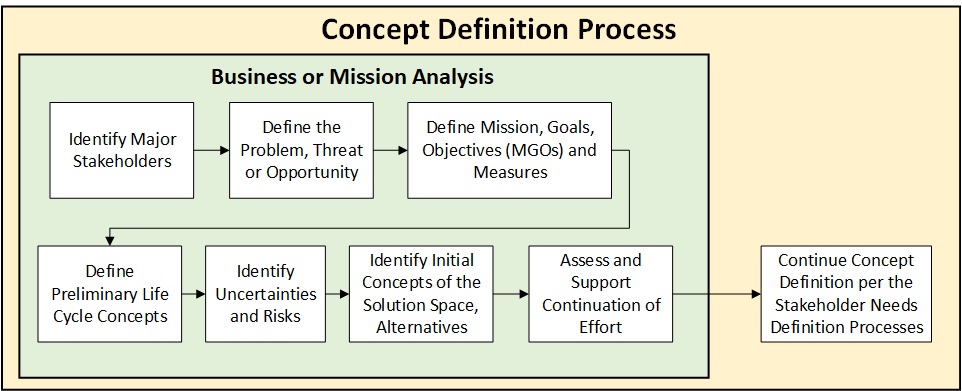
図1. ビジネスまたはミッション分析は、プロジェクトの成功を生み出す取り組みを扱い、その結果はさらなる概念定義のアクティビティのためにプロジェクトチームに提供される。(SEBoK Original)
Business or Mission Analysis
The primary start to the engineering of any system-of-interest (SoI) is to obtain an understanding the objectives behind the development of the SoI, which is performed as part of the process.
あらゆる対象システム(system-of-interest、SoI)のエンジニアリングにおける第一歩は、SoI の開発の背後にある目的を理解することであり、これは概念定義(Concept Definition)プロセスの一部として行われる。
Business or Mission Analysis, the first process performed in Concept Definition, establishes a definition of the overall strategic problem or opportunity and identification of potential solution classes to address the problem (or take advantage of an opportunity) (ISO/IEC/IEEE 15288). The solution could be a new system, a change to an existing system, a service, an operational change or some other solution.
概念定義で最初に行われるプロセスであるビジネスまたはミッション分析(Business or Mission Analysis)は、全体的な戦略的問題または機会を定義し、その問題に対処する(または機会を活かす)ための潜在的なソリューションクラスを特定する(ISO/IEC/IEEE 15288)。ソリューションとしては、新しいシステム、既存システムの変更、サービス、運用上の変更、またはその他のソリューションが考えられる。
This analysis effort identifies the primary purpose(s) of the SoI (its ""). The second Concept Definition process is called Stakeholder Needs Definition, which explores what are needed to accomplish the mission or the intended use of the system.
この分析の取り組みにより、SoI の主要な目的(その「ミッション(mission)」)が特定される。第2の概念定義プロセスはステークホルダーニーズ定義(Stakeholder Needs Definition)と呼ばれ、ミッションの達成、またはシステムの意図された使用のために、どのような能力(capabilities)が必要かを探る。
Business or Mission Analysis is often performed iteratively with the Stakeholder Needs Definition process to better understand the space, as well as options in the space.
ビジネスまたはミッション分析は、問題(problem)空間と、ソリューション(solution)空間の選択肢をよりよく理解するために、ステークホルダーニーズ定義プロセスと反復しながら行われることが多い。
The purpose of Business or Mission Analysis is to understand a mission or market problem, , or , and to establish the goals, objectives and measures of success of a potential solution class. This consists of a strategic analysis related to emerging needs, capability gaps, threats, opportunities, and potential solutions by a project team or by an organization to obtain its business objectives prior to establishing a project team.
ビジネスまたはミッション分析の目的は、ミッションまたは市場における問題、脅威(threat)、または機会(opportunity)を理解し、潜在的なソリューションクラスのゴール、目標、および成功の測定量を確立することである。これは、プロジェクトチームが行うか、事業目標の達成に向けてプロジェクトチームの設置に先立って組織が行う、新たなニーズ、能力のギャップ、脅威、機会、および潜在的なソリューションに関する戦略的分析からなる。
For the SoI under development, success depends on the project team's understanding the data and information that constitutes the purpose of the SoI (why?), acceptability or desirability of a solution (what?), measures (how well?), and the conditions in which the SOI must operate (in what operating environment?)
開発対象の SoI については、成功は、プロジェクトチームが、SoI の目的(「なぜか(why?)」)、ソリューションの受容可能性または望ましさ(「何を(what?)」)、測定量(「どの程度うまくか(how well?)」)、および SoI が動作しなければならない条件(「どのような運用環境においてか(in what operating environment?)」)を示すデータと情報を理解していることに依存する。
Prior to SoI development, a project champion works with key stakeholders to clearly define the problem, threat, or opportunity for which the project team is to address. Identifying the specific problem, threat, or opportunity will enable the project team to understand if the project is worth doing, why the system is needed, and the expected capabilities of the SoI. The next step is to identify the mission, goals, and objectives (MGOs) based on the defined problem, threat or opportunity, as well as the measures of success.
SoI の開発に先立ち、プロジェクトチャンピオンは主要なステークホルダーと協力して、プロジェクトチームが対処すべき問題、脅威、または機会を明確に定義する。具体的な問題、脅威、または機会を特定することで、プロジェクトチームは、そのプロジェクトに取り組む価値があるか、なぜシステムが必要なのか、SoI に期待される能力は何かを理解できるようになる。次のステップは、定義された問題、脅威、または機会に基づいて、ミッション、ゴール、目標(MGOs)と成功の測定量を特定することである。
• The Mission statement is based on the analysis of a problem, threat, or opportunity that the project was formed to address, the expected outcome of the SoI being developed, and defines the “why”. Why does the project exist? Why is the SoI needed? What value does it bring to the organization?
• 「ミッション(Mission)」ステートメントは、プロジェクトがその対処のために結成された問題、脅威、または機会の分析と、開発される SoI に期待される成果とに基づいて、「なぜ」を定義する。プロジェクトはなぜ存在するのか。SoI はなぜ必要なのか。それは組織にどのような価値をもたらすのか。
• Goals are elaborated from the mission statement to communicate what must be achieved to result in a successful mission. Goals allow the organization to divide the mission statement into manageable pieces and promote a shared understanding between the project team and the business operations level stakeholders of what needs to be done to achieve the mission.
• 「ゴール(Goals)」は、ミッションを成功させるために何を達成しなければならないかを伝えるため、ミッションステートメントから詳細化される。ゴールにより、組織はミッションステートメントを管理可能な単位に分割でき、またミッションを達成するために何をする必要があるかについて、プロジェクトチームと事業運用レベルのステークホルダーの間で共通理解が促進される。
• Objectives are elaborated from the goals to provide more details concerning what must be done that will result in the goals and mission to be achieved. What does the project team need to do to achieve the goals? What does the SoI need to do to achieve the goals?
• 「目標(Objectives)」は、ゴールとミッションの達成のためにしなければならないことをより詳細に示すため、ゴールから詳細化される。プロジェクトチームはゴールを達成するために何をする必要があるか。SoI はゴールを達成するために何をする必要があるか。
• Measures are quantitative metrics used to validate the SoI against the objectives as well as to manage system development across the life cycle, expressed as (reference Measurement).
• 「測定量(Measures)」は、目標に照らして SoI を妥当性確認するとともに、ライフサイクル全体を通じてシステム開発を管理するために用いられる定量的なメトリクスであり、有効性測定量(Measures of Effectiveness、MOE)として表される(「測定(Measurement)」を参照)。
As part of the Business or Mission Analysis effort, an initial assessment by key stakeholders of the SoI concepts is used to support identification of candidate solution classes. The organization then performs an evaluation of whether to proceed with development of the SoI based on analysis of the data and alignment with the organization's enterprise strategy. Upon agreement to proceed, the data from the Business and Mission Analysis effort is used by the project team to complete the rest of the concept development process for the SoI, as shown in Figure 1.
ビジネスまたはミッション分析の取り組みの一環として、主要なステークホルダーによる SoI ライフサイクル(life cycle)コンセプトの初期評価が、候補ソリューションクラスの特定を支援するために用いられる。次に組織は、データの分析と、組織のエンタープライズ戦略との整合に基づいて、SoI の開発を進めるかどうかを評価する。進めることで合意すると、図1に示すように、プロジェクトチームはビジネスまたはミッション分析の取り組みから得られたデータを用いて、SoI の残りのコンセプト開発プロセスを完了する。
図中の英語
There are several outputs of the Business or Mission Analysis process:
ビジネスまたはミッション分析プロセスには、いくつかのアウトプットがある。
• identification of major stakeholders,
• 主要なステークホルダーの特定
• definition of the problem, threat, or opportunity to which the project must address,
• プロジェクトが対処しなければならない問題、脅威、または機会の定義
• elaboration of the MGOs and measures of success,
• MGOs と成功の測定量の詳細化
• identification of preliminary life cycle concepts and the preferred solution classes,
• 予備的なライフサイクルコンセプトと優先されるソリューションクラスの特定
• of strategic problems, threats, opportunities, MGOs, and measures of success to the preferred solution classes, and
• 戦略的問題、脅威、機会、MGOs、成功の測定量から優先されるソリューションクラスへのトレーサビリティ(traceability)
• confirmation of organizational support.
• 組織の支援の確認
The effort of Business or Mission Analysis is often done at a business enterprise level, where the initial assessment results in the authorization for a project and associated budget along with an acquisition concept. For the project team responsible for developing the SoI, this means seeking an understanding of this content to ensure the outcomes of the project align with the organization's overall strategy and rationale for developing that particular SoI.
ビジネスまたはミッション分析の取り組みは事業エンタープライズレベルで行われることが多く、初期評価の結果として、プロジェクトの承認と関連予算が取得コンセプトとともに得られる。SoI の開発に責任を持つプロジェクトチームにとってこれは、プロジェクトの成果が、その特定の SoI を開発するための組織の全体戦略および根拠と整合するよう、この内容の理解に努めることを意味する。
The output from the Business or Mission Analysis is then provided to the project team for use in additional analysis that establishes an overall set of for the solution (described in Stakeholder Needs Definition).
ビジネスまたはミッション分析からのアウトプットはその後、ソリューションに対する全体的なニーズ(needs)の集合を確立する追加分析に用いるため、プロジェクトチームに提供される(「ステークホルダーニーズ定義(Stakeholder Needs Definition)」で述べる)。
During this process the initial stakeholder identification is performed. This can be captured in a stakeholder register, noting each stakeholder and their involvement with the SoI and project, as well as establishment a ranking of the stakeholders. This list is expanded upon during Stakeholder Needs Definition. At this phase, the stakeholders will often include key members from the organization at the enterprise level.
このプロセスでは、初期のステークホルダー特定が行われる。その結果はステークホルダー登録簿に記録でき、各ステークホルダーと、その SoI およびプロジェクトへの関与を記すとともに、ステークホルダーの順位付けも定める。このリストは、ステークホルダーニーズ定義の段階で拡充される。このフェーズでは、ステークホルダーにはエンタープライズレベルの組織の主要メンバーが含まれることが多い。
Identifying the specific problem, threat or opportunity will enable the project team to understand why the system is needed, and which capabilities, functions, performance, and features that are important to the customers, users, operators, maintainers, and disposers of the system.
具体的な問題、脅威、または機会を特定することで、プロジェクトチームは、なぜシステムが必要なのか、また、システムの顧客、ユーザー、オペレーター、保守者、廃棄者にとってどのような能力、機能、性能、特徴が重要なのかを理解できるようになる。
There are four steps to defining the problem, threat, or opportunity:
問題、脅威、または機会の定義には4つのステップがある。
1. Identification of the organization’s strategic and business operations level stakeholders that are impacted by the problem or threat or those who will benefit by pursuing the opportunity.
1. 問題または脅威の影響を受ける、あるいは機会の追求によって利益を得る、組織の戦略レベルおよび事業運用レベルのステークホルダーの特定。
2. Collaboration with these stakeholders to understand how they are impacted by the problem or threat, or by those that will benefit by pursuing the opportunity.
2. 問題や脅威からどのような影響を受けるか、または機会を追求するとどのような利益が得られるかを理解するため、該当するステークホルダーと協力する。
3. Clear definition of the problem, threat, or opportunity.
3. 問題、脅威、または機会の明確な定義。
4. Stakeholder concurrence with the problem, threat, or opportunity statement.
4. 問題、脅威、または機会のステートメントに対するステークホルダーの同意。
Example Problem/Threat/Opportunity statement: Marketing is seeing an increase of work from home personnel that are purchasing more coffee makers. Existing coffee makers have single functions while consumers want a multi-function hot beverage maker to produce a blend of options like traditional brew or espresso. There is a huge opportunity if first to market. (INCOSE GtNR 2022)
問題/脅威/機会ステートメントの例:マーケティング部門は、在宅勤務者が増え、こうした勤務者によるコーヒーメーカーの購入台数も増えていることを把握している。既存のコーヒーメーカーは単機能だが、消費者は、通常の抽出コーヒーやエスプレッソなど、複数の選択肢を提供する多機能の温かい飲料メーカーを求めている。一番乗りで市場に投入できれば、大きな機会がある。(INCOSE GtNR 2022)
To achieve the MGOs and measures, the project champion collaborates with the stakeholders that participated in defining the problem, threat, or opportunity to better understand what they view as an acceptable outcome by asking them a series of questions:
MGOs と測定量を達成するために、プロジェクトチャンピオンは、問題、脅威、または機会の定義に参加したステークホルダーと協力し、一連の質問を投げかけることで、彼らが何を受容可能な成果と考えているかをよりよく理解する。
• How do they define success?
• 彼らは成功をどのように定義するか。
• What measures would the stakeholders use to determine success?
• ステークホルダーは成功を判断するためにどのような測定量を用いるか。
• What is the intended use of the SoI and in what operating environment?
• SoI の意図された使用は何か、またどのような運用環境においてか。
• What capabilities, features, functions, and performance do they need?
• 彼らにはどのような能力、特徴、機能、性能が必要か。
• What are their expectations for quality and compliance (such as with standards and regulations)?
• 品質と適合(標準や規制への適合など)に対して、彼らは何を期待しているか。
• What specific outcome(s) do they expect once the SoI is delivered?
• SoI が引き渡された後に、彼らはどのような具体的成果を期待するか。
• What are the measures of success, e.g., measures of effectiveness (MOE), expected of the SoI?
• SoI に期待される成功の測定量(例えば、有効性測定量(MOE))は何か。
For cases where there is no existing SoI, a common approach is to characterize the “as is” or “present state” in terms of the problem, threat, or opportunity and then characterize the “to be” or “future state” in terms of the resolution of the problem, neutralizing the threat, or the ability to pursue the opportunity.
既存の SoI がない場合の一般的なアプローチは、問題、脅威、または機会の観点から「現状(as is)」すなわち「現在の状態」を特徴付け、次に、問題の解決、脅威の無力化、または機会を追求する能力の観点から「あるべき姿(to be)」すなわち「将来の状態」を特徴付けることである。
For existing systems that need to be updated, a common approach is to list the problems or issues with the existing “as-is” system and the reasons it needs to be changed. Key information includes what value they believe will result from the change by addressing: What can the existing SoI no longer do, what performance needs to be improved, what changes need to be made concerning interactions with external systems, what updates are needed as a result of changes to applicable standards and regulations, what updates are needed as a result of changes in the operational environment or new threats (e.g., security)?
更新が必要な既存システムについての一般的なアプローチは、既存の「現状」システムの問題や課題と、それを変更する必要がある理由を列挙することである。主要な情報には、次の問いを検討したうえで、変更によってどのような価値が得られるとステークホルダーが考えるかが含まれる。既存の SoI ではもはやできないことは何か、改善が必要な性能は何か、外部システムとの相互作用に関してどのような変更が必要か、適用される標準や規制の変更に伴ってどのような更新が必要か、運用環境の変化や新たな脅威(例えば、セキュリティ)に伴ってどのような更新が必要か。
It is also important to understand different perspectives. The problem, threat, or opportunity, MGOs, and measures from a business perspective may be different than the user’s perspective, both must be addressed. The user does not necessarily care about the developing organization's profits, time to market, market share, etc., they care about how the resulting SoI meets their needs. Thus, there could be several sets of MGOs and measures that need to be defined and met by the project team from both a business perspective and a user perspective of the SoI to be developed. This may lead to conflicts, e.g., product price vs. profitability vs. market share, which need to be prioritized based on the organizational enterprise strategy.
異なる視点を理解することも重要である。事業の視点から見た問題、脅威、または機会、MGOs、測定量は、ユーザーの視点から見たものとは異なるかもしれず、その両方に対処しなければならない。ユーザーは、開発組織の利益、市場投入までの時間、市場シェアなどには必ずしも関心がなく、出来上がった SoI が自分たちのニーズをどのように満たすかに関心がある。したがって、開発される SoI については、事業の視点とユーザーの視点の両方から、プロジェクトチームが定義し満たさなければならない MGOs と測定量の集合が複数存在し得る。これは、例えば製品価格対収益性対市場シェアのような対立につながる可能性があり、組織のエンタープライズ戦略に基づいて優先順位を付ける必要がある。
Examples (derived from INCOSE GtNR 2022):
例(INCOSE GtNR 2022 を基にしたもの):
• Mission statement: Increase revenue by providing a home-based, one-stop, multi-function hot beverage maker.
• ミッションステートメント:家庭向けのワンストップ型多機能温かい飲料メーカーを提供することで、収益を増やす。
• Consumer Goals: Product a blend of options. Obtain home brew beverage quickly.
• 消費者のゴール:複数の飲み方を選べるようにする。家庭で淹れた飲料をすばやく手に入れる。
• Consumer Objective: Options of brew or expresso. Receive finished home brew coffee within minutes upon request.
• 消費者の目標:抽出またはエスプレッソの選択肢。要求に応じて、淹れたての家庭用コーヒーを数分以内に受け取る。
• Consumer-focused Measure: Finished home brew provided within 2 minutes of activation at the selected temperature. Rationale: Consumer survey results.
• 消費者重視の測定量:起動から2分以内に、選択された温度で淹れたての家庭用コーヒーを提供する。根拠:消費者調査結果。
• Business Goals: Increase revenue. Increase market share.
• 事業のゴール:収益を増やす。市場シェアを増やす。
• Business Objective: Increase market share of Company X sales regions.
• 事業の目標:Company X の販売地域における市場シェアを増やす。
• Business-focused Measure: Improve current market share of Company X sales regions by 20%. Rationale: Aligns with the enterprise strategic vision.
• 事業重視の測定量:Company X の販売地域における現在の市場シェアを20%改善する。根拠:エンタープライズ戦略ビジョンと整合する。
Life cycle concepts, such as the , define what the SoI needs to do and how well during its intended use in the expected operational environment, from multiple perspectives. This includes various use cases with expected interactions with external systems, identification of drivers and constraints, expected risks to success in the context of the MGOs and measures.
システムレベルの運用概念(operational concept)などのライフサイクルコンセプトは、期待される運用環境での意図された使用において、SoI が何を、どの程度うまく行う必要があるかを、複数の視点から定義する。これには、外部システムとの期待される相互作用を伴うさまざまなユースケース、ドライバと制約の特定、MGOs と測定量の文脈において成功に対して予想されるリスクが含まれる。
Preliminary life cycle concepts are defined by the organization and include preliminary concepts for acquisition, development, manufacturing or coding, verification, validation, deployment, operations, support, and retirement. Operational concepts include high level operational modes or states, operational scenarios, potential use cases, misuse cases, loss scenarios, or usage within a proposed business strategy. These concepts enable feasibility analysis and evaluation of solution options. For example, concerning acquisition and development how much of the development effort will be done inhouse or outsourced to a supplier? Who will be the overall integrator? If development is done in house, what are the concepts for the supply chain for parts and components?
予備的なライフサイクルコンセプトは組織によって定義され、取得、開発、製造またはコーディング、検証、妥当性確認、展開、運用、支援、廃止に関する予備的なコンセプトを含む。システムレベルの運用概念には、高レベルの運用モードまたは状態、運用シナリオ、潜在的なユースケース、誤用ケース、損失シナリオ、または提案される事業戦略の中での使用が含まれる。これらのコンセプトにより、ソリューション選択肢の実現可能性分析と評価が可能になる。例えば、取得と開発に関しては、開発の取り組みのうちどの程度を自社で行い、どの程度をサプライヤーに外注するか。全体のインテグレーターは誰が担うか。開発を自社で行う場合、部品やコンポーネントのサプライチェーンはどのようなコンセプトになるか。
In a effort, these life cycle concepts are generated using mission analysis, such as defining use cases associated with users and life cycle stage (Figure 2). Reference Model-Based Systems Engineering (MBSE) for more information regarding usage of MBSE.
モデルベースシステムズエンジニアリング(Model-Based Systems Engineering、MBSE)の取り組みでは、これらのライフサイクルコンセプトは、ユーザーとライフサイクル段階に関連付けられたユースケースを定義するなど、ミッション分析を用いて生成される(図2)。MBSE の使用について詳しくは「モデルベースシステムズエンジニアリング(MBSE)」を参照。
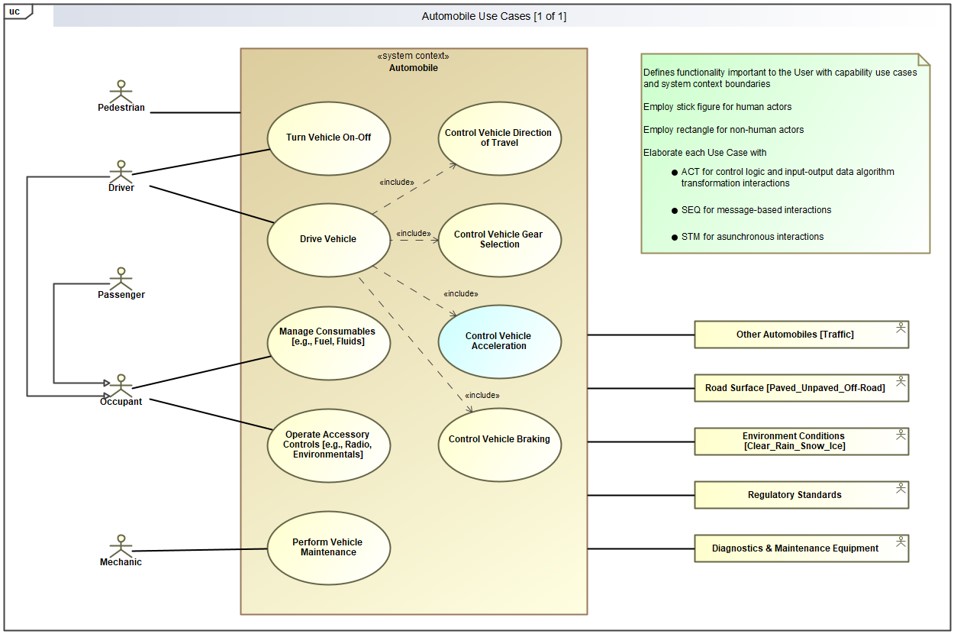
図中の英語
The life cycle concepts will be further refined within the stakeholder needs definition process. As part of the preliminary life cycle concepts, candidate solution classes are suggested for a possible range of approaches to address the MGOs, as part of a Functional Architecture definition activity.
ライフサイクルコンセプトは、ステークホルダーニーズ定義プロセスの中でさらに洗練される。予備的なライフサイクルコンセプトの一環として、また機能アーキテクチャ(Functional Architecture)定義のアクティビティの一部として、MGOs に対処するための可能なアプローチの範囲に対する候補ソリューションクラスが提案される。
The preliminary life cycle concepts include some level of uncertainty. This leads to risks which need to be identified and managed using the Risk Management process. These risks may also serve as inputs to the generation of additional life cycle concepts (such as addressing cyber security or hazards to successful operation).
予備的なライフサイクルコンセプトには、ある程度の不確実性が含まれる。これはリスクにつながり、そのリスクはリスク管理(Risk Management)プロセスを用いて特定し管理する必要がある。これらのリスクは、追加のライフサイクルコンセプト(サイバーセキュリティや、運用の成功に対するハザードへの対処など)を生成する際の入力としても役立ち得る。
A solution class refers to the means of achieving a solution. Examples include development of a new system, modifying or upgrading an existing system, leveraging multiple existing systems, or generating operational changes.
ソリューションクラスとは、ソリューションを達成する手段を指す。例としては、新しいシステムの開発、既存システムの変更またはアップグレード、複数の既存システムの活用、運用上の変更の創出がある。
Possible solution classes to address the problem, threat, or opportunity are assessed against the preliminary life cycle concepts, MGOs and measures. Feasibility of a solution class and its capability to meet the strategic needs are key decision criteria, as well as feasibility considerations in terms of cost, schedule, technology, legal, ethical, environmental, sustainability, etc. The Decision Management process is used to evaluate alternatives and to guide selection. The assessment of alternatives can include modeling, simulation, analytical techniques, or expert judgment to understand the risks, feasibility, and value of the alternative solution classes.
問題、脅威、または機会に対処するための可能なソリューションクラスは、予備的なライフサイクルコンセプト、MGOs、測定量に照らして評価される。ソリューションクラスの実現可能性と、戦略的ニーズを満たす能力は主要な決定基準であり、コスト、スケジュール、技術、法律、倫理、環境、持続可能性などの観点からの実現可能性の考慮も同様である。意思決定管理(Decision Management)プロセスは、代替案を評価し、選択を導くために用いられる。代替案の評価には、代替ソリューションクラスのリスク、実現可能性、価値を理解するためのモデリング、シミュレーション、分析技法、または専門家の判断が含まれ得る。
The conclusion of this effort results in the identification of preliminary concepts of the solution space, including alternatives, which are traceable to the organization defined problems/threats/opportunities and MGOs/measures.
この取り組みの結論として、組織が定義した問題/脅威/機会と MGOs/測定量にトレーサブルな、代替案を含むソリューション空間の予備的コンセプトが特定される。
Upon the conclusion of the Business or Mission Analysis process the organization performs an evaluation on whether to commence with development of the SoI. The key determination is alignment with the enterprise strategy. If the effort is to be continued, a project team will take the outcomes of the Business or Mission Analysis effort and commence with the Stakeholder Needs Definition activity.
ビジネスまたはミッション分析プロセスの終了時に、組織は SoI の開発に着手するかどうかを評価する。判断の要となるのは、エンタープライズ戦略との整合である。取り組みを継続する場合、プロジェクトチームはビジネスまたはミッション分析の取り組みの成果を引き継ぎ、ステークホルダーニーズ定義(Stakeholder Needs Definition)のアクティビティを開始する。
ISO/IEC/IEEE. 2023. Systems and Software Engineering -- System Life Cycle Processes. Geneva, Switzerland: International Organisation for Standardisation / International Electrotechnical Commissions / Institute of Electrical and Electronics Engineers. ISO/IEC/IEEE 15288:2023.
INCOSE. 2022. INCOSE Needs and Requirements Manual (NRM), version 1.1. INCOSE-TP-2021-002-01.
INCOSE. 2022. INCOSE Guide to Needs and Requirements (GtNR), version 1. INCOSE-TP-2021-003-01
ISO/IEC/IEEE. 2023. Systems and Software Engineering -- System Life Cycle Processes. Geneva, Switzerland: International Organisation for Standardisation / International Electrotechnical Commissions / Institute of Electrical and Electronics Engineers. ISO/IEC/IEEE 15288:2023.
INCOSE. 2023. Systems Engineering Handbook: A Guide for System Life Cycle Processes and Activities, version 5.0. Hoboken, NJ, USA: John Wiley and Sons, Inc, ISBN: 978-1-118-99940-0.
INCOSE. 2022. INCOSE Needs and Requirements Manual (NRM), version 1.1. INCOSE-TP-2021-002-01.
INCOSE. 2022. INCOSE Guide to Needs and Requirements (GtNR), version 1. INCOSE-TP-2021-003-01
None.