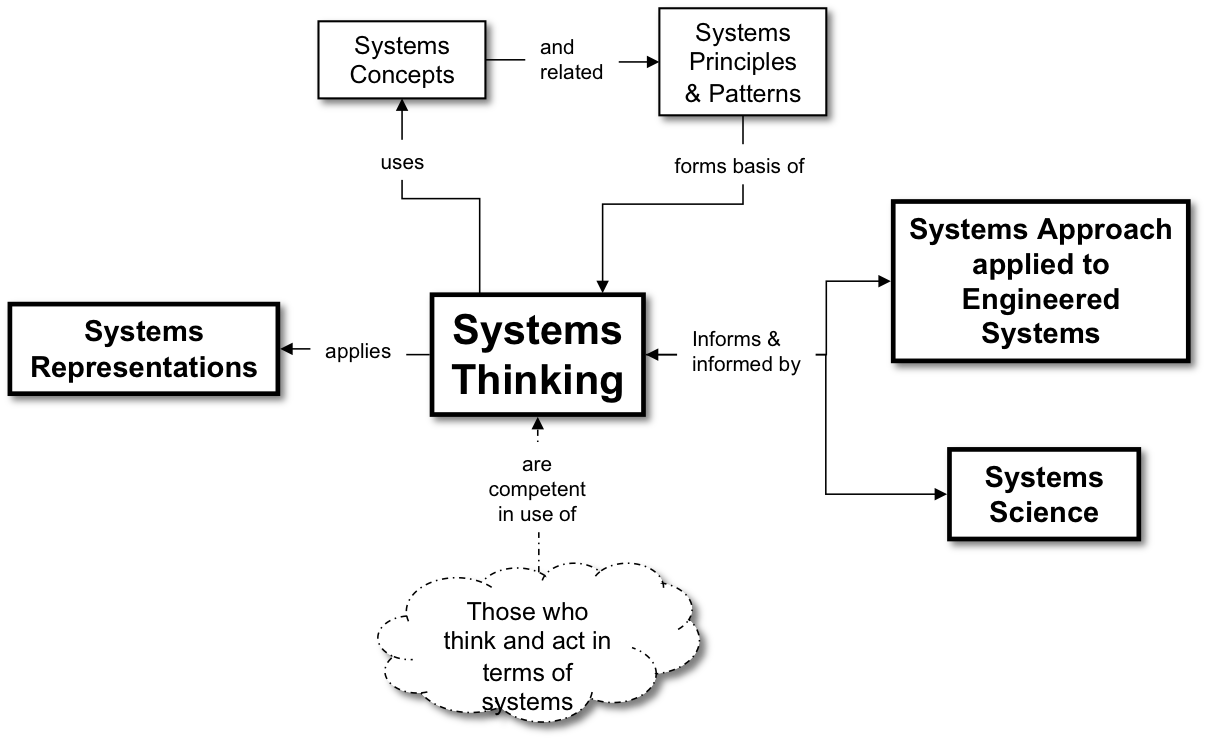
図1. SEBoK におけるシステム思考。(SEBoK Original)
Systems Thinking
This knowledge area (KA) provides a guide to knowledge about systems thinking which is the integrating paradigm for systems science and systems approaches to practice.
本知識領域(Knowledge Area、KA)は、システム思考(systems thinking)に関する知識へのガイドを提供する。システム思考は、システム科学(Systems Science)と、実践に対するシステムズアプローチ(Systems Approaches)とを統合するパラダイム(paradigm)である。
This is part of the wider systems knowledge which can help to provide a common language and intellectual foundation, and make practical systems concepts, principles, patterns and tools accessible to systems engineering (SE), as discussed in the Introduction to Part 2.
これはより広範なシステム(systems)知識の一部である。この知識は、共通の言語と知的基盤を提供し、実践的なシステムの概念(concepts)、原則(principles)、パターン(patterns)、ツールをシステムズエンジニアリング(Systems Engineering、SE)が利用できるようにするうえで役立ち得る。Part 2 序論で論じられているとおりである。
Systems thinking is concerned with understanding or intervening in problem situations, based on the principles and concepts of the systems paradigm. This KA offers some basic definitions of systems thinking. The following diagram summarizes how the knowledge is presented.
システム思考は、システムパラダイムの原則と概念に基づいて、問題(problem)状況を理解すること、あるいはその状況に介入することに関わる。本 KA では、システム思考の基本的な定義をいくつか示す。次の図は、その知識をどのように提示しているかを要約したものである。
図中の英語
Systems thinking considers the similarities between systems from different domains in terms of a set of common systems concepts, principles and patterns:
システム思考は、異なる領域のシステム間の類似性を、共通のシステム概念、原則、パターンの集合という観点から考察する。
• A principle is a rule of conduct or behavior. To take this further, a principle is a “basic generalization that is accepted as true and that can be used as a basis for reasoning or conduct” (WordWeb.com).
• 原則(principle)とは、行動規範、すなわち振る舞い(behavior)の規則である。さらに踏み込んで言えば、原則とは「真であると受け入れられ、推論や行動の基礎として用いることのできる基本的な一般化」である(WordWeb.com)。
*A concept is an abstraction, or a general idea inferred or derived from specific instances.
• 概念(concept)とは、抽象、すなわち特定の事例から推論または導出された一般的な考えである。
Principles depend on concepts in order to state a “truth.” Hence, principles and concepts go hand in hand; principles cannot exist without concepts and concepts are not very useful without principles to help guide the proper way to act (Lawson and Martin 2008).
原則は、「真理」を述べるために概念に依存する。したがって、原則と概念は表裏一体である。原則は概念なしには存在し得ず、また概念も、適切な行動のしかたを導く助けとなる原則がなければ、あまり役に立たない(Lawson and Martin 2008)。
Many sources combine both concepts and the principles based on them. The Concepts of Systems Thinking article presents concepts extracted from a variety of theory and practice sources. The Principles of Systems Thinking article, in turn, presents a summary of important principles referring back to the concepts upon which they are based.
多くの情報源は、概念と、それに基づく原則の両方を組み合わせて扱っている。「Concepts of Systems Thinking」の記事では、理論と実践にわたるさまざまな情報源から抽出した概念を提示する。「Principles of Systems Thinking」の記事では、重要な原則を、その基礎となる概念に立ち返りながら要約して示す。
A pattern is an expression of observable similarities found in systems from different domains. Patterns exist in both natural and man-made systems and are used in systems science and systems engineering. A summary of the different classes of patterns and the use of patterns to support a systems approach is discussed in the final Patterns of Systems Thinking article.
パターンとは、異なる領域のシステムに見出される、観察可能な類似性を表現したものである。パターンは自然システムにも人工システムにも存在し、システム科学とシステムズエンジニアリングで用いられる。パターンのさまざまなクラスの要約と、システムズアプローチを支援するためのパターンの使い方については、最後の「Patterns of Systems Thinking」の記事で論じる。
The practical application of systems thinking often employs the use of abstract system representations or models. Some mention of models is made in this KA; additionally, a more complete guide is provided in Representing Systems with Models.
システム思考を実際に応用する際には、抽象的なシステム表現、すなわちモデル(models)がしばしば用いられる。本 KA でもモデルについて多少触れるが、より包括的なガイドは「Representing Systems with Models」で提供されている。
Lawson, H., and J.N. Martin. 2008. "On the Use of Concepts and Principles for Improving Systems Engineering Practice," in Proceedings of the 18th Annual International Council on Systems Engineering (INCOSE) International Symposium, Utrecht, The Netherlands, 5-19 June 2008.
WordWeb Online. n.d. "Definition: Principle." Accessed Dec 3, 2014. Available at: WordWeb Online https://www.wordwebonline.com/en/PRINCIPLE.
Bertalanffy, L. von. 1968. General System Theory: Foundations, Development, Applications. Revised ed. New York, NY, USA: Braziller.
Checkland, P. 1999. Systems Thinking, Systems Practice. New York, NY, USA: John Wiley & Sons.
Churchman, C. W. 1968. The Systems Approach and its Enemies. New York, NY, USA: Dell Publishing.
Flood, R. L. 1999. Rethinking the Fifth Discipline: Learning Within the Unknowable. London UK: Routledge.
INCOSE. 2012. INCOSE Systems Engineering Handbook: A Guide for System Life Cycle Processes and Activities, version 3.2.2. San Diego, CA, USA: International Council on Systems Engineering (INCOSE), INCOSE-TP-2003-002-03.2.1.
Ackoff, R.L. 1971. "Towards a system of systems concepts," Management Science, vol. 17, no. 11.
Hitchins, D. 2009. "What are the general principles applicable to systems?" INCOSE Insight, vol. 12, no. 4.
Lawson, H. 2010. A Journey Through the Systems Landscape. London, UK: College Publications, Kings College.
Ramage, M. and K. Shipp. 2009. Systems Thinkers. Dordrecht, The Netherlands: Springer.
Weinberg, G. M. 1975. An Introduction to General Systems Thinking. New York, NY, USA: Wiley.