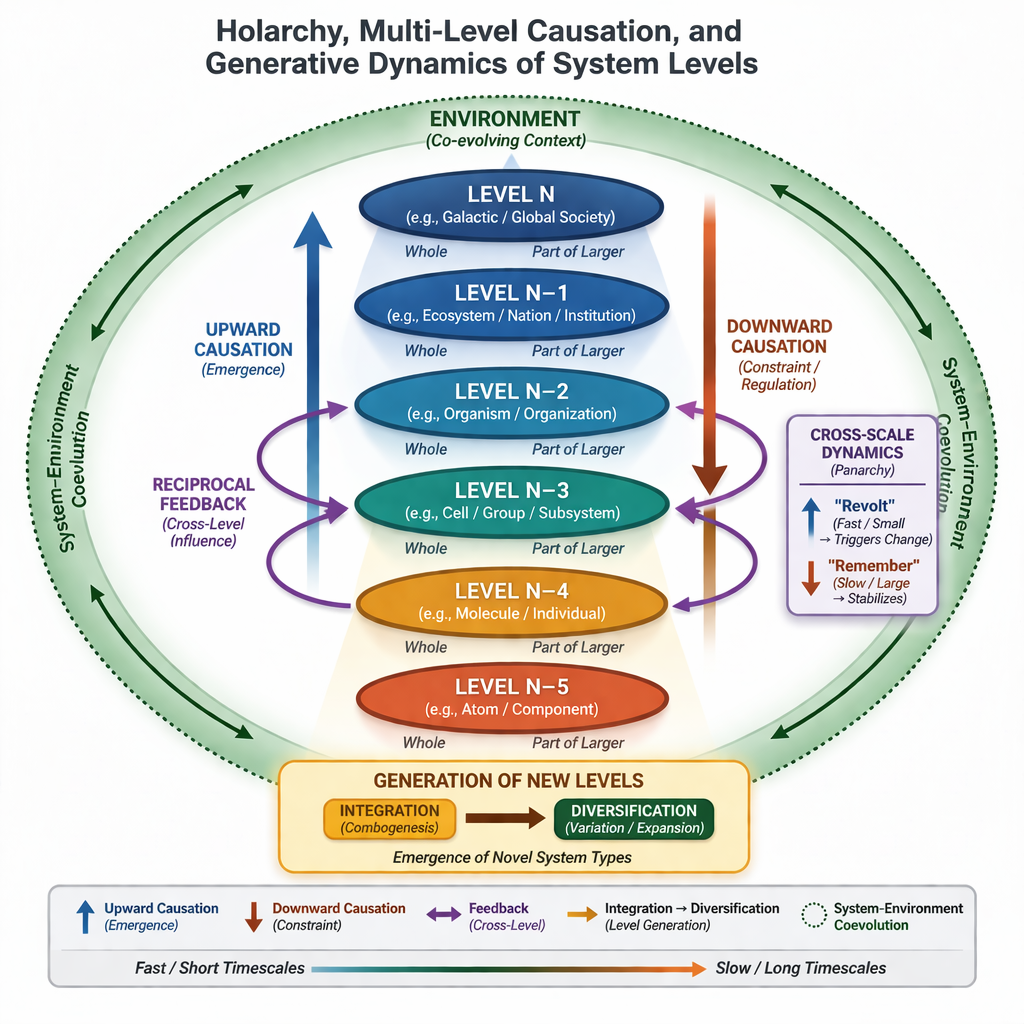
図1:ホラーキー、多重因果、生成的システムレベル。(SEBoK オリジナル)
Systems, Levels, and Holarchy
Systems are often organized across multiple levels, with smaller systems interacting to form larger, more complex systems. Concepts such as hierarchy and holarchy help explain how systems can be simultaneously whole entities and parts of broader systems, each with their own structures, behaviors, and purposes. Relationships across levels influence communication, control, adaptation, and emergent behavior within and between systems. Understanding these layered interactions supports systems thinking by providing insight into how complexity, coordination, and interdependence operate across natural, engineered, organizational, and socio-technical systems.
システムは複数のレベルにわたって組織化されていることが多く、より小さなシステムが相互作用して、より大きく、より複雑なシステムを形成する。階層やホラーキーといった概念は、システムが全体としての実体であると同時に、より広いシステムの部分でもあり得ること、そしてそれぞれが独自の構造、振る舞い、目的を持つことを説明するのに役立つ。レベルを横断する関係は、システム内部やシステム間におけるコミュニケーション、制御、適応、創発的振る舞いに影響を及ぼす。こうした層状の相互作用を理解すると、自然システム、エンジニアード・システム、組織システム、社会技術システムにおいて、複雑性、調整、相互依存がどのように作用するかについての洞察が得られ、システム思考の助けとなる。
Acknowledgement
謝辞
This article reflects established knowledge from systems science and systems engineering, organized and collated for the SEBoK. Drafting support was provided by OpenAI’s ChatGPT, with all content reviewed and finalized by the author, who retains full responsibility.
本記事は、システム科学とシステムズエンジニアリングにおける確立した知識を、SEBoK のために整理し集約したものである。草稿作成には OpenAI の ChatGPT の支援を受けたが、すべての内容は著者がレビューして確定しており、その全責任は著者が負う。
This article forms part of the Systems Science knowledge area (KA). It examines how many systems are organized across multiple levels of structure and scale, and how interactions among these levels influence system behavior.
本記事は、システム科学知識領域(KA)の一部をなす。本記事では、多くのシステムが構造とスケールの複数のレベルにわたってどのように組織化されているか、そしてこれらのレベル間の相互作用がシステムの振る舞いにどのように影響するかを検討する。
Earlier articles in this knowledge area have explored the structural organization of systems, the emergence of new properties from interacting components, the dynamic processes that regulate system behavior, and the role of information in maintaining system organization. These discussions reveal that complex systems are rarely isolated entities. Instead, they exist within nested arrangements of systems within systems, forming layered structures across multiple scales.
この知識領域のこれまでの記事では、システムの構造的組織、相互作用する構成要素からの新しい特性の創発、システムの振る舞いを調節する動的プロセス、そしてシステム組織の維持において情報が果たす役割を探求してきた。これらの議論から、複雑なシステムが孤立した実体であることはまれだということが明らかになる。むしろ、複雑なシステムはシステムの中のシステムという入れ子状の配置(nested arrangements of systems within systems)の中に存在し、複数のスケールにわたる層状の構造を形成している。
Understanding how systems are organized across levels is therefore essential for understanding complexity. Systems science investigates how these layered structures arise, how interactions occur across levels, and how systemic properties propagate through these interconnected structures.
したがって、システムがレベルを横断してどのように組織化されているかを理解することは、複雑性を理解するうえで不可欠である。システム科学は、こうした層状構造がどのように生じるのか、レベルを横断して相互作用がどのように起こるのか、そしてシステム的特性がこれらの相互接続された構造を通じてどのように伝播するか(systemic properties propagate through these interconnected structures)を探究する。
Across many domains of science, complex systems exhibit nested levels of organization. Systems are composed of subsystems that themselves contain smaller systems, while also functioning as components of larger systems.
科学の多くの領域において、複雑なシステムは組織の入れ子状のレベル(nested levels of organization)を示す。システムは、それ自体がより小さなシステムを含むサブシステムから構成されると同時に、より大きなシステムの構成要素としても機能する。
Examples of such multi-level organization include:
このような多レベル組織の例として、次のものがある:
• Physical systems: particles, atoms, molecules, materials, planetary systems
• 物理システム(Physical systems):粒子、原子、分子、物質、惑星系
• Biological systems: cells, tissues, organs, organisms, ecosystems
• 生物システム(Biological systems):細胞、組織、器官、生物、生態系
• Social systems: individuals, groups, organizations, institutions, societies
• 社会システム(Social systems):個人、集団、組織、制度、社会
• Engineered systems: components, subsystems, systems, and systems-of-systems
• エンジニアード・システム(Engineered systems):構成要素、サブシステム、システム、システム・オブ・システムズ
In each case, higher levels emerge from interactions among elements at lower levels, while simultaneously creating new contexts that influence the behavior of those elements.
いずれの場合も、より高いレベルはより低いレベルの要素間の相互作用から創発すると同時に、それらの要素の振る舞いに影響を与える新たなコンテキストを生み出す。
The existence of such layered organization has long been recognized in systems science. Boulding (1956) described the universe as consisting of multiple levels of organization characterized by increasing complexity and new forms of behavior. These levels range from simple physical structures to biological organisms and complex social systems.
このような層状組織の存在は、システム科学において古くから認識されてきた。Boulding(1956)は、宇宙を、複雑性の増大と新しい振る舞いの形態によって特徴づけられる複数の組織レベルから成るものとして記述した。これらのレベルは、単純な物理構造から生物、さらには複雑な社会システムにまで及ぶ。
Hierarchy theory further refines this understanding by emphasizing that levels are often associated with differences in scale, rate of change, and observational perspective (Allen and Starr 1982). While these levels can be distinguished analytically, they are not independent. Instead, they form interconnected structures in which processes occurring at one level both influence and are influenced by processes at other levels.
階層理論は、レベルがしばしばスケール、変化の速度、観察の視点の違い(differences in scale, rate of change, and observational perspective)と結びついていることを強調し、この理解をさらに精緻化している(Allen and Starr 1982)。これらのレベルは分析上は区別できるが、互いに独立してはいない。むしろ、あるレベルで起こるプロセスが他のレベルのプロセスに影響を与え、かつそれらから影響を受ける、相互接続された構造(interconnected structures in which processes occurring at one level both influence and are influenced by processes at other levels)を形成している。
Complex systems frequently exhibit hierarchical organization, in which subsystems are grouped into larger structures. Simon (1962) argued that such hierarchical structures play a critical role in the evolution and stability of complex systems.
複雑なシステムは、サブシステムがより大きな構造へとまとめられる階層的組織(hierarchical organization)をしばしば示す。Simon(1962)は、こうした階層構造が複雑なシステムの進化と安定性において重要な役割を果たすと論じた。
He introduced the concept of nearly decomposable systems, where interactions within subsystems are typically stronger than interactions between subsystems. This structural property enables:
Simon はほぼ分解可能なシステム(nearly decomposable systems)の概念を導入した。これは、サブシステム内部の相互作用が、典型的にはサブシステム間の相互作用よりも強いシステムである。この構造的特性によって、次のことが可能になる:
• stability through modular organization
• モジュール的組織による安定性
• scalability in system growth
• システムの成長におけるスケーラビリティ
• manageable complexity
• 管理可能な複雑性
Hierarchical organization allows complex systems to evolve through stable intermediate forms, reducing the need to manage all interactions simultaneously.
階層的組織によって、複雑なシステムは安定した中間形態を経て進化できるようになり、すべての相互作用を同時に管理する必要性が減る。
However, hierarchy should not be understood as rigid top-down control. Instead, it reflects a pattern of organization that supports both independence and interdependence across levels, enabling systems to balance stability with adaptability.
ただし、階層を硬直的なトップダウンの制御として理解すべきではない。むしろ階層は、レベルを横断する独立性と相互依存の双方を支える組織のパターン(pattern of organization that supports both independence and interdependence across levels)を反映しており、システムが安定性と適応性のバランスを取ることを可能にする。
Koestler (1967) introduced the concept of the holon to describe entities that are simultaneously:
Koestler(1967)は、次の両方の性質を同時に持つ実体を記述するために、ホロン(holon)の概念を導入した:
• wholes in themselves, and
• それ自体として全体である(wholes in themselves)
• parts of larger systems
• より大きいシステムの部分である(parts of larger systems)
Holons form holarchies, nested structures in which each level maintains a degree of autonomy while contributing to larger organizational structures.
ホロンはホラーキー(holarchies)を形成する。ホラーキーとは、各レベルが一定の自律性を保ちながら、より大きな組織構造に寄与する入れ子状の構造である。
Holons exhibit two complementary tendencies:
ホロンは、相補的な2つの傾向を示す:
• a self-assertive tendency, which maintains identity and integrity
• 自己主張的傾向(self-assertive tendency):アイデンティティと完全性を維持する
• an integrative tendency, which enables participation within larger systems
• 統合的傾向(integrative tendency):より大きなシステムへの参加を可能にする
This balance between autonomy and integration allows complex systems to maintain coherence while remaining adaptable.
自律性と統合のこのバランスによって、複雑なシステムは適応性を保ちながら一貫性を維持できる。
Holonic structures appear widely in biological systems, social institutions, and engineered systems, particularly where modular or layered architectures are present.
ホロン的構造は、生物システム、社会制度、エンジニアード・システムに広く見られ、とりわけモジュール型あるいは層状のアーキテクチャが存在するところに現れる。
Levels of organization depend fundamentally on the establishment of boundaries that distinguish systems from their environments. These boundaries may be:
組織のレベルは、システムをその環境から区別する境界(boundaries)の確立に根本的に依存している。これらの境界は、次のようなものであり得る:
• physical (e.g., membranes)
• 物理的(例:膜)
• functional (e.g., organizational roles)
• 機能的(例:組織的役割)
• informational (e.g., models and representations)
• 情報的(例:モデルと表現)
Such boundaries are often actively maintained, rather than fixed.
このような境界は、固定されたものではなく、しばしば能動的に維持される(actively maintained)ものである。
Biological systems maintain cellular membranes, social systems maintain institutional and communicative boundaries, and conceptual systems are bounded through definitions and models. These boundary processes enable systems to persist as identifiable entities.
生物システムは細胞膜を維持し、社会システムは制度的・コミュニケーション的な境界を維持し、概念的システムは定義とモデルによって境界づけられる。こうした境界プロセスによって、システムは識別可能な実体として存続できる。
Maturana and Varela (1980) emphasize that living systems continuously produce and maintain their own boundaries, while Pattee (1973) highlights the role of symbolic and informational distinctions in defining system levels.
Maturana と Varela(1980)は、生きたシステムが自らの境界を絶えず生み出し維持していることを強調し、Pattee(1973)は、システムレベルを定義するうえで象徴的・情報的な区別が果たす役割を浮き彫りにしている。
Levels of organization therefore arise not only from structure, but from the ongoing processes that maintain distinctions between system and environment.
したがって、組織のレベルは構造だけから生じるのではなく、システムと環境の間の区別を維持する継続的なプロセス(ongoing processes that maintain distinctions between system and environment)からも生じる。
The significance of levels becomes clearer when considering how causation operates across them.
レベルの重要性は、因果がレベルを横断してどのように作用するかを考えると、いっそう明確になる。
System behavior arises from interactions that occur both within levels and across them. Three broad patterns of causal interaction can be identified:
システムの振る舞いは、レベル内で起こる相互作用とレベルを横断して起こる相互作用の双方から生じる。因果的相互作用には、大きく分けて3つのパターンを見出すことができる:
• Upward causation: lower-level interactions give rise to higher-level structures and behaviors
• 上方因果(Upward causation):より低いレベルの相互作用が、より高いレベルの構造と振る舞いを生み出す
• Downward causation: higher-level structures constrain and regulate lower-level processes (Campbell 1974)
• 下方因果(Downward causation):より高いレベルの構造が、より低いレベルのプロセスを制約し調節する(Campbell 1974)
• Reciprocal causation: feedback processes link multiple levels simultaneously
• 相互因果(Reciprocal causation):フィードバックプロセスが複数のレベルを同時に結びつける
These causal relationships are central to understanding how systems maintain coherence while remaining responsive to change. Higher-level organization does not merely constrain lower-level processes—it also enables coordinated behavior by providing structure and context.
これらの因果関係は、システムが変化への応答性を保ちながら、どのように一貫性を維持するのかを理解するうえで中心的な意味を持つ。より高いレベルの組織は、より低いレベルのプロセスを単に制約するだけではない。構造とコンテキストを提供することによって、調整された振る舞いを可能にするものでもある(enables coordinated behavior by providing structure and context)。
In addition to structural nesting, systems exhibit recurring functional organization.
システムは、構造的な入れ子に加えて、繰り返し現れる機能的組織(functional organization)も示す。
Miller (1978) identified key subsystems required for living systems, including:
Miller(1978)は、生きたシステムに必要な主要サブシステムを特定した。そこには次のものが含まれる:
• boundary maintenance
• 境界の維持
• information processing
• 情報処理
• resource and energy flows
• 資源とエネルギーのフロー
• regulation and control
• 調節と制御
Similar functional patterns appear in social and engineered systems. Organizations, for example, require communication, coordination, resource allocation, and governance functions.
同様の機能的パターンは、社会システムやエンジニアード・システムにも見られる。たとえば、組織にはコミュニケーション、調整、資源配分、ガバナンスの機能が必要である。
This recurring architecture reinforces the idea that levels of organization are not merely structural layers, but patterns of organized activity that recur across multiple domains of reality.
このように繰り返し現れるアーキテクチャは、組織のレベルが単なる構造上の層ではなく、現実の複数の領域にわたって繰り返し現れる、組織化された活動のパターン(patterns of organized activity that recur across multiple domains of reality)であるという考えを補強する。
The progression of levels in the universe has been described by Volk (2003; 2017) as extending “from quarks to culture”, reflecting the emergence of increasingly complex forms of organization across cosmic, biological, and social evolution.
宇宙におけるレベルの進行は、Volk(2003; 2017)によって「クォークから文化まで(from quarks to culture)」に及ぶものとして記述されてきた。これは、宇宙の進化、生物の進化、社会の進化を通じて、ますます複雑な組織形態が創発することを反映している。
This progression includes:
この進行には次のものが含まれる:
• elementary particles
• 素粒子
• atoms and molecules
• 原子と分子
• living cells
• 生きた細胞
• multicellular organisms
• 多細胞生物
• social and cultural systems
• 社会的・文化的システム
Transitions between levels often involve major evolutionary transformations, where new forms of organization emerge (Maynard Smith and Szathmáry 1995).
レベル間の遷移には、新しい組織形態が創発する主要な進化的移行(major evolutionary transformations)が伴うことが多い(Maynard Smith and Szathmáry 1995)。
Within each level, recurring patterns, such as networks, flows, and feedback loops, appear, suggesting the presence of common systemic principles across domains.
各レベルの内部では、ネットワーク、フロー、フィードバックループといったパターンが繰り返し現れ、領域を横断する共通のシステム的原則が存在することを示唆している。
Not all system configurations persist. The emergence and stability of levels depend on constraints that regulate system behavior.
すべてのシステム構成が存続するわけではない。レベルの創発と安定性は、システムの振る舞いを調節する制約に依存する。
These include:
これらには次のものが含まれる:
• energy and material constraints
• エネルギーと物質の制約
• structural coherence
• 構造的一貫性
• environmental compatibility
• 環境との適合性
Morowitz (2002) demonstrated that increasing levels of organization arise from energy flowing through matter under far-from-equilibrium conditions.
Morowitz(2002)は、より高次の組織レベルが、平衡から遠く離れた条件下で物質を通って流れるエネルギー(energy flowing through matter under far-from-equilibrium conditions)から生じることを示した。
From this perspective, levels exist because systems are able to maintain organized structure through continuous flows and constraints. Systems that cannot sustain these conditions remain transient or fail to stabilize.
この観点からすれば、レベルが存在するのは、システムが継続的なフローと制約を通じて組織化された構造を維持できる(maintain organized structure through continuous flows and constraints)からである。こうした条件を維持できないシステムは、一時的なものにとどまるか、安定化に至らない。
Systems not only exist across levels, they interact dynamically across them.
システムはレベルを横断して存在するだけでなく、レベルを横断して動的に相互作用する。
The concept of panarchy (Gunderson and Holling 2002) describes systems as nested adaptive cycles operating across scales.
パンアーキー(panarchy)の概念(Gunderson and Holling 2002)は、システムを、スケールを横断して作動する入れ子状の適応サイクルとして記述する。
• “revolt”: small, fast processes triggering change at higher levels
• 「反乱(revolt)」:小さく高速なプロセスが、より高いレベルでの変化を引き起こす
• “remember”: large, slow processes stabilizing lower levels
• 「記憶(remember)」:大きく低速なプロセスが、より低いレベルを安定させる
These interactions show that levels are not fixed structures but dynamically coupled processes evolving over time.
こうした相互作用は、レベルが固定した構造ではなく、時間とともに進化する、動的に結合したプロセス(dynamically coupled processes evolving over time)であることを示している。
Levels of organization are often associated with characteristic time scales.
組織のレベルは、しばしば特徴的な時間スケール(time scales)と結びついている。
• lower levels → fast dynamics
• より低いレベル → 高速なダイナミクス
• higher levels → slow dynamics
• より高いレベル → 低速なダイナミクス
This separation of time scales contributes to system stability and enables coordination across levels (Allen and Starr 1982).
このような時間スケールの分離は、システムの安定性に寄与し、レベルを横断する調整を可能にする(Allen and Starr 1982)。
Systems can be understood across several broad domains:
システムは、次のようないくつかの大きな領域にわたって理解することができる:
• physical systems (matter and energy)
• 物理システム(physical systems)(物質とエネルギー)
• living systems (biological organization)
• 生きたシステム(living systems)(生物学的組織)
• social systems (institutions and societies)
• 社会システム(social systems)(制度と社会)
• conceptual systems (knowledge, models, designs)
• 概念的システム(conceptual systems)(知識、モデル、設計)
Each domain exhibits distinct forms of organization while sharing common systemic principles.
各領域は、共通のシステム的原則を共有しつつ、それぞれ異なる組織形態を示す。
The nested structure below represents a holarchy, in which each level functions as both a whole system and a component of a larger system. Arrows in the figure indicate:
下の入れ子構造はホラーキー(holarchy)を表しており、そこでは各レベルが、全体システムとしても、より大きなシステムの構成要素としても機能する。図中の矢印は次のものを示す:
• upward causation, where new levels emerge
• 上方因果(upward causation):新しいレベルが創発する
• downward causation, where higher levels constrain and regulate
• 下方因果(downward causation):より高いレベルが制約し調節する
• reciprocal feedback, linking levels dynamically
• 相互フィードバック(reciprocal feedback):レベル同士を動的に結びつける
図中の英語
Figure 1 illustrates the organization of systems across levels and the processes that connect them.
図1は、レベルを横断するシステムの組織と、それらを結びつけるプロセスを示している。
The figure also highlights generative dynamics, where integration processes give rise to new levels, followed by diversification within those levels.
この図は生成的ダイナミクス(generative dynamics)も浮き彫りにしている。そこでは、統合プロセスが新しいレベルを生み出し、続いてそれらのレベルの内部で多様化が起こる。
Surrounding the holarchy is a co-evolving environment, emphasizing that systems and environments are mutually defining and continuously interacting.
ホラーキーを取り囲むのは共進化する環境(co-evolving environment)であり、システムと環境が互いを規定し合い、絶えず相互作用していることを強調している。
Cross-scale dynamics, represented by adaptive cycles, show how processes at different levels influence one another over time.
適応サイクルによって表されるスケールを横断するダイナミクスは、異なるレベルのプロセスが時間とともに互いにどのように影響し合うかを示している。
The layered organization of systems is reflected in the diversity of scientific disciplines, each focusing on particular levels of organization.
システムの層状の組織は科学分野の多様性に反映されており、各分野は組織の特定のレベルに焦点を当てている。
Systems science plays an integrative role, identifying principles that connect knowledge across domains and scales.
システム科学は、領域やスケールを横断して知識を結びつける原則を特定することによって、統合的な役割(integrative role)を果たしている。
Understanding multi-level organization is essential in systems engineering, particularly for systems-of-systems.
多レベル組織を理解することは、システムズエンジニアリング(systems engineering)、とりわけシステム・オブ・システムズにおいて不可欠である。
Systems science helps engineers:
システム科学は、エンジニアが次のことを行うのに役立つ:
• manage complexity across levels
• レベルを横断して複雑性を管理する
• anticipate emergent behavior
• 創発的振る舞いを予期する
• design resilient and adaptive systems
• レジリエントで適応的なシステムを設計する
These insights are especially important in socio-technical systems, where interactions span technical, organizational, and environmental domains.
こうした洞察は、技術的、組織的、環境的な領域にまたがって相互作用が生じる社会技術システムにおいて、特に重要である。
Complex systems are organized across multiple levels of structure and scale, forming nested arrangements of systems within systems. Concepts such as hierarchy, holons, and holarchies help explain how these structures maintain coherence while supporting flexibility and adaptation.
複雑なシステムは、構造とスケールの複数のレベルにわたって組織化され、システムの中のシステムという入れ子状の配置を形成している。階層、ホロン、ホラーキーといった概念は、こうした構造が柔軟性と適応を支えつつ、どのように一貫性を維持するのかを説明するのに役立つ。
Interactions across levels, including upward emergence, downward constraint, and reciprocal feedback, enable systemic properties to propagate through interconnected structures. These interactions are shaped by generative processes, thermodynamic constraints, and cross-scale dynamics.
上方への創発、下方への制約、相互フィードバックを含む、レベルを横断する相互作用によって、システム的特性は相互接続された構造を通じて伝播できる。これらの相互作用は、生成的プロセス、熱力学的制約、スケールを横断するダイナミクスによって形づくられる。
Taken together, these perspectives reveal that levels of organization are not static features, but dynamic and evolving patterns of organization that arise, stabilize, and transform through continuous processes of interaction, constraint, and integration within a co-evolving environment.
これらの視点を総合すると、組織のレベルは静的な特徴ではなく、共進化する環境の中で、相互作用、制約、統合の継続的なプロセスを通じて生じ、安定し、変容する、動的で進化する組織のパターン(dynamic and evolving patterns of organization that arise, stabilize, and transform through continuous processes of interaction, constraint, and integration within a co-evolving environment)であることが明らかになる。
Allen, T. F. H., and T. B. Starr. 1982. Hierarchy: Perspectives for Ecological Complexity. Chicago, IL, USA: University of Chicago Press.
Boulding, K. E. 1956. “General Systems Theory—The Skeleton of Science.” Management Science 2(3): 197–208.
Campbell, D. T. 1974. “Downward Causation in Hierarchically Organized Biological Systems.” In Studies in the Philosophy of Biology.
Gunderson, L. H., and C. S. Holling. 2002. Panarchy: Understanding Transformations in Human and Natural Systems. Washington, DC, USA: Island Press.
Koestler, A. 1967. The Ghost in the Machine. London, UK: Hutchinson.
Maier, M. W. 1998. “Architecting Principles for Systems-of-Systems.” Systems Engineering 1(4): 267–284.
Maturana, H. R., and F. J. Varela. 1980. Autopoiesis and Cognition: The Realization of the Living. Dordrecht, Netherlands: Reidel.
Maynard Smith, J., and E. Szathmáry. 1995. The Major Transitions in Evolution. Oxford, UK: Oxford University Press.
Miller, J. G. 1978. Living Systems. New York, NY, USA: McGraw-Hill.
Mobus, G. E., and M. C. Kalton. 2015. Principles of Systems Science. New York, NY, USA: Springer.
Morowitz, H. J. 2002. The Emergence of Everything: How the World Became Complex. Oxford, UK: Oxford University Press.
Pattee, H. H. 1973. “Hierarchy Theory: The Challenge of Complex Systems.” New York, NY, USA: George Braziller.
Pattee, H. H. 1973. "Hierarchy Theory: The Challenge of Complex Systems." New York, NY, USA: George Braziller.
Simon, H. A. 1962. “The Architecture of Complexity.” Proceedings of the American Philosophical Society 106(6): 467–482.
Volk, T. 2003. Metapatterns: Across Space, Time, and Mind. New York, NY, USA: Columbia University Press.
Volk, T. 2017. Quarks to Culture: How We Came to Be. New York, NY, USA: Columbia University Press.
None.
None.