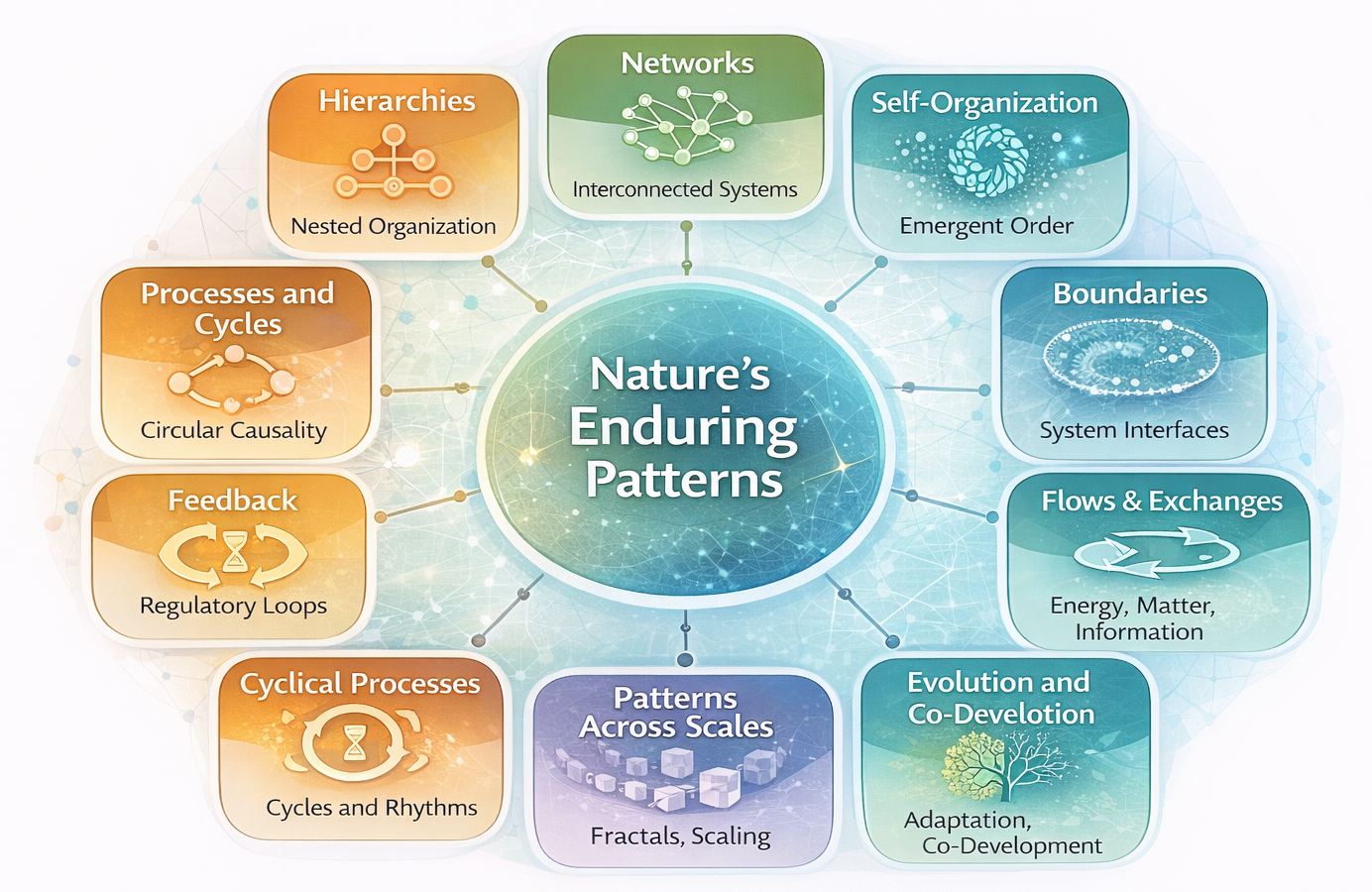
図1:自然システムと複雑なシステムにわたって見られる共通パターン。(SEBoK original)
Patterns and Principles in Systems Science
Acknowledgement
謝辞
This article reflects established knowledge from systems science and systems engineering, organized and collated for the SEBoK. Drafting support was provided by OpenAI’s ChatGPT, with all content reviewed and finalized by the author, who retains full responsibility.
本記事は、システム科学とシステムズエンジニアリングにおける確立した知識を、SEBoK のために整理し集約したものである。起草にあたっては OpenAI の ChatGPT の支援を受けた。すべての内容は著者がレビューして最終化しており、全責任は著者が負う。
A central aim of systems science is to identify recurring patterns and organizing principles that appear across many kinds of systems. While traditional scientific disciplines typically investigate particular classes of phenomena, such as physical systems, biological organisms, or social institutions—systems science seeks to understand characteristics of organization that recur across domains.
システム科学の中心的な狙いの一つは、多くの種類のシステムにわたって現れる繰り返しパターンと組織化原理を特定することである。伝統的な科学分野が通常、物理的システム、生物、社会制度といった特定の種類の現象を探究するのに対し、システム科学は領域を越えて繰り返し現れる組織化の特性を理解しようとする。
Researchers studying systems in fields ranging from physics and biology to ecology, engineering, and the social sciences have repeatedly observed similar forms of organization and behavior. These recurring characteristics suggest that many systems share common structural and dynamic properties despite differences in their components.
物理学や生物学から生態学、工学、社会科学に至る諸分野でシステムを研究する研究者たちは、類似した組織化と振る舞いの形態を繰り返し観察してきた。こうした繰り返し現れる特性は、多くのシステムが、構成要素こそ異なっても、共通の構造的・動的特性を共有していることを示唆する。
Such regularities are often described using terms such as system principles, organizational patterns, meta-patterns, or isomorphies. These concepts reflect a shared effort to understand how complex systems are structured, how they behave, and how they evolve.
こうした規則性は、システム原理(system principles)、組織化パターン(organizational patterns)、メタパターン(meta-patterns)、あるいは同型性(isomorphies)といった用語で記述されることが多い。これらの概念は、複雑なシステムがどのように構造化され、どのように振る舞い、どのように進化するのかを理解しようとする共通の取り組みを反映している。
Recognizing these patterns provides an important foundation for understanding complex systems in nature, society, and engineering. By identifying cross-domain regularities in system organization, systems science contributes to a deeper understanding of how systems maintain coherence, adapt to changing environments, and generate emergent behavior.
これらのパターンを認識することは、自然、社会、工学における複雑なシステムを理解するうえで重要な基盤となる。システム組織化における領域横断的な規則性を特定することによって、システム科学は、システムがどのように一貫性を維持し、変化する環境に適応し、創発的振る舞いを生み出すのかについて、より深い理解に寄与する。
Across many scientific disciplines, researchers have observed that systems frequently exhibit similar forms of organization. Examples include:
多くの科学分野で、研究者たちは、システムが類似した組織化の形態をしばしば示すことを観察してきた。例として以下が挙げられる。
• hierarchical organization, where systems consist of nested levels of subsystems
• 階層的組織化:システムが入れ子状のサブシステムのレベルから構成される
• network structures, in which elements are interconnected through relational links
• ネットワーク構造:要素どうしが関係的なリンクによって相互に結びついている
• flows of energy, matter, or information that sustain system processes
• エネルギー、物質、または情報の流れ:システムのプロセスを維持する
• feedback mechanisms that regulate system behavior
• フィードバック機構:システムの振る舞いを調節する
• cyclic dynamics that generate recurring patterns over time
• 循環的ダイナミクス:時間の経過とともに繰り返し現れるパターンを生み出す
• boundaries and interfaces that distinguish systems from their environments
• 境界とインタフェース:システムをその環境から区別する
• emergence, where system-level properties arise from interactions among components
• 創発:システムレベルの特性が構成要素間の相互作用から生じる
These patterns appear in systems as diverse as ecosystems, biological organisms, economies, technological infrastructures, and social institutions. Their repeated appearance across domains suggests that they represent general characteristics of organized systems rather than domain-specific phenomena.
これらのパターンは、生態系、生物、経済、技術的インフラ、社会制度といった多様なシステムに現れる。領域を越えて繰り返し現れることは、それらが領域固有の現象ではなく、組織化されたシステムの一般的特性を表していることを示唆する。
Recognizing these patterns allows researchers to identify common principles that govern the behavior of complex systems.
これらのパターンを認識することで、研究者は複雑なシステムの振る舞いを支配する共通原理を特定できる。
Researchers have increasingly sought to identify recurring organizational patterns that appear across many natural systems. These patterns often arise from fundamental interactions among system components and their environments.
研究者たちは、多くの自然システムにわたって現れる繰り返しの組織化パターンの特定を、ますます目指すようになっている。これらのパターンは、しばしばシステム構成要素とその環境との基本的な相互作用から生じる。
The major categories of such recurring patterns are illustrated in Figure 1, which highlights several organizational characteristics that appear widely across natural and complex systems.
そうした繰り返しパターンの主要なカテゴリを図1に示す。この図は、自然システムと複雑なシステムにわたって広く現れるいくつかの組織化上の特性を浮き彫りにしている。
• Hierarchies, representing nested levels of organization
• 階層(Hierarchies):入れ子になった組織化レベルを表す
• Networks, representing relational connectivity among system elements
• ネットワーク(Networks):システム要素間の関係的接続性を表す
• Flows and exchanges, involving energy, matter, and information
• 流れと交換(Flows and exchanges):エネルギー、物質、情報を伴う
• Feedback mechanisms, enabling regulation and stability
• フィードバック機構(Feedback mechanisms):調節と安定を可能にする
• Cycles and rhythms, producing repeating temporal patterns
• 周期とリズム(Cycles and rhythms):繰り返される時間的パターンを生み出す
• Self-organization, where order emerges from local interactions
• 自己組織化(Self-organization):局所的な相互作用から秩序が生じる
• Boundaries, defining interfaces between systems and environments
• 境界(Boundaries):システムと環境の間のインタフェースを定義する
• Evolution and co-development, reflecting adaptive change over time
• 進化と共発展(Evolution and co-development):時間の経過に伴う適応的変化を反映する
• Patterns across scales, including fractal and scaling relationships
• スケールを越えたパターン(Patterns across scales):フラクタルやスケーリングの関係を含む
図中の英語
These patterns can be observed in phenomena ranging from physical processes and ecological systems to social networks and technological infrastructures.
これらのパターンは、物理的プロセスや生態系から、社会ネットワークや技術インフラに至るまでの現象において観察できる。
The recurrence of these patterns across many domains suggests that they reflect fundamental properties of system organization.
多くの領域にわたってこれらのパターンが繰り返し現れることは、それらがシステム組織化の基本的な特性を反映していることを示唆する。
The search for cross-domain regularities has been a central goal of systems science since its earliest development. General Systems Theory, cybernetics, and related traditions all sought to identify principles of organization that apply across different types of systems.
領域横断的な規則性の探究は、システム科学の最初期の発展以来、その中心的な目標であり続けてきた。一般システム理論、サイバネティクス、および関連する伝統はすべて、異なる種類のシステムにわたって適用される組織化の原理を特定しようとした。
Examples of widely recognized system principles include:
広く認識されているシステム原理の例として以下が挙げられる。
• open systems, which exchange matter, energy, and information with their environments
• 開放系(open systems):環境との間で物質、エネルギー、情報を交換する
• feedback regulation, enabling systems to maintain stability and respond to disturbances
• フィードバック調節(feedback regulation):システムが安定を維持し、外乱に応答することを可能にする
• hierarchical organization, allowing complex systems to be structured across multiple levels
• 階層的組織化(hierarchical organization):複雑なシステムを複数のレベルにわたって構造化することを可能にする
• self-organization, where patterns and structures emerge from local interactions among components
• 自己組織化(self-organization):構成要素間の局所的な相互作用からパターンや構造が生じる
These principles help explain how systems maintain coherence, adapt to environmental change, and evolve over time.
これらの原理は、システムがどのように一貫性を維持し、環境の変化に適応し、時間とともに進化するのかを説明するのに役立つ。
The recognition of such principles has played a key role in establishing systems science as a field concerned with general characteristics of organization across diverse domains.
こうした原理が認識されたことは、システム科学を多様な領域にわたる組織化の一般的特性を扱う分野として確立するうえで、重要な役割を果たしてきた。
One of the most systematic efforts to identify recurring system patterns was undertaken by Len Troncale, who investigated the existence of cross-disciplinary regularities among systems phenomena.
繰り返し現れるシステムパターンを特定しようとする取り組みのなかでも、最も体系的なものの一つは Len Troncale によるものである。彼は、システム現象の間に学際的な規則性が存在するかどうかを探究した。
Troncale introduced the concept of systems isomorphies, referring to processes or organizational relationships that appear across multiple scientific domains (Troncale 1985). Through extensive surveys of scientific literature across many disciplines, he documented numerous recurring processes including:
Troncale はシステム同型性(systems isomorphies)という概念を導入した。これは、複数の科学領域にわたって現れるプロセスや組織化の関係を指す(Troncale 1985)。彼は、多くの学問分野の科学文献を広範に調査し、以下をはじめとする数多くの繰り返し現れるプロセスを文書化した。
• feedback regulation
• フィードバック調節
• oscillatory and cyclic dynamics
• 振動的・循環的ダイナミクス
• hierarchical organization
• 階層的組織化
• flow processes
• 流れのプロセス
• network interactions
• ネットワーク相互作用
• developmental and evolutionary patterns
• 発達的・進化的パターン
Troncale’s work represented one of the most comprehensive attempts to empirically document recurring system processes across natural and social systems. His research suggested that many systems exhibit similar behaviors and structures regardless of the specific domain in which they occur.
Troncale の仕事は、自然システムと社会システムにわたって繰り返し現れるシステムプロセスを実証的に文書化しようとする試みのなかでも、最も包括的なものの一つであった。彼の研究は、多くのシステムが、それが現れる具体的な領域にかかわらず、類似した振る舞いと構造を示すことを示唆した。
Although the catalog of isomorphies does not constitute a fully integrated taxonomy of system processes, it highlights the potential for identifying generalizable system phenomena that recur across many scientific fields.
同型性のカタログは、システムプロセスの完全に統合された分類体系を成すものではないが、多くの科学分野にわたって繰り返し現れる一般化可能なシステム現象を特定できる可能性を浮き彫りにしている。
Subsequent work has continued exploring recurring patterns across domains and scales. Rasmussen (2023), for example, emphasizes the importance of recognizing enduring patterns that appear across natural and social systems. Her work highlights how structures such as networks, cycles, fractal forms, and hierarchical organization appear repeatedly across levels of organization.
その後の研究も、領域やスケールを越えた繰り返しパターンの探究を続けている。例えば Rasmussen(2023)は、自然システムと社会システムにわたって現れる持続するパターン(enduring patterns)を認識することの重要性を強調している。彼女の仕事は、ネットワーク、周期、フラクタル形態、階層的組織化といった構造が、組織化のレベルを越えて繰り返し現れることを浮き彫りにする。
This perspective extends earlier efforts to identify systemic regularities by emphasizing the role of perception and recognition of patterns in developing systemic understanding.
この視点は、システム的理解を発展させる上でパターンの知覚と認識が果たす役割を強調することによって、システム的規則性を特定しようとしてきた初期の取り組みを拡張するものである。
Together, the work of Troncale and Rasmussen illustrates the continuing effort within systems science to identify recurring structures and processes that characterize complex systems.
Troncale と Rasmussen の仕事は、あわせて見ると、複雑なシステムを特徴付ける繰り返しの構造とプロセスを特定しようとする、システム科学における継続的な取り組みを示している。
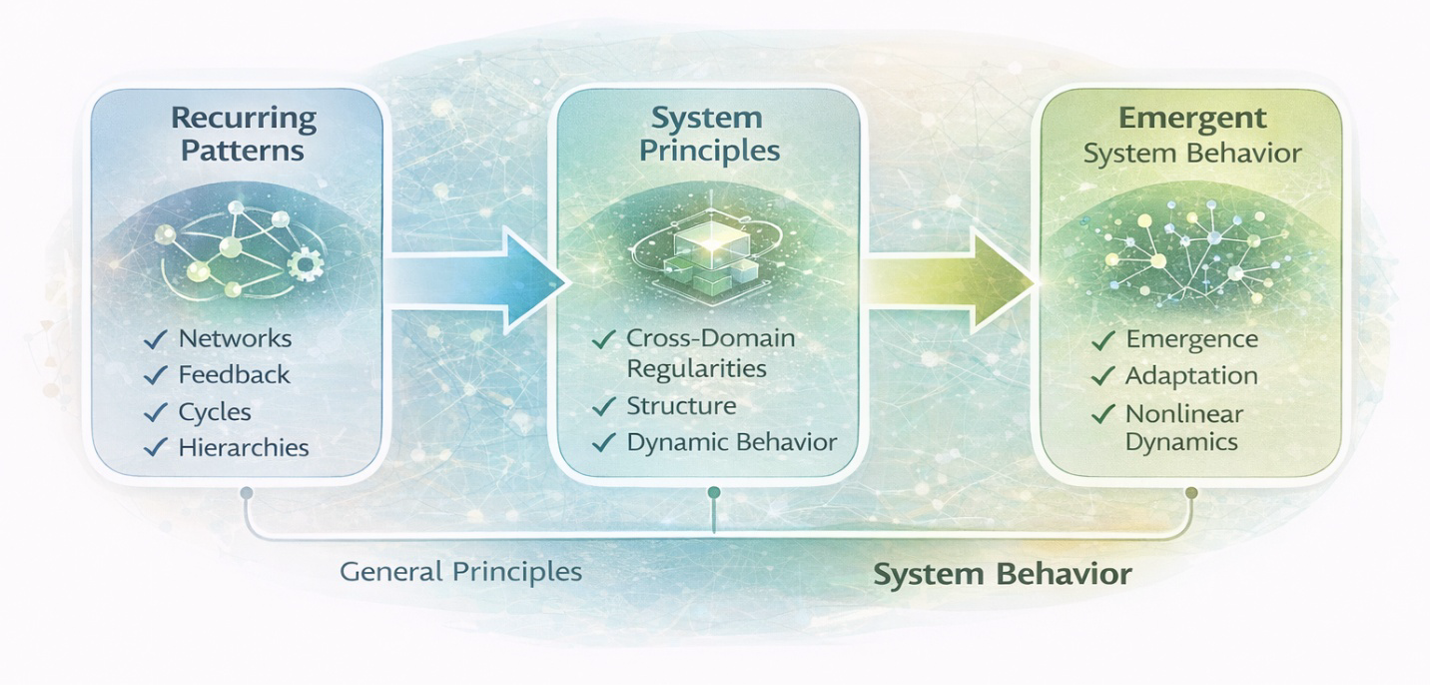
The relationship between recurring patterns, system principles, and system behavior can be understood as a progression from observation to explanation. Researchers first observe recurring patterns across systems, then formulate principles that explain those patterns, and finally investigate how these principles produce characteristic system behaviors.
繰り返しパターン、システム原理、システムの振る舞いの関係は、観察から説明へと進む過程として理解できる。研究者はまずシステムにわたる繰り返しパターンを観察し、次にそれらのパターンを説明する原理を定式化し、最後にそれらの原理が特徴的なシステムの振る舞いをどのように生み出すのかを探究する。
This relationship is illustrated in Figure 2.
この関係を図2に示す。
図中の英語
Recurring patterns such as networks, feedback loops, cycles, and hierarchies provide clues to deeper organizing principles. These principles help explain why systems exhibit behaviors such as emergence, adaptation, nonlinear dynamics, and complex interactions.
ネットワーク、フィードバックループ、周期、階層といった繰り返しパターンは、より深い組織化原理への手がかりとなる。これらの原理は、システムが創発、適応、非線形ダイナミクス、複雑な相互作用といった振る舞いを示す理由を説明するのに役立つ。
Understanding this progression helps clarify how systems science links empirical observation with theoretical explanation.
この過程を理解することは、システム科学が実証的な観察と理論的な説明をどのように結びつけているのかを明確にするのに役立つ。
Recurring system patterns can often be grouped into several broad categories.
繰り返し現れるシステムパターンは、しばしばいくつかの大きなカテゴリに分類できる。
Structural principles describe how systems are organized.
構造的原理は、システムがどのように組織化されているかを記述する。
Examples include:
例として以下が挙げられる。
• hierarchical organization
• 階層的組織化
• modular structure
• モジュール構造
• network connectivity
• ネットワーク接続性
• system boundaries and interfaces
• システム境界とインタフェース
These principles describe the architecture of systems and how their components are arranged.
これらの原理は、システムのアーキテクチャと、その構成要素がどのように配置されているかを記述する。
Dynamic principles describe how systems behave and interact over time.
動的原理は、システムが時間の経過とともにどのように振る舞い、相互作用するかを記述する。
Examples include:
例として以下が挙げられる。
• feedback and regulation
• フィードバックと調節
• flows of energy, matter, or information
• エネルギー、物質、または情報の流れ
• cyclic and oscillatory dynamics
• 循環的・振動的ダイナミクス
• adaptation to environmental change
• 環境変化への適応
These principles explain how systems maintain stability while responding to disturbances.
これらの原理は、システムが外乱に応答しながら安定を維持する仕組みを説明する。
Evolutionary principles describe how systems develop and transform.
進化的原理は、システムがどのように発展し、変容するかを記述する。
Examples include:
例として以下が挙げられる。
• emergence of new system properties
• 新しいシステム特性の創発
• self-organization
• 自己組織化
• co-evolution with environments
• 環境との共進化
• increasing complexity over time
• 時間の経過に伴う複雑性の増大
These principles help explain how systems adapt and evolve across longer timescales.
これらの原理は、システムがより長い時間スケールにわたって適応し進化する仕組みを説明するのに役立つ。
Understanding recurring patterns in systems has important implications for systems engineering. Engineers frequently design and manage complex systems whose behavior arises from interactions among many components and subsystems.
システムにおける繰り返しパターンを理解することは、システムズエンジニアリングにとって重要な含意を持つ。エンジニアは、多くの構成要素やサブシステムの間の相互作用から振る舞いが生じる複雑なシステムを、設計し管理することが多い。
Recognizing systemic patterns such as feedback effects, hierarchical organization, and emergent behavior can help engineers anticipate potential system behaviors and interactions. Awareness of these principles can therefore support more effective design, integration, and management of complex engineered systems.
フィードバック効果、階層的組織化、創発的振る舞いといったシステム的パターンを認識することは、エンジニアがシステムに生じうる振る舞いや相互作用を予測するのに役立ちうる。したがって、これらの原理を意識しておくことは、複雑なエンジニアード・システムのより効果的な設計、統合、マネジメントを支えうる。
Systems science provides conceptual tools that help engineers understand how complex systems behave beyond the properties of their individual components.
システム科学は、複雑なシステムが個々の構成要素の特性を超えてどのように振る舞うのかを、エンジニアが理解するのに役立つ概念的ツールを提供する。
Systems science seeks to identify recurring patterns and principles that characterize organized systems across many domains of reality. These patterns, such as hierarchical organization, feedback regulation, network structures, and emergent dynamics, appear repeatedly in systems ranging from physical processes and biological organisms to ecological, social, and engineered systems.
システム科学は、現実の多くの領域にわたって組織化されたシステムを特徴付ける、繰り返しパターンと原理を特定しようとする。階層的組織化、フィードバック調節、ネットワーク構造、創発的ダイナミクスといったこれらのパターンは、物理的プロセスや生物から、生態的、社会的、エンジニアード・システムに至るまで、幅広いシステムに繰り返し現れる。
Efforts to identify such patterns have been pursued through concepts such as system principles, meta-patterns, and isomorphies. Research by Troncale, Rasmussen, and others illustrates the continuing effort to document and understand these recurring characteristics of complex systems.
こうしたパターンを特定する取り組みは、システム原理、メタパターン、同型性といった概念を通じて進められてきた。Troncale、Rasmussen らの研究は、複雑なシステムのこうした繰り返し現れる特性を文書化し、理解しようとする継続的な取り組みを示している。
By identifying cross-domain regularities in system organization and behavior, systems science provides a foundation for understanding complex phenomena and supports the development of approaches for studying and managing systems in many fields.
システムの組織化と振る舞いにおける領域横断的な規則性を特定することによって、システム科学は複雑な現象を理解するための基盤を提供し、多くの分野でシステムを研究し管理するためのアプローチの発展を支えている。
The next article explores how these principles contribute to phenomena such as complexity, emergence, and adaptive behavior in systems.
次の記事では、これらの原理が、システムにおける複雑性、創発、適応的振る舞いといった現象にどのように寄与するのかを探る。
Ashby, W. R. 1956. An Introduction to Cybernetics. London: Chapman & Hall.
Bertalanffy, L. von. 1968. General System Theory: Foundations, Development, Applications. New York: Braziller.
Boulding, K. E. 1956. “General Systems Theory—The Skeleton of Science.” Management Science.
Simon, H. A. 1962. “The Architecture of Complexity.” Proceedings of the American Philosophical Society.
Troncale, L. 1985. “On the Possible Order of Systems Isomorphies.” General Systems.
Volk, T. 2017. Quarks to Culture: How We Came to Be. New York: Columbia University Press.
Rasmussen, L. 2023. Seeing: A Guide to Systems Thinking. Axminster: Triarchy Press.
None.
Miller, J. G. 1978. Living Systems. New York: McGraw-Hill.
Mobus, G. E., and M. C. Kalton. 2015. Principles of Systems Science. New York: Springer.