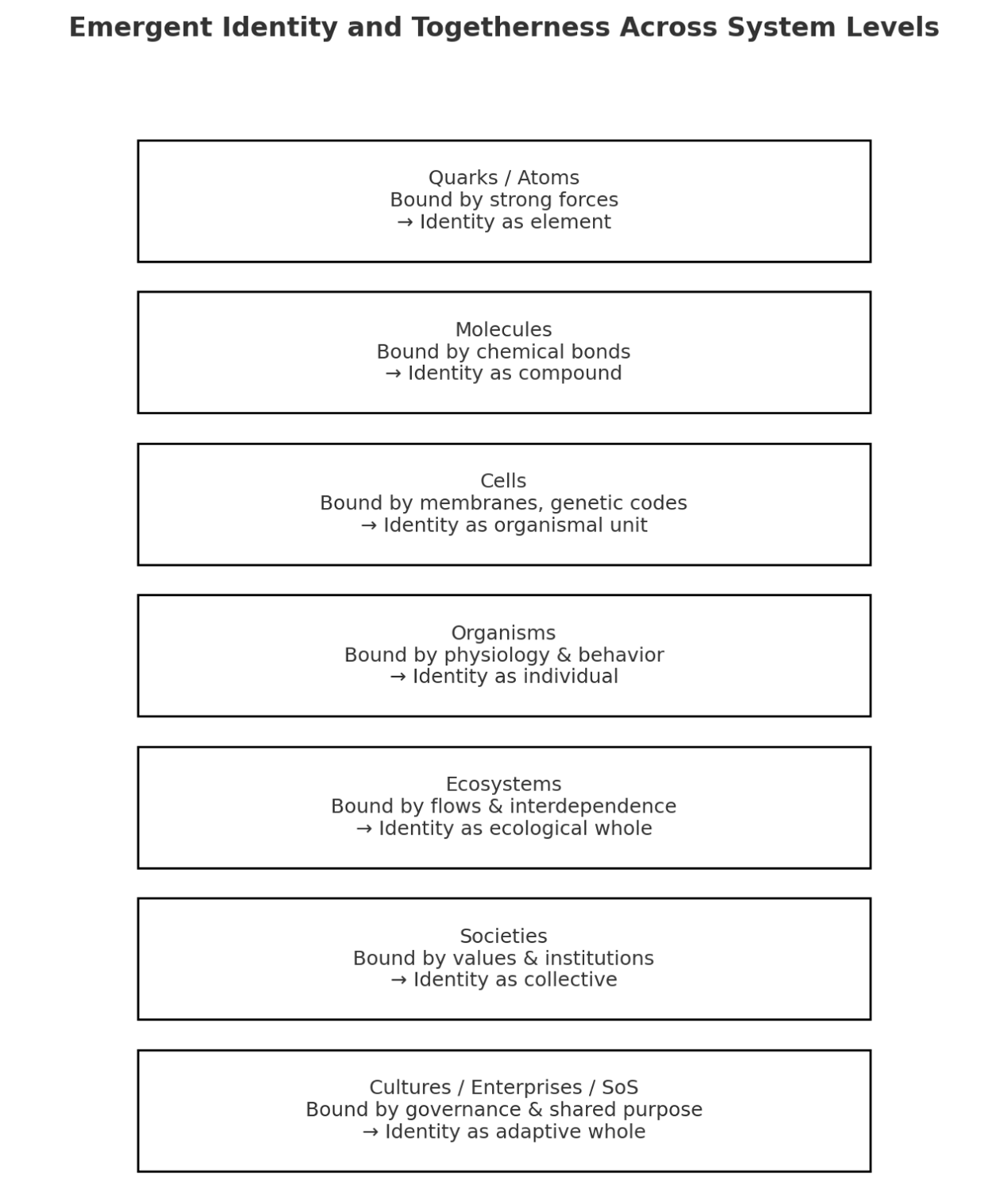
図1. システムのアイデンティティと一体性(SEBoK Original)
Identity and Togetherness of Systems
This article is part of The Nature of Systems knowledge area (KA).
本記事は「The Nature of Systems(システムの本質)」知識領域(KA)の一部である。
Acknowledgement
謝辞
This article reflects established knowledge from systems science and systems engineering, organized and collated for the SEBoK. Drafting support was provided by OpenAI’s ChatGPT, with all content reviewed and finalized by the author, who retains full responsibility.
本記事は、システム科学とシステムズエンジニアリングにおける確立した知識を、SEBoK のために整理・収集したものである。起草にあたっては OpenAI の ChatGPT の支援を受けており、全ての内容は著者がレビューして確定しており、その全責任は著者が負う。
Systems are distinguished not only by what they do, but by what they are. This article explores two foundational and interdependent properties of all systems: identity, which sustains their distinctiveness and coherence, and togetherness, which enables the organization and integration of parts into functioning wholes. Together, these properties underpin system persistence, adaptation, and recognition across scales.
システムは、何をするかによってだけでなく、何であるかによっても区別される。 本記事では、あらゆるシステムに共通し、互いに依存し合う2つの基礎的な性質を探る。すなわち、システムの独自性と一貫性を維持するアイデンティティ(identity)と、部分を組織化・統合して機能する全体とすることを可能にする一体性(togetherness)である。これらの性質は一体となって、さまざまなスケールにわたるシステムの存続、適応、認識を支えている。
This article complements other entries in this knowledge area that examine behavior, purpose, value, and cycles, offering systems engineers a deeper understanding of how systems maintain continuity while participating in complex, evolving environments.
本記事は、振る舞い、目的、価値、サイクルを扱う本知識領域の他の記事を補完するものであり、システムが複雑で進化する環境に参加しながら、どのように連続性を維持するのかについて、システムズエンジニアの理解を深める。
Identity and togetherness are fundamental properties of systems that underpin their recognition, persistence, and coherence. Identity refers to what makes a system distinct from its environment, while togetherness refers to the forces and organizing principles that bind components into a functioning whole. These concepts are central to understanding Form in the Fit–Form–Function framework and are essential for defining, modelling, and engineering systems of interest.
アイデンティティと一体性はシステムの基本的な性質であり、システムの認識、存続、一貫性を支えている。アイデンティティとは、システムをその環境から区別するものを指し、一体性とは、構成要素を結び付けて機能する全体とする力と組織化の原則を指す。これらの概念は、Fit–Form–Function フレームワークにおける Form(形態)を理解する上で中心となるものであり、対象システム(System of Interest)を定義し、モデル化し、エンジニアリングする上で不可欠である。
In natural systems, identity is expressed through mechanisms such as atomic structure, genetic codes, or ecological niches, while togetherness emerges from binding forces, membranes, flows, and interdependencies. In social systems, shared values and institutions sustain collective identity and cohesion. Engineered systems achieve identity and togetherness through standards, interfaces, and architectures that stabilize interactions across components and stakeholders.
自然システムでは、アイデンティティは原子構造、遺伝コード、生態的ニッチといった仕組みを通じて表現され、一体性は結合力、膜、流れ、相互依存から創発する。社会システムでは、共有された価値観と制度が集団のアイデンティティと結束を維持する。エンジニアード・システムは、構成要素やステークホルダーの間の相互作用を安定させる標準、インタフェース、アーキテクチャを通じて、アイデンティティと一体性を達成する。
Patterns of identity and togetherness can be observed across levels of emergence, from quarks and molecules to ecosystems, societies, and systems of systems. At each level, new forms of binding lead to new forms of identity: particles form atoms, cells form organisms, and institutions form cultures and enterprises. This progression illustrates how complexity grows through successive layers of coherence.
アイデンティティと一体性のパターンは、クォークや分子から生態系、社会、システム・オブ・システムズに至るまで、創発の各レベルにわたって観察できる。各レベルでは、新しい形の結合が新しい形のアイデンティティを生む。粒子は原子を形成し、細胞は生物を形成し、制度は文化とエンタープライズを形成する。この進展は、一貫性の層が順に積み重なることで複雑性が増していく様子を示している。
For systems engineering, attention to identity and togetherness has practical implications. Defining the System of Interest (SoI) requires clarity of boundaries and coherence. Modularity and cohesion guide system integration and interoperability. Identity supports verification, validation, and lifecycle continuity. At enterprise and SoS scales, maintaining togetherness across independent systems requires governance, shared purpose, and mission alignment. Finally, recognizing the togetherness of human systems with natural systems emphasizes the need for sustainable and symbiotic design.
システムズエンジニアリングにとって、アイデンティティと一体性に目を向けることには実践的な意味がある。対象システム(System of Interest、SoI)を定義するには、境界と一貫性を明確にする必要がある。モジュール性と凝集性は、システム統合と相互運用性の指針となる。アイデンティティは、検証、妥当性確認、ライフサイクルの連続性を支える。エンタープライズや SoS のスケールでは、独立したシステム間で一体性を維持するために、ガバナンス、共有された目的、ミッションの整合が必要となる。最後に、人間システムと自然システムの一体性を認識することで、持続可能で共生的な設計の必要性が浮き彫りになる。
By studying identity and togetherness, systems engineers and practitioners gain a foundation for addressing complexity, ensuring resilience, and designing systems that persist and adapt within broader contexts.
アイデンティティと一体性を学ぶことで、システムズエンジニアと実践者は、複雑性に対処し、レジリエンスを確保し、より広い文脈の中で存続し適応するシステムを設計するための基盤を得る。
• Identity: refers to the enduring properties by which a system is recognized as the same system over time, even as its components and context may change. It arises from:
• アイデンティティ(Identity):構成要素や文脈が変化しても、時間が経過する中で同じシステムとして認識される拠り所となる、システムの持続的な性質を指す。これは以下から生じる。
** Structure: The pattern of internal relationships that provide cohesion and functional capability. ** Boundaries: A distinction from the surrounding environment, whether physical, informational, or conceptual. ** History: Continuity through memory, record, or inherited structure (e.g., genetic code, configuration baselines). ** Intent: In engineered systems, purpose contributes to identity, what the system is for shapes what it is. Systems engineers commonly encounter identity in the form of system-of-interest (SoI) boundaries, configuration states, mission definitions, and stakeholder values. However, identity is also an emergent, relational phenomenon—it is not always fixed, and in socio-technical or natural systems, may evolve or be contested..
- 構造(Structure):凝集性と機能的能力をもたらす内部関係のパターン。 - 境界(Boundaries):物理的、情報的、概念的のいずれであるかを問わない、周囲の環境との区別。 - 履歴(History):記憶、記録、継承された構造(例:遺伝コード、構成ベースライン)による連続性。 - 意図(Intent):エンジニアード・システムでは、目的がアイデンティティに寄与する。システムが何のためにあるかが、そのシステムが何であるかを形作る。システムズエンジニアがアイデンティティに接するのは、通常、対象システム(system-of-interest、SoI)の境界、構成状態、ミッション定義、ステークホルダーの価値といった形においてである。しかし、アイデンティティは創発的で関係的な現象でもある。常に固定されているわけではなく、社会技術システムや自然システムでは、進化したり、争点となったりすることもある。
• Togetherness: refers to the organizing forces, constraints, or relations that bind a system’s parts into a coherent whole. This includes:
• 一体性(Togetherness):システムの部分を結び付けて一貫した全体とする、組織化の力、制約、関係を指す。これには以下が含まれる。
** Binding Forces: Physical (e.g., gravity, electromagnetism), informational (e.g., feedback), or organizational (e.g., hierarchy, contracts). ** Interdependence: Components rely on one another to fulfill system functions. ** Integration Mechanisms: Interfaces, modularity, and protocols enable cooperation and coordination. ** Contextual Unity: Shared environment or purpose that drives collective behavior. In engineering practice, togetherness shows up in systems integration, interface control, team dynamics, and value co-creation. The stronger and more aligned the forces of togetherness, the more functional and resilient the system..
- 結合力(Binding Forces):物理的なもの(例:重力、電磁気)、情報的なもの(例:フィードバック)、組織的なもの(例:階層、契約)。 - 相互依存(Interdependence):構成要素が、システムの機能を果たすために互いに依存し合うこと。 - 統合の仕組み(Integration Mechanisms):インタフェース、モジュール性、プロトコルが協働と調整を可能にする。 - 文脈的統一性(Contextual Unity):集団の振る舞いを駆動する、共有された環境や目的。エンジニアリングの実践では、一体性はシステム統合(systems integration)、インタフェース管理(interface control)、チームダイナミクス(team dynamics)、価値共創(value co-creation)に現れる。一体性をもたらす力が強く、よく整合しているほど、システムはより機能的でレジリエントになる。
Perspectives from systems science include:
システム科学からの視点には以下がある。
• General Systems Theory (Boulding, 1956): Identity persists through levels from structures to transcendent systems.
• 一般システム理論(General Systems Theory)(Boulding, 1956):アイデンティティは、構造から超越的システムに至る各レベルを通じて存続する。
• Relational Science (Kineman, 2011): Identity emerges through a system’s relation to self, others, and whole.
• 関係科学(Relational Science)(Kineman, 2011):アイデンティティは、システムが自己、他者、全体との間に持つ関係を通じて創発する。
• Holonic Models (Koestler, 1967): Systems as nested wholes/parts, each with autonomous identity and embeddedness.
• ホロニックモデル(Holonic Models)(Koestler, 1967):システムを入れ子になった全体/部分として捉える。それぞれが自律的なアイデンティティと埋め込み性を持つ。
• Pattern Science (Troncale, 1978; Rasmussen, 2024): Identity arises from pattern recurrence, togetherness from coupling processes.
• パターン科学(Pattern Science)(Troncale, 1978; Rasmussen, 2024):アイデンティティはパターンの再現から生じ、一体性は結合プロセスから生じる。
Identity and togetherness emerge through recurring archetypes across levels of scale. Each level demonstrates how binding mechanisms create coherence and how new forms of identity arise. These archetypes also provide analogies useful for systems engineering practice.
アイデンティティと一体性は、スケールの各レベルにわたって繰り返し現れるアーキタイプを通じて創発する。各レベルは、結合の仕組みがどのように一貫性を生み、新しい形のアイデンティティがどのように生じるかを示している。これらのアーキタイプは、システムズエンジニアリングの実践に役立つアナロジーも提供する。
Quarks and Atoms
クォークと原子
• Binding: Strong and electromagnetic forces hold particles together.
• 結合(Binding):強い力と電磁力が粒子を結び付ける。
• Identity: Stable elements with distinctive properties.
• アイデンティティ(Identity):特徴的な性質を持つ安定した元素。
• Engineering Analogy: Interface standards act like physical forces, binding components into stable configurations while preserving distinct properties (e.g., USB, TCP/IP).
• エンジニアリングのアナロジー(Engineering Analogy):インタフェース標準は物理的な力のように働き、構成要素を安定した構成へと結び付けながら、固有の性質を保持する(例:USB、TCP/IP)。
Molecules
分子
• Binding: Chemical bonds integrate atoms into compounds with new behaviors.
• 結合(Binding):化学結合が原子を統合し、新しい振る舞いを持つ化合物を生む。
• Identity: Distinct compounds with emergent properties beyond their elements.
• アイデンティティ(Identity):構成元素を超えた創発的性質を持つ、固有の化合物。
• Engineering Analogy: Software modules or hardware components bound by design rules; emergent system behavior arises from well-structured integration.
• エンジニアリングのアナロジー(Engineering Analogy):設計ルールによって結び付けられたソフトウェアモジュールやハードウェア構成要素。よく構造化された統合から、システムとしての創発的な振る舞いが生じる。
Cells
細胞
• Binding: Membranes, genetic codes, and metabolic cycles maintain integrity.
• 結合(Binding):膜、遺伝コード、代謝サイクルが完全性を維持する。
• Identity: The cell as a self-sustaining unit of life.
• アイデンティティ(Identity):自己持続的な生命の単位としての細胞。
• Engineering Analogy: Subsystems with clear boundaries and internal processes (e.g., avionics suites, autonomous vehicles) that preserve autonomy while interacting with wider systems.
• エンジニアリングのアナロジー(Engineering Analogy):明確な境界と内部プロセスを持ち、より広いシステムと相互作用しながらも自律性を保持するサブシステム(例:アビオニクススイート、自律型の乗り物)。
Organisms
生物
• Binding: Physiology, behavior, and coordination of subsystems.
• 結合(Binding):生理、振る舞い、サブシステム間の調整。
• Identity: The organism as a functioning individual capable of adaptation.
• アイデンティティ(Identity):適応能力を持ち、機能する個体としての生物。
• Engineering Analogy: Complex engineered products (e.g., aircraft, satellites) that integrate diverse subsystems into a coherent, adaptive whole.
• エンジニアリングのアナロジー(Engineering Analogy):多様なサブシステムを統合して、一貫した適応的な全体とする複雑な人工製品(例:航空機、衛星)。
Ecosystems
生態系
• Binding: Energy flows, interdependence, and ecological niches.
• 結合(Binding):エネルギーの流れ、相互依存、生態的ニッチ。
• Identity: The ecosystem as a resilient, adaptive collective.
• アイデンティティ(Identity):レジリエントで適応的な集合体としての生態系。
• Engineering Analogy: System-of-systems such as transportation networks or power grids, where diversity and redundancy enhance resilience.
• エンジニアリングのアナロジー(Engineering Analogy):交通ネットワークや電力網のようなシステム・オブ・システムズ。そこでは多様性と冗長性がレジリエンスを高める。
Societies
社会
• Binding: Shared values, culture, and institutions sustain collective identity.
• 結合(Binding):共有された価値観、文化、制度が集団のアイデンティティを維持する。
• Identity: The society as a coordinated human system.
• アイデンティティ(Identity):調整された人間システムとしての社会。
• Engineering Analogy: Enterprises and large-scale programs, where governance, standards, and culture bind people and technologies into effective organizations.
• エンジニアリングのアナロジー(Engineering Analogy):エンタープライズや大規模プログラム。そこではガバナンス、標準、文化が人とテクノロジーを結び付け、効果的な組織とする。
Cultures, Enterprises, and Systems of Systems (SoS)
文化、エンタープライズ、システム・オブ・システムズ(SoS)
• Binding: Governance structures, shared purpose, and adaptive institutions.
• 結合(Binding):ガバナンス構造、共有された目的、適応的な制度。
• Identity: The adaptive whole, capable of learning and transformation.
• アイデンティティ(Identity):学習と変革の能力を持つ、適応的な全体。
• Engineering Analogy: Multi-stakeholder SoS (e.g., smart cities, global telecommunications) where coherence depends on aligning governance, mission, and interoperability across independently managed systems.
• エンジニアリングのアナロジー(Engineering Analogy):多様なステークホルダーが関わる SoS(例:スマートシティ、グローバルな電気通信)。その一貫性は、独立に管理されるシステム群にわたって、ガバナンス、ミッション、相互運用性を整合させることにかかっている。
図中の英語
Figure 1 (Archetypes of Identity and Togetherness Across System Levels) illustrates this progression. At each step, new forms of togetherness enable the emergence of new identities, providing both inspiration and analogy for engineered systems.
図1(システムレベルの各段階におけるアイデンティティと一体性のアーキタイプ)は、この進展を示している。各段階で、新しい形の一体性が新しいアイデンティティの創発を可能にし、エンジニアード・システムへの着想とアナロジーの両方を提供する。
Identity and togetherness shape all stages of the systems engineering life cycle:
アイデンティティと一体性は、システムズエンジニアリングのライフサイクルの全段階を形作る。
• System of Interest and Requirements: Defining identity clarifies scope, boundaries, and stakeholder needs. Poorly specified identity often leads to scope creep or mismatched expectations (e.g., aerospace programs with shifting SoI definitions).
• 対象システムと要求事項(System of Interest and Requirements):アイデンティティを定義することで、範囲、境界、ステークホルダーのニーズが明確になる。アイデンティティの規定が不十分だと、しばしばスコープクリープや期待の不一致を招く(例:SoI の定義が変動する航空宇宙プログラム)。
• Architecture and Design: Togetherness informs modularity, cohesion, and interoperability. Standards and protocols provide “membranes” for interaction, as in Modular Open System Architectures (MOSA).
• アーキテクチャと設計(Architecture and Design):一体性は、モジュール性、凝集性、相互運用性の指針となる。標準とプロトコルは、モジュラー・オープン・システム・アーキテクチャ(MOSA)に見られるように、相互作用のための「膜」を提供する。
• Integration, Verification, and Validation: Preserving identity ensures continuity and traceability across lifecycle stages. Togetherness supports reliable integration without loss of coherence.
• 統合、検証、妥当性確認(Integration, Verification, and Validation):アイデンティティを保持することで、ライフサイクルの各段階にわたる連続性と追跡可能性が確保される。一体性は、一貫性を失うことのない確実な統合を支える。
• Enterprise and System of Systems Engineering: Identity at scale is maintained through governance, shared mission, and institutional alignment. Smart city SoS, for example, require governance frameworks to sustain coherence across autonomous subsystems.
• エンタープライズとシステム・オブ・システムズのエンジニアリング(Enterprise and System of Systems Engineering):大規模なレベルでは、アイデンティティは、ガバナンス、共有されたミッション、制度的な整合を通じて維持される。たとえばスマートシティの SoS では、自律的なサブシステム間で一貫性を維持するためのガバナンスの枠組みが必要となる。
• Sustainability and Ecological Context: Engineered systems always interact with natural systems. Designing for sustainability requires respecting ecological identities and fostering symbiotic forms of togetherness (e.g., circular resource flows, ecosystem resilience).
• 持続可能性と生態学的文脈(Sustainability and Ecological Context):エンジニアード・システムは常に自然システムと相互作用する。持続可能性を目指す設計には、生態学的なアイデンティティを尊重し、共生的な形の一体性を育むことが求められる(例:循環的な資源の流れ、生態系のレジリエンス)。
In practice, identity defines what the system is, while togetherness guides how the parts are bound. Integrating these concepts explicitly into lifecycle activities enables engineers to manage complexity, ensure resilience, and design systems that are effective, sustainable, and adaptive.
実践においては、アイデンティティがシステムが何であるかを定義し、一体性が部分がどのように結ばれるかを導く。これらの概念をライフサイクルアクティビティに明示的に組み込むことで、エンジニアは複雑性を管理し、レジリエンスを確保し、効果的で持続可能かつ適応的なシステムを設計できる。
Attention to identity and togetherness strengthens the conceptual foundation of systems engineering by clarifying what gives a system coherence, persistence, and purpose across its life cycle. These principles illuminate the underlying logic of ISO/IEC/IEEE 15288 processes and support the broader aims of INCOSE Vision 2035 to engineer “solutions for a better world.”
アイデンティティと一体性に注意を払うと、ライフサイクルを通じてシステムに一貫性、存続性、目的を与えているものが明確になり、システムズエンジニアリングの概念的基盤が強化される。これらの原則は、ISO/IEC/IEEE 15288 のプロセスの根底にある論理を明らかにし、「より良い世界のためのソリューション」をエンジニアリングするという INCOSE Vision 2035 のより広い目的を支える。
Defining and Maintaining System Identity
システムのアイデンティティの定義と維持
Identity provides the basis for distinguishing the System of Interest (SoI) from its environment. Establishing and maintaining this identity enables clear scope definition, stakeholder alignment, and configuration control. Through life-cycle stages, traceability of requirements, architecture, and verification activities depends on the persistence of system identity. When identity becomes ambiguous, boundaries blur, leading to scope creep, fragmented ownership, and loss of coherence.
アイデンティティは、対象システム(SoI)をその環境から区別する基礎となる。このアイデンティティを確立し維持することで、明確な範囲定義、ステークホルダーの整合、構成変更管理が可能になる。ライフサイクルの各段階を通じて、要求事項、アーキテクチャ、検証アクティビティの追跡可能性は、システムのアイデンティティが持続することに依存する。アイデンティティが曖昧になると境界がぼやけ、スコープクリープ、責任の所在の分散、一貫性の喪失を招く。
Achieving Coherence through Togetherness
一体性を通じた一貫性の達成
Togetherness expresses the organizing principles that bind parts into functioning wholes. In engineering terms, this corresponds to modularity, cohesion, and well-defined interfaces that enable integration while preserving autonomy. Standards and protocols act as the “binding forces” of engineered systems, ensuring predictable interaction among subsystems. Applying these principles supports reliable integration and effective interoperability across suppliers and organizations.
一体性は、部分を結び付けて機能する全体とする組織化の原則を表す。エンジニアリングの観点では、これはモジュール性、凝集性、明確に定義されたインタフェースに対応し、自律性を保持しながら統合を可能にする。標準とプロトコルはエンジニアード・システムの「結合力」として働き、サブシステム間の予測可能な相互作用を確保する。これらの原則を適用することで、サプライヤーや組織をまたいだ確実な統合と効果的な相互運用性が支えられる。
Supporting Lifecycle Continuity and Change
ライフサイクルの連続性と変化の支援
Systems evolve through upgrades, maintenance, and contextual change. Understanding how togetherness operates allows engineers to manage change without eroding system integrity. Configuration management, interface control, and verification and validation all rely on maintaining the balance between preserving identity and accommodating adaptation.
システムは、アップグレード、保守、文脈の変化を通じて進化する。一体性がどのように働くかを理解することで、エンジニアはシステムの完全性を損なうことなく変化を管理できる。構成管理、インタフェース管理、検証と妥当性確認はいずれも、アイデンティティの保持と適応の受容との間のバランスを維持することに依拠している。
Governance and Alignment in Enterprises and Systems of Systems
エンタープライズとシステム・オブ・システムズにおけるガバナンスと整合
At enterprise and SoS scales, identity equates to shared purpose and mission coherence among independently managed systems. Togetherness is achieved through governance, standards, and culture that sustain collaboration and mutual trust. Effective SoS engineering depends on these higher-order forms of cohesion as much as on technical interoperability.
エンタープライズや SoS のスケールでは、アイデンティティは、独立に管理されるシステムの間で共有される目的とミッションの一貫性に等しい。一体性は、協働と相互信頼を維持するガバナンス、標準、文化によって達成される。効果的な SoS エンジニアリングは、技術的な相互運用性と同じくらい、こうした高次の結束の形に依存する。
Sustainability and Societal Integration
持続可能性と社会への統合
Engineered systems inevitably interact with natural and social systems. Recognizing the togetherness of human and ecological systems highlights the responsibility to design for sustainability. Identity must extend beyond the engineered artifact to include its role within broader environmental and societal contexts. Concepts such as circular resource flows, resilience, and regenerative design exemplify this systems-level coherence.
エンジニアード・システムは必然的に自然システムや社会システムと相互作用する。人間システムと生態系システムの一体性を認識すると、持続可能性のために設計する責任が浮き彫りになる。アイデンティティは、人工物そのものにとどまらず、より広い環境的・社会的文脈におけるその役割をも含むものへと広がらなければならない。循環的な資源の流れ、レジリエンス、再生型設計(regenerative design)といった概念は、こうしたシステムレベルの一貫性を例示している。
Methodological Implications
方法論的な含意
Incorporating identity and togetherness encourages a shift from purely reductionist decomposition toward re-compositional and coherence-based design. Systems engineers can use these principles as diagnostic lenses to assess systemic integrity, identify weak coupling or fragmentation, and guide integration strategies that reinforce coherence across boundaries and life-cycle stages.
アイデンティティと一体性を取り入れることで、純粋に還元主義的な分解から、再構成と一貫性に基づく設計への転換が促される。システムズエンジニアは、これらの原則を診断のレンズとして用いて、システムの完全性を評価し、弱い結合や分断を特定し、境界やライフサイクルの各段階をまたいで一貫性を強化する統合戦略を導くことができる。
By embedding the principles of identity and togetherness within systems engineering practice, engineers can design and sustain systems that remain coherent, resilient, and ethically aligned with their wider human and ecological environments. These concepts provide a bridge between systems science and engineering application, clarifying how systems maintain continuity through change and how collective purpose and structure emerge from well-governed interconnection.
アイデンティティと一体性の原則をシステムズエンジニアリングの実践に組み込むことで、エンジニアは、一貫性とレジリエンスを保ち、より広い人間的・生態学的環境と倫理的に整合したシステムを設計し、維持できる。これらの概念は、システム科学とエンジニアリングの応用とを橋渡しし、システムが変化を経ながらどのように連続性を維持するのか、また、よく統治された相互接続から集団の目的と構造がどのように創発するのかを明らかにする。
• Boulding, K.E. (1956). “General Systems Theory: The Skeleton of Science.” Management Science, 2(3), pp. 197–208.
• Kineman, J.J. (2011). “Relational Science: A Synthesis.” Axiomathes, 21(3), pp. 393–437.
• Koestler, A. (1967). The Ghost in the Machine. London, UK: Hutchinson.
• Rasmussen, L. (2024). Seeing: Patterns in Living Systems. Synearth Publishing.
• Troncale, L.R. (1978). Nature’s Enduring Patterns. California State Polytechnic University, Pomona.
• Capra, F. and Luisi, P.L. (2014). The Systems View of Life: A Unifying Vision. Cambridge, UK: Cambridge University Press.
• von Bertalanffy, L. (1968). General System Theory: Foundations, Development, Applications. New York, NY: George Braziller.
• Rosen, R. (1991). Life Itself: A Comprehensive Inquiry into the Nature, Origin, and Fabrication of Life. New York, NY: Columbia University Pres
None