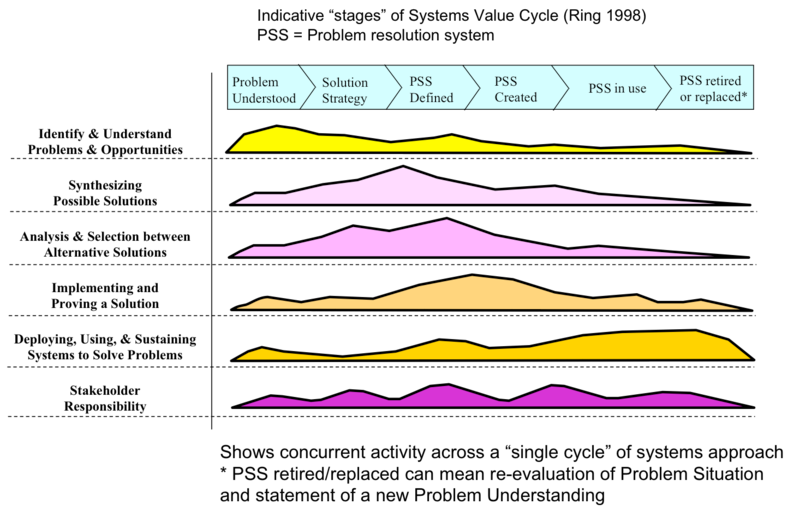
図2. システムライフサイクル内で適用されるシステムズアプローチの活動。(SEBoK Original)
Applying the Systems Approach
The "Systems Approach Applied to Engineered Systems" knowledge area is graciously sponsored by PPI.
「Systems Approach Applied to Engineered Systems」知識領域は PPI の厚意によりスポンサードされている。
この図は原典のページに掲載されています。権利の都合により本サイトでは省略しています。原典で見る
The systems approach relates to both the dynamics of problem resolution and stakeholder value over time, as well as to the levels of system relationship, detailed management, and the engineering activities this implies.
システムズアプローチ(systems approach)は、時間の経過に伴う問題(problem)解決とステークホルダー(stakeholder)の価値(value)の動態の双方に関わるとともに、システム(system)の関係の水準や詳細なマネジメント、そしてそれらが含意するエンジニアリング(engineering)活動にも関わる。
This article builds on the concepts introduced in Overview of the Systems Approach topic. It is part of the Systems Approach Applied to Engineered Systems knowledge area (KA), which describes, primarily through five groups of activities, the application of an approach based around systems thinking to engineered system contexts throughout their lives.
本記事は、トピック「Overview of the Systems Approach」で導入された概念(concepts)を基礎としており、「Systems Approach Applied to Engineered Systems」知識領域(KA)の一部をなす。この KA は、システム思考(systems thinking)に基づくアプローチをエンジニアード・システム(engineered system)のコンテキスト(contexts)にその生涯全体にわたって適用することを、主として5つの活動グループを通じて記述する。
Engineered Systems provide outcomes which deliver benefits to stakeholders by helping them achieve something of value in one or more problem situations. Ultimately, a system is successful only if it enables successful outcomes for its stakeholders (Boehm and Jain 2006). In complex real-world situations, value can best be provided through a continuing process of adapting the system needs and developing associated solutions in response to changing circumstances, according to the principle of Progressive Satisfying (Hitchins 2009).
エンジニアード・システムは、1つ以上の問題状況において価値ある何かを達成できるようステークホルダーを助けることで、彼らに利益をもたらす成果を提供する。結局のところ、システムが成功したといえるのは、ステークホルダーにとって成功した成果を可能にする場合に限られる(Boehm and Jain 2006)。複雑な(complex)現実世界の状況では、変化する状況に応じてシステムのニーズを適応させ、関連する解決策(solutions)を開発していく継続的なプロセス(process)を通じて、価値を最もよく提供できる。これは、漸進的満足化(Progressive Satisfying)の原則(principle)に基づく(Hitchins 2009)。
A value cycle associating the systems approach to the delivery of real-world stakeholder benefits is discussed in the Overview of the Systems Approach topic. A greater understanding of the value of an engineered system within its context enables agreement on the problem situation and appropriate system interventions to be created, deployed, and used overall, in turn enabling a more effective application of the systems approach. Value is fully realized only when considered within the context of time, cost, funding and other resource issues appropriate to key stakeholders (Ring 1998).
システムズアプローチを現実世界のステークホルダーへの利益の提供に結び付ける価値サイクルについては、トピック「Overview of the Systems Approach」で論じている。エンジニアード・システムがそのコンテキスト(context)の中で持つ価値への理解が深まると、問題状況について合意(agreement)を形成し、適切なシステム介入を生み出し、配備し、全体として使用することが可能になり、ひいてはシステムズアプローチをより効果的に適用できるようになる。価値が完全に実現されるのは、主要なステークホルダーにとって適切な時間、コスト(cost)、資金、その他の資源に関する課題というコンテキストの中で考えられた場合に限られる(Ring 1998)。
Figure 1. Ellipse Graphic (Ring 1998). © 1998 IEEE. Reprinted, with permission, from Jack Ring, Engineering Value-Seeking Systems, IEEE-SMC. Conference Proceedings. All other rights are reserved by the copyright owner.
図1. 楕円グラフィック(Ring 1998)。© 1998 IEEE. Reprinted, with permission, from Jack Ring, Engineering Value-Seeking Systems, IEEE-SMC. Conference Proceedings. All other rights are reserved by the copyright owner.
この図は原典のページに掲載されています。権利の都合により本サイトでは省略しています。原典で見る
The views in Figure 1 apply the idea of Systemic Intervention to the resolution of problem situations in which one or more engineered system solutions might be required. For each turn of the cycle, an agreement is made between stakeholders and developers that an Engineered System to solve problem X with effectiveness Y in agreed conditions Z has a chance of delivering value A for which they are willing to invest cost B and other resources C.
図1の見解(views)は、システム的介入(Systemic Intervention)の考え方を、1つ以上のエンジニアード・システムによる解決策が必要となり得る問題状況の解決に適用したものである。サイクルが一巡するごとに、ステークホルダーと開発者の間で、合意された条件 Z の下で有効性 Y をもって問題 X を解決するエンジニアード・システムは、彼らがコスト B とその他の資源 C を投じてもよいと考える価値 A をもたらす見込みがある、という合意が交わされる。
It is in the nature of wicked problems that this proposition cannot be a certainty. life cycle|Life cycle approaches to understand and manage the shared risk of tackling such problems are discussed in Life Cycle Models. The idea of Systemic Intervention comes from soft systems thinking (see Systems Approaches).
この命題が確実なものになり得ないのは、厄介な問題(wicked problems)の性質による。そのような問題に取り組む際に共有されるリスク(risk)を理解し管理するためのライフサイクル(life cycle)アプローチについては、「Life Cycle Models」で論じている。システム的介入の考え方は、ソフトシステム(soft systems)思考に由来する(「Systems Approaches」を参照)。
For each of the engineered system problems, the solutions agreed above must be developed such that they are effective in terms of cost, performance and other properties relevant to the problem domain. A developer must consider not only what to do, but when and how much to do to provide real value (Senge 1990). In systems engineering (SE) and management practices, this leads to the two key concepts (INCOSE 2011):
エンジニアード・システムの各問題について、上で合意された解決策は、問題領域(domain)に関連するコスト、性能、その他の特性の観点で有効となるように開発しなければならない。開発者は、何をすべきかだけでなく、実際の価値を提供するために、いつ、どれだけ行うべきかも考慮しなければならない(Senge 1990)。システムズエンジニアリング(systems engineering、SE)とマネジメントの実践において、これは2つの重要な概念につながる(INCOSE 2011)。
*Life Cycles: Stakeholder value and problem resolution described as a set of life cycle stages over which problems can be explored and resolved, and resources can be managed. *Life Cycle Processes: Systems of activities focused on creation and sharing of knowledge associated with the systems approach, that can be employed to promote a holistic approach over a life cycle.
ライフサイクル(Life Cycles): ステークホルダーの価値と問題解決を一連のライフサイクル段階(life cycle stages)として記述したものであり、それらの段階を通じて問題を探索・解決し、資源を管理できる。 ライフサイクルプロセス(Life Cycle Processes): システムズアプローチに関連する知識(knowledge)の創造と共有に焦点を当てた活動のシステムであり、ライフサイクル全体にわたって全体論的(holistic)なアプローチを促進するために用いることができる。
Life cycle management provides the framework in which to take a systems approach to all aspects of an engineered system context, which includes not only the system product or service but also the systems to create, deploy and support it (Martin 2004). The following sections consider how the systems approach should be applied to an identified problem statement, within the context of the overall value cycle discussed above.
ライフサイクルマネジメント(Life cycle management)は、エンジニアード・システムのコンテキストのあらゆる側面に対してシステムズアプローチを取るための枠組みを提供する。このコンテキストには、システムの製品(product)やサービス(service)だけでなく、それらを生み出し、配備し、支援するためのシステムも含まれる(Martin 2004)。以下の節では、上で論じた全体的な価値サイクルのコンテキストの中で、特定された問題記述に対してシステムズアプローチをどのように適用すべきかを検討する。
Within any application of the systems approach, the activities of problem identification, solution synthesis and selection, solution implementation and proving, and deployment, sustainment, and use should be applied concurrently, reflecting their interrelationships and dependencies.
The system value cycle (Ring 1998) can be taken as a generic model of the life of an engineered system within a problem resolution cycle driven by stakeholder value. For practical reasons, it is necessary to break this life down into a set of finite stages to allow activities to be organized. We can express the value cycle as six groups of questions to cycle around value, problem, and solution questions that are related to the systems approach: #What values do stakeholders want/need? #What system outcomes could improve this value? #What system can provide these outcomes? #How do we create such a system? #How do we deploy and use the system to achieve the outcomes? #Do these outcomes provide the expected improvement in value?
The above questions focus on each iteration of the systems approach to deliver stakeholder goals within an enterprise context. Activities 1 and 6 are part of the business cycles of providing stakeholder value within an enterprise, whereas activities 2 through 5 can be mapped directly to product, service, and enterprise engineering life cycles. A distinction is made here between the normal business of an enterprise and the longer-term strategic activities of Enterprise Systems Engineering.
The following diagram illustrates the concurrent nature of the activities of a systems approach over time.
システムズアプローチのいかなる適用においても、問題の特定、解決策の合成(synthesis)と選定、解決策の実装(implementation)と実証(proving)、そして配備、維持(sustainment)、使用という各活動は、相互の関係と依存関係を反映して、同時並行的に(concurrently)適用すべきである。
システム価値サイクル(Ring 1998)は、ステークホルダーの価値によって駆動される問題解決サイクルの中で、エンジニアード・システムの生涯を表す汎用的なモデル(model)とみなすことができる。実務上の理由から、活動を組織化できるよう、この生涯を有限個の段階に分割する必要がある。価値サイクルは、システムズアプローチに関連する価値、問題、解決策についての問いを巡る、6つの問いのグループとして表現できる。
上記の問いは、エンタープライズ(enterprise)コンテキストの中でステークホルダーの目標を実現するための、システムズアプローチの各反復(iteration)に焦点を当てている。活動1と6は、エンタープライズの中でステークホルダーの価値を提供する事業(business)サイクルの一部であるのに対し、活動2から5は、製品(product)、サービス(service)、エンタープライズ(enterprise)の各エンジニアリングライフサイクルに直接対応付けることができる。ここでは、エンタープライズの通常の事業と、「Enterprise Systems Engineering」のより長期的な戦略的活動とを区別している。
次の図は、時間の経過に伴うシステムズアプローチの活動の同時並行的な性質を示す。
図中の英語
The lines on Figure 2 represent activity in each of the activity areas over a simple (not to scale) life cycle based on the questions above. Activities may have a primary focus in certain stages but need to span the whole of life to ensure a holistic approach. For example, problem identification has a large input during the Problem Understanding stage, but problems are refined, reviewed, and reassessed over the rest of the life cycle. Similarly, Implement and Proving activities are conducted during the transition from Create to Use. This is only possible if proving issues, strategies, and risks are considered in earlier stages. This diagram is a schematic representation of these activity mappings, sometimes called a hump diagram (Kruchten 2003).
図2の線は、上記の問いに基づく単純な(縮尺どおりではない)ライフサイクルにわたって、各活動領域で行われる活動を表している。活動は、特定の段階に主要な焦点を持つ場合があるが、全体論的なアプローチを確実にするには、生涯全体にわたって行う必要がある。例えば、問題の特定は問題理解の段階で大きな入力(input)を持つが、問題はライフサイクルの残りの期間を通じて洗練され、レビューされ、再評価される。同様に、実装と実証の活動は、創造から使用への移行の間に行われる。これが可能になるのは、実証に関する課題、戦略、リスクがそれより前の段階で考慮されている場合に限られる。この図はこれらの活動の対応付けを模式的に表したものであり、ハンプ・ダイアグラム(hump diagram)と呼ばれることもある(Kruchten 2003)。
For the generic systems approach, the following fundamental life cycle principles apply:
汎用的なシステムズアプローチには、次の基本的なライフサイクル原則が当てはまる。
*A life cycle has groups of stages which cover understanding stakeholder value; exploration of a problem situation; creation of a system solution (see System Realization); and System Deployment and Use. *Life cycle processes define a system of engineering and management activities based on the detailed information needed to ensure a systems approach across a life cycle (e.g., requirements, architecture, verification, and validation). *Activities in any of the processes may be employed in all of the stages to allow for appropriate concurrency. *The sequence and control of the life cycle stages and concurrent process activities must be tailored to the problem situation and commercial environment (Lawson 2010), thus leading to the selection of an appropriate life cycle model. *Appropriate management activities must be included in the life cycle to ensure consideration of time, cost, and resource drivers. *In focusing on the creation of a specific system-of-interest (SoI) to provide solutions within the cycle, it is important to recognize the need to employ the right balance between reductionism and holism by considering the appropriate system context.
ライフサイクルには段階のグループがあり、それらはステークホルダーの価値の理解、問題状況の探索、システム解決策の創造(「System Realization」を参照)、「System Deployment and Use」を対象とする。 ライフサイクルプロセスは、ライフサイクル全体にわたってシステムズアプローチを確実にするために必要な詳細情報に基づいて、エンジニアリング活動とマネジメント活動のシステムを定義する(例:要求事項(requirements)、アーキテクチャ(architecture)、検証(verification)、妥当性確認(validation))。 いずれのプロセスの活動も、適切な同時並行性を確保できるよう、すべての段階で用いることができる。 ライフサイクルの段階と同時並行的なプロセス活動の順序と制御は、問題状況と商業環境(environment)に合わせてテーラリング(tailored)しなければならず(Lawson 2010)、それが適切なライフサイクルモデル(life cycle model)の選定につながる。 時間、コスト、資源という駆動要因を確実に考慮できるよう、適切なマネジメント活動をライフサイクルに含めなければならない。 サイクルの中で解決策を提供するために特定の対象システム(system-of-interest、SoI)を創造することに焦点を当てる際には、適切なシステムコンテキスト(system context)を考慮することで、還元主義(reductionism)と全体論(holism)の間で適切なバランスを取る必要性を認識することが重要である。
The ways in which this idea of concurrent process activity across a life cycle has been implemented in SE are discussed in Systems Engineering and Management.
ライフサイクル全体にわたる同時並行的なプロセス活動というこの考え方が、SE においてどのように実装されてきたかについては、「Systems Engineering and Management」で論じている。
The systems approach can be applied in an iterative way to move towards an acceptable solution to a problem situation within a larger cycle of stakeholder value.
The systems approach can be applied to multiple systems within an engineered system context, as discussed below. At each level, the approach may be applied iteratively to cycle between what is needed and versions of the solutions within a life cycle model.
Hitchins (2009) defines two principles related to iterations: *Adaptive Optimizing: Continual redesign addresses the problem space, detecting and addressing changes in situation, operational environment, other interacting systems, and other factors; it continually conceives, designs, and implements or reconfigures the whole solution system to perform with optimal effectiveness in the contemporary operational environment. *Progressive Entropy Reduction: Continual performance and capability improvement of systems in operation may be undertaken by customer or user organizations with or without support from industry, as they seek to “get the best” out of their systems in demanding situations. In terms of knowledge or information, this process involves progressively reducing entropy, going from a condition of high entropy (that is, disorder) at the outset to low entropy (order) at the finish.
In general, these two cycles of iterations can be realized from combinations of three life cycle types (Adcock 2005): *Sequential: With iteration between the stages to solve detailed issues as they arise, a single application of the systems approach is sufficient. *Incremental: Successive versions of the sequential approach are necessary for a solution concept. Each increment adds functionality or effectiveness to the growing solution over time. *Evolutionary: A series of applications of the sequential approach for alternative solutions intended to both provide stakeholder value and increase problem understanding. Each evolutionary cycle provides an opportunity to examine how the solution is used so the lessons learned can be incorporated in the next iteration.
These aspects of the systems approach form the basis for life cycle models in Life Cycle Models.
システムズアプローチは、ステークホルダーの価値というより大きなサイクルの中で、問題状況に対する受け入れ可能な解決策に向けて反復的に適用できる。
システムズアプローチは、後述するように、エンジニアード・システムのコンテキストの中にある複数のシステムに適用できる。各水準において、このアプローチは、ライフサイクルモデルの中で、必要とされるものと解決策の各版との間を行き来するために、反復的に適用される場合がある。
Hitchins(2009)は、反復に関連する2つの原則を定義している。
適応的最適化(Adaptive Optimizing): 継続的な再設計が問題空間に対処し、状況、運用環境(operational environment)、相互作用する他のシステム、その他の要因の変化を検出して対処する。それは、現在の運用環境において最適な有効性で機能するよう、解決策システム全体を継続的に構想し、設計し、実装または再構成する。 漸進的エントロピー低減(Progressive Entropy Reduction): 運用中のシステムの性能と能力(capability)の継続的な改善は、厳しい状況の中で自らのシステムから「最良のもの」を引き出そうとする顧客(customer)または利用者の組織によって、産業界の支援の有無にかかわらず行われる場合がある。知識や情報の観点では、このプロセスはエントロピーを漸進的に低減させることを伴い、開始時の高いエントロピー(すなわち無秩序)の状態から、終了時の低いエントロピー(秩序)の状態へと移行する。
一般に、これら2つの反復のサイクルは、3つのライフサイクル型の組み合わせから実現できる(Adcock 2005)。
逐次型(Sequential):詳細な課題が生じるたびに段階間で反復を行いつつ、システムズアプローチを1回適用すれば十分である。 漸増型(Incremental):解決策の概念に対して、逐次型アプローチの連続する版が必要となる。各増分は、成長していく解決策に、時間の経過とともに機能(functionality)または有効性を追加する。 * 進化型(Evolutionary):ステークホルダーの価値の提供と問題理解の深化の双方を意図した代替解決策に対する、逐次型アプローチの一連の適用である。各進化サイクルは、解決策がどのように使用されるかを検討し、得られた教訓を次の反復に取り入れる機会となる。
システムズアプローチのこれらの側面は、「Life Cycle Models」で扱うライフサイクルモデルの基礎となる。
The stakeholder value, problem resolution, and system creation aspects of the system value cycle may each require the use of a focused systems approach. These might be soft systems to prove a better understanding of a situation, product systems and/or service systems solutions to operational needs, enabling systems to support an aspect of the product or service life cycle, or enabling systems used directly by the enterprise system.
Each of these systems may be identified as a system-of-interest (SoI) and require the application of the systems approach. This application may be sequential (the start of one system approach dependent on the completion of another) or parallel (independent approaches which may or may not overlap in time), but will often be recursive in nature.
Recursion is a technique borrowed from computer science. In computer science, recursion occurs when a function calls itself repeatedly to logically simplify an algorithm. In a recursive application applied to systems, the systems approach for one system-of-interest is nested inside another. Examples include cases where:
*trades made at one level of the system require trades to be made for system elements; *the analysis of a system requires analysis of a system element; *the synthesis of a solution system requires one or more sub-system elements; and *the verification of a product system requires verification of system elements.
In each case, the “outer” system approach may continue in parallel with the “inner” to some extent but depends on key outcomes for its own progress.
As with all recursive processes, at some stage the application of the approach must reach a level at which it can be completed successfully. This then "rolls up" to allow higher levels to move forward and eventually complete all nested applications successfully.
The INCOSE Systems Engineering Handbook (INCOSE 2011) describes a recursive application of SE to levels of system element with each application representing a system project. Martin (1997) describes the recursive application of SE within a product system hierarchy until a component level is reached, at which point procurement of design and build processes can be used to create solution elements.
The principle of recursive application and how it relates to life cycle models is described in Life Cycle Models. This topic is part of the Systems Approach Applied to Engineered Systems knowledge area (KA). It summarizes various aspects of stakeholder responsibility for acquisition and ownership during the system life cycle processes covered by such sources as the International Council on Systems Engineering Handbook (INCOSE 2012). Any of the activities described below may also need to be considered concurrently with other activities in the systems approach at a particular point in the life of a system-of-interest (SoI).
The activities described below should be considered in the context of the Overview of the Systems Approach topic at the start of this KA. The final topic in this KA, Applying the Systems Approach, considers the dynamic aspects of how these activities are used as part of the systems approach and how this relates in detail to elements of systems engineering (SE).
システム価値サイクルのうち、ステークホルダーの価値、問題解決、システム創造の各側面は、それぞれ焦点を絞ったシステムズアプローチの使用を必要とする場合がある。これらは、状況をよりよく理解したことを実証するためのソフトシステム(soft systems)、運用上のニーズに対する製品システム(product systems)やサービスシステム(service systems)による解決策、製品またはサービスのライフサイクルの一側面を支援するイネーブリングシステム(enabling systems)、あるいはエンタープライズシステム(enterprise system)が直接使用するイネーブリングシステムであり得る。
これらのシステムはそれぞれ、対象システム(SoI)として特定され、システムズアプローチの適用を必要とする場合がある。この適用は、逐次的(あるシステムズアプローチの開始が別のアプローチの完了に依存する)な場合も、並行的(時間的に重なることも重ならないこともある独立したアプローチ)な場合もあるが、しばしば再帰的な性質を持つ。
再帰は、コンピュータ科学から借用された技法である。コンピュータ科学では、アルゴリズムを論理的に単純化するために関数が自らを繰り返し呼び出すときに、再帰が生じる。システムへの再帰的な適用では、ある対象システムに対するシステムズアプローチが、別のアプローチの内側に入れ子になる。例えば、次のような場合がある。
システムのある水準で行われるトレードには、システム要素(system elements)についてもトレードを行うことが必要となる。 システムの分析には、システム要素の分析が必要となる。 解決策システムの合成には、1つ以上のサブシステム要素が必要となる。 製品システムの検証には、システム要素の検証が必要となる。
いずれの場合も、「外側の」システムズアプローチは、ある程度は「内側の」アプローチと並行して継続できるが、自らの進展は重要な成果に依存する。
あらゆる再帰的プロセスと同様に、このアプローチの適用は、いずれかの段階で、成功裏に完了できる水準に到達しなければならない。その結果が「積み上がる(rolls up)」ことで、より高い水準が前進できるようになり、最終的には入れ子になったすべての適用が成功裏に完了する。
INCOSE Systems Engineering Handbook(INCOSE 2011)は、システム要素の各水準に SE を再帰的に適用することを記述しており、各適用はシステムプロジェクト(project)を表す。Martin(1997)は、製品システム階層の中で、コンポーネント(component)の水準に到達するまで SE を再帰的に適用することを記述している。その水準に達した時点で、設計および構築プロセスの調達を用いて、解決策の要素(elements)を生み出すことができる。
再帰的適用の原則と、それがライフサイクルモデルとどう関係するかについては、「Life Cycle Models」で述べている。
本トピックは「Systems Approach Applied to Engineered Systems」知識領域(KA)の一部である。International Council on Systems Engineering Handbook(INCOSE 2012)などの情報源が扱うシステムライフサイクルプロセス(life cycle processes)における、取得と所有に関するステークホルダー(stakeholder)の責任のさまざまな側面を要約する。以下に述べる活動はいずれも、対象システム(System-of-Interest、SoI)の生涯のある時点において、システムズアプローチ(systems approach)の他の活動と同時並行的に(concurrently)検討する必要が生じる場合がある。
以下に述べる活動は、本 KA の冒頭のトピック「Overview of the Systems Approach」のコンテキスト(context)の中で検討すべきである。本 KA の最後のトピック「Applying the Systems Approach」では、これらの活動がシステムズアプローチの一部としてどのように用いられるかという動的な側面と、それがシステムズエンジニアリング(systems engineering、SE)の要素(elements)と詳細にどう関係するかを検討する。
The general principles of life cycle application discussed above apply as necessary to each application of SE. The following sections clarify the different kinds of stakeholder and the roles they take for the different system contexts discussed in the SEBoK.
上で論じたライフサイクル適用の一般原則は、SE の各適用に対して必要に応じて適用される。以下の節では、SEBoK で論じるさまざまなシステムコンテキストについて、異なる種類のステークホルダーと、彼らが担う役割を明らかにする。
Most often, the terms "product" and "service" describe the effects that are exchanged in a customer and supplier agreement. This may be a commercial agreement, one funded publicly by a charity, or provided by a government agency. The difference between a product and a service is that a product is an artifact acquired to achieve an outcome while a service is an outcome supplied directly to a user.
The terms “customer” and “user” are often used interchangeably in engineering and management disciplines. The INCOSE Systems Engineering Handbook (INCOSE 2012) makes the following specific distinctions among the stakeholders associated with a system:
These terms define the roles stakeholders take; however, they may not always lie within these distinct entities (e.g. the acquirer may also be the user). This also applies to service systems, as some of the entities may also overlap in roles. Parnell et al. (2011) offer an alternative list of stakeholders that include decision authority, client, owner, user, consumer, and interconnected.
Product systems consist of hardware, software, and humans, and they have traditionally been the focus of SE efforts. These systems are delivered to the acquirer and operated to accomplish the goals that led to the requirements for the system. These requirements were derived from the need to provide products and services to one or more users as part of an enterprise.
The delivery (supplying) of a service is indicative of the direct delivery of an outcome, which is often related to the delivery of products (e.g., a maintenance, training, or cleaning service). This is not the same as the delivery of a service system (see the discussion below).
In traditional SE, the term “service” or “service system” refers to the wider system context that describes the acquirer's need to deliver user value. In this case, the service system is a fixed system definition that dictates the manner in which the acquiring enterprise will utilize the products to enable the delivery of services to users. Product systems are designed to be integrated and operated as appropriate to enable this service to be maintained or improved as required. In this view, a service system is static and contains dedicated products, people, and resources; that is, hierarchies of products are engineered to provide acquirers with the ability to offer predefined services to users or customers.
More recently, the term "service systems" has been used to describe a system that is engineered in a manner that allows enterprises to offer services directly to users, bypassing the need to hold all of the necessary products and services within the enterprise itself. This requires the expansion of the definition of a “supplier” as follows:
*A service supplier is an organization or individual that enters into an agreement with a user to supply a service.
These service systems tend to be configured dynamically to deal with problems that traditional static services find challenging to address. This view of a service system employs "late binding" with product systems that are not owned by the enterprise but are used to enable the service to be offered as closely to given time demands as possible. This is the definition of a service system used in the Service Systems Engineering topic in Part 4, Applications of Systems Engineering.
最も一般的には、「製品(product)」と「サービス(service)」という用語は、顧客(customer)と供給者(supplier)の間の合意(agreement)において交換される効果を表す。この合意は、商業的な合意である場合もあれば、慈善団体が公的に資金を提供するものや、政府機関が提供するものである場合もある。製品とサービスの違いは、製品が成果を達成するために取得される人工物であるのに対し、サービスは利用者(user)に直接提供される成果である、という点にある。
「顧客」と「利用者」という用語は、エンジニアリング(engineering)やマネジメントの分野では互換的に用いられることが多い。INCOSE Systems Engineering Handbook(INCOSE 2012)は、システム(system)に関連するステークホルダーの間に、次のような具体的な区別を設けている。
取得者(acquirer)とは、供給者から製品またはサービスを取得または調達するステークホルダー(stakeholder)である。 供給者とは、製品またはサービスを供給するために取得者と合意を結ぶ組織(organization)または個人である。 運用者とは、製品またはサービスを提供するために、知識(knowledge)、スキル、手順を用いてシステムの機能(functions)を遂行する個人または組織である。 利用者または顧客とは、システムの運用から利益を得る個人またはグループである。
これらの用語は、ステークホルダーが担う役割を定義するものである。ただし、それらが常にこうした別個の主体の中に収まるとは限らない(例:取得者が利用者を兼ねる場合がある)。これはサービスシステムにも当てはまり、主体によっては役割が重なることもある。Parnell et al.(2011)は、意思決定権者、依頼主、所有者、利用者、消費者、相互接続先を含む、別のステークホルダーのリストを提示している。
製品システムは、ハードウェア、ソフトウェア(software)、人間から構成され、伝統的に SE の取り組みの焦点となってきた。これらのシステムは取得者に引き渡され、そのシステムに対する要求事項(requirements)のもととなった目標を達成するために運用される。これらの要求事項は、エンタープライズ(enterprise)の一部として、1人以上の利用者に製品とサービスを提供する必要性から導き出されたものである。
サービスの提供(供給)は、成果の直接的な提供を意味し、これは製品の提供と関連していることが多い(例:保全(maintenance)、訓練(training)、清掃のサービス)。これは、サービスシステムの提供と同じではない(後述の議論を参照)。
伝統的な SE において、「サービス」または「サービスシステム」という用語は、利用者に価値(value)を提供するという取得者のニーズを記述する、より広いシステムコンテキストを指す。この場合、サービスシステムは固定されたシステム定義であり、取得側のエンタープライズが、利用者へのサービス提供を可能にするために製品をどのように活用するかを規定する。製品システムは、このサービスを必要に応じて維持または改善できるよう、適切に統合され運用されるように設計(designed)される。この見解(view)では、サービスシステムは静的であり、専用の製品、人員、資源を含む。すなわち、取得者が利用者または顧客に事前に定義されたサービスを提供できるように、製品の階層がエンジニアリングされる。
より最近では、「サービスシステム(service systems)」という用語は、エンタープライズが必要な製品とサービスのすべてを自らの中に保持する必要性を回避して、利用者に直接サービスを提供できるようにエンジニアリングされたシステムを指すために用いられている。そのためには、「供給者」の定義を次のように拡張する必要がある。
製品供給者(product supplier)とは、製品または関連する製品支援サービスを供給するために取得者と合意を結ぶ組織または個人である。 サービスシステム供給者(service system supplier)とは、サービスシステムを供給するために取得者と合意を結ぶ組織または個人である。 * サービス供給者(service supplier)とは、サービスを供給するために利用者と合意を結ぶ組織または個人である。
これらのサービスシステムは、伝統的な静的サービスでは対処が難しい問題に対処するため、動的に構成される傾向がある。このサービスシステムの見解では、エンタープライズが所有してはいないものの、所与の時間的要求にできる限り近い形でサービスを提供できるようにするために用いられる製品システムとの「遅延結合(late binding)」を採用する。これが、Part 4「Applications of Systems Engineering」のトピック「Service Systems Engineering」で用いられているサービスシステムの定義である。
One of the most critical stakeholder responsibilities is to identify the needs and requirements for the system that provides the products or services (INCOSE 2012). These needs and requirements are expressed in agreements between acquirers and suppliers.
ステークホルダーの最も重要な責任の一つは、製品またはサービスを提供するシステムに対するニーズと要求事項を特定することである(INCOSE 2012)。これらのニーズと要求事項は、取得者と供給者の間の合意の中で表明される。
There are other stakeholders who shape system requirements based on their needs, but who are not necessarily acquirers or suppliers. The stakeholders and the requirements engineers share the responsibility to identify their needs during the requirements process.
このほかにも、自らのニーズに基づいてシステム要求事項を形づくるものの、必ずしも取得者や供給者ではないステークホルダーが存在する。ステークホルダーと要求エンジニアは、要求プロセスの間にステークホルダーのニーズを特定する責任を共有する。
Lawson (2010) provides a perspective on what it means to own systems, trade in system products and services, and the implications of supply chains in respect to the value added and ownership of the systems, its products and services. INCOSE (2012) defines two life cycle processes related to acquisition and supply. The acquisition process includes activities to identify, select, and reach commercial agreements with a product or service supplier.
Lawson(2010)は、システムを所有するとはどういうことか、システムの製品とサービスを取引すること、そしてシステムとその製品・サービスに付加される価値と所有権に関してサプライチェーンが持つ含意について、視点を提供している。INCOSE(2012)は、取得と供給に関連する2つのライフサイクルプロセスを定義している。取得プロセス(process)には、製品またはサービスの供給者を特定し、選定し、商業的な合意を結ぶための活動が含まれる。
In many larger organizations, there is a tradition of system ownership vested in individuals or, in some cases, enterprise entities (groups or teams). Ownership implies the authority and responsibility to create, manage, and dispose of a system-of-interest (SoI), as well as sometimes to operate the SoI.
多くの大規模な組織では、システムの所有権を個人に、場合によってはエンタープライズ体(グループまたはチーム(teams))に帰属させる伝統がある。所有権とは、対象システム(system-of-interest、SoI)を創造し、管理し、廃棄する権限と責任を意味し、場合によっては SoI を運用することも含む。
In some industries, a supplier works directly with an acquirer to help understand the acquirer’s needs and then engineer one or more products to satisfy those needs. In certain cases, a single supplier will provide the complete worthy product system. In other cases, a supply chain will be formed to deliver product systems with a system integrator to ensure they fit together and integrate into the wider context. This is a theoretical view of product systems engineering in which the context is fixed and the product is designed to fit into it. A good systems engineer may suggest changes to the enterprise as a better way to solve the problem and then modify the product system’s requirements accordingly. However, at some point, an agreed context will be set and a product system developed to work within it.
一部の産業では、供給者が取得者と直接協働して取得者のニーズの理解を助け、そのニーズを満たす1つ以上の製品をエンジニアリングする。単一の供給者が、価値ある完全な製品システムを提供する場合もある。別の場合には、製品システムを引き渡すためのサプライチェーンが形成され、システムインテグレータ(integrator)が、製品システムが互いに適合し、より広いコンテキストに統合されることを確実にする。これは、コンテキストが固定されており、製品がその中に適合するよう設計されるという、製品システムズエンジニアリング(product systems engineering)の理論上の見解である。優れたシステムズエンジニア(systems engineer)であれば、問題を解決するよりよい方法としてエンタープライズへの変更を提案し、それに応じて製品システムの要求事項を修正する場合がある。しかし、いずれかの時点で合意されたコンテキストが確定し、その中で機能する製品システムが開発される。
For many commercial products, such as mobile phones, a supplier creates a representative user profile to generate the requirement and then markets the product to real users once it is realized. In these cases, the other elements of the systems approach are performed by the acquirer/user and may not follow formal SE processes. It is important that a product supplier takes this into account when considering the best manner in which to engineer a system, as additional help or support services may need to be offered with the purchased product. The idea of a supplier offering support services for users with a type of product purchased elsewhere (e.g., an auto-mechanic servicing different makes of cars) begins to overlap with the service systems context, as discussed in the next topic.
携帯電話のような多くの商業製品では、供給者が代表的な利用者プロファイルを作成して要求事項を生成し、製品が実現した時点で実際の利用者に向けて販売する。これらの場合、システムズアプローチの他の要素は取得者/利用者によって実施され、正式な SE プロセスに従わないこともある。購入された製品とともに追加の支援やサポートサービスを提供する必要が生じ得るため、製品供給者は、システムをエンジニアリングする最良の方法を検討する際に、この点を考慮することが重要である。他所で購入された種類の製品の利用者に対して支援サービスを提供する供給者(例:さまざまなメーカーの自動車を整備する自動車整備士)という考え方は、次のトピックで論じるサービスシステムのコンテキストと重なり始める。
For an institutionalized infrastructure in which SoIs are entirely owned by an enterprise or parties thereof, the entire responsibility of life cycle management, including operation, is often vested with the system owners. These systems belong to the system asset portfolio of an enterprise or multiple enterprises and provide the system resources, including the planned systems that are developed during life cycle management.
SoI がエンタープライズまたはその関係者によって完全に所有される制度化されたインフラストラクチャでは、運用を含むライフサイクルマネジメント(life cycle management)の責任全体が、システムの所有者に帰属することが多い。これらのシステムは、エンタープライズまたは複数のエンタープライズのシステム資産ポートフォリオに属し、ライフサイクルマネジメントの間に開発される計画されたシステムを含め、システム資源を提供する。
Organizations providing service systems need not own the individual products and services that they deliver to their users and customers. With this viewpoint, the supplied service system includes the means to identify and gain access to appropriate products or services when needed. The service systems would then be the bundle of products and services assembled for the user; for example, assembling software applications and service agreements for a mobile phone already owned by a user. The enterprises providing service systems may, in turn, offer infrastructure services to a wide range of different technologies or application domains. This can mean that the transition, operation, maintenance and disposal activities associated with system ownership may not be embedded in the acquiring service system enterprise, and will therefore need to be treated as separate system services. More detail can be found in Product Systems Engineering, Service Systems Engineering, and Enterprise Systems Engineering, in Part 4, Applications of Systems Engineering in the Guide to the Systems Engineering Body of Knowledge (SEBoK).
サービスシステムを提供する組織は、自らが利用者や顧客に提供する個々の製品やサービスを所有する必要はない。この視点(viewpoint)に立つと、供給されるサービスシステムには、必要なときに適切な製品やサービスを特定し、それらにアクセスする手段が含まれる。その場合、サービスシステムとは、利用者のために組み立てられた製品とサービスの束となる。例えば、利用者がすでに所有している携帯電話に対して、ソフトウェアアプリケーションとサービス契約を組み合わせることがこれに当たる。サービスシステムを提供するエンタープライズは、さらに、多種多様な技術や適用領域(domains)に対してインフラストラクチャサービスを提供する場合もある。これは、システム所有権に伴う移行、運用、保全、廃棄の活動が、取得側のサービスシステムエンタープライズの中に組み込まれていない場合があり、したがって別個のシステムサービスとして扱う必要があることを意味し得る。詳細については、SEBoK(Guide to the Systems Engineering Body of Knowledge)の Part 4「Applications of Systems Engineering」にある「Product Systems Engineering」、「Service Systems Engineering」、「Enterprise Systems Engineering」を参照されたい。
The service systems engineer helps the service supplier create and sustain the service system that can be used to discover, integrate, and use specific versions of generic products or services when needed. The realization of service systems requires the ability to make use of product systems; however, these product systems are developed and owned outside of the service system. The service system must be able to gain access to a product or service when needed, as well as to interface with it effectively. The use of open interface standards, such as standard power supplies, interface connections (e.g., Universal Serial Bus (USB)), or file formats (e.g., Portable Document Format (PDF)) can help make this easier.
サービスシステムのエンジニアは、必要なときに一般的な製品やサービスの特定の版を発見し、統合し、使用できるサービスシステムを、サービス供給者が生み出し維持するのを助ける。サービスシステムを実現するには、製品システムを活用する能力が必要である。ただし、これらの製品システムは、サービスシステムの外部で開発され、所有される。サービスシステムは、必要なときに製品やサービスにアクセスできなければならず、またそれらと効果的にインタフェースできなければならない。標準の電源、インタフェース接続(例:Universal Serial Bus(USB))、ファイル形式(例:Portable Document Format(PDF))といったオープンなインタフェース標準の使用は、これを容易にするのに役立つ。
A useful distinction between product system design and enterprise system design is that “enterprise design does not occur at a single point in time like the design of most systems. Instead, enterprises evolve over time and are constantly changing, or are constantly being designed” (Giachetti 2010, xiii).
製品システムの設計とエンタープライズシステム(enterprise system)の設計との有用な区別は、「エンタープライズの設計は、ほとんどのシステムの設計のように単一の時点で行われるのではない。むしろ、エンタープライズは時間とともに進化し、絶えず変化している、あるいは絶えず設計されている」という点にある(Giachetti 2010, xiii)。
The enterprise developer may also aim to optimize backstage processes (the internal operations) of an organization or an institution by exploiting advances in technology, particularly information technology (IT) and associated processes. In these cases, the engineered systems are considered to be enterprise systems.
エンタープライズ開発者は、技術、とりわけ情報技術(information technology、IT)と関連プロセスの進歩を活用することで、組織や機関のバックステージ・プロセス(内部の運用)を最適化することを目指す場合もある。このような場合、エンジニアード・システム(engineered systems)はエンタープライズシステムとみなされる。
Enterprise systems may offer products (goods) and/or services. From an enterprise engineering viewpoint, an enterprise concurrent with its product SE must not only look at the development and delivery of the products but also look at the alignment and optimization of the product delivery within the enterprise objectives. Similarly, in service SE, the main focus is on an intangible value delivery to the end-customer (externally focused: front stage), in which internal and external processes must be synchronized. However, with the rapid advances in information and communications technologies (ICT), in many cases the boundaries between internal and external processes are quite blurred. Current SE research is extending product methods, processes, and tools into the enterprise transformation and service innovation fields to exploit advances in business process methodologies and technologies.
エンタープライズシステムは、製品(商品)および/またはサービスを提供する場合がある。エンタープライズエンジニアリングの視点からは、製品 SE と同時並行で取り組むエンタープライズは、その製品の開発と提供に目を向けるだけでなく、エンタープライズ目標の中での製品提供の整合と最適化にも目を向けなければならない。同様に、サービス SE では、主な焦点は最終顧客への無形の価値提供(外部に焦点を当てたもの:フロントステージ)にあり、そこでは内部プロセスと外部プロセスを同期させなければならない。しかし、情報通信技術(information and communications technologies、ICT)の急速な進歩により、多くの場合、内部プロセスと外部プロセスの境界はかなり曖昧になっている。現在の SE 研究は、ビジネスプロセスの方法論と技術の進歩を活用するため、製品の手法、プロセス、ツールを、エンタープライズの変革とサービス革新の分野へと拡張している。
Enterprise SE must not only do the engineering of the enterprise itself but may also be involved in the engineering of the service systems and product systems that are necessary for the enterprise to achieve its goals.
エンタープライズ SE は、エンタープライズそのもののエンジニアリングを行わなければならないだけでなく、エンタープライズが目標を達成するために必要なサービスシステムや製品システムのエンジニアリングに関わる場合もある。
This topic belongs to the Systems Approach Applied to Engineered Systems KA from Part 2, Foundations of Systems Engineering. Other topics about activities, from the same KA, relate to high level technical processes defined in KAs in Part 3, Systems Engineering and Management, in the following way: *Identifying and Understanding Problems and Opportunities topic relates to the System Concept Definition KA. *Synthesizing Possible Solutions and Analysis and Selection between Alternative Solutions topics relate to the Systems Approach Applied to Engineered Systems KA. *Implementing and Proving a Solution topic relates to the System Realization KA. *Deploying, Using, and Sustaining Systems to Solve Problems topic relates to the Product and Service Life Management KA.
Part 3 discusses the principles defined in each of the systems approach activities, and how they help shape the technical processes to which they are mapped.
本トピックは、Part 2「Foundations of Systems Engineering」の「Systems Approach Applied to Engineered Systems」KA に属する。同じ KA に含まれる活動に関する他のトピックは、Part 3「Systems Engineering and Management」の KA で定義される上位の技術プロセスに、次のように関係する。
「Identifying and Understanding Problems and Opportunities」のトピックは、「System Concept Definition」KA に関係する。 「Synthesizing Possible Solutions」と「Analysis and Selection between Alternative Solutions」のトピックは、「Systems Approach Applied to Engineered Systems」KA に関係する。 「Implementing and Proving a Solution」のトピックは、「System Realization」KA に関係する。 「Deploying, Using, and Sustaining Systems to Solve Problems」のトピックは、「Product and Service Life Management」KA に関係する。
Part 3 では、システムズアプローチの各活動で定義された原則と、それらが、対応付けられた技術プロセスの形成にどのように役立つかを論じている。
Adcock, R.D. 2005. "Tailoring systems engineering lifecycle processes to meet the challenges of project and programme". INCOSE International Symposium 2005. Volume 15. Issue 1.
Boehm, B. and A. Jain. 2006. "A value-based theory of systems engineering." Presented at the 16th Annual INCOSE Systems Engineering Conference, Orlando, FL,USA.
Hitchins, D. 2009. "What are the general principles applicable to systems?" INCOSE Insight, vol. 12, no. 4.
INCOSE. 2011. INCOSE Systems Engineering Handbook, version 3.2.1. San Diego, CA, USA: International Council on Systems Engineering. INCOSE-TP-2003-002-03.2.1.
Giachetti, R.E. 2010. Design of Enterprise Systems: Theory, Architecture, and Methods. Boca Raton, FL, USA: CRC Press.
Kruchten, P. 2003. The Rational Unified Process: An Introduction, 3rd edition. Boston, MA, USA: Addison Wesley.
Lawson, H. 2010. A Journey Through the Systems Landscape. London, UK: College Publications, Kings College.
Martin J.N. 1997. Systems Engineering Guidebook. Boca Raton, FL, USA: CRC Press.
Martin, J. 2004. "The Seven Samurai of Systems Engineering: Dealing with the Complexity of 7 Interrelated Systems." INCOSE 2004 - 14th Annual International Symposium Proceedings.
Parnell, G.S., P.J. Driscoll, and D.L Henderson (eds). 2011. Decision Making for Systems Engineering and Management, 2nd ed. Wiley Series in Systems Engineering. Hoboken, NJ, USA: Wiley & Sons Inc.
Ring, J. 1998. "A value seeking approach to the engineering of systems." Proceedings of the IEEE Conference on Systems, Man, and Cybernetics. p. 2704-2708.
Senge, P. 1990. The Fifth Discipline: The Art and Practice of the Learning Organization. New York, NY, USA: Doubleday/Currency.
Hitchins, D. 2009. "What are the general principles applicable to systems?" INCOSE Insight, vol. 12, no. 4.
Lawson, H. 2010. A Journey Through the Systems Landscape. London, UK: College Publications, Kings College.
Blanchard, B. and W.J. Fabrycky. 2006. Systems Engineering and Analysis. Upper Saddle River, NJ, USA: Prentice Hall.
Carlock, P.G. and R.E. Fenton. 2001. "System of Systems (SoS) enterprise systems engineering for information-intensive organizations." Systems Engineering, vol. 4, no. 4, pp. 242–261.
Checkland, P. 1999. Systems Thinking, Systems Practice. New York, NY, USA: John Wiley & Sons.
Rouse, W.B. 2005. "Enterprises as systems: Essential challenges and approaches to transformation." Systems Engineering, vol. 8, no. 2, pp. 138-150.